
PMI

Search documents
美国5月服务业意外收缩 经济放缓风险加剧
Zhi Tong Cai Jing· 2025-06-04 15:00
本周一,ISM还发布了制造业数据,显示制造业连续第三个月萎缩。与此同时,由于关税的影响,供应 商交货时间创下近三年来的新高。 特朗普总统对进口商品加征关税的政策时常"无序实施",令企业陷入混乱。经济学家指出,关税带来的 不确定性正在干扰企业的财务规划和供应链管理。零售、航空、汽车等多个行业的公司已经取消或推迟 了对2025年的财务指引。 尽管大多数经济学家仍不预期今年会出现衰退,"滞胀"(即经济增长乏力但物价持续上升)已成为主流 担忧。 美国服务业5月出现近一年来的首次萎缩,同时企业面临更高的投入成本,显示美国经济正面临"低增长 +高通胀"的滞胀风险。 报告中,新订单指数从4月的52.3骤降至46.4,表明早前为规避关税而提前采购的"抢跑"效应正在消退。 客户普遍认为现有库存水平偏高,不利于近期的服务业活动增长。 美国供应管理协会(ISM)周三公布,5月非制造业采购经理人指数(PMI)降至49.9,低于荣枯线50,也是 自2024年6月以来的最低水平。4月该指数为51.6。外媒调查的经济学家此前普遍预计该指数将回升至 52.0。 与此同时,供应商交货表现继续恶化。服务业供应商交货指数从4月的51.3升至5月的 ...
无视关税威胁,欧元区5月PMI意外增长,但德、法需求持续低迷
Hua Er Jie Jian Wen· 2025-06-04 10:49
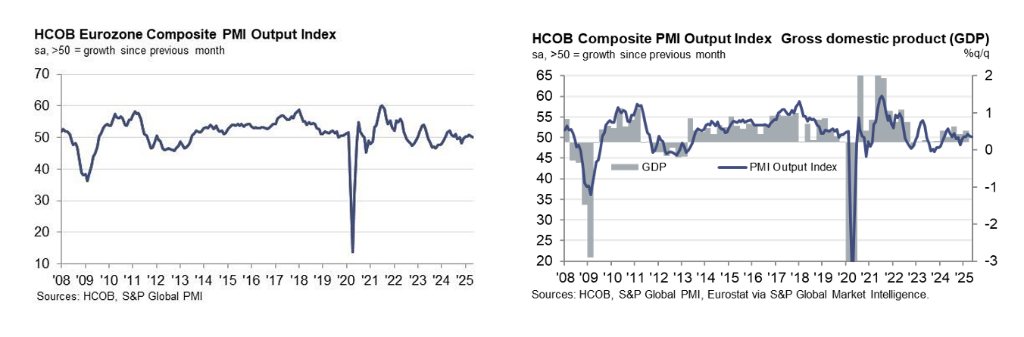
在特朗普关税威胁的阴霾下,欧元区私人部门5月依然实现了微弱增长,超过了初值和修正值49.5的收缩水平。这一意外韧性为欧央行周四降息提供了 更多空间。 周三公布的数据显示,欧元区综合PMI终值至50.2,仍略高于50的分水岭,显示出欧洲经济比最初估计的更具韧性。增长放缓主要源于服务业活动的小 幅下滑,服务业PMI创6个月新低;而制造业产出则维持了与上月相同的温和增长势头。 与此同时,德国服务业活动加速下滑,创30个月新低;法国服务业低迷有所缓解,但未来预期依然疲软。 欧元区5月份私营部门温和增长 5月,欧元区经济勉强维持扩张,但增长步伐放缓。商品和服务需求的持续疲软抑制了商业活动,限制了就业增长,并迫使企业继续消化积压订单。尽 管商业信心有所回升,但仍处于相对低迷的状态。与此同时,欧元区通胀有所降温,但这主要得益于制造业成本和价格的下降。 经季节性调整后的欧元区综合PMI指数连续第五个月高于50.0的荣枯线,显示经济处于扩张区间,但总体增长幅度微乎其微,并且是自2月份以来最弱 的。值得注意的是,制造业是欧元区增长的主要引擎,而服务业活动在5月份自去年11月以来首次出现下降。 欧元区经济增长受新业务量进一步下降的 ...

瑞达期货国债期货日报-20250604
Rui Da Qi Huo· 2025-06-04 09:34
Report Industry Investment Rating - Not provided in the given content Core Viewpoints - The negative impact on the bond market caused by the unexpected outcome of the Sino-US tariff negotiations has been largely digested. The bond market is now driven by the money supply and economic fundamentals. In the short term, there are no clear positive or negative factors, so the bond market is expected to continue its volatile consolidation. Attention should be paid to subsequent high-frequency economic data and changes in the money supply. Given the recent underperformance of short-term bond futures compared to long-term ones and the significant market divergence, there may be no good short-term trading opportunities, and the risk of a correction in long-term bond prices due to short-term spread adjustments should be watched out for [2] Summary by Related Catalogs Futures Market - **Closing Prices and Volume Changes**: T, TF, TS, and TL main contract closing prices increased by 0.09%, 0.07%, 0.04%, and 0.1% respectively. T and TL main contract trading volumes increased by 12,841 and 9,425 respectively, while TF and TS main contract trading volumes decreased by 1,213 and 6,072 respectively [2] - **Price Spreads**: The spreads of TL2509 - 2506, T2509 - 2506, TF2509 - 2506, and TS2509 - 2506 all increased by 0.02, while T06 - TL06, TS06 - T06, TS06 - TF06 spreads decreased by 0.04, and TF06 - T06 spread remained unchanged [2] - **Open Interest**: T, TF, TS, and TL main contract open interests decreased by 225, 1,564, 339, and 2 respectively. T and TL top 20 long positions increased by 3,788 and 1,637 respectively, while TF and TS top 20 long positions decreased by 358 and 1,040 respectively. T and TL top 20 short positions increased by 1,978 and 852 respectively, while TF top 20 short positions increased by 3,052 and TS top 20 short positions decreased by 1,025. T and TL top 20 net short positions decreased by 1,810 and 785 respectively, while TF and TS top 20 net short positions increased by 3,410 and 15 respectively [2] CTD Bonds - The net prices of several CTD bonds, such as 2500802.IB, 220010.IB, 240020.IB, etc., all showed an upward trend [2] Active Treasury Bonds - Yields of 1 - 7Y active treasury bonds increased by 0.75 - 1.00bp, and the 10Y yield increased by 0.10bp [2] Short - term Interest Rates - Silver - pledged overnight and Shibor overnight rates decreased by 1.37bp and 0.20bp respectively, while silver - pledged 7 - day, Shibor 7 - day, and silver - pledged 14 - day rates changed by 1.00bp, 2.80bp, and 1.00bp respectively [2] LPR Rates - 1 - year and 5 - year LPR rates remained unchanged [2] Open Market Operations - The issuance scale was 214.9 billion yuan, the maturity scale was 215.5 billion yuan, and the interest rate was 1.4% for 7 - day reverse repurchase operations, resulting in a net withdrawal of 600 million yuan [2] Industry News - The Caixin China Manufacturing PMI was 48.3, down 2.1 percentage points from the previous month, falling below the boom - bust line for the first time in eight months. The production index and new order index reached their lowest levels since December 2022 and October 2022 respectively. The US raised tariffs on imported steel, aluminum, and their derivatives from 25% to 50%. The US accused China of violating the consensus of the Geneva economic and trade talks, and China firmly rejected the groundless accusation [2] Key Data to Follow - On June 5th at 20:15, the ECB will announce its interest rate decision. At 20:30, the number of initial jobless claims in the US for the week ending May 31st will be released. On June 6th at 20:30, the US unemployment rate and seasonally - adjusted non - farm payrolls for May will be announced [3]
提醒:北京时间15:55-16:00,将陆续公布德国5月服务业和综合PMI终值、欧元区5月服务业和综合PMI终值。
news flash· 2025-06-04 07:57
提醒:北京时间15:55-16:00,将陆续公布德国5月服务业和综合PMI终值、欧元区5月服务业和综合PMI 终值。 ...
五矿期货文字早评-20250604
Wu Kuang Qi Huo· 2025-06-04 03:39
文字早评 2025/06/04 星期三 宏观金融类 股指 前一交易日沪指+0.43%,创指+0.48%,科创 50+0.48%,北证 50+1.03%,上证 50+0.32%,沪深 300+0.31%, 中证 500+0.42%,中证 1000+0.72%,中证 2000+0.82%,万得微盘+1.26%。两市合计成交 11414 亿,较上 一日+22 亿。 宏观消息面: 1、商务部等五部门组织开展 2025 年新能源汽车下乡活动。 2、中国 5 月财新制造业 PMI 降至 48.3,新订单显著收缩。 3、OECD 今年第二次下调全球经济预测,称特朗普关税风暴下美国首当其冲。 资金面:融资额-83.49 亿;隔夜 Shibor 利率+6.10bp 至 1.4710%,流动性较为宽松;3 年期企业债 AA- 级别利率-1.53bp 至 3.0261%,十年期国债利率+0.15bp 至 1.6777%,信用利差-1.68bp 至 135bp;美国 10 年期利率+5.00bp 至 4.46%,中美利差-4.85bp 至-278bp。 市盈率:沪深 300:12.50,中证 500:28.78,中证 1000:39 ...
金融工程行业景气月报:能繁母猪存栏持稳,煤炭行业景气度同比下降-20250604
EBSCN· 2025-06-04 03:14
Quantitative Models and Construction 1. Model Name: Coal Industry Profit Forecast Model - **Model Construction Idea**: The model estimates the revenue and profit growth rate of the coal industry based on changes in price and capacity factors[10] - **Model Construction Process**: - The pricing mechanism is determined by the long-term contract system, where the sales price for the next month is based on the last price index of the current month[10] - The model uses the year-on-year changes in price and capacity factors to estimate monthly revenue and profit growth rates[10] - **Model Evaluation**: The model provides a systematic approach to track and predict industry profitability, but it relies heavily on the stability of the pricing mechanism and external factors like market demand[10][14] 2. Model Name: Hog Supply-Demand Gap Estimation Model - **Model Construction Idea**: The model predicts the hog supply-demand gap six months ahead based on the breeding sow inventory and historical slaughter coefficients[15] - **Model Construction Process**: - The slaughter coefficient is calculated as: $ \text{Slaughter Coefficient} = \frac{\text{Quarterly Hog Slaughter}}{\text{Breeding Sow Inventory (Lagged 6 Months)}} $[15] - The potential supply six months later is estimated as: $ \text{Potential Supply (t+6)} = \text{Breeding Sow Inventory (t)} \times \text{Slaughter Coefficient (t+6, YoY)} $[15] - The potential demand six months later is estimated as: $ \text{Potential Demand (t+6)} = \text{Hog Slaughter (t+6, YoY)} $[16] - **Model Evaluation**: Historical data shows that this model effectively identifies hog price upward cycles, making it a valuable tool for supply-demand analysis[16] 3. Model Name: Steel Industry Profit Forecast Model - **Model Construction Idea**: The model predicts monthly profit growth and per-ton profit for the steel industry by integrating steel prices and raw material costs[18] - **Model Construction Process**: - The model incorporates comprehensive steel prices and costs of raw materials such as iron ore, coke, pulverized coal, and scrap steel to estimate profit growth rates[18] - **Model Evaluation**: The model provides a detailed profit analysis but is sensitive to fluctuations in raw material prices and global demand[22] 4. Model Name: Glass and Cement Industry Profitability Tracking Model - **Model Construction Idea**: The model tracks profitability changes in the glass and cement industries using price and cost indicators[23] - **Model Construction Process**: - The model monitors price and cost indicators to assess profitability changes and generate allocation signals[23] - **Model Evaluation**: The model is effective in identifying short-term profitability trends but requires additional macroeconomic indicators for long-term predictions[30] 5. Model Name: Refining and Oilfield Services Profitability Model - **Model Construction Idea**: The model estimates profit growth and cracking spreads for the refining industry based on changes in fuel prices, crude oil prices, and new drilling activities[31] - **Model Construction Process**: - The model calculates profit growth rates and cracking spreads using variations in fuel and crude oil prices[31] - Allocation signals are designed based on oil prices, cracking spreads, and new drilling activity[31] - **Model Evaluation**: The model provides a comprehensive view of industry profitability but is highly dependent on volatile oil price movements[35] --- Backtesting Results of Models 1. Coal Industry Profit Forecast Model - **Profit Growth Forecast**: Predicted a year-on-year profit decline for June 2025 due to lower coal prices compared to the previous year[14] 2. Hog Supply-Demand Gap Estimation Model - **Supply-Demand Balance**: Predicted a balanced supply-demand scenario for Q4 2025, with potential supply and demand both estimated at 18,226 million hogs[17] 3. Steel Industry Profit Forecast Model - **Profit Growth Forecast**: Predicted a slight year-on-year profit decline for May 2025, with PMI rolling averages remaining flat[22] 4. Glass and Cement Industry Profitability Tracking Model - **Glass Industry**: Predicted a year-on-year decline in gross profit for May 2025[30] - **Cement Industry**: Predicted a year-on-year profit growth for May 2025, driven by price recovery[30] 5. Refining and Oilfield Services Profitability Model - **Refining Industry**: Predicted a year-on-year profit decline for May 2025 due to lower oil prices compared to the previous year[35] - **Oilfield Services**: Observed stable new drilling activity and lower oil prices compared to the previous year, maintaining a neutral outlook[38]
五矿期货早报有色金属-20250604
Wu Kuang Qi Huo· 2025-06-04 01:03
1. Report Industry Investment Rating No relevant content provided. 2. Core Viewpoints of the Report - The domestic commodity atmosphere has improved, but the overseas trade situation is volatile. Different metals show different price trends and influencing factors. For example, copper prices may face resistance in rising, aluminum prices may fluctuate weakly in the short - term, zinc prices have a large downward risk, and tin prices may see a downward shift in the center of gravity [1][3][5][7]. 3. Summary According to Different Metals Copper - **Price Movement**: LME copper rose 0.24% to $9638/ton, and SHFE copper main contract closed at 78,180 yuan/ton. The expected operating range for SHFE copper main contract is 77,500 - 78,800 yuan/ton, and for LME copper 3M is $9500 - 9700/ton [1]. - **Industry Situation**: LME inventory decreased by 4600 tons to 143,850 tons, with the cancelled warrant ratio increasing to 51.7%. During the Dragon Boat Festival, domestic social inventory increased by over 10,000 tons. The SHFE copper warrant decreased by 0.3 to 31,000 tons. The spot premium in Shanghai increased, while in Guangdong, the spot changed from premium to discount. The import loss of domestic copper spot remained around 800 yuan/ton, and the Yangshan copper premium declined. The refined - scrap copper price difference was 1330 yuan/ton [1]. Aluminum - **Price Movement**: LME aluminum fell 0.1% to $2470/ton, and SHFE aluminum main contract closed at 19,990 yuan/ton. The expected operating range for SHFE aluminum main contract is 19,850 - 20,150 yuan/ton, and for LME aluminum 3M is $2440 - 2500/ton [3]. - **Industry Situation**: The SHFE aluminum weighted contract open interest increased by 0.8 to 523,000 lots, and the futures warrant slightly decreased to 51,000 tons. The social inventory of aluminum ingots increased by 0.8 to 519,000 tons, and the inventory of aluminum rods in the mainstream areas decreased slightly. The spot in East China remained at a premium of 110 yuan/ton. The LME aluminum inventory decreased by 0.2 to 368,000 tons, and the cancelled warrant ratio declined to 12.5% [3]. Lead - **Price Movement**: SHFE lead index rose 99.74% to 16,568 yuan/ton. LME lead 3S rose to $1969.5/ton [4]. - **Industry Situation**: The domestic social inventory increased to 44,900 tons. The demand for lead ingots is weak, the production of primary lead is increasing, while the production of recycled lead is decreasing due to factors such as limited raw material inventory and high finished - product inventory [4]. Zinc - **Price Movement**: SHFE zinc index fell 0.24% to 22,065 yuan/ton. LME zinc 3S rose to $2673/ton. Zinc prices still have a large downward risk [5]. - **Industry Situation**: The zinc concentrate processing fee increased again, and it is expected that the domestic refined zinc production in June 2025 will be 590,200 tons, a month - on - month increase of 40,800 tons or 7.43%, and a year - on - year increase of 8.13%. The terminal consumption is weak, and the social inventory of zinc ingots is accumulating [5]. Tin - **Price Movement**: Tin prices oscillated. The expected operating range for the domestic main contract this week is 230,000 - 260,000 yuan/ton, and for LME tin is $28,000 - 31,000/ton. The tin price center may shift downward [7]. - **Industry Situation**: The mine restart is progressing. The Bisie tin mine in Congo (Kinshasa) started phased restart in late April, and the first batch of tin concentrates has entered the logistics. The Wa State tin mine restart was approved in late April, and actual production is expected to resume from July to August. The smelting end has a low operating rate due to raw material shortage. The downstream demand has not increased significantly, but there is some demand for replenishment at low prices [6][7]. Nickel - **Price Movement**: Nickel prices oscillated weakly. The expected operating range for SHFE nickel main contract is 115,000 - 128,000 yuan/ton, and for LME nickel 3M is $14,500 - 16,500/ton. It is recommended to short at high prices [8]. - **Industry Situation**: The refined nickel production is at a historical high. The stainless - steel market is mediocre, and the downstream acceptance of high - price nickel is limited. The price of Philippine laterite nickel ore is stable, the price of Indonesian pyrometallurgical ore is difficult to rise due to demand, and the price of hydrometallurgical ore is stable after a decline [8]. Carbonate Lithium - **Price Movement**: The MMLC spot index closed at 60,537 yuan, a decrease of 0.33%. The expected operating range for the Guangzhou Futures Exchange's carbonate lithium 2507 contract is 59,200 - 61,200 yuan/ton. Lithium prices are expected to fluctuate at the bottom [10]. Alumina - **Price Movement**: The alumina index rose 1.18% to 2992 yuan/ton. The expected operating range for the domestic main contract AO2509 is 2800 - 3300 yuan/ton. It is recommended to short lightly at high prices [11][12]. - **Industry Situation**: The spot prices in some regions increased. The import window is open. The futures inventory decreased. The price of bauxite in Guinea and Australia remained stable [11][12]. Stainless Steel - **Price Movement**: The stainless - steel main contract closed at 12,630 yuan/ton, a decrease of 0.43%. The cost support is high, but under the pattern of oversupply, the market is pessimistic [14]. - **Industry Situation**: The spot prices in some markets remained stable. The raw - material prices were mostly stable, and the social inventory decreased to 1.1177 million tons, with a 0.85% month - on - month increase. The 300 - series inventory decreased by 3.42% [14].
5月PMI数据点评:供需修复,经济回稳
Tai Ping Yang Zheng Quan· 2025-06-03 15:17
宏观 证券研究报告 |点评报告 2025/6/3 5月PMI数据点评—— 供需修复,经济回稳 徐超 S1190521050001 证券分析师: 分析师登记编号: 万琦 S1190524070001 证券分析师: 分析师登记编号: 目录 请务必阅读正文之后的免责条款部分 守正 出奇 宁静 致远 1、制造业PMI温和改善 2、非制造业延续平稳扩张态势 ➢ 中国5月官方制造业PMI49.5,预期49.5,前值49.0。 1、制造业PMI温和改善 ➢制造业PMI边际小幅修复。5月制造业采购经理指数为49.5%,比上月上升0.5个百分点,符合市场预 期,表现好于季节性。经济有所回稳,如期实现温和修复,这一方面得益于国内积极政策的加紧实 施,另一方面也与5月中美日内瓦经贸会谈达成协议、关税冲击有所缓和有关。 ➢多数分项较前值有所反弹。从主要分项指数的边际变化来看,本月除产成品库存指数、购进价格指 数、出厂价格指数和供应商配送时间指数较前值下降外,其余分项(生产指数、新订单指数、新出 口订单指数、积压订单指数、采购量指数、进口指数、原材料库存指数、从业人员指数和生产经营 活动预期指数)均出现不同程度的上行,上升幅度在0.2 ...
6月铜月报:关税扰动持续,基本面支撑仍存-20250603
Chang Jiang Qi Huo· 2025-06-03 11:41
关税扰动持续,基本面支撑仍存 6月铜月报 2025-6-3 【产业服务总部 | 有色产业中心】 研究员:李 旎 执业编号:F3085657 投资咨询号: Z0017083 研究员:汪国栋 执业编号:F03101701 投资咨询号: Z0021167 长江期货股份有限公司交易咨询业务资格:鄂证监期货字[2014]1号 联系人:张 桓 执业编号:F03138663 01 行情回顾 02 宏观因素分析 03 基本面分析 05 后市展望 目 录 04 技术面分析 02 宏观因素分析 01 行情回顾 01 沪铜行情回顾 5月铜价区间震荡。运行区间7.7万元-7.9万元。特朗普关税政策持续影响市场,中美、英美就关税达成一致协议减弱关税负面影响,美国与欧盟等国贸 易谈判仍过程阻滞。美国通胀升温预期仍存,就业整体稳健。基本面偏强,矿端仍较为紧缺,铜精矿现货粗炼费持续负值且扩大,Kakula因震动而停产,同 时铜下游需求端仍有支撑,中美经贸会谈达成带来抢出口需求,低库存仍支撑铜价。 资料来源:同花顺ifind、长江期货有色产业服务中心 60000 65000 70000 75000 80000 85000 沪铜主力日K线 美国 ...
5月PMI解读:景气边际回升,政策仍需发力
China Post Securities· 2025-06-03 11:39
Report Industry Investment Rating No relevant content provided. Core Viewpoints - In May, China and the US reached an agreement to suspend the implementation of tariffs, leading to an improvement in Sino-US trade. The import index and new export order index rebounded, driving the recovery of domestic supply and demand, and the manufacturing PMI increased month-on-month. However, considering that the new order index is still below the boom line, enterprises' willingness to expand production is not strong, and the price level continues to decline. The marginal improvement in external demand may have limited impact on boosting the boom level. The US anti-globalization policy has long-term and negative effects on the Chinese economy, and the room for easing domestic fiscal and domestic demand promotion policies may be limited. The expectation of stable growth policies will continue to strengthen [3][26]. Summary by Relevant Catalogs 1. Export Marginally Improves, Manufacturing Boom Rebounds - Manufacturing PMI rebounds, with a month-on-month increase greater than the seasonal average. In May, the manufacturing PMI was 49.5%, up 0.5 percentage points from the previous month, but still below the critical point. From a seasonal perspective, the month-on-month increase of 0.5 percentage points is greater than the average increase of 0.1 percentage points in the past five years. However, the manufacturing PMI is lower than the average of 49.9% in the same period of the past five years, only higher than that in 2023 [12]. - Most sub - indices of the manufacturing PMI increase, and the number of sub - indices in the expansion range remains the same as last month. Among the 13 sub - indices, 9 increase in boom level and 4 decline. Only 2 sub - indices, namely the production and operation activity expectation and production, are in the expansion range [14]. - The price indices have declined for three consecutive months, but the decline has narrowed. In May, the main raw material purchase price index and ex - factory price index of the manufacturing PMI were 46.9% and 44.7% respectively, down 0.1 percentage points from the previous month, and the decline has narrowed by 2.7 and 3.0 percentage points respectively compared with the previous month [16]. - The finished product inventory decreases passively, and enterprises' willingness to expand production increases. The raw material inventory index is 47.4%, up 0.4 percentage points from the previous month; the finished product inventory index is 46.5%, down 0.8 percentage points; the purchase volume index is 47.6%, up 1.3 percentage points from the previous month [16]. - Production returns to expansion, and the new order index approaches the critical point. The production index is 50.7%, up 0.9 percentage points from the previous month, rising above the critical point. The new order index is 49.8%, up 0.6 percentage points from the previous month [19]. - The PMI of large enterprises rises above the critical point, the boom of medium - sized enterprises declines, and the boom of small enterprises improves. The PMI of large enterprises is 50.7%, up 1.5 percentage points from the previous month; the PMI of medium - sized enterprises is 47.5%, down 1.3 percentage points from the previous month; the PMI of small enterprises is 49.3%, up 0.6 percentage points from the previous month [19]. - The high - tech manufacturing industry continues to expand. The PMI of the high - tech manufacturing industry is 50.9%, remaining in the expansion range for four consecutive months [20]. 2. Service Industry Boom Slightly Increases, Construction Industry Boom Declines - The non - manufacturing boom level declines but remains in the expansion range, and the month - on - month performance is weaker than the seasonal average. In May, the non - manufacturing business activity index was 50.3%, down 0.1 percentage points from the previous month, but still above the critical point. From a seasonal perspective, the month - on - month decline of 0.1 percentage points is lower than the average increase of 0.9 percentage points in the past five years [22]. - The service industry boom rebounds, and the boom of holiday - related consumption industries increases. The service industry business activity index is 50.2%, up 0.1 percentage points from the previous month. Driven by the "May Day" holiday effect, industries such as railway transportation, air transportation, accommodation, and catering have significantly rebounded [22]. - The construction industry boom declines but remains in the expansion range. The construction industry business activity index is 51.0%, down 0.9 percentage points from the previous month. The business activity index of civil engineering construction is 62.3%, up 1.4 percentage points from the previous month [23]. - The composite PMI output index slightly rebounds. In May, the composite PMI output index was 50.4%, up 0.2 percentage points from the previous month, indicating that the overall production and operation activities of Chinese enterprises continue to expand [24]. 3. Marginal Recovery of Boom, Policy Still Needs to Be Strengthened - The marginal improvement in external demand has limited impact on boosting the boom level. Although the manufacturing PMI has increased, the new order index is still below the boom line, enterprises' willingness to expand production is not strong, and the price level continues to decline. The US anti - globalization policy has long - term negative effects on the Chinese economy, and the room for easing domestic fiscal and domestic demand promotion policies is limited. Therefore, the expectation of stable growth policies will continue to strengthen [3][26].