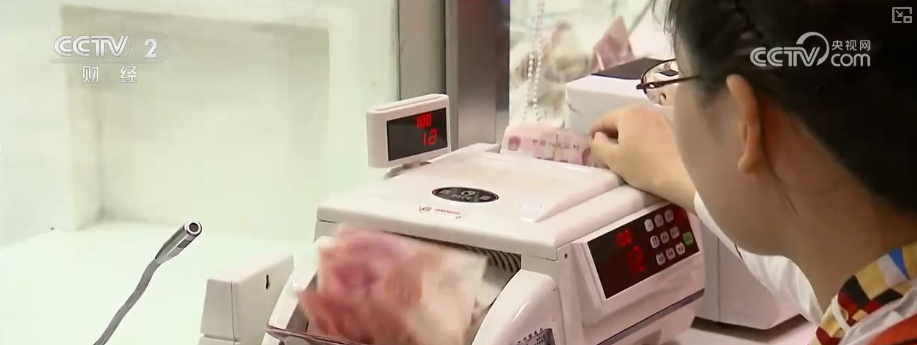
适度宽松的货币政策

Search documents
做好金融“五篇大文章” 多维度读懂央行最新货币政策执行报告要点
Yang Shi Wang· 2025-11-12 08:44
Core Viewpoint - The People's Bank of China (PBOC) will implement a moderately accommodative monetary policy in the next phase, utilizing various tools to maintain relatively loose social financing conditions while improving the monetary policy framework and enhancing execution and transmission [1][4]. Group 1: Monetary Policy Implementation - The PBOC's upcoming monetary policy will focus on maintaining a moderately accommodative stance and ensuring that social financing conditions remain relatively loose [1][4]. - The report indicates that structural monetary policy tools will continue to play a significant role in optimizing financing structures and supporting key areas of the economy [4][6]. Group 2: Financing Structure Optimization - As of the end of September, various types of loans have shown significant year-on-year growth: technology loans increased by 11.8%, green loans by 22.9%, inclusive loans by 11.2%, elderly care industry loans by 58.2%, and digital economy industry loans by 12.9% [3][12]. - The total balance of structural monetary policy tools supporting the "Five Major Articles" reached 3.9 trillion yuan, indicating a reasonable growth in financial volume and low social financing costs [3][4]. Group 3: Focus on Key Areas - The growth rate of loans in areas related to the "Five Major Articles" has exceeded 10%, with elderly care industry loans approaching 60% growth [6][8]. - The PBOC's structural monetary policy tools are designed to incentivize financial institutions to support major national strategies and key areas of economic and social development [8][10]. Group 4: Future Directions - The report emphasizes that future monetary policy will prioritize support for technological innovation, consumption stimulation, small and micro enterprises, and stabilizing foreign trade [1][14]. - The balance of loans to technology-based small and medium-sized enterprises reached 3.6 trillion yuan, with a year-on-year growth of 22.3%, and technology loans accounted for over 30% of new loans [12].

瑞达期货沪铜产业日报-20251112
Rui Da Qi Huo· 2025-11-12 08:21
Report Industry Investment Rating - Not provided in the report Core Viewpoints - The fundamentals of Shanghai copper may be in a stage where supply slightly decreases and demand gradually increases, with inventory reduction in the industry and positive expectations. The option market sentiment is bullish, and the implied volatility slightly increases. It is recommended to conduct short - term long trades at low prices with a light position, while paying attention to controlling the rhythm and trading risks [2] Summary by Relevant Catalogs Futures Market - The closing price of the Shanghai copper futures main contract is 86,840.00 yuan/ton, up 210.00 yuan; the price of LME 3 - month copper is 10,834.00 dollars/ton, up 7.00 dollars. The main contract's inter - month spread is 0.00 yuan/ton, up 90.00 yuan. The main contract's open interest of Shanghai copper is 200,769.00 lots, down 1,602.00 lots. The futures top 20 open interest of Shanghai copper is - 20,440.00 lots, down 229.00 lots. The LME copper inventory is 136,250.00 tons, down 25.00 tons. The SHFE inventory of cathode copper is 115,035.00 tons, down 1,105.00 tons. The SHFE warrant of cathode copper is 44,088.00 tons, down 2,856.00 tons [2] Spot Market - The SMM 1 copper spot price is 86,795.00 yuan/ton, up 30.00 yuan; the Yangtze River Non - ferrous Market 1 copper spot price is 86,910.00 yuan/ton, up 65.00 yuan. The Shanghai electrolytic copper CIF (bill of lading) price is 45.00 dollars/ton, unchanged. The average premium of Yangshan copper is 33.50 dollars/ton, unchanged. The CU main contract basis is - 45.00 yuan/ton, down 180.00 yuan. The LME copper cash - 3 spread is - 21.28 dollars/ton, down 6.43 dollars [2] Upstream Situation - The import volume of copper ore and concentrates is 258.69 million tons, down 17.20 million tons. The copper smelter's roughing charge (TC) is - 42.04 dollars/thousand tons, up 0.11 dollars. The copper concentrate price in Jiangxi is 77,150.00 yuan/metal ton, up 340.00 yuan; in Yunnan, it is 77,850.00 yuan/metal ton, up 340.00 yuan. The southern processing fee of blister copper is 1,200.00 yuan/ton, up 100.00 yuan; the northern processing fee is 900.00 yuan/ton, unchanged [2] Industry Situation - The output of refined copper is 126.60 million tons, down 3.50 million tons. The import volume of unwrought copper and copper products is 438,000.00 tons, down 52,000.00 tons. The social inventory of copper is 41.82 million tons, up 0.43 million tons. The price of 1 bright copper wire in Shanghai is 59,040.00 yuan/ton, up 450.00 yuan. The ex - factory price of 98% sulfuric acid of Jiangxi Copper is 790.00 yuan/ton, up 60.00 yuan. The price of 2 copper (94 - 96%) in Shanghai is 72,550.00 yuan/ton, up 350.00 yuan [2] Downstream and Application - The output of copper products is 223.20 million tons, up 1.00 million tons. The cumulative completed investment in power grid infrastructure is 4,378.07 billion yuan, up 582.31 billion yuan. The cumulative completed investment in real estate development is 67,705.71 billion yuan, up 7,396.52 billion yuan. The monthly output of integrated circuits is 4,371,236.10 thousand pieces, up 120,949.00 thousand pieces [2] Option Situation - The 20 - day historical volatility of Shanghai copper is 16.41%, down 0.92%; the 40 - day historical volatility is 19.33%, down 0.01%. The implied volatility of the current - month at - the - money IV is 13.78%, up 0.0017%. The at - the - money option call - put ratio is up 0.0127 [2] Industry News - From the four - week period ending October 25, the US private sector on average lost 11,250 jobs per week, and Goldman Sachs estimated that the US non - farm payrolls in October decreased by about 50,000, the largest decline since 2020. The central bank will implement a moderately loose monetary policy, keep social financing conditions relatively loose, and improve the monetary policy framework. The NDRC has recommended 105 REITs projects to the CSRC, 83 of which have been issued and listed, covering 10 industries and 18 asset types, expected to drive new project investment of over 1 trillion yuan. In October, the sales of new energy vehicles in China accounted for over 50% of the total new vehicle sales for the first time, reaching 51.6%. The NDRC held a private enterprise symposium, and enterprises suggested improving policy support systems such as social security and taxation in the "15th Five - Year Plan" [2]
央行:金融总量合理增长,社会融资成本处于低位
Jin Rong Jie· 2025-11-12 07:30
Core Viewpoint - The People's Bank of China has implemented a moderately accommodative monetary policy in 2023, maintaining ample liquidity to support economic recovery and stabilize financial markets [1] Group 1: Monetary Policy Implementation - The central bank has utilized various monetary policy tools, including open market operations and medium-term lending facilities, to ensure reasonable growth in money and credit [2] - A market-oriented interest rate adjustment framework has been established to lower overall financing costs, leading to a decrease in both deposit and loan rates [2] - The central bank is focusing on optimizing the credit structure by utilizing specific loan quotas for consumption, elderly care, and technological innovation [2] Group 2: Economic Indicators - As of September, the total social financing stock and broad money supply (M2) grew by 8.7% and 8.4% year-on-year, respectively, with the RMB loan balance reaching 270.4 trillion yuan [3] - New corporate loans and personal housing loan rates decreased by approximately 40 and 25 basis points year-on-year, indicating a low financing cost environment [3] - The RMB exchange rate has remained stable, with a 1.2% appreciation against the US dollar compared to the end of the previous year [3] Group 3: Risk Management - The central bank is actively working to mitigate financial risks in key areas and is enhancing its financial risk monitoring and assessment systems [2]
东海证券晨会纪要-20251112
Donghai Securities· 2025-11-12 05:12
Group 1: U.S. Employment Situation - The U.S. non-farm data may be overestimated, with concerns about the credibility of employment data rising since Q3 2025 [6][7] - The labor market is experiencing a "local replacement" effect, with a net increase of 1.861 million local workers since March 2025, but this trend may not be sustainable due to demographic challenges [7] - Cyclical industries like leisure, construction, and manufacturing are showing signs of slowdown, while non-cyclical sectors like education and healthcare are facing ongoing employment pressures [8][9] Group 2: Pharmaceutical and Biotech Industry - The pharmaceutical and biotech sector is under pressure, with a slight improvement in Q3 2025; total revenue for 452 listed companies was 1.85 trillion yuan, down 1.9% year-on-year [11][12] - Sub-sectors such as innovative drugs and CXO services are performing well, with revenue growth rates of 23.34% and 12.36% respectively, while overall profitability remains low [12] - Investment opportunities are suggested in innovative drug chains, medical devices, and healthcare services as the industry slowly recovers [12][13] Group 3: Yifeng Pharmacy (603939) - Yifeng Pharmacy reported a revenue of 17.286 billion yuan in the first three quarters of 2025, a year-on-year increase of 0.39%, with a net profit of 1.225 billion yuan, up 10.27% [14][15] - The company is focusing on optimizing its store operations and has seen significant growth in its new retail business, particularly in B2C sales [16][17] - The company plans to continue its cautious expansion strategy, emphasizing mergers and acquisitions to enhance market presence [17] Group 4: Anjieshi (688581) - Anjieshi's revenue for the first three quarters of 2025 was 459 million yuan, a year-on-year increase of 7.51%, but net profit decreased by 10.35% [18][19] - The company is facing challenges from domestic procurement policies and geopolitical factors, but is actively expanding its overseas market presence [20][21] - R&D investment is increasing, focusing on innovative products like surgical robots and energy platforms, indicating a commitment to long-term growth [21] Group 5: Non-Insurance Financial Sector - The non-insurance financial index fell by 0.2%, with a notable divergence in performance between brokerage and insurance indices [23][24] - Recent regulatory changes in non-insurance sectors are expected to create investment opportunities, particularly in health and non-auto insurance [26][27] - The market is anticipated to shift towards blue-chip stocks as investor sentiment stabilizes [25][27] Group 6: Home Appliance Industry - Sales of robotic vacuum cleaners showed a year-on-year increase of 14% in the first 44 weeks of 2025, but a significant decline in October due to high base effects from previous subsidies [28][29] - Innovations in cleaning technology, such as active water washing, are leading to competitive advantages for companies like Ecovacs [29][30] - Southeast Asia is emerging as a new growth market for robotic vacuums, with significant sales growth reported [31]
宏观日报:中游开工分化-20251112
Hua Tai Qi Huo· 2025-11-12 05:06
Industry Overview Upstream - Black: Iron ore and rebar prices declined [2] - Agriculture: Egg prices rebounded [2] - Energy: International oil prices declined and fluctuated recently [2] Midstream - Chemical: PTA operating rate decreased, urea operating rate increased slightly, and PX operating rate remained stable at a high level [2] - Energy: Coal consumption of power plants was at a low level [2] - Infrastructure: Asphalt operating rate was at a low level [2] Downstream - Real estate: Seasonal rebound in commercial housing sales in second - and third - tier cities [3] - Services: Domestic flight frequencies increased slightly [3] Key Events Production Industry - From November 10, 2025, to November 9, 2026, the US will suspend the implementation of the export control penetration rule [1] Service Industry - The People's Bank of China requires the implementation of a moderately loose monetary policy to maintain a relatively loose social financing environment [1] Key Price Indicators | Industry | Indicator | Price | YoY | | --- | --- | --- | --- | | Agriculture | Spot price of eggs | - | +5.69% | | | Spot price of palm oil | 8714.0 yuan/ton | +0.32% | | | Average wholesale price of pork | 18.1 yuan/kg | +0.61% | | | Spot price of zinc | 22558.0 yuan/ton | +1.03% | | Non - ferrous metals | Spot price of aluminum | 21503.3 yuan/ton | +0.25% | | | Spot price of nickel | 122233.3 yuan/ton | +0.01% | | Black metals | Spot price of rebar | 3133.0 yuan/ton | -1.42% | | | Spot price of iron ore | 789.4 yuan/ton | -3.25% | | Non - metals | Spot price of natural rubber | 14675.0 yuan/ton | +0.69% | | Energy | Spot price of WTI crude oil | 59.8 dollars/barrel | -2.02% | | | Spot price of Brent crude oil | 63.6 dollars/barrel | -2.21% | | | Spot price of liquefied natural gas | 4242.0 yuan/ton | -1.81% | | | Coal price | 826.0 yuan/ton | +1.10% | | Chemical | Spot price of PTA | 4645.7 yuan/ton | +1.91% | | | Spot price of urea | 1627.5 yuan/ton | +2.36% | | | Spot price of soda ash | 1207.9 yuan/ton | +0.30% | | Real estate | Building materials composite index | 112.0 points | -0.88% | | | Concrete price index | 90.9 points | -0.10% | [37]
赵伟:保持社会融资条件相对宽松
Sou Hu Cai Jing· 2025-11-12 04:24
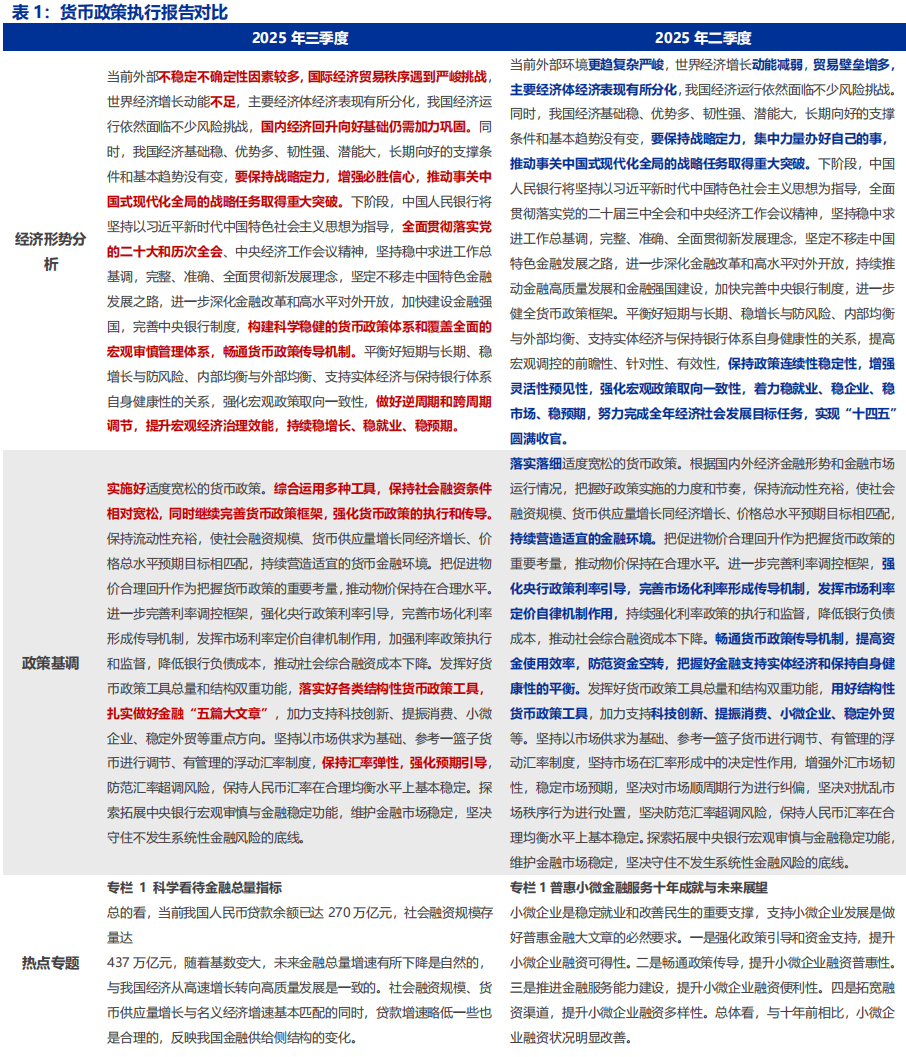
Core Viewpoint - The People's Bank of China (PBOC) emphasizes the need for strategic determination and confidence in the face of external uncertainties and challenges to the international economic order, while also highlighting the importance of consolidating the foundation for domestic economic recovery [2][5]. Economic Situation Analysis - The report indicates that external uncertainties are significant, with the international economic growth momentum described as "insufficient" compared to the previous quarter's "weakened" assessment, reflecting heightened concerns about global economic prospects [2][5]. - Domestically, while risks and challenges remain, there is a new emphasis on the need to strengthen the foundation for economic recovery, indicating a commitment to achieving annual growth targets [2][5]. Policy Tone - The PBOC's monetary policy has shifted from "implementing detailed moderate easing" to "implementing good moderate easing," focusing on the effectiveness of policies rather than just their execution [3]. - The report stresses the use of various tools to maintain relatively loose social financing conditions, highlighting the coordination between monetary and fiscal policies [3][6]. - The report reiterates the importance of maintaining exchange rate flexibility and has removed previous warnings about preventing fund misallocation, suggesting that related risks may have been controlled [3][6]. Hot Topics - The report discusses the importance of understanding financial aggregate indicators, noting that the current RMB loan balance has reached 270 trillion yuan and the social financing scale is at 437 trillion yuan, with a natural decline in growth rates expected as the economy transitions to high-quality development [7]. - It emphasizes the need for a reasonable interest rate relationship to support banks' net interest margins and enhance the counter-cyclical adjustment space for monetary policy [4][7]. Future Outlook - The PBOC plans to develop a financial technology development plan for the 14th Five-Year Plan period, focusing on the orderly advancement of AI applications in finance to support high-quality economic development [4]. - The report outlines a commitment to balancing short-term and long-term goals, ensuring macroeconomic governance effectiveness, and maintaining stability in growth, employment, and expectations [5][6].
冠通期货早盘速递-20251112
Guan Tong Qi Huo· 2025-11-12 02:49
早盘速递 2025/11/12 热点资讯 1. 中国人民银行发布2025年第三季度中国货币政策执行报告。其中提出,实施好适度宽松的货币政策。综合运用多种工具, 保持社会融资条件相对宽松,同时继续完善货币政策框架,强化货币政策的执行和传导。保持流动性充裕,使社会融资规模、 货币供应量增长同经济增长、价格总水平预期目标相匹配,持续营造适宜的货币金融环境。 2. 中国汽车工业协会今天(11日)发布的最新数据显示,今年1至10月份,我国新能源汽车产销量继续实现较高增长。其中, 10月份新能源汽车月度新车销量首次超过了汽车新车总销量的50%。 3. 国家发展改革委组织召开2025—2026年供暖季能源保供视频会议。会议要求稳定能源生产供应,加强煤炭生产组织和运输 保障。确保各类电源应开尽开、稳发满发,充分发挥风电、光伏的电力电量支撑作用。 4. Mysteel卫星数据显示,2025年11月3日-11月9日期间, 澳大利亚、巴西七个主要港口铁矿石库存总量1262.6万吨,环比上 升45.8万吨,呈小幅累库趋势,当前库存水平略低于下半年以来的中位线。 5. 美国总统特朗普表示,对印度征收高额关税是因为它购买了俄罗斯石油,印 ...
央行:实施好适度宽松的货币政策,券商ETF(159842)连续3日“吸金”,长城证券飘红
2 1 Shi Ji Jing Ji Bao Dao· 2025-11-12 01:52
Group 1 - The A-share market opened lower on November 12, with the securities sector also experiencing a slight decline [1] - The broker ETF (159842) saw a decrease of 0.51% with a trading volume exceeding 11 million yuan, while some constituent stocks like Changcheng Securities and Guotai Haitong performed positively [1] - The broker ETF has recorded net inflows for three consecutive days, accumulating over 210 million yuan in net inflows over the past five trading days [1] Group 2 - According to Shenwan Hongyuan Securities, the balance of margin trading is expected to rise due to the maintained moderately loose monetary policy and increased equity allocation by long-term funds [2] - Guotai Haitong Securities noted that the focus on brokers is returning to sustainable fundamentals, with future relative returns depending more on profit quality and ROE recovery [2] - Investment opportunities are suggested in stocks with improving ROE and still at low valuation levels, particularly those benefiting from better proprietary performance and recovery in wealth management and investment banking [2]


货政报告解读|保持社会融资条件相对宽松(申万宏观·赵伟团队)
申万宏源研究· 2025-11-12 01:12
Core Viewpoint - The central theme of the report emphasizes the need for strategic determination and confidence in the face of external uncertainties and challenges to the international economic and trade order, while also highlighting the importance of consolidating the foundation for domestic economic recovery [2][20]. Economic Situation Analysis - The report indicates that external uncertainties have increased, with the international economic growth momentum described as "insufficient" compared to the previous quarter's "weakened" assessment, reflecting heightened concerns about global economic prospects [2][20]. - Domestically, while risks and challenges remain, there is a new emphasis on the need to strengthen the foundation for economic recovery, indicating a commitment to achieving annual economic growth targets despite some slowing in economic indicators [20][21]. Policy Tone - The monetary policy tone has shifted from "implementing detailed and appropriate monetary policy" to "implementing effective monetary policy," focusing on the ultimate effectiveness of policies rather than just their execution [3][21]. - The report introduces a comprehensive approach to maintaining relatively loose social financing conditions, emphasizing the coordination between monetary and fiscal policies, particularly in the context of government bond issuance [3][21]. Monetary Policy Operations - The report highlights the need to maintain liquidity and ensure that the growth of social financing and money supply aligns with economic growth and price level expectations [7][21]. - It stresses the importance of structural monetary policy tools to support key areas such as technological innovation, consumption, small and micro enterprises, and stabilizing foreign trade [7][21]. Exchange Rate and Risk Prevention - The report reiterates the importance of maintaining exchange rate flexibility and has removed previous mentions of preventing fund circularity, suggesting that related risks may have been controlled [3][22]. - The focus has shifted to strengthening expectations guidance and maintaining a stable RMB exchange rate at a reasonable equilibrium level [7][22]. Hot Topics - The report discusses the importance of understanding financial aggregate indicators, noting that the growth of social financing and money supply is generally aligned with nominal economic growth, while also acknowledging the natural decline in financial aggregate growth due to the larger base [8][23]. - It emphasizes maintaining reasonable interest rate relationships to support banks' net interest margins and enhance the counter-cyclical adjustment space for monetary policy [23].
央行最新报告:保持社会融资条件相对宽松、支持个人修复信用
Nan Fang Du Shi Bao· 2025-11-12 01:08
Core Viewpoint - The People's Bank of China (PBOC) emphasizes the implementation of a moderately accommodative monetary policy while introducing new measures for credit repair and cross-cycle adjustments in its latest monetary policy report [2][3]. Group 1: Monetary Policy Adjustments - The report continues to advocate for a moderately accommodative monetary policy and introduces the need to maintain relatively loose social financing conditions [3][4]. - The PBOC highlights the importance of balancing short-term and long-term economic goals, as well as internal and external economic stability, through both counter-cyclical and cross-cyclical adjustments [3][6]. Group 2: Credit Repair Initiatives - The report introduces new measures aimed at supporting individuals in repairing their credit, particularly for those who have faced debt issues due to the pandemic [5][6]. - The PBOC plans to implement a one-time personal credit relief policy, which will not display certain overdue records in the credit system for individuals who have repaid loans under specific conditions [6]. Group 3: Financial Sector Development - The report emphasizes the development of various financial sectors, including technology finance, green finance, inclusive finance, pension finance, and digital finance, to support national strategies and address weak areas in the economy [5][6]. - There is a specific focus on advancing the bond market, particularly for technology companies, and utilizing risk-sharing tools for financing [6]. Group 4: Internationalization of the Renminbi - The report shifts its language regarding the internationalization of the Renminbi from a cautious approach to a more proactive stance, aiming to enhance the openness of capital projects [7].