主题投资

Search documents
公募基金投资逻辑深度重构: “主题投资”风行一时 “全市场选股”暂避锋芒
Zheng Quan Shi Bao· 2025-11-23 21:45
Core Viewpoint - The investment style of public funds has shifted from core assets to high-growth stocks under the backdrop of economic transformation, moving from "full market stock selection" to "thematic investment" strategies [1][3][10] Group 1: Shift in Investment Strategies - Public funds previously favored large-cap stocks like Sany Heavy Industry and Kweichow Moutai, achieving significant returns through a diversified portfolio [2] - The "full market stock selection" strategy has become less prominent, with thematic products dominating annual performance rankings [2][3] - Changes in the investment environment, including economic deceleration and structural adjustments, have led to a decline in the profitability of traditional consumer and manufacturing leaders [3][5] Group 2: Rise of Thematic Investment - Thematic funds have gained popularity due to structural opportunities concentrated in high-growth sectors, outperforming traditional industries [5][6] - Thematic investment allows investors to engage with long-term trends more intuitively, simplifying complex macro and industry logic [6][9] - The focus on specific high-growth sectors, such as AI and innovative pharmaceuticals, has led to significant capital inflows and heightened competition among funds [4][5] Group 3: Challenges of Thematic Investment - Thematic investment requires deeper industry understanding and foresight, raising the bar for fund managers [7][8] - The need for rigorous valuation and risk management frameworks is critical, as concentrated portfolios can be significantly impacted by individual stock performance and market events [8][12] - The complexity of managing risks in highly concentrated portfolios necessitates advanced strategies to maintain overall risk within acceptable limits [8][12] Group 4: Future of Investment Strategies - The "full market stock selection" strategy is not expected to disappear, as it offers unique advantages in capturing structural opportunities across various sectors [10][11] - The market's aesthetic preferences will continue to evolve, but the fundamental capabilities of "full market stock selection" will remain relevant [11] - Thematic investment can lead to high volatility and potential reputational risks for fund companies, emphasizing the need for careful asset allocation and risk management [12]
中信建投:市场或继续维持震荡轮动状态
Zheng Quan Shi Bao Wang· 2025-11-16 23:53
Group 1 - The core viewpoint of the article is that after the improvement in China-US relations, market risk appetite has decreased, leading to fluctuations around the 4000-point mark for the Shanghai Composite Index [1] - The average trading volume for the entire A-share market has decreased to around 2 trillion yuan [1] - Recent capital flows have been active in thematic investments and sectors with growth potential, indicating a shift in market focus [1] Group 2 - The market is expected to continue its oscillating and rotating characteristics, with the key to breaking the current state lying in capital attacking new main lines [1] - The mid-term allocation strategy suggested is to adopt a balanced approach, focusing on clear growth signals without excessive switching [1] - Key sectors to watch include dividends, new chemical materials, superhard materials, lithium battery materials, steel, agriculture, forestry, animal husbandry, batteries, and AI [1]

投资策略周报:“中小市值+主题投资”仍是11月的核心主线-20251116
HUAXI Securities· 2025-11-16 11:43
Market Review - Global stock indices showed divergence this week, with European, Brazilian, and Indian indices rising, while Chinese and American tech stocks declined. The Shanghai Composite Index continued its narrow fluctuation, with major broad indices generally adjusting. The average daily trading volume in the A-share market remained around 2 trillion yuan, indicating a focus on existing stock games. Growth leaders fell while small-cap stocks rose, with the micro-cap index increasing by 4.11% [1][2] - In terms of sector performance, the TMT, machinery, and military sectors saw the largest declines, while precious metals and copper prices rose, and domestic double焦 prices weakened [1][2] Market Outlook - The core theme for November remains "small-cap stocks + thematic investment." The recent pullback in Chinese and American tech stocks is attributed to tight overseas liquidity and concerns over AI bubbles. Future attention will be on U.S. economic data and changes in December rate cut expectations. The current A-share market is primarily focused on existing stock games, with financing and southbound trading showing a "high-low cut" trend. The performance benchmark for public funds is expected to curb issues like style drift and short-term ranking chasing, potentially weakening extreme institutional clustering [2][3] Fundamental Analysis - The domestic economy is expected to achieve a growth rate of around 5% for the year, despite a weakening trend in both supply and demand in October. Industrial added value growth was 6.1%, continuing to decline. Investment in narrow infrastructure turned negative, and real estate development investment and sales areas also saw significant declines. Retail sales growth was only 2.9%, marking five consecutive months of decline, particularly in major consumer goods. However, corporate earnings are stabilizing, and with PPI growth expected to turn positive next year, the potential for profit improvement in certain sectors is anticipated [3][4] Macro Policy - Future policy observations will focus on the December Political Bureau meeting and the Central Economic Work Conference. The central bank has reiterated "cross-cycle adjustment," signaling a balance between long-term goals and supportive monetary policy. The third-quarter monetary policy report indicates that the national economy is progressing steadily, with a solid foundation for achieving annual targets. The central bank's focus is shifting towards supporting policies that consider long-term objectives [4] Funding Dynamics - Since November, market style has shifted, with tech leaders retreating and small-cap stocks outperforming. This is due to concerns over the AI bubble affecting tech sentiment in A-shares. Financing transactions in sectors like semiconductors and communication equipment have seen net selling since November. Southbound funds have favored banks and oil sectors, leading to a phase where value stocks outperform tech stocks. Recent guidelines from the fund industry association aim to curb style drift and extreme clustering among funds, prompting some capital to migrate towards underweight sectors [5][6] Industry Configuration - Focus on "14th Five-Year Plan" related thematic investments, such as energy storage, batteries, domestic substitution, and new materials. Attention should also be given to sectors benefiting from "anti-involution" trends, such as chemicals, and the guidance signals from Hong Kong's innovative pharmaceuticals to A-shares [5]
北交所策略周报:北证开市四周年,市值近万亿流动性改善显著-20251116
Shenwan Hongyuan Securities· 2025-11-16 11:43
Group 1 - The report highlights that the North Exchange has reached its fourth anniversary with a market capitalization of nearly 1 trillion, showing significant improvement in liquidity [10][11]. - As of November 15, 2025, the North Exchange has 282 listed companies, an increase of 248% from the initial 81 companies at its inception, and a total market value of 900.8 billion, which is a 212% increase since the first trading day [10][11]. - The average daily turnover rate for 2025 is reported at 5.4%, surpassing the dual innovation market, indicating a steady increase in liquidity and the number of accounts, which has grown to approximately 9.5 million, a 1.4 times increase from the initial period [10][11]. Group 2 - The North Exchange 50 Index decreased by 0.56% this week, with a trading volume of 10.69 billion yuan, reflecting a 5.89% decrease compared to the previous week [17][22]. - The report notes that 121 stocks rose while 157 fell, resulting in a rise-to-fall ratio of 0.77, with notable gains from companies like Rongyi Precision and Zhu Laoliu [33][35]. - The report emphasizes the importance of focusing on index-weighted constituent stocks and companies entering the North Exchange 50 Index, particularly in the context of the anticipated North Exchange 50 ETF [12][13]. Group 3 - The report indicates that the North Exchange is entering a high-level adjustment period, with rapid rotation of hotspots in technology and "anti-involution" sectors, suggesting a focus on thematic investments [10][12]. - It is expected that more reform measures will be implemented in 2026, including changes to the new stock issuance system and the introduction of the 50 ETF [10][11]. - The report suggests that the market is currently cautious, with a need for more stable growth measures to support the consumer electronics and automotive supply chains in the first half of 2025 [10][12]. Group 4 - The report details that 11 new companies were listed on the New Third Board this week, while 6 were delisted, with planned financing of 96 million yuan and completed financing of 67 million yuan [46][48]. - As of November 14, 2025, there are 6061 companies listed on the New Third Board, with 2310 in the innovation layer and 3751 in the basic layer [46][48].
A股分析师前瞻:年末为什么会出现仓位与风格的再平衡?
Xuan Gu Bao· 2025-11-09 13:15
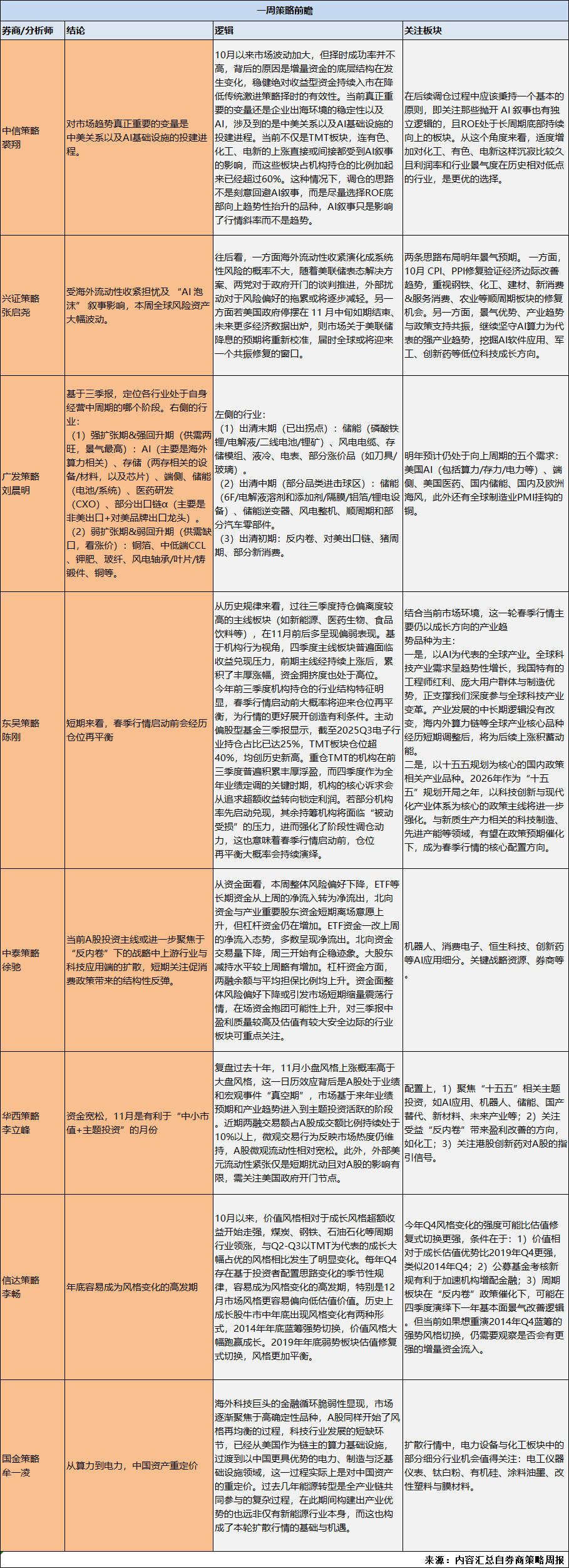
Group 1 - The focus of brokerage strategy analysts this week is on year-end style rebalancing, with historical patterns indicating that sectors with high deviation in holdings during the third quarter, such as new energy, pharmaceuticals, and food and beverage, tend to show weaker performance around November [1][3] - The fourth quarter is expected to face profit-taking pressure in main sectors, as previous main lines have accumulated significant gains, leading to high levels of capital crowding [1][3] - The structure of institutional holdings in the first three quarters of this year is evident, suggesting a high probability of position rebalancing before the spring market rally, which will create favorable conditions for better market performance [1][3] Group 2 - The strategy team from Guojin highlights the fragility of financial cycles among overseas tech giants, leading to a focus on high-certainty varieties, with A-shares also beginning a process of style rebalancing [2][4] - The transition of the tech industry's development from U.S.-led computing infrastructure to China's advantages in electricity, manufacturing, and general infrastructure represents a repricing of Chinese assets [2][4] - In the diffusion market, opportunities in specific sub-sectors within the electric equipment and chemical sectors are worth attention, including electrical instruments, titanium dioxide, organic silicon, and specialty plastics [2][4] Group 3 - The strategy team from Dongwu notes that the spring market rally is likely to experience a position rebalancing before its initiation, with a focus on sectors that have independent logic beyond AI narratives and are experiencing upward trends in ROE from long-term lows [1][3] - The analysis indicates that the small-cap style has a higher probability of rising compared to large-cap style in November, attributed to A-shares being in a performance and macro event "vacuum period," leading to active theme investments based on next year's performance expectations [1][3] Group 4 - The strategy team from Huaxi reviews the past decade, noting that November is favorable for "small-cap value + theme investment," with the market entering an active phase based on performance expectations and industry trends [1][3] - The current investment focus in A-shares may further concentrate on upstream industries and technology applications under the "anti-involution" strategy, with short-term attention on policies promoting consumption [1][3]

电力、化工多主题走出右侧形态:投资要点:
Huafu Securities· 2025-11-09 12:15
Group 1 - The report emphasizes the establishment of a thematic investment database aimed at identifying high-quality price-volume patterns and monitoring the peak rhythm of popular themes and the adjustment levels of leading stocks [2][9]. - The report identifies a total of 2 bottoming, 25 breakout, 25 main rising, and 5 accelerating thematic indices, with key industries including transportation, electric equipment, computer, media, pharmaceutical biology, and defense [12]. - The report highlights the decline in trading heat for humanoid robots to 50% and an increase for Deepseek to 45%, with leading stocks showing significant adjustments below their 60-day moving average [3][17]. Group 2 - The report outlines the two main purposes of the thematic database: to find investment opportunities and to provide warnings for potential peaks [9]. - The report details the monitoring of trading heat for popular themes, specifically humanoid robots and Deepseek, and the corresponding adjustments of leading stocks [17][22]. - The report indicates that the leading stocks for humanoid robots and Deepseek have closing prices significantly below their 60-day moving averages, suggesting potential risks in these themes [3][17].
新材料,该如何投资?
Tianfeng Securities· 2025-11-04 07:26
Investment Rating - Industry Rating: Outperform the market (maintained rating) [5] Core Viewpoints - Investment in new materials is fundamentally an investment in emerging industries and structural transformation [10][12] - The lifecycle of the industry is crucial for investment decisions, with new materials often in the development or introduction phase [13][14] - Short-term excess returns in new materials investments are closely tied to market beta (β), regardless of whether the materials are in development or introduction phases [15][16] Summary by Sections Investment in New Materials - Investing in new materials means investing in future emerging industries, as these materials are in recent or ongoing development and outperform traditional materials [10][12] - The materials industry is foundational to modern industrial systems, with each technological revolution linked to breakthroughs in materials [9][10] Lifecycle Assessment - Assessing the lifecycle of new materials is essential, as they are often in the development or introduction phase, which affects their industrialization and investment characteristics [13][14] - For development-phase materials, investment is thematic, while for introduction-phase materials, it is more about industrial investment [13][14] Market Trends and Recommendations - Recent market performance has been strong in sectors like photovoltaic equipment and glass fiber, while sectors like small appliances and communication equipment lagged [3][20] - Recommendations include focusing on solid-state batteries and electronic fabrics, with specific companies highlighted for potential investment [24][25]


A500ETF基金(512050)获大额资金布局,1-10月累计涨幅达23.58%跑赢沪深300超5%
Mei Ri Jing Ji Xin Wen· 2025-11-03 04:34
Core Viewpoint - The A-share market continues to adjust, with the A500 ETF (512050) experiencing a 1.1% decline on October 31, but still attracting significant capital inflow, indicating ongoing investor interest despite market fluctuations [1][2]. Group 1: Market Performance - The A500 ETF (512050) recorded a daily trading volume of 5.71 billion yuan and a net capital inflow of nearly 600 million yuan on the same day [1]. - From January to October, the A500 ETF (512050) has increased by 23.58%, outperforming the CSI 300 index, which rose by 17.94% during the same period [1]. Group 2: Economic Outlook - A consensus on U.S.-China trade has been reached, and the dual expansionary fiscal and monetary policies in the U.S. for 2026 are expected to support external demand and domestic economic stability [1]. - The anticipated slowdown in the Federal Reserve's interest rate cuts may create short-term volatility in market liquidity and risk appetite, necessitating close monitoring of U.S. inflation and economic recovery [1]. Group 3: Investment Strategy - The A-share market is expected to see active thematic investments in November, with a potential shift in focus towards sectors with anticipated growth in the coming year [2]. - The A500 ETF (512050) employs a dual strategy of industry-balanced allocation and leading company selection, covering all 35 sub-industries, and is particularly overweight in AI, pharmaceuticals, and renewable energy sectors compared to the CSI 300 [2].
十大券商:4000点后如何应对?结构性机会仍存,盘整震荡中布局再平衡
Zheng Quan Shi Bao Wang· 2025-11-02 23:09
Group 1 - The current index level is not as critical as the underlying quality of the market, with structural opportunities still present despite short-term fears in the technology sector [1] - The overall growth is entering a recovery phase, with improvements in net profit margins across various sectors, particularly in emerging technologies and cyclical industries [2] - The market is expected to experience a period of consolidation, with a potential shift in investment styles as the year-end approaches [4] Group 2 - The focus is shifting towards internal structural optimization following the completion of the third-quarter reports, with an emphasis on sectors like AI and export-related industries [6] - The technology sector remains a key investment theme, although short-term volatility may increase due to adjustments in fund allocations [8] - The outlook for the market remains optimistic in the medium to long term, supported by stable policies and a recovering economic environment [9]

4000点之后,A股怎么走?最新解读来了!
中国基金报· 2025-11-02 13:49
Key Points - The article discusses the outlook for A-shares after surpassing the 4000-point mark, summarizing major events and insights from ten securities firms for investment reference [2] Major Events - The State Council held a meeting to deepen reforms in key areas and expand institutional openness, focusing on enhancing market access and optimizing regulatory systems [3] - The U.S. Treasury Secretary indicated that a U.S.-China trade agreement could be signed soon, with China expressing a willingness to cooperate on economic issues [4] - The Ministry of Commerce addressed concerns regarding ASML Semiconductor, emphasizing support for companies facing difficulties and potential export exemptions [5][6] - A draft guideline for public fund performance benchmarks was released, outlining five key requirements for fund managers to enhance accountability and performance monitoring [7] Securities Firms' Insights - **CITIC Securities**: Emphasizes that the current index level is more favorable than in 2015, suggesting focus on structural opportunities in traditional manufacturing, overseas expansion, and AI [14] - **CITIC Construction Investment**: Warns of potential market adjustments after a surge in sentiment, recommending caution in increasing positions and focusing on sectors like coal, oil, and new energy [15] - **Shenwan Hongyuan**: Notes that the market is in a narrow fluctuation phase, with technology stocks losing attractiveness, and suggests that future upward movements may rely on tech growth [16] - **Guotai Junan**: Highlights the need for rebalancing in the market, with opportunities emerging beyond AI as GDP growth outpaces corporate earnings [18] - **Dongfang Caifu**: Predicts active theme investments in November, with a focus on sectors expected to see growth in the coming year [19] - **Xinda Strategy**: Analyzes the impact of fund allocation on market trends, noting that accelerated allocation often coincides with market volatility [20] - **Galaxy Strategy**: Points to positive external and domestic factors supporting market stability, with a focus on high-quality development and technological self-reliance [21] - **Xingzheng Strategy**: Discusses the importance of valuation adjustments based on next year's economic expectations, suggesting a shift in investor focus [22][23] - **Zheshang Strategy**: Observes market divergence post-4000-point breakthrough, recommending a balanced approach to sector allocation [24] - **Guangfa Securities**: Describes November as a period where market movements are less correlated with current fundamentals, suggesting a focus on undervalued sectors with recovery potential [25]