以旧换新

Search documents
7月社会零售品消费数据点评:7月社零同比+3.7%,线上消费渗透率持续提升
Shenwan Hongyuan Securities· 2025-08-17 14:22
Investment Rating - The industry investment rating is "Overweight" indicating a positive outlook for the sector compared to the overall market performance [11]. Core Insights - In July 2025, the total retail sales of consumer goods increased by 3.7% year-on-year, which was below market expectations. The total retail sales reached 3.9 trillion yuan, with a month-on-month decline of 1.1 percentage points [5]. - Online retail sales and penetration rates have significantly increased due to enhanced subsidies from instant retail platforms. The online retail sales for the first seven months of 2025 grew by 9.2% year-on-year, surpassing the overall retail growth rate [5]. - The report highlights a divergence in domestic consumption performance, with sectors like instant retail benefiting significantly, while the restaurant sector continues to face pressure [5]. Summary by Sections Retail Sales Performance - July 2025 saw a 3.7% year-on-year increase in retail sales, lower than the expected 4.9%. Excluding automobiles, retail sales grew by 4.3% [5]. - The retail sales of goods in July reached 3.4 trillion yuan, with a year-on-year growth of 4.0% [5]. Online and Offline Retail Trends - Online retail sales in July amounted to 959.9 billion yuan, with a year-on-year growth of 8.3% and a month-on-month increase of 3.6% [5]. - The online penetration rate reached 24.8%, up from 23.7% in the previous year [5]. Consumer Goods and Services - The report notes a significant increase in the sales of daily consumer goods, with categories like communication and food seeing growth rates of 14.9% and 8.6% respectively [5]. - The restaurant sector's growth remains low, with July's revenue at 450.4 billion yuan, reflecting a year-on-year increase of only 1.1% [5]. Investment Recommendations - The report recommends focusing on e-commerce and instant retail sectors, highlighting companies like Alibaba, JD.com, and Meituan as key players [5]. - It also suggests investing in quality gold and jewelry brands, as well as companies in the travel industry that are expected to benefit from the summer tourism season [5].
京东集团-SW(09618):2025Q2财报点评:核心零售增长亮眼,关注外卖后续投入与协同
Guohai Securities· 2025-08-17 13:04
Investment Rating - The report maintains a "Buy" rating for JD Group-SW (9618.HK) [1][20] Core Views - JD Group's Q2 2025 revenue reached 356.7 billion yuan, a year-on-year increase of 22% and a quarter-on-quarter increase of 18%, exceeding Bloomberg consensus expectations [5][10] - The company's adjusted net profit significantly surpassed Bloomberg consensus expectations, primarily due to better-than-expected gross margin and operating profit margin in JD Retail, despite losses from new businesses like food delivery [6][10] - The retail segment showed strong growth, with revenue from the 1P electronics category increasing by 23% year-on-year to 179 billion yuan, and the 1P daily necessities category growing by 16% to 103.4 billion yuan [6][9] Summary by Sections Financial Performance - Q2 2025 revenue was 356.7 billion yuan (YoY +22%, QoQ +18%), with a gross profit of 56.6 billion yuan (YoY +23%, QoQ +18%) [5][10] - Operating profit was -0.9 billion yuan (YoY -108%, QoQ -108%), and net profit was 6.7 billion yuan (YoY -51%, QoQ -41%) [5][10] - Non-GAAP net profit was 7.4 billion yuan (YoY -49%, QoQ -42%) [5][10] Retail Segment - JD Retail revenue grew by 21% year-on-year to 310.1 billion yuan in Q2 2025, with an operating profit margin of 4.5% [6][9] - The growth was driven by a robust recovery in consumer spending and government subsidy policies [6][9] Logistics Segment - JD Logistics revenue reached 51.6 billion yuan (YoY +17%, QoQ +10%), with a slight decrease in operating profit margin to 3.8% [9] - The integrated supply chain customer revenue grew by 19.9% year-on-year, with over 70,000 external customers [9] New Business Initiatives - New business revenue, including food delivery, reached 13.9 billion yuan, with an operating loss of 14.8 billion yuan [9] - The food delivery segment has shown significant user growth, with daily orders reaching 25 million [9] Earnings Forecast and Valuation - Revenue forecasts for 2025-2027 have been revised upwards to 1,323.58 billion yuan, 1,420.01 billion yuan, and 1,512.77 billion yuan respectively [17][18] - The target market capitalization for JD Group in 2026 is set at 544.5 billion yuan, with a target price of 171 yuan per share [17][18]

家用电器周观点:在线音乐平台中报业绩表现强劲,关注高护城河下的长期配置价值-20250817
Huafu Securities· 2025-08-17 08:57
Investment Rating - The report maintains an "Outperform" rating for the industry [8] Core Insights - The online music platforms, Tencent Music and NetEase Cloud Music, reported strong mid-year performance for 2025, with Tencent Music achieving a revenue of 8.44 billion yuan in Q2 2025, a year-on-year increase of 17.9%, and an adjusted net profit of 2.57 billion yuan, up 37.4% [3][12] - NetEase Cloud Music's revenue for H1 2025 was 3.83 billion yuan, down 6% year-on-year, but its adjusted net profit surged by 121% to 1.95 billion yuan, primarily due to the recognition of deferred tax assets [3][12] - The online music industry is characterized by a stable competitive landscape with strong user stickiness, indicating long-term investment potential [3][22] Summary by Sections Online Music Platforms - Tencent Music's online music service revenue reached 6.85 billion yuan in Q2 2025, reflecting a 26.4% increase year-on-year, with an average revenue per user (ARPU) of 11.7 yuan per month, up 9.3% [12][16] - NetEase Cloud Music's subscription revenue for H1 2025 was 2.47 billion yuan, a 15.2% increase year-on-year [16] Home Appliance Sector - The home appliance sector saw a weekly increase of 1.9%, with white goods, black goods, and small appliances rising by 1.0%, 4.2%, and 1.7% respectively, while kitchen appliances decreased by 1.1% [4][29] - The report suggests that the home appliance sector will benefit from policies supporting domestic demand recovery, particularly through trade-in programs [5][23] Investment Recommendations - The report recommends focusing on major home appliance companies such as Midea Group, Haier Smart Home, Gree Electric Appliances, and TCL Electronics, which are expected to benefit from trade-in programs [5][23] - The pet industry is highlighted as a resilient sector during economic downturns, with companies like Guibao Pet and Zhongchong Co. recommended for investment [5][23] - The report also emphasizes the potential for recovery in small appliances and branded apparel due to low baselines, suggesting companies like Bear Electric and Anta Sports for consideration [5][23] Global Manufacturing Trends - The report notes that Chinese manufacturers maintain a significant advantage in global markets, particularly in major appliances and tools, with companies like Midea Group and Haier Smart Home recommended for their global market share [6][28]

“两新”政策红利加速释放设备更新消费拉动作用凸显
Zhen Jiang Ri Bao· 2025-08-17 00:01
Core Insights - The city has effectively utilized the "Two New" working group to promote four major actions: equipment updates, trade-in programs, recycling, and standard upgrades, resulting in significant achievements in the first half of the year [1][2] Group 1: Economic Performance - The value added of regulated equipment manufacturing and digital product manufacturing industries increased by 10.5% and 14.3% year-on-year, respectively, while the automotive manufacturing industry saw a 17.3% increase [1] - The total retail sales of consumer goods grew by 6.3% year-on-year, driven by the trade-in programs that released consumer potential [1] Group 2: Policy and Project Development - The city has developed a comprehensive policy framework and project reserve, implementing 11 specialized work plans to support the "Two New" initiatives [1] - The city has established a task list for the "Two Heavy" and "Two New" initiatives, clarifying key tasks and support standards [1] Group 3: Recycling and Standards - As of now, the city has applied for a total of 566 million yuan in funding for trade-in programs, which has driven sales of related subsidized products exceeding 4.3 billion yuan [2] - The city has recycled 55,000 scrapped vehicles, 150,000 household appliances, and 36,000 electric bicycles [2] - The "Two New" standards have led to the formulation of 8 national standards and 4 local standards [2] Group 4: Future Plans - The city plans to enhance coordination and improve the awareness and satisfaction of policies among enterprises, ensuring smooth implementation of trade-in funding [2] - The development department will collaborate with relevant industry authorities to focus on key support areas, planning high-quality projects in advance [2]
长三角半年瞰:江苏社零规模全国第一,上海整体回暖、餐饮收缩
2 1 Shi Ji Jing Ji Bao Dao· 2025-08-16 12:56
Economic Performance Summary - Jiangsu's total retail sales of consumer goods reached 2.39 trillion yuan, making it the only region to surpass 2 trillion yuan, ranking first nationwide [1][2] - The retail sales growth rates for Jiangsu, Zhejiang, and Anhui were all above 5%, with Zhejiang at 189.79 billion yuan (5.3% growth), Anhui at 120.51 billion yuan (5.5% growth), and Jiangsu at 239.49 billion yuan (5% growth) [1][2] - Shanghai's retail sales totaled 826.04 billion yuan, showing a 1.7% year-on-year increase, indicating a recovery from negative growth in the first quarter [1][5] Consumption Policies and Effects - The "old-for-new" policy is expected to significantly support consumption, with a planned allocation of 150 billion yuan in special long-term bonds for 2024, increasing to 300 billion yuan in 2025 [3] - In Shanghai, the "old-for-new" policy has led to a direct increase in social consumption by over 54 billion yuan [3] - Anhui's implementation of the "old-for-new" policy included 8 billion yuan in subsidies and 620 million yuan in consumer vouchers, resulting in a 11.2% increase in retail sales for related goods [4] Regional Consumption Trends - Shanghai's restaurant income decreased by 2.6% to 99.14 billion yuan, while Jiangsu, Zhejiang, and Anhui all saw restaurant income growth exceeding 5% [6][9] - The "Su Super" sports events in Jiangsu generated 37.96 billion yuan in service revenue, marking a 42.7% increase, with significant contributions from tourism and dining [10] - Jiangsu's retail sales increased by 5.8%, with notable growth in the railway and aviation sectors, achieving revenue growth of 90.7% and 46.5%, respectively [11]


兼评7月经济数据和个人消费贷贴息:内需放缓,个人消费贷贴息或提振社零0.2个百分点
KAIYUAN SECURITIES· 2025-08-16 07:49
Consumption - The contribution of trade-in programs to retail sales has weakened, with July retail sales growth declining by 1.1 percentage points to 3.7% year-on-year[3] - The personal consumption loan interest subsidy is expected to boost retail sales by approximately 0.2 percentage points, with a historical context showing a 1% subsidy could lead to a greater impact than previous years[4] - The consumer loan consumption rate has remained low, averaging around 2.5% since 2024, indicating a shift towards cash purchases rather than credit expansion[3] Production - Industrial production growth in July was 5.7%, down 1.1 percentage points from the previous value, with a month-on-month increase of only 0.38%[5] - Service sector production also saw a slight decline of 0.2 percentage points to 5.8% year-on-year, with mixed performance across various industries[5] Fixed Investment - Real estate investment has further declined, with July showing a year-on-year drop of 12.0%, and new housing sales showing signs of weakness[6] - Manufacturing investment has decreased by 1.3 percentage points to 6.2%, with significant declines in sectors such as non-ferrous metallurgy and chemical products[6] - Infrastructure investment turned negative for the first time since 2021, with broad infrastructure showing a decline of 1.9% year-on-year in July[6] Economic Outlook - The data from July indicates a further weakening of domestic demand, suggesting increased downward pressure on economic growth in Q4, which may prompt policy adjustments[7] - Risks include potential underperformance of policy measures and unexpected downturns in the U.S. economy[7]
长三角半年瞰③:江苏社零规模全国第一,上海整体回暖、餐饮收缩
2 1 Shi Ji Jing Ji Bao Dao· 2025-08-16 07:30
Core Viewpoint - The Yangtze River Delta (YRD) region, comprising 41 cities, shows a robust economic performance in the first half of the year, with significant growth in social retail sales, particularly driven by consumption policies and the "old-for-new" initiative [2][4]. Group 1: Social Retail Sales Performance - Jiangsu leads the YRD with a social retail sales total of 2.39 trillion yuan, the only region surpassing 2 trillion yuan [2][3]. - Zhejiang and Anhui also reported strong growth in social retail sales, with totals of 1.8979 trillion yuan (5.3% YoY) and 1.2051 trillion yuan (5.5% YoY) respectively [2][3]. - Shanghai's social retail sales reached 826.04 billion yuan, showing a 1.7% YoY increase, marking a recovery from negative growth in the first quarter [2][3][7]. Group 2: Impact of "Old-for-New" Policy - The "old-for-new" policy is a significant driver of consumption, with central government support increasing from 150 billion yuan in 2024 to 300 billion yuan in 2025 [4][5]. - In Shanghai, the policy contributed over 540 billion yuan to social retail sales in the first half of the year [4]. - Zhejiang's retail sales in home appliances surged by 84.5%, while Anhui's "old-for-new" subsidies totaled 8 billion yuan, boosting retail sales growth by 11.2% [4][5]. Group 3: Restaurant Sector Trends - Shanghai's restaurant income declined by 2.6% to 99.14 billion yuan, contrasting with growth in Jiangsu, Zhejiang, and Anhui, where restaurant income increased by over 5% [8]. - The disparity in restaurant performance indicates a shift in high-end dining dynamics, with resources migrating to Jiangsu and Zhejiang [8]. Group 4: Economic Activities and Events - The "Su Super" football league significantly boosted economic activity in Jiangsu, generating 37.96 billion yuan in service revenue, a 42.7% increase [9]. - The tourism and cultural sectors in Jiangsu also saw remarkable growth, with railway and air passenger transport revenues increasing by 90.7% and 46.5% respectively [10].

7月消费环比回落,扩内需组合拳将持续发力
Hua Xia Shi Bao· 2025-08-16 07:23
Economic Overview - In July, the economy continued to show weak domestic demand and strong external demand, but overall remained stable [2] - Retail sales in July reached 38,780 billion yuan, growing by 3.7% year-on-year, but down 0.14% month-on-month [2][4] - From January to July, total retail sales amounted to 284,238 billion yuan, with a year-on-year growth of 4.8% [2] Consumption Trends - Despite weak domestic demand, there are still consumption highlights, particularly in the "trade-in" related sectors, where retail sales of home appliances and communication devices grew over 10%, with some categories even reaching 20% [2] - The growth rate of retail sales in July was 3.7%, down 1.1 percentage points from the previous month, with food and beverage income also showing a marginal decline [4][5] - Service consumption performed relatively well, with service retail sales growing by 5.2% year-on-year from January to July, driven by tourism and diverse service offerings [6] Investment Insights - Fixed asset investment (excluding rural households) in July decreased by 0.63% month-on-month, with a cumulative year-on-year growth of 1.6% from January to July [2][7] - The decline in investment growth reflects short-term weather disturbances and mid-term factors such as reduced real estate projects and equipment renewal cycles [7] - Infrastructure investment (excluding electricity) saw a cumulative year-on-year growth of 3.2%, down 1.4 percentage points from previous values, indicating a slowdown in construction activities [7] Real Estate Market - Real estate development investment continued to decline, with a year-on-year drop of 12% in July, and new housing sales area also decreased by 4% [5][8] - The credit financing growth rate for real estate companies fell sharply to -15.8%, the lowest in two years, indicating a significant contraction in the sector [8] - The ongoing contraction in the real estate market suggests that the decline in investment growth may further widen as the market has not yet bottomed out after three years of shrinkage [8]

透视税收数据:促进转型升级、提振消费需求,“两新”政策成效明显
Sou Hu Cai Jing· 2025-08-15 11:00
Group 1 - The implementation of large-scale equipment updates and the "old-for-new" consumption policy has positively impacted industrial transformation, consumption demand, and economic circulation [1][2] - From April 2024 to July 2025, the procurement amount of machinery and equipment by enterprises increased by 7.3% year-on-year, with industrial enterprises seeing a 9.8% increase [1] - The procurement amount for information transmission software and technology service industries grew by 27.8% and 28.3% respectively, indicating strong support for industrial upgrades [1] Group 2 - The "old-for-new" policy has stimulated diverse consumer demand, with sales of daily household appliances and audio-visual equipment increasing by 44.5% and 22.8% respectively from April 2024 to July 2025 [1] - The retail sales of furniture and sanitary ware grew by 30.1% and 13.6% respectively, while the service robot manufacturing industry saw a 51.1% increase [1] - The sales of new energy vehicles surged by 81.7%, reflecting the policy's significant impact on the automotive sector [1] Group 3 - The "supply and demand smoothness" has fostered a virtuous economic cycle, with the "Two New" policies driving retail demand and subsequently enhancing supply-side manufacturing efforts [2] - Manufacturing sales revenue increased by 5.8% year-on-year, contributing to a more efficient internal economic circulation [2] - The tax authority plans to strengthen the "policy + service" dual-drive approach to ensure the continued effectiveness of the "Two New" policies for high-quality economic development [2]
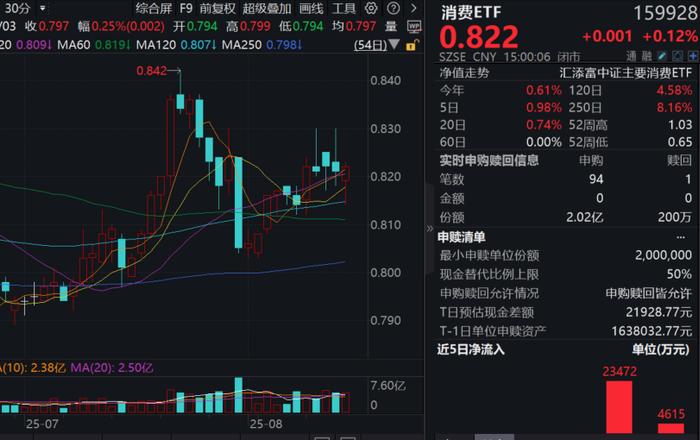
7月经济数据出炉,消费还有哪些潜在空间?规模领先的消费ETF(159928)红盘再度疯狂“吸金”,全天大举净流入2亿份!
Xin Lang Cai Jing· 2025-08-15 10:38
Group 1: Market Performance - A-shares opened lower but closed higher, with the Shanghai Composite Index reaching a new closing high [1] - The leading consumption ETF (159928) rose by 0.12%, with a total trading volume exceeding 430 million yuan, and net subscriptions of 20 million units for three consecutive days [1] - As of August 14, the latest scale of the consumption ETF (159928) exceeded 13.5 billion yuan, significantly leading its peers [1] Group 2: Economic Data - The National Bureau of Statistics reported that the industrial added value above designated size grew by 5.7% year-on-year in July, slowing down by 1.1 percentage points from June [5] - Retail sales of consumer goods increased by 3.7% year-on-year in July, also down by 1.1 percentage points from June [5] - Fixed asset investment grew by 1.6% year-on-year from January to July, a decrease of 1.2 percentage points compared to the first half of the year [6] Group 3: Consumer Trends - The consumption recovery cycle driven by "old-for-new" trade-in programs peaked in May, with retail sales growth reaching 6.4%, followed by declines in June and July [6] - The main factor affecting retail sales in July was the decline in goods retail growth, which fell from 5.3% in June to 4.0% in July [6] - The average growth rate of "old-for-new" subsidized products dropped from 17.5% to 12.7%, while non-subsidized products saw an increase from 1.9% to 4.2% [6] Group 4: Future Outlook - Despite potential pressures in the fourth quarter, there are three supporting factors for consumer growth in the second half of the year: gradual recovery in dining growth, the release of childbirth subsidies, and consumer loan interest subsidies [8] - The expected release of approximately 90 billion yuan in childbirth subsidies could boost retail sales growth by about 0.3 percentage points in the second half of the year [8] - Recent consumer policies, including personal consumption loan interest subsidies, are anticipated to support domestic consumption and stimulate consumer credit [10] Group 5: Investment Insights - The consumption ETF (159928) is characterized by its resilience across economic cycles, with the top ten constituent stocks accounting for over 68% of its weight [11] - Key stocks include leading liquor brands and major agricultural producers, indicating a strong focus on essential consumer goods [11] - The Hong Kong Stock Connect Consumption 50 ETF (159268) is highlighted as an efficient investment option for the new consumption sector, supporting T+0 trading and not occupying QDII quotas [12]