
自主可控

Search documents
港股午评|恒生指数早盘涨2.41% 芯片板块涨幅居前
智通财经网· 2025-10-20 04:08
三花智控(02050)涨超6%,上调回购股份价格上限,近期机器人领域催化密集。 亿都国际(00259)盘中涨超11%,沐曦科创板IPO即将上会,亿都旗下算丰参投沐曦且合作紧密。 太平洋航运(02343)涨超3%,中美港口费暂无影响,机构料其四季度日均收入环比进一步上涨。 智通财经APP获悉,港股恒生指数涨2.41%,涨608点,报25855点;恒生科技指数涨3.21%。港股早盘成 交1454亿港元。 芯片股多数走高。上海复旦(01385)涨6.51%,中芯国际(00981)涨超4%,华虹半导体(01347)涨超4%。招 商证券认为,在美国持续加强出口管制背景下,国内自主可控进程加速。 游戏股涨幅居前。政策支持及出海趋势提振游戏行业,机构看好后续催化。网易-S(09999)涨5%;腾讯 (00700)涨3.78%。 航空股延续近期涨势,油价下滑叠加人民币强势,航司盈利或能进一步增长。东方航空(00670)涨9%; 南方航空(01055)涨5.4%;中国国航(00753)涨5.78%。 老铺黄金(06181)回落逾6%,月内仍涨超10%,公司预告年内第三次提价。 报道称蚂蚁等暂停在港发行稳定币计划,云锋金融(00 ...
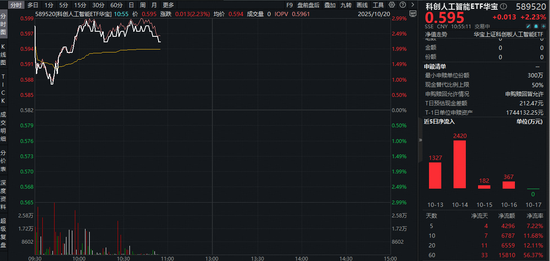
寒武纪营收增超23倍,连续四个季度盈利!科创人工智能ETF(589520)盘中上探2.9%,近5日吸金4296万元
Xin Lang Ji Jin· 2025-10-20 03:07
Core Viewpoint - The rise of domestic AI industry chain is highlighted, with significant investment in the Sci-Tech Innovation Artificial Intelligence ETF (589520), which has seen a 2.23% increase in value and attracted 42.96 million yuan in the past five days [1][3]. Group 1: Company Performance - Cambricon Technologies reported a substantial revenue increase of 1,332.52% year-on-year for Q3, reaching 1.727 billion yuan, with a net profit of 567 million yuan [3]. - For the first three quarters, Cambricon's revenue was 4.607 billion yuan, marking a 2,386.38% year-on-year growth, with a net profit of 1.605 billion yuan [3]. - The company has achieved profitability for four consecutive quarters, indicating strong resilience in the supply chain [3]. Group 2: Market Trends - Morgan Stanley predicts that by 2025, China's AI sector will enter an "application penetration period," leading to exponential growth in computing power demand [4]. - Shanxi Securities emphasizes that the domestic computing power chain is entering a major cycle, supported by continuous investments from state-owned enterprises and internet giants [4]. Group 3: Investment Highlights - The Sci-Tech Innovation Artificial Intelligence ETF (589520) is positioned to benefit from policy support and the rapid development of AI, with a focus on companies that are leaders in their respective segments [5]. - The ETF offers a low-threshold investment opportunity with a 20% price fluctuation limit, enhancing efficiency during market surges [5]. - The top ten holdings of the ETF account for over 70% of its weight, with the semiconductor sector representing more than half of the portfolio [6].


科技股走强、板块轮动,如何锚定投资“黄金位”?
Zhong Guo Ji Jin Bao· 2025-10-20 02:57
Core Viewpoint - The current A-share market is experiencing significant structural changes, with the technology sector, particularly AI, leading the rally, achieving a 46.72% increase in the Sci-Tech Innovation Board Index as of October 15 this year [1]. Technology Sector - The strong performance of the technology sector, especially the AI industry chain, is driven by accelerated domestic and international AI development, with a notable increase in the iteration speed of large models and a growing number of paying users [2]. - The high demand for computing power has created a "flywheel effect," positively impacting various segments, including GPUs, optical modules, and semiconductors [2]. - While many AI-related stocks have seen significant price increases, some non-mainstream stocks lack fundamental support and may exhibit bubble-like valuations, indicating potential risks of correction [3]. Market Rotation - The expectation of "high cutting low" in the market is hindered by the lack of clear catalysts for low-position sectors, leading to investor hesitation between "chasing highs" and "bottom fishing" [4]. - However, there are still investment opportunities in low-position sectors, particularly in cyclical and consumer sectors, which can be explored through a cautious approach based on macroeconomic data improvements [4]. Investment Strategy - The core holdings are primarily focused on technology and renewable energy, particularly in the AI and semiconductor sectors, with an emphasis on sustainable profit models [5]. - The investment strategy involves dynamic adjustments based on market conditions and sector valuations, shifting focus from previously high-performing segments to downstream semiconductor equipment and design [5]. Renewable Energy - In the renewable energy sector, there is a significant focus on energy storage and solid-state batteries, with both domestic and international markets experiencing high growth [6]. Future Market Outlook - Key areas to watch include sectors with strong policy support, such as computing infrastructure and renewable energy exports, as well as self-sufficiency sectors to mitigate overseas risks [7]. - The overall macroeconomic environment is expected to remain stable, with strong policy support, although a trend recovery may require more time or stronger measures [8]. - The ongoing global AI technology wave and domestic innovation vitality are anticipated to create structural opportunities in the market [8][9].
科技股走强、板块轮动,如何锚定投资“黄金位”?
中国基金报· 2025-10-20 02:53
中国基金报记者: 近期科技板块表现极为强势,尤其是AI产业链,你认为这波行情的持续性 如何?背后的驱动因素又有哪些? 于浩成: 最近科技板块,特别是AI产业链的强势表现,确实吸引了众多目光。从驱动因素来 看,国内外AI发展都在加速。以美国为例,大模型的迭代速度明显加快,智能化水平不断提 升,终端付费用户数量快速增长。这种增长反过来又带动了对算力的巨大需求,形成了一 个"飞轮效应"。算力环节的高景气已经从GPU、光模块、PCB开始,逐步传导至存储、半导 体设备甚至电力环节。所以,我认为这轮科技行情是有较好的基本面基础的,并具有一定的 持续性。 中国基金报记者 : 估值方面,目前部分科技股估值已经不低,你怎么看,是否存在泡沫风 险? 【导读】泓德基金于浩成:结构性行情中探寻投资"黄金锚点" 中国基金报记者 李树超 近期A股市场结构变化显著,科技板块一骑绝尘,AI引领的科技股行情强势爆发,成为本轮市 场上涨中的最强主线,今年以来截至10月15日,科创综指已实现46.72%的涨幅。与此同 时,板块轮动频繁,"高切低"预期与实际状况落差引发讨论。 泓德基金基金经理、成长组组长于浩成认为,本轮科技行情有着较好的基本面支撑 ...

港股异动 | 芯片股多数走高 上海复旦(01385)涨超7% 中芯国际(00981)涨超4%
智通财经网· 2025-10-20 02:28
Group 1 - The semiconductor stocks are mostly rising, with Shanghai Fudan up 7.41% at 41.6 HKD, SMIC up 4.2% at 72 HKD, and Hua Hong Semiconductor up 3.56% at 78.5 HKD [1] - NVIDIA's CEO Jensen Huang stated that due to U.S. export controls, the company's market share in high-end chips in China has dropped from 95% to 0% [1] - Cambricon's Q3 report shows a revenue increase of 2386.38% year-on-year for the first three quarters [1] Group 2 - TSMC reported a record net profit of 452.3 billion NTD in Q3, a year-on-year increase of 39.1% [1] - Huajin Securities remains optimistic about the semiconductor supercycle driven by artificial intelligence and suggests focusing on the entire semiconductor industry chain [1] - According to招商证券, the acceleration of domestic self-sufficiency is expected due to ongoing U.S. export controls, with advanced production line expansions anticipated to boost orders in domestic equipment and components [1]

恒生科技ETF天弘(520920)盘中走强涨超2%,上市8日持续“吸金”累计超15亿元,阿里巴巴设立香港总部
2 1 Shi Ji Jing Ji Bao Dao· 2025-10-20 02:20
Group 1 - The Hang Seng Technology ETF Tianhong (520920) has shown strong performance, rising 2.29% with a trading volume exceeding 190 million yuan and a premium rate of 0.76% [1] - Major constituent stocks such as NIO-SW and NetEase-S have increased over 5%, while Alibaba-W and Bilibili-W have risen over 4% [1] - Since its listing on September 30, the Hang Seng Technology ETF Tianhong has attracted over 1.5 billion yuan in net inflows over 8 trading days [1] Group 2 - The Hang Seng Technology Index, which the ETF closely tracks, consists of the top 30 Hong Kong stocks related to technology, covering sectors like information technology, consumer discretionary, and communication services [1] - Alibaba and Ant Group announced a joint investment of 925 million USD (approximately 6.6 billion yuan) to acquire a commercial office building in Hong Kong, aiming to establish their headquarters and expand international business [1] Group 3 - Dongfang Securities highlighted that investment opportunities are primarily focused on technology growth, with short-term attention on low-positioned self-controllable sectors (like software) and technology related to the "14th Five-Year Plan" [2] - The report indicated that recent pullbacks in equipment and previously high-performing tech companies could enhance the attractiveness of core companies within these sectors, potentially leading to a reallocation of funds [2]


东吴证券:持续推荐内需超预期的工程机械 强推短期调整业绩确定高增的油服设备
智通财经网· 2025-10-19 23:45
Group 1: Excavator Sales - In September, a total of 19,858 excavators were sold, representing a year-on-year increase of 25%, with domestic sales of 9,249 units (+22%) and export sales of 10,609 units (+29%), significantly exceeding market expectations [1][3][4] - The domestic excavator market has shown a clear upward trend from June to September, supported by factors such as labor substitution and water conservancy funding, despite weak fundamentals in real estate and infrastructure [1][3] - The structure of excavators in China is expected to shift towards a higher proportion of small excavators, which will continue to provide a stabilizing effect on the domestic market [1][3] Group 2: Oilfield Equipment - On October 10, international oil prices fell by approximately 2%, with Brent crude priced at $64 per barrel, primarily due to renewed tariffs announced by Trump and concerns over international trade [2][4] - The decline in oil prices is not expected to significantly impact the demand for oilfield equipment in the medium term, as the cost of oil production in the Middle East remains low and above the breakeven point [2][4] - The demand for LNG as a transitional energy source is expected to sustain, with continued capital expenditure growth in the Middle East, driving up equipment demand [2][4] Group 3: Investment Recommendations - Companies recommended for investment in the excavator sector include SANY Heavy Industry, Zoomlion, LiuGong, Shantui, and Hengli Hydraulic [1][3] - In the oilfield equipment sector, companies such as Jereh and Neway are highlighted as strong players due to high barriers to entry and increasing domestic market share [2][4]

浙商早知道-20251020
ZHESHANG SECURITIES· 2025-10-19 23:30
Group 1: Key Recommendations - The report highlights the strong growth potential of the company "October Rice Field" (09676) in the health food sector, driven by the launch of new products and expansion into high-potential sales channels [6] - The company has exceeded expectations in both new product sales and channel expansion, with corn products emerging as a significant growth driver alongside rice products [6] - Revenue projections for "October Rice Field" are estimated at 6.951 billion, 8.371 billion, and 9.884 billion yuan for 2025-2027, reflecting year-on-year growth rates of 21%, 20%, and 18% respectively [6] Group 2: Industry Insights - The mechanical equipment sector is experiencing a cyclical reversal and growth, emphasizing the importance of self-sufficiency and domestic substitution due to trade tensions [8] - The report suggests that the military industry is poised for growth, with increased domestic demand and potential for foreign trade expansion leading to a revaluation of the sector [10] - The telecommunications industry is expected to maintain steady growth, with significant opportunities arising from advancements in computing power and satellite internet technologies [10][11] Group 3: Investment Opportunities - The report identifies generative recommendation technology as a key area for investment, with major internet companies exploring its potential to enhance business outcomes [11] - Companies that successfully implement generative recommendation technology are expected to achieve substantial commercial value, surpassing industry averages [11] - Catalysts for growth in this area include improved advertising conversion rates and successful implementation by leading internet firms [11]
以史为鉴看本轮风格切换的时间和幅度
Changjiang Securities· 2025-10-19 23:30
Group 1 - The A-share market is currently experiencing an adjustment phase, with a shift from growth to value style, influenced by various short-term disturbances, differing from previous cycles [1][5][7] - A historical review from 2009 shows seven significant phases of style switching in the A-share market, indicating that such transitions are closely related to changes in fundamentals and economic cycles [5][6][7] - The current style switch is primarily driven by short-term factors such as external tariff concerns and profit-taking in the technology sector, rather than fundamental changes in the growth-value dynamic [7][8] Group 2 - The report highlights that the current value style dominance is characterized by two scenarios: upward market adjustments during economic improvements or downward adjustments due to rapid economic declines [6][7] - Historical data indicates that significant style switches often coincide with economic turning points or major policy adjustments, with the probability of switching increasing when the relative difference in ROE between value and growth indices widens [6][7][15] - The report anticipates that the ongoing trade tensions may lead to increased volatility, but the long-term "slow bull" trend remains intact, with specific investment directions suggested in both growth and value sectors [8][15]
固收每周观察|结构性修复能持续多久?
2025-10-19 15:58
Summary of Key Points from Conference Call Records Industry or Company Involved - The discussion primarily revolves around the bond market, particularly focusing on the performance of government bonds, credit bonds, and convertible bonds in the context of the broader financial market dynamics in China. Core Insights and Arguments 1. **Market Outlook for Bonds**: The bond market is expected to exhibit a "weak front, weak back" pattern in Q4, with a structural market trend persisting from October to early November, but potential declines in December [1][4][13]. 2. **Interest Rate Dynamics**: The 10-year government bond is fluctuating between 1.6% and 1.75%, indicating limited recovery in the interest rate center. The recovery in credit bonds is mainly seen in perpetual bonds [1][6][8]. 3. **KPI Impact on Market**: The KPI assessments for brokers and rural commercial banks are expected to influence market behavior significantly, with potential profit-taking leading to increased selling pressure towards the end of the year [10][11]. 4. **Sensitivity of Bond Market**: The bond market's sensitivity to the equity market has decreased. Stability in the equity market is now seen as a positive factor for the bond market [12]. 5. **Structural Market Characteristics**: The current market shows limited recovery in interest rates, with a focus on long-term bonds that have higher yields compared to their rates. The market is characterized by speculative trading rather than clear directional strategies [6][9][13]. 6. **Credit Bond Market Trends**: The credit bond market is experiencing a recovery from oversold conditions, particularly in perpetual bonds, which show better resilience compared to ordinary credit bonds [16]. 7. **Convertible Bonds Performance**: Recent valuation compression in convertible bonds indicates a weak short-term outlook, but they may perform well in the long term when the premium rate is high [17][18]. 8. **Investment Recommendations**: It is advised to focus on liquid bonds with thick spreads and to consider bonds where the real yield exceeds the real interest rate. The emphasis is on maintaining a trading mindset in the current environment [13][14]. Other Important but Possibly Overlooked Content 1. **Market Behavior and Trading Patterns**: The trading behavior of brokers and rural banks has been characterized by high-frequency trading, which has not significantly improved liquidity in specific bonds [9]. 2. **Long-term vs. Short-term Logic**: The long-term market logic is tied to banks' pricing capabilities and cost control, which are currently constrained by high deposit rates [8]. 3. **Future of Specific Bonds**: The issuance prospects for certain bonds, such as the 2,502 bond in 2026, are viewed positively, with current high spreads indicating investment opportunities [15]. 4. **Sector Allocation Recommendations**: A balanced allocation strategy is recommended, focusing on technology sectors, cyclical commodities, and undervalued financial sectors with high dividends [21][22]. This summary encapsulates the key points discussed in the conference call, providing insights into the current state and future expectations of the bond market and related sectors.