
日历效应

Search documents
从“日历效应”看转债年末的配置方向
Changjiang Securities· 2025-11-17 03:13
1. Report Industry Investment Rating No information about the report industry investment rating is provided in the content. 2. Core Viewpoints of the Report - The calendar effect in the convertible bond market results from the multi - dimensional intersection of macro - policy rhythms, micro - capital behaviors, and supply - demand changes. It provides a reference perspective for analyzing the fluctuations in the convertible bond and equity markets [4]. - There are significant "calendar effects" in the convertible bond and equity markets, which are formed by multiple factors such as policy meetings, capital - flow periodic fluctuations, earnings disclosure rhythms, and changes in investors' risk preferences. This offers a time - dimension reference for asset allocation [7]. - At the sector level, the "calendar effect" is related to industry rotation intensity, policy rhythms, and performance disclosure cycles. It can help identify phased allocation opportunities. In the short term, it is recommended to focus on industrial and information technology convertible bonds [8]. - From the perspective of supply - demand rhythms, the price center of convertible bonds is expected to continue rising. The supply - demand pattern of the convertible bond market shows certain seasonal characteristics, and grasping the rhythm changes may help in layout during phased supply - demand relaxation windows [9]. 3. Summary According to Relevant Catalogs 3.1 Periodically Appearing "Calendar Effect" - The "calendar effect" refers to the statistically repeatable return deviations or behavior patterns in the securities market within specific time cycles. The research focuses on the performance of A - share and convertible bond main indices from early 2018 to October 24, 2025 [18]. - In the weekly calendar effect, there is a "Monday strong" phenomenon. Mid - and large - cap indices like CSI 300 and CSI 500, as well as the CSI Convertible Bond Index, show a "Wednesday weak" feature, while small - and mid - cap indices like CSI 1000 and CSI 2000 show a "Friday weak" feature. This may be related to the "T + 1" trading mechanism and the influence of public funds [18][21]. - In the monthly performance, the overall performance of major indices in the late part of the month is usually weaker than that in the first and middle parts. The "calendar effect" within a month may be related to the periodic fluctuations of the capital flow. The CSI Convertible Bond market also shows a significant monthly calendar effect [27][30]. 3.2 "Calendar Effect" under Policy Guidelines - Policy releases have certain time rules and rhythms, which are important sources of the A - share market's "calendar effect". Key economic meetings should be highly concerned, such as the Politburo meeting, the Central Economic Work Conference, and the Central Financial Work Conference [35]. - The CSI Convertible Bond Index and the Wind All - A Index show certain monthly seasonal characteristics. The risk premium of the market has declined, and the equity market still has relatively high cost - effectiveness. The monthly periodic performance of these indices may be related to the annual policy release rhythm and important meeting arrangements [38][43]. 3.3 "Calendar Effect" from the Perspective of Financial Reports - The equity market shows periodic stock - price fluctuations around financial report releases. After the annual report season, the performance of small - and mid - cap indices weakens, while the large - cap style is dominant at the end of the year and the beginning of the year. Different sectors have different performances during and after the annual report performance disclosure period [45][47]. 3.4 "Calendar Effect" under Risk Preferences - Changes in risk preferences are a key factor driving the calendar effect in the convertible bond market. The convertible bond market is more active in the second and third quarters. The financing - margin trading volume ratio to the total A - share trading volume also shows periodic changes, which may be related to policy release rhythms and corporate earnings disclosure cycles [57][59]. 3.5 Opportunity Identification of the "Calendar Effect" at the Sector Dimension - Since September, the industry rotation intensity has increased. The periods of high rotation intensity are usually in April, August, September, and December, while February, June, October, and November are relatively flat. The narrowing of the conversion premium rate channel may indicate future directional changes in the convertible bond market [67][72]. 3.6 Monthly - Dimension Industry Rotation Rules - In the "Spring Rally" at the beginning of the year (January - February), technology - growth sectors perform prominently. During the annual report performance disclosure period (March - May), defensive sectors perform well. In the mid - year report performance game period (June - July), cyclical and growth sectors resonate. After the mid - year report is released (August - September), most sectors enter a callback. At the end of the year (October - December), there is a style switch and defensive allocation [75][81]. 3.7 Industrial Convertible Bonds Still Have Room for Growth during Supply - Demand Reconstruction - Industrial convertible bonds are a worthy allocation direction in November. Benefiting from the improvement of the supply - demand relationship and the overall contraction of the convertible bond market supply, industrial convertible bonds perform better than in previous years. Although the current valuation is high, it is still attractive, and the convertible bonds have the potential to rise after valuation digestion [85][90]. 3.8 The Information Technology Sector May Continue to Be the Main Line - The information technology sector has a higher probability of strengthening in March, July, and November. Currently, it is in the early stage of the "15th Five - Year Plan", and with policy support and technological iteration, its performance in the equity market may be sustainable. From August, the information technology convertible bond index has gradually recovered, and it may still have performance space from November to December [97].
年末或可关注质量风格的配置机会,自由现金流ETF(159201)近20个交易日合计“吸金”超15亿元
Mei Ri Jing Ji Xin Wen· 2025-11-14 01:59
Group 1 - The report by CICC summarizes the calendar effect exhibited by mainstream styles in the A-share market, highlighting that the growth style portfolio shows significant excess returns in January and June/July, with a win rate of 90.9% [1] - The quality style demonstrates a "strong at both ends" pattern, with January (excess return of 1.4%, win rate of 81.8%) and December (excess return of 0.5%, win rate of 80%) being the advantageous months for this style [1] - The 800 quality index also performs relatively well in January and December, indicating strong seasonal trends for quality stocks [1] Group 2 - On November 14, the Free Cash Flow ETF (159201) experienced a slight decline of approximately 0.5%, while leading stocks such as Huaren Health, Hailu Heavy Industry, and CIMC Vehicles showed gains [1] - The Free Cash Flow ETF has seen net inflows in 19 out of the last 20 trading days, totaling over 1.5 billion yuan, indicating significant capital attraction [1] - The latest scale of the Free Cash Flow ETF reached 6.464 billion yuan, marking a new high since its inception and outperforming similar products [1] Group 3 - The Free Cash Flow ETF (159201) and its linked funds (A: 023917; C: 023918) closely track the National Index of Free Cash Flow, selecting stocks with positive and high free cash flow after liquidity, industry, and ROE stability screening [1] - The index is characterized by high quality and strong risk resistance, making it suitable for core portfolio allocation and long-term investment needs [1] - The fund management fee is set at an annual rate of 0.15%, and the custody fee at 0.05%, both representing the lowest rates in the market, maximizing benefits for investors [1]
红利类资产年末“日历效应”浮现!港股通红利ETF(513530)、港股通红利低波ETF(520890)震荡市中韧性凸显
Xin Lang Ji Jin· 2025-11-13 05:07
Core Viewpoint - The Hong Kong stock market continues to show resilience in dividend assets, particularly as institutional demand for high-dividend stocks increases due to upcoming accounting standard changes for insurance companies [1][2]. Group 1: Market Performance - The Hong Kong dividend ETFs (513530 and 520890) have demonstrated strong performance, with one-year cumulative returns of 35.25% and 37.72%, respectively, outperforming several A-share dividend indices [2][3]. - The dividend yields for the Hong Kong dividend ETFs are notably high at 5.44% and 5.63%, significantly exceeding the 1.81% yield of the 10-year government bonds, highlighting their attractiveness [2][3]. Group 2: Institutional Investment Trends - Insurance companies are expected to increase their allocation to high-dividend assets, with projections indicating that by 2027, the allocation could reach between 250 billion to 500 billion yuan annually for five listed A-share insurance companies [1][2]. - The shift to new accounting standards in 2026 will further enhance the demand for high-dividend assets among both listed and non-listed insurance companies [1]. Group 3: Product Features - The Hong Kong dividend ETFs (513530 and 520890) allow for T+0 trading and are designed to provide flexibility in cash distribution, with potential for up to 12 distributions per year [4][5]. - The management of these ETFs by Huatai-PB Fund, which has over 18 years of experience in index investment, adds credibility to their performance and strategy [5][6].
牛市中岁末还会出现风格切换吗
Guohai Securities· 2025-11-08 15:03
Group 1 - The report indicates that in November, small themes often outperform, but this year may not have similar liquidity support, suggesting that November themes are likely to continue, while the probability of December outperforming is low [6][12][13] - Historical analysis shows that in past bull markets, the main style often remains strong in November and December under strong liquidity support, with complete non-switching observed in 2005 and 2006 [6][29][31] - The report highlights that if a switch occurs in November or December, it typically involves a high-low switch, with the possibility of returning to the main line in early next year [6][46][49] Group 2 - The report emphasizes that the lack of significant improvement in incremental funds is a crucial factor, with current public fund holdings being extreme and new account openings slowing down [6][51][56] - It suggests that after the November theme performance, if there is no further clarity from policy, banks and white goods should be considered for allocation, as they currently have a higher probability of success [6][58][73] - The report notes that the white goods sector has a high probability of outperforming in December, with historical data showing an 81.3% success rate since 2009 [6][61][63] Group 3 - The report discusses the conditions under which the calendar effect for banks in January may fail, noting that since 2009, banks have a 75% probability of outperforming in January [6][66][68] - It highlights that exceptions to this trend occurred in 2010, 2015, 2020, and 2023 due to regulatory tightening and market conditions [6][69][70] - The report concludes that the potential for a switch in the main line direction may occur, particularly towards banks and cyclical sectors that lag behind in performance from January to October [6][73]
国泰海通|金工:综合量化模型信号和日历效应,11月建议超配小盘风格、价值风格
国泰海通证券研究· 2025-11-06 12:05
Core Insights - The report suggests an overweight position in small-cap and value styles for November based on quantitative model signals and calendar effects [1][5] Size and Style Rotation Monthly Strategy - As of the end of October, the quantitative model signal was -0.17, indicating a preference for large-cap stocks; however, historical data shows that small-cap stocks tend to outperform in November [1] - The current market capitalization factor valuation spread is 0.88, which is still below the historical peak range of 1.7 to 2.6, indicating that the market is not overcrowded and small-cap stocks remain attractive in the medium to long term [1] - Year-to-date, the size rotation quantitative model has yielded a return of 27.85%, with an excess return of 2.86% relative to an equal-weight benchmark [1] - The combined strategy, incorporating subjective views, has achieved a return of 26.6% with an excess return of 1.61% [1] Value and Growth Style Rotation Monthly Strategy - The monthly quantitative model signal for October was 1, recommending an overweight position in value stocks [1] - Year-to-date, the value-growth style rotation strategy has returned 18.96%, with an excess return of 1.35% compared to an equal-weight benchmark of growth and value indices [1] Style Factor Performance Tracking - Among eight major factors, the dividend and momentum factors showed high positive returns in October, while large-cap and volatility factors exhibited high negative returns [2] - Year-to-date, the volatility and momentum factors have shown strong positive returns, while liquidity and large-cap factors have shown negative returns [2] - In October, the profitability, dividend yield, and momentum factors had high positive returns, while large-cap, profitability, and beta factors had high negative returns [2] - Year-to-date, the beta, profitability volatility, and momentum factors have shown strong positive returns, while mid-cap, liquidity, and large-cap factors have shown negative returns [2] Factor Covariance Matrix Update - The report updates the latest factor covariance matrix as of October 31, 2025, which is crucial for predicting stock portfolio risks [2]


11月转债市场月报:蓄势待发,看好新高-20251102
CAITONG SECURITIES· 2025-11-02 07:34
Report Summary 1. Report Industry Investment Rating The report does not explicitly mention the industry investment rating. 2. Core Views - The overall market uncertainty in November is expected to decline, and the probability of institutional加仓 is relatively high. Geopolitical negotiations between China and the United States are progressing orderly, and there was a summit in Busan at the end of October. Historically, insurance funds tend to enter the market for allocation in November and reduce positions in December. From 2022 - 2024, the average convertible bond position of insurance funds in November increased by 3.2% month - on - month, only slightly lower than that in January. [1][7] - Historically, the convertible bond market in November has a strong risk preference, with small - scale and low - rating bonds having high win - rate and odds. However, in December, there may be an obvious style switch, with large - scale and high - rating convertible bonds being dominant. [2] - The market has continuously broken through the upper edge of the 10 - year "convergent triangle", and the market trend is more optimistic. In October, the Shanghai Composite Index broke through 4000 points and closed above the "convergent triangle" formed since 2015 for many consecutive days. Although there may be a back - test for confirmation later, the trend breakthrough may bring more confidence to the market, and the subsequent market is worth looking forward to. [3][7] - Historically, the convertible bond market in November has a certain calendar effect, with a relatively high probability of positive performance. From 2018 to 2024, the probability of the China Securities Convertible Bond Index rising in November was about 71%, second only to July; the average monthly increase was 1.3%, second only to February and July. The high prosperity of the convertible bond market in November mainly comes from the promotion of the underlying stocks, and the valuation performance is average. [3][8] - Quantitatively, it is recommended to continue to pay attention to convexity and undervaluation strategies. The deep - learning undervaluation + convexity strategy and the traditional high - convexity strategy proposed earlier both achieved positive excess returns in October. The MLP undervaluation strategy had an excess return of nearly 1.8% in the past month and over 15% in the past year, performing the best. [3][22] - The top ten convertible bonds in November are Yiwei, Guanyu, Liyang, Yirui, Shentong, Bojun, Zhongte, ALa, Hebang, and Bengang. [3][26] 3. Summary According to the Directory 3.1 Market Trend Breakthrough and Year - End Allocation Market - In October, due to profit - taking demands, the release of listed companies' third - quarter reports, and geopolitical uncertainties, institutional enthusiasm for participating in the convertible bond market was generally low. In September 2025, the convertible bond positions of insurance institutions in the Shanghai and Shenzhen stock markets decreased by more than 20% month - on - month, reaching the lowest level since 2023. [7] - Looking forward to November, the overall market uncertainty is expected to decline, and the probability of institutional加仓 is relatively high. The market has broken through the upper edge of the 10 - year "convergent triangle", and the subsequent market is worth looking forward to. [7] 3.2 November's Win - Rate and Odds, Focus on Stock - like Nature and Qualification Downgrade - From 2018 to 2024, the probability of the China Securities Convertible Bond Index rising in November was about 71%, and the average monthly increase was 1.3%, indicating a high probability of high prosperity. The high prosperity mainly comes from the promotion of the underlying stocks, and the valuation performance is average. The average change in the 100 - yuan premium rate in November from 2018 to 2024 was - 0.4%, with a probability of more than 50% of a decline. [8][12] - In terms of style, small - scale and low - rating bonds may have high win - rate and odds in November. Since 2020, the average excess return of low - rating bonds relative to high - rating bonds in November was 10.4%, and that of small - scale bonds relative to large - scale bonds was 8.6%, both being the highest among all months. The probability of positive excess returns for small - scale and low - rating convertible bonds in November is about 80%. However, in December, there may be an obvious style switch. [17] 3.3 Quantification: Timing Signals Strengthen at the End of the Month, Focus on Undervaluation and Convexity - In terms of timing, the model's bullish signal strengthened at the end of October. Based on the timing model in the previous report, the model signal fluctuated around the threshold throughout October, and the timing effect slightly outperformed the China Securities Convertible Bond Index. At the end of October, the model signal value was 9.4%, the strongest in the past month. It is considered that the probability of the model being bullish in November is relatively high. [20] - Strategically, it is recommended to continue to pay attention to convexity and undervaluation strategies. The MLP undervaluation strategy had an excess return of nearly 1.8% in the past month and over 15% in the past year, performing the best. The positions of the MLP undervaluation and small - scale high - convexity strategies as of October 31, 2025, are provided. [22][23] 3.4 Individual Bonds: Top Ten Convertible Bonds in November - In November, a dumbbell - shaped combination of technology and cyclical domestic demand is continued. In the technology sector, the lithium - battery and energy - storage directions are favored, such as Yiwei and Guanyu convertible bonds. Technology - related convertible bonds may continue to be the main line in November, such as Liyang, Yirui, and Shentong convertible bonds. For high - performance convertible bonds, Bojun is recommended. In the cyclical + domestic demand sector, Zhongte, ALa, Hebang, and Bengang convertible bonds are recommended. [26] 3.5 October Market Review - In October, the China Securities Convertible Bond Index fluctuated, and the valuation remained high. The index showed a "V" - shaped trend, and Sino - US game was the main influencing factor. Compared with major broad - based indexes, the China Securities Convertible Bond Index performed strongly, underperforming the Guozheng Value and Shanghai Composite Indexes but outperforming the Guozheng 2000 and China Securities 1000 with similar underlying stocks. The 100 - yuan premium rate continued to fluctuate at a high level, closing at 28.8% at the end of the month, remaining above 28% throughout the month. [28] - In terms of clause games, the probability of convertible bond downward revisions decreased month - on - month in October, and the probability of non - call increased. Only three companies proposed downward revisions in October. Nine listed companies announced call provisions in October, the lowest number in the second half of 2025. [30][31] - In terms of supply, there was a net exit of convertible bonds in October, and the acceptance speed of new bonds increased significantly. The net supply of the convertible bond market in October was - 3.31 billion yuan, and the scale of convertible bonds at the end of the month was 55.979 billion yuan. Three convertible bonds were listed in October, with a listing scale of 730.2 million yuan. The two exchanges accepted a total of 20 convertible bond issuance plans, with a face - value scale of 20.144 billion yuan, the highest monthly level since April 2023. [32] - In terms of institutional behavior, insurance funds may have continued to reduce their convertible bond positions in October, while the convertible bond positions of public funds were firm. Insurance's convertible bond positions on the Shanghai Stock Exchange decreased by 7.25% month - on - month in October 2025, and the scale of convertible bonds held by general institutional investors decreased significantly due to the delisting of Pufa Convertible Bonds. Bank - related funds, including wealth management and self - operation, significantly reduced their convertible bond holdings. [34]
300增强ETF(561300)盘中涨1%,关注日历效应布局
Mei Ri Jing Ji Xin Wen· 2025-10-29 07:08
Core Viewpoint - The CSI 300 index is exhibiting "absolute low volatility" characteristics in the current market environment, appealing to long-term capital that prefers strong growth and dividend assets [1] Industry Analysis - Long-term capital has a longer assessment cycle and does not require frequent trading, focusing on assets with strong growth trends and dividends [1] - The crowding effect in the CSI 300 index is less significant compared to specific industry sectors, particularly in dividend assets like the CSI Dividend Index and low-volatility dividend stocks, which show more effective crowding indicators due to similar stock logic [1] - Dividend assets, such as banks, are entering a high win-rate zone in the current market environment, suggesting increased attention towards the end of the year and the beginning of the next [1] Company Insights - The CSI 300 Enhanced ETF (561300) not only tracks the CSI 300 index but also incorporates quantitative strategies aimed at pursuing excess returns based on quality beta [1]
日历效应下资金开始布局小盘?中证2000增强ETF(159552)连续三日“揽金”6600万
Sou Hu Cai Jing· 2025-10-27 05:15
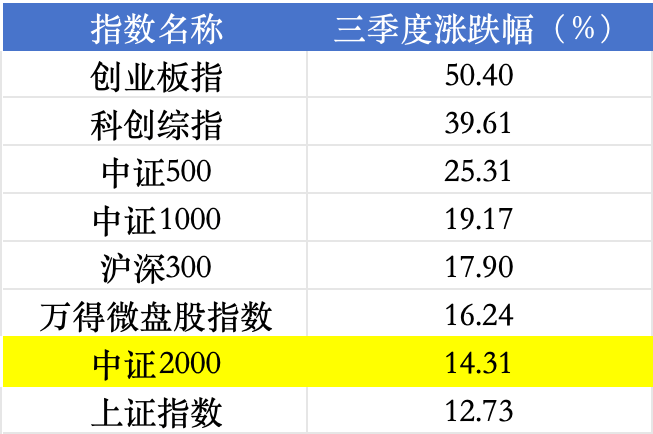
Core Insights - The three major stock indices opened higher on October 27, with the Shanghai Composite Index approaching 4000 points, indicating a positive market sentiment [1] - The CSI 2000 Enhanced ETF (159552) has seen significant inflows, accumulating 66 million over three consecutive days, suggesting a shift in investor focus towards small-cap stocks [1] - Analysts from Zheshang Securities noted that small-cap stocks are likely to outperform the broader market in November, with historical data showing strong performance in previous months [1] Performance Summary - As of October 17, the CSI 2000 Enhanced ETF (159552) achieved a one-year return of 62.67%, ranking first among 33 similar products [1][2] - In the third quarter, the CSI 2000 Index recorded a gain of 14.31%, which was relatively modest compared to other major indices [1][2] - The performance of various indices in the third quarter was as follows: - ChiNext Index: 50.40% - Sci-Tech Innovation Index: 39.61% - CSI 500: 25.31% - CSI 1000: 19.17% - CSI 300: 17.90% - Wind Micro-Cap Index: 16.24% - CSI 2000: 14.31% - Shanghai Composite Index: 12.73% [2] Fund Manager Insights - Fund manager Deng Tong highlighted a significant divergence in market styles during the third quarter, with growth styles outperforming value styles [1][2] - The performance of quantitative models was negatively impacted by the underperformance of value factors and volume-price factors, leading to a decline in excess returns in the latter half of the quarter [2] - Looking ahead, Deng Tong indicated that the main hotspots in the large-cap growth sector are concentrated in the technology sector, with external uncertainties potentially affecting market confidence [2]
策略研究框架的时代底色:极致的轮动与绝对的低波
Guohai Securities· 2025-10-25 14:39
Core Insights - The report highlights the acceleration of industry rotation in the A-share market, indicating a shift from sustained single-line trends to rapid sector changes, with the industry rotation index showing increased activity since 2023 [13][14] - It emphasizes the scarcity of fundamentally strong investment opportunities, suggesting that while growth investment remains relevant, the range of viable options has significantly narrowed compared to the past two decades [20][19] - The report identifies the importance of "crowding" and "calendar effects" as tools for navigating the current market dynamics, with a focus on how these metrics can guide investment strategies [37][38] Group 1: Industry Rotation Dynamics - The A-share market has experienced a notable increase in industry rotation speed, with the duration of dominant trends decreasing from 6-12 months in previous years to approximately 2 months in 2023 [13][14] - The report outlines that the current market environment is characterized by a blend of "extreme rotation" and "absolute low volatility," where thematic investments and stable fundamental assets coexist [4][5] - The report provides a comparative analysis of industry performance, indicating that sectors such as military, robotics, and software are expected to benefit from low crowding and catalysts in the near term [6] Group 2: Investment Strategies and Sector Focus - For active funds, the report suggests focusing on sectors with strong growth trends and catalysts, particularly in the context of the upcoming quarterly reports [6] - It recommends maintaining positions in sectors like computing power, innovative pharmaceuticals, and non-ferrous metals, while also noting the potential for increased allocations in dividend-paying sectors such as banks and home appliances as the year-end approaches [6] - The report highlights the significance of calendar effects, suggesting that both active and long-term investors may find opportunities for positioning in the market during specific periods [5][6]
传媒行业点评:从日历效应看传媒行业,当前或是布局良机
Guoxin Securities· 2025-10-24 14:20
Investment Rating - The report maintains an "Outperform" rating for the media industry [2][7]. Core Insights - The media industry exhibits significant calendar effects, particularly in February and November, which historically show high positive return probabilities. The report suggests that the current market conditions may present a good opportunity for investment [3][4][5]. - The report highlights that the media sector has experienced a notable adjustment in October, with upcoming third-quarter earnings risks expected to be released, providing a potential upward basis for the industry [4][11]. - Key drivers for the media sector's performance include the ongoing improvement in the gaming and trendy toy industries, the introduction of the "21 Regulations" in broadcasting, and the continuous advancement of AI applications [4][24]. Summary by Sections Historical Performance - From January 2008 to September 2025, the media industry has shown a monthly average return of 0.25%, with 43 positive return months, indicating a 46.24% probability of positive returns. Notably, February and November are the best-performing months [6][11]. - The gaming sub-sector has a higher average monthly return of 0.64% and a positive return probability of 44.09% [6]. Current Market Conditions - In the first half of 2025, the media sector achieved revenues of 254.9 billion and a net profit of 21.8 billion, reflecting year-on-year growth of 4.06% and 28.70%, respectively [15][22]. - The gaming sector specifically reported revenues of 27.7 billion and a net profit of 4.6 billion in Q2 2025, with year-on-year growth rates of 22.40% and 104.47% [22]. Investment Recommendations - The report recommends focusing on leading companies in the gaming and trendy toy sectors, such as Giant Network, Kaineng Network, and Jibite, as well as emphasizing AI-driven short dramas and content platforms like Mango Super Media and Bilibili [4][32]. - The report also suggests that the recent adjustments in the media sector provide a favorable opportunity for investment, particularly in AI applications and content policy shifts [4][32].