
供需双弱

Search documents
瑞达期货菜籽系产业日报-20251104
Rui Da Qi Huo· 2025-11-04 09:21
1. Report Industry Investment Rating - Not provided in the content 2. Core Viewpoints of the Report - The rapeseed meal market is in a situation of weak supply and demand. The supply is under less pressure due to import restrictions and oil - mill shutdowns, but the demand is also weakening as aquaculture demand decreases and soybean supply is relatively abundant with good substitution advantages [2]. - The rapeseed oil market is supported by the tightening supply of imported rapeseed and the de - stocking mode. However, the demand is mainly for essential needs due to the sufficient supply and good substitution advantage of soybean oil. The near - month contracts of rapeseed oil perform better than the far - month ones, and the price is in a narrow - range fluctuation, suggesting short - term observation [2]. 3. Summary According to Related Catalogs 3.1 Futures Market - The closing price of the active rapeseed oil contract is 9443 yuan/ton, down 27 yuan; the closing price of the active rapeseed meal contract is 2497 yuan/ton, up 6 yuan. The ICE rapeseed closing price is 647.6 Canadian dollars/ton, up 9.7 Canadian dollars; the closing price of the active rapeseed contract is 5130 yuan/ton, down 130 yuan [2]. - The 1 - 5 month spread of rapeseed oil is 363 yuan/ton, down 23 yuan; the 1 - 5 month spread of rapeseed meal is - 85 yuan/ton, up 8 yuan. The net long positions of the top 20 futures holders for rapeseed oil are - 3380 lots, down 5277 lots; for rapeseed meal, they are - 24967 lots, up 13261 lots [2]. - The number of rapeseed oil warehouse receipts is 7540, unchanged; the number of rapeseed meal warehouse receipts is 2955, unchanged. The main - contract positions for rapeseed oil are 213040 lots; for rapeseed meal, they are 375310 lots [2]. 3.2 Spot Market - The spot price of rapeseed oil in Jiangsu is 9770 yuan/ton, down 30 yuan; the spot price of rapeseed meal in Nantong is 2530 yuan/ton, up 10 yuan. The average price of rapeseed oil is 9887.5 yuan/ton, down 30 yuan [2]. - The import cost of rapeseed is 7969.31 yuan/ton, up 150.43 yuan. The spot price of rapeseed in Yancheng, Jiangsu is 5700 yuan/ton, unchanged. The oil - meal ratio is 3.78, down 0.03 [2]. - The basis of the rapeseed oil main contract is 327 yuan/ton, down 3 yuan; the basis of the rapeseed meal main contract is 33 yuan/ton, up 4 yuan. The spot price difference between rapeseed oil and soybean oil is 1360 yuan/ton, down 80 yuan [2]. 3.3 Substitute Spot Prices - The spot price of 24 - degree palm oil in Guangdong is 8570 yuan/ton, down 30 yuan; the spot price difference between rapeseed oil and palm oil is 1200 yuan/ton, unchanged. The spot price of soybean meal in Zhangjiagang is 3050 yuan/ton, up 10 yuan; the spot price difference between soybean meal and rapeseed meal is 520 yuan/ton, unchanged [2]. 3.4 Upstream Situation - The global rapeseed production forecast is 90.96 million tons, up 1.38 million tons; the annual rapeseed production forecast is 13446 thousand tons, up 1068 thousand tons. The total rapeseed import volume is 11.53 tons, down 13.13 tons [2]. - The crushing profit of imported rapeseed is 596 yuan/ton, down 63 yuan. The total rapeseed inventory in oil mills is 2 tons, down 1 ton; the weekly operating rate of imported rapeseed is 1.6%, down 1.33% [2]. 3.5 Industry Situation - The import volume of rapeseed oil and mustard oil is 16 tons, up 2 tons; the import volume of rapeseed meal is 15.77 tons, down 5.57 tons [2]. - The rapeseed oil inventory in coastal areas is 3.8 tons, down 0.4 tons; the rapeseed meal inventory is 0.71 tons, unchanged. The rapeseed oil inventory in the East China region is 47.8 tons, down 1.6 tons; the rapeseed meal inventory is 26.05 tons, down 0.7 tons [2]. - The rapeseed oil inventory in Guangxi is 2.4 tons, down 0.3 tons; the rapeseed meal inventory in South China is 20.7 tons, down 0.6 tons. The weekly rapeseed oil pick - up volume is 1.84 tons, up 1.49 tons; the weekly rapeseed meal pick - up volume is 0.39 tons, up 0.17 tons [2]. 3.6 Downstream Situation - The monthly output of feed is 201.5 tons; the monthly output of edible vegetable oil is 3128.7 tons, up 495 tons. The monthly retail sales of social consumer goods in the catering industry is 4508.6 billion yuan, up 12.9 billion yuan [2]. 3.7 Option Market - The implied volatility of at - the - money call options for rapeseed meal is 23.8%, up 1.31%; the implied volatility of at - the - money put options is 18.97%, down 3.52%. The 20 - day historical volatility is 25.27%, up 4.27%; the 60 - day historical volatility is 26.8%, up 1.45% [2]. - The implied volatility of at - the - money call options for rapeseed oil is 14.42%, down 0.19%; the implied volatility of at - the - money put options is 13%, down 1.6%. The 20 - day historical volatility is 13.77%, up 0.22%; the 60 - day historical volatility is 15.09%, up 0.03% [2]. 3.8 Industry News - On November 3, ICE rapeseed futures closed higher, supported by trade optimism and the spill - over effect of CBOT soybean futures. The January rapeseed futures closed 10.90 Canadian dollars higher at 647.90 Canadian dollars per ton [2]. - The US Treasury Secretary confirmed that China has agreed to purchase 12 million tons of US soybeans this season and at least 25 million tons per year in the next three years, which boosts the US soybean futures price and benefits the domestic meal market [2]. - The Canadian Prime Minister and the Chinese President's meeting in South Korea failed to make a breakthrough on rapeseed tariffs. The harvest of Canadian rapeseed is over, with a large supply and weakening exports, but an agreement with Pakistan provides additional support [2]. - GAPKI expects Indonesia's palm oil production to increase by 10% in 2025, and the B50 biodiesel plan in Indonesia is uncertain, causing concerns about long - term biodiesel demand [2].
中辉期货:螺纹钢早报-20251104
Zhong Hui Qi Huo· 2025-11-04 03:57
Report Industry Investment Ratings - **Steel Products (including Rebar and Hot Rolled Coil)**: Cautiously bearish [1][5] - **Iron Ore**: Cautiously bearish [1][7] - **Coke**: Cautiously bullish [1][10] - **Coking Coal**: Cautiously bullish [1][13] - **Ferroalloys (including Manganese Silicon and Ferrosilicon)**: Cautiously bearish [1][17] Core Views of the Report - For rebar, weekly production and apparent demand increased month - on - month, inventory continued to decline, with weak supply and demand in the off - season, and iron water production decreased significantly, and mid - term it will run in a range with potential short - term weakness [1][4][5] - For hot rolled coil, both apparent demand and production recovered, inventory decreased slightly but remained higher than the same period in previous years, and mid - term it will run in a range with potential short - term correction [1][4][5] - For iron ore, iron water production decreased significantly this week due to environmental protection and maintenance, with mills reducing inventory and ports accumulating inventory, and short - term ore prices will fluctuate weakly [1][6][7] - For coke, the second round of price increases has fully landed, and the expectation of the third round is strengthening. Although iron water production has declined, the supply - demand structure is relatively balanced, and prices will remain strong [1][9][10] - For coking coal, coal mine production and operating rates decreased slightly, supply may tighten in November, and although demand weakened marginally, the supply - demand pattern is still healthy, with prices remaining strong [1][12][13] - For manganese silicon, production area supply remains high, downstream demand weakened marginally, inventory increased, and short - term cost provides some support, but overall it's bearish [1][16][17] - For ferrosilicon, production area supply remains high, downstream demand weakened marginally, inventory increased significantly, and it's bearish due to the loose fundamentals and potential upward pressure on coal prices [1][16][17] Summary by Related Catalogs Steel Products - **Variety View**: Rebar shows weak supply - demand in the off - season with iron water production decline, and hot rolled coil has recovered demand and production but high inventory [4] - **Market Data**: Futures and spot prices of rebar and hot rolled coil mostly declined, and there were changes in basis, futures spreads, and other indicators [2] - **Operation Suggestion**: Rebar has limited upward and downward drivers, running in a mid - term range with potential short - term weakness; hot rolled coil runs in a mid - term range with potential short - term correction [5] Iron Ore - **Variety View**: This week, iron water production decreased significantly due to environmental protection and maintenance, mills reduced inventory, ports accumulated inventory, and external ore arrivals increased significantly, with a neutral - bearish static fundamentals [6] - **Operation Suggestion**: Cautiously bearish, as production cuts and supply increases put pressure on ore prices [7] Coke - **Variety View**: The second round of price increases has fully landed, the third - round expectation is strengthening, and although iron water production has declined, the supply - demand structure is relatively balanced, with some mills still replenishing inventory [9] - **Market Data**: Futures prices of coke contracts decreased slightly, and there were changes in basis, spreads, and weekly data such as inventory and production [8] - **Operation Suggestion**: Cautiously bullish [10] Coking Coal - **Variety View**: Coal mine production and operating rates decreased slightly, supply may tighten in November due to over - production checks and political instability in Mongolia, and although demand weakened marginally, the supply - demand pattern is still healthy [12] - **Market Data**: Futures prices of coking coal contracts decreased slightly, and there were changes in basis, spreads, and weekly data such as inventory and production [11] - **Operation Suggestion**: Cautiously bullish [13] Ferrosilicon and Manganese Silicon - **Variety View**: For manganese silicon, production area supply is high, downstream demand weakened marginally, and inventory increased; for ferrosilicon, production area supply remains high, downstream demand weakened marginally, and inventory increased significantly [16] - **Market Data**: Futures and spot prices of manganese silicon and ferrosilicon had different changes, and there were changes in basis, spreads, and weekly data such as production and inventory [15] - **Operation Suggestion**: For manganese silicon, cautiously bearish with short - term cost support; for ferrosilicon, bearish due to loose fundamentals and potential upward pressure on coal prices [17]
工业硅期货周报-20251028
Guo Jin Qi Huo· 2025-10-28 06:32
Report Summary 1. Report Industry Investment Rating - Not provided in the content 2. Core View - From October 20 - 24, 2025, the main contract of industrial silicon, si2601, closed at 8,920 yuan/ton, up 120 yuan/ton or 1.36% from the previous week. The trading volume was 709,000 lots, and the open interest was 186,000 lots [2] 3. Summary by Relevant Catalogs 3.1 Futures Market - **Contract Price**: The price of industrial silicon futures fluctuated strongly within the range during the week. As of Friday's close, the main contract (si2601) rose 120 yuan/ton to 8,920 yuan/ton, a 1.36% increase, with a high of 9,090 yuan/ton and a low of 8,765 yuan/ton, and an open interest of 186,000 lots [3] - **Variety Market**: Among the weekly quotes of industrial silicon futures, the contract price of industrial silicon (si2610) was the highest, and that of industrial silicon (si2511) was the lowest [3] 3.2 Spot Market - **Spot Market Condition**: From October 20 - 24, 2025, the spot price of industrial silicon remained stagnant, with the center staying at a low level. On October 23, SMM's East - China oxygen - containing 553 silicon was at 9,300 - 9,400 yuan/ton, flat week - on - week; 441 silicon was at 9,500 - 9,700 yuan/ton, down 50 yuan/ton week - on - week; 421 silicon was at 9,500 - 9,800 yuan/ton, down 50 yuan/ton week - on - week; 3303 silicon was at 10,400 - 10,600 yuan/ton, flat week - on - week [5] - **Registered Warehouse Receipts**: According to the data of the Guangzhou Futures Exchange, the registered warehouse receipts of industrial silicon this week were 48,327 lots, a decrease of 1,787 lots from last week. The short - term market was in a wait - and - see equilibrium state [5] 3.3 Influencing Factors - **Latest News**: In terms of market transactions, there were some silicon powder orders in the north during the week, and the transaction price decreased compared with the previous round. Other downstream users had strong price - pressing sentiment, and the market was dominated by low - price transactions [6] - **Supply Side**: The weekly output of industrial silicon increased slightly on a week - on - week basis. Near the end of October, most silicon plants in the southwest planned to gradually reduce production or stop production. Therefore, the output of industrial silicon next week is expected to change little on a week - on - week basis, and it will show a downward trend in November [6] - **Demand Side**: The weekly output of polysilicon decreased slightly on a week - on - week basis, reducing the consumption of industrial silicon. There were some silicon powder orders released in the northern region during the week, and the price of some concluded powder orders dropped by more than 200 yuan/ton compared with the previous round. The weekly operating rate of the silicone industry was basically stable, and a small amount of monomer production capacity under maintenance would resume production next week, with the industry's operating rate increasing slightly to around 70%. The operating rate of the aluminum alloy industry changed little, with the primary aluminum alloy sector operating steadily, while the operating rate of the recycled aluminum alloy sector was restricted by the tight supply of raw material scrap aluminum [6][7] 3.4 Market Outlook - Looking ahead, the industrial silicon market was in a "weak supply and demand" dilemma this week. The core of the market game lies in the confrontation between the rising cost in the dry season in the southwest region and the collective weakness of downstream demand. Currently, the downward space of the market is supported by cost, but the upward space is limited due to the lack of substantial improvement in the supply - demand fundamentals. It is expected that the silicon price will mainly fluctuate in the future [8]
硅业分会:本周工业硅市场陷入了“供需双弱”的困境
智通财经网· 2025-10-23 09:23
Core Insights - The industrial silicon market is currently facing a "double weakness" in supply and demand, primarily due to rising costs in the southwest region during the dry season and weak downstream demand [1][2] - The market is experiencing a downward trend with futures fluctuating and spot prices slightly declining, indicating limited upward potential due to unchanged supply-demand fundamentals [1][2] Supply Summary - Increased production in the northwest region and falling prices are offsetting the impact of reduced production and stable prices in the southwest, leading to growing inventory pressure [2] - The northwest's new production and futures warehouse delivery are putting pressure on market prices, while the north's rising transportation costs due to lower temperatures are forcing spot prices down [2] - In the southwest, production costs have significantly increased due to the approaching dry season, causing companies to halt quotes or cautiously raise prices, but the ample supply limits price rebounds [2] Demand Summary - All three major downstream industries are showing weak performance, resulting in insufficient momentum for improving industrial silicon demand [2] - The aluminum alloy market remains stable in price but lacks demand, preventing any increase in procurement [2] - The organic silicon market is struggling with low prices and companies operating at a loss, leading to significantly lower operating rates compared to historical levels and reduced stocking willingness [2] - The polysilicon market's prices remain stable, but some companies are expected to cut production in November, which will be a key factor affecting industrial silicon demand in the short term [2] Price Summary - As of October 22, the national average price for industrial silicon is reported at 9174 yuan/ton, down 33 yuan/ton from the previous week [1][3] - Specific prices for different grades include 553 at 8708 yuan/ton (down 49 yuan), 441 at 9055 yuan/ton (down 37 yuan), and 421 at 9658 yuan/ton (down 14 yuan) [3] - Regional prices show Xinjiang at 8798 yuan/ton, Yunnan at 9753 yuan/ton, and Sichuan at 9950 yuan/ton [3] Freight Summary - The freight cost from Yili to Tianjin Port is 620 yuan/ton, while from Kunming to Huangpu Port it is 350 yuan/ton [5]

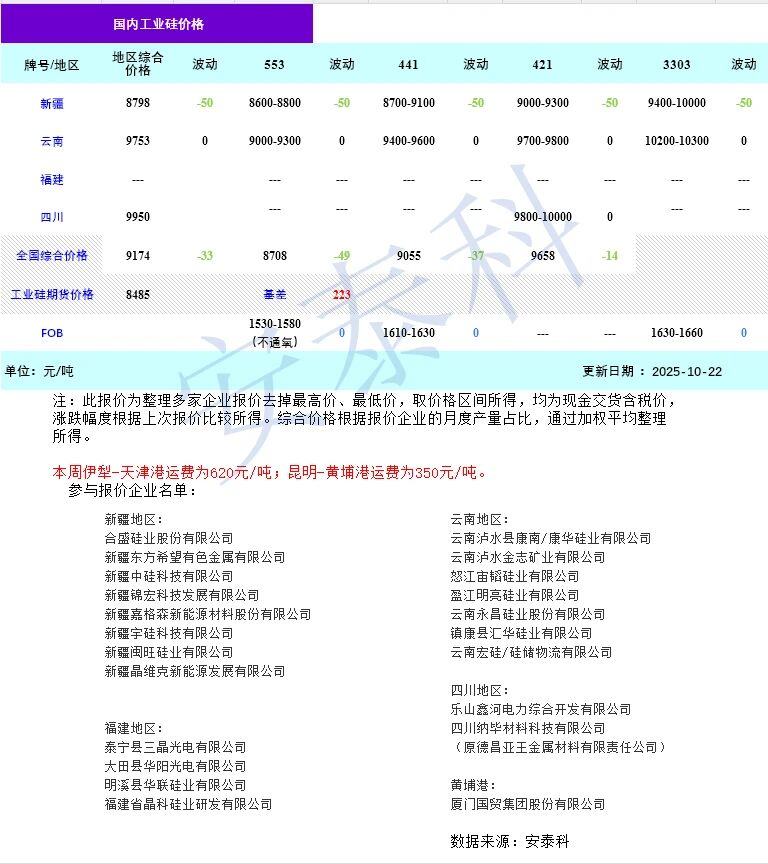
【安泰科】工业硅周评—供需双弱,期现同步承压(2025年10月22日)
中国有色金属工业协会硅业分会· 2025-10-23 09:07
Core Viewpoint - The industrial silicon market is experiencing a "futures fluctuation and slight decline in spot prices" trend, with overall supply and demand showing weakness, leading to a challenging market environment [1][2]. Supply Analysis - Increased production in the northwest region and declining prices are offsetting the impact of reduced production and stable prices in the southwest region, resulting in growing inventory pressure [2]. - The northwest region's new production and futures warehouse delivery are putting pressure on market prices, while the north region faces increased transportation costs due to lower temperatures, forcing spot prices down [2]. - In the southwest region, rising production costs due to the approaching dry season have led companies to halt quotes or cautiously raise prices, but ample supply limits price rebounds [2]. Demand Analysis - All three major downstream industries are showing weak performance, lacking momentum for improvement in industrial silicon demand [2]. - The aluminum alloy market remains stable in price but experiences weak demand, hindering incremental purchases [2]. - The organic silicon market is struggling with low prices and companies operating at a loss, resulting in significantly lower operating rates compared to historical levels and reduced willingness to stock [2]. - The polysilicon market's prices remain stable, but some companies are expected to cut production in November, leading to low purchasing intentions, with production cuts being a key short-term factor affecting industrial silicon demand [2]. Market Overview - The industrial silicon market is currently in a "dual weakness" situation regarding supply and demand, with the core market dynamics being the conflict between rising costs in the southwest region and collectively weak downstream demand [2]. - The market's downward space is supported by cost factors, while the upward potential is limited due to the lack of substantial improvement in the supply-demand fundamentals [2].
南华期货锡产业周报:窄幅震荡,短期等待入场机会-20251019
Nan Hua Qi Huo· 2025-10-19 13:41
Group 1: Report Investment Rating - No information provided Group 2: Core Views - This week, tin prices maintained a narrow - range oscillation after a pull - back from the high. The Fed officials sent dovish signals, slightly strengthening the expectation of interest rate cuts again. The gold price remained high, and market sentiment was still pessimistic. The supply side faced significant pressure due to continuous disruptions in domestic and overseas mines and ongoing maintenance of some domestic smelters. Demand in traditional consumer electronics and home appliances was weak, and the increase in emerging fields was uncertain. Overall, it was in a situation of weak supply and demand. Affected by macro - upward drivers and a large proportion of mine - end disturbances, tin is still regarded as a long - position asset. In the short term, enter the market on dips [2] Group 3: Summary by Directory Chapter 1: Core Contradictions and Strategy Recommendations 1.1 Core Contradictions - Tin prices oscillated narrowly after a pull - back from the high. Macro factors included dovish Fed signals and strengthened interest - rate cut expectations, with high gold prices and pessimistic market sentiment. On the fundamental side, there were continuous disturbances in mines at home and abroad and maintenance of some domestic smelters, leading to supply - side pressure. Demand in traditional sectors was weak, and the increase in emerging fields was uncertain. Tin is considered a long - position asset, and short - term dip - buying is recommended [2] 1.3 Industrial Customer Operation Recommendations - **Price Volatility and Forecast**: The latest closing price of Shanghai tin is 280,750 yuan/ton, the monthly price range forecast is 265,000 - 290,000 yuan/ton, the current volatility is 19.31%, and the historical percentile of the current volatility is 49.6% [18] - **Risk Management Strategies**: For inventory management with high finished - product inventory and fear of price drops, sell 75% of Shanghai tin's main futures contract at around 288,000 yuan/ton and sell 25% of call options (SN2511C290000) when volatility is appropriate. For raw - material management with low raw - material inventory and fear of price increases, buy 50% of Shanghai tin's main futures contract at around 277,000 yuan/ton and sell 25% of put options (SN2511P270000) when volatility is appropriate [21] - **Import Profit and Loss and Processing Fees**: The tin import profit and loss is - 14,530.35 yuan/ton, with a weekly change of 4,721.03 yuan and a weekly decline of 24.52%. The 40% tin ore processing fee is 12,200 yuan/ton with no change, and the 60% tin ore processing fee is 10,050 yuan/ton with no change [21] Chapter 2: This Week's Important Information and Next Week's Attention Events 2.1 This Week's Important Information - **Positive Information**: The US government shutdown has lasted for over half a month. On October 16, the US Senate's tenth vote on the temporary appropriation bill still failed to pass, and there is no sign of the shutdown ending in the short term [22] - **Negative Information**: Alphamin Resources increased its annual tin production forecast to 18,000 - 18,500 tons, with a 26.4% increase in the third - quarter output compared to the previous quarter and a 5.6% increase compared to the same period last year. The Indonesian president transferred six seized tin smelters to a state - owned enterprise. Cornish Metals plans to produce 49,000 tons of tin, 3,800 tons of copper, and 3,200 tons of zinc annually, with production expected to start in mid - 2028. Nathan Trotter started the construction of a secondary tin smelter in the US with an investment of $65 million [23][24][25] - **Spot Transaction Information**: The Shanghai Non - Ferrous tin ingot price is 281,000 yuan/ton, down 2.23% week - on - week. The 1 tin premium is 400 yuan/ton, up 60% week - on - week. The 40% tin concentrate price is 269,000 yuan/ton, down 2.32% week - on - week, and the 60% tin concentrate price is 273,000 yuan/ton, down 2.29% week - on - week. The prices of 60A and 63A solder bars also decreased [24] 2.2 Next Week's Important Events to Watch - China's Q3 GDP annual rate and the US September unadjusted CPI annual rate will be announced [27] Chapter 3: Market Interpretation 3.1 Price - Volume and Capital Interpretation - **Futures Price and Change**: The latest price of the Shanghai tin main contract is 280,750 yuan/ton, down 1.96% week - on - week; the Shanghai tin continuous - one contract is 281,180 yuan/ton, down 1.81% week - on - week; the Shanghai tin continuous - three contract is 281,350 yuan/ton, down 1.81% week - on - week; the LME tin 3M is $35,030/ton, down 0.91% week - on - week; the Shanghai - London ratio is 7.87, up 1.94% week - on - week [27] - **Inventory and Change**: The Shanghai tin warehouse receipts total 5,652 tons, down 2.7% week - on - week; the Shanghai tin inventory is 5,879 tons, down 8.55% week - on - week; the LME tin registered warehouse receipts are 2,505 tons, up 15.44% week - on - week; the LME tin cancelled warehouse receipts are 230 tons, down 4.17% week - on - week; the LME tin inventory is 2,575 tons, up 7.74% week - on - week; the social inventory is 9,644 tons, down 1.13% week - on - week [28] - **Domestic Market**: Tin prices oscillated narrowly this week, closing at 280,700 yuan/ton. Profitable positions were mainly long in net positions. The domestic basis and monthly - spread structure were stable, and the Shanghai tin term structure maintained a C - structure. The LME tin term structure maintained a B - structure, and the forward trading volume was small. The domestic - foreign spread was stable and oscillated narrowly [29][31][35] Chapter 4: Valuation and Profit Analysis 4.1 Upstream and Downstream Profit Tracking in the Industry Chain - Yunnan's tin ore processing fees have been hovering at historical lows, suppressing smelters' profits and production willingness [38] 4.2 Import and Export Profit Tracking - No specific profit - tracking content is summarized, mainly presenting import volume seasonal charts of Chinese tin ore and unforged non - alloy tin [40][41] Chapter 5: Supply - Demand and Inventory Deduction 5.1 Supply - Side and Deduction - Mine - end disturbances and smelter losses have brought significant pressure to the supply side [42] 5.2 Demand - Side and Deduction - No specific demand - side deduction content is summarized, mainly presenting seasonal charts of China's refined tin production, domestic recycled refined tin monthly production, SMM tin solder enterprise monthly starting rate, and tin ingot monthly apparent consumption [48][49]
近期菜粕供需形势分析
Qi Huo Ri Bao· 2025-10-17 03:41
Core Viewpoint - The reduction in imported canola seed from Canada due to anti-dumping investigations has significantly impacted China's canola seed imports, leading to low domestic crushing volumes and a potential shift in supply dynamics for canola meal and oil [1][4]. Group 1: Impact of Anti-Dumping Investigation - China's imports of canola seed have sharply decreased, with no imports expected in October and November, and only one shipment of 65,000 tons anticipated in December [1]. - The anti-dumping investigation has led to a theoretical profit margin exceeding 1,000 yuan for importing Canadian canola seeds, but the overall international canola prices are under pressure due to increased supply from new harvests [1][5]. - The relationship between China and Canada shows signs of improvement, which could lead to a potential cancellation of the anti-dumping investigation if trade conditions change [2]. Group 2: Supply and Demand Dynamics - From January to August, China imported 2.33 million tons of canola seed, a decrease from 3.42 million tons in the same period last year, with a significant drop in imports from Canada [3]. - The import of canola meal has not declined despite the reduction in canola seed imports, with a notable increase in imports from Dubai and India [4]. - The domestic demand for canola meal is expected to remain stable, with the supply being sufficient to meet the needs despite the seasonal decline in consumption during the fourth quarter [4]. Group 3: International Market Trends - The USDA forecasts a global canola seed production of 89.54 million tons for the 2025/2026 season, which is a slight decrease from previous estimates but still represents a historical high [5]. - International canola prices are under pressure, particularly for Canadian canola, which is experiencing a more significant price drop compared to other major producing regions [5].
供需双弱持续,纯苯苯乙烯延续偏弱走势
Tong Hui Qi Huo· 2025-10-16 06:25
Group 1: Report Title and Date - Energy Chemicals Pure Benzene & Styrene Daily Report, published on October 16, 2025 [1] Group 2: Daily Market Summary - Fundamentals - On October 15, the main styrene contract closed down 0.06% at 6,540 yuan/ton, with a basis of 0 (-41 yuan/ton); the main pure benzene contract closed down 0.32% at 5,579 yuan/ton [2] - On October 15, Brent crude closed at $58.7 per barrel (-$0.8 per barrel), and WTI crude closed at $62.4 per barrel (-$0.9 per barrel). The spot price of pure benzene in East China was 5,590 yuan/ton (-35 yuan/ton) [2] - Styrene port inventory was 19.7 tons (-0.5 tons), a 2.7% decline; pure benzene port inventory was 9.1 tons (-1.5 tons), a 14.2% decline [2] - Styrene maintenance units started to resume, with the production rate and supply increasing month-on-month. Currently, the weekly styrene output is 34.8 tons (+1.1 tons), and the factory capacity utilization rate is 73.6% (+2.4%) [2] - The operating rates of downstream 3S varied, with overall demand weakening. The EPS capacity utilization rate was 40.7% (-2.4%), the ABS capacity utilization rate was 72.5% (+1.5%), and the PS capacity utilization rate was 54.6% (-1.7%) [2] Group 3: Daily Market Summary - Views - Pure benzene: On the supply side, the operating rate of petroleum benzene units increased slightly, and the load of hydrobenzene units decreased slightly but had limited impact. Overall, the pure benzene output increased slightly month-on-month. On the demand side, the operating rates of downstream styrene, caprolactam, aniline, and adipic acid units increased to varying degrees, and phenol remained stable, driving the overall weighted operating rate of downstream products to increase month-on-month. However, the recovery of terminal demand was still insufficient. The inventory at East China ports continued to decline slightly, although it was still at a relatively high level. Affected by the weakening of international oil prices and the pressure on downstream product prices, the processing profit of petroleum benzene remained in a low range. Looking ahead to this week, some petroleum benzene and hydrobenzene units are planned to restart, and the supply of pure benzene may continue to increase. In October, new styrene, caprolactam, and phenol units are about to be put into operation, and although the calculated demand has increased, due to styrene maintenance and the reduction of some downstream loads, the overall boost is limited. The external oil price dropped significantly due to the US plan to impose tariffs, weakening the cost support. In the short term, pure benzene may continue to fluctuate weakly [2] - Styrene: On the supply side, two units of Zhejiang Petrochemical restarted, and the load of some units in South China increased, resulting in a month-on-month increase in overall output. On the demand side, the operating rates of EPS, PS, and ABS units decreased, terminal consumption continued to be weak, and spot transactions were light. The inventory at factories and ports continued to decline month-on-month, but the high-level pressure had not been fully released. Affected by the decline in the prices of pure benzene and ethylene, the non-integrated cost decreased, and the profit repair was limited. In the short term, the shutdown and maintenance of units at Jingbosidarei, Anhui Jiaxi, and Guangzhou Petrochemical will partially offset the increase from the restart of Zhejiang Petrochemical, and the capacity utilization rate may increase slightly this week. In October, about 1.2 million tons of new styrene production capacity is still planned to be put into operation, while new downstream EPS, PS, and ABS units are concentrated in November - December, and the supply-demand mismatch may further intensify. The downstream profit is low, and the finished product inventory is high, limiting the demand recovery. Affected by the expectation of US tariff increases, international oil prices weakened, and the cost-side support weakened. In the short term, styrene may continue to fluctuate weakly [2] Group 4: Industrial Chain Data Monitoring - Prices - From October 13 to 14, 2025, the main styrene futures contract decreased from 6,690.0 to 6,544.0 yuan/ton, a 2.18% decline; the styrene spot price remained unchanged at 7,020.0 yuan/ton; the styrene basis increased from 15.0 to 41.0 yuan/ton, a 173.33% increase [4] - The main pure benzene futures contract decreased from 5,682.0 to 5,597.0 yuan/ton, a 1.50% decline; the pure benzene price in East China decreased from 5,710.0 to 5,625.0 yuan/ton, a 1.49% decline; the FOB price of pure benzene in South Korea decreased from 689.6 to 673.0 dollars/ton, a 2.41% decline; the FOB price of pure benzene in the US decreased from 759.6 to 747.5 dollars/ton, a 1.59% decline; the CFR price of pure benzene in China decreased from 703.1 to 688.0 dollars/ton, a 2.15% decline [4] - The spread between domestic pure benzene and CFR increased from -317.9 to -276.2 yuan/ton, a 13.11% increase; the spread between pure benzene in East China and Shandong decreased from -190.0 to -225.0 yuan/ton, an 18.42% decline [4] - Brent crude increased from 58.9 to 59.5 dollars/ton, a 1.00% increase; WTI crude increased from 62.7 to 63.3 dollars/ton, a 0.94% increase; naphtha remained unchanged at 7,411.5 yuan/ton [4] Group 5: Industrial Chain Data Monitoring - Production and Inventory - From October 3 to 10, 2025, the styrene production in China increased from 33.6 to 34.8 tons, a 3.32% increase; the pure benzene production in China increased from 45.7 to 46.0 tons, a 0.70% increase [5] - The styrene port inventory in Jiangsu increased from 19.8 to 20.2 tons, a 2.23% increase; the domestic styrene factory inventory decreased from 20.3 to 19.4 tons, a 4.63% decline; the national pure benzene port inventory decreased from 10.6 to 9.1 tons, a 14.15% decline [5] Group 6: Industrial Chain Data Monitoring - Operating Rates - From October 3 to 10, 2025, the capacity utilization rate of styrene among pure benzene downstream increased from 71.2% to 73.6%, a 2.37% increase; the capacity utilization rate of caprolactam remained unchanged at 96.0%; the capacity utilization rate of phenol decreased from 78.7% to 78.3%, a 0.34% decline; the capacity utilization rate of aniline increased from 76.0% to 77.2%, a 1.12% increase [6] - Among styrene downstream, the EPS capacity utilization rate decreased from 43.1% to 40.7%, a 2.37% decline; the ABS capacity utilization rate increased from 71.0% to 72.5%, a 1.50% increase; the PS capacity utilization rate decreased from 56.3% to 54.6%, a 1.70% decline [6] Group 7: Industry News - OPEC+ production in September increased by 400,000 barrels per day month-on-month, with Saudi Arabia contributing an increase of 320,000 barrels per day. After the resumption of oil exports from the Iraqi Kurdistan region, production in October may further recover [7] - US refineries entered autumn maintenance, and refined oil demand declined seasonally. EIA data showed that US crude oil inventories increased by 3.7 million barrels last week, exceeding expectations [7] - Israel and Hamas reached a ceasefire agreement, the tense situation in the Middle East eased, and the geopolitical premium of crude oil continued to subside [7] Group 8: Industrial Chain Data Charts - The report includes charts on pure benzene price, styrene price, styrene - pure benzene spread, SM import pure benzene cost vs. domestic pure benzene cost, styrene port inventory, styrene factory inventory, pure benzene port inventory, ABS inventory, aniline weekly capacity utilization rate, caprolactam weekly capacity utilization rate, and phenol weekly capacity utilization rate [8][12][15]
华宝期货晨报铝锭-20251015
Hua Bao Qi Huo· 2025-10-15 03:13
Report Summary 1) Report Industry Investment Rating No specific industry investment rating is provided in the given content. 2) Core Views - For building materials (成材): Expected to move in a range with a downward - shifting center of gravity, and run in a weak and volatile manner. The market is in a situation of weak supply and demand, with pessimistic market sentiment, and this year's winter storage is sluggish, providing little price support. The view is for volatile consolidation [1][3]. - For aluminum ingots: The price is expected to run in a short - term range. In the short term, the fundamentals are stable, but macro - overseas interference events repeatedly affect market sentiment. The price is currently in a high - level shock, and future attention should be paid to the inventory - consumption trend [4]. 3) Summary by Related Catalogs Building Materials - Production suspension impact: Yunnan - Guizhou short - process building steel enterprises' production suspension during the Spring Festival is expected to affect a total of 741,000 tons of building steel production. In Anhui, 1 out of 6 short - process steel mills stopped production on January 5, and most of the rest will stop production around mid - January, with a daily production impact of about 16,200 tons during the suspension period [2][3]. - Real estate transaction data: From December 30, 2024, to January 5, 2025, the total transaction (signing) area of newly - built commercial housing in 10 key cities was 2.234 million square meters, a 40.3% decrease from the previous period and a 43.2% increase year - on - year [3]. - Market situation: The price continued to decline in a volatile manner yesterday, reaching a new low recently. The market is in a situation of weak supply and demand, with no significant highlights in the near term, and this year's winter storage is sluggish, providing little support for prices [3]. - Later focus: Macro - policies and downstream demand [3]. Aluminum - Supply - side situation: After entering October, due to the peak season of downstream processed materials demand, the proportion of direct aluminum water supply is expected to increase, resulting in low aluminum ingot production and reduced market supply, which supports the aluminum price [3]. - Demand - side situation: In early October, the overall performance of the aluminum processing industry was in line with seasonal characteristics, but there was obvious internal differentiation. The overall industry showed resilience, but the "Golden September and Silver October" in the demand side was lackluster, and the high aluminum price and order differentiation restricted the short - term upward space of the operating rate. High prices will gradually suppress downstream purchasing, leading to a marginal weakening of demand and limiting the upward space of aluminum prices [3]. - Inventory data: On October 13, the inventory of electrolytic aluminum ingots in domestic mainstream consumption areas was 650,000 tons, an increase of 1,000 tons from last Thursday and 58,000 tons from last Monday [3]. - Later focus: Macro - expectations, geopolitical crises, mine resumption, and consumption release [4].
宝城期货螺纹钢早报(2025年10月15日)-20251015
Bao Cheng Qi Huo· 2025-10-15 01:45
Report Summary 1) Industry Investment Rating - No industry investment rating is provided in the report. 2) Core Viewpoint - The steel price of rebar is expected to continue the trend of oscillating to find the bottom, and attention should be paid to the demand performance. The industrial contradictions are accumulating, and the steel price is oscillating to find the bottom. The rebar 2601 is expected to be weak in the short - term and intraday, and oscillating in the medium - term, and attention should be paid to the pressure at the MA5 line [1][2]. 3) Summary by Related Contents a. Variety Viewpoint Reference - For rebar 2601, the short - term view is weakly oscillating, the medium - term view is oscillating, and the intraday view is weakly oscillating. The reference is to pay attention to the pressure at the MA5 line. The core logic is the accumulation of industrial contradictions and the steel price oscillating to find the bottom. The time - cycle definitions are: short - term is within one week, and medium - term is from two weeks to one month. The definitions of price trends are: for varieties with night trading, the starting price is the night - trading closing price, and for those without, it's the previous day's closing price, with the day - trading closing price as the end price; a decline greater than 1% is a fall, a decline of 0 - 1% is weakly oscillating, a rise of 0 - 1% is strongly oscillating, and a rise greater than 1% is an increase. The strong/weak oscillation only applies to intraday views [1]. b. Market Driving Logic - Rebar shows a pattern of weak supply and demand. The production of construction steel mills is weakening, with output continuously falling to a relatively low level, but inventory is high, and the motivation for production reduction during the peak season is not strong, so the positive effect on the supply side is limited. Meanwhile, affected by holidays, the demand is weak, the downstream situation has not improved, and the peak - season performance is expected to be poor. The weak demand is pressuring the steel price. Currently, the fundamentals of rebar are running weakly, industrial contradictions are continuously accumulating, and there is great pressure to reduce inventory under weak demand, so the steel price continues to be under pressure. The relatively positive factor is cost support [2].