通胀预期

Search documents
【资产配置快评】2025年第35期:Riders on the Charts,每周大类资产配置图表精粹-20250805
Huachuang Securities· 2025-08-05 09:00
Employment Data Insights - In July, the U.S. non-farm payroll increased by 74,000, falling short of the expected 110,000[4] - The non-farm payroll figures for May and June were significantly revised down, with May's figure adjusted from 144,000 to 19,000 and June's from 147,000 to 14,000[4] - The unemployment rate remained stable at 4.2% from May to July, while hourly wages increased year-on-year from 3.8% to 3.9%[4] Data Quality Concerns - The response rate for employment data surveys has declined, with May's non-farm payroll survey response rate at 42.9%, down from 59% pre-pandemic[5] - The response rate for unemployment rate surveys was 67.4%, compared to 82.3% before the pandemic[5] Federal Reserve Insights - The number of dissenting votes in the July Federal Reserve meeting reached the highest level in 32 years, with two members opposing the decision to keep interest rates unchanged[10] - The overall sentiment remains cautious regarding inflation, with concerns about high tariffs impacting inflation levels[12] Market Expectations - Despite disappointing employment data, investor expectations for short-term inflation remain upward, with the 2-year inflation swap dropping from 3% to 2.9%[16] - The broad dollar speculative net short positions decreased to 20,000 contracts, the lowest level since April, reflecting a reduction of over 50% from five weeks prior[12] Equity Risk Premium - As of August 1, the equity risk premium (ERP) for the CSI 300 index was 5.2%, which is significantly below the 16-year average by more than one standard deviation, indicating potential for valuation uplift[17] Bond Market Insights - The forward arbitrage return for China's 10-year government bonds was 18 basis points as of August 1, which is 48 basis points higher than the level in December 2016[22] - The 3-month dollar-yen basis swap was at -19.4 basis points, indicating a more relaxed offshore dollar financing environment[24] Commodity Indicators - The copper-gold price ratio fell to 2.9, while the offshore RMB exchange rate rose to 7.2, indicating a divergence in signals between RMB and copper trends[29] Stock vs. Bond Performance - The total return ratio of domestic stocks to bonds was 24.9 as of August 1, which is below the average level over the past 16 years, suggesting a return to mean performance between equities and fixed income[31]
7月全球投资十大主线
一瑜中的· 2025-08-05 08:47
Core Viewpoint - The global asset performance in July shows that the US dollar leads with a return of 3.19%, followed by commodities at 2.00%, global stocks at 1.30%, and the Chinese yuan at -0.50%, with global bonds declining by 1.49% [2] Group 1: Global Asset Trends - The liquidity of Japanese government bonds has deteriorated beyond the levels seen during the 2008 financial crisis, with the Bloomberg Japan Government Bond Liquidity Index surpassing the post-Lehman Brothers bankruptcy levels [4][10] - There is a divergence in the performance of cyclical stocks versus defensive stocks in the US market, closely linked to forward swap rates tied to interest rates, indicating optimism among investors regarding sustained high interest rates [12] - The relative performance of MSCI Japan bank stocks is highly correlated with the 10-year Japanese government bond yield, benefiting from rising inflation expectations [5][15] Group 2: Fund Manager Allocations - Global fund managers have increased their allocation to technology to the highest level since March 2009, while reducing positions in cash, consumer staples, banks, emerging markets, and commodities [18] - Emerging market sovereign debt has seen its yield spread over US Treasuries narrow to a 15-year low, reducing the attractiveness of this strategy despite strong performance earlier in the year [24][21] Group 3: Economic Indicators - The relative performance of European consumer staples has diverged from the gold-to-copper ratio since 2024, indicating a weakening relationship between macroeconomic conditions and defensive sectors [28] - The relative price-to-earnings ratio of European and US stock indices is closely related to the uncertainty of economic policies in both regions, with European valuations rising as US policy uncertainty increases [31] Group 4: Interest Rate Dynamics - The interest rate swap spread between China's 5-year and 1-year rates has turned positive for the first time in seven months, reflecting confidence in long-term inflation due to domestic policies and infrastructure projects [35] - The South African stock index has closely followed gold prices, with a cumulative increase of approximately 19% since 2025, outperforming other emerging market indices [38] Group 5: Market Sentiment - The volume of bullish options on the SPDR US Dollar ETF has been declining, suggesting a potential softening of the dollar, as indicated by the falling risk reversal options [41]


每周大类资产配置图表精粹-20250805
Huachuang Securities· 2025-08-05 03:45
Employment Data Insights - July non-farm employment increased by 74,000, below the expected 110,000[4] - The unemployment rate remained stable at 4.2% from May to July, with hourly wages rising from 3.8% to 3.9% year-on-year[4] - Survey response rates for employment data have declined significantly, with May's response rate at 42.9%, down from 59% pre-pandemic[7] Federal Reserve Insights - The number of dissenting votes in the July Federal Reserve meeting reached the highest level in 32 years, with two members opposing the decision to maintain interest rates[10] - Speculative net short positions on the broad dollar fell to 20,000 contracts, the lowest level in four months, indicating reduced bearish sentiment[13] Inflation Expectations - Despite disappointing employment data, short-term inflation expectations remain elevated, with the 2-year CPI swap dropping from 3% to 2.9%[16] - The 5-year CPI swap also decreased from 2.7% to 2.6%, aligning with June's CPI year-on-year figure of 2.7%[16] Market Valuation Metrics - The equity risk premium (ERP) for the CSI 300 index is currently at 5.2%, which is one standard deviation above the 16-year average, suggesting potential for valuation uplift[19] - The forward arbitrage return on China's 10-year government bonds is 18 basis points, up 48 basis points from December 2016 levels[22] Currency and Commodity Trends - The 3-month USD/JPY basis swap is at -19.4 basis points, indicating a higher cost of dollar financing for offshore institutions[25] - The copper-to-gold price ratio has decreased to 2.9, while the offshore RMB exchange rate has risen to 7.2, indicating diverging trends in demand and currency valuation[28] Stock and Bond Performance - The total return ratio of domestic stocks to bonds is at 24.9, below the 16-year average, suggesting a return to mean levels and increasing attractiveness of equities relative to fixed income[30]
篡改经济数据?市场反噬终将让特朗普自食苦果
智通财经网· 2025-08-05 03:32
Group 1 - The article discusses Trump's attempts to manipulate economic data to present a more favorable view of the economy, which could backfire and damage his presidency more than any real data would [1][2] - The latest employment report shows a significant slowdown in hiring, leading to the dismissal of the BLS chief economist by Trump, who accused the agency of "manipulating" employment data [1][2] - The BLS's employment survey quality has been questioned, with budget cuts and complex methodologies increasing the probability of errors, but data revisions are meant to enhance accuracy [1][2] Group 2 - Trump's administration is seen as trying to control government agencies, including those that should operate independently, to produce favorable economic statistics [2] - The article highlights the potential for adverse economic data to emerge as tariffs and immigration policies continue to negatively impact the economy [2][3] - The bond market is signaling concerns about the "Trump economy," with a risk premium indicating investor fears about future inflation and policy uncertainty [3][4] Group 3 - Even if Trump successfully pressures the Federal Reserve to lower interest rates, long-term rates may rise due to increased inflation expectations, contradicting his goals [4] - The manipulation of economic data could exacerbate market uncertainty and increase risk premiums, potentially leading to significantly higher mortgage rates [4] - The article suggests that the real issue for the American public is the perception of economic mismanagement and a sense of lost prosperity, rather than the potential for recession [5]
洪灏:牛市的逻辑
2025-08-05 03:15
Summary of Key Points from Conference Call Industry or Company Involved - The discussion primarily revolves around the macroeconomic strategies and market conditions in the United States and China, with a focus on the implications for various asset classes, including equities and commodities. Core Insights and Arguments 1. **US-China Trade Relations**: The recent US-China trade talks in Stockholm were constructive, with both sides agreeing to extend discussions on tariffs and countermeasures for 90 days, indicating a potential easing of trade tensions [1] 2. **US Economic Expansion**: The US economy has been expanding for 63 consecutive months, avoiding recession, but the growth rate has been declining over the decades, currently averaging around 2% [2] 3. **Labor Productivity and AI**: The US labor productivity cycle appears to be at a low point but is expected to improve due to the ongoing AI revolution, which could increase demand for precious metals [2] 4. **Market Speculation**: There are signs of increased speculation in the US market, with a surge in penny stocks and call options, indicating a potential market top [3] 5. **Dollar Dynamics**: The relationship between the US dollar and long-term inflation expectations has changed since the Fed's rapid interest rate hikes began in 2021, with the dollar now seen as a high-yield investment rather than just a currency [6] 6. **China's Economic Outlook**: China's economy performed better than expected in the first half of the year, but there are concerns about growth pressures in the second half, leading to increased government spending and subsidies [7] 7. **Commodity Prices**: Upstream commodity prices are rising, although recent corrections may be due to regulatory guidance to prevent excessive price increases [7] 8. **Inflation Transmission**: Historical data shows that changes in upstream inflation eventually affect downstream consumer prices, indicating that expectations, rather than current prices, drive market behavior [8] 9. **Stock Market Performance**: If deflationary expectations are curbed, it could positively impact stock market performance, as upstream price increases lead to improved profit margins across the capital market [10] 10. **Market Sentiment and Strategy**: There is a prevailing market sentiment that the state may reduce holdings if the index exceeds 3500, but this logic may not hold if the market continues to rise [12] Other Important but Potentially Overlooked Content - The analysis suggests that the current market conditions are characterized by high liquidity, which may support continued market activity despite signs of overbought conditions [12] - The discussion emphasizes the importance of changing expectations in the market, which can lead to shifts in demand and price levels, rather than just focusing on current price movements [8]
【宏观月报】7月全球投资十大主线-20250804
Huachuang Securities· 2025-08-04 15:10
Group 1: Macroeconomic Insights - Japan's government bond liquidity has deteriorated beyond the levels seen during the 2008 financial crisis, with the Bloomberg Japan government bond liquidity index surpassing the post-Lehman Brothers bankruptcy levels[2] - The relative performance of U.S. cyclical stocks versus defensive stocks is closely tied to forward swap rates linked to interest rates, indicating market optimism about sustained high rates despite expectations of Fed rate cuts[5] - The relative performance of MSCI Japan bank stocks is highly correlated with the 10-year Japanese government bond yield, benefiting from rising inflation expectations in Japan[5] Group 2: Investment Trends - Global fund managers have increased their allocation to technology stocks, reaching the highest level since March 2009, while reducing positions in cash and consumer staples[6] - Emerging market sovereign debt and U.S. Treasury yield spreads have narrowed to a 15-year low, reducing the attractiveness of emerging market debt strategies[6] - The relative performance of European consumer staples has diverged from the gold-to-copper ratio since 2024, indicating a weakening relationship with macroeconomic conditions[7] Group 3: Market Dynamics - The relative P/E ratios of U.S. and European stock indices are closely linked to the uncertainty of economic policies, with European valuations rising as U.S. policy uncertainty increases[9] - China's 5-year and 1-year interest rate swap spread turned positive in July 2025, reflecting increased investor confidence in inflation due to domestic policies and infrastructure projects[8] - The South African stock index has risen approximately 19% since 2025, driven by increasing gold and platinum prices, outperforming other emerging market indices[13] Group 4: Sentiment and Risk - The SPDR U.S. Dollar ETF's call option volume has been declining, suggesting limited upward momentum for the dollar index in the near future[13] - A significant portion of fund managers (38%) view global trade conflicts as the biggest tail risk, with "shorting the U.S. dollar" identified as the most crowded trade[6]
资金跟踪系列之五:市场热度维持阶段高位,两融活跃度续创年内新高
SINOLINK SECURITIES· 2025-08-04 13:25
Group 1: Macroeconomic Liquidity - The US dollar index has rebounded, and the degree of inversion in the China-US interest rate spread has narrowed, with inflation expectations also declining [1][12] - Offshore US dollar liquidity remains generally loose, while the domestic interbank funding environment is balanced and slightly loose, with the yield curve spread (10Y-1Y) narrowing [1][20] Group 2: Market Trading Activity - Overall market trading activity has slightly decreased but remains at a high level since March, with trading heat in sectors such as pharmaceuticals, steel, construction, consumer services, military, and communications above the 80th percentile [2][27] - Major indices have seen a decline in volatility, with most sectors' volatility below the 50th historical percentile [2][33] Group 3: Analyst Predictions - Analysts have simultaneously lowered the net profit forecasts for the entire A-share market for 2025/2026, with specific sectors such as electric power and utilities, non-ferrous metals, pharmaceuticals, and real estate seeing upward adjustments in their profit forecasts [3][51] - The net profit forecasts for the ChiNext Index and CSI 500 for 2025/2026 have been raised, while those for the Shanghai 50 and CSI 300 have been lowered [3][51] Group 4: Northbound Trading Activity - Northbound trading activity has increased, but there has been an overall net sell-off in A-shares, with a rise in the buy/sell ratio in sectors like pharmaceuticals, communications, and computers [5][31] - For stocks with Northbound holdings below 30 million shares, there has been a net buy in electronics, pharmaceuticals, and electric new energy sectors, while net selling occurred in food and beverage, agriculture, and public utilities [5][33] Group 5: Margin Financing Activity - Margin financing activity has reached a new high for the year, with a net buy of 32.458 billion yuan, primarily in pharmaceuticals, electronics, and computers, while sectors like non-ferrous metals and coal saw net selling [6][11] - The proportion of financing purchases in sectors such as communications, media, and transportation has increased [6][38] Group 6: Fund Activity - Active equity funds have increased their positions, particularly in communications, military, and steel sectors, while ETFs have experienced overall net redemptions [8][45] - The correlation between active equity funds and large/mid-cap growth/value indices has risen, indicating a shift in investment strategies [8][48]
逆势而为?英国央行或将降息,但通胀已“蠢蠢欲动”
Jin Shi Shu Ju· 2025-08-04 09:27
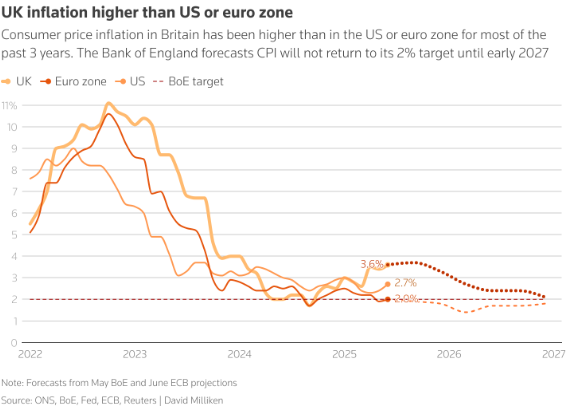
Group 1 - The Bank of England is expected to lower its key interest rate from 4.25% to 4% this Thursday, with further cuts anticipated by the end of the year, despite rising inflation concerns [2] - UK inflation surged to a peak of 11.1% post-Russia-Ukraine conflict, significantly higher than the Eurozone or the US, primarily due to reliance on natural gas for heating and electricity [2] - Inflation rates in the UK are projected to decline significantly, reaching a low of 1.7% by September 2024, but are expected to rebound faster than in the US or Eurozone [2] Group 2 - Inflation expectations in the UK have risen, with long-term inflation indicators nearing their highest levels since late 2022, reflecting concerns about future price increases and wage demands [5] - Despite a significant drop in overall consumer inflation in 2023, key components used to measure long-term domestic price pressures have not decreased similarly [8] - Service sector price inflation is heavily influenced by rising labor costs, and food and beverage prices are also experiencing a rapid increase, impacting public perception of inflation, especially among poorer demographics [9][12] Group 3 - Private sector annual wage growth is slightly below 5%, down from over 8% two years ago, but still above pre-pandemic levels, indicating persistent inflationary pressures [13] - Wage growth is expected to slow to around 3% over the next 18 months, which could exert downward pressure on inflation [13][15] - The July Purchasing Managers' Index (PMI) indicates strong pricing pressures, with significant cost increases reported by service and manufacturing sectors, suggesting potential upward pressure on consumer prices [16][19]
【策略周报】全球市场震荡,是忧还是机?
华宝财富魔方· 2025-08-03 13:59
01 重要事件回顾 1、中国商务部国际贸易谈判代表兼副部长李成钢29日晚在瑞典斯德哥尔摩说,根据中 美新一轮经贸会谈共识,双方将继续推动已暂停的美方对等关税24%部分以及中方反制 措施如期展期。 8、美国7月就业增长超预期放缓,美国7月季调后非农就业人口录得7.3万人,远低于市 场预期的11万人。同时前月数据被大幅下修,显示劳动力市场显著降温。 2、7月30日,中共中央政治局召开会议,分析研究当前经济形势和经济工作。会议重申 稳中求进的工作总基调,延续了4月政治局会议中"加紧实施更加积极有为的宏观政策"的 表述。货币政策适度宽松取向不变,但未提及降准降息。会议指出,依法依规治理企业 无序竞争。推进重点行业产能治理。规范地方招商引资行为。坚持"两个毫不动摇",激 发各类经营主体活力。 3、7月30日,美联储如期按兵不动,将联邦基金利率目标区间维持在4.25%至4.50%。 这是美联储连续第五次在货币政策会议上决定暂停降息。鲍威尔在最新一轮货币政策会 议后的新闻发布会上表示,美联储尚未就9月利率做出任何决定。 4、7月30日,美国经济分析局公布2025年二季度GDP数据初值:二季度实际GDP年化 季率初值+3.0 ...

深夜,美股崩了!金价飙升,油价大跌
第一财经· 2025-08-02 00:28
Core Viewpoint - The article discusses the negative impact of new tariffs imposed by the U.S. on various trade partners and disappointing employment data, leading to a decline in U.S. stock markets [3][4]. Market Performance - On Friday, the Dow Jones Industrial Average fell by 542.40 points, a decrease of 1.23%, closing at 43,588.58 points. The Nasdaq dropped by 2.24% to 20,650.13 points, and the S&P 500 index fell by 1.60% to 6,238.01 points [3]. - For the week, the Dow Jones decreased by 2.9%, the S&P 500 fell by 2.4%, and the Nasdaq declined by 2.2% [4]. Employment Data - The U.S. non-farm payrolls increased by 73,000 in the last month, falling short of the expected increase of 104,000. The unemployment rate rose by 0.1 percentage points to 4.2% [4]. - Adjustments to previous months' employment growth were significant, surprising many analysts [4]. Consumer Confidence - The University of Michigan's survey indicated that U.S. consumer confidence rose for the second consecutive month in July, with inflation expectations for the next year dropping to the lowest level since February [5]. Federal Reserve Actions - Federal Reserve officials expressed dissent regarding the decision to maintain interest rates, advocating for a loosening of monetary policy to prevent potential deterioration in the labor market [5]. - U.S. Treasury yields fell, with the two-year rate dropping by 26.5 basis points to 3.7% and the ten-year rate decreasing by 15.1 basis points to 4.22% [5]. Corporate Performance - Amazon's stock fell by 8.3% due to third-quarter revenue guidance that was below market expectations [6]. - Major tech stocks also experienced declines, with Apple down 2.5%, Nvidia down 2.3%, Tesla and Microsoft down 1.8%, and Meta down 0.7% [7]. Chinese Stocks - The Nasdaq Golden Dragon China Index fell by 1.8%, with Alibaba down 2.9%, NetEase down 2.2%, Baidu down 2.0%, and JD.com down 1.8% [8]. Commodity Prices - Oil prices were pressured by economic uncertainty and OPEC+ production increase expectations, with WTI crude oil falling by 2.79% to $67.33 per barrel and Brent crude oil down by 2.83% to $69.67 per barrel [8]. - Gold prices rose due to increased risk aversion, with October contracts surpassing $3,400, marking a 2.02% increase [9].