滞胀

Search documents
关税“波动下”的风险与机遇?
2025-04-11 02:20
Summary of Key Points from Conference Call Industry and Company Involved - The conference call discusses the impact of U.S. tariff policies on global trade dynamics, particularly focusing on the U.S.-China trade relationship and its implications for various countries including Vietnam, Japan, and Canada [2][3][11]. Core Insights and Arguments - **U.S. Tariff Policy Changes**: The Trump administration's tariff policies differ fundamentally from previous U.S. administrations, focusing on altering the distribution system rather than enhancing efficiency through globalization [2][11]. - **Global Trade Responses**: Countries are responding to the tariff war with three strategies: hardline (e.g., China raising tariffs to 84%), moderate (e.g., EU's restrained actions), and compromise (e.g., Vietnam and Japan seeking negotiations) [2][5]. - **Economic Risks in the U.S.**: The U.S. economy faces risks from declining discretionary consumer demand and rising inflation, with the Federal Reserve maintaining a neutral stance, contributing to market volatility and increasing recession or stagflation uncertainties [2][8]. - **Impact on China’s Economy**: An increase of 1% in U.S. tariffs could lead to a 1.7% decline in Chinese exports to the U.S., potentially resulting in a GDP drop of 1-1.5% if tariffs reach 84% [2][16]. - **Market Volatility**: Global financial markets are experiencing significant volatility, with U.S. stocks and commodities declining sharply, while precious metals show strength but with notable fluctuations [2][17]. Other Important but Possibly Overlooked Content - **Investment Strategies**: A "barbell" strategy is recommended for RMB asset allocation, focusing on dividends and technology while also considering high-dividend stability and new energy development [2][29]. - **Long-term Economic Changes**: The current macroeconomic paradigm shift is affecting asset pricing, with a need for new pricing anchors like U.S. Treasury yields and the dollar index [2][18]. - **Potential for Commodity Markets**: The outlook for the commodity market, particularly for non-ferrous metals, is positive, while agricultural products are expected to remain weak in the U.S. but strong domestically [2][20]. - **Japan's Economic Position**: Japan is highlighted as a key non-U.S. market due to its potential for growth and the Bank of Japan's discussions on interest rate hikes, which could support domestic demand [2][26]. - **Future Risks and Market Reversal Conditions**: Market reversals may occur due to significant monetary easing or corrections in pessimistic expectations, with current conditions suggesting limited downside for commodities due to already low prices [2][23]. This summary encapsulates the critical insights from the conference call, focusing on the implications of U.S. tariff policies, global economic risks, and strategic investment opportunities.
太平洋投资管理公司(PIMCO):贸易政策带来的滞胀影响令私募市场感到担忧。
news flash· 2025-04-09 17:58
Group 1 - The core viewpoint of the article highlights concerns in the private equity market due to the inflationary effects of trade policies [1] Group 2 - PIMCO indicates that trade policies are contributing to a stagflation environment, which is causing unease among investors in private markets [1] - The article suggests that the current economic climate may lead to reduced investment opportunities and increased risk in private equity [1]

Wall Street Titan Jamie Dimon Just Gave a Big Warning on the Stock Market. And Trump's Tariffs Are Only Part of It.
The Motley Fool· 2025-04-09 09:59
JPMorgan Chase (JPM 0.91%) Chief Executive Officer Jamie Dimon is one of the most respected voices on Wall Street. Dimon leads the nation's largest bank by assets, and he successfully steered JPMorgan Chase through the great financial crisis without needing a bailout. The company and Wall Street analysts often refer to the company's "fortress" balance sheet, a nod to Dimon's canny risk management. Dimon is also one of the most vocal leaders in banking, and he's never been hesitant to share his thoughts on w ...



TradeMax:市场又在求助美联储,但鲍威尔最好沉住气?
Sou Hu Cai Jing· 2025-04-09 01:53
Core Viewpoint - The article emphasizes the challenges faced by the Federal Reserve under Jerome Powell's leadership, highlighting the need for the Fed to resist the temptation to lower interest rates in response to market volatility, despite external pressures and past mistakes [1][3][5]. Group 1: Federal Reserve's Challenges - The Federal Reserve is described as the "unluckiest" in history, facing significant external shocks since the COVID-19 pandemic, including trade policy impacts and internal conflicts [3]. - The Fed's credibility has been undermined by past misjudgments, particularly regarding inflation, and its political independence is now at risk [3][5]. - Major Wall Street banks have adjusted their economic forecasts, raising inflation expectations and predicting a higher unemployment rate, indicating the Fed's policy dilemma in balancing employment and price stability [4][5]. Group 2: Policy Dilemmas - The Fed's current policy-making is marked by uncertainty, with conflicting signals regarding interest rate adjustments in response to rising unemployment and inflation [5][6]. - Market participants expect the Fed to lower interest rates multiple times this year, reflecting a historical pattern of the Fed responding to market volatility with easing measures [5][6]. - The persistent high inflation poses a significant challenge for the Fed, complicating its ability to address potential unemployment increases effectively [6]. Group 3: Recommendations for the Federal Reserve - The article suggests that the Fed must adopt a more humble approach to avoid repeating past mistakes in analysis, forecasting, and policy design [6]. - It is recommended that the Fed prioritize controlling inflation over addressing unemployment when both factors are moving in an unfavorable direction [6].
中金:关税冲击如何影响全球经济与市场
中金点睛· 2025-04-08 23:47
Core Viewpoint - The article discusses the potential economic impacts of recent tariff increases by the U.S., suggesting that the U.S. may face recession or stagflation, while China could continue its M-shaped recovery. Countries with significant trade exposure may experience economic headwinds. The recommendation is to overweight gold and Chinese bonds, while underweighting U.S. stocks and commodities [1][4][12]. Tariff Impact - The U.S. has announced a general 10% tariff on imports, with countries having large trade deficits facing tariffs exceeding 30%. This escalation in tariffs has exceeded market expectations, leading to a risk-off sentiment in global assets, resulting in declines in global stocks and commodities [3][4]. - The tariff impact was anticipated, as previous analyses indicated that the market underestimated the negative effects of Trump's policies, predicting that the U.S. economy would struggle to maintain a balanced growth path [5][11]. Economic Outlook - The U.S. economy is expected to face a downward trend, with consumption and investment showing signs of decline. The potential paths for the U.S. economy include stagflation (high inflation and low growth) and recession (low inflation and low growth) [11][12]. - In contrast, China's economy is projected to follow a "weak recovery" path, supported by policy stimulus, with expectations of an M-shaped growth trajectory similar to the previous year. China's inflation remains significantly lower than that of the U.S., allowing for more flexibility in counter-cyclical policies [11][12]. Asset Allocation Recommendations - To mitigate the negative impacts of tariffs, the recommendation is to overweight safe assets such as gold and Chinese bonds. Historical data shows that safe assets tend to perform well during significant declines in U.S. stocks [12][13]. - Gold is highlighted as a key asset due to its inflation-hedging properties, with projections suggesting a long-term price range of $3,000 to $5,000 per ounce. Recent price declines are attributed to market sentiment rather than liquidity issues [17][19]. - The recommendation for U.S. bonds is cautious due to high uncertainty, while Chinese bonds are expected to perform well as monetary policy may counteract the negative effects of tariffs [19][20]. Stock Market Strategy - The article advises underweighting U.S. stocks and commodities, with a focus on high-dividend and policy-benefiting stocks in China. The recent declines in U.S. stock indices, such as the S&P 500 and Nasdaq, indicate a significant adjustment risk [20][22]. - Historical analysis suggests that after a 20% decline in U.S. stocks, there may be opportunities for technical rebounds, but these often occur after clear policy shifts [20][22]. Conclusion on Global Economic Dynamics - The economic performance of countries outside the U.S. may depend on their trade exposure to the U.S. and the extent of tariff increases. Countries with high reliance on exports to the U.S. may face significant economic risks due to the tariff pressures [11][12][26]. - The article emphasizes the importance of monitoring the evolving economic landscape and adjusting investment strategies accordingly, particularly in light of the ongoing trade tensions and their implications for global markets [11][12][26].
郁观海外系列之八:美国关税,或虎头蛇尾
HUAXI Securities· 2025-04-08 11:23
Tariff Overview - The U.S. implemented reciprocal tariffs with a baseline rate of 10% on April 3, 2025, affecting major economies such as Vietnam (46%), China (34%), and the EU (20%) among others[1][9]. - The tariffs are based on the IEEPA from 1977, declaring a national emergency to impose these tariffs[1][9]. Economic Impact - The tariffs are expected to increase U.S. inflation, with a potential price increase of approximately 2.9% if the full 20% tariff burden is passed to consumers[2][10]. - The short-term impact on China's exports to the U.S. could result in a decline of about 5% in overall exports, with a mid-term effect of approximately 7%[3][20][23]. GDP Effects - A 5% decline in exports could directly reduce the current GDP by about 0.9%, potentially exceeding 1% when considering downstream effects[3][20][23]. - The estimated impact on GDP from the tariffs could be lower than projected due to U.S. importers potentially underreporting import prices[24]. Market Reactions - The initial phase post-tariff implementation may see a decrease in market risk appetite, favoring bonds over equities[4][42]. - A second phase may involve domestic policy responses that could restore risk appetite, benefiting risk assets[4][43]. Trade Dynamics - The tariffs may disrupt re-export trade, with an estimated impact of around $40.68 billion, equivalent to 1.6% of total exports and about 0.3% of GDP[3][33]. - The U.S. trade deficit with China is projected to decrease by approximately $75.7 billion annually, while surpluses with other countries may increase by $365.1 billion[3][33]. Structural Industry Impact - Consumer goods and machinery exports from China are likely to face significant challenges due to the tariffs, with electronics and appliances being particularly affected[4][38]. - The automotive sector may experience limited direct impact, as the U.S. is not a primary export market for Chinese vehicles[4][39]. Risk Considerations - There are risks associated with unexpected domestic fiscal and monetary policies, as well as potential retaliatory measures from the U.S. trading partners[4][44].

特朗普正在使用七伤拳!制造一场衰退
雪球· 2025-04-08 08:32
以下文章来源于睿知睿见 ,作者睿知睿见 睿知睿见 . 一个好的投资者,其能量一定的积极的,向上的,乐观的! 别人看着他,就像看着太阳! 他还能用朴 实易懂的语言,传递正确的投资理念! 长按即可参与 风险提示:本文所提到的观点仅代表个人的意见,所涉及标的不作推荐,据此买卖,风险自负。 作者: 睿知睿见 来源:雪球 从特朗普胜选后,市场对美国经济的预期就在不断的发生变化。 一会认为会再通胀,一会认为会滞胀,一会认为会 衰退。 为什么市场的预期会变来变去呢? 第三,商品价格大幅上涨,导致居民需求大幅下降,需求下降的速度更快,最终就会引发衰退。 也就是说, 商品价格上涨的幅度不同,导致的结果就不同。 一、市场预期的变化 在特朗普胜选前,市场根据民调已经预期特朗普会胜出了。 市场知道,一旦特朗普胜出,拜登政府就会突击式花钱,所以开始交易再通胀,2年美债利率上 升。 特朗普胜出后就再一个劲的鼓吹自己会创纪录式的加征关税,虽然市场认为特朗普会加税,但不 会有他说的那么离谱,于是开始交易滞胀,2年美债利率横着走。 特朗普上台后,出招一次比一次狠,这就让市场认为特朗普不是闹着玩的,于是开始交易衰退,2 年美债利率下跌,美股下跌 ...

人民日报:降准、降息随时可以出台,资金面边际收敛,债市大幅走强-2025-04-08
Dong Fang Jin Cheng· 2025-04-08 06:31
1. Report Industry Investment Rating - No relevant content provided 2. Core Views - On April 7, the funding situation tightened marginally, with major repurchase rates rising; market risk aversion continued to increase, and the probability of short - term reserve requirement ratio cuts and interest rate cuts rose, leading to the continued strength of the bond market; the convertible bond market followed the equity market and declined significantly, with most convertible bond issues falling; overseas, yields on U.S. Treasuries across all maturities generally increased, and yields on 10 - year government bonds of major European economies generally rose [1] 3. Summary by Directory 3.1 Bond Market News 3.1.1 Domestic News - The "Plan for Accelerating the Construction of an Agricultural Power (2024 - 2035)" proposes to improve the distribution mechanism of land value - added income, and sets clear goals for the construction of an agricultural power at different stages [3] - On April 7, the Ministry of Agriculture and Rural Affairs held a video conference to expand the use of special bonds in the agricultural and rural sectors, emphasizing the role of special bonds and putting forward requirements for their use [4] - As of the end of March 2025, China's foreign exchange reserves reached $324.07 billion, up $1.34 billion from the end of February, an increase of 0.42%, and the central bank has increased its gold reserves for five consecutive months [5] - On April 7, People's Daily stated that there is room for adjustment of monetary policy tools such as reserve requirement ratio cuts and interest rate cuts, and fiscal policy has room for further expansion. There are also plans to boost consumption, stabilize the capital market, and help affected industries and enterprises [6] - On April 7, the Shenzhen Stock Exchange released the "Green Bond White Paper", which introduced the overall policy framework and development of the green bond market [7] 3.1.2 International News - Former New York Fed President Bill Dudley said that Trump's tariff policy will push up inflation in the U.S., suppress demand, and weaken the long - term growth potential of the U.S. economy. Stagflation is the most optimistic scenario, and the Fed is in a dilemma [8][9] 3.1.3 Commodities - On April 7, international crude oil futures prices continued to fall, with WTI May crude futures down 2.08% to $60.70 per barrel, and Brent June crude futures down 2.09% to $64.21 per barrel; COMEX gold futures fell 1.16% to $3000.20 per ounce; NYMEX natural gas prices fell 4.98% to $3.629 per ounce [10] 3.2 Funding Situation 3.2.1 Open Market Operations - On April 7, the central bank conducted 7 - day reverse repurchase operations worth 93.5 billion yuan at a fixed interest rate of 1.50%. With 245.2 billion yuan of reverse repurchases and 150 billion yuan of treasury cash fixed - term deposits maturing on the same day, the net withdrawal of funds was 301.7 billion yuan [12] 3.2.2 Funding Rates - On April 7, the central bank's open - market operations led to a net withdrawal of funds, and major repurchase rates rose. DR001 increased by 11.99bp to 1.744%, and DR007 increased by 4.46bp to 1.743% [13] 3.3 Bond Market Dynamics 3.3.1 Interest - Rate Bonds - **Spot Bond Yield Trends**: On April 7, due to anti - tariff measures and U.S. tariff uncertainties, market risk aversion increased, and the bond market remained strong. Yields on 10 - year treasury bonds and 10 - year China Development Bank bonds declined [16] - **Bond Tendering**: Information on the issuance scale, winning yields, and other aspects of several agricultural development bonds was provided [18] 3.3.2 Credit Bonds - **Secondary Market Transaction Anomalies**: On April 7, the trading prices of two industrial bonds deviated by more than 10%, with "H0 Baolong 04" falling more than 21% and "H0 Yangcheng 04" rising more than 220% [18] - **Credit Bond Events**: There were announcements from companies such as South China City, Kunming Urban Construction Investment, and Rizhao Lanshan Urban Construction regarding issues such as court hearings, being included in the list of dishonest executors, and bill overdue [19] 3.3.3 Convertible Bonds - **Equity and Convertible Bond Indexes**: On April 7, the three major A - share indexes fell collectively, and the convertible bond market also declined significantly, with most convertible bond issues falling [20] - **Convertible Bond Tracking**: Information on the online subscription of Qingyuan Convertible Bonds, the listing of Zhibang Convertible Bonds, and the non - downward adjustment of the conversion price of Kairun Convertible Bonds was provided [26] 3.3.4 Overseas Bond Markets - **U.S. Bond Market**: On April 7, yields on U.S. Treasuries across all maturities generally increased, and the yield spreads between different maturities widened. The break - even inflation rate of 10 - year U.S. Treasury Inflation - Protected Securities (TIPS) increased by 1bp to 2.19% [22][23][24] - **European Bond Market**: On April 7, yields on 10 - year government bonds of major European economies generally increased [25] - **Daily Price Changes of Chinese - Issued U.S. Dollar Bonds**: Information on the daily price changes of Chinese - issued U.S. dollar bonds as of the close on April 7 was provided, including single - day gainers and losers [28]
FICC日报:关税风波进行时,关注欧盟等国反制措施-2025-04-08
Hua Tai Qi Huo· 2025-04-08 05:27
Report Industry Investment Rating - The overall rating for commodities and stock index futures is neutral [4] Core Viewpoints - External risks are rising, but the domestic trend remains optimistic. The Two Sessions in China set a positive tone for the year, with more proactive fiscal and moderately loose monetary policies. The government has also increased the deficit ratio and set clear targets for CPI, while expanding government credit. China's official manufacturing PMI in March showed improvement, but the year-on-year performance is still weak, and the industry is showing differentiation. The external tariff pressure from the US has increased the possibility of further domestic easing [2] - Trump's "reciprocal tariff" policy has led to a significant shock in the global financial market. China has quickly taken countermeasures. The US tariff policy will lead to a decrease in demand and an increase in inflation, which will ultimately harm the US economy itself and put the Fed in a policy dilemma of stagflation. After a short-term adjustment, anti-inflation assets such as commodities and gold can be over-allocated [2] - From the perspective of commodity investment, in the short term, we need to be vigilant against the emotional impact of the tariff event, especially for industrial products. In the long term, we should focus on the stagflation configuration. Currently, the certainty of gold is relatively high [3] - For investment strategies, in the short term, pay attention to the liquidity risk caused by the tariff event. After the market stabilizes, focus on the allocation opportunities of anti-inflation assets such as gold and commodities, as well as A-shares [4] Summary by Related Catalogs Market Analysis - The Two Sessions in China set a positive tone for the year, with a deficit ratio of 4% and a CPI target of 2%. The government has also set a special bond quota of 4.4 trillion, a local debt replacement quota of 2 trillion, and a special treasury bond of 1.8 trillion. China's official manufacturing PMI in March was 50.5, showing a month-on-month improvement but a year-on-year weakness [2] - On April 7, the US tariff policy led to a global financial market shock. A-shares opened lower, and the central Huijin Company carried out market stabilization operations. The Shanghai Composite Index fell 7.34%, the Shenzhen Component Index fell 9.66%, and the ChiNext Index fell 12.5%. The central bank has continuously increased its gold reserves for five months, and the Ministry of Commerce held a roundtable meeting for US-funded enterprises [2] - Trump signed an executive order on "reciprocal tariffs" on April 2, imposing a 10% "minimum benchmark tariff" on trading partners and higher tariffs on some. China has taken countermeasures, including imposing a 34% tariff on all US imports and controlling the export of medium and heavy rare earths. The US tariff policy will lead to stagflation and put the Fed in a policy dilemma [2] Commodity Analysis - For industrial products such as black and non-ferrous metals, be vigilant against the emotional impact of the US stock adjustment. For agricultural products, the probability of price upward fluctuations caused by tariffs is greater, and pay attention to the change in the soybean-palm oil price difference. In the energy sector, the crude oil price has declined, and the medium-term supply is expected to be relatively loose [3] - Currently, the certainty of gold is relatively high, as the de-dollarization and overseas stagflation narratives support the gold price [3] Strategy - The overall strategy for commodities and stock index futures is neutral. In the short term, pay attention to the liquidity risk caused by the tariff event. After the market stabilizes, focus on the allocation opportunities of anti-inflation assets such as gold and commodities, as well as A-shares [4] - Pay attention to three signals of market sentiment easing: the stop of the decline of US stocks and gold, the unexpected easing of central banks such as the Fed, and the progress of tariff negotiations [4] Important News - Affected by overseas tariffs, A-shares adjusted, with the Shanghai Composite Index falling 7.34% to 3096.58 points, the Shenzhen Component Index falling 9.66%, and the ChiNext Index falling 12.5% [2][6] - The central Huijin Company announced that it has increased its holdings of exchange-traded funds (ETFs) and will continue to do so to maintain the stability of the capital market [6] - China's gold reserves at the end of March were 73.7 million ounces, an increase from 73.61 million ounces at the end of February [6] - The Ministry of Commerce held a roundtable meeting for US-funded enterprises, strongly condemning the US tariff policy and emphasizing China's countermeasures to protect the legitimate rights and interests of enterprises and promote the US to return to the correct track of the multilateral trading system [6] - Central banks in Indonesia, South Korea, and Japan have taken measures to stabilize the market. The US Treasury yield curve has become steeper, and the market expects the Fed to cut interest rates significantly this year [6] - The Fed will hold a closed-door meeting on April 7 to review and determine the advance and discount rates charged by the Federal Reserve Banks [2][6] - The US dollar has depreciated against the Japanese yen and the Swiss franc [6]
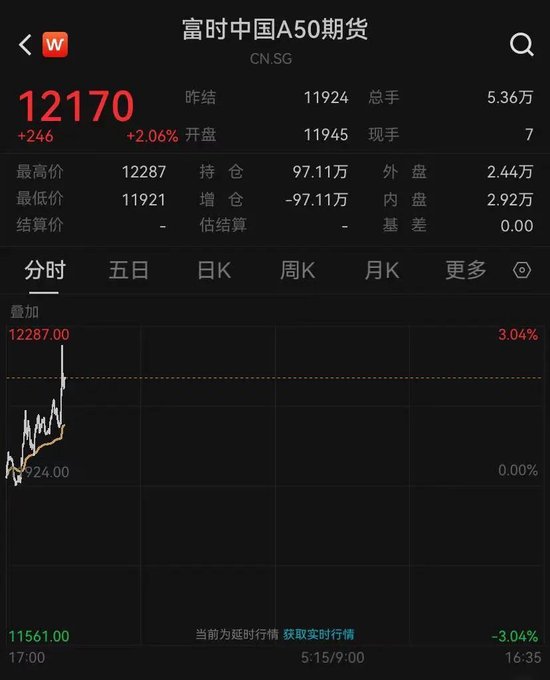
重要信号!A50突然拉涨
Shang Hai Zheng Quan Bao· 2025-04-07 12:02
炒股就看金麒麟分析师研报,权威,专业,及时,全面,助您挖掘潜力主题机会! 随着美国"对等关税"政策对全球资本市场的冲击蔓延,亚太多个市场率先行动。 4月7日,中央汇金公司公告称,中央汇金公司坚定看好中国资本市场发展前景,充分认可当前A股配置 价值,已再次增持了交易型开放式指数基金(ETF),未来将继续增持,坚决维护资本市场平稳运行。 市场表现方面,富时A50中国指数期货在4月7日17:00重开后走高,涨幅扩大至2%。此外,欧洲市场 主要股指跌幅收窄,德国DAX指数跌幅收窄至不足4%,此前一度跌10%。欧洲斯托克50指数跌幅收窄 至4%,英国富时100指数跌幅收窄至3.5%,法国CAC40指数跌幅收窄至3.7%。 | < W | 富时中国A50期货 | | | | | | | | --- | --- | --- | --- | --- | --- | --- | --- | | | CN.SG | | | | | | | | 12170 | 昨结 | | 11924 | 总手 | | | 5.36万 | | +246 | +2.06% 开盘 | | 11945 | 现手 | | | 7 | | 最高价 | 持 ...