
资金面宽松

Search documents
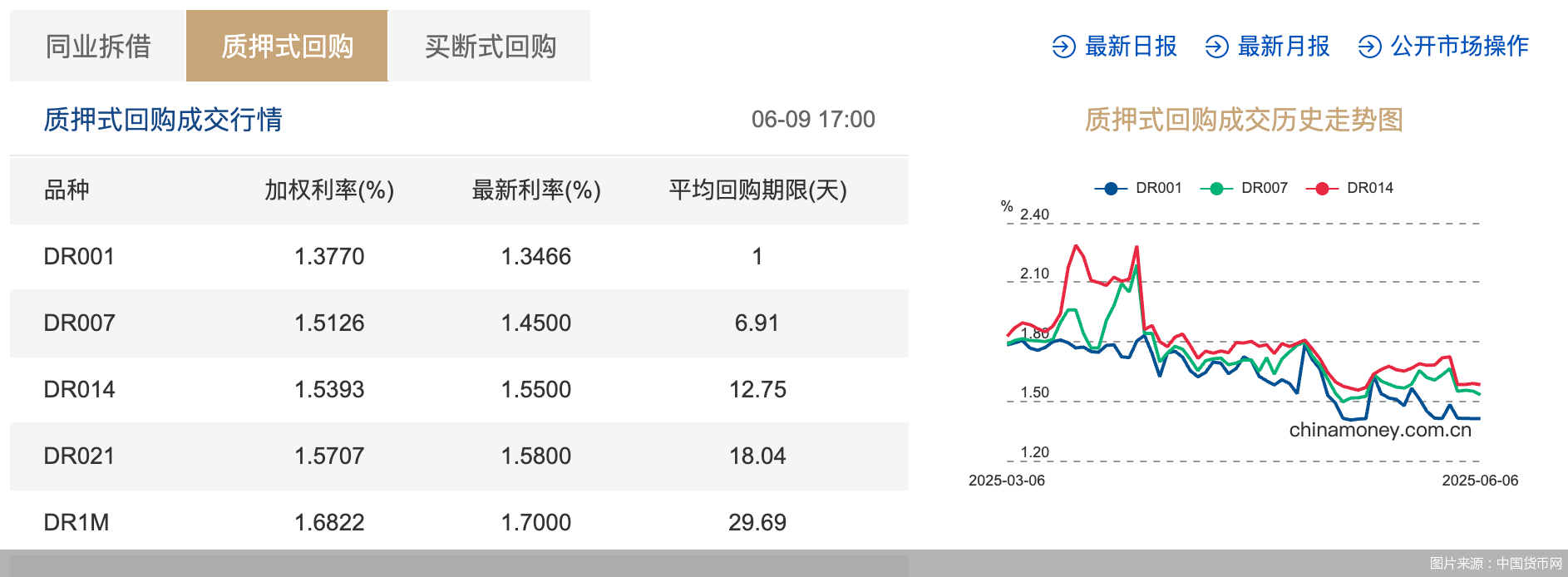
国债 中性偏多思路对待
Qi Huo Ri Bao· 2025-07-03 03:08
Group 1: Bond Market Performance - The bond market shows a relatively strong trend post-quarter, with long-end contracts outperforming short-end contracts. As of July 2, the main contracts TL, T, TF, and TS increased by 0.40%, 0.14%, 0.07%, and 0.03% respectively [1] Group 2: Manufacturing PMI - The official manufacturing PMI for June rose by 0.2 percentage points to 49.7%, indicating a continued recovery in domestic manufacturing sentiment. Key sub-indices showed improvement, with the production index at 51.0% and the new orders index at 50.2%, both reflecting stable performance [2] - The increase in the new orders index was primarily driven by domestic demand, while new export orders saw a limited rebound to 47.7%. The raw material inventory index rose by 0.6 percentage points to 48.0%, suggesting an increased willingness among manufacturers to replenish stocks [2] - Manufacturing prices also showed signs of recovery, with the factory price index and major raw material purchase price index rising to 46.2% and 48.4%, respectively, both up by 1.5 percentage points from the previous month [2] Group 3: Funding Conditions - Post-quarter, the funding environment is trending towards looseness, with DR001 and DR007 rates falling to approximately 1.37% and 1.54%. The overnight funding spread is around 8 basis points, indicating a relatively low level [3] - The recent monetary policy committee meeting expressed a more optimistic view on the domestic economic situation, removing references to potential rate cuts, and emphasizing a flexible approach to policy implementation based on economic conditions [3] - The market is sensitive to changes in funding conditions, with expectations for a balanced and slightly loose funding environment in the near future. However, further easing may depend on adjustments to policy rates [3] Group 4: Investment Strategy - The recommendation is to maintain a neutral to slightly bullish stance in trading strategies. Given the current flat yield curve, a loosening of funding conditions is necessary for short-term rates to decline, suggesting a strategy of accumulating TS positions on dips [4] - Attention should be paid to potential profit-taking as bond prices rise significantly, and the existence of a yield spread between new and old 30-year government bonds provides some protection for the bond market [4]
国债期货:月初资金面宽裕 期债延续上行
Jin Tou Wang· 2025-07-03 01:22
Market Performance - Government bond futures closed higher across the board, with the 30-year main contract rising by 0.40%, the 10-year main contract increasing by 0.14%, the 5-year main contract up by 0.07%, and the 2-year main contract gaining 0.03% [1] - Major interbank bond yields declined, with the 30-year government bond yield down by 0.75 basis points to 1.8435%, the 10-year policy bank bond yield down by 0.7 basis points to 1.7110%, the 10-year government bond yield down by 0.6 basis points to 1.6365%, and the 2-year government bond yield down by 0.85 basis points to 1.3575% [1] Funding Conditions - The central bank announced a 985 billion yuan 7-day reverse repurchase operation at a fixed rate of 1.40%, with the full amount being successfully bid [2] - On the same day, 3,653 billion yuan in reverse repos matured, resulting in a net withdrawal of 2,668 billion yuan [2] - The overnight pledged repo rate slightly declined, remaining around 1.36%, while the 7-day pledged repo rate decreased by 4 basis points [2] - The latest transaction for one-year interbank certificates of deposit from major banks was around 1.6%, down by approximately 2 basis points from the previous day [2] - Non-bank institutions experienced a significant decrease in financing costs, indicating a continuation of a loose funding environment in the short term [2] Operational Recommendations - The funding environment remains loose at the beginning of the month, with government bond futures continuing to rebound [3] - The central bank's June monetary policy tool operations did not include government bond transactions, leading to a generally strong sentiment in the futures market, although there is a lack of momentum for a breakthrough at previous highs [3] - Future focus should be on whether funding rates can further decline and the subsequent fundamental conditions [3] - For government bond futures strategy: it is recommended to appropriately allocate long positions during adjustments, with attention to profit-taking near previous highs, while monitoring economic data and funding trends [3] - For curve strategy: there is potential to consider steepening [3]
流动性月报:资金面利多大于利空-20250702
SINOLINK SECURITIES· 2025-07-02 08:58
1. Report Industry Investment Rating - No relevant content provided. 2. Core View of the Report - In June, the capital market was loose with a slight downward shift in the capital center under the central bank's care. In July, the capital market may continue to be moderately loose due to favorable factors, but it may not loosen significantly [2][4][6]. 3. Summary by Relevant Catalogs 3.1 6 - Month Review: Central Bank's Care Leads to Slight Downward Shift in Capital Center - **Capital Market Looseness**: In June, the capital market remained loose, with most - term capital centers moving down. DR001, DR007, and DR014 operation centers decreased by 11bp, 2bp, and 1bp respectively compared to May. DR001 mostly operated below the policy rate, and the deviation of DR007 from the policy rate "anti - seasonally" narrowed [2][12]. - **Central Bank's Warm Attitude**: The central bank showed a warm attitude. It conducted two outright reverse - repurchase operations in June with early announcements, net - injecting 2000 billion yuan. MLF continued to increase, with a net injection of 118 billion yuan in June. The central bank's total net - injected funds in June were the second - highest among the same periods since 2018 [16]. - **Inter - bank Certificate of Deposit (NCD)**: In June, the maturity scale of NCDs reached a record high, and the issuance scale was the second - highest in history. However, the NCD issuance rate, after rising in mid - to - late May, started to decline in June under the central bank's long - term capital injection. The R - DR spread seasonally widened [3][19][21]. 3.2 7 - Month Outlook: Capital Market May Continue to be Moderately Loose under Favorable Factors - **Historical Seasonal Pattern**: Historically, capital rates in July tend to decline seasonally. Since 2018, the capital market in July has been more relaxed than in June, mainly manifested by the narrowing of the deviation of DR007 from the policy rate [4][24]. - **Exchange Rate Factor**: The recent dissipation of RMB depreciation pressure and the exchange rate approaching 7.15 mean that the current exchange - rate environment no longer restricts the central bank's monetary easing [4]. - **Central Bank's Mention of "Preventing Capital Idling"**: Although the central bank mentioned "preventing capital idling" in the second - quarter monetary policy meeting, since 2024, when this statement was made, the capital rate did not rise significantly. The central bank's frequent mention of it in 2025 may not be directly related to a change in its attitude [5][31][32]. - **Liquidity Gap**: In July, the net financing pressure of government bonds will slightly increase by 80 billion yuan compared to June. The increase in government deposits may widen the liquidity gap. Considering the maturity of monetary tools, the liquidity gap will be 2.06 trillion yuan. Assuming the central bank conducts equal - amount roll - overs, the estimated excess - reserve ratio in July is about 1.3%, slightly lower than in June [6][37][42].
兴业期货日度策略-20250624
Xing Ye Qi Huo· 2025-06-24 12:12
Report Industry Investment Ratings No specific industry investment ratings are provided in the report. Core Viewpoints - The geopolitical conflict between Israel and Iran has cooled down, and the market risk appetite has rebounded. However, the impact of external factors on the A-share market is limited, and the shock center of the stock index is expected to gradually move up. With the approaching of the interim report season, IF and IH with higher performance certainty may be relatively strong, while IC and IM face increased performance verification pressure [1]. - The bond market sentiment is optimistic, but the high valuation restricts the upward space. The short - term policy interest rate is difficult to cut [1]. - The geopolitical risk premium of precious metals has declined, and the prices are oscillating at a high level. It is recommended to continue holding the strategy of selling out - of - the - money put options on gold and silver 08 contracts [1][4]. - The macro - uncertainty persists, and copper prices continue to oscillate. The supply of copper is tight, but the overseas macro situation is uncertain, and the real demand is cautious [4]. - The cost of aluminum is disturbed, and the inventory is at a low level. The supply of alumina is in excess, but the downward drive may slow down. The supply - demand of aluminum is intertwined, and the low inventory provides support [4]. - The fundamentals of nickel are weak, and the price continues to decline. The supply of the nickel industry chain is in excess, but the price of nickel ore is firm. It is recommended to continue holding the strategy of selling call options [4]. - The supply of lithium carbonate is loose, and the price is under pressure. The demand for lithium is weak, while the supply is increasing, and the inventory of smelters is rising [4][6]. - The high inventory of polysilicon suppresses the rebound. The supply - demand pattern of the polysilicon market is gradually becoming looser. It is recommended to continue holding the strategy of selling call options [6]. - The geopolitical risk premium of steel has declined, and the prices are close to the upper limit of the range. The fundamentals of steel are not significantly changed, and the upward space is limited. It is recommended to hold the strategies of selling out - of - the - money call and put options on rebar [6]. - Coke has completed four rounds of price cuts, and the spot price is approaching the bottom while the futures price rebounds first. The long - term supply of coking coal is in excess, but the short - term supply tightens. It is recommended that cautious investors close their short positions in coking coal and wait and see for new orders [8]. - The glass has stronger support than soda ash. The supply of soda ash is expected to be loose, and it is recommended to hold short positions. The performance of float glass is also weak, and it is recommended to hold short positions and some arbitrage strategies [8]. - The geopolitical premium of crude oil may further decline. It is recommended to close the long - call option positions [8]. - The import volume of methanol may not decrease significantly, and the futures price may face a correction. The positive impact of the Middle - East conflict is fading [10]. - The demand for polyolefins is poor, and the price is expected to decline. The demand for polyolefins is weak, and the crude oil premium is retreating [10]. - The inventory of the cotton industry is decreasing, and it is recommended to maintain a long - position strategy. The supply of cotton is expected to be tight, and the short - term fundamentals have no obvious negative drive [10]. - The demand for rubber is not fulfilled, and the port inventory is increasing. The supply of rubber is increasing while the demand is decreasing, and the price is under pressure [10]. Summary by Categories Stock Index - Geopolitical conflict cools down, market risk appetite rebounds, A - share oscillates upward on Monday, small and micro - cap indexes strengthen, and the trading volume of the two markets slightly rebounds to 1.15 trillion yuan [1]. - The performance of IF and IH may be relatively strong during the interim report season, while IC and IM face performance verification pressure [1]. Treasury Bond - The bond market sentiment is optimistic due to loose liquidity, but the high valuation and the difficulty of short - term policy interest rate cuts restrict the upward space [1]. Precious Metals - Geopolitical risk premium declines, gold and silver prices oscillate at a high level. It is recommended to hold the strategy of selling out - of - the - money put options on gold and silver 08 contracts [1][4]. Non - ferrous Metals - Copper: The supply is tight, but the overseas macro situation is uncertain, and the real demand is cautious. Copper prices continue to oscillate in the short term [4]. - Aluminum: The cost is disturbed, and the inventory is low. The supply of alumina is in excess, but the downward drive may slow down. The supply - demand of aluminum is intertwined, and the low inventory provides support [4]. - Nickel: The fundamentals are weak, the supply of the industry chain is in excess, but the price of nickel ore is firm. It is recommended to hold the strategy of selling call options [4]. Energy and Chemicals - Polypropylene (PP): The event - driven positive factors fade, and the supply is in excess. It is recommended to open new short positions in PP2509 [2]. - Polysilicon: The high inventory suppresses the rebound. It is recommended to continue holding the strategy of selling call options on polysilicon PS2508 - C - 34500 [2][6]. - Aluminum: The inventory is at a low level. It is recommended to hold the previous long positions in AL2508 [2]. - Crude Oil: The geopolitical premium may further decline. It is recommended to close the long - call option positions [8]. - Methanol: The import volume may not decrease significantly, and the futures price may face a correction [10]. - Polyolefins: The demand is poor, and the price is expected to decline [10]. Steel and Iron - Rebar: The geopolitical risk premium declines, and the price is close to the upper limit of the range. It is recommended to hold the strategies of selling out - of - the - money call and put options [6]. - Hot - rolled Coil: The fundamentals change little, and the price oscillates. It is recommended to wait and see for new orders [6]. - Iron Ore: The supply - demand may be slightly looser in June - July, and the price follows the steel price to oscillate in a narrow range. It is recommended to wait and see for new orders [6]. Coking Coal and Coke - Coking Coal: The long - term supply is in excess, but the short - term supply tightens. Cautious investors are recommended to close their short positions and wait and see for new orders [8]. - Coke: The fundamentals show a double - decline in supply and demand. The spot price is approaching the bottom, and the futures price rebounds first [8]. Soda Ash and Glass - Soda Ash: The supply is expected to be loose, and it is recommended to hold short positions and some arbitrage strategies [8]. - Float Glass: The performance is weak, and it is recommended to hold short positions and some arbitrage strategies [8]. Agricultural Products - Cotton: The inventory of the industry is decreasing, and the supply is expected to be tight. It is recommended to maintain a long - position strategy [10]. - Rubber: The demand is not fulfilled, the port inventory is increasing, and the price is under pressure [10].
固定收益点评:资金还能更宽松吗?
Guohai Securities· 2025-06-15 15:16
Group 1: Report's Investment Rating - No information about the industry investment rating is provided in the report [1][2][5] Group 2: Core Viewpoints - The capital market has no basis for tightening as the real - estate market and credit demand face downward pressure, and external exchange - rate pressure has significantly eased. However, the central bank's attitude towards the capital market is limitedly loose, so the probability of a significant decline in capital interest rates is low. DR007 is expected to fluctuate in the range of 1.5 - 1.6%. The CD maturity peak is not over, and CD interest rates may remain in a sideways oscillation state, with limited downward momentum in the bond market. Further long - position opportunities may require greater liquidity support from the central bank, a significant decline in CD interest rates, and an increase in interest - rate cut expectations [5][19][23] Group 3: Summary by Directory 1. Can the funds become even looser? - From the fundamental perspective, the real - estate market and credit demand have downward pressure. As of June 14, the year - on - year decline in the commercial housing transaction area of 30 large - and medium - sized cities in June was 8.0%, and the year - on - year growth of first - tier cities' transaction area also decreased. As of June 8, the national urban second - hand housing listing price index decreased by 0.48% month - on - month. In May, the year - on - year growth of RMB loan balances was 7.1%, and the credit growth rate was still in a downward range. The growth of social financing was mainly supported by government bond issuance and direct financing, with weak financing demand from the real economy [7][12] - External exchange - rate pressure has significantly eased. After the Sino - US Geneva talks on May 12, bilateral tariff levels were significantly reduced, and the RMB showed an appreciation trend, so the central bank does not need to tighten funds to stabilize the exchange rate [15] - The central bank's attitude towards the capital market is limitedly loose. The central bank conducted two outright reverse repurchases in June, with a total investment of 1.4 trillion yuan, but the net investment was only 200 billion yuan. Considering the upcoming tax period and cross - quarter pressure, the upward range of capital interest rates is expected to be limited, and DR007 may fluctuate in the 1.5 - 1.6% range [17][18] 2. What is the impact on the bond market? - Since late May, although capital interest rates have significantly declined, CD interest rates have been in a sideways oscillation state, restricting the downward space of bond interest rates. In the next two weeks, CD repayment pressure is high, but the net lending scale of large banks has been increasing, so CD interest rates are expected to remain in an oscillating state, and the downward momentum of the bond market is limited [19]
5月物价、贸易数据出炉,资金面持续宽松,银行间主要利率债收益率涨跌不一
Dong Fang Jin Cheng· 2025-06-10 03:51
5 月物价、贸易数据出炉;资金面持续宽松,银行间主要利率债收益率涨跌不一 【内容摘要】6 月 9 日,资金面持续宽松;银行间主要利率债收益率涨跌不一;转债市场主要 指数集体收涨,转债个券多数上涨;各期限美债收益率普遍下行,主要欧洲经济体 10 年期国 债收益率走势分化。 一、债市要闻 (一)国内要闻 【中美经贸磋商机制首次会议在英国伦敦开始举行】当地时间 6 月 9 日下午,中美经贸磋商 机制首次会议在英国伦敦开始举行。国务院副总理何立峰与美国有关方面举行会谈。路透社、 天空新闻频道等英国媒体指出,中美新一轮会谈引起各界高度关注,双方开展面对面对话将有 助于加强两国经贸关系,深化相互理解信任。 【5 月 CPI 继续低位运行,PPI 同比降幅有所扩大】国家统计局 6 月 9 日发布的数据显示, 2025 年 5 月,CPI 同比下降 0.1%,上月为下降 0.1%,1-5 月 CPI 累计同比下降 0.1%;5 月 PPI 同比下降 3.3%,上月为下降 2.7%,1-5 月 PPI 累计同比下降 2.6%。 【5 月对美出口降幅扩大,整体出口保持较强韧性】海关总署 6 月 9 日发布数据显示,以美元 计价, ...
公开市场短期利率走低,资金宽松,债市回暖
Bei Jing Shang Bao· 2025-06-09 12:55
Core Viewpoint - The liquidity injection of one trillion yuan has led to significant changes in the market's funding environment, with a notable decline in short-term interest rates across various instruments, indicating a continued easing of monetary conditions [1][2][3]. Group 1: Market Interest Rates - As of June 9, 2025, the weighted average interest rates for various repo instruments have decreased, with DR001 at 1.377%, DR007 at 1.5126%, and DR014 at 1.5393%, marking new lows since December 2024 and January 2023 respectively [1][2]. - The R007 rate also fell to 1.4938%, the lowest since October 2024, while the overnight repo rate dropped to 1.3705%, the lowest since December 2024 [2][3]. Group 2: Monetary Policy Actions - The People's Bank of China (PBOC) has implemented a one trillion yuan buyout reverse repo operation to maintain liquidity, which has been a key factor in the recent decline of short-term interest rates [5][6]. - The PBOC's actions, including the announcement of large-scale reverse repos at the beginning of the month, are aimed at countering the pressure from maturing interbank certificates of deposit, which have reached a peak of over 4.2 trillion yuan in June [6][7]. Group 3: Bond Market Impact - The bond market has shown signs of recovery, with long-term bond yields continuing to decline. The 10-year government bond yield was reported at 1.6547% on June 6, down 1.65 basis points from the previous week [10][11]. - Analysts expect the bond market to remain strong due to supportive monetary conditions and the PBOC's proactive liquidity management, which is likely to keep interest rates low [10][11].

货币市场日报:6月9日
Xin Hua Cai Jing· 2025-06-09 11:48
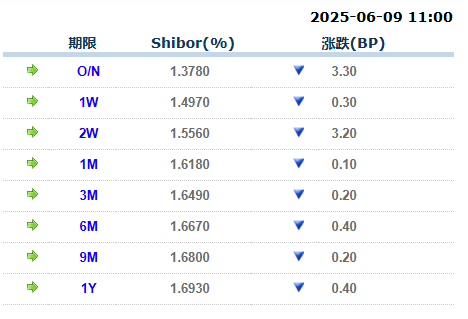
Core Points - The People's Bank of China conducted a 173.8 billion yuan reverse repurchase operation on June 9, maintaining the operation rate at 1.40%, resulting in a net injection of 173.8 billion yuan into the market as there were no reverse repos maturing on that day [1] - The Shanghai Interbank Offered Rate (Shibor) saw a slight decline across all maturities, with the overnight Shibor down by 3.30 basis points to 1.3780%, and the 7-day Shibor down by 0.30 basis points to 1.4970% [1][2] - The interbank pledged repo market showed a slight downward trend in rates, with the weighted average rates for DR001 and R001 decreasing by 3.5 basis points and 2.9 basis points, respectively, while transaction volumes varied [6] Market Conditions - The funding environment on June 9 was characterized by a loose liquidity situation, with overnight rates for pledged repo transactions falling to around 1.45% by the end of the day [10] - A total of 145 interbank certificates of deposit were issued on June 9, with an actual issuance volume of 224.51 billion yuan, indicating active trading sentiment in the primary market [11] - The issuance of the second batch of 39.5 billion yuan special bonds aimed at stabilizing growth and investment was successfully completed, supporting central enterprises in key investment areas [13]
债市日报:6月9日
Xin Hua Cai Jing· 2025-06-09 10:18
Market Overview - The bond market continued to consolidate on June 9, with narrow fluctuations in interbank bond yields and mixed performance in government bond futures [1] - The People's Bank of China (PBOC) continued to provide liquidity support through net injections in the open market, leading to a more relaxed funding environment [5] - Overnight pledged repo rates for deposit-taking institutions fell over 3 basis points, dropping below 1.4% [5] Bond Futures Performance - The 30-year main contract rose by 0.35%, while the 10-year main contract increased by 0.09%, with 5-year and 2-year contracts remaining unchanged [2] - The yield on the 30-year government bond "25超长特别国债02" decreased by 0.50 basis points to 1.8700%, while the 10-year government bond "25附息国债11" saw an increase of 0.25 basis points to 1.6550% [2] International Bond Market - In North America, U.S. Treasury yields rose across the board, with the 10-year yield increasing by 11.11 basis points to 4.506% [3] - In Asia, Japanese bond yields mostly increased, with the 10-year yield rising by 1.3 basis points to 1.467% [3] - In the Eurozone, yields on 10-year bonds in France, Germany, Italy, and Spain all saw slight declines [3] Primary Market - The Agricultural Development Bank of China issued financial bonds with varying yields, with the 3-year bond yielding 1.3286% and a bid-to-cover ratio of 2.23 [4] Funding Conditions - On June 9, the PBOC conducted a 7-day reverse repo operation with a fixed rate of 1.40%, injecting 173.8 billion yuan into the market [5] - The funding environment remains increasingly relaxed, with a significant net injection following a previous large-scale reverse repo operation [5] Economic Indicators - In May, China's Producer Price Index (PPI) fell by 3.3% year-on-year, while the Consumer Price Index (CPI) decreased by 0.1% [8] - China's exports in May increased by 4.8% year-on-year, while imports fell by 3.4%, resulting in a trade surplus of 103.22 billion USD [8] Institutional Perspectives - Huatai Fixed Income suggests that attention should be paid to tariffs and fundamental developments, with expectations of a slight increase in risk appetite due to U.S.-China tariff negotiations [9] - Guosheng Fixed Income anticipates that interest rates may reach new lows, driven by changes in fundamentals and improved market supply-demand dynamics [9]
月初资金宽松 债市震荡偏强
Qi Huo Ri Bao· 2025-06-09 02:43
Group 1 - The bond market is experiencing a volatile yet strong trend, with 2-year, 5-year, 10-year, and 30-year treasury futures showing weekly increases of 0.05%, 0.11%, 0.18%, and 0.31% respectively, indicating a balanced tug-of-war between bulls and bears [1] - The official manufacturing PMI for May is reported at 49.5%, a month-on-month increase of 0.5 percentage points, while the Caixin manufacturing PMI decreased to 48.3%, a drop of 2.1 percentage points, highlighting a divergence between large and small enterprises [1] - The recent easing of tariffs between China and the U.S. may continue to support manufacturing sentiment in the second quarter, although uncertainties regarding external demand persist in the medium to long term [1] Group 2 - In response to a slowing global economic recovery and increasing geopolitical uncertainties, multiple central banks are signaling monetary easing, with the People's Bank of China announcing a 1 trillion yuan reverse repo operation [2] - Recent U.S. economic data, including a significant drop in ADP employment numbers and a contraction in the ISM non-manufacturing PMI, has heightened expectations for potential interest rate cuts by the Federal Reserve [2] - The market's anticipation of Fed rate cuts has surged, with the probability of a rate cut in September reaching 77.1% according to the CME FedWatch tool [2] Group 3 - The funding environment remains loose, with slight declines in overnight and 7-day repo rates, although there is pressure from over 4 trillion yuan in maturing certificates of deposit in June, complicating banks' asset-liability management [3] - The combination of government debt supply pressure, significant credit issuance, and the peak of maturing certificates of deposit in June may lead to increased volatility in the funding environment [3] - Short-term attention should be on the movement of certificates of deposit and the demand for government bonds, particularly long-term bonds, as well as regulatory measures to stabilize banks' liabilities [3] Group 4 - The bond market is likely to maintain a volatile pattern, with the potential for interest rates to decline requiring further triggering factors, including changes in the economic fundamentals and central bank policies [4] - The likelihood of further monetary easing from the central bank in the short term is relatively low, but any unexpected resumption of government bond purchases could catalyze a decline in long-term interest rates [4] - Technically, mid to short-term interest rate bonds are considered a relatively safe choice in the current market environment [4]