
地缘政治风险

Search documents
广发早知道:汇总版-20260123
Guang Fa Qi Huo· 2026-01-23 03:13
每日精选: 每日重点关注品种逻辑解析 金融衍生品: 2026 年 1 月 23 日星期五 广发早知道-汇总版 投资咨询业务资格: 广发期货研究所 电 话:020-88818009 E-Mail:zhangxiaozhen@gf.com.cn 目录: 金融期货: 股指期货、国债期货 贵金属: 黄金、白银、铂、钯 集运欧线 商品期货: 有色金属: 铜、氧化铝、铝、铝合金、锌、锡、镍、不锈钢、碳酸锂、工业硅、多 晶硅 黑色金属: 钢材、铁矿石、焦煤、焦炭、硅铁、锰硅 农产品: 油脂、粕类、玉米、生猪、白糖、棉花、鸡蛋、红枣、苹果 能源化工: PTA、乙二醇、苯乙烯、纯苯、短纤、瓶片、烧碱、PVC、LLDPE、PP、 甲醇、合成橡胶、橡胶、玻璃纯碱 证监许可【2011】1292 号 组长联系信息: 张晓珍(投资咨询资格:Z0003135) 电话:020- 88818009 邮箱:zhangxiaozhen@gf.com.cn 周敏波(投资咨询资格:Z0010559) 电话:020-81868743 邮箱:zhoumingbo@gf.com.cn 朱迪(投资咨询资格:Z0015979) 电话:020-88818008 ...
贵金属日评-20260123
Jian Xin Qi Huo· 2026-01-23 02:34
Group 1: Report General Information - The report is a daily review of the precious metals industry dated January 23, 2026 [1] - The research team members include He Zhuoqiao (macro precious metals), Huang Wenxin (treasury bonds and container shipping), and Nie Jiayi (stock index) [2] Group 2: Industry Investment Rating - No industry investment rating is provided in the report Group 3: Core Viewpoints - In 2026, precious metals, especially industrial precious metals, will continue to perform strongly under the influence of factors such as the restructuring of the international political and economic landscape, the Fed's loose monetary policy, the improvement of the global economic growth outlook, and the substitution demand of silver and platinum for gold jewelry. Investors are advised to maintain a bullish trading mindset but control the position size, and short hedgers should appropriately reduce the hedging ratio [4][6] - Geopolitical risks may significantly increase in 2026, and the restructuring of the global political and economic landscape and the loose monetary policies of global central banks will continue to boost the demand for reserve diversification, strategic value, and liquidity premium of the precious metals sector. The precious metals sector will continue the medium - term upward trend since 2024 [6] - The improvement of global economic growth momentum and the substitution demand of silver and platinum for gold jewelry will make the performance of silver and platinum stronger than that of gold, but the large influx of investment funds also means significant amplification of price volatility [6] Group 4: Precious Metals Market Conditions and Outlook Intraday Market - Trump's withdrawal of the threat to impose tariffs on eight European countries during the Davos Forum and the agreement on the future cooperation framework in Greenland and the entire Arctic region between the US and NATO led to a significant adjustment in precious metals overnight. However, media reports of the US trying to overthrow the Cuban regime and the weakness of the US real estate market helped precious metals recover most of the previous day's losses in the Asian session on the 22nd, remaining in a relatively strong operating pattern [4] Medium - term Market - Trump will focus on consolidating the geopolitical strategic space in the Western Hemisphere in 2026, which may lead to a significant increase in geopolitical risks [6] - The industrial demand for silver is significantly boosted by the global green energy transition, and the expected industrial demand for platinum and palladium is improved due to the EU's cancellation of the 2035 fuel - vehicle ban. The strong and rising gold price boosts the physical demand for silver, platinum, and palladium through jewelry substitution demand [6] - Investors are advised to maintain a bullish trading mindset but strictly control the position size. Conservative traders can consider cross - variety arbitrage of going long on silver and platinum and short on gold and palladium. Long hedgers should conduct hedging in batches as soon as possible, and short hedgers should appropriately reduce the hedging ratio [6] Group 5: Domestic Precious Metals Market Data | Contract | Pre - closing Price | High Price | Low Price | Closing Price | Change (%) | Open Interest | Change in Open Interest | | --- | --- | --- | --- | --- | --- | --- | --- | | Shanghai Gold Index | 1,092.94 | 1,100.06 | 1,074.63 | 1,088.22 | - 0.43% | 369,376 | - 11,750 | | Shanghai Silver Index | 23,112 | 23,352 | 22,409 | 23,319 | 0.90% | 693,041 | 12,506 | | Guangzhou Platinum Index | 627.94 | 633.50 | 606.34 | 633.47 | 0.88% | 36,352 | - 1,071 | | Guangzhou Palladium Index | 487.24 | 487.74 | 470.95 | 484.52 | - 0.56% | 13,918 | - 5 | [5] Group 6: Main Macro Events/Data - Trump withdrew the threat of using tariffs as a bargaining chip for Greenland and ruled out the possibility of using force. An agreement to end the dispute over the Danish territory is about to be reached [18] - The US Supreme Court justices seem skeptical of Trump's attempt to remove Fed Governor Cook. Trump said he is close to selecting a new Fed chairman and prefers to keep White House economic advisor Hassett in his current position [18] - US pending home sales unexpectedly dropped to a five - month low in December. The decline of 9.3% to 71.8 was due to increased concerns in the labor market and the shortage of entry - level housing offsetting the boost from lower mortgage rates [18]
宝城期货贵金属有色早报(2026年1月23日)-20260123
Bao Cheng Qi Huo· 2026-01-23 02:21
Report Summary 1. Report Industry Investment Rating No relevant content provided. 2. Core Viewpoints - Gold is expected to be strong in the long - term, with a short - term strong trend, a medium - term strong trend, and an intraday trend of oscillating on the strong side. The core logic is that liquidity recovery drives up the gold price [1][3]. - Copper is expected to be strong in the long - term, with a short - term oscillating trend, a medium - term strong trend, and an intraday trend of oscillating on the weak side. The core logic is that the macro - atmosphere cools down and short - term bulls' willingness to close positions rises [1][4]. 3. Summary by Related Catalogs Gold - **Price Performance**: Yesterday, the gold price rose strongly. New York gold reached above $4900, approaching the $5000 mark, and Shanghai gold reached above 1100 yuan [3]. - **Driving Factors**: The direct trigger for the gold price increase is the sharp rise in geopolitical risks in "Greenland". Although the short - term market risk - aversion demand decreased, the gold price rebounded after a brief decline and broke through the previous high. It is mainly driven by short - term liquidity recovery. Technically, the long - short game at the $5000 mark should be continuously monitored [3]. Copper - **Price Performance**: Yesterday, the copper price declined after the Asian session, and the domestic night session opened lower and moved higher, oscillating around the 100,000 - yuan mark [4]. - **Driving Factors**: At the macro level, the precious metals rose strongly yesterday while the copper price was weak, showing insufficient willingness to follow the rise in the short term. At the industrial level, as the copper price declined, the willingness of some industries to replenish inventory increased slightly. On Thursday, the inventory stopped accumulating and slightly declined, and the monthly spread also rebounded. Technically, the long - short game at the 100,000 - yuan mark should be monitored [4].
华泰期货:地缘冲突阴云不散 贵金属再次走强
Xin Lang Cai Jing· 2026-01-23 02:12
Geopolitical Analysis - U.S. President Trump stated that the ongoing Greenland agreement will grant the U.S. "all desired military access" [2] - Trump threatened "strong retaliation" if European countries sell U.S. assets due to tariff threats related to Greenland [2] Economic Data - U.S. GDP for Q3 2025 was revised to an annualized growth of 4.4%, up from the initial estimate of 4.3%, marking the fastest growth in nearly two years [2] - The core PCE price index, a key inflation measure favored by the Federal Reserve, rose 2.8% year-over-year and 0.2% month-over-month, both in line with expectations [2] - Initial jobless claims in the U.S. were reported at 200,000, below the expected 210,000 [2] Futures Market Overview - On January 22, 2026, the main gold contract opened at 1,097.00 CNY/gram and closed at 1,087.58 CNY/gram, a decrease of 0.43% from the previous trading day [16] - The main silver contract opened at 23,037.00 CNY/kilogram and closed at 23,339.00 CNY/kilogram, an increase of 0.90% from the previous trading day [16] Bond Market Monitoring - On January 22, 2026, the U.S. 10-year Treasury yield remained unchanged at 4.241%, with the yield spread between 10-year and 2-year notes at 0.646% [17] Gold and Silver Holdings - As of January 22, 2026, gold ETF holdings were 1,077.66 tons, unchanged from the previous day, while silver ETF holdings decreased by 56 tons to 16,166 tons [19] Trading Strategies - Gold is viewed cautiously bullish, with expectations for prices to remain in a range of 1,090 CNY/gram to 1,170 CNY/gram [22] - Silver is also seen as cautiously bullish, with anticipated price fluctuations between 23,800 CNY/kilogram and 25,000 CNY/kilogram [23]


金饰克价破1500元!一条项链一夜贵千元,还要追高吗?
Sou Hu Cai Jing· 2026-01-23 02:03
Core Viewpoint - The recent surge in gold prices, driven by geopolitical risks and changing monetary policies, has led to significant price increases in the domestic gold market, with major brands reaching around 1500 yuan per gram [1][3]. Group 1: Price Surge - On January 21, 2026, the price of gold jewelry in China jumped to 1498 yuan per gram, with some brands exceeding 1500 yuan per gram [1][3]. - The international gold price has reached a historic high of 4842 USD per ounce, reflecting a substantial increase [1][3]. Group 2: Driving Factors - Geopolitical risks, such as the threat of increased tariffs by the U.S. on Europe, have heightened global risk aversion, prompting investors to turn to gold as a safe-haven asset [5]. - Changes in monetary policy, including interest rate declines and shifts in the Federal Reserve's leadership, are supporting the macro environment for gold [5]. - Central banks are increasing their gold reserves to counter credit crises, which is bolstering gold prices [5]. - Tight supply of physical gold is also contributing to the price increase, with analysts suggesting that the bullish trend in gold may continue [5]. Group 3: Consumer Behavior - The high gold prices have led to a noticeable shift in consumer behavior, with a decline in gold jewelry consumption by 32.5% year-on-year, while gold bars and coins consumption increased by 24.55% [7]. - Consumers are increasingly valuing gold for its financial attributes rather than just as a decorative item, with younger generations favoring innovative designs and materials [7]. Group 4: Industry Transformation - The high gold prices are reshaping the jewelry industry in China, with a focus on hard gold becoming popular among younger consumers [9]. - Traditional gold markets are maturing, and brands are leveraging craftsmanship and cultural elements to attract high-spending consumers [9]. - Collaborations with popular IPs have emerged as a trend, appealing to younger demographics [9]. Group 5: Future Outlook - Morgan Stanley predicts that gold prices could reach 4800 USD per ounce by the fourth quarter of 2026, while Citic Securities is more optimistic, forecasting prices could hit 5000 USD per ounce [11][13]. - Ongoing geopolitical uncertainties and central bank demand will continue to influence the gold market [13].
中辉能化观点-20260123
Zhong Hui Qi Huo· 2026-01-23 01:44
1. Report Industry Investment Ratings - Crude oil: Cautiously bearish [1] - LPG: Cautiously bearish [1] - L: Bearish rebound [1] - PP: Bearish rebound [1] - PVC: Bearish rebound [1] - PX/PTA: Oscillating strongly [2] - Ethylene glycol: Oversold rebound [2] - Methanol: Cautiously avoid shorting [2] - Urea: Cautiously avoid shorting [3] - Natural gas: Cautiously bullish [6] - Asphalt: Cautiously bearish [6] - Glass: Bearish continuation [6] - Soda ash: Bearish continuation [6] 2. Core Views of the Report - The report analyzes multiple energy and chemical products, including crude oil, LPG, L, PP, PVC, PX/PTA, ethylene glycol, methanol, urea, natural gas, asphalt, glass, and soda ash. It provides core views and main logics for each product, considering factors such as supply - demand, cost, inventory, and geopolitical situations [1][2][6]. 3. Summaries According to Related Catalogs Crude Oil - **Market Performance**: Overnight international oil prices declined, with WTI down 2.08%, Brent down 2.91%, and domestic SC up 1.18%. As of January 16, US crude oil inventories rose by 3.6 million barrels to 426.04 million barrels, gasoline inventories increased by 5.97 million barrels to 256.9 million barrels, distillate inventories rose by 3.35 million barrels to 132.5 million barrels, and strategic crude oil reserves increased by 0.8 million barrels to 414.5 million barrels [7][8][10]. - **Main Logic**: Short - term, the recent cold snap in the Northern Hemisphere drove up natural gas prices, which in turn led to an oil price rebound. The Middle East geopolitical situation has eased but remains uncertain. In the off - season, there is an oversupply of crude oil, with global crude oil inventories accelerating the accumulation, putting significant downward pressure on oil prices [9]. - **Strategy Recommendation**: In the long - term, OPEC+ is expanding production and pressing down prices, so oil prices will enter a low - price range. Short - term, it is expected to rebound, but bearish in the long - term. Pay attention to the range of SC [430 - 440] [11]. LPG - **Market Performance**: On January 22, the PG main contract closed at 4,120 yuan/ton, up 1.38% month - on - month. Spot prices in Shandong, East China, and South China were 4,480 (+10) yuan/ton, 4,428 (-39) yuan/ton, and 4,815 (-25) yuan/ton respectively [12][13]. - **Main Logic**: The price is mainly determined by the cost of crude oil, and crude oil prices are bearish in the long - term. In terms of supply - demand, the commodity volume remains stable, downstream chemical demand weakens, and inventories accumulate, making the LPG fundamentals bearish [14]. - **Strategy Recommendation**: In the long - term, due to the oversupply of upstream crude oil, the price center is expected to continue to decline, and there is still room for LPG price compression. Pay attention to the range of PG [3050 - 3150] [15]. L - **Market Performance**: The L05 closing price was 6,666 yuan/ton, up 0.4%. The L05 basis was - 176 yuan/ton, and the L59 spread was - 28 yuan/ton [17][18]. - **Main Logic**: The inventory of Sinopec and PetroChina has no obvious pressure. In the short - term, it fluctuates strongly following the chemical sector. Linear production scheduling has increased, but the spot price has not risen enough, and the basis continues to weaken. The device restart plan has increased this week, and the operating rate has risen to 85%. It is the off - season for agricultural film demand, and the terminal restocking is not sustainable. There is insufficient upward driving force in the fundamentals, and attention should be paid to the impact of the expected tax reform on naphtha tariffs on the olefin industry chain [19]. - **Strategy Recommendation**: Pay attention to the range of L [6700 - 6950] [19]. PP - **Market Performance**: The PP05 closing price was 6,624 yuan/ton, up 2.1%. The PP05 basis was - 65 yuan/ton, and the PP59 spread was - 34 yuan/ton [21][22]. - **Main Logic**: In the short - term, it fluctuates strongly following the chemical sector. The cost of propylene maintains an upward trend. Pay attention to the impact of changes in naphtha consumption tax on the olefin industry chain. The fundamentals show weak supply and demand. In January, the demand side is gradually entering the off - season, and downstream restocking power is insufficient. The shutdown ratio is 19%, and the short - term supply pressure is relieved. PDH profits are compressed and remain at a low level, increasing the expectation of maintenance. The short - term supply - demand contradiction is not prominent. Pay attention to the dynamics of PDH devices [23]. - **Strategy Recommendation**: Pay attention to the range of PP [6600 - 6750] [23]. PVC - **Market Performance**: The V05 closing price was 4,743 yuan/ton, down 1.3%. The V05 basis was - 243 yuan/ton, and the V59 spread was - 118 yuan/ton [24][25]. - **Main Logic**: Social inventories are hitting new highs, and it is rising following the chemical sector. The spot price of liquid caustic soda has been falling continuously, and the comprehensive gross profit in Shandong has been compressed again. The cost support of marginal devices has improved. The FOB price of Tianjin calcium carbide method has decreased. In 2025, the export growth rate was 47%. There is a short - term phenomenon of rushing to export, but there is an expectation of weakening supply - demand in the long - term, and the high - inventory structure is difficult to reverse. The main strategy is positive arbitrage between months. The fundamentals maintain a weak reality pattern. The domestic operating rate has increased to 80%, and both domestic and foreign demand are in the seasonal off - season, with no upward driving force [26]. - **Strategy Recommendation**: Pay attention to the range of V [4750 - 4950] [26]. PX/PTA - **Market Performance**: As of January 16, TA05 closed at 5,018 yuan/ton, and the basis was - 58 yuan/ton. The TA5 - 9 spread was 44 yuan/ton, and the PTA spot processing fee was 401.6 yuan/ton [27][28]. - **Main Logic**: In terms of valuation, it is not low. The PTA processing fee has been repaired. On the supply side, domestic devices are overhauled as planned, and the overall overhaul intensity is high. On the demand side, downstream demand is seasonally weak, and polyester factories have announced overhaul plans for January and February. In terms of inventory, PTA accumulates inventory seasonally in January and February, but the pressure is not large. The cost side, PX, is in a weak balance [28]. - **Strategy Recommendation**: The short - term driving force is limited. Pay attention to the opportunity to buy on dips for TA05. Pay attention to the range of TA05 [5260 - 5450] [29]. Ethylene Glycol - **Market Performance**: The EG05 closing price was 3,614 yuan/ton. The EG05 basis was - 101 yuan/ton, and the 5 - 9 spread was - 104 yuan/ton [30]. - **Main Logic**: From a valuation perspective, it is relatively low. On the supply side, the domestic operating load has generally increased. Overseas devices have some changes and high overhaul expectations. Downstream demand is seasonally weak, and polyester factories have announced overhaul plans for January and February. The port inventory is rising, and there is an expectation of inventory accumulation in January and February. It follows the cost fluctuation in the short - term and operates in a range [31]. - **Strategy Recommendation**: Pay attention to the opportunity to short on rebounds. Pay attention to the range of EG05 [3820 - 3890] [32]. Methanol - **Market Performance**: The methanol comprehensive profit was - 215.5 yuan/ton, at the 16.0% quantile level in the past six months, and the East China basis strengthened [35]. - **Main Logic**: The valuation is not low. On the supply side, the comprehensive profit has weakened, and the operating load of domestic methanol devices has declined from a high level. Overseas devices have generally reduced their loads. The expected arrival volume in January is about 850,000 tons, and the supply - side pressure is expected to ease. On the demand side, it has weakened slightly. The cost support is weakly stable. The supply - demand of methanol is slightly loose, and there is a game between weak reality and strong expectation [35]. - **Strategy Recommendation**: The expected arrival volume in January is 850,000 tons, and the supply - side pressure is expected to ease. The demand side is suppressed by the weak olefin market. Pay attention to the range of MA05 [2230 - 2280] [37]. Urea - **Market Performance**: The main contract of urea closed at 1,801 yuan/ton, and the Shandong small - particle basis was - 31 yuan/ton. The UR5 - 9 spread was 29 yuan/ton, and the weighted comprehensive profit was 60.20 yuan/ton [38][40]. - **Main Logic**: The absolute valuation is not low. The comprehensive profit is good, and the operating rate of coal - based and gas - based urea devices has increased. The warehouse receipts are at a high level in the same period. The short - term demand is strong, and the winter storage is progressing steadily. The exports of urea and fertilizers are relatively good but declining month - on - month. The social inventory is still at a relatively high level. Under the background of "export quota system" and "ensuring supply and stabilizing prices", the urea price has a ceiling and a floor. The downstream demand is entering the off - season, and the support may weaken [39][40]. - **Strategy Recommendation**: The benefit of winter storage is relatively limited, the supply - side pressure is expected to increase, and the demand is seasonally weak during the festival. The support from compound fertilizer demand is limited. Overseas natural gas price surges may affect the domestic market. Pay attention to the range of UR05 [1770 - 1800] [41]. Natural Gas - **Market Performance**: On January 22, the NG main contract closed at 3.529 US dollars/million British thermal units, up 10.87% month - on - month. The US Henry Hub spot price was 4.350 (+0.810) US dollars/million British thermal units, the Dutch TTF spot price was 14.659 (+1.336) US dollars/million British thermal units, and the domestic LNG market price was 3,828 (+29) yuan/ton [42][43]. - **Main Logic**: Recently, the cold snap in the Northern Hemisphere has led to a significant drop in temperature, boosting the demand side and driving up the gas price. The domestic LNG retail profit is 336 yuan/ton. On the supply side, the natural gas production has increased year - on - year, and the number of US natural gas rigs has decreased. On the demand side, the proportion of natural gas heavy - duty trucks in the actual sales of heavy - duty trucks from January to November 2025 was 26.00%. The US natural gas inventory has decreased [44]. - **Strategy Recommendation**: In winter, the demand for combustion and heating increases, supporting the gas price. However, the supply side is relatively sufficient, so the upward space of the gas price may be limited. Pay attention to the range of NG [4.866 - 5.496] [45]. Asphalt - **Market Performance**: On January 22, the BU main contract closed at 3,242 yuan/ton, up 2.69% month - on - month. The market prices in Shandong, East China, and South China were 3,080 (+10) yuan/ton, 3,200 (+0) yuan/ton, and 3,180 (+0) yuan/ton respectively [46][47]. - **Main Logic**: The increase in buyers of Venezuelan crude oil exports and the decrease in discounts for domestic sales support the asphalt price. The asphalt comprehensive profit is 62 yuan/ton. In February 2026, the domestic asphalt refinery production plan is 1.023 million tons, a decrease of 3.3% month - on - month and 9.1% year - on - year. In 2025, the asphalt import and export volumes increased year - on - year. The social inventory of 70 sample enterprises has increased [48]. - **Strategy Recommendation**: The valuation has returned to normal, but there is still about 200 yuan/ton of compression space. The supply - side uncertainty has increased. Pay attention to the range of BU [3150 - 3250] [49]. Glass - **Market Performance**: The FG05 closing price was 1,039 yuan/ton, down 1.6%. The FG05 basis was - 28 yuan/ton, and the FG59 spread was - 63 yuan/ton [51][52]. - **Main Logic**: The enterprise inventory has increased from a decline. It is the seasonal off - season for demand, and there is no upward driving force. Before the cold repair is further realized, it should be treated bearishly. The fundamentals show weak supply and demand, with the daily melting volume remaining at 150,700 tons. The weak demand suppresses the upward space [53]. - **Strategy Recommendation**: Pay attention to the range of FG [1030 - 1080] [53]. Soda Ash - **Market Performance**: The SA05 closing price was 1,185 yuan/ton, up 1.9%. The SA05 basis was - 28 yuan/ton, and the SA59 spread was - 63 yuan/ton [55][56]. - **Main Logic**: Upstream production enterprises maintain a high operating rate, and the in - factory inventory is slowly decreasing from a high level. The daily melting volume of float glass has been declining continuously, and the demand for heavy soda ash is insufficient. The second - phase 2.8 million - ton device of Yuanxing has been put into production, and the short - term device restart has increased, with the capacity utilization rate rising to 84%. The real - estate demand is continuously weak, and the cold - repair expectation of float glass has increased. The demand support is insufficient. Before the overhaul is further intensified, it should be treated bearishly [57]. - **Strategy Recommendation**: Pay attention to the range of SA [1170 - 1220] [57].
特朗普的威胁让欧洲富豪焦虑,黄金创新高,达利欧如何配置资产
Di Yi Cai Jing· 2026-01-23 01:39
达利欧表示:"我现在的配置混合了对新技术的投资以及对黄金的持有。" 新年伊始,美国总统特朗普"反复变卦",搅动资本市场。 23日,特朗普表态如果欧洲国家因他对格陵兰岛的关税威胁而出售美国资产,美国将采取"大规模报 复",叠加其他地缘因素,现货黄金强势站上4900美元/盎司,本月涨幅已达13%,累计涨了近600美 元。 欧洲思索出售美国资产并非空穴来风。据报道,有私人银行家和顾问透露,在特朗普就格陵兰岛发表声 明以及委内瑞拉和伊朗近期发生地缘政治动荡之后,一些欧洲富裕精英开始评估投资组合中对美国的风 险敞口,考虑将部分资金撤出美国资产,以扩大投资的地域多元化,或者降低对美元的依赖。 "许多客户感到非常不安,这是可以理解的。"总部位于美国和瑞士的国际家族财富管理公司Creative Planning国际财富管理总监昆齐(David Kuenzi)表示,"欧洲客户尤其如此,他们担心自己可能成为 (特朗普)总统下一个大规模报复的目标群体。" 长久以来,大西洋两岸的投资一直很通畅。譬如Zara创始人、西班牙人奥特加 (Amancio Ortega)在西雅 图拥有多处房产,其中包括亚马逊公司的办公楼。他还拥有曼哈顿历史悠 ...

金瑞期货金属早评:地缘持续紧张,金银再创新高
Xin Lang Cai Jing· 2026-01-23 01:32
热点栏目 自选股 数据中心 行情中心 资金流向 模拟交易 客户端 宏观分析 国内:央行行长潘功胜表示,2026年将继续实施好适度宽松的货币政策,灵活高效运用降准降息等多种 货币政策工具,保持流动性充裕。今年降准降息还有一定的空间。央行将于1月23日开展9000亿元MLF 操作。鉴于1月有2000亿元MLF到期,央行本次通过MLF操作净投放7000亿元,为连续11个月加量续 作,且较上个月净投放规模1000亿元大幅增加。 国际:美国总统特朗普表示,正在推进中的格陵兰岛协议将赋予美国"一切想要的军事进入权"。特朗普 还威胁称,如果欧洲国家因其与格陵兰岛相关的关税威胁而抛售美国资产,美方将进行"强烈报复"。对 于美联储主席人选,特朗普表示,很快就会公布,自己心中已有人选,已结束对美联储主席候选人的面 试。美国2025年第三季度GDP终值年化环比增长4.4%,高于4.3%的初值,创下近两年来最快增速。美 联储青睐的通胀指标——11月核心PCE物价指数同比上涨2.8%,环比上涨0.2%,均符合预期。美国上周 初请失业金人数20万人,低于预期的21万人。 贵金属 上一个交易日COMEX黄金期货涨2.09%报4938.40 ...

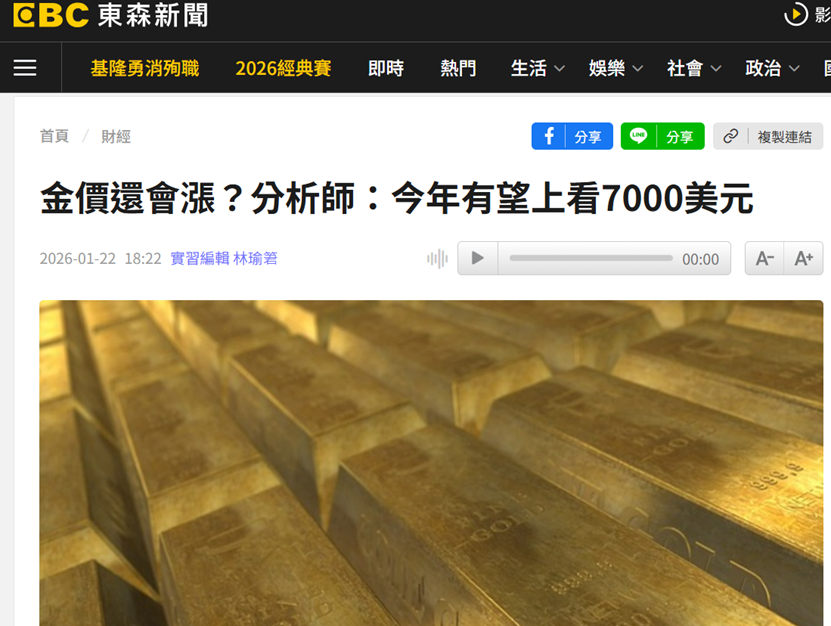
金价连续3天刷新历史新高,有分析师看高至每盎司7150美元
Huan Qiu Wang· 2026-01-23 01:16
Group 1 - International precious metals futures experienced a general increase, with COMEX gold futures rising by 2.09% to $4938.40 per ounce and COMEX silver futures increasing by 3.86% to $96.22 per ounce, driven by heightened geopolitical risks and policy uncertainties [1] - The demand for safe-haven assets has surged, leading to gold futures breaking the $4900 mark for the first time, marking a historical high for three consecutive days [1] - Analysts from the London Bullion Market Association (LBMA) predict that gold prices may exceed $5000 per ounce this year, with some forecasts suggesting a potential rise to $7150 per ounce [1] Group 2 - Central bank purchases of gold are expected to drive price increases in 2023 and 2024, with private sector demand anticipated to accelerate growth in 2025 [4] - Private investors are diversifying their gold investments through various channels, with ETF inflows being a significant indicator of this trend [4] - The precious metals market had a historically significant year, with silver prices nearly doubling and gold prices increasing by approximately 60%, although similar growth rates may not be replicated in the future [4]
刚刚 金价突破4900美元/盎司 银价暴涨!特朗普警告欧洲!俄乌 大消息
Qi Huo Ri Bao· 2026-01-23 00:33
早上好,原油市场传来利空,金价再创新高! 22日晚,美国能源部长赖特在世界经济论坛上呼吁将全球石油产量提高1倍以上,以满足不断增长的需 求并防止能源贫困。他强调了全球能源供应和获取方面面临的重大挑战。 谈及美伊关系时,特朗普称,伊朗方面有意与美国接触,并暗示双方可能恢复外交沟通。特朗普在出席 所谓"和平委员会"相关活动时称:"伊朗确实想谈,我们也会谈。"但他未就对话的具体形式、时间或议 题作出进一步说明。 俄乌局势方面,乌克兰总统泽连斯基表示,乌克兰、美国和俄罗斯的三方会谈将于23日在阿联酋举行, 他表示这是技术层面的会谈。据悉,此次三方会谈将持续两天。 据悉,美国总统特使威特科夫和特朗普女婿库什纳与俄罗斯总统普京的会晤将于23日进行。 此外,威特科夫表示,俄乌和平进程已取得重大进展,如今已到了最后阶段,他保持乐观态度。在访问 俄罗斯之后,他将前往阿联酋,参加美、俄、乌三方工作组会议。 受此影响,国际油价下跌。 截至今晨收盘,WTI原油期货主力合约下跌1.57%,布伦特原油期货主力合约下跌1.23%。 贵金属方面,伦敦金现货价格收涨3.31%,报4935.75美元/盎司;伦敦银现货价格大涨近6%。沪金、沪 银 ...