地缘政治风险

Search documents
刚刚,金价突破4900美元/盎司,银价暴涨!特朗普警告欧洲!俄乌,大消息→
Xin Lang Cai Jing· 2026-01-22 23:36
Group 1 - The U.S. Energy Secretary, Granholm, called for a doubling of global oil production to meet rising demand and prevent energy poverty, highlighting significant challenges in global energy supply and access [3][20] - Following this announcement, international oil prices experienced a decline, with WTI crude futures down by 1.57% and Brent crude futures down by 1.23% [6][23] - The International Energy Agency (IEA) warned of a significant oversupply in the global oil market in the first quarter of 2026 unless major supply disruptions occur, with U.S. crude inventories increasing by 3 million barrels last week [12][29] Group 2 - Precious metals saw a rise, with London gold prices increasing by 3.31% to $4935.75 per ounce, and London silver prices rising nearly 6% [6][23] - The Turkish central bank announced a 100 basis point cut in its policy rate, reducing it from 38% to 37%, which led to a decline of over 2% in the main banking index [10][28] - Analysts noted that geopolitical tensions, particularly in the Middle East, continue to influence oil prices, with potential for increased volatility due to U.S. military presence and actions against Iran [30][31]


黄金失守4800关口,2026年值得期待的是铜?
凤凰网财经· 2026-01-22 12:57
Core Viewpoint - The recent volatility in the gold market is primarily driven by the easing of geopolitical risks surrounding Greenland, as indicated by U.S. President Trump's statements at the World Economic Forum [6][7]. Group 1: Gold and Silver Market Analysis - On January 22, the spot gold price experienced a daily decline of 1.00%, reaching a low of $4777.23 per ounce before fluctuating around the $4800 mark [4]. - Spot silver hit a peak of $90.79 per ounce before rising to $94 per ounce, showing high-level fluctuations [4]. - The market's risk aversion has decreased due to the temporary alleviation of tariff threats related to Greenland, leading to a pullback in gold prices [7]. Group 2: Copper Market Insights - Analysts predict that gold prices may rise less sharply in 2026 compared to 2025, while copper is expected to perform strongly [8]. - The price dynamics of copper differ significantly from precious metals; copper's potential price increase is more closely tied to rising investments in the power sector rather than the safe-haven appeal of gold [8]. - The relationship between gold and copper is complex; both are influenced by U.S. dollar policies, but they react differently to inflationary pressures [9].

北欧养老基金加速离场:丹麦清仓美债,瑞典跟卖,格陵兰考虑抛售美国股票
Xin Lang Cai Jing· 2026-01-22 12:45
Group 1 - Major Nordic pension funds are accelerating their withdrawal from the US market to avoid rising macroeconomic risks, fiscal uncertainties, and geopolitical pressures [1][2][3] - Swedish and Danish pension funds have disclosed large-scale plans to reduce their holdings in US Treasury bonds, with SISA Pension from Greenland considering a complete exit from US stocks due to political pressure [1][2][3] - Alecta and AkademikerPension have confirmed substantial actions in the bond market, with Alecta having sold most of its US Treasury holdings since early 2025 and AkademikerPension planning to fully liquidate its US Treasury bonds by the end of the month [2][5][12] Group 2 - The withdrawal actions reflect a shift in the definition of "safe assets" among Nordic institutional investors, driven by concerns over fiscal sustainability and geopolitical tensions, particularly related to the Trump administration's claims over Greenland [6][12][13] - SISA Pension, managing approximately $1.1 billion in assets, has about 50% of its exposure in the US, primarily in publicly traded stocks, and is debating the implications of a potential withdrawal [3][11] - The recent geopolitical tensions, including Trump's threats regarding Greenland, have prompted SISA Pension to reconsider its investment stance in the US, highlighting the influence of political risks on investment decisions [4][11][15] Group 3 - Concerns over extreme geopolitical scenarios, such as potential military invasions, are now being integrated into risk models by institutions like SISA Pension, which raises questions about asset safety and valuation [7][15] - The actions of Alecta and AkademikerPension may signal the beginning of a broader trend among international capital flows, as traditional views on US Treasury bonds as safe assets are being challenged [6][13]
黄金2026:5000美元关口前,一场静悄悄的多空大博弈
Sou Hu Cai Jing· 2026-01-22 12:34
Core Viewpoint - The gold market is experiencing contrasting predictions for 2026, with some analysts forecasting prices as high as $5,400 per ounce, while others expect prices to decline compared to 2025 [1][9]. Group 1: Market Performance and Trends - In 2025, gold prices exhibited extreme volatility, with a 32.4% rebound from August to October, followed by a nearly 10% decline in late October [3]. - Central banks have been significant buyers of gold, with purchases exceeding 1,000 tons annually from 2022 to 2024, leading to a situation where the value of gold reserves held by central banks surpassed that of U.S. Treasury bonds [3]. Group 2: Key Variables Influencing Gold Prices - The U.S. interest rate policy is identified as the primary factor affecting gold prices in 2026, according to the LBMA [4]. - Market expectations of Federal Reserve interest rate cuts directly influence the opportunity cost of holding gold, making it more attractive during periods of declining rates [5]. - The demand for gold is supported by central bank purchases and the ongoing process of de-dollarization, with predictions suggesting gold prices could reach $6,600 per ounce by 2030 based on long-term GDP growth assumptions [6]. Group 3: Geopolitical and Economic Factors - Geopolitical risks are considered a significant underlying factor supporting gold prices in 2026, as investors tend to increase gold allocations during times of uncertainty [7][8]. - The potential for a "soft landing" in the U.S. economy could reduce gold's appeal as a safe haven, while a slowdown or regional economic crisis would enhance its attractiveness [19]. Group 4: Diverging Market Perspectives - Goldman Sachs maintains a bullish outlook on gold, raising its price target for the end of 2026 to $5,400 per ounce, driven by private sector hedging demand [9]. - In contrast, CITIC Securities predicts weaker gold prices in 2026, suggesting a shift in focus towards industrial metals like copper due to increased capital spending driven by AI advancements [14][15]. Group 5: Risks and Uncertainties - The uncertainty surrounding U.S. monetary policy is viewed as the biggest risk for the gold market in 2026, with analysts suggesting that 2026 may be a year of price consolidation rather than continuous increases [16]. - If the Federal Reserve's rate cuts are slower than expected or if inflation data fluctuates, gold may face significant downward pressure [17]. - The crowded trading positions in the gold market, following a period of continuous price increases, raise the likelihood of technical adjustments [20].

原油日报:原油震荡上行-20260122
Guan Tong Qi Huo· 2026-01-22 11:19
【冠通期货研究报告】 原油日报:原油震荡上行 发布日期:2026年1月22日 【行情分析】 1月4日,欧佩克+发布声明,决定维持2025年11月初制定的产量计划,在2026年2月和3月继续暂 停增产。原油需求淡季,EIA数据显示,美国原油库存超预期累库,同时汽油库存增幅超预期,整体 油品库存继续增加。美国原油产量小幅减少,仍位于历史最高位附近。特朗普警告,如果印度不按 美方要求限制购买俄罗斯石油,美国可能继续提高对印度产品征收的关税。印度在2025年12月对俄 原油进口已跌至三年低点,较6月峰值下降三分之一。近期国际货币基金组织将2026年世界经济增速 上调0.2个百分点,寒冷天气推动柴油取暖需求,需求担忧有所缓解。不过,全球原油浮库高企,原 油仍是供应过剩格局,EIA和IEA最新的1月月报上调了2026年原油供应过剩幅度。特朗普称委内瑞拉 将向美国移交3000万至5000万桶石油,雪佛龙正加大对于委内瑞拉原油的运输。目前委内瑞拉对于 全球原油供需影响不大。特朗普在白宫表示,收到了"来自伊朗非常积极的声明","我们要先观 望局势发展",伊朗国内骚乱得到控制,不过目前美国并未排除采取军事行动的可能性,伊朗地缘 ...
申银万国期货:避险需求与降息预期共振 贵金属上涨逻辑稳固
Jin Tou Wang· 2026-01-22 09:31
Group 1 - Gold prices continue to rebound, with silver experiencing a pullback, driven by rising geopolitical uncertainties that enhance market demand for safe-haven assets [1] - Economic data indicates a relief in inflationary pressures in the U.S., with December's core CPI rebound falling short of expectations, suggesting a continued loose liquidity environment that supports precious metal prices [1] - The long-term upward trend for gold is expected to persist due to factors such as weakened U.S. dollar credibility, central bank gold purchases, and heightened geopolitical risks [1] Group 2 - Silver and platinum possess both financial and industrial attributes, with their prices supported not only by macroeconomic factors but also by supply-demand gaps [1] - Silver supply remains tight, with limited increases in mining output, while industrial demand, particularly from solar energy, continues to grow, stimulating active investment demand for silver [1] - Platinum supply is also constrained, with increasing demand for catalytic converters in hybrid vehicles and hydrogen energy expected to drive future growth, activating investment demand as platinum prices rise [1]
黄金失守4800关口,2026年值得期待的是铜?
Ge Long Hui· 2026-01-22 09:28
Group 1 - The recent volatility in the gold market is attributed to the easing geopolitical risks surrounding Greenland, as indicated by a statement from U.S. President Trump regarding the non-use of force to acquire the territory [1] - On January 22, spot gold experienced a daily decline of 1.00%, reaching a low of $4777.23 per ounce before rebounding near the $4800 mark, while spot silver fluctuated between $90.79 and $94 per ounce [1] - The European Parliament has indefinitely postponed the vote on the U.S.-EU trade agreement until the U.S. returns to a cooperative stance, which has contributed to the reduction of market risk aversion [1] Group 2 - Analysts predict that the price of gold may rise less aggressively in 2026 compared to 2025, while copper is expected to show strong performance driven by increased investment in the power sector [2] - The price dynamics of gold and copper are influenced by different factors; gold is primarily driven by its safe-haven appeal, whereas copper's demand is linked to industrial applications, particularly in electricity transmission [2] - The relationship between gold and copper is complex; both are affected by U.S. monetary policy, but they respond differently to inflationary pressures, with high inflation favoring gold and moderate inflation benefiting copper [2][3]
对话基金经理沙川:黄金还在牛市中,未来波动或加剧|基遇2026
Sou Hu Cai Jing· 2026-01-22 08:07
出品|搜狐财经 作者|汪梦婷 编辑|杨锦 更多访谈点击查看《基金佳问》专栏 2025年,A股总市值站上100 万亿元的高峰,上证指数涨破4000点创下近十年新高。2026年A股市场又将如何演绎?哪些行业将孕育新的投资机遇? 搜狐财经《基金佳问》栏目特别推出"基遇2026"专题系列报道,复盘A股市场细分领域年内行情,展望及预测2026年各热门赛道的投资机遇,把握后市资产 配置的主逻辑,寻找具有投资潜力的基金产品。 1月21日,来自天弘基金的基金经理沙川做客搜狐财经直播间,对2026年市场贵金属领域的投资机会进行了深入解读,重点分析了黄金、白银相关资产的布 局前景。 "黄金还是处于牛市之中。" 沙川在直播中明确表示,在逆全球化趋势下,作为主要国际结算货币的美元信用持续走弱,但全球贸易体系依然围绕美元运 转。国际社会正在寻找能够分担国际贸易结算职能的替代选择,而黄金是公认的选项之一。 去年白银涨幅约150%,显著超过黄金的表现引发了广泛关注。"白银与黄金在投资逻辑上既有相似又有不同。"他解释道,黄金的贵金属属性更为纯粹,价 格主要受金融因素驱动;而白银则兼具较强的工业属性。 沙川分析称,本轮行情初期,白银涨幅明显滞 ...

高盛上调黄金年末价格预期后 金价收复部分跌幅
Xin Lang Cai Jing· 2026-01-22 07:55
Core Viewpoint - The easing of tensions related to Greenland has led to a reversal in gold prices, with Goldman Sachs raising its year-end target price for gold by $500 due to increasing demand from central banks and private investors [1][4]. Group 1: Gold Market Dynamics - Spot gold is currently trading around $4,830 per ounce, recovering from an early drop of 1.2% earlier in the week [1][5]. - Gold prices have surged nearly 5% this week, driven by geopolitical tensions and a crisis in U.S.-NATO relations, with gold prices reaching historical highs over the past year [3][7]. - Goldman Sachs has increased its year-end gold price target from $4,900 to $5,400, citing rising demand from private investors and central banks [4][8]. Group 2: Geopolitical Influences - The geopolitical risks have intensified, with President Trump’s policies causing diplomatic crises with European allies, which in turn has increased gold's appeal as a safe-haven asset [3][7]. - Trump's criticism of the Federal Reserve has weakened market confidence in the dollar, further supporting precious metal prices [3][7]. Group 3: Silver Market Insights - Silver prices have also seen a rise, with an increase of 1.2% to over $94 per ounce, driven by unprecedented demand from retail investors [4][9]. - The recent adjustments in China's silver export license policies have created market confusion, heightening expectations of silver scarcity [9].
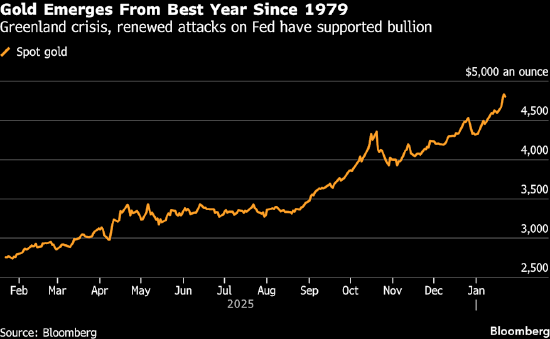
倒车接人?金价跳水,黄金股领跌!资金逢跌抢筹,有色ETF华宝(159876)获实时净申购4380万份!
Xin Lang Cai Jing· 2026-01-22 05:18
Group 1 - The core viewpoint of the news is the performance of the Huabao Nonferrous ETF (159876), which saw a price drop of nearly 2% but received a net subscription of 43.8 million units, indicating strong investor interest despite the decline [1][9] - The ETF's latest scale reached 1.736 billion yuan, marking a historical high and making it the largest ETF tracking the China Nonferrous Metals Index among three similar products [12][14] - The performance of constituent stocks varied, with silver stocks hitting the limit up, while gold stocks like Western Gold and Hengbang fell significantly, impacting the overall index performance [1][9] Group 2 - The London gold price reached a historical high of $4,890 per ounce on January 21 but retreated to around $4,800 due to easing geopolitical tensions related to Greenland [3][11] - Four main factors are expected to influence international gold prices by 2026: rising U.S. fiscal risks, increased gold allocation by global central banks, ongoing U.S. interest rate cuts, and heightened geopolitical risks [3][11][12] - The global geopolitical landscape is becoming more uncertain, with potential military interventions and resource competition expected to keep geopolitical risks elevated [4][12] Group 3 - The Huabao Nonferrous ETF and its linked funds cover a wide range of sectors including copper, aluminum, gold, rare earths, and lithium, allowing for better exposure to various market cycles [6][14] - The long-term commodity cycle is expected to last 25-30 years, with upward trends lasting 8-10 years and downward trends lasting 15-20 years, indicating a sustained period of growth once a direction is established [4][12]