去美元化

Search documents
玻璃纯碱1月报:玻碱节后库存承压,价格偏弱运行-20260130
Yin He Qi Huo· 2026-01-30 07:14
交易咨询业务资格: 证监许可[2011]1428 号 研究员:李轩怡 电 话:13164701108 邮 箱: lixuanyi_qh@chinastock.com.cn 期货从业资格证号:F03108920 投资咨询资格证号:F0018403 能化板块研发报告 2026 年 1 月 30 日 玻碱节后库存承压,价格偏弱运行 第一部分 前言概要 【纯碱】 在去美元化背景下,1 月有色及贵金属加速上涨,断崖式领涨于商品市场。本轮 商品价格普涨更像是随着全球金属价格上涨而出现的输入性通胀,但若上游资源价格 涨价过快,下游涨价能否顺畅传导,还是会进一步缩减需求有待观察,但这部分担忧 的计价预计会延迟到临近春节或节后释放。市场对春季商品普涨行情有一定期待,在 当前估值下对节后累库计价也比较谨慎。但随着春节的临近,库存压力将会愈发突出, 若宏观情绪边际走弱,价格易跌难涨。 1 月纯碱新增产能陆续提负,湖北新都,博源二线新增产能提量,逐步对纯碱供 应形成压力。2 月份预计 2 条浮法玻璃产线放水冷修,光伏玻璃产能或变动不大,重 碱用量预计下滑,春节假期期间部分轻碱下游用户放假,下游需求减少。通胀计价下 商品普涨,但传导上 ...
金源灿:金价巨震下的坚守与博弈 多头趋势未改震荡休整期将至
Xin Lang Cai Jing· 2026-01-30 07:01
1月30日,年初突破4500美元时的势如破竹,登顶5600美元后的骤然回调,2026年初的国际金价用一轮 极致的波动,将"该不该下车"的灵魂拷问推向了全球市场的焦点。自2023年开启的三年连涨态势中,黄 金在2025年迎来爆发式行情,全年涨幅飙至67%,创下近四十余年以来的最佳年度表现之一。支撑这波 壮阔涨势的核心逻辑——央行购金的刚需托底、美联储降息的周期红利、美元信用松动下的货币属性回 归,在本轮剧烈回调后,是否已悄然瓦解?而全球地缘风险的持续发酵、供需缺口的不断扩大,又能否 继续为金价注入上行动能?市场的多空分歧,在波动中愈发清晰。回顾此轮行情,黄金的上涨并非单一 因素驱动,而是多重利好共振的结果。从央行层面来看,2022年以来全球央行购金行为发生结构性转 变,黄金正成为储备资产中美元的主要挑战者,尤其是波兰央行放弃黄金占储备30%的比例目标,转而 设定700吨的绝对持有量目标,即便金价处于高位仍持续增配。2025年全球央行黄金净增持量创纪录, 新兴市场央行更是战略性增持黄金,塞尔维亚、韩国等多个国家均明确表示有意扩大黄金储备,这种刚 性需求为金价构筑了坚实的底部支撑。与此同时,美联储2025年持续降息 ...
关注美国12月PPI数据和中国1月官方制造业PMI
Hua Tai Qi Huo· 2026-01-30 05:21
Report Industry Investment Rating - Not provided in the given content Core Viewpoints - The overall inflation trend remains unchanged. Future price recovery depends on supply - side policies. There is room for further RRR cuts and interest rate cuts this year, and the RMB exchange rate is expected to float bidirectionally [1]. - The Fed kept interest rates unchanged, with two dissenting votes in favor of a 25 - basis - point rate cut. Inflation risks have subsided to some extent, and employment risks may be stabilizing [2]. - In the short term, pay attention to the rotation of low - valuation sectors. Different commodity sectors have different trends and influencing factors [3]. - For commodities and stock index futures, go long on precious metals, non - ferrous metals, and stock indices on dips [4]. Summary by Related Catalogs Market Analysis - The Central Economic Work Conference emphasized boosting consumption and anti - "involution" measures. The central bank cut the interest rates of various structural monetary policy tools by 0.25 percentage points, and there is still room for RRR cuts and interest rate cuts this year. The RMB exchange rate is expected to float bidirectionally [1]. - The U.S. Treasury Department issued 5 important policy documents to support multiple loan fields, aiming to reduce financing costs and stimulate market vitality [1]. - Geopolitical tensions between Iran and Venezuela, and between the U.S. and European countries due to Trump's actions, have accelerated the global de - dollarization trend [1]. - The CME adjusted the margin parameters of some silver, platinum, and palladium futures contracts, with the new margin ratio for some silver contracts being about 11% of the nominal value [1]. Fed's Decision - The Fed kept the federal funds rate target range at 3.50% - 3.75% unchanged, with two Fed governors dissenting and preferring a 25 - basis - point rate cut [2]. - Fed Chairman Powell said inflation risks have subsided, and employment risks may be stabilizing. He did not respond to political issues [2]. - U.S. Treasury Secretary Besent said the U.S. adheres to a strong - dollar policy and denied intervention in the yen exchange rate [2]. Commodity Analysis - Non - ferrous metals have long - term supply constraints, but short - term upward momentum may slow [3]. - In the energy sector, the U.S. will "distribute" Venezuelan oil, and Trump hopes to lower oil prices to $50 per barrel. The situation in Iran also needs attention. A winter storm in the U.S. has pushed up natural gas prices [3]. - In the chemical sector, pay attention to the "anti - involution" and stock - commodity linkage of methanol, PTA and other varieties [3]. - For agricultural products, focus on weather forecasts and short - term pig diseases. For black metals, pay attention to domestic policy expectations and low - valuation repair [3]. - The de - dollarization trend has opened up room for gold price increases [3]. Strategy - Go long on precious metals, non - ferrous metals, and stock indices on dips in commodities and stock index futures [4]. Important News - MSCI's warning on the investability of the Indonesian market and Goldman Sachs' downgrade led to a more than 15% two - day plunge in the Indonesian stock market, with the benchmark index potentially entering a technical bear market. Goldman Sachs said extreme scenarios could lead to over $13 billion in capital outflows [2][6]. - In 2025, global gold demand soared, and the gold price rose significantly. Economic and geopolitical risks drove consumers and investors to buy and hold gold [6].
贵金属数据日报-20260130
Guo Mao Qi Huo· 2026-01-30 04:21
| | | | | 国贸期货研究院 | | | 投资咨询号: Z0013700 | | | 2026/1/30 | | --- | --- | --- | --- | --- | --- | --- | --- | --- | --- | --- | | | | | | 贵金属与新能源研究中心 白素娜 | | | 从业资格号:F3023916 | | | | | 内外盘金 | 日期 | 伦敦金现 (美元/盎司) | 伦敦银现 (美元/盎司) | COMEX黄金 (美元/盎司) | COMEX白银 (美元/盎司) | | AU2602 | AG2602 (元/千克) | AU (T+D) (元/克) | AG (T+D) | | 银15点价 | | | | | | | (元/克) | | | (元/千克) | | 格眼踪 | 2026/1/29 | 5565. 88 | 118. 95 | 5595. 50 | 119. 05 | | 1252. 10 | 30055.00 | 1245. 20 | 29925.00 | | (本表数 | 2026/1/28 | 5264.93 | 114. 87 | 5258 ...
昨夜,黄金、白银闪崩!史诗级暴跌,发生了什么?| 多家基金宣布:今起集体停牌
Sou Hu Cai Jing· 2026-01-30 04:19
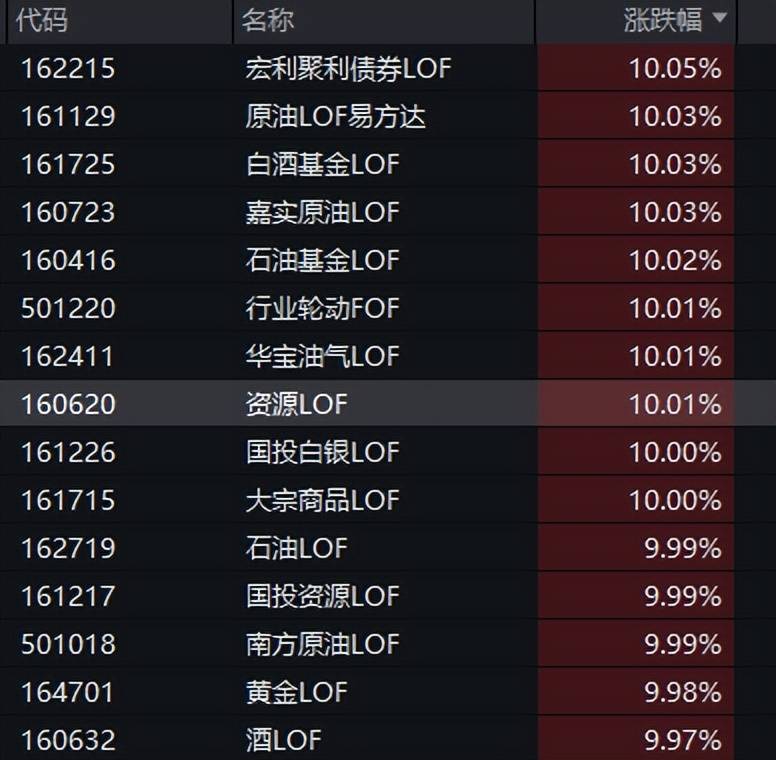
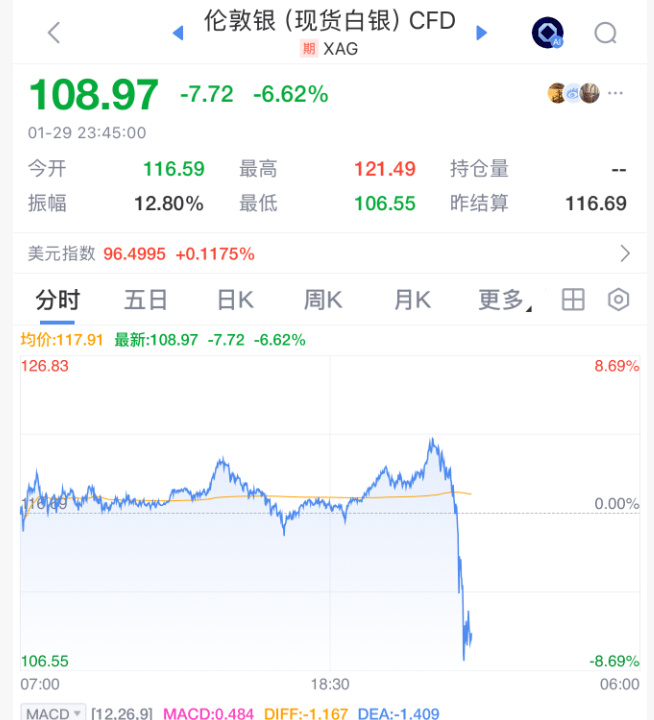
Group 1: Precious Metals Market - International precious metals futures experienced significant volatility, with gold and silver prices initially plummeting before recovering, ultimately closing with gains of over 1% for both COMEX gold and silver [1] - At one point, spot silver fell by 8%, and spot gold dropped below $5,200 per ounce [1] Group 2: Stock Market Performance - U.S. stock indices showed mixed results, with technology stocks experiencing divergent trends; Meta surged by 10%, while Microsoft fell by over 10% due to slowing cloud business growth [4][6] - Chinese online education stocks mostly rose, with TAL Education Group increasing by over 18% following better-than-expected earnings [4][8] Group 3: Fund Market Activity - Multiple funds announced a collective suspension of trading starting January 30, following a strong performance in resource-related LOFs, including oil and silver funds [9][10] - The price of WTI crude oil reached $65.002 per barrel, marking a 2.83% increase and the highest level since September 2025, driven by heightened geopolitical risks and inflation expectations [14] Group 4: Fund Subscription Limits - Starting January 30, several funds, including those managed by Huashan and GF Fund, significantly reduced their daily subscription limits to as low as 2 yuan, effectively restricting large investments [15][20] - The high premium rates in the secondary market prompted warnings from fund managers about potential risks associated with blind investments [17][18]



大行情突袭沪金断崖式暴跌
Jin Tou Wang· 2026-01-30 04:07
地缘方面,美军持续在中东威胁伊朗,伊朗方面强硬表态;美国威胁对古巴进行石油贸易的国家加征关 税;俄罗斯外长拉夫罗夫表示泽连斯基寻求的停火对俄罗斯来说是不可接受的。 美国至1月24日当周初请失业金人数20.9万人,前值21万,预期20.5万。美国11月贸易帐-568亿美元,前 值-292亿美元,预期-405亿美元。美国11月工厂订单月率2.7%,前值-1.2%,预期1.6%。美国11月批发 销售月率1.3%,前值-0.40%。数据整体偏弱。 美国国会参议院在程序性投票中未能推进已获众议院通过的政府拨款法案,美国联邦政府再次面临部 分"停摆"的危机。美国数个联邦部门的运转资金将于1月30日耗尽。美国参议院共和党领袖图恩表示距 离达成避免政府停摆的协议更近一步。根据最新协议,国土安全部将获得临时拨款。希望众议院能重返 谈判桌,帮助避免政府停摆。 芝商所上调部分黄金期货保证金比例黄金合约的新保证金比例高于此前5%水平,约为名义价值的6%。 新标准将于当地时间1月30日收盘后生效。 周五(1月30日)亚洲早盘,黄金期货短线回落,沪金主力合约日内下跌超3.00%,现报1175.34元/克, 今日沪金主力开盘1246.00 ...
西南期货早间评论-20260130
Xi Nan Qi Huo· 2026-01-30 04:04
Report Summary 1. Investment Rating The report does not provide an overall industry investment rating. 2. Core Views - **Fixed Income**: Treasury bond futures are expected to face some pressure, and a cautious approach is recommended [6][7]. - **Equity Index**: The volatility center of stock index futures is expected to gradually move up, and previous long positions can be held [9][10]. - **Precious Metals**: Market volatility is expected to increase significantly, and it is advisable to exit long positions and wait and see [13][14]. - **Base Metals and Building Materials**: Most products are expected to show weak or volatile trends, with some opportunities for long - positions on dips, but investors should pay attention to position management [15][17][20]. - **Energy**: Crude oil and fuel oil are expected to have upward space due to geopolitical risks, and long - position opportunities should be focused on [26][27][28]. - **Chemicals**: Most chemical products are expected to show volatile trends, with some having upward potential, and investors should pay attention to cost and supply - demand changes [32][46][47]. - **Agricultural Products**: Different agricultural products have different trends. Some are expected to be strong, some weak, and investment strategies vary accordingly [72][80][84]. 3. Summary by Categories Fixed Income - **Treasury Bonds**: On the previous trading day, most treasury bond futures closed higher. The central bank conducted 354 billion yuan of 7 - day reverse repurchase operations, with a net investment of 143.8 billion yuan. Due to the relatively low yield, economic recovery, and improved risk appetite, treasury bond futures are expected to face pressure [5][6]. Equity Index - **Stock Index Futures**: On the previous trading day, stock index futures showed mixed trends. Considering the low domestic asset valuation, economic resilience, and increased market sentiment, the volatility center of stock index futures is expected to rise [8][9]. Precious Metals - **Gold and Silver**: On the previous trading day, gold and silver futures rose significantly. In 2025, global gold demand reached a record high. Given the complex trade - financial environment and central bank purchases, gold has allocation value, but recent speculation has increased, and market volatility is expected to widen [11][13]. Base Metals and Building Materials - **Steel Products (Rebar and Hot - Rolled Coil)**: On the previous trading day, rebar and hot - rolled coil futures rebounded slightly. In the medium - term, the price is dominated by supply - demand. With weak demand in the real estate industry and over - capacity, the price may continue to oscillate weakly [15]. - **Iron Ore**: On the previous trading day, iron ore futures rebounded significantly. The demand is at a low level, and the supply is increasing, with inventory at a high level. Technically, there are signs of stabilization, and investors can focus on long - position opportunities on dips [17]. - **Coking Coal and Coke**: On the previous trading day, coking coal and coke futures rose significantly. The supply of coking coal may decrease during the Spring Festival, and the demand for coke is weak. The price is expected to oscillate in the medium - term [20]. - **Ferroalloys**: On the previous trading day, manganese silicon and silicon iron futures rose. The supply of manganese ore is gradually recovering, and the cost is stable. The overall supply is still loose, but the short - term surplus has decreased. Investors can consider long - position opportunities at low levels [22][23]. Energy - **Crude Oil**: On the previous trading day, INE crude oil rose significantly due to geopolitical tensions. Speculators increased their net long positions, and the number of active oil rigs increased slightly. Geopolitical risks are expected to remain high, and there is upward space for crude oil [24][26]. - **Fuel Oil**: On the previous trading day, fuel oil rose significantly, following the trend of crude oil. The supply in Singapore is tightening, and the price is expected to continue to rise [28]. Chemicals - **Polyolefins**: The PP and LLDPE markets showed different trends. The polyolefin market is expected to be in a tight supply - demand situation, and the price may rise in the short - term due to factors such as rising crude oil prices and production line maintenance [30][32]. - **Synthetic Rubber**: On the previous trading day, synthetic rubber futures rose. The price is supported by the increase in butadiene prices and high device operation rates, but limited by weak demand. It is expected to oscillate strongly [34][35]. - **Natural Rubber**: On the previous trading day, natural rubber futures rose. The supply is decreasing, and the cost is supported. The demand is expected to be stable to weak, and the inventory is increasing. It is expected to oscillate widely [36][38]. - **PVC**: On the previous trading day, PVC futures fell slightly. Although it is in the traditional off - season, the policy expectation may lead to a strong oscillation. In the medium - term, supply - demand may improve, but demand uncertainty should be noted [39][41]. - **Urea**: On the previous trading day, urea futures rose slightly. The price is expected to oscillate strongly in the short - term, driven by export demand and cost support [42][45]. - **PX**: On the previous trading day, PX futures rose. The PXN spread and short - term profit are stable, the start - up rate is declining, and there is support from market sentiment and crude oil. It is expected to oscillate strongly in the short - term [46]. - **PTA**: On the previous trading day, PTA futures rose. The processing fee is at an average level, the inventory is low, the supply is stable, and the demand is seasonally weak. It is expected to oscillate within a range [47][48]. - **Ethylene Glycol**: On the previous trading day, ethylene glycol futures showed a mixed trend. The overseas device maintenance is increasing, and the cost is supported, but the domestic coal - based device start - up is rising, and the inventory is increasing. It is expected to oscillate in the short - term [49]. - **Short - Fiber**: On the previous trading day, short - fiber futures rose. The supply is at a high level, the sales are improving, and the inventory is low. It is expected to follow the raw material price and oscillate [50][51]. - **Bottle Chips**: On the previous trading day, bottle chip futures rose. The production load is decreasing, and there are plans for concentrated production cuts during the Spring Festival. The export is increasing, and it is expected to follow the cost and oscillate [52]. - **Soda Ash**: On the previous trading day, soda ash futures rose. The supply is loose, the inventory is increasing slightly, and the downstream demand is weak. It is expected to be stable and weak before the festival [53][54]. - **Glass**: On the previous trading day, glass futures rose. The supply - demand pattern is loose, the inventory is high, and the cost support is weak. It is expected to oscillate before the festival [55]. - **Caustic Soda**: On the previous trading day, caustic soda futures rose slightly. The supply is high, the inventory is increasing, and the demand is weak. It is expected to oscillate before the festival, but caution is needed [56][57]. - **Pulp**: On the previous trading day, pulp futures rose. The inventory is increasing, the downstream demand is weak, and there is a lack of new orders. It is expected to have limited fluctuations before the festival [58]. Agricultural Products - **Lithium Carbonate**: On the previous trading day, lithium carbonate futures fell. The supply is at a high level, the demand is improving, and the inventory is decreasing. There is support for the price, but short - term volatility may increase [59][60]. - **Copper**: On the previous trading day, copper futures rose. The global copper concentrate supply is tight, but the demand is suppressed by high prices. The inventory is increasing. It is advisable to be cautious when chasing up [61][62]. - **Aluminum**: On the previous trading day, aluminum futures fell. The alumina market has an oversupply, and the electrolytic aluminum supply is inelastic. High prices suppress demand, and inventory is increasing. Caution is needed when chasing up [63][64][65]. - **Zinc**: On the previous trading day, zinc futures rose. The supply is increasing, and the demand is in the off - season. Although the price has moved up, there is a possibility of a high - level correction [66][67]. - **Lead**: On the previous trading day, lead futures fell. The supply and demand are both weak, and the price is expected to oscillate within a range [68][69]. - **Tin**: On the previous trading day, tin futures fell. The supply is tight, and the demand has certain resilience. The price is expected to oscillate strongly, but risk control is needed [69]. - **Nickel**: On the previous trading day, nickel futures fell. The macro environment is complex, the cost is rising, but the demand is weak, and the inventory is at a high level. Attention should be paid to Indonesian policies [70]. - **Soybean Oil and Soybean Meal**: On the previous trading day, soybean oil and soybean meal futures rose. The Brazilian soybean harvest is progressing quickly, and the supply is relatively loose. There may be long - position opportunities for soybean meal at low - cost support levels, and long - position exit opportunities for soybean oil when the price rises [71][72]. - **Palm Oil**: Malaysian palm oil prices rose. The export is increasing, and the production is decreasing. There may be long - position opportunities after a correction [73][75]. - **Rapeseed Meal and Rapeseed Oil**: Canadian rapeseed prices fell slightly. The import policy has changed, and the inventory of rapeseed meal is decreasing, while that of rapeseed oil is increasing. It is advisable to wait and see [76][77]. - **Cotton**: On the previous trading day, domestic cotton futures fell. The USDA supply - demand report is favorable, and the domestic supply is expected to be tight in the future. It is recommended to go long in batches after a correction [78][80][81]. - **Sugar**: On the previous trading day, sugar futures showed a mixed trend. India's sugar production is expected to increase, and the domestic supply is under pressure. It is advisable to go short in batches after a rebound [82][84][85]. - **Apples**: On the previous trading day, apple futures rebounded slightly. The inventory is at a low level, and the production has decreased. The price is expected to be strong in the medium - to long - term, and long - position operations can be considered after a correction [86][87][88]. - **Hogs**: On the previous trading day, hog futures fell. The supply is under pressure in the first quarter, and it is advisable to wait and see [89]. - **Eggs**: On the previous trading day, egg futures fell. The supply is at a high level, and it is advisable to take profit on previous long - position spreads [91]. - **Corn and Starch**: On the previous trading day, corn futures rose slightly, and starch futures were flat. The supply - demand of corn is basically balanced, and starch may follow the corn market [92][93]. - **Logs**: On the previous trading day, log futures rose. The supply is decreasing, the inventory is decreasing, and the demand is entering the pre - festival end. The cost is rising, and the overall supply - demand is expected to be loose, but cost support is strengthening [95][96].
美联储政策转向 独立性争议成关键变量
Jin Tou Wang· 2026-01-30 02:52
截至2026年1月30日,美元指数延续弱势震荡态势,1月28日大跌0.95%报96.17,创下2022年2月以来的 逾四年新低,后续小幅整理维持在96.20附近。兑主要非美货币普遍承压,美元兑人民币汇率中间价报 7.12左右,在岸与离岸市场波动幅度收窄;兑日元汇率逼近129的均衡合理区间,日元走强态势明显; 兑加元汇率跌破1.35关口,最新报1.3504,日内微涨0.12%,凸显美元整体弱势格局。开年以来,美元 指数累计下跌超2.3%,延续2025年下半年以来的下行趋势,市场对美元的看空情绪持续升温。 美联储的独立性正遭遇前所未有的冲击,成为影响美元走势的隐性风险。鲍威尔在记者会上直言,正在 审理的最高法院案件可能是"美联储113年历史上最重要的法律案件",并公开建议继任者"与美国政治划 清界限"。近期美国政府针对美联储办公大楼翻修项目展开的刑事调查,被广泛解读为政治报复,核心 分歧之一是美联储未按白宫意愿加速降息。此外,美国总统特朗普已高调预告将尽快宣布下一任美联储 主席人选,支持降息的美联储理事沃勒获提名,市场解读为未来政策可能更贴近白宫诉求,若独立性受 损,美联储或被迫在通胀未受控的前提下过早宽松,重蹈 ...
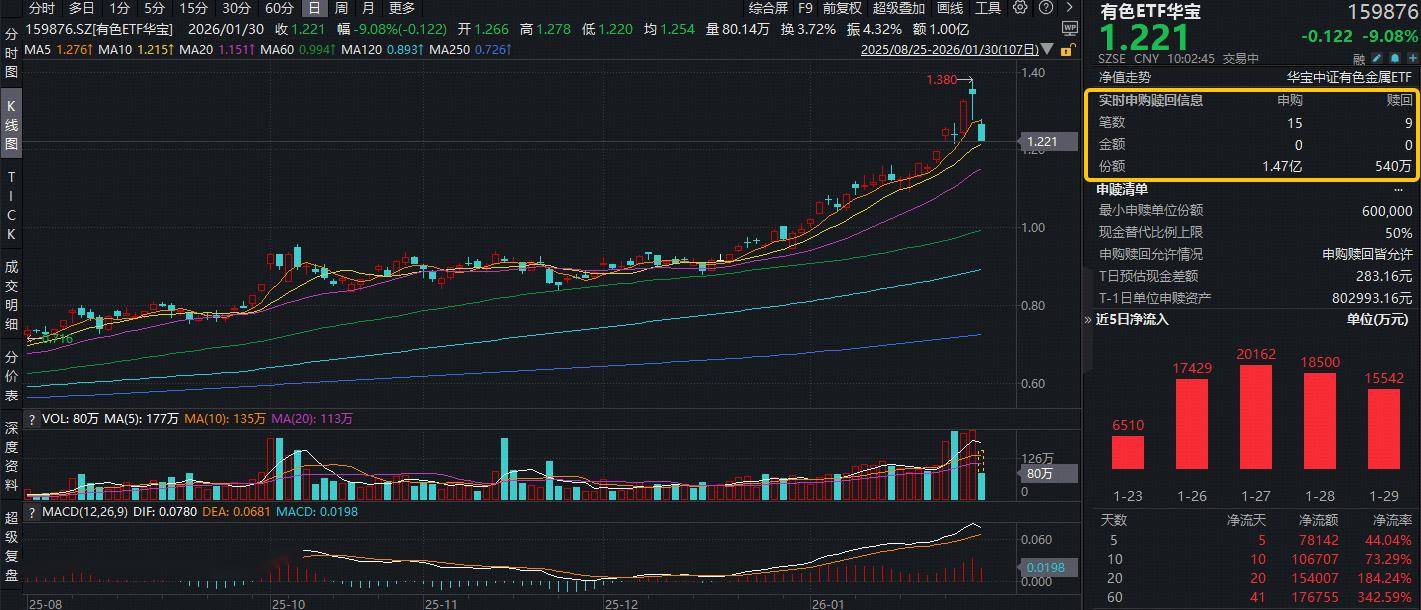
ETF盘中资讯|有色ETF跌超9%,获资金实时净申购1.42亿份!资金为何逆行加仓,越跌越买?
Sou Hu Cai Jing· 2026-01-30 02:31
Core Viewpoint - The article discusses the recent volatility in the global risk asset market, particularly focusing on the surge in demand for precious metals and the performance of the Huabao ETF amid geopolitical tensions and macroeconomic factors [1][3]. Group 1: Market Dynamics - Geopolitical risks have led to a significant drop in global risk assets, prompting some investors to take profits, which has resulted in a sharp decline in gold and silver prices [1]. - Despite the market downturn, the Huabao ETF saw a net subscription of 142 million units, indicating a counter-trend investment in the non-ferrous metals sector [1]. - The demand for non-ferrous metals is supported by macroeconomic factors such as the Federal Reserve's ongoing easing policies, rising geopolitical uncertainties, and concerns over the sustainability of U.S. debt and deficits [3]. Group 2: Industry Outlook - The non-ferrous metals sector is expected to maintain a high profitability state for an extended period, driven by new demand from emerging industries such as renewable energy, AI, and aerospace [4]. - Domestic non-ferrous metal companies are valued lower compared to their international counterparts, despite having similar growth potential and core competitiveness [4]. - The industry is experiencing a significant output gap due to a long-term contraction in capital expenditures since 2011, which continues to support prices and highlight the strategic value of these metals [3]. Group 3: Performance Indicators - As of January 28, 2025, 24 out of 60 listed companies covered by the non-ferrous ETF have released earnings forecasts, with 21 companies expected to be profitable, indicating a positive outlook for the sector [3]. - The Huabao ETF covers a wide range of metals, including copper, aluminum, gold, rare earths, and lithium, allowing investors to capture the overall sector's performance effectively [5].
最新公告!今天,多家基金集体停牌
Sou Hu Cai Jing· 2026-01-30 02:25
Core Viewpoint - Multiple resource-related LOF funds have announced a collective suspension of trading due to significant price premiums and market volatility, signaling potential risks to investors [5][6]. Group 1: Fund Performance and Market Reactions - Several LOF products, including the oil LOF funds, experienced a strong performance with multiple funds hitting the daily limit up, reflecting high premium rates [1][2]. - The WTI crude oil futures reached $65.002 per barrel, marking a 2.83% increase and the highest level since September 2025, contributing to the bullish sentiment in the market [4]. Group 2: Suspension and Limit Adjustments - Starting January 30, 2026, several funds, including the Huazhong Oil Fund LOF and others, will suspend trading until 10:30 AM due to significant price deviations from net asset values [5][6]. - The Huazhong Oil Fund LOF has reduced the daily purchase limit from 100 yuan to 2 yuan, while other funds have similarly tightened their subscription limits to manage inflows [4][7]. Group 3: Market Dynamics and Investor Sentiment - Analysts attribute the high premiums in oil LOF funds to tight QDII quotas, low subscription limits, and a surge in investor interest driven by international oil prices and risk aversion [4]. - The overall market sentiment remains strong for commodities, supported by factors such as inflation expectations and demand recovery, indicating continued upward momentum in the short term [4][9].