
地缘政治风险

Search documents
地缘政治风险持续存在 沪银走势高位震荡
Jin Tou Wang· 2026-01-20 06:57
Group 1 - Silver futures are currently trading above 22910, with a reported price of 23231 per kilogram, reflecting a 4.38% increase, and a daily high of 23568 and a low of 22777 [1] - The geopolitical risks stemming from the ongoing Russia-Ukraine conflict are supporting silver's safe-haven appeal, particularly following large-scale drone attacks on Ukraine's energy infrastructure [2] - The relationship between the US and Europe is facing unprecedented challenges due to potential trade wars, which could lead to increased costs for US businesses and consumers, thereby impacting inflation and economic growth [2] Group 2 - Despite the rise in silver prices, sentiment in the Shanghai silver market has cooled, with the silver premium expanding to 2400 per gram, indicating a mixed outlook [3] - The support levels for Shanghai silver are projected at 22500 and 21000, with the main contract expected to trade within a range of 21600 to 23700 [3]
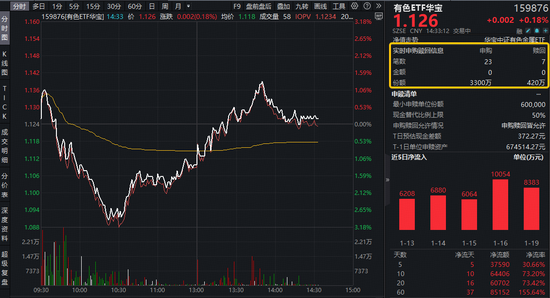
黄金首次突破4700美元!有色ETF华宝(159876)下探回升,获实时净申购2880万份!湖南白银等3股涨停!
Xin Lang Cai Jing· 2026-01-20 06:45
Core Viewpoint - The recent performance of the non-ferrous metal sector, particularly the Huabao ETF (159876), indicates strong investor confidence, with significant net subscriptions and price resilience, suggesting a bullish outlook for the sector [1][9]. Group 1: Market Performance - On January 20, the Huabao ETF (159876) showed resilience with a price increase of 0.18%, and it received a net subscription of 28.8 million units, following a remarkable 644 million yuan in subscriptions over the previous ten days [1][9]. - The total market capitalization of the Huabao ETF reached 1.626 billion yuan, setting a new historical high as of January 19 [3][11]. Group 2: Stock Performance - Key stocks in the non-ferrous metal sector, such as Hunan Silver, Silver Industry, and Mingtai Aluminum, experienced significant price increases, with Hunan Silver and Silver Industry both hitting the daily limit of 10.03% [2][12]. - Other notable performers included Nanshan Aluminum with a 7.49% increase and Shanjin International with a 5.71% rise [2][12]. Group 3: Industry Outlook - Analysts believe that the non-ferrous metal sector is driven by multiple factors, including global capital expenditure cycles, manufacturing recovery, and improved domestic macroeconomic expectations, leading to a consensus that the sector will continue to perform well [3][11]. - Institutions like CICC and Zhongtai Securities predict a bull market for the non-ferrous industry by 2026, driven by a combination of monetary, demand, and supply factors [3][11]. Group 4: Gold Market Dynamics - The geopolitical risks and inflation pressures have led to a surge in gold prices, with the international COMEX gold reaching a historic high of $4,723 per ounce [2][10]. - Ever-increasing demand for gold as a traditional safe-haven asset is expected to make it an essential part of asset allocation strategies by 2026 [2][10]. Group 5: ETF Coverage - The Huabao ETF and its linked funds cover a wide range of sectors, including copper, aluminum, gold, rare earths, and lithium, allowing investors to capture the beta performance across different economic cycles [6][14].


特朗普突发!黄金再创新高!
中国基金报· 2026-01-20 06:39
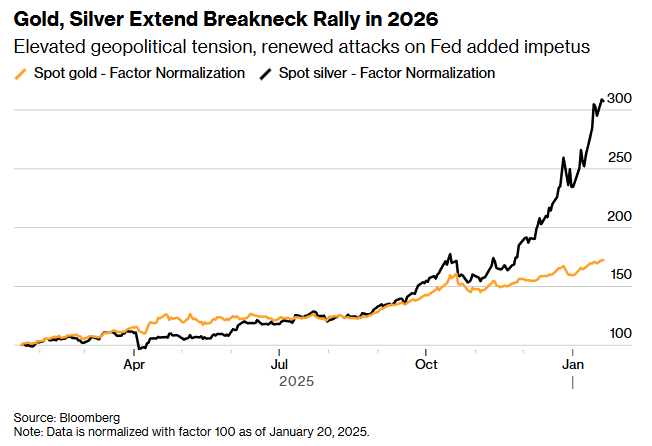
Core Viewpoint - The article highlights that spot gold has surpassed $4,700 per ounce, reaching a new historical high, driven by rising geopolitical uncertainties and market risk aversion [1][5]. Group 1: Gold and Silver Prices - Spot gold reached $4,705.720, marking an increase of $36.536 or 0.78% [2]. - COMEX silver futures rose by 6.49%, achieving a new high [1]. - COMEX gold was priced at $4,702.3, up by $25.6 or 0.55% [2]. Group 2: Geopolitical Factors - Increasing divisions between the US and Europe, along with geopolitical uncertainties, have heightened market risk aversion, contributing to the surge in gold prices [5]. - US President Trump emphasized the US's claim over Greenland, which has added to geopolitical tensions [6]. - Trump announced a 200% tariff on French wine and champagne, further escalating trade tensions [7]. Group 3: Market Outlook - Short-term geopolitical risks may see a temporary cooling after initial emotional responses, but uncertainties surrounding Trump's policies and potential actions remain high [8]. - The financial attributes related to future interest rate cuts are expected to support gold prices, with the independence of the Federal Reserve being crucial [8]. - Long-term factors regarding the credibility of the US dollar and the sustainability of US Treasury bonds continue to provide core support for gold pricing [8].

特朗普最新发声,黄金首次突破4700美元
21世纪经济报道· 2026-01-20 05:59
Group 1 - The core viewpoint of the article highlights the significant rise in spot gold prices, which have reached an all-time high of $4,700 per ounce, reflecting an increase of over 8% since the beginning of the year, translating to a gain of more than $380 [1][3] - The geopolitical risks and inflation pressures are driving investors towards gold as a safe-haven asset, reinforcing its traditional role in uncertain economic conditions [3] - The World Gold Council indicates that current gold prices reflect expectations of stable global economic growth and a cycle of interest rate cuts by major central banks, predicting that gold prices will fluctuate within a ±5% range in the short term [3] Group 2 - Analysts from Everbright Securities predict that gold will become an essential part of asset allocation by 2026, with a target price of $4,950 per ounce [3] - Recent geopolitical tensions, including potential tariffs on French wine and champagne by the U.S., contribute to the ongoing volatility and attractiveness of gold as an investment [3]

宝城期货贵金属有色早报(2026年1月20日)-20260120
Bao Cheng Qi Huo· 2026-01-20 05:27
Report Industry Investment Rating - Not provided in the content Core Viewpoints of the Report - Gold is expected to be strong in the long - term, with a short - term and mid - term strong trend and an intraday oscillating and slightly stronger trend. Copper is also projected to be strong in the long - term, with a mid - term strong trend, a short - term oscillating trend, and an intraday oscillating and slightly weaker trend [1] Summary by Related Catalogs Gold - **Price Performance**: Yesterday, New York gold opened high and went high, breaking last week's high and approaching $4700 per ounce, while Shanghai gold broke through 1050 yuan per gram [3] - **Driving Factors**: The direct trigger for the gold price increase is the sharp rise in geopolitical risks in "Greenland". The US-EU relationship has deteriorated, with the US threatening tariffs and military action, and the EU preparing retaliatory tariffs. The significant rise of silver has also driven up the price of gold, and the gold - silver ratio has dropped to around 50, a 14 - year low, attracting arbitrage funds into gold [3] - **Viewpoints**: Long - term strong, short - term and mid - term strong, intraday oscillating and slightly stronger. Monitor the long - short game at the $4700 level of New York gold [1][3] Copper - **Price Performance**: Yesterday, the copper price opened high and maintained an oscillating trend. On Monday morning, affected by the "Greenland" issue, the strong opening of precious metals boosted the long sentiment in the non - ferrous sector, causing the copper price to rebound from the bottom [4] - **Industrial Situation**: As the copper price declined, the willingness of some industries to replenish inventory increased slightly, but the social inventory continued to accumulate [4] - **Viewpoints**: Long - term strong, mid - term strong, short - term oscillating, intraday oscillating and slightly weaker. Pay attention to the support at the 100,000 level [1][4]
贵金属数据日报-20260120
Guo Mao Qi Huo· 2026-01-20 03:14
Group 1: Investment Rating - No relevant information provided Group 2: Core Views - Due to the Greenland issue, Trump threatened to impose tariffs on European super - countries starting from February 1st, and foreign media reported that Europe might counter. The dual uncertainties in geopolitics and trade have increased the market's risk - aversion demand, leading to a sharp rise in precious metal prices. The long - term upward logic of precious metals remains unchanged, and strategies should focus on buying on dips or selling out - of - the - money put options [4] - In the medium to long term, the Fed is in an easing cycle, geopolitical uncertainties will continue, and the US dollar credit risk will increase. The allocation demand of global central banks, institutions, and residents is expected to continue, so the medium - to - long - term price center of gold is likely to move up. Long - term investors are advised to buy on dips [5] Group 3: Summary by Directory 1. Price Tracking of Domestic and Foreign Gold and Silver - On January 19, 2026, London gold spot was $4674.54/ounce, London silver spot was $93.65/ounce, and compared with January 16, the price increases were 1.7% and 3.5% respectively. The prices of other gold and silver products also showed different degrees of increase [3] 2. Spread/Ratio - On January 19, 2026, the gold TD - SHFE active spread was - 2.88 yuan/gram, and the silver TD - SHFE active spread was - 40 yuan/kg. Compared with January 16, the changes were 35.8% and 185.7% respectively [3] 3. Position Data - As of January 16, 2026, the gold ETF - SPDR was 1085.67 tons, and the silver ETF - SLV was 16073.05851 tons. The non - commercial long positions of COMEX gold and silver also had different changes compared with January 15 [3] 4. Inventory Data - On January 19, 2026, the SHFE gold inventory was 99990.00 kg, and the SHFE silver inventory was 617760.00 kg, showing a decline compared with January 16 [3] 5. Interest Rate/Exchange Rate/Stock Market - On January 19, 2026, the US dollar/yuan central parity rate was 7.01, the US dollar index was 99.37, and other indicators also had slight changes compared with the previous period [3] 6. Market Review - On January 19, the main contract of Shanghai gold futures rose 1.54% to 1048.88 yuan/gram, and the main contract of Shanghai silver futures rose 2.75% to 20189 yuan/kg [3]
综合晨报-20260120
Guo Tou Qi Huo· 2026-01-20 02:42
Group 1: Energy and Metals Crude Oil - In December, domestic industrial crude oil production was 17.8 million tons, a 0.6% year-on-year decline, while processing volume was 62.46 million tons, a 5.0% year-on-year increase. Trump's suspension of military action against Iran led to a partial retreat of geopolitical risk premium. The global crude oil supply-demand structure in Q1 2026 shows significant inventory pressure, and supply surplus remains the main factor suppressing oil prices [1]. Precious Metals - Overnight, precious metals continued to be strong. Fed officials' negative attitude towards short - term interest rate cuts and geopolitical tensions in Iran and the Greenland issue maintain the bullish trend of precious metals [2]. Copper - Overnight, copper prices rebounded. LME US inventory registration and narrowing of the US - London spread affected the market. Domestic copper market is mainly in a "supply exceeds demand" situation, with social inventory reaching 329,400 tons. It is recommended to hold a combination of selling call options with an exercise price of 104,000 and buying put options with an exercise price of 98,000 [3]. Aluminum - Overnight, Shanghai aluminum continued to fluctuate. Social inventories of aluminum ingots and bars increased by 13,000 tons each on Monday, and spot feedback was weak. Shanghai aluminum fluctuates around 24,000 yuan, waiting for a driving factor [4]. Cast Aluminum Alloy - Cast aluminum alloy follows the fluctuation of Shanghai aluminum, with low market activity. Tight scrap aluminum supply and tax adjustments may increase costs in some areas. The seasonal performance of the price difference between cast aluminum alloy and Shanghai aluminum will continue to be weaker than in previous years [5]. Alumina - Domestic alumina operating capacity remains around 95 million tons, with no long - term production cuts. The alumina market is in significant surplus, with the average cash cost in Shanxi and Henan dropping to around 2,600 yuan. Spot prices are under pressure, and it is advisable to participate in short - selling when the basis is low [6]. Zinc - Zinc prices have corrected. Downstream acceptance is limited, and spot trading is weak. The weighted precipitation funds of Shanghai zinc have dropped to 5.1 billion yuan. Considering the import ore TC and downstream pre - holiday stocking demand, the short - term support is seen at 24,000 yuan/ton. The annual high is considered to be 25,600 yuan/ton, and it is advisable to short - sell on rallies [7]. Lead - The import window remains open. Both domestic and foreign markets are in a low - level consolidation due to oversupply. In late January, the resumption of production of domestic primary aluminum smelters is relatively concentrated, increasing supply pressure. The lower support for Shanghai lead is seen at 17,000 yuan/ton [7]. Nickel and Stainless Steel - Shanghai nickel is oscillating at a high level, and the market is active. Stainless steel is in the traditional off - season, with high - level transactions blocked. The negative feedback risk is accumulating. Short - term sentiment is high, and it is advisable to maintain a bullish mindset [8]. Tin - Overnight, domestic and foreign tin prices rebounded. LME tin ingot inventory increased to 6,440 tons, and the spot discount widened to $104. The long - side focuses on factors such as tight ore supply, while the short - side focuses on the reality of restricted demand. It is advisable to hold short - call options at a high level [9]. Lithium Carbonate - Lithium carbonate is weakly oscillating, and the market is active. Downstream acceptance of high prices is weak. The overall inventory reduction speed has slowed down significantly. The futures price is in a high - level oscillation, with high short - term uncertainty [10]. Group 2: Steel and Related Products Rebar and Hot - Rolled Coil - Night - session steel prices mainly oscillated. Rebar apparent demand increased slightly, production decreased slightly, and inventory accumulation slowed down. Hot - rolled coil demand improved, production increased slightly, and inventory continued to decline. Steel prices are expected to oscillate within a range, and it is necessary to pay attention to market trends [11]. Iron Ore - Overnight, the iron ore futures market oscillated, and the basis narrowed recently. Supply is in line with seasonal patterns, with a decline in shipments from Australia and Brazil but an increase in non - mainstream shipments. Domestic arrivals decreased. Demand is affected by potential disruptions to iron - making production. The market is expected to oscillate weakly in the short term [12]. Coke - The daily price mainly oscillated. The first round of coke price increase is expected to be implemented this week. Coke production decreased slightly, and inventory increased slightly. The market is expected to oscillate weakly, affected by factors such as coal inventory and policies [13]. Coking Coal - The daily price mainly oscillated. Mongolian coal customs clearance was 1,465 tons. Coking coal production increased significantly, terminal inventory increased, and total inventory increased slightly. The market is expected to oscillate weakly, affected by inventory and policies [14]. Manganese Silicon - The daily price oscillated downward. There are structural problems in manganese ore port inventory. Iron - making production decreased seasonally, and silicon - manganese production and inventory decreased slightly. It is necessary to pay attention to relevant impacts and cost support [15]. Silicon Iron - The daily price oscillated downward. Affected by policies, the price is relatively strong. There are expectations of a decrease in power and raw material costs. Iron - making production rebounded, and overall demand is still resilient. Supply decreased significantly, and inventory decreased slightly. It is necessary to pay attention to relevant impacts and cost support [16]. Group 3: Shipping and Fuels Container Freight Index (European Line) - The inflection point of spot freight rates has been confirmed, leading the futures market into a weak trend. The near - month contract is affected by the actual "rush - shipping" intensity due to export - tax policy adjustments. The 04 contract may oscillate in the short term, and the far - month contract is suppressed by the resumption - of - shipping expectation. Contract rules will be adjusted [17]. Fuel Oil and Low - Sulfur Fuel Oil - Geopolitical tensions continue to affect the fuel oil market. Geopolitical risks are expected to support the high - sulfur cracking spread, but the supply of high - sulfur heavy - raw materials will tend to be loose in the medium term. The supply of low - sulfur fuel oil is expected to increase, and its weak pattern is expected to continue [18]. Asphalt - Asphalt prices follow crude oil but with limited amplitude. The arrival of Venezuelan crude oil needs to be closely monitored. The market is in an oscillating range [19]. Group 4: Chemicals Urea - Urea production has increased, and downstream demand has also improved. The short - term market may decline slightly, but with the start of agricultural demand, the market is expected to oscillate strongly within a range [20]. Methanol - Methanol prices continued to decline at night. Import arrivals decreased significantly, and port inventory decreased. However, demand from some olefin plants decreased, and the market is expected to oscillate in a stalemate. The expected significant reduction in imports in Q1 provides support [21]. Pure Benzene - Pure benzene prices continued to oscillate strongly at night. Domestic refinery production cuts and reduced imports, along with increased downstream demand, led to a significant reduction in East China port inventory. The short - term market is expected to oscillate strongly [22]. Styrene - Styrene is in a tight - balance state, with limited port arrivals and expected inventory reduction. Domestic production enterprises have good sales, and exports provide some support [23]. Polypropylene, Plastic, and Propylene - The supply of propylene is tight in the short term, but downstream purchasing willingness is limited due to high costs. The demand support for polyethylene is expected to weaken, and the supply - demand fundamentals of polypropylene may lack upward driving force [24]. PVC and Caustic Soda - PVC prices are weakening, with a decline in production capacity utilization. The cost is rising, and it is expected to go through capacity reduction. It is advisable to adopt a low - buying strategy. Caustic soda is operating weakly, with high inventory pressure [25]. PX and PTA - Before and after the Spring Festival, PX has limited upward - driving force, and PTA follows the raw material. In Q2, considering PX maintenance and polyester production increase, there are opportunities for long - term PX processing spreads and positive spreads. PTA processing spreads will moderately recover in the new year [26]. Ethylene Glycol - Domestic new ethylene - glycol plants are put into operation, and overseas plants are shutting down. Supply is expected to increase domestically and decrease overseas. In Q2, there are expectations of concentrated maintenance and demand recovery, but the long - term outlook is under pressure due to capacity growth [27]. Short - Fiber and Bottle Chips - Short - fiber enterprises have high production loads and low inventories. Downstream orders are weak, and prices follow the raw material. Bottle - chip production has decreased, and processing spreads have recovered, but there is long - term capacity pressure [28]. Glass - Glass prices declined due to new ignition plans. The industry is in a state of inventory reduction, but supply may increase slightly. Processing orders are weak, and the market may enter a seasonal inventory - accumulation period. It is advisable to consider long - buying opportunities when the price drops to around 1,000 yuan [29]. 20 - Rubber, Natural Rubber, and Butadiene Rubber - International crude oil prices oscillate, and Thai raw - material prices decline. Natural - rubber supply is decreasing, and demand is gradually recovering. Synthetic - rubber supply is increasing, and inventory trends are different. It is advisable to adopt a wait - and - see strategy [30]. Soda Ash - Soda ash is operating weakly, with high inventory pressure. Production may decline slightly in the short term, but long - term supply pressure is large. It is advisable to short - sell on rallies and wait and see when the price drops to the cost level [31]. Group 5: Agricultural Products Soybeans and Soybean Meal - US soybeans were closed for the Martin Luther King Jr. Day. South American weather has improved, increasing the probability of ENSO neutrality. US soybean exports have strengthened. In China, soybean crushing is expected to increase in January. It is necessary to pay attention to US soybean exports and South American weather [32]. Soybean Oil and Palm Oil - Palm oil export data shows an increase, and production shows a decrease, which is beneficial for inventory reduction. For soybean oil, it is necessary to pay attention to the actual demand for US biodiesel. The overall outlook for soybean and palm oil is an oscillating range [33]. Rapeseed Meal and Rapeseed Oil - China and Canada have reached a preliminary arrangement on trade issues. If the import policy of Canadian rapeseed and rapeseed meal improves as expected before March 1, it is expected to drive purchases. The short - term view on rapeseed products is bearish [34]. Soybean No. 1 - Domestic soybeans are oscillating. Policy - driven auction results have a guiding effect on prices. The supply of grassroots grain sources is tight, and high prices suppress demand. It is necessary to pay attention to policies and the spot market [35]. Corn - Snow in Northeast China boosts the bullish sentiment, and transportation of grassroots grain is difficult. Corn prices in Northeast China and northern ports are strong. However, increased auctions by state and local reserves may form pressure. Dalian corn futures are expected to oscillate weakly in the short term [36]. Live Pigs - On Monday, the sentiment of live - pig futures changed significantly. After a weekend increase in prices, the futures prices dropped in the afternoon. The short - term rebound may be over. The industry capacity is showing signs of contraction, and pig prices are expected to reach a low point in the first half of next year [37]. Eggs - After the New Year's Day, egg spot prices have been strengthening. The futures prices have followed the spot, but on Monday, the futures prices dropped significantly. In the long - term, the inventory of laying hens is expected to decline, and it is advisable to adopt a long - buying strategy on dips [38]. Cotton - Zhengzhou cotton prices continued to correct. After the previous rise, the positive factors have been mostly reflected. Downstream demand is average, and the reduction in Xinjiang's planting area needs further observation. It is advisable to adopt a wait - and - see strategy [39]. Sugar - Overnight, US sugar prices oscillated. India's sugar production is progressing rapidly, while Thailand's is slow. In China, the market focus is on the expected difference in production. Guangxi's production is slow, but there is a strong expectation of an increase in the 2025/26 season, and the rebound of Zhengzhou sugar is expected to be limited [40]. Apples - Futures prices have corrected. Spot market transactions for the Spring Festival are increasing, but the quality of apples is poor, and the high purchase price and strong reluctance to sell may affect inventory reduction. It is necessary to pay attention to future demand [41]. Wood - Futures prices are at a low level. Supply is expected to decrease in the short term, and demand has increased compared to the same period last year. Low inventory provides some support, and it is advisable to adopt a wait - and - see strategy [42]. Pulp - Pulp futures prices were basically flat. The short - term fundamentals are average due to weak downstream demand. Inventory is accumulating, and the price difference between softwood and hardwood pulp is narrowing. Paper mills purchase pulp for immediate needs. It is advisable to adopt a wait - and - see strategy [43]. Group 6: Financial Products Stock Index - Yesterday, China's A - share indices had mixed performance, and futures indices mostly rose. The geopolitical situation has increased the risk - aversion sentiment. The stock - index trend is expected to change from a one - way increase to an oscillatingly strong trend, with a slower upward slope. It is necessary to pay attention to the transition from liquidity - driven to profit - driven and geopolitical impacts [44]. Treasury Bonds - On January 19, 2026, 30 - year treasury - bond futures led the decline. The first structural "interest - rate cut" of the year was implemented. The central bank adjusted the minimum down - payment ratio for commercial - housing loans and carried out reverse - repurchase operations. The money market is gradually becoming loose, but the short - term downward space for interest rates may be limited during the tax - payment period [45].
贵金属日评-20260120
Jian Xin Qi Huo· 2026-01-20 02:31
1. Report Industry Investment Rating - No information provided in the content 2. Core Viewpoints of the Report - In 2026, precious metals, especially industrial precious metals, will continue to be strong. Investors are advised to take a long - biased approach but control the position size, and short hedgers should appropriately reduce the hedging ratio [4][5] 3. Summary by Relevant Catalogs Precious Metals Market Conditions and Outlook Intraday Market - Trump's threat to impose tariffs on eight European countries due to the Greenland issue has increased geopolitical risks, pushing up the prices of gold and silver in the Asian session on the 19th. London gold approached the $4700 per ounce mark. The adjustment risk in precious metals was fully released in the late December 2025 correction. This week, attention should be paid to China's annual GDP, US November PCE inflation, the Bank of Japan's interest - rate meeting, the Greenland issue, and the US Supreme Court's ruling on Trump's tariff measures [4] - The previous closing prices, highest prices, lowest prices, closing prices, price change percentages, open interest, and changes in open interest of domestic precious metal contracts such as the Shanghai Gold Index, Shanghai Silver Index, Guangzhou Platinum Index, and Guangzhou Palladium Index are presented [5] Medium - term Market - Trump will focus on consolidating the geopolitical strategic space in the Western Hemisphere in 2026, which may lead to a significant increase in geopolitical risks. The restructuring of the global political and economic landscape and the loose monetary policies of central banks will continue to boost the demand for reserve diversification, strategic value, and liquidity premium of the precious metal sector. In 2026, the precious metal sector will continue the medium - term upward trend since 2024. Silver and platinum will outperform gold, but the large influx of investment funds will also significantly increase price volatility. Investors are recommended to take a long - biased approach, and conservative traders can consider cross - product arbitrage. Long hedgers should hedge in batches as soon as possible, and short hedgers should appropriately reduce the hedging ratio [5] Main Macroeconomic Events/Data - Trump plans to impose a 10% import tariff on goods from eight European countries on February 1st, increasing to 25% on June 1st until the US reaches an agreement to purchase Greenland. EU countries may impose tariffs worth 93 billion euros on the US or restrict US companies from entering the EU market [16] - Canada and China have reached a preliminary trade agreement to cut tariffs on electric vehicles and rapeseed. Canada will allow up to 49,000 Chinese electric vehicles to enter at a 6.1% tariff rate, and China will lower the tariff rate on Canadian rapeseed to about 15% by March 1st. Trump supports Canadian Prime Minister Carney [16] - Trump may keep economic advisor Hassett in his position. He is considering candidates for the next Fed Chair. Fed Vice - Chair for Supervision Bowman said the weak job market may deteriorate rapidly and the Fed should be ready to cut rates again if necessary. Fed Vice - Chair Jefferson signaled support for keeping rates unchanged in the January meeting and is cautiously optimistic about the economy, labor market, and inflation in the coming year [17]
格陵兰争端持续发酵!白银再创新高 黄金交投于纪录高位
智通财经网· 2026-01-20 02:13
Lombard Odier Asset Management宏观研究主管弗洛里安·伊尔波(Florian Ielpo)表示:"短期内,任何通过 对欧洲加征关税的意外升级,都可能引发典型的避险情绪,尤其是在今年开局强劲、市场情绪乐观的背 景下。""在这种情况下,政府债券可能受益,优质资产或将跑赢,黄金也可能受到追捧。" 智通财经APP获悉,在美国总统特朗普企图接管格陵兰的举动引发美欧贸易战担忧、令市场情绪持续紧 绷之际,白银价格创下历史新高,黄金则在纪录高位附近交投。数据显示,周二,白银一度触及每盎司 94.7295美元的历史高点,黄金则徘徊在每盎司4,670美元附近。 当地时间1月17日,特朗普在社交媒体上宣布,将从2月1日起对来自丹麦、挪威、瑞典、法国、德国、 英国、荷兰和芬兰的输美商品加征10%关税,并宣称加征关税的税率将从6月1日起提高至25%,直到相 关方就美国"全面、彻底购买格陵兰岛"达成协议。 美国对其北约盟友采取的强硬立场震动了市场,提振了避险需求,并重新激活"抛售美国资产"的交易逻 辑。投资者目前正等待欧洲方面将作何回应。 当地时间1月18日,欧盟召开紧急会议,就反制方案可行性进行磋商。方案之 ...
银河期货沥青周报-20260120
Yin He Qi Huo· 2026-01-20 02:03
Report Summary 1. Investment Rating No investment rating for the industry is provided in the report. 2. Core Viewpoints - After the escalation and subsequent decline of the Iran situation, geopolitical risks have fluctuated more widely. The impact of the Venezuelan situation on oil prices has been gradually digested by the market, and the expectation of tight supply of asphalt raw materials has eased. However, the increase in raw material discounts has not been fully priced in, leading to high - level oscillations in asphalt. In terms of supply and demand, the off - season at the beginning of the year has arrived as expected, with both weekly supply and demand decreasing month - on - month. The industrial chain inventory remains at a low level, and the spot price is relatively firm. In the short term, the futures market is expected to oscillate at a high level [5]. - For trading strategies, the single - side trading of asphalt is expected to oscillate at a high level with increased geopolitical risk fluctuations. Attention should be paid to the positive spread arbitrage between BU4 - 6, and it is recommended to wait and see for options trading [6]. 3. Summary by Directory 3.1 Chapter 1: Comprehensive Analysis and Trading Strategies - **Comprehensive Analysis**: Geopolitical risks lead to increased cost fluctuations. The supply and demand of asphalt are in the off - season, with inventory at a low level and the spot price remaining firm. The futures market is expected to oscillate at a high level [5]. - **Trading Strategies**: Single - side trading: high - level oscillation with increased geopolitical risk fluctuations; Arbitrage: focus on BU4 - 6 positive spread arbitrage; Options: wait and see [6]. 3.2 Chapter 2: Core Logic Analysis - **Cost and Supply**: The cost is strengthening, and the supply is at a low level. The price of asphalt in some regions has increased, and the overall market price has continued to rise. The increase in crude oil prices and the reduction in supply in some areas have led to price increases in North China, Shandong, and other regions [11]. - **Price Movement**: The price of asphalt in the market has continued to rise. The prices in Northeast, North China, Shandong, the Yangtze River Delta, and Southwest (Sichuan and Chongqing) regions have increased by 5 - 40 yuan/ton, while prices in other regions have remained stable. The rise in crude oil and futures prices, as well as supply - demand factors in different regions, have supported the price increase [11]. - **Cost and Profit**: Geopolitical instability has increased cost fluctuations. The Brent main contract is expected to fluctuate between 61 - 64 US dollars. As of January 9, the theoretical processing profit of asphalt refineries was 55 yuan/ton, a decrease of 22 yuan/ton compared to the previous week. The basis of asphalt in different regions has changed to varying degrees [14]. - **Production**: The overall production of asphalt has increased slightly month - on - month. The production in the Northwest region has increased significantly, while that in the Northeast region has decreased slightly. The production in other regions has shown different degrees of change [16][17]. - **Inventory**: The refinery inventory has remained at a low level, with a slight increase in the overall inventory. The social inventory has increased steadily due to the storage of winter - reserve resources. Different regions have shown different inventory trends due to factors such as production, demand, and resource storage [19][20][22]. 3.3 Chapter 3: Weekly Data Tracking - **Price and Spread**: The closing price of the asphalt main contract, Brent crude oil, and the prices of asphalt in different regions have shown certain fluctuations. The basis and profit margins of asphalt refineries and refined oil refineries have also changed [25]. - **Supply and Demand Data**: The refinery operating rate has increased slightly, the refinery inventory rate has increased slightly, the social inventory rate has increased slightly, the refinery weekly output has increased, and the refinery shipment volume has also changed [25].