中美经贸谈判

Search documents
大宗商品周度报告:风偏高位叠加旺季预期支撑商品或偏稳运行-20250922
Guo Tou Qi Huo· 2025-09-22 11:34
Report Information - Report Title: Commodity Weekly Report - Report Date: September 22, 2025 - Analyst: Hu Jingyi from Guotou Futures - Investment Consulting Number: Z0019749 - Futures Practitioner Qualification Number: F03090299 [1][5] 1. Report Industry Investment Rating - No industry investment rating is provided in the report. 2. Core Viewpoints - The commodity market rose 0.24% last week, with the black sector leading the gain at 2.27%. The Fed's 25bp rate cut and relatively stable Sino-US economic and trade negotiations create a neutral and warm macro - environment. With the support of the consumer peak season and pre - holiday restocking, the commodity market may run stably in the short term. Precious metals are likely to remain easy to rise and difficult to fall, while the short - term trend of other sectors varies [2]. 3. Summary by Directory 3.1 Market Review - **Overall Market Performance**: The commodity market rose 0.24% last week, with the black sector up 2.27%, energy and chemicals up 1.42%, and precious metals, agricultural products, and non - ferrous metals down 0.8%, 0.78%, and 0.66% respectively. The top - rising varieties were coking coal, coke, and glass, while the top - falling ones were live pigs, soybean meal, and tin. The 20 - day average volatility of the commodity market rebounded, and only the black and agricultural product sectors had net capital inflows [2][7]. - **Market Data Charts**: There are multiple charts showing the performance of different sectors and varieties, including the rise and fall of the Nanhua Index, the weekly contribution rate of each sector of the China Securities Commodity Index, the fluctuation of each variety's main contract, the performance of commodity - related sector indexes, the precipitation funds of each commodity sector, the weekly precipitation fund changes of each variety, the average trading - to - holding ratio of each variety, macro - high - frequency data, relevant ratios, and black - industry chain ratios [8][10][12] 3.2 Outlook for Different Sectors - **Precious Metals**: After the Fed's rate cut, the sector initially corrected due to profit - taking but rebounded on the dovish remarks of the new Fed governor. It is likely to remain easy to rise and difficult to fall in the short term [2]. - **Non - ferrous Metals**: After the Fed's rate cut, the previous bullish sentiment cooled, but the restart of rate cuts still provides short - term support. With the pre - holiday restocking and improving macro - sentiment, the sector may run stably in the short term [3]. - **Black Sector**: The apparent demand for rebar improved, production continued to decline, and inventory decreased slightly. Steel mills have pre - holiday restocking needs, but low profit per ton restricts further production resumption. The iron ore port inventory decreased, and the coking coal's capacity expansion is less likely. The sector fluctuates with policy expectations [3]. - **Energy Sector**: Oil prices rose and then fell last week. The Fed's 25bp rate cut did not bring unexpected benefits, and the supply - demand contradiction after the peak oil - consumption season will gradually intensify. Geopolitical factors may cause short - term supply disruptions, but the premium space is limited. Trump's statement to lower oil prices also affects market sentiment. Oil prices may fluctuate weakly in the short term [3]. - **Chemical Sector**: For polyester, the weaving load decreased slightly, and filament inventory continued to accumulate. The downstream has pre - holiday stocking expectations, but cost support is weak. Building materials such as glass and PVC still face high - supply and low - demand situations, and attention should be paid to pre - holiday restocking demand [4]. - **Agricultural Products**: The actual export demand for US soybeans was poor, and the Sino - US call did not mention agricultural product trade. The overseas palm oil export data in the first half of September was inconsistent. The short - term domestic supply of oils and fats is relatively loose, and the sector may run in a volatile manner [4]. 3.3 Commodity Fund Overview - The report provides information on various commodity ETFs, including net value, weekly return, scale, share change, trading volume, trading volume change, and underlying assets. Gold - related ETFs have different performance in terms of return and scale change, and other commodity ETFs such as energy - chemical and agricultural - product - related ones also show different trends [41]
国庆前后市场怎么走?日历效应如何?十大券商最新研判
Ge Long Hui· 2025-09-21 23:32
Market Overview - The market experienced fluctuations last week, with the Shanghai Composite Index falling by 1.30%, while sectors like power equipment, electronics, and communications continued to lead in gains, contrasting with stagnant performance in banking, non-banking, and food and beverage sectors [1] Broker Insights - Guotai Junan Securities believes that the recent market adjustment presents an opportunity, asserting that the Chinese stock market will not stagnate and is expected to reach new highs, driven by favorable conditions such as a stable short-term risk outlook and potential capital market reforms [1] - Guojin Securities indicates that a bull market may be in the making, with opportunities arising from the easing of liquidity constraints and a shift towards cyclical manufacturing sectors like non-ferrous metals, machinery, and chemicals [2] - Zheshang Securities suggests a period of consolidation for the Shanghai Composite Index, recommending a cautious approach to investment and a focus on sectors like hard technology and infrastructure [3] - Everbright Securities anticipates continued market fluctuations leading up to the National Day holiday, with a tendency for funds to secure profits amid uncertainties [4] - According to China Merchants Securities, historical patterns suggest that financing activities typically contract before the holiday and surge afterward, with a focus on sectors like solid-state batteries and AI [5] - Industrial rotation is emphasized by Industrial Securities, advocating for a diversified approach to investment to navigate market volatility [6][7] - CITIC Construction Investment highlights the clarity in future market trends following the Federal Reserve's interest rate cuts, with a focus on AI and domestic demand recovery [8] - Huaxia Securities maintains a positive long-term outlook despite short-term fluctuations, emphasizing the importance of sectors like AI and essential materials [9] - Galaxy Securities recommends four investment themes in the construction sector, focusing on urban renewal and digital transformation in construction [10]
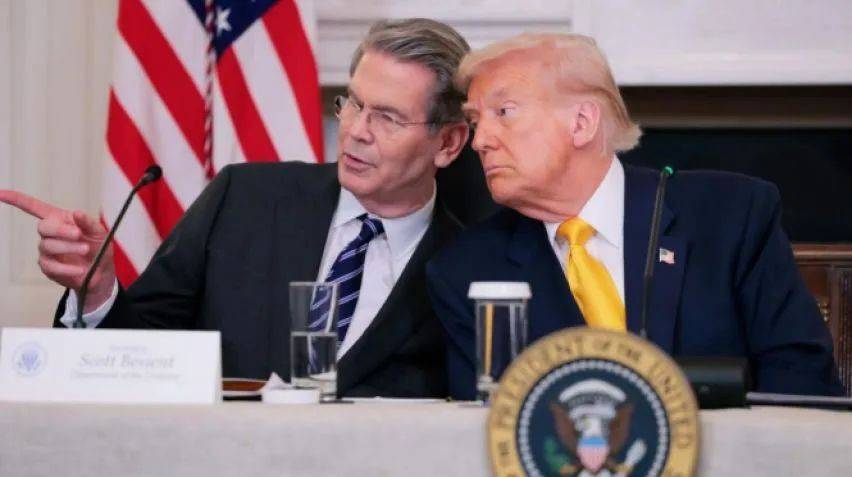
谈判结束后,美国财长公开表示,可以不对中国加征关税,但有一个前提
Sou Hu Cai Jing· 2025-09-17 04:59
Group 1 - The core viewpoint of the article highlights the ongoing psychological game between China and the U.S. regarding trade and technology issues, with both sides reaching a framework agreement but underlying tensions remaining evident [1][5] - China's delegation emphasized three points: opposition to politicizing trade and technology issues, the necessity of legal approval for any technology exports, and a reaffirmation of the "mutual benefit" principle, which directly responds to the U.S. expanding its sanctions against China [1][5] - U.S. Treasury Secretary Bessent's comments complicated the situation, suggesting that while the U.S. could refrain from imposing tariffs on China for purchasing Russian oil, this was contingent on Europe not taking similar actions, indicating a pressure tactic directed at Europe [1][5] Group 2 - Europe's stance is not as straightforward as the U.S. hopes, as evidenced by Germany's refusal to impose 100% tariffs on China and India due to deep trade ties, which could harm its own economy [3] - European countries face a dilemma of wanting to pressure Moscow while ensuring their economic interests are not compromised, particularly in energy relations with Russia [3][5] - The ongoing negotiations for a free trade agreement with India further illustrate Europe's struggle to balance cooperation with the U.S. against its own economic stability [3] Group 3 - The U.S. aims to leverage this situation to undermine Russia while promoting its own energy exports, particularly liquefied natural gas, to Europe, positioning itself as a key supplier [5] - Despite reaching a framework agreement, the underlying disputes between the U.S. and China remain unresolved, with Bessent's promise of no new tariffs acting as a potential threat rather than a guarantee [5][7] - The upcoming deadline for tariff negotiations on November 10 could lead to significant changes in the dynamics of U.S.-China relations, with both sides seeking a mutually acceptable set of rules [7][8]

深夜:突发7个重磅消息,明天周三大概率会这么走!
Sou Hu Cai Jing· 2025-09-16 15:10
Market Overview - The US stock market is currently in a cautious state, with major indices remaining flat and individual stocks showing mixed performance, reflecting market apprehension towards the Federal Reserve's decisions [1] - The market anticipates at least a 25 basis point rate cut from the Federal Reserve, but uncertainty remains due to inflation not returning to the 2% target despite signs of employment weakness [1] A-Share Market - The A-share market is also exhibiting caution, with various positive news such as domestic substitution and new energy developments failing to push the index above 3900 points [2] - There is a prevailing sentiment of concern in the market, and without significant positive catalysts, the market is likely to remain volatile [2] Industry Developments - Yushutech and State Grid Hangzhou Power Supply signed a framework cooperation agreement focusing on "Electricity + Embodied Intelligence," aiming to promote the integration of AI and energy sectors [5] - Tencent is accelerating its infrastructure development and global expansion, adapting its products to fit global technology ecosystems, which is beneficial for both Tencent and the AI industry [6] - The US and China are engaging in economic negotiations in Madrid, reaching preliminary consensus on issues related to TikTok, which may help alleviate investment barriers and enhance economic cooperation [7] - CATL launched its first sodium-ion battery certified by new national standards, which, while having slightly lower energy density than lithium batteries, offers advantages in low-temperature performance, carbon emissions, and safety, potentially reducing reliance on lithium resources [9] - Data shows that the growth rate of household deposits in August was approximately 9.8%, indicating a shift towards investment channels like the stock market, especially in anticipation of potential interest rate cuts [10] - The successful launch of a satellite by the Jiuquan Satellite Launch Center marks the 595th flight of the Long March series rockets, showcasing advancements in satellite internet technology [10] - According to CINNO Research, the revenue of the top ten global semiconductor equipment manufacturers is expected to exceed $64 billion in the first half of 2025, reflecting a year-on-year growth of approximately 24% [10]



如何看待科技板块再度上涨?
ZHONGTAI SECURITIES· 2025-09-15 08:05
Group 1: Market Review - Most major market indices rose last week, with the STAR 50 having the largest increase of 5.48% [7][8][13] - In terms of major industry performance, the real estate and information technology indices performed relatively well, with weekly changes of 6.05% and 4.94% respectively. The healthcare and financial indices performed weakly, with weekly changes of -0.28% and -0.20% respectively [7][8][13] - Among the 30 Shenwan primary industries, 26 industries rose. The industries with larger increases were electronics, real estate, and agriculture, forestry, animal husbandry, and fishery, rising 6.15%, 5.98%, and 4.81% respectively. The industries with larger declines were banks, petroleum and petrochemicals, and pharmaceuticals and biotechnology, falling 0.66%, 0.41%, and 0.36% respectively [7][14][15] - Last week, the average daily trading volume of the Wind All - A was 23,264.15 billion yuan (the previous value was 26,032.01 billion yuan), at a very high historical level (96.00% of the three - year historical quantile) [7][18] - As of September 12, 2025, the valuation (PE_TTM) of the Wind All - A was 22.25, up 0.38 from last week, at the 90.20% of the historical quantile (in the past 5 years). Among industries, 26 out of 30 Shenwan primary industries saw valuation (PE_TTM) repairs [7][22] Group 2: Market Observation How to view the recent upward movement of the A - share technology sector? - The current market's focus is on whether the technology sector can continue to lead the market. The policy has identified technological innovation and new - quality productivity as the main lines, and the Fourth Plenary Session in October is expected to clarify the direction. Overseas, the industrial logic of AI, computing power, and semiconductors is still in the expansion phase. Although there are phased redemptions of ETFs such as the STAR Market, northbound capital trading remains high, and margin trading balances have reached new highs, indicating that funds are adjusting their structures rather than exiting. However, there is a redemption trend in STAR and ChiNext ETFs, and industrial capital is reducing holdings at high levels, indicating continued pressure for funds to realize profits [5] - In terms of capital, long - term funds are providing support, leveraged funds are continuously flowing in, and some industrial capital is taking profits. As of September 11, the margin trading balance was 2.34 trillion yuan, still at a historical high. The average market guarantee ratio remained at around 287.25%, indicating generally optimistic investor sentiment. The subscription scale of ETFs such as the Dividend Index, CSI 300, CSI 500, and ChiNext Index turned positive last week, showing that long - term funds have increased their allocation to low - level weights and high - dividend directions and still firmly hold the technology main line. Northbound capital's average daily trading volume remained above 250 billion yuan last week. The STAR Market still has capital divergence, with STAR Market ETFs continuing net redemptions last week, in contrast to the net subscriptions of ChiNext ETFs. In the second week of September, the net reduction of major shareholders was about 16.355 billion yuan, a significant increase from the first week of September [5] - External events may boost the technology main line. In mid - to late September, if the China - US economic and trade negotiations achieve substantial results, it may boost investor sentiment. The Fourth Plenary Session in October is expected to focus on technological innovation and new - quality productivity, strengthening long - term technology industry policy expectations. In the short term, due to stricter restrictions from Anthropic on Chinese - related enterprises, the domestic substitution logic (such as AI applications like kimi) is expected to continue to attract market attention. Oracle's better - than - expected performance in the US has driven the overseas AI industry chain, which may also have a spill - over effect on related A/H stocks [5] Policy signals and market characteristics - The recent advancement of financial anti - corruption has sent a clear policy signal that risk prevention is the primary principle of financial supervision. The market expects policy support for the capital market, but the regulatory tolerance for leverage and bubbles has decreased. This round of the market is more likely to show a "zig - zag and rapid rotation" structural characteristic rather than a comprehensive bubble - driven bull market in 2015. Future market constraints include changes in the proportion of leveraged funds, overall valuation levels (stock - bond cost - effectiveness), and interest rate pressure from local government debt [6] Investment suggestions - The level of this round of adjustment is generally similar to that in mid - December last year. In the short term, the adjustment of high - level technology, growth, and small - and medium - cap sectors is not yet complete, and it is not suitable to chase high. If the market declines again, opportunities can be seized to lay out brokerage firms and some technology leaders at low levels. Currently, the allocation focus should be on defensive directions, including high - to - low rotations within the technology sector, dividend sectors (such as electricity), cyclical sectors, and Hang Seng Technology favored by foreign capital [6] Group 3: Economic Calendar - This week's domestic economic data includes the year - on - year change in the housing price index of 70 large and medium - sized cities in China, the unemployment rate, the year - on - year and cumulative year - on - year changes in total retail sales of consumer goods, and the cumulative year - on - year change in urban fixed - asset investment [24] - Overseas economic data includes the month - on - month change in US core retail sales, the year - on - year change in US retail sales, the year - on - year change in US industrial output, the Atlanta Fed's GDPNow economic growth forecast, the one - year forecast of the US federal funds rate, the Fed's interest rate decision, the Fed FOMC's economic forecast, and the Fed FOMC's monetary policy statement [24]
贵金属再度强势上涨,但短期需警惕波动加剧风险
Guo Mao Qi Huo· 2025-09-15 07:53
Report Investment Rating - No investment rating for the industry is provided in the report. Core Viewpoints - Last week, gold and silver continued their strong upward trend, with silver showing a more robust performance. The weakening employment and consumer confidence in the US, along with limited inflation recovery, strengthened the expectation of a Fed rate cut in September, boosting precious metal prices. Silver also showed a significant catch - up effect. [2] - In the short term, with the almost certain rate cut in September, precious metal prices are expected to remain high and strong. However, the recent rise may have fully priced in the September rate - cut expectation, so there is a risk of "buy the rumor, sell the fact," and short - term market volatility may intensify. [4] - In the long term, gold prices still have upward potential due to factors such as the high probability of a Fed rate cut in September, global geopolitical instability, intensifying anti - globalization, and the weakening of the US dollar's credit, which support central banks' net gold purchases. [4] Summary by Directory PART ONE: Market and Fundamental Indicator Tracking - **Price Movements**: Last week, London spot gold broke through the $3650/ounce mark, and Shanghai gold futures' main contract exceeded 840 yuan/kg, both hitting new highs. London silver broke through the $42/ounce mark, and Shanghai silver futures' main contract exceeded 10,000 yuan/kg, reaching a high since the end of December 2012. [2] - **Data Metrics**: For gold, London spot gold rose 1.58% week - on - week, and Shanghai gold's main contract rose 2.28%. For silver, London spot silver rose 2.91% week - on - week, and Shanghai silver's main contract rose 2.27%. There were also changes in various indicators such as basis, spread, ETF holdings, and inventory. [3] PART TWO: Main Macroeconomic Indicator Tracking - **US Economic Indicators** - **GDP**: The US second - degree GDP growth was strong, but consumer confidence declined again. Manufacturing and service PMI both dropped, and retail sales data showed mixed trends. [55][56] - **Employment**: The employment market cooled significantly. The August non - farm payrolls were weak, the unemployment rate rose, job vacancies decreased, labor participation increased, and wage growth slowed down both month - on - month and year - on - year. [62][66] - **Inflation**: There was a rising pressure on inflation. Core commodity inflation increased, while core service inflation decreased. Consumer inflation expectations also rose significantly. [68][71] - **European Economic Indicators** - **Eurozone**: The Eurozone's manufacturing PMI recovered, while the service PMI declined. GDP showed a bottom - up trend, and inflation data in the Eurozone and the UK were also presented. [75][77] - **Central Bank Gold Purchases** - China's central bank has been increasing its gold reserves for 10 consecutive months. As of the end of August, China's gold reserves were about 2302.279 tons, with a month - on - month increase of about 1.87 tons. [85] - Global central banks maintained net gold purchases in 2025. In the first half of 2025, they net - purchased 415.1 tons of gold, a year - on - year decrease of about 20.4%. [85]
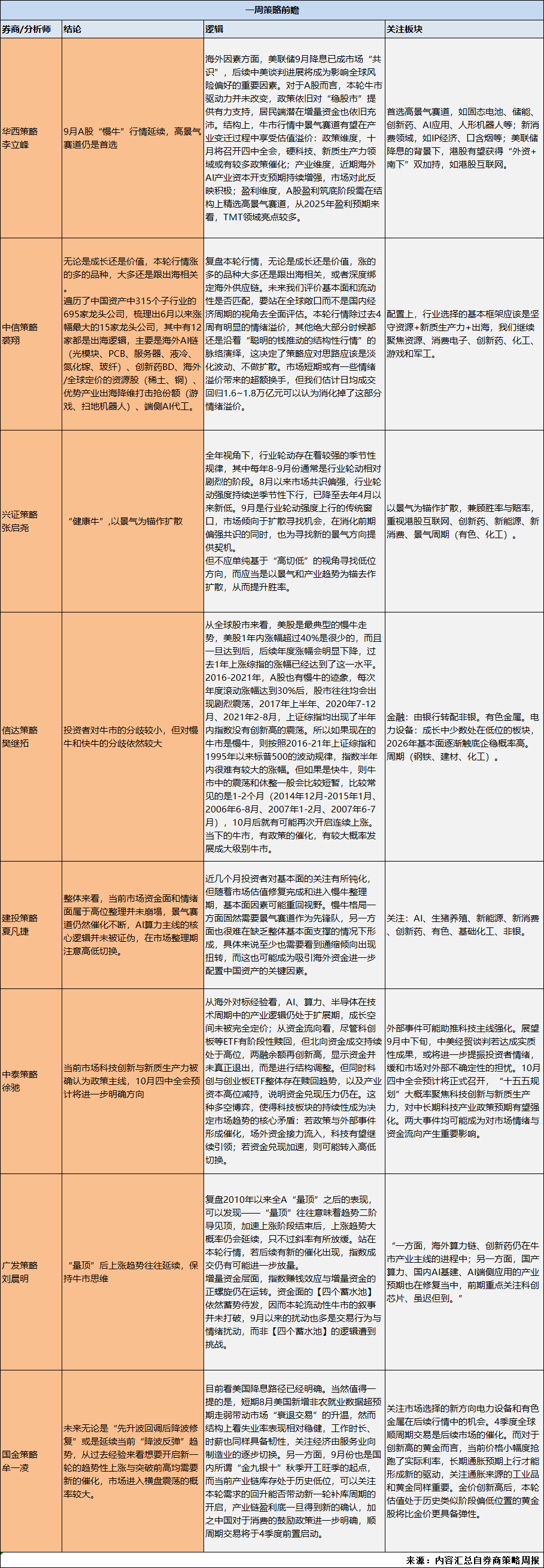
A股分析师前瞻:“慢牛”行情或延续,高景气赛道仍是首选
Xuan Gu Bao· 2025-09-14 14:08
Group 1 - The core viewpoint is that the A-share market is experiencing a "slow bull" trend, with high-growth sectors being the preferred choice for investment [1][2] - Policy support is expected to strengthen with the upcoming Fourth Plenary Session in October, particularly in hard technology and new productivity sectors [1][2] - Recent increases in overseas AI industry capital expenditure are positively influencing market sentiment [1][2] Group 2 - A total of 12 out of the 15 leading companies with the highest gains since June are linked to overseas expansion, particularly in the AI supply chain and innovative pharmaceuticals [2][3] - The market consensus has been strong since August, but the intensity of sector rotation has decreased to a new low since April of the previous year [2][3] - The focus should be on high-growth sectors such as solid-state batteries, energy storage, and innovative pharmaceuticals, while also considering new consumption trends [1][2] Group 3 - The current market sentiment is characterized by a high degree of volatility, with a potential for a significant upward trend if new catalysts emerge [3][4] - The upcoming October meeting is anticipated to clarify the direction of the "14th Five-Year Plan," likely emphasizing technological innovation and new productivity [3][4] - The market is expected to see a shift towards cyclical trades as the economy transitions from service to manufacturing sectors [4]
美俄峰会后,鲁比奥摊牌了:不敢制裁中国,只敢惩罚印度
Sou Hu Cai Jing· 2025-08-18 13:30
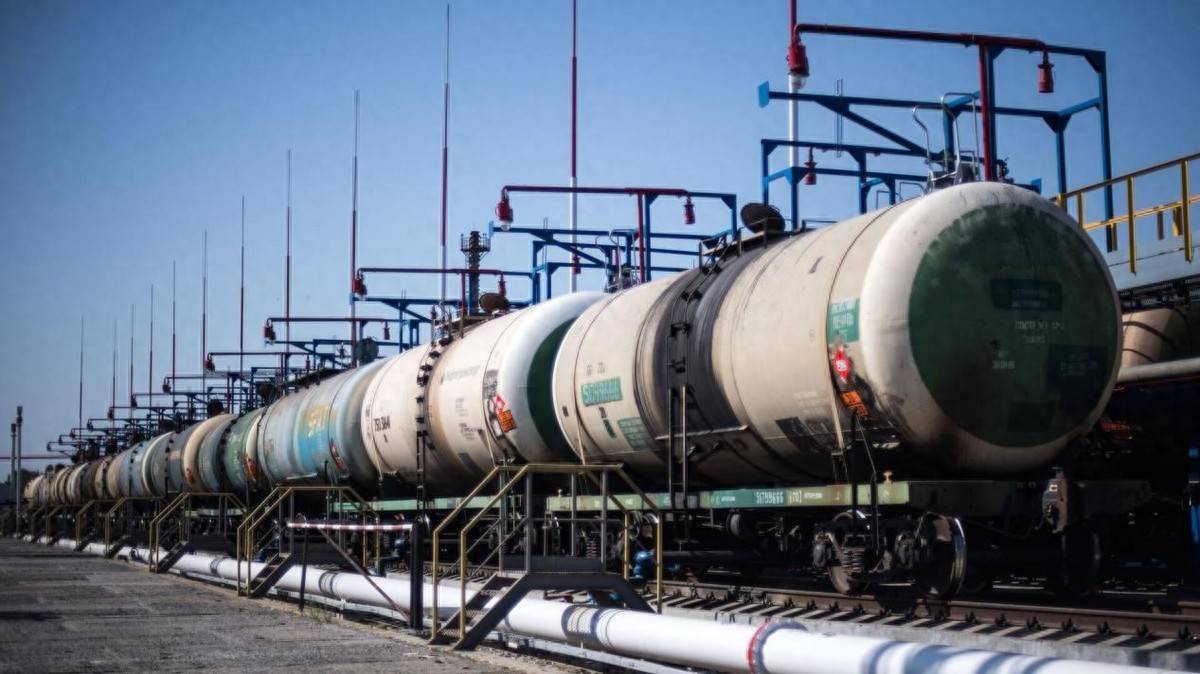
Group 1 - The relationship between the US and India is under significant strain due to punitive tariffs imposed by the US on Indian imports of Russian oil, leading India to suspend the purchase of P-8A surveillance aircraft worth $3.6 billion from the US [1] - The US has shown a double standard in its approach, as other major buyers of Russian oil, such as China and Europe, have not faced similar sanctions, highlighting a targeted strategy against India [1] - US Secretary of State Rubio indicated uncertainty about imposing secondary sanctions on Europe, while acknowledging the potential economic repercussions of sanctioning China, which plays a crucial role in the global energy market [3][5] Group 2 - The US's previous attempts to impose tariffs on China resulted in strong retaliatory measures from China, which included imposing equivalent tariffs and export controls on strategic resources, impacting the US economy negatively [5] - The current trade negotiations between the US and China have reached a fragile consensus, and any aggressive actions by the US against China regarding energy purchases could destabilize this balance, potentially harming the US economy [8] - India's attempts to balance its relationships with both the US and Russia may lead to a precarious situation, as it seeks to reduce dependence on the US while simultaneously trying to benefit from Russian oil, which may not be sustainable in the long run [10]
特朗普咋收敛了?美国财长泄了底,中美谈判藏玄机!中国当场这话太关键
Sou Hu Cai Jing· 2025-08-10 03:10
Group 1 - The recent shift in Trump's diplomatic approach is linked to significant U.S.-China negotiations, particularly regarding trade and energy policies [1][4][6] - The U.S. government is applying pressure on major trade partners through tariffs, indicating a strong stance on altering international trade dynamics [2][4] - The U.S. Treasury Secretary, Bessent, revealed intense negotiations over sovereignty issues, with China asserting its rights and energy needs, marking a pivotal moment in discussions [4][6][7] Group 2 - The U.S. is facing dual pressures from the Russia-Ukraine conflict and the need to manage U.S.-China trade relations, leading to a reconsideration of its hardline tariff strategies [6][8] - China's response to U.S. technology restrictions includes enhancing rare earth export controls and deepening energy cooperation with Russia, demonstrating its countermeasures [7][8] - Despite some progress in negotiations, underlying tensions between the U.S. and China remain unresolved, particularly concerning long-term issues like technology decoupling and geopolitical strategies [8][9]
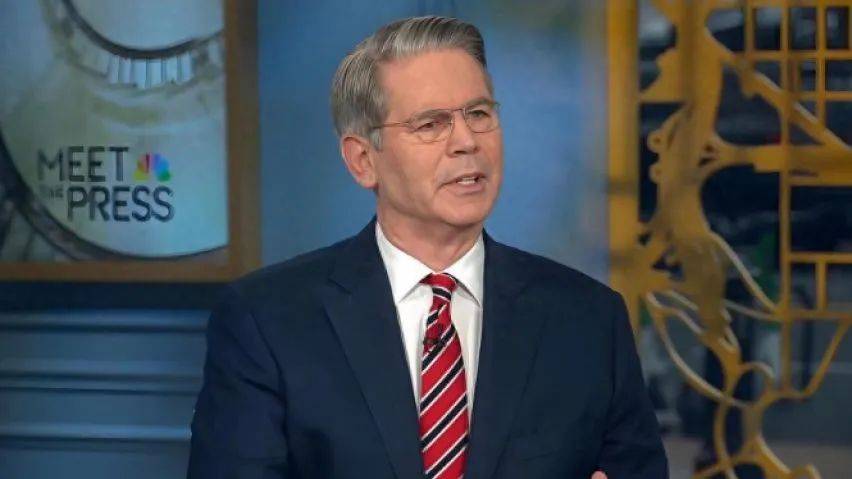
难怪特朗普老实了!美国财政部长透露细节,中美谈判果然不简单!中国当场送给美国一句话
Sou Hu Cai Jing· 2025-08-09 08:29
Group 1: Recent Diplomatic Dynamics - The Trump administration has been active in diplomacy, particularly regarding the Russia-Ukraine conflict, aiming to facilitate a ceasefire without European involvement [3] - The U.S. has adopted a hardline stance on global tariff policies, imposing tariffs on major trade partners like India and the EU, indicating significant trade tensions [4] Group 2: Insights from U.S.-China Negotiations - U.S. Treasury Secretary Bessent revealed intense negotiations over sovereignty issues, with China asserting its right to purchase Russian oil and maintain its own security needs [5] - The Chinese delegation demonstrated preparedness and flexibility in discussions about tariff exemptions and energy cooperation, indicating a strong negotiating position [5] Group 3: Underlying Motivations for Trump's Shift - The Trump administration faces dual pressures from the Russia-Ukraine situation and U.S.-China trade negotiations, prompting a reassessment of its hardline tariff strategies [7] - Domestic inflation and upcoming midterm elections are influencing the Trump administration to reconsider the effectiveness of its trade policies with China [7] Group 4: Future Implications of U.S.-China Relations - Structural conflicts between the U.S. and China remain unresolved, with potential for temporary agreements on tariffs and energy procurement, but long-term competition is expected to escalate [9] - The evolving global power dynamics are reflected in the shifting alliances and the impact of U.S. unilateralism on its relationships with allies [9][11]