
特朗普关税政策

Search documents
Big Pharma Unfazed by Trump Tariffs, But Small Biotechs Face Vulnerability
WSJ· 2025-09-26 18:55
Core Viewpoint - Drugmakers are preparing for potential levies and are proactively committing to invest billions in domestic manufacturing [1] Group 1 - Drugmakers are bracing for upcoming levies [1] - Companies are seeking to get ahead of these levies by pledging significant investments [1] - The focus of these investments is on enhancing domestic manufacturing capabilities [1]


再创历史新高:现货黄金价格突破3749美元!普通人还能入手黄金吗?
Sou Hu Cai Jing· 2025-09-23 06:25
Core Viewpoint - The price of gold has reached a historic high, surpassing $3749.27 per ounce, with a year-to-date increase of over 40%, driven by various economic and geopolitical factors [1][3][10]. Group 1: Price Surge - On September 23, the international gold price hit $3749.27 per ounce, marking a new record [3]. - Year-to-date, gold prices have surged over 40%, with a monthly increase exceeding 8%, surpassing the inflation-adjusted peak from 1980 [3][10]. - As of the report, spot gold prices have further risen to $3753 per ounce [3]. Group 2: Reasons for Price Increase - The primary drivers for the recent surge in gold prices include: - The Federal Reserve's interest rate cut, which has weakened the dollar and strengthened gold [7]. - Escalating geopolitical tensions, including conflicts in the Middle East and the ongoing Russia-Ukraine war, leading to increased demand for gold as a safe haven [8]. - Central banks globally, including the People's Bank of China, have been increasing their gold reserves, contributing to a "de-dollarization" trend and enhancing trust in gold [9]. Group 3: Future Price Outlook - Short-term fluctuations in gold prices are expected, with potential resistance around $3740 per ounce, but a strong bullish momentum could push prices towards $3800 or even $4000 [12]. - Long-term trends suggest that if the Federal Reserve continues its rate cuts or geopolitical tensions escalate, gold prices may rise further. Conversely, if risks subside, a temporary decline could occur [12]. - Goldman Sachs predicts that gold prices could reach $4000 per ounce by 2026, emphasizing the growing demand for gold amid rising global debt and concerns over the dollar's credibility [12].
基金研究周报:科技赛道爆发,红利板块回调(8.25-8.29)
Wind万得· 2025-08-30 22:29
Market Overview - The A-share market experienced slight fluctuations from August 25 to August 29, with major indices showing reduced volatility. The ChiNext Index and ChiNext 50 rose by 7.74% and 9.27% respectively, while the Sci-Tech 50 recorded a 7.49% increase, driven by policy support, particularly the State Council's announcement on August 26 regarding the "Artificial Intelligence +" initiative [3][4] - The Shanghai Composite Index increased by 0.84%, and the Shenzhen Index rose by 4.36%, indicating a positive market sentiment despite some sectors facing challenges [3] Industry Performance - The Wind first-level average index rose by 0.87%, with 72% of the Wind Top 100 concept indices showing positive returns. The telecommunications, non-ferrous metals, and electronics sectors performed well, increasing by 12.38%, 7.16%, and 6.28% respectively. In contrast, the banking, coal, and textile sectors declined by 2.13%, 2.76%, and 2.87% [3][16] - The technology and materials sectors led the market, with the information technology sector achieving a 5.69% increase, while traditional sectors like energy and finance faced declines of -1.74% and -1.44% respectively, reflecting a growing divergence in industry performance during the economic recovery [16][17] Fund Issuance and Performance - A total of 41 funds were issued last week, including 29 equity funds, 5 mixed funds, 5 bond funds, and 2 FOFs, with a total issuance of 28.205 billion units [4][20] - The Wind All Fund Index rose by 1.41%, with the ordinary equity fund index increasing by 2.59% and the mixed equity fund index rising by 2.86% [4][11] Global Asset Review - Global equity markets showed structural differentiation, with U.S. indices slightly declining due to pressure on tech stocks. European markets faced significant drops, with the French CAC and German DAX falling by 2.60% and 1.89% respectively, influenced by political instability in France and concerns over the Federal Reserve [6][7] - Commodity markets saw precious metals leading gains, with COMEX gold and silver rising by 2.86% and 4.34% respectively, driven by increased demand for safe-haven assets amid geopolitical risks [6]

“黑天鹅之父”塔勒布最新分享,深谈反脆弱、黄金、关税以及中国机会︱重阳荐文
重阳投资· 2025-08-12 07:32
Core Viewpoints - Understanding fragility is essential to comprehend the concept of anti-fragility, where certain systems become stronger and benefit from shocks and volatility [4][40]. - The current economic environment is characterized by high uncertainty, and the best strategy is to remain cautious and observe before making investment decisions [140][149]. Group 1: Investment Strategies - A "barbell strategy" is recommended, where 80% of assets are placed in extremely safe investments, while the remaining 20% is allocated to high-risk opportunities [9][123]. - Traditional diversification may not effectively hedge risks due to changing correlations between assets, making it unreliable [120][121]. - The importance of recognizing hidden risks in seemingly stable investments is emphasized, as these can lead to significant losses during extreme events [81][86]. Group 2: Economic Observations - The U.S. faces increasing vulnerability due to high debt levels and a lack of growth potential, which could lead to stagnation or regression [76][127]. - In contrast, China is viewed as having greater resilience and potential for growth, with a strong capacity to rebound from economic shocks [11][150][155]. - The current global economic landscape is marked by a shift towards "de-dollarization," with investors increasingly turning to gold and other hard assets as a hedge against uncertainty [104][108]. Group 3: Market Dynamics - The interconnectedness of global supply chains has heightened vulnerability, where disruptions in one area can have widespread economic impacts [65][66]. - The concept of "black swan" events highlights the unpredictability of significant market shifts, necessitating a focus on risk management and preparedness [95][100]. - The rise of AI introduces further uncertainty in the market, as its long-term effects on employment and economic structures remain unclear [133][140].

最大航运股的空头们遭反噬! 从红海危机到关税博弈 纵使航运变幻莫测 马士基涨势如虹
智通财经网· 2025-08-11 12:00
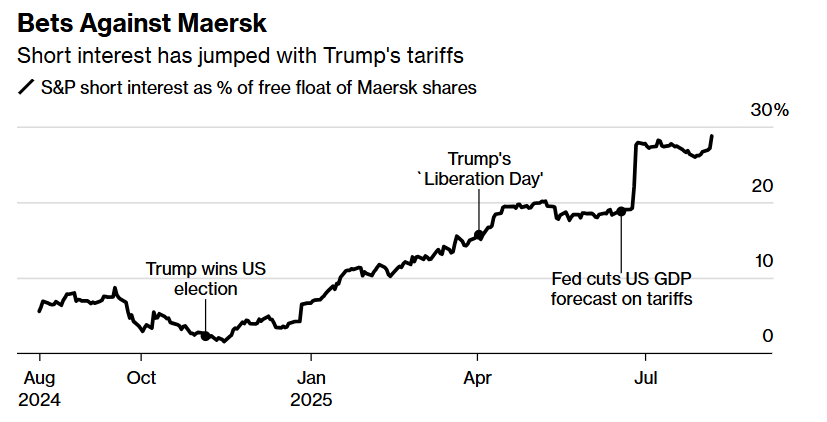
Core Viewpoint - Short selling the stock of Maersk, the world's largest publicly traded shipping company, during the global trade war has resulted in significant losses for investors since April, despite initial expectations of profit from this strategy [1][4]. Group 1: Stock Performance and Short Selling - As of now, nearly one-third of Maersk's freely traded shares have been borrowed, marking the highest short interest level since data collection began in 2014, reflecting a 15% increase since the announcement of tariffs by President Trump in early April [1][4]. - Following an initial drop after the tariff announcement, Maersk's stock has surged approximately 50% from its low in April [1]. - Analysts on Wall Street generally hold a pessimistic view on Maersk's long-term performance, with an average 12-month target price indicating a potential decline of about 15% from current levels [4]. Group 2: Business Resilience and Market Opportunities - Maersk's CEO, Vincent Clerc, emphasized that tariffs have not significantly hindered global trade, as many products cannot be easily replaced with local alternatives, presenting market opportunities for the company [5]. - The company has raised its financial performance expectations for 2025, citing resilient global transportation demand outside the U.S. [1][5]. - Historical trends indicate that shipping stocks often rebound quickly after major negative global events, suggesting a potential for continued growth in the shipping sector despite current challenges [7]. Group 3: Market Sentiment and Investment Logic - The primary rationale for shorting Maersk's stock is not based on its fundamental performance but rather on its high valuation and the belief that Trump's tariff policies will ultimately harm global trade [9]. - Despite the bearish sentiment from some investors, the stock has not performed as expected, indicating that the short sellers' logic has not yet been validated [9].
亚马逊(AMZN.US)Prime Day大促今日开启!美国消费者韧性面临特朗普关税政策考验
智通财经网· 2025-07-08 11:13
Core Viewpoint - Amazon's Prime Day event from July 8 to 11, 2025, is facing challenges due to the ongoing trade war initiated by former President Trump, which has led to fluctuating tariff policies affecting brand participation and consumer spending [1][2]. Group 1: Consumer Behavior and Spending - Despite resilient economic indicators, short-term consumer behavior, such as preemptive purchases before tariffs take effect, may obscure long-term trends [2]. - A survey indicated that 25% of respondents would skip Prime Day due to tariffs, while 57% would closely monitor price trends [2]. - Amazon's Prime Day is expected to provide insights into consumer spending patterns for the summer [2]. Group 2: Brand Participation and Pricing - Some brands, like Unilever's Blueair, have reduced the number of promotional products due to increased costs from tariffs, with discounts typically around 30% now being reconsidered [3]. - Approximately 60% of products on Amazon come from third-party sellers, some of whom are unable to offer discounts this year due to rising costs [2][3]. - Amazon's CEO stated that tariffs have not significantly raised prices, and the company is working with partners to maintain low prices and a diverse product selection [3]. Group 3: Sales Projections and Market Impact - Adobe predicts that Amazon and other U.S. retailers will achieve $23.8 billion in online sales during the four-day event [1]. - EMarketer estimates that U.S. consumers will spend nearly $13 billion on Amazon during Prime Day, accounting for 75% of all online spending during that period, up from 59% in 2024 [3]. - Morgan Stanley forecasts a 10% year-over-year increase in average daily sales during the extended event, despite ongoing macroeconomic pressures [3]. Group 4: Risks of Extended Promotion - Extending the duration of Prime Day may reduce the urgency that typically drives consumer purchases, potentially leading to increased cart abandonment [4].

美联储“按兵不动”可能再次招致特朗普不满
Sou Hu Cai Jing· 2025-06-18 11:21
Core Viewpoint - The Federal Reserve is signaling a long-term intention to maintain interest rates unchanged, with no immediate rate cuts expected, as economic conditions remain stable and uncertain factors persist [2][3]. Economic Conditions - The U.S. economy is showing signs of slow cooling, with no immediate triggers for the Federal Reserve to intervene, despite concerns over tariffs and their impact on inflation [3][4]. - The unemployment rate has remained stable for three consecutive months, which allows the Federal Reserve to keep interest rates high as a measure against potential inflation [3][5]. Inflation and Interest Rates - Recent inflation data has not raised alarms, with core inflation in May remaining below expectations for the fourth consecutive month, leading to a rise in U.S. Treasury prices [3][6]. - Market expectations suggest that the Federal Reserve may not lower borrowing costs until at least September, with traders betting on multiple rate cuts later in the year [2][3]. Federal Reserve Predictions - Upcoming economic and interest rate forecasts are expected to provide insights into the Federal Reserve's thinking, particularly following President Trump's tariff announcements [4][5]. - Analysts note a wide range of possibilities in the Federal Reserve's predictions, with some suggesting that a significant increase in the unemployment rate could lead to rate cuts before the fourth quarter [5][6]. Policy Uncertainty - Federal Reserve officials are considering the uncertainty surrounding Trump's policies, which may lead them to maintain their current forecasts without significant changes [7][8]. - The timing of the Federal Reserve's next actions will depend on how long Trump's policies take to reflect in economic data and the strength of recession concerns that arise from these data [7][8].
日本央行坚持货币正常化路线,预计年内加息
日经中文网· 2025-06-18 02:36
Core Viewpoint - Japan's inflation rate has exceeded 3%, surpassing the government's and Bank of Japan's target of 2%, leading to market speculation about the timing of interest rate hikes [1][4]. Group 1: Monetary Policy and Inflation - The Bank of Japan is committed to a monetary normalization path, gradually reducing its bond purchases starting from April 2026 while decreasing its holdings of Japanese government bonds [1][3]. - The current inflation rate in Japan is over 3%, prompting market attention on the timing of potential interest rate increases, with the Bank of Japan monitoring the impact of U.S. tariffs and domestic political developments [1][4]. Group 2: Government Bond Holdings - The Bank of Japan holds approximately 560 trillion yen in government bonds, with internal consensus indicating that this amount is considered "excessive" [3]. - The Bank of Japan plans to exclude government bond purchases from its monetary policy tools, actively pursuing a quantitative tightening route to reduce its bond holdings [3][4]. Group 3: Future Rate Hikes and Economic Indicators - The Bank of Japan's President, Ueda, indicated that the timing for future interest rate hikes will be based on a comprehensive assessment of various data and information, without providing a clear stance [4][5]. - Market expectations for interest rate hikes are increasing, with probabilities of 9% for July, 20% for September, and 24% for October [4]. Group 4: Political and Economic Context - The upcoming Japanese Senate elections in late July and geopolitical developments may influence the Bank of Japan's decisions regarding interest rate hikes [5].

五矿期货文字早评-20250512
Wu Kuang Qi Huo· 2025-05-12 06:06
Report Investment Ratings No investment ratings for the industries are provided in the report. Core Views - The overall market situation is complex, affected by macro - policies, international trade (especially tariff policies), and supply - demand relationships in different industries. Different asset classes show different trends and investment opportunities. For example, in the stock index market, it is recommended to buy certain index futures on dips; in the bond market, a cautious strategy is suggested for long - term bonds, while short - term bonds may have better performance; in the commodity market, various commodities have different price trends and investment suggestions based on their own supply - demand fundamentals [2][3][6]. Summary by Categories Macro - Financial - **Stock Index**: The previous trading day saw mixed performance in major indices, with a decrease in trading volume. Macro news includes CPI and PPI data, and trade data. The liquidity is relatively loose. Due to the weakening of the emotional impact of tariff policies and the potential for domestic policy adjustment, it is recommended to buy long positions in IH or IF index futures related to the economy on dips, or buy IC or IM futures related to "new - quality productivity" opportunistically. The unilateral strategy is to buy IF index futures on dips [2][3][4]. - **Treasury Bonds**: After the implementation of reserve requirement ratio cuts and interest rate cuts, and the policy exceeding expectations at the press conference, the long - term interest rate has already priced in the interest rate cut expectation, so a cautious strategy is recommended in the short term. The short - term bonds are expected to be more cost - effective. The long - term trend depends on the fundamental situation, and attention should be paid to the tariff negotiation process and economic data [5][6]. - **Precious Metals**: In the short term, precious metal prices are driven to be weak by the macro - environment and capital positions. However, considering the potential for the Fed to cut interest rates in the second half of the year and the expansion of the US fiscal deficit, gold prices are expected to rise in the medium term after a short - term correction, and silver prices may show a strong performance when the Fed's easing expectations are concentrated. It is recommended to wait for a significant correction in gold prices and then buy long positions, and to wait and see or short on rallies for silver [7][8][9]. Non - Ferrous Metals - **Copper**: The copper price is expected to face greater pressure for shock adjustment due to the uncertain result of Sino - US trade negotiations, the tight supply of copper ore and recycled copper, and the marginal weakening of consumption [11]. - **Aluminum**: The aluminum price is expected to fluctuate. Although the domestic policy exceeds expectations, the bearish atmosphere in the commodity market continues, and the consumption is marginally weakening. However, the improvement in downstream demand after the short - term price correction provides strong support [12]. - **Zinc**: In the short term, the near - end is relatively strong, but in the medium term, due to the limited downstream purchasing sustainability and the pressure of imported zinc ingots, the zinc price may decline [13][14]. - **Lead**: The Shanghai lead index is expected to fluctuate in a box in the medium term, and the short - term price shows a weak shock [15]. - **Nickel**: The continuous weakness of the nickel - iron price is the main driver for the decline of the nickel price. It is recommended to hold short positions. The short - term price of the Shanghai nickel main contract is expected to range from 115,000 to 130,000 yuan/ton [16]. - **Tin**: The supply of tin is expected to loosen, and with the impact of tariffs on demand, the tin price may decline. The domestic main contract is expected to run in the range of 250,000 - 270,000 yuan [17]. - **Lithium Carbonate**: The short - term fundamentals lack positive drivers, and the price may continue to decline. Attention should be paid to the operating disturbances of mines and salt factories, the price trend of lithium concentrate, and demand performance [18]. - **Alumina**: In the short term, it is recommended to wait and see. In the long - term, the supply surplus trend is difficult to change, and attention can be paid to the 7 - 9 positive spread opportunity [19]. - **Stainless Steel**: The supply is at a high level, the market has large inventory pressure, and the supply - demand imbalance brings downward pressure on the price [20]. Black Building Materials - **Steel**: The traditional peak season is over, the demand for finished steel products has shifted downward, and the price may maintain a weak shock. Attention should be paid to tariff policy changes, terminal demand trends, and cost support [22][23]. - **Iron Ore**: The supply of iron ore has a slight decline in shipping volume, and the demand is expected to peak and decline. The price of the main 09 contract may still be weak [24]. - **Glass and Soda Ash**: The glass price is weak, with inventory accumulation. The soda ash supply is at a high level with a slight decline, and the price is expected to be weak [25][26]. - **Manganese Silicon and Ferrosilicon**: For manganese silicon, the price may stop falling and enter a shock stage, and it is recommended to wait and see. For ferrosilicon, the price may continue to decline, and short - term trading or waiting and seeing is recommended [27][28]. - **Industrial Silicon**: The supply of industrial silicon is in surplus, and the demand is insufficient. The price is under pressure, and it is recommended to wait and see or follow the short - term trend [33]. Energy and Chemicals - **Rubber**: The rubber price returns to range - bound. The implementation of Thailand's policy to postpone rubber tapping is the focus of the market. There are different views on the rise and fall of the price. It is recommended to adopt a neutral and short - term trading strategy [36][37][39]. - **Crude Oil**: In the short term, OPEC's production increase has been realized as expected. In the context of low inventory, buying on dips and short - term positive spread is a good position [40]. - **Methanol**: The supply of methanol is increasing, and the demand is weakening. The price is expected to decline. It is recommended to look for short - selling opportunities on rallies [41]. - **Urea**: The price of urea is expected to be relatively strong, but the upward space is limited. It is recommended to take partial profit on previous long positions and wait and see for new positions [42]. - **Styrene**: The price of styrene is under pressure, but the low port inventory may limit the decline. It is recommended to wait and see [43]. - **PVC**: The supply and demand of PVC are both weak. The price is expected to be weakly volatile in the short term [44]. - **Ethylene Glycol**: The industry is in a short - term de - stocking stage, but there is a risk of negative feedback in the medium term. Attention can be paid to the opportunity of buying on dips when the port de - stocking is realized [45]. - **PTA and p - Xylene**: Both are in the maintenance season. There is a risk of negative feedback in the medium term, but the short - term valuation is supported. Attention can be paid to the opportunity of buying on dips and positive spread [46][47]. - **Polyethylene and Polypropylene**: The price of polyethylene is expected to fluctuate. The price of polypropylene is expected to be weakly volatile in May [48][49]. Agricultural Products - **Pig**: The short - term pig price may be adjusted slightly. It is recommended to short on rallies caused by emotions such as hoarding and second - fattening [51]. - **Egg**: The egg price is expected to decline slightly and then stabilize. It is recommended to short on rallies in the medium term [52]. - **Soybean and Rapeseed Meal**: The soybean and soybean meal in China are expected to accumulate inventory in the next three months. The USDA report may have a short - term negative impact, but there may be a chance for a rebound after the negative news is exhausted [53][54]. - **Edible Oils**: The medium - term price of edible oils may decline, but the short - term may be volatile or slightly bullish due to the expected release of the new RVO rule in the United States [55][58]. - **Sugar**: The international raw sugar price may decline in the second and third quarters. The domestic sugar price may weaken in the future as the import profit window may reopen [59][60]. - **Cotton**: The domestic cotton market shows a pattern of weak supply and demand. The short - term cotton price is expected to fluctuate. Attention should be paid to the Sino - US negotiation process and inventory changes [61].
鲍威尔5月新闻发布会要点总结:还不是时候判断价格目标和就业目标哪个更重要
news flash· 2025-05-07 19:32
Monetary Policy - The Federal Reserve does not need to rush to adjust interest rate policies as current data supports a wait-and-see approach, particularly the weakening relationship between confidence data and spending data [1] Trump Tariffs - The impact of Trump's tariffs on inflation may be temporary; if the tariffs remain in place, the Federal Reserve will struggle to make progress on its dual policy goals of price stability and employment [1] - Businesses are delaying investment decisions, and households are postponing consumption expenditures, limiting the Federal Reserve's ability to take preemptive action [1] - Trade negotiations could significantly alter the current situation [1] Inflation and Employment - The potential inflation outlook appears favorable, with data likely to easily meet one of the Federal Reserve's dual targets of price stability and employment [1] Central Bank Independence - Statements from Trump are not expected to affect the Federal Reserve's operations [2]