公用事业

Search documents
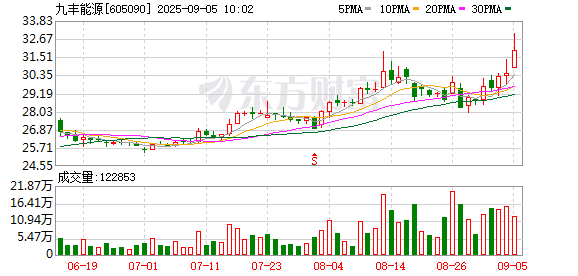
九丰能源盘中创历史新高
Zheng Quan Shi Bao Wang· 2025-09-05 02:01
Company Performance - Jiufeng Energy's stock price reached a historical high, increasing by 6.70% to 32.49 yuan, with a trading volume of 3.2055 million shares and a transaction amount of 102 million yuan [2] - The company's latest A-share total market capitalization is 21.667 billion yuan, and the A-share circulating market capitalization is 21.616 billion yuan [2] - The company reported a revenue of 10.428 billion yuan for the first half of the year, a year-on-year decrease of 7.45%, and a net profit of 861 million yuan, down 22.17% year-on-year, with basic earnings per share of 1.3500 yuan and a weighted average return on equity of 8.87% [2] Industry Overview - The public utility sector, to which Jiufeng Energy belongs, experienced an overall decline of 0.23%, with 29 stocks rising, including Jiufeng Energy, Jingyuntong, and Jiawei New Energy, which increased by 6.70%, 3.65%, and 2.30% respectively [2] - Conversely, 94 stocks in the sector saw declines, with Zhaoxin Co., Huayin Power, and Jinko Technology experiencing the largest drops of 9.15%, 2.28%, and 1.99% respectively [2] Financing and Ratings - As of September 4, the latest margin trading balance for Jiufeng Energy was 225 million yuan, with a financing balance of 223 million yuan, reflecting a decrease of 33.1747 million yuan over the past 10 days, a decline of 12.96% [2] - In terms of institutional ratings, two institutions rated the stock in the past 10 days, with GF Securities setting a target price of 35.67 yuan on August 22 [2]


中信证券:2025H1公用事业整体业绩小幅增长 板块盈利分化持续
智通财经网· 2025-09-05 01:13
Core Viewpoint - The A-share public utility sector is expected to see a slight year-on-year increase of 1.5% in net profit attributable to shareholders in H1 2025, driven by improved fuel costs for thermal power and the release of hydropower generation elasticity [1] Group 1: Overall Industry Performance - The public utility sector's revenue is projected to decline by 1.7% year-on-year to 966.6 billion yuan due to a general decrease in market electricity prices [1] - The profitability of different segments is showing significant divergence, with thermal and hydropower benefiting from cost or revenue improvements, while nuclear, renewable, and gas sectors are experiencing declines in net profit and ROE [1] - Investment intensity remains high but has shifted structurally, with thermal and nuclear investments increasing by 52.0% and 52.3% year-on-year, while renewable investments have decreased by 15.2% [1] Group 2: Thermal Power - The thermal power sector's revenue is expected to decline by 3.9% year-on-year, but improved coal prices have led to a significant enhancement in profitability, with net profit increasing by 4.2% to 48.2 billion yuan [2] - The gross margin for thermal power has improved by 2 percentage points to 17.5% [2] - The sector's performance is anticipated to remain strong throughout the year due to locked-in electricity prices and low coal prices during peak summer demand [2] Group 3: Hydropower - The hydropower sector's revenue is projected to grow by 4.8% year-on-year to 91.2 billion yuan, driven by improved water conditions and stable electricity prices [3] - Net profit is expected to increase by 11.2%, with ROE rising by 0.1 percentage points [3] - The sector is likely to maintain stable electricity prices and profitability due to its low-cost and clean energy advantages [3] Group 4: Nuclear Power - The nuclear power sector's profitability is expected to decline by 10.6% year-on-year due to falling electricity prices, despite an 11.3% increase in generation volume [4] - The approval of new nuclear units continues at a steady pace, with more than 10 units approved annually since 2022 [4] - Long-term growth in installed capacity is expected to support cash flow growth for nuclear companies [4] Group 5: Renewable Energy - The renewable energy sector faces increasing consumption pressure, with wind and solar abandonment rates rising by 2.7 percentage points to 6.4% and 5.7%, respectively [5] - Revenue and net profit for the sector are expected to decline by 2.9% and 6.4% year-on-year, respectively, with ROE decreasing by 0.6 percentage points to 4.4% [5] - The sector is anticipated to return to rational development as new policies and mechanisms are implemented [5] Group 6: Gas Sector - The gas sector's net profit is projected to decline slightly by 1.3% year-on-year due to a slowdown in margin recovery and pressure on connection services [7] - Overall natural gas demand is expected to decrease by 0.9%, but procurement prices are anticipated to gradually decline [7] - The gas sector's performance for the full year is expected to show a slight improvement compared to the previous year [7] Group 7: Investment Strategy - The public utility sector's performance in H1 2025 indicates that supply growth is impacting electricity prices and utilization hours, leading to divergent profitability across segments [8] - Hydropower and thermal power are expected to continue their improvement trends due to favorable conditions [8]

港股日评:港股整体承压,港股通电力设备及新能源领涨-20250905
Changjiang Securities· 2025-09-04 23:30
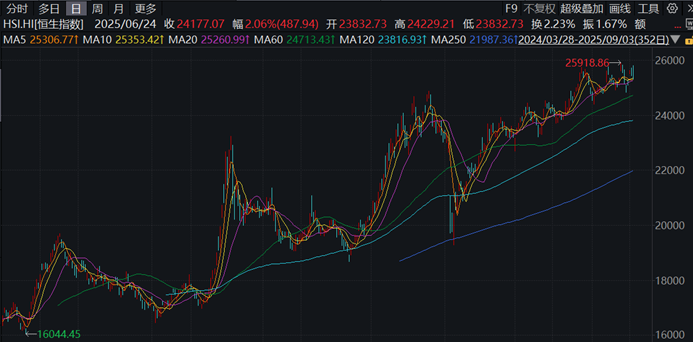
Group 1 - The Hong Kong stock market faced overall pressure, with the Hang Seng Index declining by 1.12% to close at 25,058.51, the Hang Seng Tech Index down 1.85% to 5,578.86, and the Hang Seng China Enterprises Index falling 1.25% to 8,937.09 [6][8] - The market's trading volume reached HKD 302.23 billion, with net inflows from southbound funds amounting to HKD 706 million [2][8] - Sectors with stable cash flow and high defensive attributes, such as utilities, coal, and banks, showed resilience and outperformed the market despite the overall downturn [6][8] Group 2 - In terms of sector performance, the power equipment and new energy sectors led gains with an increase of 1.46%, while sectors like non-ferrous metals and pharmaceuticals saw declines of 4.94% and 4.01%, respectively [6][8] - The report highlights a market style shift, with funds rotating towards sectors that exhibit strong defensive characteristics amid market volatility [8] - Future outlook suggests potential for Hong Kong stocks to reach new highs, driven by AI technology, sustained inflows from southbound funds, and favorable monetary conditions [8]
市场回调下,前期弱势行业展韧性
Nan Hua Qi Huo· 2025-09-04 08:57
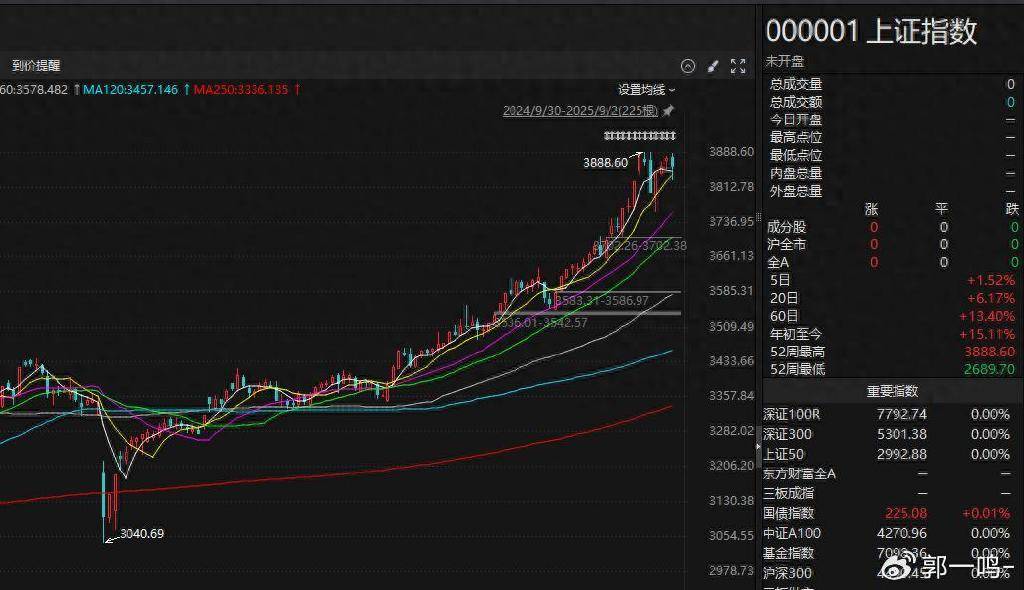
Report Industry Investment Rating - Not provided Core View - The decline in the stock market today has widened, which generally aligns with the idea of a fall in sentiment and a rise in risk - aversion mentioned yesterday. Banks, consumer - related industries, public utilities, and transportation, which had relatively small increases since June 20, showed resilience, while TMT continued to lead the decline. Although the trading volume of the two markets has fallen from the high of three trillion, it remains at an active level. After three consecutive negative days in the stock market, sentiment is expected to be cautious, and there is significant pressure for a short - term rebound. However, the short - selling power is not strong, as indicated by the long lower shadow of the stock index. With no strong negative factors, after a rapid and substantial short - term correction, the stock market is expected to return to a volatile state [4]. Market Review - The stock index declined with increased trading volume today. Taking the CSI 300 index as an example, it closed down 2.12%. The trading volume of the two markets increased by 180.171 billion yuan. In the futures index market, all varieties declined with increased volume [2]. Important Information - The Ministry of Industry and Information Technology and the State Administration for Market Regulation issued a notice on printing and distributing the "Action Plan for Stable Growth of the Electronic Information Manufacturing Industry from 2025 - 2026" [3]. Strategy Recommendation Futures Index Market Observation | | IF | IH | IC | IM | | --- | --- | --- | --- | --- | | Main contract intraday change (%) | -1.88 | -1.51 | -2.42 | -2.21 | | Trading volume (10,000 lots) | 21.4783 | 10.143 | 19.4079 | 38.3239 | | Trading volume change (10,000 lots) | 1.8541 | 1.5325 | 2.7933 | 4.4942 | | Open interest (10,000 lots) | 29.8905 | 11.1522 | 26.1202 | 40.4746 | | Open interest change (10,000 lots) | 1.2436 | 0.8984 | 1.6332 | 0.5496 | [5] Spot Market Observation | Name | Value | | --- | --- | | Shanghai Composite Index change (%) | -1.25 | | Shenzhen Component Index change (%) | -2.83 | | Ratio of rising to falling stocks | 0.72 | | Trading volume of the two markets (100 million yuan) | 25442.57 | | Trading volume change (100 million yuan) | 1801.71 | [6]
业绩之锚3:定价困境反转的中报季
China Post Securities· 2025-09-04 06:15
Group 1 - The report indicates that buying stocks with "earnings exceeding expectations" during the mid-year reporting season does not yield sustained relative returns, as the market quickly digests the positive impact, unlike the first quarter reports which provide ongoing excess returns [3][12][20] - The mid-year reporting season exhibits severe growth illusion, making it difficult to construct effective stock selection strategies based on the relationship between earnings growth and the extent of exceeding expectations [4][31][36] - The "dilemma reversal" strategy is highlighted as a more effective approach for performance discovery during the mid-year reporting season, where stocks with downward earnings expectations in the first quarter but upward adjustments in the mid-year show significant advantages in relative returns [4][37][43] Group 2 - As of September 3, 2025, the proportion of stocks exceeding earnings expectations is 21.78%, lower than the historical average of 25.48%, but shows a significant recovery from the 15.53% low in 2024, indicating a positive shift in earnings expectations [5][54] - The report notes that only the non-bank financial, banking, and non-ferrous metal sectors have a higher proportion of upward earnings adjustments compared to downward adjustments, suggesting a lack of mainline opportunities for performance verification across industries [5][56] - The overall performance of the A-share market remains in a bottom-seeking phase, with the net profit growth rate for the Wind All A Index declining from 3.46% in the first quarter to 1.31% in the second quarter of 2025, indicating ongoing struggles in revenue and profit growth [53][54]
华泰证券今日早参-20250904
HTSC· 2025-09-04 02:33
Group 1: Aerospace and Defense - The recent military parade showcased China's military modernization, highlighting new equipment and military trade opportunities [2] - A significant portion of the parade featured new fourth-generation equipment, including advanced tanks and fighter jets, demonstrating the military's operational capabilities [2] - The display included cutting-edge technologies such as unmanned aerial vehicles and directed energy weapons, emphasizing the military's strategic deterrence capabilities [2] Group 2: Power Equipment and New Energy - Global energy storage demand is expected to exceed expectations, driven by supportive policies and market demand in China and Europe [3] - The domestic energy storage industry is seeing price competition nearing its end, with battery prices beginning to rise, indicating a shift towards market-driven profitability [3] - Recommended companies in the energy storage sector include Sungrow Power Supply, CATL, and several others across different segments of the supply chain [3] Group 3: Consumer Electronics and Home Appliances - The home appliance sector has seen a cumulative increase of approximately 6.17% from January to August 2025, ranking 24th among 30 sub-industries [8] - Domestic demand remains resilient due to the "trade-in" policy, although export pressures have increased due to tariffs and weakened overseas demand [8] - The sector's revenue grew by 8.4% year-on-year, with net profit increasing by 13.1%, despite competitive pressures and fluctuating raw material costs [8] Group 4: Technology and Computing - The autumn strategy meeting highlighted the increasing demand for computing power driven by changes in AI inference paradigms [9] - The application of AI agents in research and investment scenarios is gaining traction, indicating a shift in how technology is utilized in these fields [9] Group 5: Environmental Services - A leading environmental services company reported a revenue of 8.731 billion yuan for H1 2025, with a net profit of 929 million yuan, reflecting a stable performance [13] - The company is focusing on integrating new technologies into urban services, which is expected to enhance growth potential [13] Group 6: Automotive Industry - An automotive company reported a revenue of 56.2 billion yuan for H1 2025, with a net profit of 1.7 billion yuan, indicating a positive outlook for the upcoming i6 model launch [14] - The company maintains a leading position in electric vehicle competitiveness, particularly in advanced driver-assistance systems [14] Group 7: Clean Energy and Waste Management - A diversified company in clean energy and waste management achieved a revenue of 10.642 billion yuan in H1 2025, with a net profit of 566 million yuan, driven by strong performance in clean energy equipment [15] - The company is expected to see further profit contributions from its clean energy equipment business due to ongoing project developments [15] Group 8: Biotechnology - A biotechnology firm reported stable revenue but a significant decline in net profit due to increased R&D and operational costs, with a focus on long-term growth in various therapeutic areas [16] - The company is optimistic about future revenue stabilization as it expands its product pipeline [16]
17个行业获融资净买入 17股获融资净买入额超2亿元
Zheng Quan Shi Bao Wang· 2025-09-04 01:44
Group 1 - On September 3, among the 31 first-level industries, 17 industries received net financing inflows, with the power equipment industry leading at a net inflow of 3.338 billion [1] - Other industries with significant net financing inflows included communication, real estate, food and beverage, public utilities, and automotive, each exceeding 300 million [1] Group 2 - A total of 1,695 stocks received net financing inflows on September 3, with 89 stocks having inflows exceeding 50 million [1] - Among these, 17 stocks had net financing inflows over 200 million, with Zhongji Xuchuang leading at 1.748 billion [1] - Other notable stocks with high net inflows included Xinyi Sheng, Guoxuan High-Tech, Sunshine Power, Ningde Times, and Wolong Electric Drive, each exceeding 500 million [1]





南向资金连续27个月净流入港股,银行股的持股数量增幅较高
Huan Qiu Wang· 2025-09-04 00:55
Group 1 - The Hong Kong stock market has attracted significant attention from global investors, with net inflows from southbound funds reaching 100.573 billion HKD as of September 3, marking the highest annual level since the launch of the mutual market access mechanism [1] - Since July 2023, southbound funds have recorded 27 consecutive months of net inflows, with nearly 60% of Hong Kong Stock Connect stocks seeing an increase in shareholding [3] - According to a report by China Merchants Securities, the Hong Kong market is undergoing a destocking cycle, with upstream industries continuing to destock while midstream and downstream sectors have entered a restocking phase [3] Group 2 - The new economy sectors are entering a sustained restocking phase, while the old economy is still experiencing a double-digit contraction in supply [3] - By industry, information technology, consumer discretionary, and healthcare are in a "proactive restocking" phase with favorable supply-demand dynamics, while energy, utilities, and real estate are in a "proactive destocking" phase at the cycle bottom [3] - China Merchants Securities suggests that investors focusing on fundamentals should pay attention to investment opportunities in technology growth stocks, as companies in the new economy with strong growth potential and weak ties to the Chinese macroeconomy reported better mid-year results [3]
资金抢跑,沪指小幅调整
Hua Tai Qi Huo· 2025-09-03 06:30
Report Industry Investment Rating - Not provided in the content Core Viewpoints - Near the military parade node, market funds have shown signs of pre - emptive action. Driven by heavy - weight sectors, the broader market was relatively stable on the day. Affected by the sentiment related to the military parade, the market may stage a phased rally, but attention should be paid to the adjustment pressure after the rally. In the short term, the market may face shock consolidation, but in the medium - to - long term, it still has an upward foundation [3] Summary by Directory 1. Market Analysis - Domestically, the Ministry of Finance and the State Taxation Administration issued a notice clarifying 4 tax - exemption measures to support the operation and management of state - owned equity and cash proceeds transferred to enrich the social security fund. The measures are effective from April 1, 2024, and eligible taxpayers who have already paid taxes before the notice can get a refund. This tax preference directly boosts the investment return rate of the social security fund by reducing the operating costs of the receiving entities. Overseas, the US ISM manufacturing index in August rose slightly from 48 in July to 48.7, lower than the market expectation of 49, and remained below the boom - bust line for six consecutive months. The new orders index rose to 51.4, expanding for the first time since the beginning of this year, but the output index dropped 3.6 points to 47.8, falling back into the contraction range [1] - In the spot market, the three major A - share indices fluctuated and adjusted. The Shanghai Composite Index fell 0.45% to close at 3858.13 points, and the ChiNext Index fell 2.85%. Most sector indices declined, with banking, public utilities, and household appliances sectors leading the gains, while communication, computer, electronics, and national defense and military industries leading the losses. The trading volume of the Shanghai and Shenzhen stock markets on the day was 2.87 trillion yuan. Overseas, the US Federal Circuit Court of Appeals ruled on August 29 that the law cited by Trump when imposing tariffs on multiple countries did not actually authorize him to levy these taxes. The three major US stock indices closed down across the board, with the Nasdaq falling 0.82% to 21279.63 points [2] - In the futures market, the basis of stock index futures rebounded, and the deep discount situation of IC and IM improved. Both the trading volume and open interest of stock index futures increased [2] 2. Strategy - Near the military parade node, market funds have shown pre - emptive action. Driven by heavy - weight sectors, the broader market was relatively stable on the day. Affected by the sentiment related to the military parade, the market may stage a phased rally, but attention should be paid to the adjustment pressure after the rally. In the short term, the market may face shock consolidation, but in the medium - to - long term, it still has an upward foundation [3] 3. Macro - economic Charts - The content mainly includes charts such as the relationship between the US dollar index and A - share trends, the relationship between US Treasury yields and A - share trends, the relationship between the RMB exchange rate and A - share trends, and the relationship between US Treasury yields and A - share styles, with data sources from Flush and Huatai Futures Research Institute [6][9][11] 4. Spot Market Tracking Charts - The daily performance of major domestic stock indices on September 1, 2025, shows that the Shanghai Composite Index rose 0.46%, the Shenzhen Component Index rose 1.05%, the ChiNext Index rose 2.29%, the CSI 300 Index rose 0.60%, the SSE 50 Index rose 0.00%, the CSI 500 Index rose 0.94%, and the CSI 1000 Index rose 0.84%. There are also charts of the trading volume of the Shanghai and Shenzhen stock markets and the margin trading balance, with data sources from Flush and Huatai Futures Research Institute [13][14] 5. Stock Index Futures Tracking Charts - The trading volume and open interest data of IF, IH, IC, and IM contracts show changes. For example, the trading volume of the IF contract was 144,297 with a change of - 55,399, and the open interest was 276,618 with a change of - 16,713 [15] - The basis data of stock index futures show the basis and its changes for different contracts (current month, next month, current quarter, and next quarter) of IF, IH, IC, and IM. For example, the current - month contract basis of the IF contract was - 13.11 with a change of - 22.55 [39] - The inter - delivery spread data of stock index futures show the spreads and their changes between different delivery months (next month - current month, next quarter - current month, etc.) for IF, IH, IC, and IM. For example, the next - month minus current - month spread of the IF contract was - 7.60 with a change of - 2.20 [42]
9.3 A股反攻!
Sou Hu Cai Jing· 2025-09-03 02:52
Core Viewpoint - The recent sharp decline in the A-share market, particularly the 2.85% drop in the ChiNext Index, is not indicative of the end of a bull market but rather a typical shakeout behavior during an upward trend, suggesting a potential for short-term rebound [1][4]. Market Adjustment Factors - The market adjustment on September 2 was influenced by multiple factors, including technical pressure from accumulated profit-taking after a prolonged upward trend since April [3]. - There was a significant rotation of funds from high-valuation growth sectors, particularly in technology, to undervalued defensive sectors such as banking and utilities, amplifying market volatility [3]. - The negative sentiment from the substantial decline in U.S. tech stocks and the market's cautious stance ahead of the Federal Reserve's September meeting contributed to the adjustment [3]. Long-term Market Support - Despite the recent downturn, the core logic supporting a medium to long-term positive outlook for the market remains intact, driven by ongoing policies in sectors like "Artificial Intelligence+" and measures aimed at stabilizing growth and boosting consumption [5]. - The rapid decline is seen as a quick release of risks, effectively digesting profit-taking and eliminating localized bubbles, which can accumulate strength for future upward movement [5]. Short-term Market Outlook - In the short term, there is potential for a technical rebound following the recent sharp decline, supported by ample policy tools for growth stabilization and expectations of possible interest rate cuts [7]. - The anticipated easing of the Federal Reserve's monetary policy and a weaker dollar may enhance the attractiveness of RMB assets, potentially leading to a continued inflow of northbound capital [7]. - The significant trading volume of 2.87 trillion yuan during the decline indicates a release of short-term selling pressure, with stabilization in key sectors providing support for the market [7]. - The emotional release from the sharp drop may lead to a stabilization of market sentiment, allowing for a recovery of quality stocks that were oversold [7].