债券

Search documents
【立方债市通】河南新增一AAA主体/前10月地方政府借钱超9万亿/全国首单“人工智能和低空经济”科创债完成发行
Sou Hu Cai Jing· 2025-11-04 12:47
根据财政部及公开发债数据,今年前10个月全国发行地方政府债券合计约91062亿元,同比增长约 23%。目前地方政府融资的合法渠道主要是发行上述地方政府债券,超9万亿元举债规模创下同期历史 新高,也体现出今年更加积极财政政策靠前发力,以推动经济运行在合理区间。 另外,根据财政部及国家发改委公开信息,10月中旬地方政府额外允许新增发行5000亿元地方政府债 券。市场预计这5000亿元增量政策在今年11月和12月落地,这或许会使得地方政府债券发行规模保持相 对稳定。 第 490 期 2025-11-04 焦点关注 前10月地方政府借钱超9万亿,5000亿增量预计年底前落地 宏观动态 央行明日开展7000亿元买断式逆回购操作 央行公告,为保持银行体系流动性充裕,2025年11月5日,中国人民银行将以固定数量、利率招标、多 重价位中标方式开展7000亿元买断式逆回购操作,期限为3个月(91天)。 同日,央行公布,10月公开市场国债买卖净投放200亿元。这意味着10月央行已恢复2025年1月以来暂停 的国债买卖,当月向银行体系注入长期流动性200亿元。 央行开展1175亿元7天期逆回购操作,净回笼3578亿元 11月4日 ...


Riders on the Charts: 每周大类资产配置图表精粹 第285期
Sou Hu Cai Jing· 2025-11-04 12:25
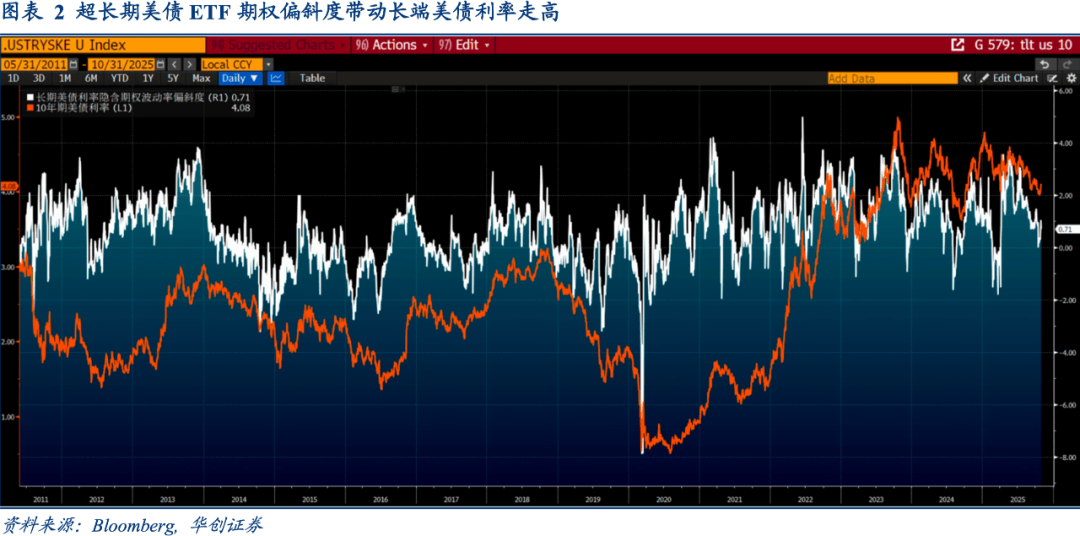
Group 1 - The ratio of total returns between gold and U.S. Treasuries suggests that high inflation risks may have been adequately priced in, with the ratio reaching 0.38 as of October 2023, comparable to levels seen in August 1975 and June 1978 when U.S. CPI was significantly higher [2][4] - The skewness of options for the iShares 20+ Year Treasury Bond ETF (TLT) has rebounded, indicating increased investor concern over inflation risks, leading to a rise in the 10-year Treasury yield to 4.1% despite the Federal Reserve's rate cuts [2][4] - The U.S. Treasury's increased debt issuance has resulted in a surge in the usage of the Standing Repo Facility (SRF), with Treasury cash reserves rising from $330 billion to $1 trillion between June and October 2023, while commercial bank reserves fell significantly [8][10] Group 2 - The equity risk premium (ERP) for the CSI 300 Index was reported at 4.4% as of October 31, 2023, indicating a potential for valuation uplift as it is below the historical average [14] - The forward arbitrage return for China's 10-year government bonds was noted at 27 basis points, which is significantly higher than levels recorded in December 2016, suggesting improved arbitrage opportunities [16] - The total return ratio between domestic stocks and bonds stood at 28.6 as of October 31, 2023, indicating that the relative attractiveness of equity assets compared to fixed income has increased [26]
政府债周报:一级利差收窄,二级利差走阔-20251104
Changjiang Securities· 2025-11-04 11:44
Report Title - 《一级利差收窄,二级利差走阔——政府债周报(11/02)》 [1][6] Report Summary 1. Issuance Forecast and Review - From November 3rd to November 9th, local government bonds with a total value of 9.1607 billion yuan were scheduled for issuance, including 4.5211 billion yuan in new bonds (0 billion yuan in new general bonds and 4.5211 billion yuan in new special bonds) and 4.6397 billion yuan in refinancing bonds (3.3664 billion yuan in refinancing general bonds and 1.2733 billion yuan in refinancing special bonds) [2][6]. - From October 27th to November 2nd, local government bonds worth 27.0682 billion yuan were issued, including 17.191 billion yuan in new bonds (1.7004 billion yuan in new general bonds and 15.4906 billion yuan in new special bonds) and 9.8772 billion yuan in refinancing bonds (7.7314 billion yuan in refinancing general bonds and 2.1458 billion yuan in refinancing special bonds) [2][6]. 2. Special Bond Issuance Progress - As of November 2nd, a total of 199.3409 billion yuan in the second batch of the fifth - round special refinancing bonds and 7.82 billion yuan in the sixth - round special refinancing bonds had been disclosed, with an additional 570 million yuan to be disclosed next week. The top three provinces or municipalities with the largest disclosed issuance amounts in the second batch of the fifth - round were Jiangsu (25.11 billion yuan), Hunan (12.88 billion yuan), and Guizhou (11.76 billion yuan) [6]. - As of November 2nd, 124.4366 billion yuan in special new special bonds for 2025 and 243.223 billion yuan since 2023 had been disclosed. The top three regions in terms of disclosed issuance amounts were Jiangsu (23.4035 billion yuan), Xinjiang (13.117 billion yuan), and Hubei (12.9769 billion yuan). The top three provinces or municipalities in 2025 were Jiangsu (11.89 billion yuan), Guangdong (10.2748 billion yuan), and Yunnan (7.2997 billion yuan) [7]. 3. Local Government Bond Net Supply and Issuance Progress - From October 27th to November 2nd, the net supply of local government bonds was 17.8 billion yuan, while the forecasted net supply from November 3rd to November 9th was - 3.6 billion yuan [11][13]. - As of November 2nd, the issuance progress of new general bonds was 85.81%, and that of new special bonds was 90.63% [11][26]. 4. Local Government Bond Investment and Trading - The first - and second - level spreads of local government bonds showed different trends. The first - level spread narrowed, and the second - level spread widened [1][6]. 5. New Special Bond Investment Directions - The investment directions of new special bonds included transportation infrastructure, energy, agriculture, forestry and water conservancy, ecological environment protection, and other fields. The investment amounts varied by month [43].
固收深度报告20251104:“低利率”和“低波动”环境下的活跃券利差交易策略
Soochow Securities· 2025-11-04 11:24
Group 1 - The report discusses the emergence of active bond yield spreads, defined as the difference in yields between newly issued bonds (active bonds) and older bonds, primarily due to the liquidity premium associated with new bonds [7][18]. - It identifies three key patterns observed since 2016 regarding the trading volume and transaction amounts of 10-year government bonds and policy bank bonds, highlighting that the trading volume of new bonds is significantly higher than that of older bonds [7][18]. - The report notes that the trading volume of 30-year government bonds has increased significantly since 2024, indicating a growing institutional interest in ultra-long bonds [7][18]. Group 2 - The report analyzes the convergence patterns of active bond yield spreads, noting that after each switch of active bonds, the yield spread typically exhibits an inverted "V" shape, initially widening before gradually narrowing [27][31]. - It emphasizes that the speed and extent of convergence can vary under different market conditions, influenced by the behavior of trading and allocation participants [31][34]. - The report suggests that in a low-rate environment, allocation demand drives the market, leading to a "hold" mentality that increases prices and decreases yields on older bonds, potentially resulting in negative yield spreads [34][42]. Group 3 - The report proposes a trading strategy based on the active bond yield spread, recommending a "long old bonds, short new bonds" approach, while considering borrowing costs and potential returns during the convergence of yield spreads [45][49]. - It estimates that the borrowing cost for this strategy is approximately 40 basis points, and the active bond yield spread needs to be around 5 basis points to cover these costs [45][49]. - The report concludes that the active bond yield spread trading strategy remains profitable, with the maximum yield spread observed since 2023 being around 9.8 basis points [45][49].
基于收益率曲线的国债久期轮动策略:量化资产配置系列之一
EBSCN· 2025-11-04 10:30
Group 1 - The essence of bond duration rotation is the dynamic adjustment strategy based on interest rate expectations, where long bonds act as an "offensive spear" during declining interest rates and short bonds serve as a "defensive shield" during rising interest rate risks [1][15]. - The bond market is a cornerstone of the modern financial system, with its depth and breadth forming the basis for the stable operation of financial markets [1][14]. - The report emphasizes the importance of duration as a core indicator for measuring bond price sensitivity to interest rates, which is crucial for managing interest rate risk [14]. Group 2 - The Nelson-Siegel model is utilized to fit different maturities of interest rates, allowing for the construction of a yield curve based on three factors: level, slope, and curvature [2][32]. - The model's core idea is to predict future changes in the yield curve by forecasting the values of these three factors, which can then be used to determine the optimal duration for bond allocation [2][51]. - The report highlights that the average yield curve is monotonically increasing over the historical period analyzed, indicating a general upward trend in interest rates as maturity increases [23][24]. Group 3 - The report presents a significant improvement in the predictive power of the model for the level factor by incorporating external variables, which enhances the direction prediction success rate [3][56]. - The introduction of slope and curvature factors further improves the model's performance, especially during periods of yield curve inversion [3][4]. - Backtesting results show that the duration rotation strategy achieved an absolute return of 110.37% from June 1, 2009, to October 31, 2025, with an annualized return of 4.63%, outperforming the benchmark [4][18]. Group 4 - The latest signal from the duration rotation strategy indicates a recommendation to allocate to long-duration interest rate bonds as of October 31, 2025 [5]. - The strategy's value lies in enhancing returns through duration mismatching, hedging risks with short bonds, and optimizing the portfolio by dynamically adjusting duration exposure [18][19]. - The report provides a comprehensive framework for the duration rotation strategy, emphasizing the need for precise interest rate predictions to maximize capital gains [19][20].
沪市债券新语|累计发行逾9500亿元 上交所持续优化绿债市场建设
Xin Hua Cai Jing· 2025-11-04 10:21
Core Insights - The Chinese green bond market has made significant progress in policy support, scale growth, and product innovation, indicating a trend of high-quality development by 2025 [1][4] Group 1: Market Growth and Performance - In the first half of 2025, 170 issuers participated in green bond issuance, with a total of 249 bonds issued, amounting to 491.55 billion yuan, representing a 25.13% increase in issuance quantity and a 97.47% increase in issuance scale compared to the same period last year [1] - The green bond index in China showed a steady upward trend, rising in 79 out of 120 days, with a full price index of 113.0521 points as of June 30, 2025, up 0.95% from the end of 2024 [2] - By the end of September 2025, the Shanghai Stock Exchange had issued over 950 billion yuan in green and low-carbon transition bonds, with approximately 82.4 billion yuan issued from January to September 2025 [2] Group 2: Product Innovation and Market Mechanisms - The Shanghai Stock Exchange has introduced special arrangements for market-making and trading mechanisms for green corporate bonds to enhance liquidity and pricing efficiency [3] - Various types of green bonds have been introduced, including low-carbon transition bonds, blue bonds, and carbon-neutral bonds, creating a complementary product system [2] Group 3: Policy and Regulatory Framework - The development of the green bond market is supported by policies such as the 2024 guidelines for accelerating green transformation and the 2025 white paper on the quality evaluation of the green bond market [4] - The regulatory focus is shifting towards preventing and penalizing "greenwashing" and enhancing market transparency [1][6] Group 4: Challenges and Future Outlook - Key challenges include the risk of "greenwashing," insufficient information disclosure, and the need for unified standards in green bond issuance [6] - The market is expected to generate trillions of yuan in financing demand under the dual carbon goals, with ongoing efforts to improve incentive mechanisms, information disclosure, and international collaboration [7][8]
\年末抢跑+双降\预期及债市有效策略的探讨:近期市场反馈及思考7
Shenwan Hongyuan Securities· 2025-11-04 09:00
Group 1 - The core view of the report indicates that the Q4 market may not experience the same "running ahead" trend as in previous years, with a weaker attitude towards institutional buying in the bond market [6][7][8] - The report suggests that the central bank's resumption of bond purchases is primarily aimed at injecting long-term liquidity and replacing financial liabilities at low costs, with potential buying space estimated between 870 billion and 1.15 trillion [9][10] - The probability of interest rate cuts may marginally increase, but remains low, with the decision on reserve requirement ratios depending on the scale of bond purchases [11][12] Group 2 - Current market trading congestion has decreased compared to Q3, but many funds still maintain high durations, indicating a mixed sentiment among investors [12] - The report highlights that strategies for Q4 and 2026 may shift from duration strategies to interest rate arbitrage strategies, with an increased focus on asset allocation [15] - Credit bonds have shown strong performance since October, but the report warns that this trend may not be sustainable due to potential regulatory impacts and reduced demand for credit bonds [16][18] Group 3 - The implementation of new accounting standards for insurance in early 2026 may weaken the allocation power of insurance towards perpetual bonds, with a more significant negative impact expected on bank perpetual bonds [20][21] - The new VAT regulations on bond interest income may create pricing discrepancies between new and old financial bonds, affecting investor choices and market dynamics [23][24] - The report discusses the impact of stock market inflows on convertible bonds, suggesting that increased risk appetite may lead to higher demand for convertible bonds, benefiting their prices [27][28] Group 4 - The report emphasizes the need to adjust the investment framework for convertible bonds, shifting from a cyclical price perspective to a focus on the underlying stock's fundamental elasticity [29][30]
月初资金面宽松无虞,债市整体窄幅波动,长债表现稍好
Dong Fang Jin Cheng· 2025-11-04 05:18
1. Report Industry Investment Rating - No relevant content provided 2. Core View of the Report - On November 3, the liquidity at the beginning of the month was ample; the bond market fluctuated within a narrow range, with long - term bonds performing slightly better; the main indices of the convertible bond market rose collectively, and most convertible bond issues increased; the yields of U.S. Treasury bonds across all maturities generally increased, and the yields of 10 - year government bonds in major European economies generally increased [1] 3. Summary by Relevant Catalogs 3.1 Bond Market News 3.1.1 Domestic News - The National Association of Financial Market Institutional Investors revised the "Administrative Measures for Registration Experts of Non - Financial Enterprise Debt Financing Instruments" to optimize the management mechanism and improve work efficiency, with investor representatives accounting for no less than 30% [3] - The Debt Management Department of the Ministry of Finance was listed on the official website of the Ministry of Finance, with responsibilities including formulating and implementing government domestic debt management systems and policies, and preventing and resolving implicit debt risks [4] - In response to the U.S. Treasury Secretary's statement about potential tariff hikes if China continues to restrict rare - earth exports, the Chinese Foreign Ministry stated that dialogue and cooperation are the right ways to solve problems [5] - The "upgraded" China - EU export control dialogue and consultation was held in Brussels, aiming to promote the stability and smoothness of the industrial and supply chains [6] - The central bank renewed a bilateral local currency swap agreement with the Bank of Korea, with a scale of 400 billion yuan [6] - Hong Kong announced major policy initiatives to promote the development of the digital asset ecosystem, including relaxing regulatory restrictions on virtual asset trading platforms and promoting the "one - stop" clearing and settlement of tokenized money funds [7] 3.1.2 International News - The U.S. ISM manufacturing PMI in October was 48.7, indicating an eight - month consecutive contraction due to production decline and weak demand, but there were signs of a potential rebound in future orders [8] 3.1.3 Commodities - On November 3, international crude oil and natural gas futures prices continued to rise, with WTI 12 - month crude oil futures up 0.11%, Brent 1 - month crude oil futures up 0.19%, COMEX 12 - month gold futures up 0.44%, and NYMEX natural gas prices up 12.72% [9] 3.2 Liquidity 3.2.1 Open Market Operations - On November 3, the central bank conducted 78.3 billion yuan of 7 - day reverse repurchase operations at a fixed interest rate, with a net withdrawal of 25.9 billion yuan as 337.3 billion yuan of reverse repurchases matured on the same day [11] 3.2.2 Funding Rates - On November 3, the liquidity at the beginning of the month was ample. DR001 decreased by 0.57bp to 1.313%, and DR007 decreased by 3.64bp to 1.419%. Other major funding rates also showed downward trends [12][13] 3.3 Bond Market Dynamics 3.3.1 Interest - rate Bonds - **Spot Bond Yield Trends**: On November 3, the bond market fluctuated within a narrow range, with long - term bonds performing slightly better. The yield of the 10 - year Treasury bond active issue 250016 decreased by 0.25bp to 1.7900%, and the yield of the 10 - year China Development Bank bond active issue 250215 decreased by 0.35bp to 1.8600% [15] - **Bond Tendering Results**: Multiple bonds were tendered on November 3, including agricultural development and China Development Bank bonds, with details such as issue scale, winning yield, and multiples provided [17] 3.3.2 Credit Bonds - **Secondary Market Transaction Anomalies**: One industrial bond ("H0 Baolong 04") rose by over 25%, and one urban investment bond ("20 Jinzhou New City Bond") fell by over 31% [17][18] - **Credit Bond Events**: Several companies announced credit - related events, such as overdue debts, risk warnings, and listing as dishonest被执行人 [21] 3.3.3 Convertible Bonds - **Equity and Convertible Bond Indices**: On November 3, the three major A - share indices rose, with the Shanghai Composite Index, Shenzhen Component Index, and ChiNext Index up 0.55%, 0.19%, and 0.29% respectively. The main indices of the convertible bond market also rose, with the CSI Convertible Bond Index, Shanghai Convertible Bond Index, and Shenzhen Convertible Bond Index up 0.19%, 0.15%, and 0.25% respectively [20] - **Convertible Bond Tracking**: Taiping Convertible Bond and Weining Convertible Bond announced that they were about to trigger the conditions for downward revision of the conversion price [22] 3.3.4 Overseas Bond Markets - **U.S. Bond Market**: On November 3, the yield of the 2 - year U.S. Treasury bond remained unchanged at 3.60%, while the yields of other maturities generally increased. The yield spread between 2 - year and 10 - year U.S. Treasury bonds and between 5 - year and 30 - year U.S. Treasury bonds both widened by 2bp [23][24] - **European Bond Market**: The yields of 10 - year government bonds in major European economies generally increased on November 3, with Germany, France, Italy, Spain, and the UK seeing increases of 2bp, 2bp, 3bp, 3bp, and 3bp respectively [26][27] - **Daily Price Changes of Chinese - funded U.S. Dollar Bonds**: The daily price changes of Chinese - funded U.S. dollar bonds as of the close on November 3 were provided, including bonds issued by companies such as New World Development and Lenovo Group [29]
关税冲击下市场震荡,四季度股债如何配置?
Mei Ri Jing Ji Xin Wen· 2025-11-04 02:15
Equity Market Review - The core viewpoint is that the trend remains bullish, awaiting a breakthrough, with A-shares experiencing significant fluctuations due to tariff impacts, similar to previous market behaviors in April [1] - The market has shifted to a wider trading channel, making high-selling and low-buying strategies more effective as each dip is followed by higher lows, indicating a strong upward trend [2] - Normal corrections are expected after significant gains, driven by profit-taking psychology and external factors like trade disputes, but the long-term confidence in China's economy remains strong [2][3] - The market's upward movement is supported by expectations rather than current realities, with investors more inclined to bet on rising prices rather than declines [3] - A solid economic recovery would further strengthen the upward trend, while ongoing policy support can prevent significant downturns, making corrections good opportunities for accumulation [3][4] Bond Market Review - The bond market outlook is less optimistic than equities but still positive, with a core conclusion of favorable support and a mid-term positive trend [5] - The fundamental backdrop is influenced by supply-demand mismatches, with PPI remaining negative for 36 consecutive months, but recent policy shifts indicate a change in attitude towards economic quality and pricing [6] - Recent government policies aim to maintain liquidity and promote lower financing costs, which is positive for the bond market, although interest rates are already at low levels [6] - Technical indicators show a significant oversold condition in the bond market, suggesting a potential rebound phase, with ten-year government bonds being a key investment choice due to their balance of yield and volatility [7]
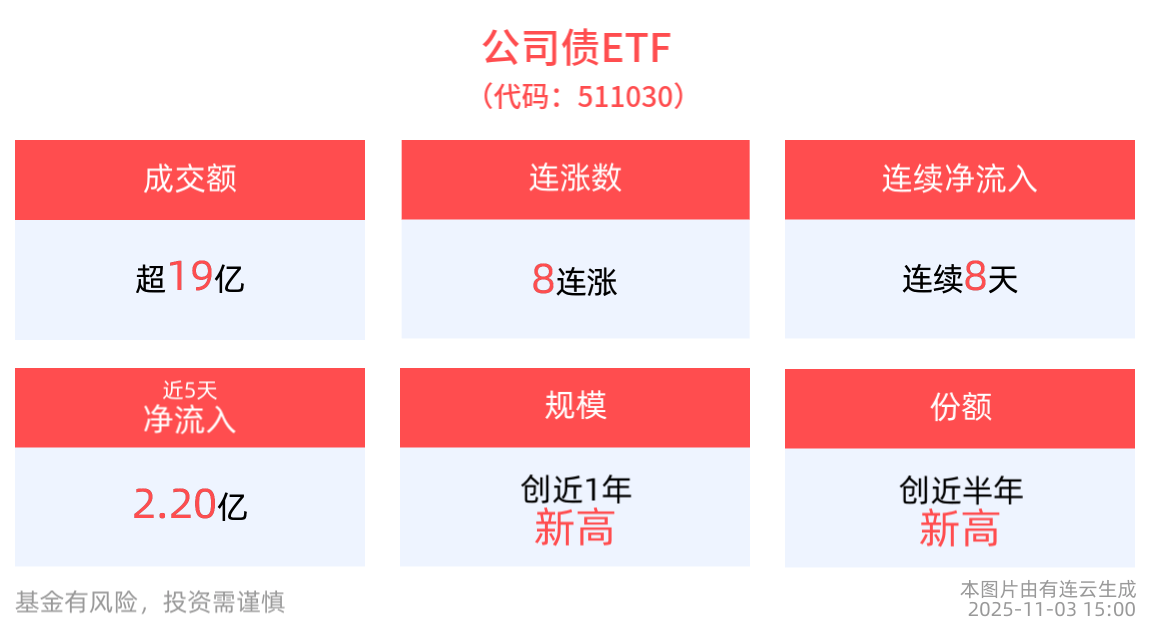
收益新“债”见,公司债ETF(511030)实现8连涨
Sou Hu Cai Jing· 2025-11-04 01:15
Group 1 - The bond market showed strong performance last week, primarily due to the central bank's resumption of bond purchases, which boosted market confidence [1] - This week, aside from potential impacts from new fund redemption regulations, most negative factors have been exhausted, allowing for a more optimistic outlook for the bond market [1] - Historical data indicates a higher probability of bond market declines in November, with a core focus on the potential restart of interest rate cuts, suggesting a strategy of extending duration [1] Group 2 - As of November 3, 2025, the company bond ETF (511030) rose by 0.03%, marking its eighth consecutive increase, with a latest price of 106.56 yuan and a year-to-date increase of 1.39% [4] - The company bond ETF's liquidity showed a turnover rate of 8.41% with a transaction volume of 1.972 billion yuan, and an average daily transaction volume of 2.189 billion yuan over the past month [4] - The latest scale of the company bond ETF reached 23.453 billion yuan, a new high in nearly a year, with the latest share count at 220 million, also a six-month high [4] Group 3 - Over the past five years, the net value of the company bond ETF has increased by 13.34%, with a maximum monthly return of 1.22% and a longest consecutive increase of nine months [5] - The company bond ETF has a historical annual profit percentage of 83.33% and a monthly profit probability of 78.94%, with a 100% probability of profit over a three-year holding period [5] - As of October 31, 2025, the company bond ETF's one-month Sharpe ratio was 1.81, and the maximum drawdown over the past six months was 0.28% [5] Group 4 - The company bond ETF closely tracks the China Bond - Medium to High Grade Corporate Bond Spread Factor Index, which reflects the trends in the RMB bond market [6] - The index is based on AAA-rated corporate bonds listed on the Shanghai Stock Exchange and is segmented by implied ratings, serving as a benchmark for investment performance in medium to high-grade corporate bonds [6]