债券

Search documents
关税冲击下市场震荡,四季度股债如何配置?
Mei Ri Jing Ji Xin Wen· 2025-11-04 02:15
Equity Market Review - The core viewpoint is that the trend remains bullish, awaiting a breakthrough, with A-shares experiencing significant fluctuations due to tariff impacts, similar to previous market behaviors in April [1] - The market has shifted to a wider trading channel, making high-selling and low-buying strategies more effective as each dip is followed by higher lows, indicating a strong upward trend [2] - Normal corrections are expected after significant gains, driven by profit-taking psychology and external factors like trade disputes, but the long-term confidence in China's economy remains strong [2][3] - The market's upward movement is supported by expectations rather than current realities, with investors more inclined to bet on rising prices rather than declines [3] - A solid economic recovery would further strengthen the upward trend, while ongoing policy support can prevent significant downturns, making corrections good opportunities for accumulation [3][4] Bond Market Review - The bond market outlook is less optimistic than equities but still positive, with a core conclusion of favorable support and a mid-term positive trend [5] - The fundamental backdrop is influenced by supply-demand mismatches, with PPI remaining negative for 36 consecutive months, but recent policy shifts indicate a change in attitude towards economic quality and pricing [6] - Recent government policies aim to maintain liquidity and promote lower financing costs, which is positive for the bond market, although interest rates are already at low levels [6] - Technical indicators show a significant oversold condition in the bond market, suggesting a potential rebound phase, with ten-year government bonds being a key investment choice due to their balance of yield and volatility [7]
收益新“债”见,公司债ETF(511030)实现8连涨
Sou Hu Cai Jing· 2025-11-04 01:15
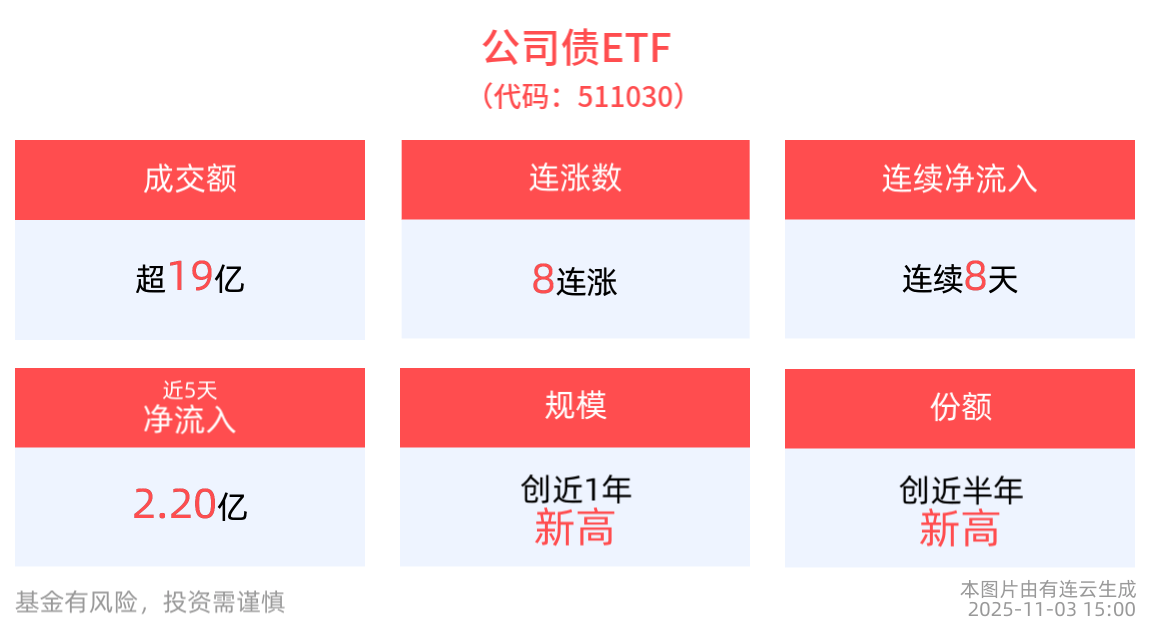
Group 1 - The bond market showed strong performance last week, primarily due to the central bank's resumption of bond purchases, which boosted market confidence [1] - This week, aside from potential impacts from new fund redemption regulations, most negative factors have been exhausted, allowing for a more optimistic outlook for the bond market [1] - Historical data indicates a higher probability of bond market declines in November, with a core focus on the potential restart of interest rate cuts, suggesting a strategy of extending duration [1] Group 2 - As of November 3, 2025, the company bond ETF (511030) rose by 0.03%, marking its eighth consecutive increase, with a latest price of 106.56 yuan and a year-to-date increase of 1.39% [4] - The company bond ETF's liquidity showed a turnover rate of 8.41% with a transaction volume of 1.972 billion yuan, and an average daily transaction volume of 2.189 billion yuan over the past month [4] - The latest scale of the company bond ETF reached 23.453 billion yuan, a new high in nearly a year, with the latest share count at 220 million, also a six-month high [4] Group 3 - Over the past five years, the net value of the company bond ETF has increased by 13.34%, with a maximum monthly return of 1.22% and a longest consecutive increase of nine months [5] - The company bond ETF has a historical annual profit percentage of 83.33% and a monthly profit probability of 78.94%, with a 100% probability of profit over a three-year holding period [5] - As of October 31, 2025, the company bond ETF's one-month Sharpe ratio was 1.81, and the maximum drawdown over the past six months was 0.28% [5] Group 4 - The company bond ETF closely tracks the China Bond - Medium to High Grade Corporate Bond Spread Factor Index, which reflects the trends in the RMB bond market [6] - The index is based on AAA-rated corporate bonds listed on the Shanghai Stock Exchange and is segmented by implied ratings, serving as a benchmark for investment performance in medium to high-grade corporate bonds [6]

机构称债市已重回基本面资金面定价,国债ETF5至10年(511020)备受关注
Sou Hu Cai Jing· 2025-11-04 01:15
Group 1 - The bond market is expected to have a smooth bullish phase in Q4 due to limited supply and increased allocation by banks and insurance funds [1] - Since October 13, various institutions have increased their positions in long-term bonds, while rural commercial banks have significantly reduced their holdings [1] - The central bank's resumption of government bond purchases has established a yield ceiling for bonds, leading to a growing trend of non-bank entities investing in the bond market [1] Group 2 - The scale of actively managed pure bond funds decreased by 743.3 billion, with potential adjustments to punitive redemption fees expected to be a net positive for the market [2] - MLF rates have dropped to 1.60%, indicating a potential future decrease in policy rates, with expectations for 30Y government bonds to decline by nearly 15 basis points [2] - As of November 3, 2025, the 5-10 year government bond ETF has seen a recent increase in trading activity, with a turnover of 153.59% and a total transaction volume of 2.469 billion [2] Group 3 - The 5-10 year government bond ETF reached a new high in scale at 1.608 billion, with recent inflows balancing out [3] - The ETF has shown a net value increase of 21.59% over the past five years, ranking in the top 18.78% among index bond funds [3] - Historical performance indicates a 100% probability of profit over three years, with a monthly profit probability of 70.91% [3] Group 4 - The 5-10 year government bond ETF has a Sharpe ratio of 1.05 over the past year, indicating favorable risk-adjusted returns [4] - The maximum drawdown over the past six months was 1.09%, with a relative benchmark drawdown of 0.46% [5] - The management fee for the ETF is 0.15%, and the custody fee is 0.05% [6] Group 5 - The tracking error for the 5-10 year government bond ETF was 0.027% over the past month, demonstrating its close alignment with the underlying index [7] - The index reflects the performance of actively traded government bonds with maturities of 5, 7, and 10 years [7]
固收:11月债市投资策略
2025-11-03 15:48
Summary of the Conference Call on Bond Market Investment Strategy Industry Overview - The focus is on the bond market, specifically the investment strategies for November 2025, highlighting a strong but limited downward movement in bond prices with low risk [1][4]. Key Points and Arguments - **Economic Expectations**: Investors have high expectations for a strong economic start in the coming year, supported by positive developments in US-China trade negotiations and potential recovery in PMI data [1][3]. - **Interest Rate Trends**: The ten-year government bond yield needs more favorable conditions to effectively drop below 1.7%. Current conditions show a 7,000 fund level around 1.4, indicating a loose but not extremely low liquidity environment [2][3]. - **Duration Strategy**: It is recommended to maintain a neutral to slightly high duration strategy in November, focusing on opportunities to compress spreads, particularly in 30-year non-active bonds, 50-year government bonds, and 5-10 year active government bonds [5][11]. - **Short-term vs Long-term Bonds**: Short-term certificates of deposit are not cost-effective, while short-term government bonds are less likely to decline due to central bank purchases. If short-term rates continue to decline, a bullet strategy is preferred; if rates fluctuate, a balanced approach between bullet and barbell strategies is suggested [6][10]. - **Central Bank Actions**: The central bank restarted government bond trading to stabilize the balance sheet and as a long-term liquidity tool. This move is crucial given the declining balance of central government debt from January to September [7][8]. - **Government Bond Supply**: Although the net financing scale of government bonds in Q4 is lower than last year, it is still significant, necessitating central bank cooperation. The expected net financing scale for November to December is approximately 1.7 trillion, lower than last year's nearly 3 trillion [9][10]. - **Future Monetary Policy**: There is a high probability of interest rate cuts next year, although the likelihood of cuts within the year is low. The central bank may adopt a more flexible approach to reserve requirement ratio adjustments based on market conditions [10][12]. - **Investment Recommendations**: For 10-year government bonds, the new bond 220 is less attractive compared to the main bond 215 due to its small issuance scale. Recommendations include focusing on high-value long-term bonds such as the 30-year and 50-year government bonds [11][12]. - **Floating Rate Bonds**: Floating rate bonds benefit from declining short-term rates, but many are currently overpriced. Investors are advised to selectively focus on specific floating rate products [13]. - **Bond Futures Strategies**: The December contract IR2 is at a high level, suggesting effective hedging strategies using bond futures. Specific analysis is required for different contracts during the November rollover [14]. Other Important Insights - The overall bond market is expected to remain strong with limited downside risk, indicating a cautious but optimistic outlook for investors [4]. - The central bank's actions are crucial for maintaining liquidity and supporting the bond market amid fluctuating economic conditions [8][10].
固收-债市行情升温能否持续?
2025-11-03 15:48
Summary of Key Points from the Conference Call Industry Overview - The conference call primarily discusses the bond market, focusing on the impact of central bank policies and market dynamics on fixed income securities, particularly government and credit bonds [1][2][4]. Core Insights and Arguments - **Central Bank Actions**: The central bank's resumption of bond purchases is viewed as a signal of renewed expectations for monetary easing, significantly boosting market sentiment despite limited liquidity increase [1][2][4]. - **Market Sentiment**: Short-term trading sentiment has exceeded expectations, with a notable recovery in market activity following the central bank's actions [2][3]. - **Institutional Buyers**: The primary buyers of long-term government bonds are brokerages and insurance companies, while public funds show limited expectations for future yield declines [3][4]. - **Credit Bond Performance**: The credit bond market has shown strong performance, with demand driven by insurance funds, wealth management products, and asset management products. Public funds have increased their allocation to credit bonds, particularly in the 3 to 5-year maturity range [8][9][11]. - **Yield Movements**: Recent yield declines for government bonds ranged from 8.9 to 11.5 basis points for 1 to 5-year maturities, while credit bonds showed more significant declines for maturities beyond two years [10][12]. Additional Important Insights - **Market Dynamics**: The bond market is expected to face challenges in forming a smooth bull market due to year-end redemption pressures and new public fund fee regulations [6][7]. - **Investment Strategies**: Recommendations include extending duration and focusing on 3 to 5-year AA/AA2 rated municipal bonds, which offer high coupon rates as a core allocation. Super long-term bonds should be approached cautiously, with a focus on liquidity [16][18]. - **Future Market Outlook**: The market's recovery is ongoing, but caution is advised as the absolute yield levels are currently in the historical top 25%, indicating potential risks of rapid increases [14][15]. - **ETF and Insurance Trends**: The growth of new ETF products is limited, and insurance premium growth is not expected to be significant in the fourth quarter, suggesting weaker demand for long-term bonds [17][18]. This summary encapsulates the key points discussed in the conference call, providing insights into the current state and future outlook of the bond market.
10-Year Treasury Yield Long-Term Perspective: October 2025
Etftrends· 2025-11-03 15:34
Core Insights - The article examines the historical trends of the 10-year Treasury yield since 1962, highlighting its correlation with significant economic indicators such as the Fed Funds Rate, inflation, and the S&P 500 [1] Economic Indicators - The relationship between the 10-year Treasury yield and the Fed Funds Rate is analyzed, indicating how changes in monetary policy impact long-term interest rates [1] - Inflation trends are discussed in relation to the 10-year Treasury yield, emphasizing the yield's role as a predictor of future inflation expectations [1] - The article also explores the connection between the 10-year Treasury yield and the performance of the S&P 500, suggesting that shifts in yield can influence equity market dynamics [1]

信用债市场周度回顾 251103:关注中长期信用债的骑乘收益空间-20251103
GUOTAI HAITONG SECURITIES· 2025-11-03 11:51
Group 1 - The report emphasizes a duration strategy for credit bonds, suggesting a focus on the relative value and steepness of the yield curve for medium to long-term credit bonds due to the recent recovery since late September [1][6]. - The net financing for major credit bond types decreased to 36 billion yuan for the week of October 27 to October 31, 2025, compared to 1953.1 billion yuan in the previous week [6][8]. - The issuance of corporate bonds reached 881.1 billion yuan, while the total issuance of major credit bond types was 2186.8 billion yuan, indicating a slight reduction in market activity [6][7]. Group 2 - Secondary market trading saw an increase, with total transactions amounting to 9653.12 billion yuan, up by 632.69 billion yuan from the previous week [6][11]. - The yields on medium-term notes (MTNs) generally declined, with the 3-year AAA MTN yield falling by 4.79 basis points to 1.88% [6][11]. - The credit spreads for MTNs widened, with the spreads for 3-year notes across different ratings showing significant differentiation, indicating a more pronounced risk perception in the market [11][12]. Group 3 - No credit rating upgrades were reported for issuers in the domestic market during the week, and there were no downgrades or defaults noted [6][8]. - The report highlights that AAA-rated issuers accounted for 51.04% of the total issuance, with the construction industry being the largest contributor at 24.65% [6][7].
固收周报:关注指导区间内的配置机会-20251103
Yin He Zheng Quan· 2025-11-03 10:40
Report Industry Investment Rating No relevant content provided. Core Viewpoints of the Report - The bond market is generally in an oscillating and favorable situation in the short - term, but there may be short - term fluctuations. The allocation value of the 10 - year bond around 1.8% continues to emerge. It is recommended to increase positions on rallies, and actively seize short - term opportunities when a significant pulse of 2 - 4BP or more occurs in a single day [2][4]. - After the cross - month period, the bond market's capital supply is likely to face limited pressure under the central bank's support. The strong positive of the central bank's restart of treasury bond trading and the accelerated debt - resolution leading to the increased supply of government bonds still leave room for the market to bet on loose monetary policy. However, changes in risk appetite and the upcoming implementation of the new public - offering fee regulations may cause short - term fluctuations in the bond market [2]. Summary According to Relevant Catalogs 1. This Week's Bond Market Review - The bond market yields declined overall this week (10/27 - 10/31). As of 10/31, the yields of 30Y, 10Y, and 1Y treasury bonds changed by - 6BP, - 4.5BP, and - 8BP respectively, closing at 2.14%, 1.80%, and 1.38%. The term spreads of 30Y - 10Y and 10Y - 1Y changed by - 1.5BP and 3.5BP respectively, closing at 35BP and 41BP [1]. - The decline in the 10Y yield was due to factors such as the market's risk - aversion sentiment under Sino - US trade frictions, the central bank's announcement of restarting open - market treasury bond trading, and the market's expectation of loose monetary policy [6]. 2. Next Week's Bond Market Outlook and Strategy (1) Bond Market Outlook - **Fundamentals**: Production indicators showed differentiation, real - estate transactions had different year - on - year performances, and most price sectors rebounded. Production indicators mostly declined, demand on the consumer side mostly fell, and real - estate transactions varied. The price index rebounded this week, with a month - on - month increase ranging from 0.4% to 1.6% [25][40]. - **Supply**: From 10/27 - 11/2, the issuance scale of interest - rate bonds declined. The issuance of treasury bonds was 0 billion yuan, local bonds was 2706.82 billion yuan, and inter - bank certificates of deposit was 7349.2 billion yuan, a decrease of 8930.16 billion yuan compared with last week. The issuance progress of local bonds reached 89.7%, and the issuance progress of new special bonds and new general bonds were 90.4% and 86.3% respectively [54]. - **Funding**: From 10/27 - 10/31, the central bank net - injected 12008 billion yuan through 7 - day reverse repurchase and 2000 billion yuan of MLF this month. The funding situation fluctuated and tightened marginally. It is expected that after the cross - month period, the funding situation will likely return to equilibrium [60]. (2) Bond Market Strategy - Next week, attention should be paid to four aspects: the return of funds to equilibrium after the cross - month period, the situation of subsequent treasury bond trading and further monetary operations under loose monetary policy, the impact of changes in risk appetite on the bond market driven by short - term risk - aversion sentiment, and the impact of the new public - offering fee regulations [74]. - The bond market is favorable in the short - term. It is necessary to grasp the key position of 1.8%. Although the Sino - US consultations reached an agreement at the end of October, the market sentiment was not significantly boosted. The new public - offering fee regulations may cause short - term negative feedback, but the probability of substantial large - scale redemptions disturbing the market is currently limited [2][78]. 3. Next Week's Open - Market Operations and Financial Calendar - **Open - market operations**: The net injection (withdrawal) situation in the past four weeks and the next four weeks is provided, including reverse - repurchase and MLF operations. For example, this week (2025/10/31), the net injection was 14,008 billion yuan [79]. - **Financial calendar**: Information on local - government bond issuance, certificate - of - deposit maturity, reverse - repurchase maturity, MLF maturity, tax - payment weeks, and reserve - payment weeks from November 3rd to November 9th is provided [79].
11月信用月报:临近年末,信用债参与机会怎么看?-20251103
Western Securities· 2025-11-03 10:06
1. Report Industry Investment Rating No relevant content provided. 2. Core Viewpoints of the Report - In November, credit bonds are expected to show a volatile trend, but there are certain participation opportunities. It is recommended to seize the opportunity to buy medium - and high - grade varieties on dips. The ticket - coupon strategy is the main approach, and attention should be paid to the investment opportunities brought by the centralized position - building of amortized fixed - open bond funds [1][28]. - The supply of credit bonds in November may increase seasonally, but the incremental supply is not expected to be large. The demand side shows that bank wealth management still has increments, and the impact of the new public offering regulations on bond funds is expected to be limited [20]. 3. Summary According to Relevant Catalogs 3.1 Credit Bond Market Review and Outlook 3.1.1 October Credit Bond Market Review - In October, credit bond yields declined across the board, with the decline more than that of the same - term interest - rate bonds. Medium - and long - term bonds performed better than short - term bonds, and general credit bonds outperformed financial bonds [11]. - By week, the performance of credit bonds was affected by factors such as holiday data, tariff frictions, equity markets, risk - aversion sentiment, policy expectations, and the restart of treasury bond trading. The yields and spreads of credit bonds showed different trends in each week [10]. - As of November 2, the full - caliber wealth management scale dropped to 31.5 trillion yuan, a decrease of 6.1 billion yuan from the previous week. The net - breaking rates of all bank wealth management products and wealth management subsidiaries decreased [13]. 3.1.2 November Credit Bond Market Outlook - Supply: Seasonally, credit bond supply usually increases in November, but considering the continuous contraction of urban investment bond supply, the supply increment this year may not be large [20]. - Demand: Bank wealth management is expected to have positive growth in November, but the incremental growth may continue to narrow. If the new public offering regulations are mitigated, the impact on bond funds may be limited [20]. - Overall, credit bonds are expected to fluctuate in November. There are participation opportunities, but it is difficult to have an independent trend. It is recommended to buy medium - and high - grade varieties on dips. Pay attention to the investment opportunities brought by the centralized position - building of amortized fixed - open bond funds [28]. 3.2 Primary Market 3.2.1 Issuance Volume - In October 2025, the credit bond issuance scale was 1492.311 billion yuan, an increase of 161.8 billion yuan year - on - year and a decrease of 270.9 billion yuan month - on - month. The net financing amount was 310.974 billion yuan, a decrease of 132.1 billion yuan year - on - year and an increase of 140.4 billion yuan month - on - month [34]. - By type, the net financing amount of urban investment bonds was - 5.838 billion yuan, while that of industrial bonds and financial bonds was 300.042 billion and 16.77 billion yuan respectively [34]. 3.2.2 Issuance Cost - From October 1 to 31, the average issuance interest rate of credit bonds was 2.22%, a decrease of 8.4bp compared with September. The average issuance interest rates of industrial bonds and urban investment bonds decreased, while that of financial bonds increased [39]. 3.2.3 Issuance Term - From October 1 to 31, the average issuance term of credit bonds was 2.95 years, a decrease of 0.01 year compared with September. The average issuance terms of industrial bonds and financial bonds increased, while that of urban investment bonds decreased [48]. 3.2.4 Cancellation of Issuance - In October, 27 credit bonds were cancelled for issuance, with a cancellation scale of 10.687 billion yuan, a decrease of 26 bonds and 17.993 billion yuan respectively compared with the previous month [49]. 3.3 Secondary Market 3.3.1 Trading Volume - In October, the trading volume of all credit bond varieties except insurance sub - bonds decreased compared with the previous month. The trading volume of bank secondary capital bonds decreased the most, followed by bank perpetual bonds [54]. - By trading term, 1 - 5 - year urban investment bonds were more popular. The trading performance of industrial bonds varied by term, and the trading terms of bank perpetual bonds and some other bonds also showed different trends [54]. - By implied rating, the trading of urban investment bonds shifted from medium - rated to other ratings, while that of industrial bonds shifted to high - rated bonds [55]. 3.3.2 Trading Liquidity - In October, the turnover rates of urban investment bonds, industrial bonds, and financial bonds all decreased. By trading term, the turnover rate of 1 - 3 - year urban investment bonds decreased the most, and that of less than 1 - year industrial and financial bonds decreased the most [57]. 3.3.3 Spread Tracking - In October, the spreads of all urban investment bond varieties narrowed, with medium - and long - term spreads narrowing more significantly. The 5 - year AA - rated variety had the largest narrowing amplitude of 22bp [62]. - By region, most spreads in October narrowed, with the narrowing amplitude of each province not exceeding 5bp [66]. - In October, the spreads of AAA - rated and AA - rated industrial bonds in all industries narrowed, with the AA - rated bonds having a larger average narrowing amplitude [67]. - In October, the spreads of bank secondary and perpetual bonds narrowed, with medium - and long - term spreads narrowing more significantly [70]. - In October, most spreads of securities sub - bonds narrowed, while those of insurance sub - bonds narrowed across the board [72]. 3.4 October Hot Bonds Overview - The report selects the top 20 urban investment bonds, industrial bonds, and financial bonds in terms of liquidity scores for investors' reference [74]. 3.5 Credit Rating Adjustment Review - In October, 7 bonds had their debt ratings upgraded, and there were no downgrades [78].
为什么你没亏钱,却变穷了?
伍治坚证据主义· 2025-11-03 08:02
Core Viewpoint - The article discusses historical instances of debt management through inflation and the implications for modern economies, particularly focusing on France's "two-thirds bankruptcy" in 1797 and Japan's prolonged economic stagnation since the 1990s, highlighting how governments can manage debt without outright defaulting [2][7][10]. Group 1: Historical Context of Debt Management - In 1797, the French government reduced the value of government bonds by 67%, leading to significant losses for bondholders, a situation referred to as "two-thirds bankruptcy" [2]. - France's financial crisis was rooted in excessive debt accumulation due to continuous wars and ineffective tax reforms, resulting in a national debt of 5 billion livres by 1788, with interest payments consuming half of tax revenues [2][3]. - The introduction of the Assignat paper currency in 1789, initially backed by confiscated church lands, led to rampant inflation, with its total issuance reaching over 45 billion livres by 1796, nearly ten times France's GDP [3][5]. Group 2: Economic Consequences of Inflation - The inflation primarily affected the urban middle class, leading to protests and a loss of confidence in the currency, culminating in the abolition of the Assignat system in 1796 [5][6]. - The radical debt reduction plan proposed by Finance Minister La Meillur in 1797 effectively reduced France's debt-to-GDP ratio from 120% to below 40%, allowing the government to regain borrowing capacity [6]. - The aftermath of the debt reduction saw the "interest class" suffer significant losses, while the government stabilized its finances, illustrating the harsh realities of economic recovery post-crisis [6][14]. Group 3: Modern Parallels in Japan - Japan's economic situation post-1990 mirrors France's historical experience, with a debt-to-GDP ratio exceeding 250%, the highest globally, yet maintaining low bond yields due to the Bank of Japan's monetary policies [7][9]. - The implementation of "Abenomics" in 2013, particularly through aggressive monetary easing, has allowed the government to manage its debt without triggering market panic, effectively achieving a form of "implicit default" [7][9]. - Current inflation rates in Japan reached 3.1% in 2023, while bond yields remained low, resulting in negative real returns for investors, akin to the historical experiences of the French middle class [9][11]. Group 4: Lessons and Insights - Governments can manage debt through inflation rather than outright default, as seen in both historical and modern contexts, allowing for a "silent wealth transfer" from creditors to debtors [11][12]. - Investors should focus on real returns after accounting for inflation, as nominal returns can be misleading, with historical examples illustrating the erosion of purchasing power over time [12][13]. - Economic recoveries post-debt crises can be prolonged, with structural adjustments taking decades, as evidenced by both France and Japan's slow paths to recovery following their respective financial upheavals [14][15].