
原油

Search documents
STARTRADER:亚市跟随美联储节奏 原油供过于求迫在眉睫 油价挣扎
Sou Hu Cai Jing· 2025-09-04 10:54
Group 1 - Asian stock markets are buoyant following weak U.S. employment data, with expectations of an interest rate cut by the Federal Reserve [1] - The MSCI Asia Index rises, led by Japan, while the S&P 500 and Nasdaq futures also show slight increases due to anticipated Fed actions [1] - Chinese stock markets, however, experience a decline of over 2% due to concerns over a $1.2 trillion margin financing event, prompting potential tightening of monetary policy [1] Group 2 - The bond market remains favorable as traders expect two more interest rate cuts from the Federal Reserve by the end of the year [3] - Global bond yields decline in response to falling U.S. Treasury yields, with non-farm payroll data being a critical indicator for future monetary policy [3] - Gold prices have seen a drop after seven consecutive days of increases, although long-term trends indicate structural support from central banks [3] Group 3 - Brent crude oil prices fall to $67 per barrel, while West Texas Intermediate drops below $64, with discussions of "oversupply" rather than "scarcity" emerging [5] - OPEC+ considers increasing production, which seems counterintuitive given the current market conditions, as supply growth outpaces demand absorption [5] - Geopolitical factors, including U.S. sanctions on Russian oil, complicate the oil market, with traders noting that oil continues to flow to China and India despite sanctions [6] Group 4 - The market shows a divergence: stock markets are buoyed by Fed's accommodative policies, gold receives support from central banks, while oil struggles under supply surplus pressures [6] - Liquidity remains a dominant force in the market, but its distribution is uneven across different asset classes [6]


基本面呈利空导向 预计原油大概率承压震荡为主
Jin Tou Wang· 2025-09-04 06:07
Group 1 - The core viewpoint indicates that the domestic energy sector is experiencing a downward trend in crude oil prices, with the main contract fluctuating between 480.7 and 487.7 yuan per barrel, reflecting a decline of 1.85% [1] - Analysts from Huishang Futures believe that short-term oil prices have strong support due to a stable macro environment and the ongoing destocking process, but mid-term risks are rising due to the upcoming demand off-season and OPEC+'s planned production increase of 1.66 million barrels per day [1] - Zhonghui Futures notes that the end of the peak consumption season and OPEC+'s expansion cycle are likely to keep crude oil prices under pressure, with a focus on the outcomes of the upcoming OPEC+ meetings [1] Group 2 - Nanhua Futures highlights the uncertainty surrounding OPEC+'s decision to continue increasing production, which could significantly impact oil price volatility next week; a continuation of production increases may further suppress prices, while a pause could lead to limited rebounds [2] - The geopolitical risks, particularly the tensions between the U.S. and Venezuela, are identified as short-term disturbances that could influence oil prices, with potential fluctuations of $5 to $10 if conflicts escalate [2] - The overall market sentiment is currently negative, with both macroeconomic and fundamental factors indicating bearish trends, necessitating close monitoring of future developments [2]
广发期货《能源化工》日报-20250904
Guang Fa Qi Huo· 2025-09-04 05:37
Report Industry Investment Ratings - Not provided in the given content Core Views - **Polyester Industry**: Short - term PX, PTA, short - fiber, and bottle - chip prices follow oil prices, with limited upward drivers. Ethylene glycol has a "strong present, weak future" pattern. Strategies vary by product, such as PX11 and TA being under observation, and attention to support levels [2]. - **Fertilizer Industry**: Urea futures face pressure due to weak demand and high supply. It is advisable to monitor the recovery of industrial demand in North China after the parade [5]. - **Methanol Industry**: Methanol supply is abundant in September, while traditional downstream demand is weak. Attention should be paid to the restart of port MTO devices and inventory digestion [12]. - **Crude Oil Industry**: OPEC + supply news increases concerns about a supply surplus in the fourth quarter. The oil price is likely to be weak, and a bearish strategy is recommended [15]. - **Polyolefin Industry**: In September, the polyolefin market shows a pattern of "decreased supply and increased demand", with controllable inventory pressure. It is suggested to hold the expanding position of the LP01 contract [22]. - **Chlor - alkali Industry**: Caustic soda prices may remain firm in the short - term, and PVC is expected to continue weak and volatile [30]. - **Pure Benzene - Styrene Industry**: Short - term pure benzene and styrene prices are under pressure, but the downward space is limited if oil prices do not drop sharply. For EB10, short - term support around 6900 can be monitored [34]. Summaries by Related Catalogs Polyester Industry - **Prices and Cash Flows**: On September 3, Brent crude oil (November) was at $67.60/barrel, down 2.2%. Most polyester product prices were stable or slightly decreased, and cash flows showed different changes [2]. - **Supply and Demand**: PX supply is expected to increase, while demand has limited upward potential. PTA supply - demand prospects have improved, but the implementation of device maintenance is not as expected. Other products also have their own supply - demand characteristics [2]. Fertilizer Industry - **Prices and Supply - Demand**: On September 3 - 5, most fertilizer product prices were stable, and urea production and inventory data showed small fluctuations. Urea demand is weak, and supply is relatively sufficient [5]. Methanol Industry - **Prices and Inventory**: On September 3, MA2601 closed at 2382 yuan/ton, up 0.42%. Methanol enterprise, port, and social inventories all increased [12]. - **Supply and Demand**: In September, methanol supply is high, and traditional downstream demand is weak. Attention should be paid to the restart of port MTO devices [12]. Crude Oil Industry - **Prices and Spreads**: On September 4, Brent was at $67.39/barrel, down 0.31%. Most oil - related prices and spreads changed slightly, and the crack spread of refined oil increased slightly [15]. - **Supply and Demand**: OPEC + supply news intensifies concerns about a supply surplus in the fourth quarter, and the oil price is likely to be weak [15]. Polyolefin Industry - **Prices and Inventory**: On September 3, L2601 closed at 7247 yuan/ton, down 0.07%. PE and PP enterprise and social inventories increased [22]. - **Supply and Demand**: In September, PE supply pressure is limited, and PP shows a pattern of "both supply and demand increasing". Downstream demand has increased slightly [22]. Chlor - alkali Industry - **Prices and Inventory**: On September 3, the price of Shandong 32% liquid caustic soda was stable, and the price of PVC was also stable. Chlor - alkali inventories showed different changes [30]. - **Supply and Demand**: Caustic soda supply will gradually recover, and demand may increase. PVC supply is expected to increase, while demand remains weak [30]. Pure Benzene - Styrene Industry - **Prices and Inventory**: On September 3, CFR China pure benzene was at $734/ton, up 0.8%. Pure benzene and styrene port inventories increased [34]. - **Supply and Demand**: Pure benzene supply is expected to remain high, and demand support is weakening. Styrene supply is high in the short - term, but there are expectations of improvement in supply - demand later [34].
《能源化工》日报-20250904
Guang Fa Qi Huo· 2025-09-04 03:29
Industry Investment Ratings No information provided regarding industry investment ratings. Core Views Polyester Industry - PX supply is expected to increase due to the restart of maintenance devices and good short - process benefits. Demand has some support but limited upside. PX11 is under observation, with support around 6600 and attention on oil price trends [2]. - PTA supply - demand is near a tight balance in September. Although the device maintenance execution is not as expected, the low absolute price is supported, but the driving force is limited. TA is under observation, paying attention to the support around 4600 and oil price trends [2]. - Ethylene glycol has a "strong reality, weak expectation" supply - demand pattern. Short - term futures have limited downside, but the fourth - quarter supply - demand is weak. Attention is paid to the support of EG2601 around 4300 [2]. - Short - fiber supply - demand is expected to improve in September, but the destocking amplitude is limited. It follows raw material fluctuations, with the disk processing fee oscillating between 800 - 1100 [2]. - Bottle - chip supply and procurement may both decrease in September, with inventory expected to increase. PR follows the cost - end fluctuation, and the processing fee has limited upside [2]. Urea Industry - Urea futures prices fell due to weak demand and high - supply pressure. Domestic agricultural and industrial demand is weak, and export demand is also under pressure. The market supply is sufficient, and the futures price may be under pressure. Attention is paid to the recovery of industrial demand in North China after the parade [8]. Methanol Industry - Methanol supply is expected to increase with the return of inland maintenance devices and high - level imports in September. Traditional downstream demand is weak. The market is under pressure due to significant inventory accumulation, and attention is paid to the inventory digestion rhythm [10][11][12]. Crude Oil Industry - Overnight oil prices fell due to concerns about increased OPEC+ supply in the fourth quarter. The disk may run weakly, with support levels for WTI at [62, 63], Brent at [65, 66], and SC at [470, 480]. Options can wait for opportunities to expand after increased volatility [19]. Polyolefin Industry - PE supply pressure is relatively limited in the short - term, and PP shows a "supply - demand double - increase" situation. Downstream industry开工率 has increased, but new orders have limited support. In September, the market shows a "supply - decrease, demand - increase" pattern, and it is recommended to hold the expanding position of the LP01 contract [23]. Chlor - alkali Industry - Caustic soda market is supported by rigid demand, with low inventory in Shandong. The spot price may remain firm, and the disk callback space is limited. Attention is paid to downstream purchasing rhythm and device fluctuations [48]. - PVC supply - demand remains oversupplied. Supply is expected to increase in September, while demand remains weak. It is expected to continue weak and volatile, with cost - end support [48]. Pure Benzene and Styrene Industry - Pure benzene supply is expected to remain high, while demand support is weak. Short - term absolute price is under pressure, but the downward space is limited if oil prices do not fall deeply [53]. - Styrene supply is high in the short - term, with weak driving force. However, there is an expectation of supply - demand improvement later. EB10 can be lightly long at low positions, and mainly short on rebounds later [53]. Summary by Directory Polyester Industry - **Prices and Spreads**: On September 3, WTI crude oil (October) was at 63.97 dollars/barrel, down 1.62 dollars or 2.5% from the previous day. Various polyester product prices and spreads changed, such as PTA, MEG, and different polyester fiber prices [2]. - **Inventory and Expected Arrival**: MEG port inventory was 44.9 million tons on September 1, down 10.2% from August 25, and the expected arrival was 4.4 million tons, up 122.7% [2]. - **Industry开工率**: Asian PX开工率 was 75.6% on August 29, down 0.7% from August 22; PTA开工率 was 70.4%, down 1.2% [2]. Urea Industry - **Futures and Spot Prices**: On September 3, the 01 - contract futures price was 1714 yuan/ton, down 1.83% from the previous day. Spot prices in different regions had different changes [7][8]. - **Supply and Demand**: Domestic urea daily output was 18.80 million tons on September 5, down 0.93% from September 4. Factory inventory increased slightly, and order days decreased [8]. Methanol Industry - **Prices and Spreads**: On September 3, MA2601 closed at 2382 yuan/ton, up 0.42% from the previous day. There were also changes in various price spreads and regional price differences [10]. - **Inventory**: As of Wednesday, methanol enterprise inventory was 34.1083%, up 2.31%; port inventory was 142.8 million tons, up 9.88% [11]. - **开工率**: Upstream domestic enterprise开工率 was 72.19% on Thursday, down 1.12% from the previous value; downstream MTO device开工率 was 78.56%, up 2.13% [12]. Crude Oil Industry - **Prices and Spreads**: On September 4, Brent was at 67.39 dollars/barrel, down 0.31% from the previous day; WTI was at 63.75 dollars/barrel, down 0.34% [19]. - **Refined Oil**: NYM RBOB was at 200.90 cents/gallon on September 4, down 0.15% from the previous day. Refined oil cracking spreads had different changes [19]. Polyolefin Industry - **Prices and Spreads**: On September 3, L2601 closed at 7247 yuan/ton, down 0.07% from the previous day. There were also changes in price spreads and basis [23]. - **Inventory and开工率**: PE enterprise inventory on Wednesday was 45.1 million tons, up 5.57%; PP装置开工率 on Thursday was 80.2%, up 2.6% [23]. Chlor - alkali Industry - **Prices and Spreads**: On September 3, Shandong 32% liquid caustic soda equivalent - to - 100% price was 2718.8 yuan/ton, unchanged from the previous day. PVC prices and price spreads also had changes [48]. - **Supply and Demand**: Caustic soda industry开工率 was 85.4% on August 29, down 0.8% from August 22; PVC total开工率 was 73.3%, down 2.3% [48]. Pure Benzene and Styrene Industry - **Prices and Spreads**: On September 3, CFR China pure benzene was at 734 dollars/ton, up 0.8% from the previous day. Styrene - related prices and spreads also changed [53]. - **Inventory and开工率**: Pure benzene Jiangsu port inventory was 1.10 million tons on September 1, up 8.0% from August 25; domestic pure benzene开工率 was 79.2% on August 29, up 0.2% from August 22 [53].
美银:看好欧洲高收益债、中国股市及黄金,建议减持美国科技股
Ge Long Hui A P P· 2025-09-04 02:02
Core Viewpoint - The report from Bank of America highlights significant divergence in asset performance this year, with gold leading precious metals, a resurgence in the Chinese stock market, and U.S. equities at high levels but nearing bubble warning signs [1] Investment Strategy - Bank of America recommends a "three increases and two decreases" risk-averse investment strategy, suggesting investors increase holdings in European high-yield bonds and emerging market sovereign debt, which are expected to benefit from a shift towards looser monetary policy [1] - The report expresses optimism about the Chinese stock market, citing attractive valuations and a gradual inflow of capital [1] - Gold is identified as a key asset for hedging against geopolitical risks and potential depreciation of the U.S. dollar [1] Asset Recommendations - The report advises reducing exposure to U.S. technology stocks, particularly the "big tech" companies, due to their high valuations and associated risks [1] - Additionally, the outlook for the oil market is negative, with the report indicating that the supply-demand imbalance is unlikely to improve in the short term [1]
五矿期货能源化工日报-20250904
Wu Kuang Qi Huo· 2025-09-04 01:52
1. Report Industry Investment Rating No relevant content provided. 2. Core Views of the Report - The current oil price has been relatively undervalued, presenting a good opportunity for left - hand side layout. The fundamentals will support the current price, and if the geopolitical premium re - emerges, the oil price will have more upside potential [6]. - For methanol, supply pressure is increasing, the market is weak, and it is advisable to wait and see for now [3]. - Regarding urea, it is currently in a situation of low valuation and weak drivers, with limited downside space. It is recommended to focus on going long at low prices [5]. - For rubber, the medium - term view is bullish. In the short - term, the rubber price is expected to be strong, and it is advisable to go long on dips with quick entry and exit. Partially close the position of going long RU2601 and shorting RU2509 [13]. - For PVC, the domestic situation is one of strong supply, weak demand, and high valuation, with a weakening export outlook. It is recommended to look for opportunities to short on rallies [15]. - For styrene, the BZN spread is expected to recover in the long - term. When the inventory starts to decline, the styrene price may rebound [18]. - For polyethylene, the long - term contradiction has shifted from cost - driven downward movement to the Korean ethylene clearance policy, and the price is expected to fluctuate upwards [20]. - For polypropylene, in the context of weak supply and demand with high inventory pressure and no prominent short - term contradictions, it is recommended to go long on the LL - PP2601 contract at low prices [21]. - For PX, although there is currently a lack of upward drivers, the terminal and polyester data are gradually improving, and there is support at the lower end of the valuation. It is advisable to follow the trend of crude oil and look for opportunities to go long at low prices during the peak season [23]. - For PTA, the supply has shifted from inventory accumulation to de - stocking, and the demand side is improving. It is recommended to follow PX and look for opportunities to go long at low prices [25]. - For ethylene glycol, the supply is still in excess, and there is downward pressure on the valuation in the medium - term [26]. 3. Summary by Related Catalogs 3.1 Crude Oil - **Market Quotes**: The main INE crude oil futures closed up 3.40 yuan/barrel, or 0.69%, at 493.20 yuan/barrel. The main futures of related refined oils, high - sulfur fuel oil, closed down 1.00 yuan/ton, or 0.04%, at 2840.00 yuan/ton, and low - sulfur fuel oil closed down 30.00 yuan/ton, or 0.85%, at 3512.00 yuan/ton [1]. - **Data**: According to the US EIA weekly data, US commercial crude oil inventories decreased by 2.39 million barrels to 418.29 million barrels, a month - on - month decrease of 0.57%; SPR increased by 0.78 million barrels to 404.20 million barrels, a month - on - month increase of 0.19%; gasoline inventories decreased by 1.24 million barrels to 222.33 million barrels, a month - on - month decrease of 0.55%; diesel inventories decreased by 1.79 million barrels to 114.24 million barrels, a month - on - month decrease of 1.54%; fuel oil inventories increased by 0.32 million barrels to 20.13 million barrels, a month - on - month increase of 1.60%; aviation kerosene inventories increased by 0.29 million barrels to 43.59 million barrels, a month - on - month increase of 0.68% [1]. 3.2 Methanol - **Market Quotes**: On September 3, the 01 contract rose 10 yuan/ton to 2382 yuan/ton, and the spot price rose 15 yuan/ton, with a basis of - 132 [3]. - **Supply**: Domestic production has further increased, and there is still room for improvement in the future. Import arrivals have increased, and port inventories have accumulated to a high level [3]. - **Demand**: The profit of port MTO has continued to improve, but demand is weak. Traditional demand has not improved significantly, and overall downstream performance is average [3]. - **Strategy**: Temporarily wait and see [3]. 3.3 Urea - **Market Quotes**: On September 3, the 01 contract fell 32 yuan/ton to 1714 yuan/ton, and the spot price remained unchanged, with a basis of - 14. The futures price broke through the support level on Wednesday, while the spot price remained stable, and the basis strengthened [5]. - **Supply**: The number of maintenance devices has increased, domestic production has decreased, and short - term supply pressure has been relieved. However, enterprise profits are still at a medium - low level [5]. - **Demand**: The production of compound fertilizers has peaked and declined, and domestic agricultural demand has entered the off - season. Exports have increased, and port inventories have risen rapidly. Currently, demand is mainly concentrated in exports [5]. - **Inventory**: Although domestic supply has decreased, demand is weak, and enterprise inventories are at a high level compared to the same period last year [5]. - **Strategy**: It is recommended to focus on going long at low prices [5]. 3.4 Rubber - **Market Quotes**: NR and RU fluctuated and consolidated [8]. - **Factor Analysis**: Due to heavy rain in Thailand in the next 2 - 10 days, the risk of floods has increased, which may cause the rubber price to rise. Bulls believe that factors such as weather and rubber forest conditions in Southeast Asia, especially Thailand, may limit rubber production growth, the seasonal pattern usually turns bullish in the second half of the year, and China's demand is expected to improve. Bears believe that macro - economic expectations are uncertain, demand is in the seasonal off - season, and the positive impact of supply may be less than expected [8][9]. - **Industry Data**: As of August 28, 2025, the operating rate of all - steel tires of Shandong tire enterprises was 62.78%, 1.76 percentage points lower than the previous week and 3.95 percentage points higher than the same period last year. All - steel tire exports were good. The operating rate of semi - steel tires of domestic tire enterprises was 74.57%, 0.19 percentage points higher than the previous week and 4.06 percentage points lower than the same period last year. The downstream inventory of semi - steel tire factories was slow to consume. As of August 31, 2025, China's natural rubber social inventory was 126.5 million tons, a decrease of 0.6 million tons or 0.5% from the previous month. China's total social inventory of dark - colored rubber was 79.6 million tons, a month - on - month decrease of 0.09%. China's total social inventory of light - colored rubber was 46.8 million tons, a month - on - month decrease of 1.1%. As of August 31, 2025, the inventory of natural rubber in Qingdao was 47.34 (- 0.36) million tons [11]. - **Spot Prices**: Thai standard mixed rubber was 14880 (+ 30) yuan, STR20 was reported at 1830 (+ 0) US dollars, STR20 mixed was 1840 (+ 5) US dollars, butadiene in Jiangsu and Zhejiang was 9400 (+ 50) yuan, and cis - polybutadiene in North China was 11650 (0) yuan [12]. - **Strategy**: The medium - term view is bullish. In the short - term, the rubber price is expected to be strong, and it is advisable to go long on dips with quick entry and exit. Partially close the position of going long RU2601 and shorting RU2509 [13]. 3.5 PVC - **Market Quotes**: The PVC01 contract fell 10 yuan to 4878 yuan. The spot price of Changzhou SG - 5 was 4680 (0) yuan/ton, the basis was - 198 (+ 10) yuan/ton, and the 1 - 5 spread was - 294 (0) yuan/ton [15]. - **Cost**: The cost side remained stable, with the price of calcium carbide in Wuhai at 2300 (0) yuan/ton, the price of medium - grade semi - coke at 660 (0) yuan/ton, and the price of ethylene at 840 (0) US dollars/ton. The spot price of caustic soda was 870 (0) yuan/ton [15]. - **Supply**: The overall operating rate of PVC was 76%, a month - on - month decrease of 1.6%. Among them, the operating rate of the calcium carbide method was 77.3%, a month - on - month increase of 0.4%, and the operating rate of the ethylene method was 73%, a month - on - month decrease of 6.6% [15]. - **Demand**: The overall downstream operating rate was 42.6%, a month - on - month decrease of 0.1% [15]. - **Inventory**: Factory inventory was 31.2 million tons (+ 0.6), and social inventory was 89.6 million tons (+ 4.4) [15]. - **Strategy**: In the domestic situation of strong supply, weak demand, and high valuation, with a weakening export outlook and poor fundamentals, it is recommended to look for opportunities to short on rallies [15]. 3.6 Styrene - **Market Quotes**: The spot price fell, the futures price rose, and the basis weakened [17]. - **Factor Analysis**: Currently, the BZN spread is at a relatively low level compared to the same period, with a large upward adjustment space. The production of pure benzene has been fluctuating at a moderate level, and the supply is still abundant. The profit of ethylbenzene dehydrogenation has increased, and styrene production has continued to rise. Styrene port inventories have continued to accumulate significantly. At the end of the seasonal off - season, the overall operating rate of the three S products has been rising [18]. - **Fundamentals**: The price of pure benzene in East China was 5810 yuan/ton, unchanged; the spot price of styrene was 7000 yuan/ton, a decrease of 50 yuan/ton; the closing price of the active styrene contract was 7040 yuan/ton, an increase of 106 yuan/ton; the basis was - 40 yuan/ton, a weakening of 156 yuan/ton; the BZN spread was 127.5 yuan/ton, a decrease of 9.25 yuan/ton; the profit of non - integrated EB plants was - 344.9 yuan/ton, an increase of 90 yuan/ton; the spread between EB contract 1 and contract 2 was 69 yuan/ton, a narrowing of 19 yuan/ton; the upstream operating rate was 78.1%, a decrease of 0.40%; the inventory in Jiangsu ports was 19.65 million tons, an increase of 1.75 million tons; the weighted operating rate of the three S products was 43.84%, an increase of 0.24%; the operating rate of PS was 59.90%, an increase of 2.40%, the operating rate of EPS was 58.35%, a decrease of 2.63%, and the operating rate of ABS was 70.80%, a decrease of 0.30% [18]. - **Outlook**: In the long - term, the BZN spread is expected to recover. When the inventory starts to decline, the styrene price may rebound [18]. 3.7 Polyolefins 3.7.1 Polyethylene - **Market Quotes**: The futures price fell [20]. - **Factor Analysis**: The market is expecting favorable policies from the Chinese Ministry of Finance in the third quarter, and there is still support on the cost side. The spot price of polyethylene has remained unchanged, and the downward space for PE valuation is limited. There is only 400,000 tons of planned production capacity left, and the overall inventory has decreased from a high level, providing support for the price. The seasonal peak season may be approaching, and the procurement of raw materials for agricultural films has started, with the overall operating rate stabilizing at a low level [20]. - **Fundamentals**: The closing price of the main contract was 7247 yuan/ton, a decrease of 5 yuan/ton, the spot price was 7250 yuan/ton, unchanged; the basis was 3 yuan/ton, a strengthening of 5 yuan/ton. The upstream operating rate was 81.09%, a month - on - month increase of 0.07%. In terms of weekly inventory, the production enterprise inventory was 45.08 million tons, an increase of 2.38 million tons, and the trader inventory was 5.85 million tons, a decrease of 0.12 million tons. The average downstream operating rate was 40.5%, a month - on - month increase of 0.20%. The LL1 - 5 spread was 7 yuan/ton, a month - on - month narrowing of 1 yuan/ton [20]. - **Outlook**: The long - term contradiction has shifted from cost - driven downward movement to the Korean ethylene clearance policy, and the price is expected to fluctuate upwards [20]. 3.7.2 Polypropylene - **Market Quotes**: The futures price rose [21]. - **Factor Analysis**: There is still 1.45 million tons of planned production capacity, resulting in relatively high supply pressure. On the demand side, the downstream operating rate has rebounded from a seasonal low. In the context of weak supply and demand, the overall inventory pressure is high, and there are no prominent short - term contradictions [21]. - **Fundamentals**: The closing price of the main contract was 6954 yuan/ton, an increase of 11 yuan/ton, the spot price was 6990 yuan/ton, unchanged; the basis was 36 yuan/ton, a weakening of 11 yuan/ton. The upstream operating rate was 80.42%, a month - on - month decrease of 0.19%. In terms of weekly inventory, the production enterprise inventory was 55 million tons, an increase of 1.15 million tons, the trader inventory was 19.30 million tons, an increase of 2.48 million tons, and the port inventory was 5.85 million tons, a decrease of 0.18 million tons. The average downstream operating rate was 49.74%, a month - on - month increase of 0.21%. The LL - PP spread was 293 yuan/ton, a month - on - month narrowing of 16 yuan/ton [21]. - **Strategy**: It is recommended to go long on the LL - PP2601 contract at low prices [21]. 3.8 Polyester 3.8.1 PX - **Market Quotes**: The PX11 contract fell 24 yuan to 6810 yuan, the PX CFR price fell 3 US dollars to 843 US dollars, the basis was 99 yuan (+ 1) after conversion at the RMB central parity rate, and the 11 - 1 spread was 48 yuan (- 4) [23]. - **Supply**: The operating rate in China was 83.3%, a month - on - month decrease of 1.3%, and the operating rate in Asia was 75.6%, a month - on - month decrease of 0.7%. There were few changes in domestic plants [23]. - **Demand**: The operating rate of PTA was 70.4%, a month - on - month decrease of 2.5%. Some PTA plants had maintenance or unexpected shutdowns, while others were in the process of restarting or commissioning [23]. - **Import**: In August, South Korea exported 37.6 million tons of PX to China, an increase of 0.2 million tons compared to the same period last year [23]. - **Inventory**: At the end of July, the inventory was 389.9 million tons, a month - on - month decrease of 24 million tons [23]. - **Valuation and Cost**: The PXN was 246 US dollars (- 6), and the naphtha crack spread was 94 US dollars (- 3) [23]. - **,**: Currently, the PX operating rate remains high, and there have been many unexpected short - term maintenance of downstream PTA plants, with the overall operating rate at a low level. However, due to the commissioning of new PTA plants, PX is expected to maintain low inventory levels, and the terminal and polyester data are gradually improving, providing support for the valuation at the lower end. However, due to the lack of upward drivers currently and the reduction in the amount of unexpected PTA maintenance compared to previous expectations, the PXN has limited upward momentum. The valuation is currently at a moderate level, and the terminal and polyester are expected to continue to recover. It is advisable to follow the trend of crude oil and look for opportunities to go long at low prices during the
黄金续创新高-20250904
申银万国期货研究· 2025-09-04 00:39
Group 1 - The core viewpoint of the article highlights the decline in job vacancies in the US, which fell to 7.181 million in July, the lowest in 10 months, indicating a slowdown in economic activity and consumer spending [1][2] - The Federal Reserve's Beige Book indicates that economic activity across most regions of the US has remained unchanged, with many households' wages not keeping pace with rising prices, leading to stagnant or declining consumer spending [1] - There has been a trend of increasing minimum wage standards across 12 provinces in China this year, with most provinces raising their monthly minimum wage by approximately 8%-12%, resulting in all 31 provinces having a minimum wage exceeding 2000 yuan [1] Group 2 - In the precious metals sector, gold and silver prices are rising, with market focus on upcoming non-farm payroll data. The reduction in job vacancies is seen as a bullish factor for precious metals [2][17] - The dual-fuel market shows weak performance, with coal inventory increasing and steel production remaining stable, indicating a potential pressure on prices due to seasonal demand fluctuations [3][23] - The oil market is experiencing a decline, influenced by geopolitical tensions and changes in US inventory levels, with total US crude oil inventory decreasing to 822.493 million barrels [4][12] Group 3 - Internationally, the Federal Reserve's Waller suggests potential interest rate cuts in upcoming meetings, indicating a shift in monetary policy that could impact various sectors [5] - Domestically, the Chinese Ministry of Commerce has ruled against US fiber optic exporters, indicating ongoing trade tensions and regulatory scrutiny [6] - The FTSE Russell announced changes to the FTSE China 50 index, which will take effect on September 19, impacting the composition of the index and potentially influencing market dynamics [7]

贺博生:9.4黄金原油今日行情涨跌趋势分析及最新独家操作建议指导
Sou Hu Cai Jing· 2025-09-03 23:39
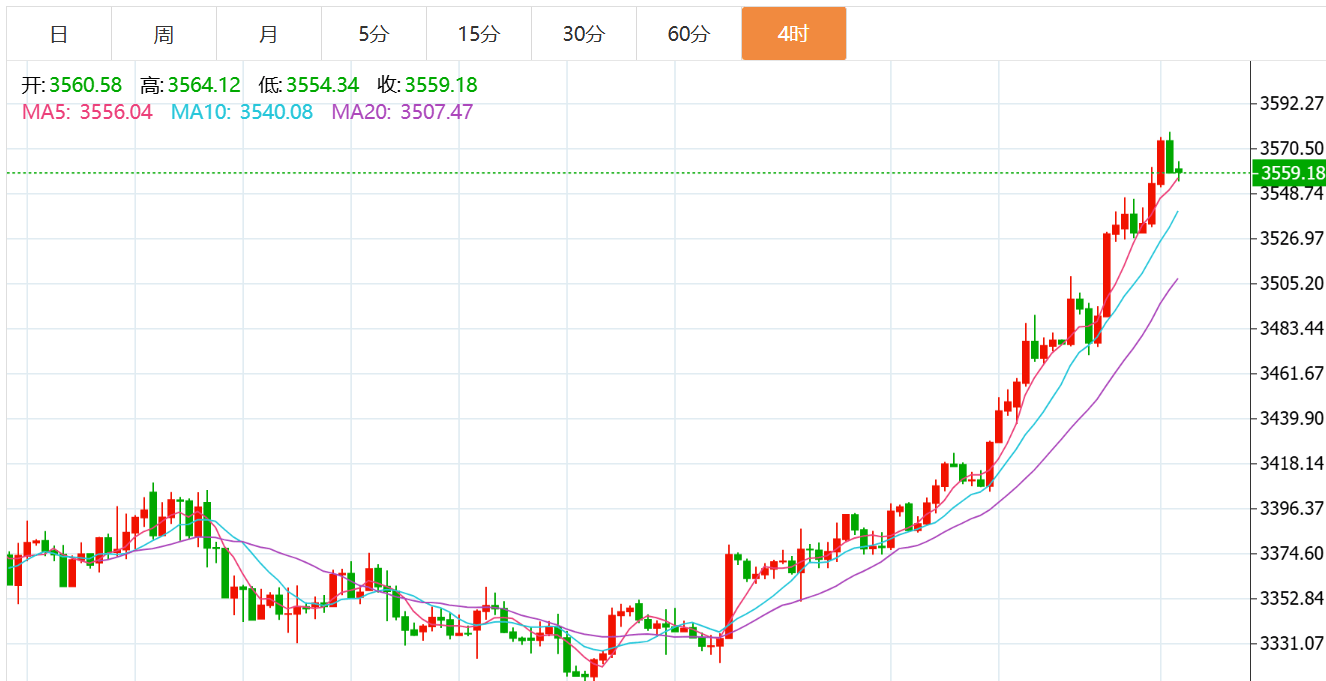
Group 1: Gold Market Analysis - Gold prices have risen for six consecutive trading days, reaching a historical high, driven by expectations of a Federal Reserve rate cut and increased risk aversion [2] - The upcoming U.S. non-farm payroll data is seen as a critical indicator, with a consensus of approximately 75,000 new jobs expected, which could influence monetary policy [2] - Technical analysis suggests a bullish outlook for gold, with key support levels at 3450 and 3470, while resistance is noted at 3578-3590 [3][5] Group 2: Oil Market Analysis - International oil prices are experiencing a downward trend, with Brent crude oil slightly down to $69.13 per barrel and WTI at $65.63, influenced by new U.S. sanctions on shipping networks related to Iranian oil [6] - The oil market is supported by sanctions and declining inventories, but economic data weakness poses a risk to demand outlook [6] - Technical indicators suggest a mixed outlook for oil, with short-term upward movement expected, but a longer-term downward trend remains probable [7]
美股大型科技股多数上涨,黄金创新高
Zhong Guo Zheng Quan Bao· 2025-09-03 23:38
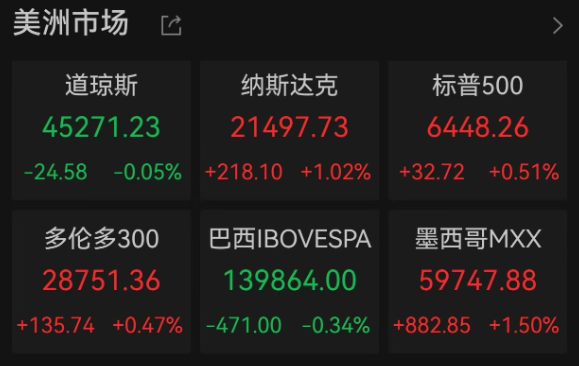
Market Performance - The Nasdaq index rose over 1%, while the Dow Jones Industrial Average fell by 0.05% and the S&P 500 increased by 0.51% [2] - Major U.S. tech stocks saw significant gains, with Alphabet (Google) rising over 9% and reaching a record high, while Apple increased by nearly 4% [4] - The technology sector's seven giants index rose by 2.01% [4] - Chinese concept stocks showed mixed results, with Huya rising over 7% [4] Commodity Prices - Gold prices reached historical highs, with London spot gold hitting $3,578.375 per ounce and COMEX gold futures reaching $3,640.1 per ounce [6] - The price of international crude oil futures fell by over 2%, influenced by an unexpected increase in U.S. API crude oil inventories by 622,000 barrels, contrary to market expectations of a decrease of 3.4 million barrels [8] European Market - All three major European stock indices closed higher, with Germany's DAX up 0.46%, France's CAC40 up 0.86%, and the UK's FTSE 100 up 0.67% [4]



每日投行/机构观点梳理(2025-09-03)
Jin Shi Shu Ju· 2025-09-03 10:38
Group 1: Gold Market Insights - Analysts from Philip Nova predict that gold prices may reach the range of $3600 to $3900 per ounce in the coming months if spot gold continues to break above $3500, driven by geopolitical risks and strong ETF demand [1] Group 2: Currency Market Analysis - Dutch bank analysts suggest that the recent decline of the US dollar may be limited, with potential for a rebound in the coming months as the market has already priced in interest rate cuts [2] - Analysts from Mitsubishi UFJ state that the political situation in France is unlikely to disrupt the upward trend of the euro, as market participants remain optimistic despite political turmoil [4] - Dutch bank analysts note that the euro's recent performance indicates that market participants do not believe the political situation in France will shake the euro's upward trend [4] Group 3: Oil Market Dynamics - Analysts from Dutch International highlight that the risk in oil prices lies in OPEC+'s decision to potentially re-implement production cuts, with Brent crude oil prices recently rising above $68 per barrel [3] Group 4: A-Share Market Trends - CITIC Securities reports that the A-share market is entering a mild recovery phase, with a structural shift towards growth sectors driven by AI and domestic substitution [6] - CITIC Securities also sees potential bottom-fishing opportunities in the white liquor industry, despite recent declines in revenue and profit due to reduced demand [7] Group 5: Investment Opportunities in Utilities - Huatai Securities suggests focusing on state-owned electric utility companies with low asset securitization ratios, as capital operations may enhance dividend payouts [8]