
机械

Search documents
考虑“生产回归美国”在华美企为0
日经中文网· 2025-06-11 07:47
Core Insights - The survey conducted by the American Chamber of Commerce in China reveals that U.S. companies operating in China are cautious about relocating production back to the U.S. despite potential increases in tariffs [1][2]. Group 1: Impact of Tariffs - 13% of surveyed companies indicated they would consider relocating production to countries outside of China and the U.S. if tariffs were raised again [1]. - 9% of companies stated they would reduce exports to the U.S. in response to potential tariff increases [1]. - Zero companies expressed intentions to move production back to the U.S., highlighting a significant reluctance to shift operations domestically [1]. Group 2: Business Strategy and Effects - Only 21% of companies reported that their business strategies were unaffected by the tariffs, while 44% experienced some level of impact, 25% reported significant impact, and 11% indicated extreme impact [2]. - A manufacturer in Suzhou noted that various constraints beyond costs, such as client specifications for components, make it difficult to easily relocate production [2]. - The survey included responses from 112 companies across various sectors, including manufacturing, consumer goods, and services, indicating a broad impact of tariffs [2].


沪指微跌0.44% 航运港口逆市走强
Chang Jiang Shang Bao· 2025-06-10 23:25
Group 1 - A-shares experienced a sudden drop in the afternoon, with the Shanghai Composite Index reaching 3400 points before retreating, closing down 0.44% at 3384.82 points [1] - The Shenzhen Component Index fell 0.86% to 10162.18 points, while the ChiNext Index decreased by 1.17% to 2037.27 points, with a total trading volume of 14153.73 billion yuan [1] - Sectors such as port shipping, beauty care, innovative drugs, and rare earth permanent magnets saw gains, while sectors like Huawei Ascend, military industry, semiconductors, and software development faced declines [1] Group 2 - The rare earth permanent magnet sector saw significant gains, with Zhongke Magnetic Industry (301141) hitting the daily limit, following two consecutive gains for Beikong Technology (600980) [1] - The agriculture sector rallied in the afternoon, led by the seed industry, while short drama concepts surged, with Ciweng Media (002343) hitting the daily limit and other companies like Zhongwen Online (300364) and Guomai Culture (301052) rising over 10% [1] - Dongwu Securities anticipates a series of event catalysts for the technology sector in June, suggesting sustained prosperity and better elasticity for growth stocks due to a weak dollar environment [1] Group 3 - Jifeng Investment Advisors noted that with a series of counter-cyclical adjustment policies being implemented, the A-share market has gradually found a bottom, presenting medium to long-term investment opportunities [2] - The stock market has shown signs of stabilizing profit corrections, opening up space for further upward movement in profits and valuations, recommending investors to buy on dips [2]


东兴证券晨报-20250609
Dongxing Securities· 2025-06-09 11:45
东兴晨报 P1 2025 年 6 月 9 日星期一 分析师推荐 东 兴 晨 报 【东兴煤炭】煤炭行业 2025 年中期投资策略:高股息与多频次高分红兼备, 煤炭防御性红利价值凸显(20250609) 2025 年以来,国内经济缓慢修复,煤炭板块跌幅明显。2025 年初至 6 月 3 日,煤炭板块累计跌幅 11.98%。沪深 300 指数累计跌幅 2.11%,煤炭跑输沪 深 300 指数 9.87 个百分点。 基本面展望:动力煤供强需弱,政策加码叠加煤炭两协会发布倡议书,煤价 仍将反弹修复。2025 年 1-5 月煤炭价格持续下跌。暖冬影响居民用电表现较 差,同时受到风光发电出力,火电需求同比走弱,供给受到山西增产+新疆持 续贡献增量,供强需弱导致煤价持续下跌。长协煤政策颁布稳定动力煤价, 煤炭协会出台倡议以来,长协价稳定,及时应对市场价的下滑。长协煤政策 仍然是煤价的稳定器。2025 年 2 月 28 日,中国煤炭工业协会、中国煤炭运 销协会发布倡议书,面对煤炭市场价格快速下滑,倡议书从"严格执行电煤 合同严格兑现"等五个维度对煤炭行业发展提出倡议,有助于减少煤价非理 性波动。2025 年 3 月起长协价高于 ...
6.9犀牛财经晚报:多家银行理财管理费调降 小米中国区人事调整
Xi Niu Cai Jing· 2025-06-09 10:28
Group 1 - Multiple banks have reduced management fees for wealth management products to attract investors, with some products having conditional fee reductions or no fees at all [1] - Canalys predicts that 2026 may be a key year for the recovery of the foldable smartphone market, with Apple's rumored foldable product potentially stimulating market demand [1] - TrendForce reports that the global wafer foundry industry revenue decreased by approximately 5.4% in Q1 2025, amounting to $36.4 billion, due to international market conditions [1] Group 2 - As of Q1 this year, China's market regulatory authorities have repaired a total of 8.7779 million pieces of corporate illegal credit information, a year-on-year increase of 34.52% [2] - In the first five months of this year, over 200,000 defective children's products were recalled in China, including 54 recalls of toys involving 96,600 items [2] - Greenme's Hong Kong listing process is progressing in an orderly manner, with the company committed to timely information disclosure [2] Group 3 - Qualcomm has agreed to acquire UK-listed company Alphawave for approximately $2.4 billion, valuing the entire issued and to-be-issued share capital at £1.83 per share [3] - Xiaomi has undergone personnel adjustments in its China region, with Vice President Wang Xiaoyan taking on additional responsibilities as General Manager of Xiaomi Home [4] - JD.com has launched its wine and travel business, actively recruiting talent and establishing a complete business line for "flights + hotels + travel" [4] Group 4 - Midea Group clarified that the recall of its U-shaped air conditioning units in North America is a voluntary recall, not a mandatory one, and the product meets market standards [4] - A rumor regarding Hoshine Silicon Industry's control transfer has been denied by a company insider, stating that the information is false [5] - Haosai announced the termination of the transfer of a 0.71% stake in Yida New Energy due to unmet conditions of the agreement [5] Group 5 - Yibin Technology received a project designation notice from a domestic new energy vehicle company, with an estimated total sales amount of approximately 256 million yuan over a five-year lifecycle [6] - Kaichun Co. announced an adjustment to its share repurchase price limit from 26.625 yuan per share to 40 yuan per share, effective from June 10, 2025 [7] - The ChiNext index rose over 1% with more than 4,100 stocks in the market increasing, indicating a strong market performance [8]
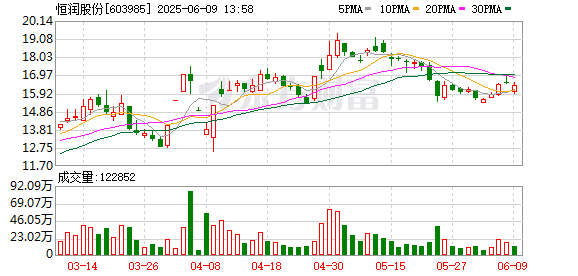
恒润股份:周洪亮计划减持公司股份不超过约624万股
Mei Ri Jing Ji Xin Wen· 2025-06-09 05:58
Group 1 - The core point of the announcement is that major shareholders of Hengrun Co., Ltd. plan to reduce their holdings in the company through various methods, including centralized bidding and block trading [2] - Zhou Hongliang, the general manager and a major shareholder, holds approximately 25.21 million shares, accounting for 5.72% of the total share capital, and intends to reduce his holdings by up to 6.24 million shares, or 1.41% of the total share capital [2] - Jiarun International and Zhituo Group also plan to reduce their holdings by 120,000 shares (0.27%) and 91,000 shares (0.21%) respectively, within the same time frame [2] Group 2 - For the fiscal year 2024, Hengrun Co., Ltd.'s revenue composition is as follows: wind power tower flanges account for 37.26%, wind power bearings 16.43%, other businesses 13.34%, computing industry 11.45%, mechanical industry support 11.22%, and other industries 10.27% [3]

国泰海通 · 晨报0609|宏观、策略、海外策略
国泰海通证券研究· 2025-06-08 13:53
Group 1: Stablecoins and Global Currency System - Stablecoins are typically pegged to stable assets like fiat currencies (mainly USD), precious metals, or other cryptocurrencies, providing relative stability in value [1] - The stablecoin market has significantly expanded since 2020, currently valued at nearly $245 billion, driven by advantages in payment settlements, demand from the expanding cryptocurrency market, and geopolitical risks [1][2] - The development of stablecoins essentially extends the dominance of the USD into the cryptocurrency realm, although the ongoing de-globalization of the USD may not be reversed by stablecoin growth [2] Group 2: China's Market Outlook - The "transformation bull" market in China is becoming clearer, with strategic optimism for 2025 driven by reduced marginal impacts from valuation contractions and a shift in investor expectations [3] - Key drivers for this market include a decline in risk-free rates, effective economic policies, and a focus on investor returns, which are crucial for changing risk perceptions among investors [3][4] - Investment opportunities are identified in sectors such as finance, emerging technology, and cyclical consumption, with recommendations for stocks in brokerage, banking, insurance, and new consumer trends [4][5] Group 3: Hong Kong Market Dynamics - The Hong Kong stock market has outperformed the A-share market since the beginning of the year, with a 19% increase in the Hang Seng Index, driven by sectors like healthcare, technology, and consumer goods [7] - The scarcity of certain assets in the Hong Kong market, particularly those related to AI applications and new consumption trends, is a significant factor in its outperformance [7][8] - Positive factors supporting the Hong Kong market's upward trajectory include fundamental recovery and improved liquidity, with a focus on technology stocks benefiting from accelerated AI applications [8]

本期震荡偏强,科技板块仍具性价比
Guotou Securities· 2025-06-08 08:35
- The "Four-Wheel Drive Model" issued multiple bullish signals for the TMT sector, indicating potential opportunities based on low-frequency thermometer metrics and crowding levels. The TMT sector remains at a relatively low position compared to the market, with slight upward movement after hitting a two-year low at the end of May[6][13] - Specific industries highlighted by the "Four-Wheel Drive Model" include electronics, computers, media, non-bank financials, food and beverages, textiles and apparel, communications, machinery, and military industries, all showing potential opportunities based on recent signals and market dynamics[6][13] - The "Four-Wheel Drive Model" uses metrics such as Sharpe ratio rankings and signal dates to identify potential opportunities in various industries, with recent signals indicating upward trends or crowding effects in sectors like electronics and media[13]
热点追踪周报:由创新高个股看市场投资热点(第197期)-20250606
Guoxin Securities· 2025-06-06 11:26
- The report introduces a quantitative model called "250-day new high distance" to track market trends and identify investment hotspots. The model is based on the concept that stocks nearing their 52-week high tend to outperform those far from their 52-week high, as supported by research from [George@2004] and other notable investors like William O'Neil and Mark Minervini. The formula for calculating the 250-day new high distance is: $ 250 \text{ day new high distance} = 1 - \frac{\text{Close}_{t}}{\text{ts\_max(Close, 250)}} $ where $\text{Close}_{t}$ represents the latest closing price, and $\text{ts\_max(Close, 250)}$ is the maximum closing price over the past 250 trading days. If the latest closing price reaches a new high, the distance is 0; otherwise, it is a positive value indicating the percentage drop from the high. [11] - The report evaluates the "250-day new high distance" model as an effective tool for identifying market trends and leading stocks, emphasizing its ability to highlight momentum and trend-following strategies. [11][18] - The report also introduces a composite factor for selecting "stable new high stocks" from the pool of stocks that have reached a 250-day new high in the past 20 trading days. The selection criteria include: 1. Analyst attention: At least 5 buy or overweight ratings in the past 3 months 2. Relative stock strength: Top 20% of market-wide 250-day returns 3. Price stability: Evaluated using two metrics: - Price path smoothness: Stock price displacement ratio - Innovation high persistence: Time-series average of the 250-day new high distance over the past 120 days 4. Trend continuation: Time-series average of the 250-day new high distance over the past 5 days, selecting the top 50 stocks based on ranking. [23][26] Model Testing Results - The "250-day new high distance" model shows the following results for major indices as of June 6, 2025: - Shanghai Composite Index: 2.99% - Shenzhen Component Index: 11.41% - CSI 300 Index: 8.98% - CSI 500 Index: 8.98% - CSI 1000 Index: 6.94% - CSI 2000 Index: 4.25% - ChiNext Index: 20.03% - STAR 50 Index: 12.00% [2][12][31] - The "stable new high stocks" factor identified 38 stocks from the pool of 777 stocks that reached a 250-day new high in the past 20 trading days. These stocks were distributed across sectors as follows: - Manufacturing: 11 stocks - Consumer: 8 stocks - Other sectors include finance, technology, and healthcare [3][27][32]


【环球财经】期待中美贸易谈判进展 东京股市反弹
Xin Hua Cai Jing· 2025-06-06 08:06
Group 1 - The core viewpoint of the news is that the Tokyo stock market rebounded due to expectations of progress in trade negotiations between China and the United States following a phone call between the two leaders on June 5 [1] - The Nikkei 225 index rose by 187.12 points, closing at 37,741.61 points, with a gain of 0.50%, while the Tokyo Stock Exchange Price Index increased by 12.86 points, closing at 2,769.33 points, with a gain of 0.47% [1] - The market sentiment was supported by the confirmation of a second round of ministerial talks on tariffs and an agreement on mutual visits between the leaders of China and the U.S. [1] Group 2 - On June 6, all sectors in the Tokyo Stock Exchange, except for three (Aquaculture and Agriculture, Glass and Ceramics Products, and Fiber Products), experienced gains, with steel, construction, and machinery sectors leading the increases [2] - The weakening of the yen against the dollar during the trading hours also provided support to the stock market [1] - Despite the overall positive movement, the Tokyo stock market showed limited enthusiasm for aggressive buying due to weak U.S. employment data released on June 5, which led to declines in major U.S. stock indices [1]
资产配置月报:六月配置视点:今年业绩领先的基金有何特征?-20250605
Minsheng Securities· 2025-06-05 07:26
1. Report Industry Investment Rating No industry investment rating information is provided in the report. 2. Core Viewpoints of the Report - This year, public - offering equity funds have outperformed the market. Leading equity active funds are a mix of focused, rotational, and gambling types in terms of industries, with mid - growth and mid - high valuation styles. Their returns mainly come from stock - picking and trading abilities, and they are more concentrated in the consumer sector. Leading equity quantitative funds may deviate towards large - cap and value, with less under - allocation of finance and less over - allocation of machinery and electronics compared to other public - offering quantitative funds [1][14][33]. - In June 2025, the equity market's sentiment will continue to recover, and investors should take advantage of trading opportunities; the 10Y Treasury bond rate may decline by 9BP to 1.60%; gold should be continuously allocated; the real - estate supply - side pressure will rise; foreign capital will continue to flow in slightly, and the Indian equity market will have a phased rebound, but its current allocation value is relatively limited [2][35]. - In terms of market style, it is recommended to focus on the expected growth style, and the institutional attention to small - cap stocks is accelerating [4][91]. - For industry allocation, the high - probability and high - odds strategy recommends non - ferrous metals, electronics, power equipment and new energy, computers, machinery, and agriculture, forestry, animal husbandry and fishery; the industry clearance and reversal strategy recommends non - ferrous metals, electronics, and communications [5][107]. 3. Summary by Relevant Catalogs 3.1 This Year's Characteristics of Leading - Performance Funds 3.1.1 Equity Active Funds - As of May 30, 2025, public - offering equity active funds have achieved good results. The average absolute return is 2.51%, the median is 1.13%, and the proportion of positive absolute returns is 57.30%. The average excess return relative to their respective benchmarks is 2.45%, the median is 1.49%, and the proportion of positive excess returns is 61.19%. The average information ratio is 2.67%, and the average information ratio of the top 20 is 26.1% [10][12]. - The top 20 equity active funds with an information ratio and established for more than one year are a mix of focused, rotational, and gambling types in industries, mainly with mid - growth and mid - high valuation styles, and their scale is generally below 1 billion. There are three main models: focused on consumption - mid - growth and high - valuation, industry rotation - mid - growth and mid - valuation, and industry gambling - mid - growth and high - valuation [14][15]. - The returns of these three models mainly come from stock - picking and trading contributions. Style and industry returns contribute relatively little to the total return. The leading - performance equity active funds' returns mainly come from stock - picking and trading abilities [19]. - In terms of industry distribution, these funds are mainly concentrated in the consumer sector. Focused funds are concentrated in medicine and food and beverage; rotational funds are relatively diversified, mainly in consumer and manufacturing sectors; gambling funds are concentrated in food and beverage, basic chemicals, and commerce and retail [21]. 3.1.2 Equity Quantitative Funds - In terms of style exposure relative to the benchmark, the top 20 public - offering quantitative funds in terms of information ratio may deviate towards large - cap and value. They have less deviation in small - cap and greater deviation in non - linear small - cap, indicating an increase in large - cap stocks. They also have higher exposure to undervaluation factors, showing a preference for value, and obvious deviations in low - liquidity and low - volatility [29]. - In terms of industry exposure, these top 20 funds have less under - allocation of finance and less over - allocation of machinery and electronics compared to other public - offering quantitative funds. They also have over - allocation in construction and food and beverage [31]. 3.1.3 Summary This year, public - offering equity funds have outperformed the market. Leading equity active funds are a mix of different types in industries, with mid - growth and mid - high valuation styles, and their returns mainly come from stock - picking and trading abilities, and are concentrated in the consumer sector. Leading equity quantitative funds may deviate towards large - cap and value, with different industry exposure characteristics [33]. 3.2 Quantitative Views on Major Asset Classes 3.2.1 Equity: Sentiment Continues to Recover, Seize Trading Opportunities in June - In May, the overall sentiment recovered, with a slight decline in the financial sector and a steady recovery in the industrial sector. The full - A net profit in Q2 may further improve [39]. - Credit expansion has weakened, and the structure still needs improvement. It is estimated that the new social financing in May 2025 will be about 2.33 trillion yuan, an increase of 0.27 trillion yuan year - on - year. Government bonds will continue to support the growth of social financing [45]. - The market will remain in a volatile pattern in June. Investors can increase excess returns by seizing trading opportunities. The market is in a volatile pattern, and the overall market center may gradually rise, but the pace may be slow. The Shanghai and Shenzhen 300 Index has a healthy microstructure, and investors can buy low and sell high [48]. 3.2.2 Interest Rates: The 10Y Treasury Bond Rate May Decline by 9BP to 1.60% in June - Since 2023, the out - of - sample direction prediction of the 10Y Treasury bond rate has been correct for 20 months, with a winning rate of 69%. - Economic growth, inflation, and short - term interest rate factors are declining, while the debt - leverage factor has slightly increased. Overall, the 10Y Treasury bond rate may continue to decline in June [35]. 3.2.3 Gold: Continue to Allocate - Since 2023, the out - of - sample direction prediction of gold has been correct for 22 months, with a winning rate of 76%. - Various factors jointly drive the continued rise of gold. The US economic factor is declining, the fiscal factor is rising but at a slower pace, the employment factor is recovering, and the external debt factor is increasing [62]. - The slowdown in the upward rate of the fiscal factor is due to the reduction in defense spending, while overall consumption and investment expenditures have not declined [67]. 3.2.4 Real Estate: Supply - Side Pressure Rises - As of May 31, 2025, the three - month moving average of the real - estate industry pressure index is 0.569, indicating an increase in overall industry pressure. The supply - side pressure has increased due to the weak performance at the start - up end, while the demand - side pressure is basically the same as last month [72]. 3.2.5 Overseas: Foreign Capital Continues to Flow in Slightly, and Indian Equity Has a Phased Rebound - In May, there was a small inflow of foreign capital into the Indian equity market, with a net FPI inflow of $2.344 billion. The NIFTY 50 index rose 1.71% in May. - India is currently in a stage of foreign - capital outflow and valuation downward - adjustment due to lower - than - expected profit growth, and its current allocation value is relatively limited [80][88]. 3.3 Quantitative Views on Binary Styles 3.3.1 Comprehensive View on Styles: Recommend Focusing on the Expected Growth Style - The advantage gap of actual - growth assets continues to recover, and it is recommended to maintain the allocation of actual - growth strategies. The advantage gap of expected - growth assets continues to recover, and it is recommended to increase the allocation of expected - growth strategies. - The ROE advantage gap is declining marginally, with low crowding, and the profitability strategy is not recommended although it has short - term performance. The crowding of high - dividend assets remains high, and there is a crowding risk for pure dividend assets. - Currently, both Δg and Δgf are expanding, and the expected growth sector is more worthy of attention. It is recommended to focus on the growth style in June [91]. 3.3.2 Supplementary Observation on Styles: Institutional Attention to Small - Cap Stocks is Accelerating - The downward trend of the US Treasury bond rate is unlikely to reverse. Although there may still be short - term opportunities for dividends, it is expected to have reached an inflection point in the long run. - In May, the institutional attention to small - cap stocks relative to large - cap stocks continued to accelerate. The crowding of the small - cap style increased slightly in May and remains at a high level. There is no significant difference between large - cap and small - cap stocks in June based on the seasonal effect since 2010 [95][100][105]. 3.4 Quantitative Views on Industry Allocation 3.4.1 Industry Recommendation: High - Probability and High - Odds Strategy - This strategy recommends non - ferrous metals, electronics, power equipment and new energy, computers, machinery, and agriculture, forestry, animal husbandry and fishery. Since 2024, the absolute return is 12.59%, and the excess return relative to the equal - weighted benchmark of CITIC first - level industries is 0.97% [5][110][114]. 3.4.2 Industry Recommendation: Industry Clearance and Reversal Strategy - This strategy recommends non - ferrous metals, electronics, and communications. It defines the state where both industry demand and supply are declining as the industry clearance state, and the state where the demand side recovers after clearance, the supply side has not turned around, and the concentration declines as the end - of - clearance reversal state [116][124].