
创新药

Search documents
短期或维持区间震荡,中长期向上概率仍偏高
Datong Securities· 2025-12-02 09:32
Group 1 - The core viewpoint indicates that the equity market is recovering after a recent downturn, with significant rebounds in previously underperforming sectors such as chips and communications, which are crucial for the market's future performance [1][7][9] - The domestic macroeconomic situation remains stable without major negative surprises, while overseas markets, particularly the US stock market, have stabilized and are showing signs of recovery, providing support for the domestic equity market [1][7][9] - The report suggests that the A-share market may experience short-term fluctuations within a range due to profit-taking pressures, but the medium to long-term outlook remains positive, supported by a relatively stable international market environment and the potential for strong performance in key sectors [2][10][11] Group 2 - The bond market is experiencing a notable decline, attributed to the rebound in the equity market, which has led to a shift in investor preference towards riskier assets, resulting in a lack of upward support for bonds [4][31] - The report recommends a cautious approach to bond investments, suggesting that the bond market may continue to face downward pressure in the short term, with a need for observation in the medium to long term [4][31] Group 3 - The commodity market has shown signs of recovery, particularly with a strong rebound in gold prices, which is expected to provide substantial support for the overall commodity market [5][34] - The report highlights that while gold is currently in a range-bound state, the long-term outlook remains positive due to ongoing trends away from the US dollar, suggesting a high probability of upward movement for gold prices [5][35][38]
ETF日报 | “高股息+稳增长”逆市走强!年末行情如何选择“避风港”?
Sou Hu Cai Jing· 2025-12-02 08:15
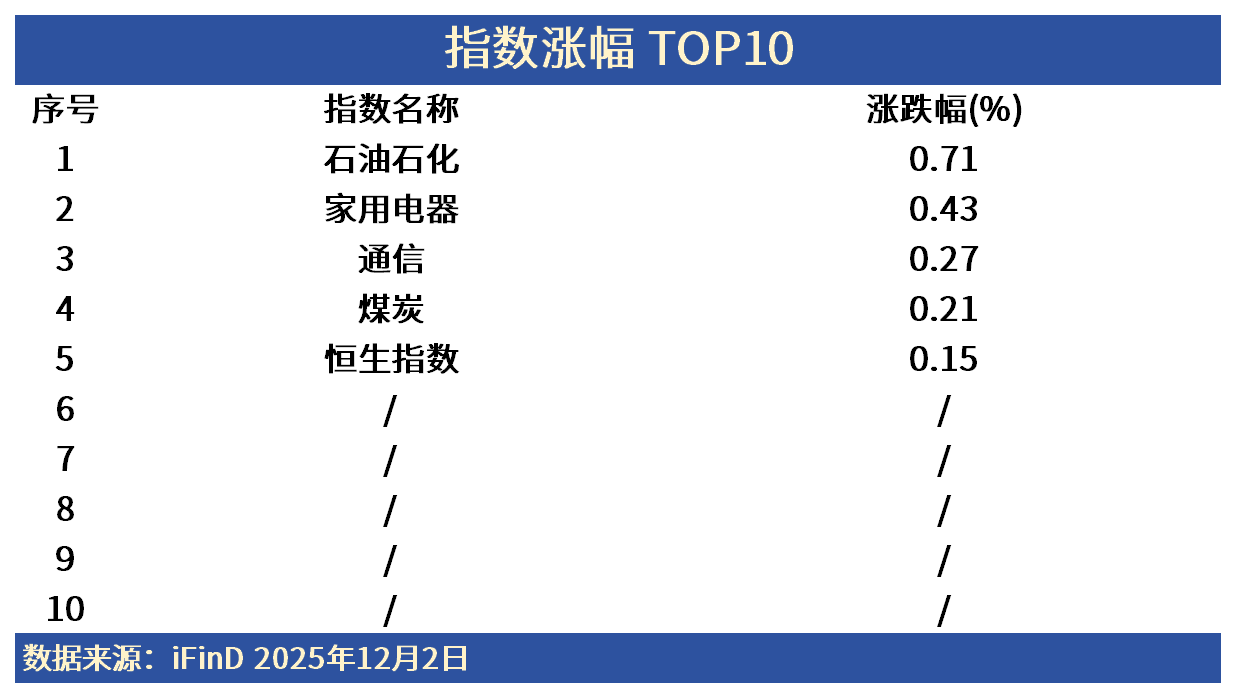
Group 1: Market Performance - The A-share market saw significant gains in the oil and petrochemical, home appliance, and coal sectors, with increases of 0.71%, 0.43%, and 0.21% respectively as of December 2, 2025 [1][7] - The coal industry is experiencing stable profitability due to a stable average daily production of over 12 million tons since October and a recent price increase of 8 yuan per ton for long-term contracts [2] Group 2: Policy Impact - Recent national policies have injected strong momentum into the oil and petrochemical, coal, and home appliance sectors, including a meeting by the National Development and Reform Commission to ensure stable coal production and transportation [2] - The home appliance sector benefits from a new policy in Shanghai that expands the scope of subsidies for old-for-new exchanges to 12 product categories, with a maximum subsidy of 2,000 yuan [2][3] Group 3: Industry Outlook - The oil and petrochemical sector is benefiting from the implementation of green electricity direct supply policies, which are reducing energy costs and meeting carbon reduction demands [2] - The home appliance industry is showing clear signs of recovery, supported by both domestic policies and an optimized export tax rebate policy [3] Group 4: Investment Opportunities - Analysts suggest that coal companies are expected to see stable profits as coal prices are projected to bottom out in the second quarter of 2025, leading to improved performance for listed coal companies [4] - The home appliance ETF has shown positive growth in market share, indicating a strong recovery trend in the sector [4]


超3700只个股下跌
Di Yi Cai Jing· 2025-12-02 08:11
Market Overview - The A-share market experienced fluctuations with the Shanghai Composite Index down by 0.42%, the Shenzhen Component Index down by 0.68%, and the ChiNext Index down by 0.69% [2][3] - The total trading volume in the Shanghai and Shenzhen markets was 1.59 trillion yuan, a decrease of 280.5 billion yuan compared to the previous trading day [6] Sector Performance - The lithium battery industry chain led the decline, with significant drops in sectors such as innovative drugs, GPUs, robotics, photovoltaics, AI applications, semiconductors, and new energy vehicles [2][3] - Conversely, the pharmaceutical commerce and consumer electronics sectors showed resilience, with several local stocks in Fujian province experiencing notable gains [2][3] Notable Stocks - Stocks such as Jiarong Technology (+20.01%), Zhaobiao Co. (+20.00%), and Fujian Expressway (+10.10%) were among the top gainers [5][6] - The aerospace sector was active, with Aerospace Development achieving 9 limit-up days in 13 trading sessions [5][6] Capital Flow - Main capital inflows were observed in the consumer electronics, shipbuilding, and automotive sectors, while outflows were noted in the computer, securities, and non-ferrous metals sectors [9] - Specific stocks like Industrial Fulian, New Yi Sheng, and Shenghong Technology saw net inflows of 1.114 billion yuan, 1.077 billion yuan, and 993 million yuan respectively [9] Institutional Insights - Huaxi Securities anticipates that the A-share market will enter a critical policy observation window in December, potentially increasing market risk appetite and setting the stage for a year-end rally [10] - CICC suggests that the current valuation of the A-share market is relatively reasonable, supported by the AI technology revolution and energy transition, which are expected to enhance corporate performance [10] - According to GF Securities, December to January is historically a prime time for positioning in the year-end market, particularly for sectors with positive earnings forecasts [10]




超3700只个股下跌
第一财经· 2025-12-02 07:48
Core Viewpoint - The A-share market experienced a day of fluctuation and adjustment, with all three major indices closing lower, indicating a cautious market sentiment amid sector-specific performance variations [3][4]. Market Performance - The Shanghai Composite Index fell by 0.42% to 3897.71, the Shenzhen Component Index decreased by 0.68% to 13056.70, and the ChiNext Index dropped by 0.69% to 3071.15 [4]. - The lithium battery industry chain led the decline, while sectors such as pharmaceutical commerce and consumer electronics showed resilience [3][4]. Sector Highlights - Local stocks in Fujian province surged, with companies like Jiarong Technology and Zhaobiao Shares hitting the daily limit up [5][6]. - The aerospace sector was notably active, with Aerospace Development achieving nine consecutive trading limits in 13 days [6][7]. Capital Flow - Main capital inflows were observed in consumer electronics, shipbuilding, and automotive sectors, while significant outflows occurred in computing, securities, and non-ferrous metals [10]. - Specific stocks like Industrial Fulian and New Yisheng saw net inflows of 1.114 billion and 1.077 billion respectively, while ZTE Corporation faced a net outflow of 2.968 billion [11][12]. Analyst Insights - Huaxi Securities anticipates that the A-share market will enter a critical policy observation window in December, potentially increasing market risk appetite [12]. - CICC suggests that the current valuation of the A-share market is relatively reasonable, supported by the AI technology revolution and energy transition, indicating a continued upward trend [12]. - Guangfa Securities highlights December to January as a prime window for positioning in the market, especially for sectors with positive earnings forecasts [13].

收盘丨A股三大指数缩量调整,福建本地股逆势爆发
Di Yi Cai Jing· 2025-12-02 07:17
| 代码 | 名称 | 两日图 | 现价 | 涨跌 | 涨跌幅 | | --- | --- | --- | --- | --- | --- | | 000001 | 上证指数 | NYm | 3897.71 с | -16.29 | -0.42% | | 399001 | 深证成指 | proving | 13056.70 c | -90.02 | -0.68% | | 399006 | 创业板指 | NASH | 3071.15 c | -21.35 | -0.69% | 盘面上,锂电池产业链领跌,创新药、GPU、机器人、光伏、AI应用、半导体、新能源车概念股跌幅 居前。两岸融合、医药商业、消费电子题材逆势走强。 具体来看,福建本地股逆势爆发,嘉戎技术、招标股份、福建高速、平潭发展等10股涨停。 | 代码 | 名称 | 涨幅量 | 现价 | | --- | --- | --- | --- | | 301148 | 嘉戎技术 | +20.01% | 47.57 | | 301136 | 招标股份 | +20.00% | 19.92 | | 300300 | 海峡创新 | +13.53% | 18.46 | | ...

中泰证券医药首席祝嘉琦:2026医药投资把握“两极”机遇,创新与反转双线布局
Xin Lang Cai Jing· 2025-12-02 07:10
Core Insights - The 2025 Analyst Conference highlighted the potential for a bull market in A-shares, attracting global capital inflows [1][3] - The event gathered over 300 industry experts to discuss future opportunities in the Chinese capital market [1][3] Investment Strategy - The pharmaceutical sector is expected to exhibit a "dual strength" characteristic in 2025, with leading companies maintaining robust performance while small-cap firms with technological breakthroughs also showing promise [1][3] - Analysts recommend a "core leaders and growth enhancers" strategy, focusing on strong companies while also investing in high-growth small-cap stocks to achieve a balance of stability and flexibility [1][3] Focus Areas for 2026 - Two main investment themes were emphasized: 1. **Innovation-Driven Theme**: Innovative drugs and their supply chains are seen as key long-term growth drivers, closely linked to market risk appetite [2][5] 2. **Turnaround Theme**: Certain sub-sectors like medical devices, traditional Chinese medicine, and consumer healthcare are showing signs of recovery, making them suitable for defensive positioning during market fluctuations [2][5] Market Dynamics - The valuation of innovative drugs is highly correlated with market sentiment towards technology stocks, necessitating a dynamic investment perspective [2][5] - The internal rotation within the pharmaceutical sector is expected to balance between "growth (innovative drugs)" and "safety (turnaround)" depending on market conditions [2][5]

长城基金汪立:前瞻布局春季行情
Xin Lang Cai Jing· 2025-12-02 06:09
Group 1: Market Overview - In November, the A-share market exhibited a volatile pattern, with the Shanghai Composite Index declining by 1.67%, while the ChiNext Index and the STAR Market Index fell by 4.23% and 6.24% respectively [1][7] - There was a significant shift in market structure as funds sought to rebalance their portfolios, with banking, petrochemical, textile, and light industry sectors showing the highest gains, while electronics, computers, and automotive sectors experienced notable pullbacks [1][7] Group 2: Macro Analysis - In October, the profits of industrial enterprises above designated size weakened, with a cumulative year-on-year growth rate of 1.9% from January to October, down from 2.4% in the previous period, and a significant drop to -5.5% in October compared to 21.6% in September [2][8] - The increase in raw material prices under the "anti-involution" policy, combined with weak demand, has narrowed corporate profit margins, although sectors like non-ferrous metals, electronic equipment, food, beverages, and automotive still maintained positive year-on-year growth [2][8] - The expectation of a Federal Reserve interest rate cut has risen, with indications from Fed officials suggesting a need for significant rate reductions to support economic growth, despite a recent increase in the unemployment rate to 4.4% [2][8] Group 3: Investment Strategy - Following the market correction since October, there has been a notable decline in margin trading activity, but recent stabilization in market risk appetite has led to a rebound in margin trading volumes [4][10] - The anticipated recovery in global liquidity due to the Fed's rate cut expectations, alongside the need for further policy measures to stimulate domestic growth, suggests a potential rebalancing of industry allocations [4][10] - Current market conditions may present an opportune moment to position for a spring rally, with a focus on emerging technologies, undervalued consumer stocks, and brokerage firms [5][11] - Specific sectors to watch include technology growth (internet, semiconductors, media, power equipment, innovative pharmaceuticals), consumer goods (mass products, hotels, airlines, retail), and non-ferrous metals, which are expected to benefit from easing monetary policies [5][11]
【申万宏源策略 | 一周回顾展望】春季行情的幅度和定位
申万宏源研究· 2025-12-02 05:19
Core Viewpoint - The market has experienced a rebound after a significant decline, but the adjustment in technology growth stocks regarding cost-effectiveness issues is still ongoing, with the adjustment magnitude having surpassed half but the time insufficient for a complete recovery [2][3]. Group 1: Market Analysis - The current market is within the "two-phase bull market" framework, with the first phase at a high level. The AI industry chain is experiencing a trend that has not yet concluded, leading to a situation where the cost-effectiveness of mid and small-cap stocks is temporarily insufficient [2][3]. - Historical experience suggests that when technology adjustments approach the bull-bear boundary, it may indicate a mid-term bottom area. However, the challenge lies in waiting for industrial catalysts and performance validation to digest valuations [2][3]. - The adjustment in technology growth stocks has reached over half of its potential, but the time required for a complete adjustment remains a challenge. A significant recovery in long-term cost-effectiveness may signal the resumption of an upward trend [2][3]. Group 2: Spring Market Outlook - The spring market is positioned as a potential rebound phase within the high-level adjustment of the bull market 1.0. The overall market adjustment pressure is limited, leaning towards this scenario [4]. - There are two potential scenarios for the spring market: it may either be a rebound within the high-level adjustment phase or a transition from the adjustment phase to a bottoming phase [4]. - The spring market is expected to see effective rebounds in offensive assets (technology and cyclical sectors), but upward breakthroughs may be challenging due to high supply growth and limited improvement in supply-demand dynamics [3][4]. Group 3: Investment Opportunities - The "policy bottom" may be validated earlier, and cyclical price increases could serve as the foundation for the spring market, with a focus on basic chemicals and industrial technology sectors [4]. - Technology stocks are likely to experience a general rebound as their adjustment magnitude reaches a critical point. Key areas to watch include innovative pharmaceuticals and national defense industries, as well as AI computing power, storage, energy storage, and robotics [4][6]. - The Hong Kong stock market continues to exhibit high beta characteristics, with the Hang Seng Technology index showing more substantial adjustments and potential for a more elastic rebound [4].

【申万宏源策略】周度研究成果(11.24-11.30)
申万宏源研究· 2025-12-02 05:19
Market Overview - The market experienced a rebound after a period of decline, but the adjustment in technology growth stocks has not fully resolved, indicating that while the price adjustment is over half complete, the time for recovery remains insufficient [5] - The spring market is characterized by potential effective rebounds in offensive assets like technology and cyclical stocks, but the upward breakthrough logic may be difficult to realize, suggesting a limited upper range for the spring market [5] - Short-term rebounds are expected, with the "policy bottom" potentially being validated earlier, alongside rising prices in cyclical sectors, indicating that cyclical assets may form the foundation for the spring market [5] Industry Valuation and Comparison - As of November 28, 2025, the valuation metrics for major indices are as follows: - CSI All Share (excluding ST) PE at 21.0x, PB at 1.8x, at historical percentiles of 77% and 38% respectively - SSE 50 PE at 11.8x, PB at 1.3x, at historical percentiles of 63% and 42% - ChiNext Index PE at 39.2x, PB at 5.1x, at historical percentiles of 30% and 56% [8][9] - Industries with PE valuations above the 85th percentile include real estate, retail, pharmaceuticals, and IT services, while the medical services sector is below the 15th percentile for both PE and PB [9][10] Global Asset Allocation - The expectation of interest rate cuts in the US has increased, with the probability of a 25 basis point cut in December rising to 86.4%, up from 71.0% the previous week, driven by a weakening labor market [11] - The decline in the US dollar index below 100 indicates a shift to a weaker position, contributing to an inflow of both domestic and foreign capital into the Chinese stock market [11]

科望医药三闯港交所:持续亏损,明星资本押注双抗能否破局?
2 1 Shi Ji Jing Ji Bao Dao· 2025-12-02 04:19
Core Viewpoint - The company, Kewang Pharmaceuticals, is facing significant financial challenges and is under pressure to go public to avoid bankruptcy, with a cash reserve that can only sustain operations for three months [1][3][6] Financial Situation - As of the end of 2024, the company had only 32.82 million yuan in cash, a drastic decrease of 88% from the previous year, while R&D costs remained high at 117 million yuan [2] - Cumulative losses from 2022 to 2024 reached 1.712 billion yuan, with total losses exceeding 2.067 billion yuan since its inception [3] - The company has a net debt of 2.738 billion yuan due to convertible redeemable preferred shares, which come with mandatory redemption clauses if the IPO is not completed by a specific date [3] R&D and Pipeline Challenges - The company has seven major assets in its R&D pipeline, with four in clinical stages, but its core product, ES102, has shown disappointing clinical data, raising doubts about its efficacy [1][4] - The objective response rate (ORR) for ES102 was only 11.1%, significantly lower than the average ORR for other treatments in similar indications [4] - The company’s reliance on licensed products rather than self-developed assets raises concerns about its long-term viability and market competitiveness [5] Market and Valuation Dynamics - The valuation logic for innovative drug companies has shifted from quantity of pipeline assets to quality, emphasizing the need for clear differentiation in technology and clinical data [2] - Kewang Pharmaceuticals' valuation has soared from 20 million USD in its first round of financing to 600 million USD by 2021, but its current market valuation appears inflated compared to industry averages [5] - The company’s market valuation is significantly higher than the median price-to-research ratio of 15.65 for similar unprofitable biotech firms listed in Hong Kong [5] IPO and Regulatory Environment - The company has made three attempts to go public, with the latest submission being a critical last chance to secure funding and avoid financial collapse [6] - Recent regulatory changes in Hong Kong have increased the requirements for unprofitable biotech companies, necessitating proof of commercial potential for late-stage clinical products [6]