啤酒

Search documents
华润啤酒发布年度业绩 股东应占溢利33.71亿元同比减少28.87%
Xin Lang Cai Jing· 2026-03-23 04:36
Core Viewpoint - China Resources Beer (00291) reported a revenue of RMB 37.985 billion for the year ending December 31, 2025, a year-on-year decrease of 1.68% [1][6] - The company's net profit attributable to shareholders was RMB 3.371 billion, down 28.87% year-on-year, with basic earnings per share of RMB 1.04 and a proposed final dividend of RMB 0.557 per share [1][6] Beer Business - The company achieved beer sales of approximately 11.03 billion liters in 2025, reflecting a year-on-year growth of 1.4% [1][6] - High-end beer products continued to perform well, with sales of mid to high-end beers growing in the high single digits year-on-year, accounting for nearly 25% of total sales, while sales of premium and above beers increased by nearly 10 percentage points year-on-year [1][6] - The beer business maintained stable revenue of approximately RMB 36.489 billion in 2025, with a gross margin increase of 1.4 percentage points to 42.5% due to ongoing premiumization and cost savings in raw material procurement [1][6] - Excluding special items such as gains from investment relocation agreements and fixed asset impairments, the EBITDA for the beer business was RMB 9.611 billion, representing a year-on-year increase of 17.4% [1][6] Baijiu Business - The baijiu business faced challenges due to deep adjustments in the industry and a decline in consumer demand, leading to structural adjustments and increased differentiation in the second half of the year [2][7] - The revenue for the baijiu business in 2025 was RMB 1.496 billion [2][7] - The company recognized an impairment of goodwill amounting to RMB 2.877 billion due to the current market environment and operational conditions of the baijiu business; without this impairment, the EBITDA for the baijiu business would have been RMB 264 million [2][7]


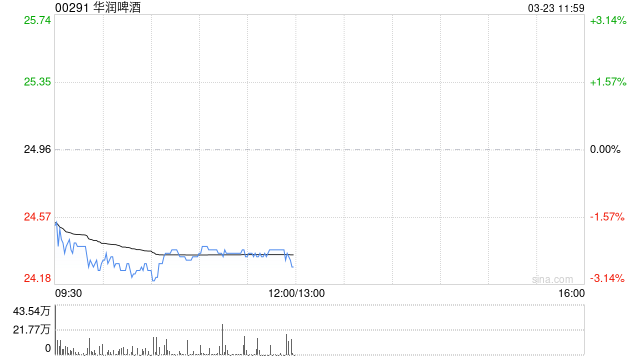
华润啤酒(00291)发布年度业绩,股东应占溢利33.71亿元 同比减少28.87%
智通财经网· 2026-03-23 04:15
Group 1: Overall Performance - The company reported a revenue of RMB 37.985 billion for the year ending December 31, 2025, a decrease of 1.68% year-on-year [1] - The profit attributable to shareholders was RMB 3.371 billion, down 28.87% year-on-year [1] - Basic earnings per share were RMB 1.04, with a proposed final dividend of RMB 0.557 per share [1] Group 2: Beer Business - The company achieved beer sales of approximately 11.03 billion liters in 2025, representing a year-on-year growth of 1.4% [1] - High-end beer products continued to perform well, with sales of premium and above beers growing in the mid to high single digits year-on-year, accounting for nearly 25% of total sales [1] - The beer business maintained stable revenue of approximately RMB 36.489 billion, with a gross margin increase of 1.4 percentage points to 42.5% due to ongoing premiumization and cost savings in raw material procurement [1] - Excluding special items, the EBITDA for the beer business was RMB 9.611 billion, reflecting a year-on-year increase of 17.4% [1] Group 3: Baijiu Business - The baijiu business generated revenue of RMB 1.496 billion in 2025, impacted by structural adjustments and declining consumer demand in the industry [2] - The company recognized an impairment of goodwill amounting to RMB 2.877 billion for the baijiu business due to the current market environment [2] - Without accounting for the goodwill impairment, the EBITDA for the baijiu business was RMB 264 million [2]
华润啤酒(00291.HK)2025年度纯利跌28.87%至33.71亿元 末期息0.557元
Ge Long Hui· 2026-03-23 04:10
Core Viewpoint - China Resources Beer reported a revenue of RMB 37.985 billion for the fiscal year ending December 31, 2025, representing a year-on-year decrease of 1.68% [1] - The company's net profit attributable to shareholders was RMB 3.371 billion, down 28.87% year-on-year, with basic earnings per share at RMB 1.04 and a proposed final dividend of RMB 0.557 per share [1] Group 1: Beer Business Performance - The beer segment maintained stable revenue of approximately RMB 36.489 billion in 2025, driven by ongoing premiumization and cost savings in raw material procurement, leading to a gross margin increase of 1.4 percentage points to 42.5% [2] - The beer business's EBITDA (Earnings Before Interest, Taxes, Depreciation, and Amortization) for 2025 was RMB 9.611 billion, reflecting a year-on-year increase of 17.4% after excluding special items [2] - Beer sales volume reached approximately 11.03 million kiloliters, showing a year-on-year growth of 1.4%, with premium and above beer products accounting for nearly 25% of total sales [1][2] Group 2: Baijiu Business Performance - The baijiu segment faced challenges due to deep adjustments in the industry and declining consumer demand, resulting in a revenue of RMB 1.496 billion for 2025 [2] - The company recognized an impairment loss of RMB 2.877 billion on goodwill related to the baijiu business, reflecting the current market environment and operational conditions [2] - Excluding the goodwill impairment, the baijiu business's EBITDA for 2025 would have been RMB 264 million [2]
华润啤酒(00291) - 2025 H2 - 电话会议演示
2026-03-23 04:00
2025 Results Announcement Investor Presentation 23 March 2026 Navigating Change and Pursing Innovation with Steady Growth 1. Results Overview 2. Development Strategies of Beer Business 3. Development Strategies of Baijiu Business Remarks: * Special items – company overall: 1. Shenzhen headquarters-related income of RMB1,005 million (2024: RMB-26 million); 2. impairment loss of goodwill of baijiu business of RMB2,877 million (2024: -); 3. impairment loss of fixed assets and one-off staff compensation and set ...
【十大券商一周策略】A股下行空间相对有限,决断看4月!聚焦景气确定性
券商中国· 2026-03-22 14:41
Group 1 - The core viewpoint is that the market is currently facing significant uncertainty due to geopolitical tensions and economic conditions, with a decisive direction expected to emerge around April [2] - The article discusses three key unresolved questions regarding the Iran conflict, U.S. Federal Reserve's focus, and China's economic situation, which are crucial for market predictions [2] - The market has seen some short-term reduction in positions, particularly in previously high-performing sectors, but overall returns have reverted to the starting line since the beginning of the year [2] Group 2 - The article identifies sectors that may maintain independent high prosperity despite geopolitical tensions and high oil prices, highlighting the importance of sectors like optical communication and energy storage [3] - It suggests that sectors with upward trends and less sensitivity to oil prices, such as energy storage and domestic AIDC chains, should be prioritized for investment [3] Group 3 - The current phase is described as potentially the most pressured stage due to the ongoing U.S.-Iran conflict, with a focus on the divergence between stable policy and absolute return strategies [4] - The article emphasizes that the mid-term variables are underestimated, particularly regarding inflation tolerance and the resilience of the U.S. and Chinese economies [4][5] Group 4 - A-shares are expected to have limited downside potential, with the market likely to experience oscillation and structural rotation as it absorbs external pressures [6] - Key sectors to watch include energy-related industries, defensive assets, and technology innovation sectors, with a focus on undervalued consumer segments [6] Group 5 - The market is anticipated to undergo a prolonged period of consolidation due to the impact of the U.S.-Iran conflict and changing expectations regarding interest rates [7] - The article highlights three investment directions: industries benefiting from high oil prices, stable cash flow defensive stocks, and certain growth sectors that may be undervalued [7] Group 6 - China's manufacturing sector is positioned for a value reassessment, with leading industries in coal chemical and power equipment showing resilience and potential for growth [8] - The article notes that China's energy system's completeness reduces vulnerability to external shocks and enhances its role in global energy supply [8] Group 7 - The narrative around the rise of physical assets remains intact, with a focus on energy security and the potential for China's manufacturing sector to serve as a stabilizing force in the global economy [9] - Investment recommendations include sectors related to energy, manufacturing, and consumer goods that are expected to benefit from structural changes in the market [9] Group 8 - The current market adjustment is attributed to concerns over economic stagnation and escalating conflict risks, with a potential for market recovery when sentiment is at its lowest [11] - Investment strategies should focus on sectors that benefit from rising oil prices and those with clear growth prospects, particularly in technology and renewable energy [11] Group 9 - The market is expected to remain under pressure from external factors, but there are positive indicators such as proactive monetary policy and strong early economic data [12] - The article suggests a dual focus on growth and cyclical sectors, with an emphasis on clean energy and resource-related investments [12] Group 10 - The outlook for the market suggests a gradual stabilization post-mid-March, with a focus on both growth and value sectors, particularly in energy and technology [13] - The article encourages investment in sectors that are likely to benefit from ongoing trends in AI and traditional industries undergoing value reassessment [13] Group 11 - The ongoing U.S.-Iran conflict and shifting interest rate expectations are impacting global markets, with a focus on stable domestic policies providing a clearer investment environment [14] - Recommended sectors include defensive strategies, energy independence, and high-growth areas such as AI and energy storage [14]

食品饮料-筑底接近尾声-聚焦高质量增长
2026-03-22 14:35
Summary of Key Points from Conference Call Records Industry Overview: Food and Beverage Sector - The food and beverage sector is nearing a bottoming phase, focusing on high-quality growth as of 2026 [1] - The sector's valuation and institutional holdings are at historical lows, with a notable improvement in consumption during the 2026 Spring Festival [1][2] - The beverage and liquor sales are showing signs of recovery, driven by an 8% increase in cross-regional personnel movement [1][3] Key Insights on Specific Segments Liquor Sector - The liquor sector is expected to see a report clearing phase in April 2026, with a gradual recovery anticipated from May onwards due to low base effects from 2025 [1][4] - High-end liquor brands like Moutai and Wuliangye are experiencing double-digit growth during the Spring Festival, with Moutai's price rising from 1,500 to 1,700 RMB [1][6] - The competitive landscape is shifting, with high-end brands expanding their consumer base while putting pressure on mid-range competitors [6] Soft Drinks - The soft drink industry is witnessing structural changes, with a decline in sugary drinks and growth in healthier options like sugar-free tea and functional beverages [10] - The market share of Nongfu Spring's sugar-free tea has reached 79.8%, indicating a strong trend towards health-oriented products [10][11] Snack Foods - The snack food sector is transitioning to a dual oligopoly, with significant growth in discount snack channels [1][8] - The focus for 2026 will shift from rapid store expansion to improving profitability as the market matures [8] Dairy Products - The raw milk cycle is expected to stabilize in the second half of 2026, improving profitability for downstream dairy companies [1][13] - Long-term growth potential exists in fresh milk and cheese segments, with current penetration rates in China being significantly lower than in mature markets [14][15] Frozen Foods - The frozen food sector is recovering from previous price wars, with a focus on new product launches and channel expansion [16] - The introduction of national standards for prepared dishes is expected to further standardize the industry [16] Beer Industry - The beer sector is experiencing a slowdown in high-end product growth, with the 6-10 RMB price range becoming the main focus for upgrades [18][19] - The overall beer market is expected to remain flat, with a slight increase in profits due to improved cost efficiency [19] Health Supplements - The health supplement market is seeing a decline in concentration due to the rise of content e-commerce, with the CR5 dropping from 32% in 2015 to 26% in 2024 [20] - Major companies are adapting by increasing their presence in emerging online channels, potentially reversing the trend of declining concentration [20] Additional Observations - The overall consumer sentiment remains cautious, with a preference for high-value products in various categories [1][8] - The shift towards healthier options across multiple segments indicates a long-term trend that companies need to adapt to in their product offerings and marketing strategies [10][11][20]


食品饮料行业研究:步入业绩窗口期,关注稳健型a标的配置价值
SINOLINK SECURITIES· 2026-03-22 12:12
Investment Rating - The report suggests a positive outlook for the liquor sector, particularly for high-end brands like Guizhou Moutai and Wuliangye, indicating a favorable investment environment in the current market conditions [1][10][11]. Core Insights - The liquor industry is entering a clear "de-stocking" phase, with performance improvements expected in Q4 2025 and Q1 2026, particularly for second-tier brands and those with strong alpha attributes [1][10]. - The report highlights the potential for a stabilization phase in H2 2026 due to low base effects, with a focus on brands that have strong market positioning and robust demand resilience [1][11]. - The beer sector is experiencing steady recovery in on-premise consumption, with companies diversifying into non-drink channels and soft drinks, suggesting a stable outlook for the industry [2][11]. - The yellow wine industry is witnessing a trend towards premiumization and market promotion, with leading brands enhancing their marketing capabilities [2][12]. - The snack food sector is expanding rapidly, with significant growth in store openings and new product launches, indicating a strong market performance [2][12]. Summary by Sections Liquor Sector - The report indicates that liquor companies have begun to clear inventory since Q3 2025, with expectations for continued performance improvement into early 2026 [1][10]. - Specific recommendations include focusing on high-end brands with strong market positions and those benefiting from consumer demand trends [1][11]. Beer Sector - The beer industry is expected to maintain a stable outlook, with recovery in restaurant consumption and a focus on diversified product offerings [2][11]. Yellow Wine Sector - The yellow wine industry is moving towards a big product strategy and premiumization, with leading brands enhancing their marketing efforts [2][12]. Snack Food Sector - The snack food industry is experiencing rapid growth, with a solid foundation established in early 2026 and significant expansion in store openings [2][12]. Soft Drinks - The soft drink sector is seeing slight improvements in demand, although facing pressure from rising packaging costs [3][15]. Condiments - The condiment industry is stabilizing, with improvements in consumer demand and the ability to pass on cost increases to consumers [4][15].



食品饮料周观点:社零增长提速,关注春糖反馈-20260322
GOLDEN SUN SECURITIES· 2026-03-22 11:35
Investment Rating - The report maintains an "Accumulate" rating for the food and beverage industry [5] Core Insights - The retail sales growth has accelerated, with a focus on feedback from the Spring Sugar Festival. The report suggests that the overall rhythm of the liquor industry is expected to improve on a month-on-month basis, with key recommendations including leading companies like Kweichow Moutai and others focusing on supply clearance [1][2] - The beer sector is witnessing a recovery, with a notable increase in beer production and the launch of new products, indicating a positive trend in consumer demand [3] - The food sector shows a recovery in retail sales, particularly in the restaurant segment, which is expected to drive opportunities in related supply chains [4][7] Summary by Sections Liquor Industry - Jinhuijiu reported a revenue of 2.918 billion yuan for 2025, a year-on-year decrease of 3.4%, while Shide Jiuye reported a revenue of 4.42 billion yuan, down 17.5% year-on-year. The report highlights a significant divergence in performance among liquor companies, with Kweichow Moutai leading the recovery through reforms [2] - Jinhuijiu's product structure upgrade is notable, with high-end products (above 300 yuan) increasing by 25.21% year-on-year, while low-end products (below 100 yuan) decreased by 36.88% [2] Beer and Beverage Sector - In the beer segment, the cumulative production of major enterprises reached 5.797 million kiloliters in January-February 2026, reflecting a year-on-year growth of 6.5%. The launch of the new Yanjing A10 product is expected to enhance market presence [3] - The beverage sector is characterized by intense competition, with companies launching new products to capture market share. Notable new releases include flavored waters and teas targeting specific consumer scenarios [3] Food Sector - Retail sales in the food sector increased by 2.8% year-on-year in January-February 2026, with restaurant income growing by 4.8%. This growth is attributed to the recovery of consumer spending and seasonal factors [4][7] - Wanchen Group reported a record high net profit margin of 5.7% in Q4 2025, indicating strong profitability and market expansion potential [7]



食品饮料2026年春季投资策略:转折之年
GUOTAI HAITONG SECURITIES· 2026-03-22 07:45
Investment Rating - The industry investment rating is "Overweight" [3] Core Views - The report emphasizes that the turning point is approaching, highlighting the importance of price increases. The white liquor sector is nearing the end of its adjustment phase, with a long-term focus on pricing and continued concentration. The consumer goods sector is bottoming out, with increasing differentiation among segments, while condiments, beer, and beverages show strong resilience [3]. Summary by Sections White Liquor - The industry is transitioning from a "U-shaped adjustment" to a "V-shaped adjustment." Compared to the adjustment period from 2013 to 2016, the current cycle has a smaller adjustment in demand and expectations, with a notably extended adjustment period. The previous cycle saw a rapid clearing of the industry, while the current adjustment is expected to accelerate the bottoming process starting from Q3 2025 [4][16]. Beer & Beverages - With the stabilization of dining scenarios and gradual recovery of consumer spending, the beer industry is expected to improve. Structural upgrades, price increases, and efficiency optimization will continue to drive profitability. Historical trends during CPI recovery periods show that the beer sector generally benefits from expanded gross sales margins and improved profitability [5][45]. Consumer Goods - As cost advantages diminish, there is an increasing focus on companies with strong price transmission capabilities in the consumer goods sector. The report anticipates a turning point for condiments, with expected price increases. The dairy sector is also expected to see a rebound in supply-demand cycles, while the snack segment favors companies with new product categories and channel expansion logic [6][14]. Market Dynamics - The report notes that the white liquor industry is still in an adjustment phase, while soft drinks and snacks are less affected by economic cycles and are expected to lead in growth rates. Beer, dairy products, and condiments are showing marginal improvements after undergoing stress tests, with consumer goods outperforming white liquor [14][30]. Structural Changes - The report indicates that the current cycle will accelerate the concentration process in the industry, with leading brands benefiting from their brand and channel advantages. The differentiation among brands is expected to increase, with high-end brands like Moutai and Wuliangye continuing to lead, while competition intensifies in the mid-range and lower segments [30][39]. Valuation and Returns - The overall valuation of the white liquor industry and individual stocks is currently at historically low levels, reflecting pessimistic expectations. The report suggests that the micro-structure of the industry has improved, with a potential for recovery in valuations ahead of fundamental improvements [36][39]. Dividend Trends - There is an increasing awareness of shareholder returns in the white liquor industry, with leading companies likely to enhance shareholder value through dividends. The report notes that several companies have raised their dividend rates, making them attractive to investors [39][40].

亚盛绿鑫集团荣获华润啤酒“三星供应商”荣誉称号
Xin Lang Cai Jing· 2026-03-20 12:20
Group 1 - The 2026 China Resources Beer Supplier Conference was held in Shenzhen, where Yasheng Green Xin Group was awarded the "Three-Star Supplier" honor, reflecting high recognition from the industry and customers for its excellent product quality, efficient delivery capabilities, and deep collaborative innovation [1][4]. - China Resources Beer emphasized three core dimensions: "innovation, value, and experience," elaborating on the strategic direction for supply chain collaborative development during the conference [3][6]. - Yasheng Green Xin Group, as a long-term partner of China Resources Beer, actively participated in discussions on supply chain digitization, green production, and quality control, laying a solid foundation for future deepened cooperation [3][6]. Group 2 - The company plans to continue focusing on the hop raw material industry, consistently improving product quality and service levels, leveraging technological innovation and lean management to create higher value for customers [3][6]. - The commitment to contribute positively to the high-quality development of the beer industry chain is a key aspect of the company's future strategy [3][6].