农产品加工

Search documents
研究所晨会观点精萃-20251022
Dong Hai Qi Huo· 2025-10-22 01:07
Report Summary 1) Report Industry Investment Rating No industry investment rating is provided in the report. 2) Core Viewpoints of the Report - The market is influenced by the optimistic sentiment of the China - US trade agreement, with the US dollar index rebounding and global risk appetite rising. The domestic economic growth is accelerating, and the market is generally optimistic about the China - US trade negotiations. The increase in domestic policy support boosts domestic risk appetite. The short - term macro - upward drive has strengthened, and attention should be paid to the progress of China - US trade negotiations and the implementation of domestic incremental policies [2][3]. - Different asset classes have different trends: stocks are expected to be strongly volatile in the short term; bonds are expected to be volatile; commodities show different trends in different sectors, with some in a state of shock and some with clear short - term trends [2]. 3) Summary by Related Catalogs Macro - finance - **Macro**: Overseas, the US dollar rebounds due to the optimistic sentiment of the China - US trade agreement, and global risk appetite rises. Domestically, economic growth accelerates, and the market is optimistic about trade negotiations. Policy support increases, and the short - term macro - upward drive strengthens. For assets, stocks are strongly volatile in the short term and can be cautiously bought; bonds are volatile and should be cautiously observed; different commodity sectors have different trends [2]. - **Stock Index**: Driven by sectors such as combustible ice, fruit chains, and construction machinery, the domestic stock market rises significantly. With economic growth and policy support, the short - term macro - upward drive strengthens. It is recommended to cautiously buy in the short term [3]. - **Precious Metals**: The precious metals market falls at night. Due to the rise of the US dollar and profit - taking, the short - term is in a high - level correction, but the medium - and long - term upward pattern remains unchanged. Short - term long positions should be reduced on rallies, and medium - and long - term positions should be bought on dips [3]. Black Metals - **Steel**: The steel futures and spot markets continue to fluctuate. Trade conflicts are expected to ease, and there are expectations for policies, which support prices. However, the fundamentals are weak, demand is weak, and it is expected to weaken further after late October. Supply is likely to decline. There is no trending market, and the upward and downward space is limited in the short term [4]. - **Iron Ore**: The spot price is flat, and the futures price rebounds slightly. The iron - water production is expected to decline further. Steel mills replenish stocks slightly. Global shipments increase, and arrivals decrease. The port inventory rises. It is recommended to treat it with a range - bound thinking [6]. - **Silicon Manganese/Silicon Iron**: The spot prices decline slightly, and the futures prices fluctuate. The demand for ferroalloys decreases. The supply of silicon manganese increases slightly. The prices of both are expected to continue to fluctuate in the range [7]. Chemicals - **Soda Ash**: The main contract fluctuates in the range. Supply is in the capacity - release period, and demand increases slightly. It should be treated with a bearish view in the medium and long term [8]. - **Glass**: The main contract fluctuates in the range. Supply increases, and demand is weak after the "Golden September and Silver October". It is recommended to operate in the short - term range [8]. Non - ferrous Metals and New Energy - **Copper**: The Shanghai copper price fluctuates and falls, affected by the weak commodity atmosphere and the decline of gold. The US copper inventory is high, and the domestic de - stocking is less than expected. Although the Indonesian mine is shut down, it will resume production next year, and the supply is expected to increase. It is expected to maintain high - level volatility [9]. - **Aluminum**: The Shanghai aluminum price rises slightly. The external market is stronger than the domestic market, and the domestic fundamentals are poor. The inventory decline is slow. The London inventory decreases. It is expected to fluctuate in the range in the short term [10]. - **Tin**: The supply is tight in the short term, and the demand improvement is limited. The price is at a high level, which suppresses consumption. The inventory decreases this week. It is expected to maintain high - level volatility [11]. - **Lithium Carbonate**: The main contract falls slightly. The supply and demand both increase, the inventory decreases, and the market is expected to be strongly volatile [12]. - **Industrial Silicon**: The main contract falls. The production reaches a new high, and the inventory does not accumulate during the wet season. The 2511 contract faces the pressure of warehouse - receipt digestion. It is expected to fluctuate in the range [12]. - **Polysilicon**: The main contract falls. The warehouse - receipt quantity increases, and there is pressure from the concentrated cancellation of warehouse receipts in November. The supply is high, and the demand is low. It is necessary to wait for the implementation of the state - reserve news [13][14]. Energy and Chemicals - **Methanol**: The domestic methanol market is weak, and the port market has a weakening basis. The short - term supply decreases, the demand for olefins is high, and the inventory decreases slightly. However, the traditional downstream demand is weak, and the supply pressure will increase. It is expected to fluctuate in the short term [15]. - **PP**: The market price falls in part. The supply growth rate is higher than the demand, the inventory is high, and the cost support weakens. It is necessary to focus on the recovery of downstream demand [16]. - **LLDPE**: The price of polyethylene is adjusted. The supply increases, the inventory accumulates, and the demand is differentiated. The cost support weakens, and the market is under pressure in the short term [16]. - **Urea**: The urea market is weak. The production is expected to increase, the demand for compound fertilizers is ending, the agricultural demand is warming up, and the export is shrinking. The short - term market may rise slightly after a stalemate, but there is still a risk of decline [17]. Agricultural Products - **US Soybeans**: The rise of US soybeans pauses. The sowing in Brazil is progressing smoothly, and the weather in Argentina is good. The CBOT soybean assets are mainly in a wait - and - see state. The trade between China and the US is the key factor for the future market [18][19]. - **Soybean Meal/Rapeseed Meal**: The oil - mill operating rate is high, the soybean meal delivery is urgent, and the terminal procurement is cautious. The oil - mill profit is in deficit, and the willingness to support the price is strong. There is a supply gap risk in the domestic market before the South American new soybeans are listed. The soybean meal is expected to stabilize after a decline, and the rapeseed meal is mainly affected by the soybean meal [19]. - **Soybean Oil/Rapeseed Oil**: The soybean oil market is in the peak season, and the price difference between soybean oil and palm oil provides consumption expectations. The rapeseed oil inventory is decreasing, and the spot basis is stable [19]. - **Palm Oil**: The domestic palm oil arrives in large quantities, the inventory increases, and the basis is weak. The production and export growth rates in Malaysia decline [20]. - **Corn**: The corn market price is strong, the new - season corn is on the market, the downstream demand is positive, the price is close to the cost line, and farmers' reluctance to sell may increase [20]. - **Pigs**: After the festival, the production and inventory reduction accelerate, the pig price falls to a new low, and the profit is in deficit. There is support for restocking in some areas, and the supply is expected to decrease in late October, which will stabilize the price. Unless the demand increases seasonally, it is difficult for the price to recover significantly [20].
吃得更健康 科技范更强——展会里的乡村产业发展新动向
Xin Hua Wang· 2025-10-21 14:04
Core Insights - The 113th National Sugar and Wine Products Trade Fair and the 22nd China International Agricultural Products Trade Fair showcased new agricultural products and technologies, reflecting evolving industry trends and consumer preferences [1] Group 1: Technological Innovations - The introduction of a digital traceability system allows over 70 types of fruits and vegetables to be tracked from soil to table, enhancing food safety and quality [3] - The development of proprietary seed varieties, such as "Damo Jiaozi No. 1," demonstrates advancements in agricultural biotechnology, contributing to improved nutritional content [2] - The integration of smart management systems in livestock farming has reduced costs by over 30%, showcasing the impact of technology on agricultural efficiency [3] Group 2: Health and Consumer Trends - The rising demand for low-GI (glycemic index) foods has led to significant growth in product offerings, with sales of low-GI items increasing from under 1 million yuan to nearly 60 million yuan in just a few months [4] - Consumers are increasingly prioritizing health, as evidenced by the popularity of low-sugar bread and the demand for high-quality agricultural products with traceability [4] Group 3: New Business Models - The combination of online and offline sales strategies is transforming the agricultural market, with e-commerce and live-streaming becoming essential tools for product promotion [5] - The rural online retail market is projected to reach 2.56 trillion yuan in 2024, indicating a significant increase in digital commerce within the agricultural sector [5] Group 4: Trade Fair Dynamics - The trade fairs have evolved into comprehensive platforms that connect industry, consumers, and various business models, attracting thousands of exhibitors and professional visitors [6] - The 113th Sugar and Wine Fair attracted around 4,000 exhibitors and over 400,000 professional visitors, highlighting its significance in the industry [6]

农牧渔反击!三重压力倒逼产能出清,全市场唯一农牧渔ETF(159275)收涨1.22%终结三连阴!布局时机已现?
Xin Lang Ji Jin· 2025-10-21 12:20
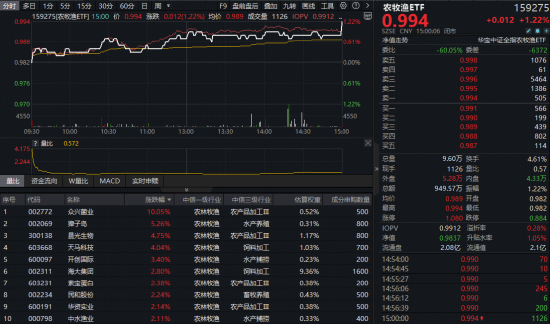
Core Viewpoint - The agricultural, animal husbandry, and fishery sector showed a strong rebound on October 21, with the first agricultural ETF (159275) rising by 1.22%, ending a three-day decline [1][3]. Market Performance - The agricultural ETF (159275) opened higher and maintained a positive trend throughout the day, closing with a price increase of 1.22% [1]. - Key stocks in the sector included Zhongxing Junye, which hit the daily limit, and Zhuangzidao, which surged over 5% [1]. Sector Analysis - The agricultural sector is currently experiencing a rebound, with significant gains in sub-sectors such as agricultural product processing, aquaculture, and feed processing [1]. - The sector's valuation remains relatively low, with the agricultural ETF's underlying index price-to-book ratio at 2.55, indicating a favorable long-term investment opportunity [3]. Policy Impact - Recent government policies aimed at reducing overcapacity in the pig farming industry are expected to accelerate capacity reduction in the fourth quarter, potentially leading to a price increase in the second half of next year [1][4]. - The ongoing "anti-involution" measures in the pig farming industry are expected to enhance the quality and efficiency of production, leading to a gradual elimination of outdated capacity [4]. Investment Opportunities - Analysts suggest focusing on companies with significant cost improvements and high future output elasticity, particularly in the pig farming sector [4][5]. - The agricultural ETF (159275) tracks the CSI Agricultural Index, which includes leading companies in various segments such as pig farming, feed, and planting [5].

“土特产”新气象︱从土特产到金招牌,邮储银行金融赋能常山胡柚产业升级
Xin Lang Cai Jing· 2025-10-21 10:33
Core Insights - The article highlights the successful development of the Changshan pomelo industry in Zhejiang Province, which has reached a scale of over 1.18 million mu and is now part of the 10 billion yuan local specialty product industry chain in Zhejiang [1][2] - The growth of the pomelo industry is significantly supported by innovative financial services from Postal Savings Bank, which has introduced products like "Youyou Loan" to alleviate financing difficulties for agricultural operators [1][2] Financial Support and Innovation - Postal Savings Bank has provided credit support to 318 new agricultural operators in Changshan County, with a total loan balance of 77.7045 million yuan for the "Youyou Loan" program, effectively facilitating financial access for farmers [2] - The bank has also tailored financial service solutions for specific projects, such as a 10 million yuan science and technology credit loan for the construction of the Pomelo Cultural and Tourism Integration Industrial Park [2][3] Industry Growth and Diversification - The Changshan pomelo is evolving from a fresh fruit into various products, including beverages, food ingredients, and cosmetics, aiming for a target of becoming a 10 billion yuan industry [2][3] - The article emphasizes the collaboration between Postal Savings Bank, local government, and agricultural entities in driving the transformation of local specialties into a thriving industry, showcasing the practical implementation of rural revitalization strategies [3]

玉米淀粉日报-20251021
Yin He Qi Huo· 2025-10-21 08:58
Group 1: Investment Rating - No investment rating information provided in the report Group 2: Core Viewpoints - The US corn report lowered the yield, but the production remains high. The US corn price has declined and may continue to adjust downward. The US corn is expected to trade in a narrow range. China has imposed a 15% tariff on US corn, with a total of 26% tariff within the quota, and a 22% tariff on US sorghum. The import profit of foreign corn is relatively high, with the Brazilian import price in December at 2,136 yuan. The northern port flat - price is stable, and the spot price in the Northeast corn - producing area is strong. The supply in North China has decreased, and the corn spot price has stabilized and rebounded. The wheat price in North China is strong, and the price difference between wheat and corn has widened. The domestic breeding demand is still weak, and the inventory of downstream feed enterprises is low. The new - season corn pressure has eased, and the Northeast corn spot price has started to stabilize and rebound, but there may be selling pressure in Jilin in late October [4][7]. - The number of trucks arriving at Shandong deep - processing plants has increased, and the corn spot price in Shandong is weak. The starch spot price in Shandong is around 2,760 yuan, and the Northeast starch spot price is stable. This week, the corn starch inventory has increased to 1.199 million tons, a monthly increase of 5.27% and a year - on - year increase of 46.9%. The starch price mainly depends on the corn price and downstream stocking. The by - product price is still strong, and the enterprise has made a profit. The 01 starch contract has rebounded with corn, but the North China corn price may still decline by the end of October, and the corn starch spot price will also fall later. It is expected that the 01 starch contract will trade in a narrow range following corn in the short term [8]. - The US corn is expected to rebound, and the yield may continue to be lowered, but with an expected increase in production, it will still trade in a narrow range. The quality of North China corn is poor, and the supply period will be extended. The corn spot price will bottom - out and fluctuate. The large - scale listing of Jilin corn at the end of October may bring short - term pressure relief, and the corn price may rebound in the short term. The price difference between Northeast and North China corn has narrowed. The market is currently trading on the weakening of selling pressure in the Northeast, and the port spot price has stabilized and rebounded. The 01 corn contract is bottom - out and fluctuating, and the corn spot price still has room to fall [9]. Group 3: Summary by Directory 1. First Part: Data - **Futures Market**: The C2601 contract rose 0.28% to 2,144 yuan, with a trading volume of 597,677 and a decrease of 11.20%, and an open interest of 849,415 with an increase of 6.13%. The CS2601 contract rose 0.78% to 2,429 yuan, with a trading volume of 144,253 and an increase of 53.93%, and an open interest of 200,536 with an increase of 7.48%. Other contracts also showed different price, volume, and open - interest changes [2]. - **Spot and Basis**: The spot price of corn in Zhucheng Xingmao is 2,340 yuan, and the basis is 53 yuan. The spot price of starch in Jiajie is 2,800 yuan, and the basis is 250 yuan. Different regions have different spot prices and basis values [2]. - **Spreads**: The C01 - C05 spread of corn is - 121 yuan, and the CS01 - CS05 spread of starch is 12 yuan. There are also spreads and their changes in other combinations [2]. 2. Second Part: Market Judgment - **Corn**: The US corn situation, China's tariff policy, import profit, port and regional spot price trends, wheat - corn price relationship, and breeding demand are factors affecting the corn market. The short - term corn spot price is relatively stable, but there are still uncertainties such as the selling pressure in Jilin at the end of October [4][7]. - **Starch**: The starch price is affected by corn price and downstream stocking. The inventory has increased, and the by - product price is strong. The enterprise has made a profit. The short - term starch price will follow the corn price trend [8]. 3. Third Part: Corn Options - The option strategy is a short - term strategy of accumulating puts and calls with rolling operations. Two option contracts, C2605 - P - 2160.DCE and C2601 - P - 2080.DCE, are listed with their corresponding underlying prices, closing prices, and price changes [14]. 4. Fourth Part: Related Attachments - There are six figures in total, including the spot price of corn in various regions, the basis of the corn 01 contract, the 1 - 5 spread of corn and corn starch, the basis of the corn starch 01 contract, and the spread of the corn starch 01 contract, which visually show the price trends and relationships of different varieties and contracts [16][18][21].
农产品加工板块10月21日涨2.75%,中粮糖业领涨,主力资金净流出6135.31万元
Zheng Xing Xing Ye Ri Bao· 2025-10-21 08:22
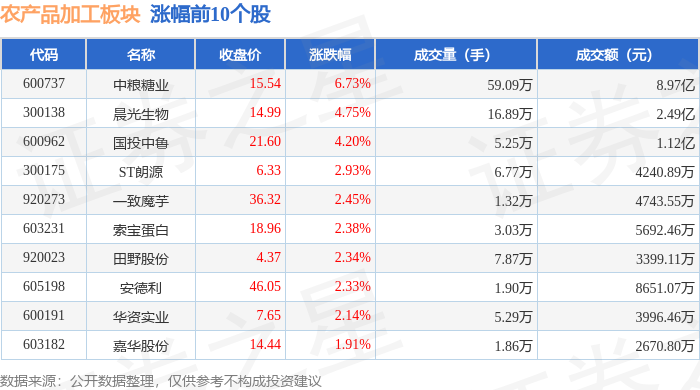
Market Overview - On October 21, the agricultural processing sector rose by 2.75% compared to the previous trading day, with COFCO Sugar leading the gains [1] - The Shanghai Composite Index closed at 3916.33, up 1.36%, while the Shenzhen Component Index closed at 13077.32, up 2.06% [1] Individual Stock Performance - COFCO Sugar (600737) closed at 15.54, with a gain of 6.73% and a trading volume of 590,900 shares, amounting to a transaction value of 897 million yuan [1] - Morning Light Biological (300138) closed at 14.99, up 4.75%, with a trading volume of 168,900 shares and a transaction value of 249 million yuan [1] - Guotou Zhonglu (600962) closed at 21.60, increasing by 4.20%, with a trading volume of 52,500 shares and a transaction value of 112 million yuan [1] - Other notable stocks include ST Langyuan (300175) with a 2.93% increase and a closing price of 6.33, and Yicheng Magic Hand (920273) with a 2.45% increase and a closing price of 36.32 [1] Capital Flow Analysis - The agricultural processing sector experienced a net outflow of 61.35 million yuan from institutional investors, while retail investors saw a net inflow of 93.76 million yuan [2] - The main capital flow for COFCO Sugar showed a net outflow of 34.51 million yuan from institutional investors, indicating a potential shift in investor sentiment [3] - Morning Light Biological had a net inflow of 4.03 million yuan from retail investors, suggesting continued interest from smaller investors despite overall sector outflows [3]

国投期货晨会早报-20251021
Guo Tou Qi Huo· 2025-10-21 05:58
Oil Market - International oil prices declined, with Brent crude falling by 0.65%. Since September, global oil inventory accumulation has accelerated, reaching a 1.5% increase in the fourth quarter. The mid-term outlook for the oil market remains under pressure due to ongoing US-China trade tensions, despite upward revisions in earnings forecasts by three major institutions for the next two years [2] - Geopolitical risks have eased following a ceasefire agreement in Gaza, leading to a reduction in oil market risk premiums. However, with oil prices nearing the lows seen during the trade war in April, the short-term downward momentum is weakening, suggesting a potential shift to a weak consolidation phase [2] Precious Metals - Precious metals rebounded, with market sentiment influenced by ongoing negotiations regarding US-China trade, the Russia-Ukraine conflict, and the US government shutdown. The long-term upward trend for gold and silver remains intact, but short-term volatility risks have increased, suggesting a cautious approach to positions [3] Base Metals - Copper prices experienced fluctuations, supported by easing tariffs under Trump's policies and the potential end of the US government shutdown. However, domestic supply and demand conditions are mixed, with copper inventories rising. The outlook suggests high copper prices may lead to continued volatility [4] - Aluminum prices remained stable, with consumption levels since August showing little change year-on-year. Inventory levels have been neutral, indicating limited fundamental drivers for price movements [5] - The aluminum alloy market is facing tight scrap supply and rising costs due to tax policy adjustments, although high inventory levels are present [6] - Alumina production capacity is at historical highs, with rising inventories and evident oversupply. The average cost in September was around 3000 yuan, nearing levels that could trigger production cuts [7] - Zinc inventories increased, confirming a supply surplus. Despite short-term export opportunities, actual shipments remain limited, and zinc prices are under pressure [8] Steel and Iron Ore - Steel prices are fluctuating, with rebar demand showing a significant month-on-month increase, although year-on-year figures remain weak. Production continues to decline, and inventory levels are decreasing [15] - Iron ore prices are experiencing weak fluctuations, with global shipments increasing compared to last year. Domestic demand is expected to decrease as the peak season ends, leading to potential production cuts [16] Other Commodities - The LPG market is experiencing narrow fluctuations, with a slight increase in supply. Chemical demand is rising, but overall demand remains subdued [23] - The urea market is facing a loose supply-demand balance, with prices under pressure due to high inventories and limited export policies [24] - The cotton market is seeing stable prices amid weak demand, with ongoing attention to US-China trade relations [42] - The sugar market is under pressure from high production levels in Brazil, India, and Thailand, leading to a cautious outlook for prices [43]
瞭望 | 落细技能导向薪酬分配制度
Sou Hu Cai Jing· 2025-10-21 03:41
进一步完善技能人才薪酬分配制度,增强政策与产业发展实际的适配性,在平衡人才和企业利益的基础上提高技 能人才待遇水平,让技能人才发展更有"奔头" 通过税收优惠、融资支持、政策奖励、资金补助等方式,对建立完善技能导向的薪酬分配制度的中小微企业,加 大支持和激励 业内人士表示,各地已出台一些针对高收入技能人才的税收优惠政策,但可操作性有待加强。比如,一些政策表 述为"对个人所得税实际税负超过15%的部分,给予一定比例奖励"。但各负责落实的归口单位对"一定比例"的理 解不同,政策落地效果与预想有差距。 文 |《瞭望》新闻周刊记者 技能人才是支撑中国制造、中国创造的重要力量。近年来,我国技能导向的薪酬分配制度正在建立。 《瞭望》新闻周刊记者近日采访发现,我国技能导向的薪酬分配制度面临增技增收有落差、制度落地有困难等现 实问题。受访业内人士建议,进一步完善技能人才薪酬分配制度,增强政策与产业发展实际的适配性,在平衡人 才和企业利益的基础上提高技能人才待遇水平,让技能人才发展更有奔头。 增技增收存落差 记者采访了解到,在构建技能导向的薪酬分配制度的过程中,一些地方仍存在制度落实精准度不足、政策延续性 不强等问题。 一方面, ...

大豆进口量高,油厂开机率回升
Hong Ye Qi Huo· 2025-10-21 02:53
Report Summary 1. Investment Rating - No investment rating for the industry is provided in the report. 2. Core View - The domestic soybean harvest is nearing completion with quality differentiation, and prices are stabilizing. High soybean imports continue, and there is a possibility of importing US soybeans due to upcoming Sino - US negotiations. Oil mill operating rates are rising, and soybean meal inventories are gradually decreasing. Demand remains strong. The soybean No.1 contract is expected to fluctuate and rebound, while the soybean meal contract will oscillate and adjust. Enterprises are advised to make purchases on dips as needed [4][6]. 3. Summary by Relevant Catalogs Market Performance - The soybean No.2601 contract oscillated and rebounded. The spot price was relatively stable, with the market price of Fuyin soybeans around 4000 yuan/ton. The soybean basis weakened, and the futures price shifted from a discount to a premium. - The soybean meal 01 contract stopped falling after oscillation, rebounding after hitting a low of 2863. The spot price of soybean meal slightly declined, with the 43 - protein soybean meal in Zhangjiagang dropping from 2900 yuan/ton to around 2870 yuan/ton. The basis oscillated, and the futures price maintained a slight premium [4]. Domestic Soybean Situation - As of October 17, the domestic soybean harvest was more than half - completed, showing variety differentiation. The remaining grain ratio in Heilongjiang rose to 90%, in Anhui to 70%, in Henan to 60%, and in Shandong to 70%. The soybean harvest in Heilongjiang was almost finished, with good quality, while in North China and other regions, continuous rain led to poor quality [4]. Import Situation - In September, domestic soybean imports reached 12.87 million tons, a month - on - month increase of 4.8% and a year - on - year increase of 13.2%. From January to September, cumulative imports were 86.185 million tons, a year - on - year increase of 5.3%. Sino - US negotiations may take place at the end of this month, with soybeans being one of the three major demands. The market expects China to purchase US soybeans to ease the situation. However, domestic imports are mainly from South America, and as the cost of Brazilian soybeans rises, purchases have slowed down. As of October 17, the arrival of soybeans at oil mills was 2.21 million tons, a significant month - on - month decline, and port soybean inventories were 9.884 million tons, a slight month - on - month decline, remaining at a high level in recent years [4]. US Soybean Situation - US soybeans are oscillating at a low level. The US government shutdown has suspended the release of USDA reports. Currently, the US soybean harvest may be more than half - completed, but US soybean farmers have nowhere to sell their soybeans due to the government shutdown and受阻 aid. Sino - US negotiation expectations are boosting US soybeans [5]. Oil Mill Situation - As of October 17, the operating rate of oil mills was 59.59%, a significant increase. The soybean crushing volume was 2.166 million tons, returning to a high level. Oil mill soybean inventories reached 7.687 million tons, hitting a new high in recent years. Soybean meal production was 1.711 million tons, a significant increase. Oil mill soybean meal inventories were 976,200 tons, a further month - on - month decline, and the unexecuted soybean meal contracts were 5.007 million tons, a month - on - month decline. The profit from crushing Brazilian soybeans has declined [5]. Feed Demand Situation - In the livestock farming sector, pig prices rebounded after a sharp decline, but farming is still in significant losses. As of October 17, the profit from purchasing piglets for farming was - 375.29 yuan per head, and the self - breeding and self - raising profit was - 244.7 yuan per head, with losses widening. Leading pig enterprises are also facing losses. Policy regulation is insufficient and has a lagging effect. Although the production capacity has been adjusted downward to some extent, the decline is not large, and the pig inventory is still growing due to inertia. - In the poultry sector, egg prices rebounded and then fell again. Laying hen farming is back in the red, and the culling rate is insufficient. The inventory in September continued to grow and remained at a historical high. Feed demand is strong. As of October 17, the soybean meal inventory days of feed mills were 7.93 days, continuing to decline [6].
全球市场一夜变天,A股迎来关键周!三大利空全透视
Sou Hu Cai Jing· 2025-10-21 02:52
Group 1 - The expectation for interest rate cuts by the Federal Reserve has diminished, leading to reduced foreign capital inflow into A-shares as the attractiveness of the dollar remains high [3] - The geopolitical conflicts, particularly the ongoing Russia-Ukraine conflict and the recent Israel-Palestine tensions, are impacting A-share industries, especially those reliant on energy and agricultural commodities [4] - Domestic and external demand pressures are evident, with commodity markets showing signs of weakness and trade protectionism affecting export-oriented sectors, particularly electronics and light industry [5] Group 2 - The A-share market is experiencing a critical week, with the potential for continued volatility depending on the persistence of these three major negative factors and the response of policies [5]