
房地产

Search documents
上证T字星险守4100点,贵金属、化学原料涨幅居前,商业航天大跌
Guan Cha Zhe Wang· 2026-01-20 07:43
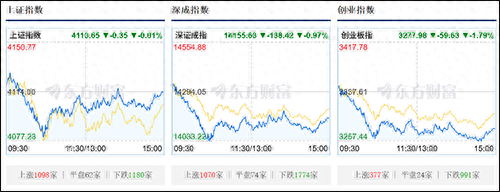
Market Performance - The A-share market showed mixed performance with the Shanghai Composite Index closing at 4113.65 points, down 0.01%, after testing the 4100-point support level multiple times [1] - The Shenzhen Component Index fell by 0.97% to 14155.63 points, while the ChiNext Index experienced a decline of 1.79%, closing at 3277.98 points [1] Sector Performance - Most industry sectors saw declines, with notable gains in precious metals, chemical raw materials, cement and building materials, and chemical fiber industries [3] - The communication equipment, photovoltaic equipment, aerospace, power equipment, batteries, computer equipment, and electronic components sectors faced significant declines [3] Individual Stocks - The real estate sector was active, with stocks like Daxin City and Urban Investment Holdings hitting the daily limit [3] - In the AI application sector, stocks such as Jiayun Technology, Yue Media, and Zhejiang Wenlian also reached the daily limit [3] - A total of 2233 stocks rose while 3102 stocks fell, with over 60 stocks hitting the daily limit [3] - The precious metals sector saw significant gains, with Hunan Baiyin and Zhaojin Gold reaching the daily limit [3] Declining Stocks - The computing hardware and commercial aerospace sectors experienced the largest declines, with commercial aerospace concept stocks collectively dropping, including Shenjian Co. facing four consecutive daily limits and Aerospace Power facing two consecutive daily limits [3]


亚太主要股指集体飘绿,A股化工股爆发,泡泡玛特涨超8%,黄金涨白银跌
2 1 Shi Ji Jing Ji Bao Dao· 2026-01-20 07:23
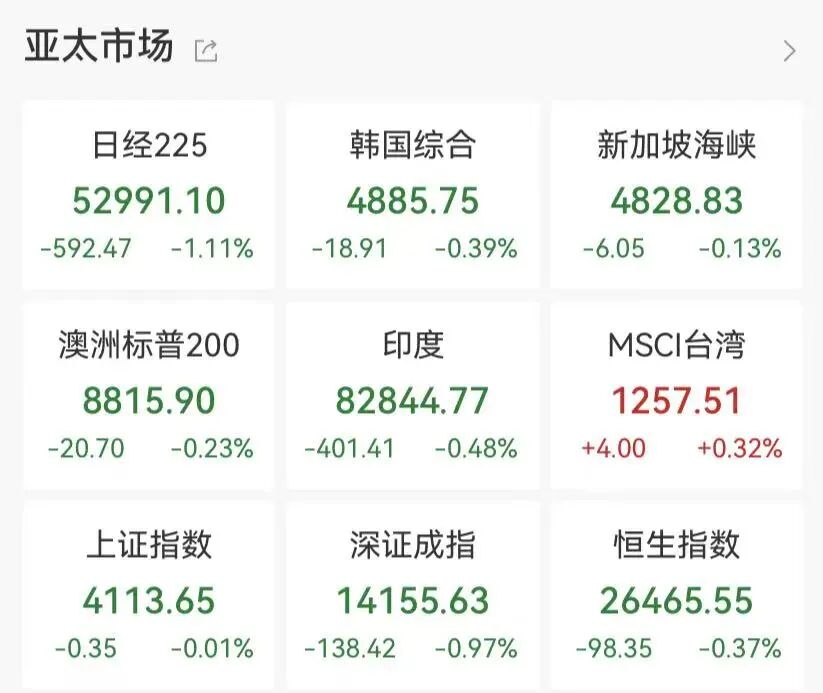
Market Overview - Major Asia-Pacific stock indices collectively declined on January 20, with the Nikkei 225 down by 592.47 points or 1.11%, the KOSPI down by 18.91 points or 0.39%, and the Straits Times Index down by 6.05 points or 0.13% [2] - The A-share market experienced fluctuations, with the Shanghai Composite Index down by 0.01%, the Shenzhen Component down by 0.97%, and the ChiNext Index down by 1.79%. Over 3,100 stocks in the market fell [2] Sector Performance - The satellite internet, CPO, commercial aerospace, and telecommunications sectors led the declines, with commercial aerospace stocks experiencing significant drops, including Shenjian Co. (002361) facing four consecutive trading halts and Aerospace Power (600343) facing two consecutive halts [3] - The chemical sector showed resilience, with over ten constituent stocks hitting the daily limit up, including Hongbaoli (002165), Shandong Heda (002810), Weiyuan Co. (600955), and Hongqiang Co. (002809) [3] - The real estate sector was active, with Dayuecheng (000031) and City Investment Holdings (600649) hitting the daily limit up [3] Hong Kong Market - In the Hong Kong market, the Hang Seng Technology Index fell over 1%, while the Hang Seng Index and Hang Seng China Enterprises Index saw slight declines. Most tech stocks were in the red, with SMIC, Sunny Optical Technology, and BYD (002594) down over 3%, while Xiaomi Group fell over 2%. Ctrip Group rose over 2.5%, and Midea Group (000333) and Baidu Group increased by over 1% [3] Gold and Silver Market - Gold prices rose, with spot gold surpassing $4,700, increasing by nearly 1% and up over 9% year-to-date. In contrast, spot silver fell nearly 0.5%, fluctuating around $94 per ounce [5] - Current prices for gold and silver include: - London Gold: $4,714.235, up by $45.051 or 0.96%, with a year-to-date increase of 9.17% - London Silver: $93.954, down by $0.444 or -0.47%, with a year-to-date increase of 31.26% - COMEX Gold: $4,712.5, up by $35.8 or 0.77%, with a year-to-date increase of 8.78% - COMEX Silver: $93.380, down by $0.900 or -0.95%, with a year-to-date increase of 31.58% [6]

A股收评:创业板指跌1.79% 化工、贵金属板块逆势爆发
2 1 Shi Ji Jing Ji Bao Dao· 2026-01-20 07:23
Market Overview - The three major indices collectively declined, with the ChiNext Index dropping by 1.79% and briefly falling over 2% during the trading session [1][2] - The Shanghai Composite Index fell by 0.01%, and the Shenzhen Component Index decreased by 0.97% [1][2] - The total trading volume in the Shanghai and Shenzhen markets reached 2.78 trillion yuan, an increase of 694 billion yuan compared to the previous trading day [1][2] - Over 3,100 stocks in the market experienced declines [1][2] Sector Performance - The chemical sector showed strong performance, with over ten constituent stocks hitting the daily limit, including Hongbaoli, Shandong Heda, Weiyuan Co., and Hongqiang Co. [1][2] - Precious metals continued to perform well, with Zhaojin Gold achieving two consecutive limit-ups and Hunan Silver also hitting the limit [1][2] - The real estate sector was active, with Dayue City and Urban Investment Holdings reaching the daily limit [1][2] - AI application stocks saw localized gains, with Jiayun Technology, Yue Media, and Zhejiang Wenhu Interconnect hitting the limit [1][2] Declining Sectors - The computing hardware and commercial aerospace sectors experienced significant declines [1][2] - Stocks in the commercial aerospace sector collectively fell, with Shenjian Co. facing four consecutive limit-downs and Aerospace Power experiencing two consecutive limit-downs [1][2]

收评:沪指震荡调整跌0.01% 贵金属板块涨幅居前
Zhong Guo Jing Ji Wang· 2026-01-20 07:18
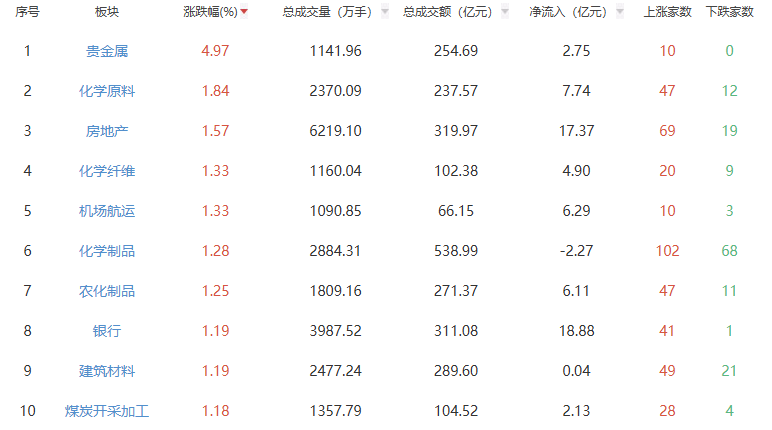
Core Viewpoint - The A-share market experienced a collective decline across the three major indices, with the Shanghai Composite Index closing at 4113.65 points, down 0.01%, and total trading volume reaching 12,214.86 billion yuan [1] Market Performance - The Shenzhen Component Index closed at 14,155.63 points, down 0.97%, with a trading volume of 15,561.72 billion yuan [1] - The ChiNext Index closed at 3,277.98 points, down 1.79%, with a trading volume of 7,026.80 billion yuan [1] Sector Performance - The sectors that saw the highest gains included precious metals, chemical raw materials, and real estate, while sectors such as military electronics, communication equipment, and military equipment experienced the largest declines [1] - In the sector rankings, the top performers were: - Electric metals: +4.97% with a trading volume of 1,141.96 million hands and a net inflow of 254.69 million yuan [2] - Chemical raw materials: +1.84% with a trading volume of 2,370.09 million hands and a net inflow of 237.57 million yuan [2] - Real estate: +1.57% with a trading volume of 6,219.10 million hands and a net inflow of 319.97 million yuan [2] Declining Sectors - The sectors that faced the largest declines included: - Military electronics: -3.82% with a trading volume of 2,953.16 million hands and a net outflow of 62.58 million yuan [2] - Communication equipment: -3.11% with a trading volume of 2,705.64 million hands and a net outflow of 136.34 million yuan [2] - Military equipment: -2.66% with a trading volume of 2,957.57 million hands and a net outflow of 95.34 million yuan [2]
亚太主要股指集体飘绿,A股化工股爆发,泡泡玛特涨超8%,黄金涨白银跌
21世纪经济报道· 2026-01-20 07:18
Market Overview - Major Asia-Pacific stock indices collectively declined, with the Nikkei 225 down by 1.11% and the Hang Seng Index down by 0.37% [2] - A-shares experienced volatility, with the Shanghai Composite Index closing down 0.01%, the Shenzhen Component down 0.97%, and the ChiNext Index down 1.79% [2] - Over 3,100 stocks in the market fell, indicating a broad market downturn [2] Sector Performance - The satellite internet, CPO, commercial aerospace, and communications sectors led the decline, with significant drops in commercial aerospace stocks [3] - The chemical sector showed resilience, with over ten stocks hitting the daily limit up, including Hongbaoli and Shandong Heda [3] - The real estate sector was active, with stocks like Diyi City and Urban Investment Holdings reaching the daily limit up [3] Stock Highlights - In Hong Kong, the Hang Seng Technology Index fell over 1%, while the overall Hang Seng Index saw a slight decline [3] - Notable declines were observed in tech stocks such as SMIC and BYD, both dropping over 3%, while Ctrip Group rose over 2.5% [3] - Pop Mart showed strong performance, initially rising over 10% after announcing a share buyback of 140,000 shares for HKD 251 million [3] Gold and Silver Market - Gold prices rose, surpassing USD 4,700, marking a year-to-date increase of over 9% [5] - In contrast, silver prices fell nearly 0.5%, fluctuating around USD 94 per ounce [5]

三大指数集体收跌,创业板指跌1.79%,化工、贵金属板块逆势爆发
Feng Huang Wang Cai Jing· 2026-01-20 07:16
Market Overview - The three major indices collectively declined, with the ChiNext Index dropping over 2% at one point. The Shanghai Composite Index closed down 0.01%, the Shenzhen Component Index down 0.97%, and the ChiNext Index down 1.79% [1] - The total trading volume in the Shanghai and Shenzhen markets reached 2.78 trillion yuan, an increase of 69.4 billion yuan compared to the previous trading day [5][6] Index Performance - Shanghai Composite Index: 4113.65, down 0.01% [2] - Shenzhen Component Index: 14155.63, down 0.97% [2] - ChiNext Index: 3277.98, down 1.79% [2] - The market saw over 3100 stocks decline, with a significant number of stocks in the chemical sector hitting the daily limit up [2] Sector Performance - The chemical sector showed strong performance, with several stocks such as Hongbaoli and Shandong Heda hitting the daily limit up [2] - Precious metals continued to perform well, with stocks like Zhaojin Gold and Hunan Silver reaching the daily limit up [2] - The real estate sector was active, with stocks like Dayuecheng and City Investment Holdings also hitting the daily limit up [2] Stock Movements - AI application stocks saw partial gains, with companies like Jiayun Technology and Yue Media hitting the daily limit up [3] - Conversely, sectors such as computing hardware and commercial aerospace experienced significant declines, with stocks like Shenjian Co. and Aerospace Power facing consecutive limit downs [3]

收评:创指高开低走跌1.79% 贵金属、化工板块领涨
Xin Lang Cai Jing· 2026-01-20 07:08
Market Overview - The three major stock indices experienced fluctuations throughout the day, with the ChiNext Index leading the decline, dropping nearly 2% [1] - The Shanghai Composite Index closed at 4113.65 points, down 0.01%; the Shenzhen Component Index closed at 14155.63 points, down 0.97%; and the ChiNext Index closed at 3277.98 points, down 1.79% [1] Sector Performance - The precious metals sector continued to strengthen, with Hunan Silver and Zhaojin Gold both hitting the daily limit [1] - The chemical sector also showed robust performance, with China Chemical and Hongqiang Co. among several stocks reaching the daily limit [1] - The real estate sector was active throughout the day, with stocks like Dayue City and Hefei Urban Construction hitting the daily limit [1] - The tourism and hotel concept stocks gained strength, with Dalian Shengya and Jiuhua Tourism reaching the daily limit [1] - Conversely, the CPO sector saw a collective adjustment, with Tongyu Communication hitting the daily limit down [1] - The commercial aerospace sector experienced significant declines, with Chaojie Co. dropping over 10% [1] Overall Market Sentiment - Overall, there were more declining stocks than advancing ones, with over 3100 stocks declining across the two markets [1] - The leading gainers included the epoxy propylene, precious metals, and glyphosate sectors, while military electronics, military information technology, and terahertz sectors faced the largest declines [1]
【盘中播报】沪指跌0.15% 国防军工行业跌幅最大
Zheng Quan Shi Bao Wang· 2026-01-20 06:35
Market Overview - The Shanghai Composite Index decreased by 0.15% as of 13:57, with a trading volume of 1,319.92 million shares and a transaction amount of 22,891.62 billion yuan, an increase of 2.20% compared to the previous trading day [1] Industry Performance - Real estate, oil and petrochemicals, and basic chemicals sectors showed the highest gains, with increases of 1.89%, 1.33%, and 1.07% respectively [1] - The defense and military, communication, and computer sectors experienced the largest declines, with decreases of 3.42%, 2.78%, and 2.07% respectively [2] Leading Stocks - In the real estate sector, Doyou City led with a rise of 10.17% [1] - In the oil and petrochemicals sector, Bohai Chemical increased by 8.00% [1] - In the basic chemicals sector, Meibang Technology surged by 29.94% [1] Detailed Industry Data - Real Estate: 1.89% increase, transaction amount of 306.65 billion yuan, up 34.92% from the previous day [1] - Oil and Petrochemicals: 1.33% increase, transaction amount of 144.28 billion yuan, up 17.62% from the previous day [1] - Basic Chemicals: 1.07% increase, transaction amount of 1,233.25 billion yuan, up 15.65% from the previous day [1] - Defense and Military: 3.42% decrease, transaction amount of 1,357.00 billion yuan, up 11.48% from the previous day [2] - Communication: 2.78% decrease, transaction amount of 1,186.52 billion yuan, up 1.08% from the previous day [2] - Computer: 2.07% decrease, transaction amount of 1,536.79 billion yuan, down 10.09% from the previous day [2]
扩大内需政策“暖”风频吹!大消费尝试修复
Mei Ri Jing Ji Xin Wen· 2026-01-20 06:13
Group 1 - The National Development and Reform Commission (NDRC) is formulating a strategy for expanding domestic demand from 2026 to 2030, focusing on improving supply structure and enhancing consumer capacity [1] - The consumer sector is experiencing negative performance, exemplified by Shui Jing Fang's (600779) forecast of a 42% year-on-year decline in revenue for 2025, indicating that the industry's pessimism is already reflected in prior adjustments [1] - Leading companies like Kweichow Moutai (600519) are adapting by launching market-oriented initiatives, such as online direct sales, to increase accessibility for consumers [1] Group 2 - The consumer ETF from Huaxia (510630.SH) has seen net inflows for three consecutive days, covering various consumer sub-sectors including liquor and dairy [2] - The food ETF from Huaxia (159151.SZ) focuses on daily consumer goods without including liquor or beer, emphasizing strong demand resilience [2] - The optional consumption ETF (562580.SH) covers sectors like automotive and retail, excluding food and beverage categories [2]
——12月经济数据点评:基本面延续偏弱,通胀回升是亮点
Shenwan Hongyuan Securities· 2026-01-20 05:45
Group 1 - The core viewpoint of the report indicates that China's GDP growth rate for 2025 reached 5%, aligning with market expectations, but the economy still faces challenges such as weak domestic demand and external disturbances [1][3] - The report highlights a significant decline in fixed asset investment driven by the real estate sector, with a year-on-year decrease of 17.2% in real estate investment for December 2025 [3][12] - Consumer spending showed limited improvement, with retail sales growth for the year at 3.7%, down 0.3 percentage points from the previous month, primarily affected by declines in automobile sales and dining [3][24] Group 2 - Industrial value-added growth for December 2025 was reported at 5.9%, a decrease of 0.1 percentage points from November, indicating a divergence in production chains, with traditional sectors like steel and cement continuing to contract [3][6] - Inflation showed signs of recovery, with the Consumer Price Index (CPI) rising to 0.8% year-on-year in December, supported by an increase in food prices, particularly vegetables due to adverse weather conditions [3][10] - Fixed asset investment continued to decline, with a cumulative year-on-year decrease of 3.8% in December, reflecting a broader trend of reduced investment across various sectors [3][12]