镍矿

Search documents
受贵金属回调影响,沪镍价格冲高回落
Hua Tai Qi Huo· 2025-12-30 06:07
1. Report Industry Investment Rating - No information provided on industry investment rating 2. Report Core View - The price of Shanghai nickel futures has recently been affected by Indonesian policies and the overall trends of non - ferrous and precious metals. With high inventory and the terminal in the consumption off - season, it is expected to remain range - bound in the short term. Stainless steel prices are expected to maintain a volatile trend, closely following the price of Shanghai nickel [1][3][4] 3. Summary by Related Catalogs Nickel Variety Market Analysis - On December 29, 2025, the main contract 2601 of Shanghai nickel opened at 126,700 yuan/ton and closed at 125,710 yuan/ton, a change of - 0.86% from the previous trading day's close. The trading volume was 785,240 (+168,241) lots, and the open interest was 131,413 (-5,234) lots. The main contract showed a "rush up and fall back + wide - range shock" trend, with an intraday amplitude of 4.4%. In the afternoon, it was driven by a sharp correction in precious metals and quickly declined [1] - The nickel ore market was relatively calm, with prices remaining stable. Affected by the rainy season in the Philippines, resources were limited. Mines had a bullish expectation. There was a certain price difference in the market. Shipping efficiency was delayed due to increased rainfall. The downstream nickel - iron market improved, and the bargaining price moved up. Iron mills were eager to stock up in advance, and the mentality of suppressing raw material nickel ore prices might slow down. In Indonesia, the domestic trade benchmark price in January 2026 (Phase II) is expected to rise by 0.05 - 0.08 US dollars/wet ton, and the current mainstream premium is +25, with the premium range mostly between +25 - 26 [1] - The spot price of Jinchuan Group in the Shanghai market was 135,400 yuan/ton, up 2,200 yuan/ton from the previous trading day. Spot trading was average. Traders were expected to start purchasing after New Year's Day. The spot premiums of refined nickel of each brand were mostly stable. The premium of Jinchuan nickel changed by 100 yuan/ton to 7,200 yuan/ton, the premium of imported nickel changed by 0 yuan/ton to 400 yuan/ton, and the premium of nickel beans was 2,450 yuan/ton. The previous trading day's Shanghai nickel warrant volume was 38,510 (983) tons, and the LME nickel inventory was 255,696 (1,092) tons [2] Strategy - The price of Shanghai nickel is easily affected by Indonesian policies and the overall trends of non - ferrous and precious metals. With high inventory and the terminal in the consumption off - season, it is expected to remain range - bound in the short term. Consider high - selling and low - buying in the range of 123,000 - 130,000 yuan. For trading strategies, focus on range operations for single - side trading, and there are no suggestions for cross - period, cross - variety, spot - futures, and option trading [3] Stainless Steel Variety Market Analysis - On December 29, 2025, the main contract 2602 of stainless steel opened at 12,955 yuan/ton and closed at 12,910 yuan/ton. The trading volume was 169,875 (+40,115) lots, and the open interest was 84,501 (-4,171) lots. The main contract continued to follow the trend of Shanghai nickel, showing a "rush up and fall back + wide - range shock" trend. However, due to weaker fundamentals, the overall trend was weaker than that of Shanghai nickel [3] - The upward momentum of the futures market has slowed down. Although the spot price has risen compared with the previous period, in the context of the year - end off - season, downstream demand remained weak, and there was a lack of further stimulating factors in the news. The spot price remained stable overall. Future attention should be paid to the production reduction process of stainless steel plants and the winter stocking situation of downstream enterprises. The stainless steel price in the Wuxi market was 13,075 (+0) yuan/ton, and that in the Foshan market was 13,075 (+0) yuan/ton. The premium of 304/2B was 145 - 395 yuan/ton. According to SMM data, the ex - factory tax - included average price of high - nickel pig iron changed by 6.50 yuan/nickel point to 910.5 yuan/nickel point [3][4] Strategy - Some macro - level positive factors have been realized, and inventory has been declining for four consecutive weeks. However, downstream demand is weak in the off - season. Stainless steel prices are expected to maintain a volatile trend, closely following the price of Shanghai nickel. For trading strategies, take a neutral stance on single - side trading, and there are no suggestions for cross - period, cross - variety, spot - futures, and option trading [4]
镍研究:印尼镍矿业政策分析与展望
2025-12-29 01:04
Summary of Nickel Industry Research: Indonesia Nickel Mining Policy Analysis and Outlook Industry Overview - The focus is on the nickel mining industry in Indonesia, particularly the government's policies affecting nickel quotas and pricing for 2026 [1][2]. Key Points and Arguments Nickel Quota and Pricing Changes - Indonesia plans to reduce the preliminary nickel mining quota for 2026 to 250 million tons, significantly lower than the actual usage of 288 million tons in 2025 [1][2]. - The government is expected to raise the nickel benchmark price from approximately $23 per ton to around $50 per ton, which will increase production costs for mining companies [1][2]. - The new pricing formula is anticipated to be implemented around the Lunar New Year in 2025, with a differentiation between hydrometallurgical and pyrometallurgical nickel pricing [2][4]. Environmental Regulations and Penalties - The Indonesian government is enforcing strict environmental checks, imposing fines of up to $400,000 per hectare for companies that damage forests [1][6]. - The total fines related to nickel mining are estimated to be around $5 billion, affecting major nickel mining companies in Indonesia [6][7]. Mining Rights and Supply Dynamics - The government plans to redistribute mining rights, with new regulations expected in the first quarter of 2026, which may lead to increased market supply by 2027 [1][8]. - Many nickel iron projects in Indonesia have been delayed or canceled, with existing projects operating at low capacity or idled [1][9]. Impact on Small Mining Companies - The reduction in quotas and increase in benchmark prices will pose significant challenges for smaller mining companies that may struggle to obtain supplementary quotas [5][18]. - The prioritization of companies that have exhausted their quotas, own shares in processing plants, and are geographically closer to mining sites will reshape the competitive landscape [5][20]. Future Supply and Demand - New hydrometallurgical projects are expected to increase demand for nickel ore, with several projects planned to come online, significantly boosting production capacity [3][10]. - The overall nickel supply is expected to remain tight in 2026, despite potential increases in production from new projects [8][19]. Cost Structure and Tax Implications - The adjustment of the underground resource tax calculation aims to align the guidance price with market prices, potentially increasing tax liabilities for some mining companies [3][16]. - The increase in benchmark prices will lead to higher production costs, which may force companies to raise product prices to maintain profit margins [5][17]. Market Sentiment and Price Outlook - Current market conditions indicate a significant oversupply, with high inventories of pure nickel, making substantial price increases unlikely in the near term [31]. - The anticipated nickel price peak is around $16,000 per ton, with limited upward movement expected due to the current supply-demand dynamics [31]. Additional Important Information - The illegal mining rate in Indonesia is very low, estimated at less than 1%, due to strict regulations and monitoring [12]. - The nickel ore quality is declining, with current acceptance levels around 1.4% nickel content, which may impact future supply [19]. - The government is expected to release new quotas in the first quarter of 2026, which may influence inventory strategies among mining companies [21][23].
镍:资金与产业力量博弈,关注结构机会的出现不锈钢:基本面约束弹性,但关注印尼政策风险
Guo Tai Jun An Qi Huo· 2025-12-28 11:19
Report Summary 1. Report Industry Investment Rating No investment ratings are provided in the report. 2. Report's Core View - **Nickel and Stainless Steel**: Industry and capital are in a game, with nickel prices likely to fluctuate widely. Stainless steel is constrained by fundamentals, and its direction depends on the implementation of Indonesian policies in the first quarter [3][5][7]. - **Industrial Silicon and Polysilicon**: Industrial silicon inventories are accumulating, and short - term supply is expected to be disrupted. Polysilicon is in a high - level oscillation. It is recommended to short industrial silicon after a rebound, and polysilicon is expected to oscillate in a high - level range [34][35]. - **Lithium Carbonate**: In the off - season, demand is under pressure, but optimistic expectations are strengthening. The futures main contract price is expected to operate in the range of 120,000 - 140,000 yuan/ton [67][68]. - **Palm Oil and Soybean Oil**: Palm oil is waiting for the December production reduction in Malaysia to confirm the price bottom. Soybean oil is expected to oscillate in a range, waiting for the resonance of themes in the first quarter after the overall stabilization of the oil and fat sector [84][86][87]. - **Soybean Meal and Soybean No.1**: It is expected that the prices of soybean meal and soybean No.1 futures will oscillate, and risks during the New Year's Day holiday should be avoided [101]. - **Corn**: Focus on the performance of the spot market. Pay attention to the inventory accumulation in northern ports, the inventory building of traders, and the amount of supply from the grass - roots level [114]. - **Sugar**: The international sugar market is in a low - level range consolidation. The domestic sugar market maintains a weak basis expectation. Pay attention to Brazil's production and export rhythm, India's production and relevant industrial policies, and domestic import policy changes [137][159]. - **Cotton**: ICE cotton is expected to maintain low - level oscillation in the short term. Domestic cotton futures are expected to maintain a moderately strong oscillation, but the upward space may be limited [167][178]. - **Live Pigs**: Spot prices are expected to oscillate weakly. The LH2601 futures contract may rise rapidly, and attention should be paid to the 3 - 7 reverse spread [182][183]. - **Peanuts**: Spot prices are stable, and futures are expected to oscillate weakly. Pay attention to the purchase strategies of large - scale oil mills [202]. 3. Summary by Relevant Catalogs Nickel and Stainless Steel - **Industry News**: Indonesian government may cut nickel ore quotas to 2.5 billion tons in 2026 and include cobalt in the pricing and taxation system. The cost of pyrometallurgy and hydrometallurgy may increase by about 5% - 10% [3][4]. - **Market Trend**: Nickel prices may fluctuate widely due to the game between industry and capital. Stainless steel is constrained by fundamentals, and its cost center has shifted upward [5][7]. - **Inventory**: On December 26, China's refined nickel social inventory decreased by 263 tons, and LME nickel inventory increased by 1,146 tons. SMM nickel - iron full - industry chain inventory increased by 8% month - on - month [8]. Industrial Silicon and Polysilicon - **Price Movement**: This week, the industrial silicon futures price closed at 8,880 yuan/ton, and the polysilicon futures price closed at 58,955 yuan/ton [29]. - **Supply and Demand**: Industrial silicon inventories are accumulating, with supply expected to decrease and demand remaining weak. Polysilicon supply and demand are both weak, with upstream inventories accumulating [30][31][33]. - **Future Outlook**: Industrial silicon is expected to have its price lifted by sentiment in the short term, but the upward space is limited. Polysilicon is in a high - level oscillation [34][35]. Lithium Carbonate - **Price Fluctuation**: This week, lithium carbonate futures prices rose significantly. The 2601 contract closed at 127,800 yuan/ton, and the spot price rose to 111,900 yuan/ton [64]. - **Supply and Demand**: Overseas shipments are increasing, and short - term production elasticity is limited. Positive electrode factories are starting maintenance, and demand is in the off - season [65]. - **Market Outlook**: In the off - season, demand is under pressure, but optimistic expectations are strengthening. The futures main contract price is expected to operate in the range of 120,000 - 140,000 yuan/ton [67][68]. Palm Oil and Soybean Oil - **Previous Week's Logic**: In December, palm oil production decreased by nearly 10%, and high - frequency export data was good. Soybean oil rebounded following palm oil [82][83]. - **This Week's Logic**: Palm oil production in December decreased by 8%, and exports increased by 2%. It may confirm the price bottom in the short term. Soybean oil is expected to oscillate in a range [84][86]. - **Market Outlook**: Palm oil needs to wait for the December production reduction in Malaysia to confirm the price bottom. Soybean oil is waiting for the resonance of themes in the first quarter [84][86][87]. Soybean Meal and Soybean No.1 - **Previous Week's Market**: Last week, US soybean futures prices fluctuated, with the main 03 - month contract rising 1.16%. Domestic soybean meal futures prices were strongly oscillating, and soybean No.1 futures prices rose slightly [97]. - **Fundamentals**: China's purchase of US soybeans is limited, and Brazilian soybean import costs have decreased. Domestic soybean meal trading volume has increased, and soybean No.1 prices are stable [97][99][100]. - **Future Forecast**: It is expected that the prices of soybean meal and soybean No.1 futures will oscillate, and risks during the New Year's Day holiday should be avoided [101]. Corn - **Market Review**: Last week, corn spot prices fell slightly, and futures prices rebounded. Corn starch inventories increased [109][110][113]. - **Market Outlook**: CBOT corn prices rose, wheat prices fell, and imported corn auctions restarted. Attention should be paid to the performance of the spot market [111][112][114]. Sugar - **Market Review**: Internationally, the New York raw sugar active contract price rose 2.15%. Domestically, the Zhengzhou sugar main contract price rose 197 yuan/ton [135][136]. - **Supply and Demand**: In the 25/26 season, Brazil's sugar production increased by 450,000 tons, India's increased by 1.72 million tons, and Thailand's increased by 1.27 million tons [135]. - **Market Outlook**: The international sugar market is in a low - level range consolidation. The domestic sugar market maintains a weak basis expectation [137][159]. Cotton - **Market Review**: ICE cotton rebounded slightly, and domestic cotton prices rose. Cotton exports from the US improved, and India's CCI continued to purchase [161][166][167]. - **Supply and Demand**: New cotton has been on the market for more than three months, supply is sufficient, and downstream demand is in the off - season. However, the market is not pessimistic about the annual demand in the 2025/26 season [162][178]. - **Market Outlook**: ICE cotton is expected to maintain low - level oscillation in the short term. Domestic cotton futures are expected to maintain a moderately strong oscillation, but the upward space may be limited [167][178]. Live Pigs - **Market Review**: Spot prices were strong, and futures prices oscillated strongly. Supply decreased, and demand was still in the peak season [180][181]. - **Market Outlook**: Spot prices are expected to oscillate weakly. The LH2601 futures contract may rise rapidly, and attention should be paid to the 3 - 7 reverse spread [182][183]. Peanuts - **Market Review**: Spot prices were stable, and futures prices fell. Supply pressure increased, and oil mill开机率 increased [201]. - **Market Outlook**: Spot prices are stable, and futures are expected to oscillate weakly. Pay attention to the purchase strategies of large - scale oil mills [202].
“妖镍”井喷:除了矿端扰动,还有没有需求新故事?
经济观察报· 2025-12-28 07:38
Core Viewpoint - The price movement of electrolytic nickel is primarily influenced by actual demand conditions, despite supply-side contractions and market speculation [1] Supply Disruption - Nickel is categorized into primary and recycled nickel, with electrolytic nickel being a key trading product and delivery standard for futures [4] - The price of electrolytic nickel has been in a downward trend due to weak downstream demand, with historical data showing significant volatility in nickel prices [4][5] - Recent policy adjustments in Indonesia, which plans to significantly reduce nickel ore production targets for 2026, have led to a rapid price rebound in the nickel market [6][5] - The futures market saw a dramatic increase in trading volume and price, indicating a surge in market participation and speculation [7] Demand Dilemma - The primary demand for electrolytic nickel comes from stainless steel, which accounts for over 70% of nickel consumption [9] - Despite supportive policies for the real estate sector, actual improvements in demand remain slow, with recent data showing a decline in stainless steel production [9][10] - Other sectors like alloys and electroplating have stable but limited demand, insufficient to absorb the excess supply of electrolytic nickel [10] Potential for Nickel Recovery - Some analysts remain optimistic about future nickel prices, citing historical trends where metals gain value in a low-interest-rate environment [12] - The demand from the new energy battery sector, particularly with the rise of solid-state batteries, is expected to contribute to future nickel consumption growth [13][14] - However, the realization of this demand is projected to be long-term, with significant commercial viability not expected until 2030 [14] - The recent price surge is attributed to policy expectations and market speculation rather than a fundamental improvement in supply-demand dynamics [14]


长江有色:26日镍价上涨 期货强势现货交投观望
Xin Lang Cai Jing· 2025-12-26 08:49
Core Viewpoint - Nickel prices are experiencing upward momentum driven by macroeconomic factors and supply constraints, with a notable increase in both futures and spot prices observed recently [1][2]. Group 1: Price Movements - The Shanghai nickel futures market saw the main contract for January 2026 open at 125,790 CNY/ton, reaching a high of 127,980 CNY/ton and closing at 126,750 CNY/ton, marking an increase of 1,640 CNY/ton or 1.31% [1]. - The average price for 1 nickel on December 26 was reported at 130,900 CNY/ton, up by 3,600 CNY from the previous day, while the spot price averaged 131,600 CNY/ton, reflecting a rise of 4,250 CNY [1]. Group 2: Macro Factors - The expectation of interest rate cuts by the Federal Reserve has weakened the US dollar, making nickel more attractive to global buyers and boosting its price [2]. - The overall sentiment in the non-ferrous metals sector has improved, with strong performances in lithium and other energy metals contributing to a bullish atmosphere that supports nickel prices [2]. Group 3: Supply Dynamics - A significant reduction in nickel supply is anticipated due to Indonesia's policy to cut nickel ore production by 34% by 2026, which is expected to tighten long-term supply [2]. - New regulations in Indonesia that impose separate taxation on cobalt may increase mining costs, further supporting nickel prices [2]. Group 4: Market Activity - The spot market is characterized by a "price without market" scenario, where trading activity remains subdued despite slight improvements in sentiment, leading to a situation where high-priced resources are not being sold [3]. - Downstream enterprises are cautious, focusing on purchasing based on need and at lower price points, which has resulted in transactions primarily occurring in the mid to low price range [3]. Group 5: Short-term Outlook - The short-term rebound in nickel prices is likely to continue, although the upward potential may be limited, suggesting a strong but constrained market environment [4].

刚刚,跳空高开,白银大涨!突然宣布:降息100个基点
Qi Huo Ri Bao· 2025-12-25 23:39
Group 1: Silver Market Dynamics - The Shanghai silver futures main contract surged over 5%, closing at 18,131 yuan per kilogram, while international spot silver opened at a record high of $73.7 per ounce, marking a significant increase [1] - Year-to-date, the spot silver price has risen nearly 150%, with a key breakout in August signaling a bullish trend, supported by momentum indicators reaching their highest levels since 2011 [3] - The ongoing AI boom is expected to sustain demand for silver in the electronics sector, with a positive outlook for the silver market through 2026 [3] Group 2: Fund Management and Investment Strategies - The Guotai Asset Management announced a limit on daily subscriptions for its silver fund to 100 yuan starting December 29, down from a previous limit of 500 yuan [6] - The fund's secondary market price has significantly exceeded its net asset value, with a premium reaching nearly 70%, prompting concerns about potential losses for investors [10] - The recent surge in the Guotai silver fund's price has attracted attention on social media, leading to discussions about arbitrage opportunities [12] Group 3: Nickel Market Developments - Indonesia is reportedly considering a significant reduction of 34% in its nickel production quota for 2026, which could indicate a major shift in resource management and market regulation [13] - The Shanghai nickel futures experienced volatility, with a decline of 1.22% in the main contract, influenced by market sentiment and profit-taking [14] - Analysts suggest that the nickel market remains oversupplied globally, and future price movements will depend on Indonesia's policy decisions and production cost changes [15]

南华期货镍&不锈钢2026年度展望:供需结构调整周期,随势而动
Nan Hua Qi Huo· 2025-12-25 12:10
Report Title - Nanhua Futures' Outlook for Nickel & Stainless Steel in 2026: Adapting to the Supply-Demand Structural Adjustment Cycle [1] Report Industry Investment Rating - Not provided Core Views - In 2025, the nickel market first rose and then declined. The price was mainly influenced by demand fluctuations and sentiment changes, lacking fundamental factors for a trend reversal. The annual price performance was weaker than previous years [2][3]. - In 2026, the focus of the nickel market remains on the progress of supply-demand structural adjustments. The demand for stainless steel is expected to remain stable, while the demand for nickel in the new energy sector is likely to be moderate. The Indonesian government's policies will continue to affect the market, and the supply surplus situation may improve marginally [4][5][6]. - The report predicts that in 2026, the main contract range for nickel will be between 118,000 - 130,000 yuan, and for stainless steel, it will be between 12,100 - 13,000 yuan [6]. Summary by Directory 2025 Annual Market Review - **First Quarter**: The nickel price showed a volatile and upward - trending pattern, with the price center rising to the range of 125,000 - 136,000 yuan/ton. The main influencing factors were Indonesian policy adjustments and the contradiction between short - term cost support and long - term oversupply [9]. - **Second Quarter**: The nickel - stainless steel market showed a volatile and downward - trending pattern. Factors such as the US tariff policy, rising LME nickel inventories, and weak terminal demand led to the decline of nickel and stainless steel prices [11]. - **Third Quarter**: The market showed a range - bound and slightly upward - trending pattern, mainly driven by news and policy expectations. However, high inventories and weak demand restricted the upward space of prices [12]. - **Fourth Quarter**: The market was mainly affected by Indonesian policy disturbances and macro - expectations. Although there were short - term price rebounds, the overall supply surplus situation remained unchanged, and the price fluctuations were mainly due to market sentiment and capital speculation [13]. Industrial Chain Performance Nickel Ore - In 2025, the supply of the nickel ore market was affected by policies and seasons. The supply was tight in the first half of the year and then eased. The demand was mainly suppressed by downstream smelting profits, showing cost - sensitivity characteristics [16][19]. - In 2026, the nickel ore market will be in a cycle of strong policy supervision and rational return of production capacity. The Indonesian government's policies will lead to a certain degree of supply contraction, and the price is expected to remain stable with a slight upward trend [22][23]. Ferronickel - In 2025, the supply of the ferronickel market showed regional differentiation and structural substitution characteristics. The supply was tight in the first half of the year and then increased. The demand was mainly suppressed by the weak profits of downstream stainless steel [25][29]. - In 2026, the ferronickel market will also enter a cycle of policy supervision and rational return of production capacity. The growth rate of effective production capacity is expected to slow down, and the price center will likely be affected by the demand of downstream steel mills [30][31]. Nickel Sulfate and Intermediates - In 2025, the supply of global nickel intermediates was mainly from Indonesia. The production of MHP increased significantly, while the production of nickel sulfate decreased. The demand was affected by the differentiation of technical routes, and the pricing system was adjusted [33][35]. - In 2026, the supply of nickel sulfate intermediates will show a structural increase, while the demand in the Chinese battery sector will slow down. The market may enter a cycle of processing fee control and raw material coefficient game [37][38]. Stainless Steel - In 2025, the supply of stainless steel showed a pattern of marginal slowdown in total growth, internal structural differentiation, and intensified extrusion from overseas capacity. The demand was affected by the weakening of traditional growth engines and the challenges of the external market [42][46][47]. - In 2026, the stainless steel market may enter a cycle of supply - demand re - balance. The supply side will see further elimination of high - cost production capacity, and the demand side may have a marginal improvement, especially in high - end special stainless steel [50][52]. 2026 Annual Balance Deduction - In 2026, the core trading logic of the nickel market will shift to the joint action of supply - demand structural optimization and integrated cost rigid support. The supply surplus situation will be alleviated but not reversed [54]. - The demand for nickel in the stainless steel industry will be the core anchor point. The new energy vehicle battery sector will face pressure from the penetration of lithium iron phosphate, and the nickel market surplus will continue in 2026 [54][55].
锂钴镍板块更新:商品价格或迎来齐涨
2025-12-25 02:43
Industry and Company Analysis Summary Industry Overview - The lithium, cobalt, and nickel sectors are expected to see price increases in Q1 2026, driven by strong demand and supply constraints [10][11] - Despite concerns regarding the demand for new energy vehicles in 2026, an overall growth rate of 15%-20% is anticipated, with a positive outlook for the energy storage market [1][2] Key Points on Lithium Market - Recent lithium carbonate prices have surged, exceeding 120,000 yuan per ton, primarily due to stable demand and production delays from major companies like CATL [2] - Current lithium carbonate supply is nearly at full capacity, limiting production flexibility. Even with price increases, significant new capacity is not expected in the short term [3][4] - Companies with substantial investment potential in the lithium sector include Guocheng Mining, Dazhong Mining, Tianhua Xinneng, and Shengxin Lithium Energy, all of which have considerable growth prospects [5] Nickel Market Insights - The Indonesian Nickel Mining Association has announced a planned 34% reduction in RKA approvals for 2026, which could shift the nickel market from surplus to a tight balance if strictly enforced [6][7] - The nickel market is currently influenced by potential policy changes from the Indonesian government, with significant implications for supply and demand dynamics [7][8] Cobalt Market Analysis - The cobalt market is currently in a state of information vacuum, with delays in cobalt exports from the Democratic Republic of Congo (DRC) leading to increased domestic inventory consumption [9] - In November, China imported approximately 4,900 tons of cobalt intermediate products, with a significant monthly demand leading to a reduction in inventory levels [9] - A rapid increase in cobalt prices is expected in Q1 2026 due to panic buying as inventory levels are depleted [9][10] Additional Considerations - The overall supply chain is becoming more closed, with heightened security concerns regarding resource availability, making commodity prices more resistant to declines [11] - Companies like Huayou, Likin, Greeenmei, Zhongwei, and Weiming Environmental are noted for their bottom-fishing value, even in a declining price environment [8]
情绪持续发酵,镍不锈钢反弹延续
Hua Tai Qi Huo· 2025-12-25 01:48
1. Report Industry Investment Rating - Not provided in the given content 2. Core Viewpoints - For the nickel market, influenced by Indonesian policy changes, the bullish sentiment is high, and nickel prices are expected to maintain an overall rebound trend. However, high inventory and oversupply in the fundamentals will drag down the rebound strength [3]. - For the stainless - steel market, although the weak supply - demand situation has not changed fundamentally, short - term cost support and technical strength provide price resilience. Investors should pay attention to the implementation progress of Indonesian policies and inventory changes to seize the opportunity of oscillating upward [6]. 3. Summary by Related Catalogs Nickel Variety Market Analysis - **Futures**: On December 24, 2025, the main contract 2602 of Shanghai nickel opened at 120,280 yuan/ton and closed at 123,440 yuan/ton, a 3.92% change from the previous trading day's close. The trading volume was 386,986 (+190,610) lots, and the open interest was 134,454 (+21,822) lots. It showed a strong and volatile trend with significant capital inflow, driven by the expectation of Indonesian quota contraction and external market, but restricted by high inventory and differences between long and short positions. The continuous weakening of the US dollar increased the attractiveness of commodities, while weak consumption and high inventory limited the rebound strength [1]. - **Nickel Ore**: The trading atmosphere in the nickel ore market was fair, and prices remained stable overall. In China's southern region, 1.3% nickel ore was traded at CIF $39.5. In the Philippines, the 1.3% nickel ore tender at the northern Benguet mine was settled at FOB $33.5, with a price increase. Considering rainfall, the shipping efficiency was fair. Downstream iron plants were still in losses, and their attitude of pressing prices for raw material nickel ore purchases might ease. In Indonesia, the second - phase domestic trade benchmark price in December dropped by $0.11 - $0.18 per wet ton, and the current mainstream premium was +25, with a premium range of +25 - 26, expected to remain flat [1]. - **Spot**: Jinchuan Group's sales price in the Shanghai market was 133,800 yuan/ton, up 5,400 yuan/ton from the previous trading day. Nickel prices rose significantly, and spot trading was weak. The spot premiums of refined nickel brands decreased slightly. The premium of Jinchuan nickel changed by - 150 yuan/ton to 6,750 yuan/ton, the premium of imported nickel remained unchanged at 400 yuan/ton, and the premium of nickel beans was 2,450 yuan/ton. The previous trading day's Shanghai nickel warehouse receipt volume was 38,621 (-301) tons, and the LME nickel inventory was 254,604 (+216) tons [2]. Strategy - **Unilateral**: Mainly conduct range operations [4]. - **Inter - delivery**: None [4]. - **Inter - variety**: None [4]. - **Futures - spot**: None [4]. - **Options**: None [4]. Stainless - Steel Variety Market Analysis - **Futures**: On December 24, 2025, the stainless - steel main contract 2602 opened at 12,920 yuan/ton and closed at 12,905 yuan/ton. The trading volume was 168,990 (-497) lots, and the open interest was 100,771 (-4,171) lots. It showed a mild rebound with increasing volume and price, and the fluctuation was relatively stable, consistent with the strong continuation of Shanghai nickel's sharp rise the previous day [4]. - **Spot**: The futures market weakened, and downstream purchasing enthusiasm was low, mainly purchasing on - demand. Inventory depletion slowed down. The stainless - steel price in the Wuxi market was 13,050 (+75) yuan/ton, and in the Foshan market, it was 13,025 (+75) yuan/ton. The 304/2B premium was 100 - 350 yuan/ton. The ex - factory tax - included average price of high - nickel pig iron changed by 4.00 yuan/nickel point to 893.0 yuan/nickel point [4][5]. Strategy - **Unilateral**: Buy on dips [6]. - **Inter - delivery**: None [6]. - **Inter - variety**: None [6]. - **Futures - spot**: None [6]. - **Options**: None [6].
全球最大产镍国印尼释放减产信号,全面整顿海关,合规风险飙升!
Sou Hu Cai Jing· 2025-12-24 12:20
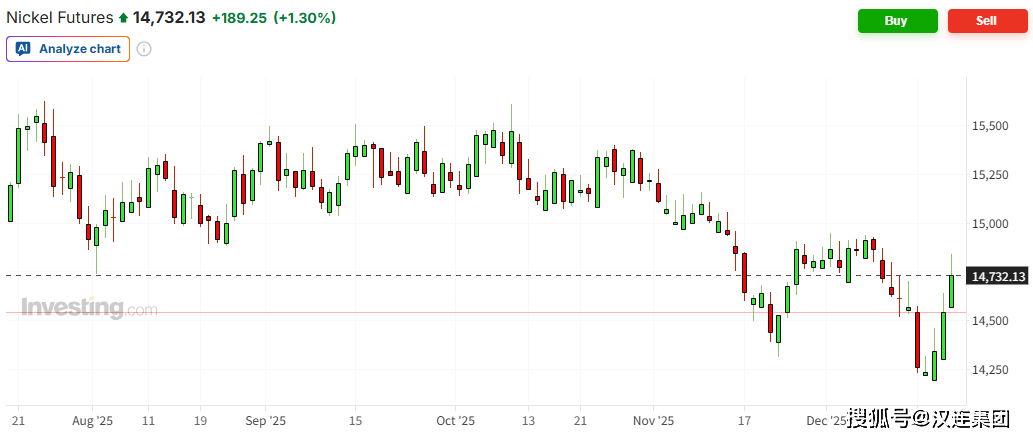
Group 1: Nickel Production and Price Dynamics - Indonesia, the world's largest nickel producer, plans to cut nickel production by nearly one-third by 2026 to stabilize nickel prices, responding to recent price declines [1][2][4] - Nickel prices on the London Metal Exchange (LME) rose approximately 1.3% to $14,732 per ton, recovering from a low of $14,200, the lowest level since April [2] - The proposed production target for 2026 is about 250 million tons, down from 379 million tons in 2025, indicating a significant reduction in output [2] Group 2: Nickel Reserves and Market Impact - Indonesia holds 40% to 45% of the world's nickel reserves and has shifted from being a raw material exporter to a resource processing country since 2020 [4] - The decline in nickel prices, which have dropped over 3% this year, is attributed to reduced electric vehicle policies in Europe and the U.S., making nickel the only industrial metal expected to decline in value for the year [4] - Analysts suggest that Indonesia's production cut plan poses a risk to bearish investors, especially as nickel prices approach production costs [4] Group 3: Regulatory Changes and Revenue Generation - Indonesia's Ministry of Energy and Mineral Resources plans to revise the nickel ore pricing formula by early 2026, which may include cobalt as a separate commodity subject to royalties [5][7] - The potential introduction of a royalty on cobalt, which is valued at twice the price of nickel, could generate an additional revenue of approximately $600 million for the Indonesian government [7] Group 4: Customs and Compliance Reforms - Indonesia is undergoing a comprehensive reform of its customs and tax authority to improve compliance and reduce corruption, with a focus on addressing issues like invoice undervaluation and smuggling [9][11] - The government has invested significantly in technology to enhance customs operations, including a centralized scanning system to improve compliance checks and reduce the risk of undervaluation [11][13] - The new system will allow real-time analysis of scanning results at a central processing center in Jakarta, shifting the decision-making process away from local port officials [13]