啤酒

Search documents
五粮液上半年营收利润微增,多数酒企营收利润双降 | 封面观酒
Sou Hu Cai Jing· 2025-08-28 05:26
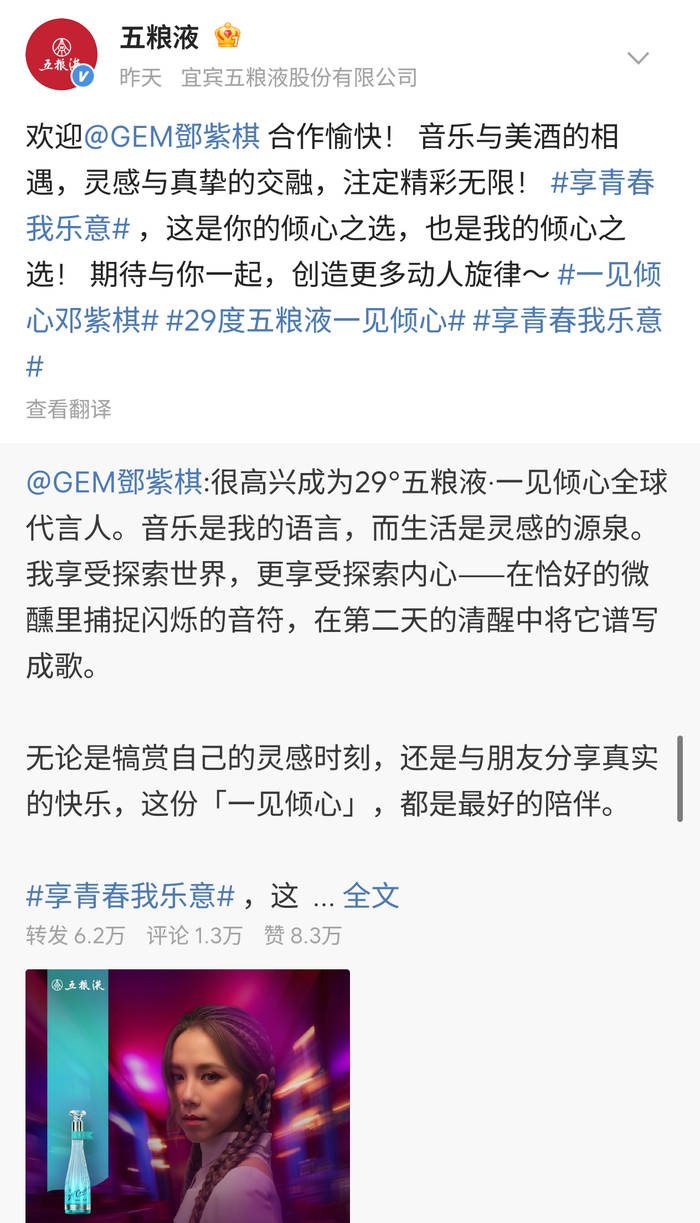
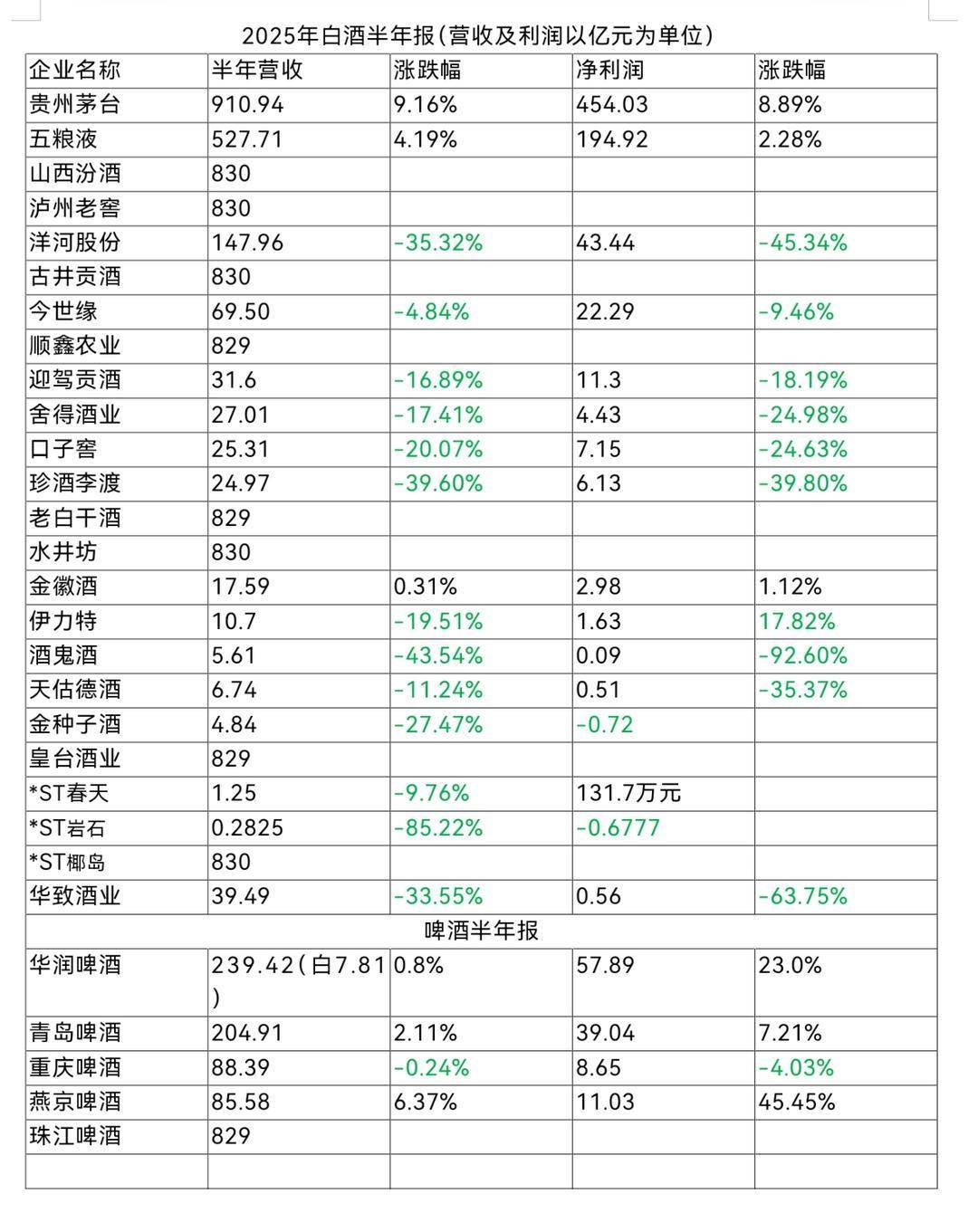
Core Viewpoint - Wuliangye's revenue and net profit for the first half of 2025 reached historical highs, but growth rates have dropped to single digits, indicating a significant shift in the industry dynamics [1][4]. Company Performance - Wuliangye achieved a revenue of 52.771 billion yuan, a year-on-year increase of 4.19%, and a net profit of 19.492 billion yuan, up 2.28% [1][3]. - Other companies like Jinhui Wine reported revenue and profit growth of 0.31% and 1.12%, respectively [5]. - In contrast, most other liquor companies reported negative revenue growth, with many experiencing double-digit declines [5][6]. Industry Trends - A total of 15 liquor companies have released their semi-annual reports, with only three showing positive growth in both revenue and profit [3][5]. - The liquor industry is undergoing a significant adjustment, with over two-thirds of companies expected to report declines in both revenue and profit [7]. - The beer industry has shown better performance compared to the liquor sector in the first half of 2025 [7].


娃哈哈:宗庆后持有的29.4%股权由宗馥莉100%继承|首席资讯日报
首席商业评论· 2025-08-28 04:28
Group 1 - Zhuhai is enhancing support for low-altitude economy development by formulating a "policy package" to leverage its resources and platforms, aiming to establish a competitive low-altitude industry cluster [2] - Rongtai Health has entered a strategic partnership with Aoshark Intelligent to explore "human-machine symbiosis" applications in health technology and robotics [3] - The Hong Kong Securities and Futures Commission reported a significant increase in IPO fundraising, with a total of 51 IPOs raising HKD 128 billion, marking a year-on-year increase of over 610% [4] Group 2 - China Resources Beer announced a halt in the supply of certain products to instant retail platforms in response to market chaos caused by price wars, aiming to maintain product value and brand competitiveness [4] - Mixue Group reported a revenue of CNY 14.87 billion for the first half of the year, a year-on-year increase of 39.3%, with a net profit of CNY 2.718 billion, up 44.1% [5] - FWD Group signed a ten-year lease with Swire Properties, becoming the largest single office tenant in Taikoo Place, with an office space of 330,000 square feet [6] Group 3 - Wahaha confirmed that the 29.4% stake directly held by Zong Qinghou has been fully inherited by his daughter, Zong Fuli, following a notarized will [7] - Cainiao Network employees will receive a "double year-end" bonus if they were employed as of August 1, with the special bonus to be distributed by the end of August [8] - Jia Yueting executed a stock purchase plan, acquiring approximately USD 200,000 worth of Faraday Future common stock, indicating confidence in the company's future [11]


华润啤酒(0291.HK):啤酒成本改善明显 利润稳增长
Ge Long Hui· 2025-08-28 02:44
Core Viewpoint - The company reported a stable performance in its beer business for the first half of 2025, while the white liquor segment faced significant challenges due to reduced demand from business banquets [1][2]. Group 1: Beer Business Performance - In H1 2025, the company achieved beer revenue of 240.75 billion yuan, a year-on-year increase of 6.69%, with sales volume reaching 6.487 million kiloliters, up 2.19% year-on-year [1]. - The company continued to push for premiumization, with revenue per kiloliter increasing by 4.4% year-on-year, and sales of premium and above beer growing over 10% [1]. - The company’s gross margin improved to 48.88%, an increase of 1.97 percentage points year-on-year, driven by a 0.41% decrease in beer cost per kiloliter [1]. Group 2: White Liquor Business Challenges - The white liquor segment reported revenue of 7.83 billion yuan in H1 2025, a decline of 33.53% year-on-year, primarily due to the impact of reduced business banquet scenarios [2]. - The white liquor business incurred an EBIT loss of 1.52 billion yuan, attributed to the significant drop in revenue [2]. - The company plans to enhance pricing strategies and optimize expenses to improve sales in the second half of the year [2]. Group 3: Financial Outlook and Dividends - The company declared an interim dividend of 0.464 yuan per share, with a payout ratio of 26.07%, reflecting a year-on-year increase of 0.34 percentage points [2]. - Earnings per share (EPS) forecasts for 2025-2027 are projected at 1.93, 1.97, and 2.09 yuan, corresponding to price-to-earnings ratios of 14, 13, and 13 times based on the closing price on August 25, 2025 [2].
食品饮料ETF天弘(159736)连续7日获资金净流入!机构:高切低行情或演绎,建议关注低位布局机会
2 1 Shi Ji Jing Ji Bao Dao· 2025-08-28 02:05
Group 1 - A-shares opened lower on August 28, with the consumer sector experiencing slight adjustments [1] - The Tianhong Food and Beverage ETF (159736) fell by 0.67% as of the report, while stocks like San Yuan and Xin Dairy saw gains exceeding 4% [1] - The Tianhong Food and Beverage ETF has seen a net inflow of over 68 million yuan in the week from August 25 to August 27, marking seven consecutive trading days of inflows [1] Group 2 - The current period is critical for the liquor sector as it seeks a bottom, with policies correcting previous bans and supply adjustments being made by liquor companies [2] - The market is experiencing a high-low rotation, with the restaurant supply chain and processed food sectors showing signs of recovery, particularly in beer due to favorable weather conditions [2] - The liquor sector has been under pressure since the second quarter due to demand constraints, but there are expectations for a gradual narrowing of policy impacts and a foundation for recovery [2]





青岛啤酒(600600):Q2量价增长 成本红利延续
Xin Lang Cai Jing· 2025-08-28 00:31
Core Viewpoint - The company reported a slight increase in revenue and net profit for the first half of 2025, with expectations for continued profitability in the second half as the impact of alcohol bans diminishes and cost advantages persist [1][3]. Group 1: Financial Performance - For 25H1, the company achieved revenue of 20.49 billion yuan, net profit of 3.90 billion yuan, and net profit excluding non-recurring items of 3.63 billion yuan, representing year-on-year growth of +2.1%, +7.2%, and +6.0% respectively [1]. - In Q2 2025, revenue was 10.05 billion yuan, net profit was 2.19 billion yuan, and net profit excluding non-recurring items was 2.03 billion yuan, with year-on-year growth of +1.3%, +7.3%, and +6.0% respectively [1]. - The gross margin for 25H1 was 43.7%, up by 2.1 percentage points year-on-year, while Q2 gross margin increased by 3.0 percentage points to 45.8% [3]. Group 2: Sales and Market Dynamics - The company sold 4.732 million tons of beer in 25H1, a year-on-year increase of +2.3%, with Q2 sales showing a +1.0% increase [2]. - The sales volume of mid-to-high-end products increased by +5.1% in 25H1, while low-end products saw a +1.0% increase [2]. - The impact of alcohol bans and weak consumer demand has pressured industry sales, with Q2 industry production down by -0.3% year-on-year [2]. Group 3: Cost Management and Profitability - The company benefited from a decline in raw material costs, with Q2 costs per ton down by -5.1% year-on-year, leading to improved profitability [3]. - The selling expense ratio and management expense ratio for 25H1 were 10.7% and 3.3%, showing stable expense management amid competitive pressures [3]. Group 4: Earnings Forecast and Valuation - The company has adjusted its earnings forecast for 2025-2027, now expecting EPS of 3.51, 3.80, and 4.10 yuan, reflecting a downward revision of 1% to 2% [4]. - The target price for A-shares is set at 84.24 yuan, based on a 24x PE ratio for 2025, while the target price for H-shares is 65.46 HKD, based on a 17x PE ratio [4].
8点1氪:被五月天粉丝质疑抄袭,老庙黄金道歉;美团将于年底全面取消骑手超时罚款;宗馥莉回应砍掉年销300万以下经销商
36氪· 2025-08-28 00:09
Group 1 - The core issue involves a gold pendant shaped like a carrot by Laomiao Gold, which has been accused of plagiarism from STAYREAL's IP "Momo Hu Hu Carrot" [3][4] - Laomiao Gold recently announced a formal collaboration with STAYREAL on August 24, but the controversial product was not part of this collaboration, leading to accusations of betrayal [5] - Following the backlash, Laomiao Gold issued an apology on August 26, explaining that the product was an internal design mistakenly listed by e-commerce staff, and they have since removed it from all platforms [5] Group 2 - Meituan announced plans to eliminate late delivery penalties for riders by the end of 2025, shifting from punitive measures to positive incentives [5][7] - The company has already begun trials in 22 cities to implement a system that rewards timely deliveries instead of penalizing delays [5][7] Group 3 - Cambrian Technology's stock price surged, briefly surpassing Kweichow Moutai to become the "king of A-shares," with a monthly increase of over 100% and a year-to-date increase exceeding 2500% [6][19] - Anta Group reported a revenue of 38.544 billion yuan for the first half of the year, a year-on-year increase of 14.3% [19] - Mixue Group achieved a revenue of 14.87 billion yuan in the first half of the year, reflecting a year-on-year growth of 39.3% [20]


青岛啤酒2025年中报简析:营收净利润同比双双增长,盈利能力上升
Zheng Quan Zhi Xing· 2025-08-27 22:56
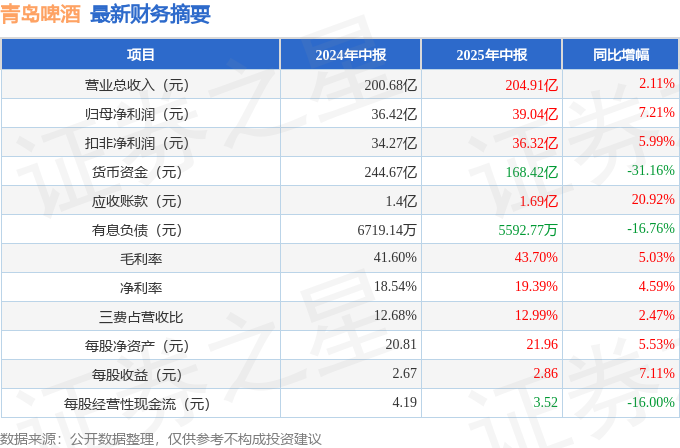
Core Viewpoint - Qingdao Beer (600600) reported a revenue of 20.491 billion yuan for the first half of 2025, reflecting a year-on-year increase of 2.11%, and a net profit of 3.904 billion yuan, up 7.21% year-on-year [1] Financial Performance - Total revenue for Q2 2025 reached 10.046 billion yuan, a 1.28% increase year-on-year, while net profit for the same period was 2.194 billion yuan, up 7.32% year-on-year [1] - Gross margin improved to 43.7%, an increase of 5.03% year-on-year, and net margin rose to 19.39%, up 4.59% year-on-year [1] - Total expenses (selling, administrative, and financial) amounted to 2.662 billion yuan, accounting for 12.99% of revenue, a 2.47% increase year-on-year [1] - Earnings per share (EPS) increased to 2.86 yuan, a rise of 7.11% year-on-year [1] Key Financial Metrics - Cash flow per share decreased to 3.52 yuan, down 16.0% year-on-year [1] - The company's return on invested capital (ROIC) was 13.36%, indicating strong capital returns [7] - The net profit margin for the previous year was 13.98%, suggesting high added value in products or services [7] Changes in Financial Items - Significant changes in financial items included a 156.16% increase in trading financial assets due to the rise in structured deposits [3] - Accounts receivable increased by 64.95% due to higher receivables from subsidiaries [3] - Inventory decreased by 42.05% as subsidiaries reduced stock in preparation for peak sales season [4] - Tax liabilities surged by 150.92% due to increased income, value-added, and consumption taxes [5] Fund Holdings - The largest fund holding Qingdao Beer is the Penghua Zhongzheng Wine ETF, which holds 7.5849 million shares and has increased its position [9] - The fund's current scale is 12.64 billion yuan, with a recent net value of 0.6118, down 3.07% from the previous trading day [9]
青岛啤酒(600600):公司信息更新报告:稳住销量,力保增长
KAIYUAN SECURITIES· 2025-08-27 15:19
Investment Rating - The investment rating for Qingdao Beer is maintained at "Outperform" [1] Core Views - The company aims to stabilize sales and ensure growth despite pressure on demand, with a focus on repairing sales before product structure adjustments [5][7] - The company has adjusted its net profit forecasts for 2025-2027 to 4.83 billion, 5.32 billion, and 5.93 billion CNY respectively, reflecting a decrease from previous estimates [4] - The current stock price corresponds to a low valuation with PE ratios of 19.5, 17.7, and 15.9 for 2025-2027, indicating potential resilience in demand [4] Sales and Revenue - In H1 2025, the company's revenue reached 20.49 billion CNY, a year-on-year increase of 2.1%, with net profit attributable to shareholders at 3.904 billion CNY, up 7.21% [4] - Beer sales volume increased by 2.2% year-on-year, while the average price per ton decreased slightly by 0.1% [5] - The company is focusing on enhancing sales of mid-to-high-end products, with a stable growth rate in its main and high-end brands [5][7] Cost and Profitability - The company's gross profit margin improved by 3.05 percentage points year-on-year, driven by a 5.1% decrease in ton costs, primarily due to lower costs of barley and packaging materials [6] - The net profit margin increased by 1.23 percentage points year-on-year, indicating better cost management and profitability [6] Financial Forecasts - The company expects revenue growth to recover gradually, with projected revenues of 33.055 billion, 34.015 billion, and 35.650 billion CNY for 2025-2027 [8] - The projected EPS for 2025-2027 is 3.54, 3.90, and 4.35 CNY, reflecting a positive growth trajectory [8]
青岛啤酒(600600):销量同比增长,成本红利持续释放
EBSCN· 2025-08-27 13:42
Investment Rating - The report maintains a "Buy" rating for Qingdao Beer (600600.SH) with a current price of 69.78 CNY [1] Core Views - Qingdao Beer achieved a revenue of 20.49 billion CNY in H1 2025, a year-on-year increase of 2.1%, and a net profit attributable to shareholders of 3.9 billion CNY, up 7.2% year-on-year [5][9] - The company continues to experience steady sales growth and cost advantages, with a focus on product structure optimization and market expansion [6][8] Sales Performance - In H1 2025, sales volume reached 4.73 million kiloliters, a year-on-year increase of 2.3%, driven by inventory reduction and a focus on market share [6] - The average selling price in H1 2025 was 4,330 CNY per kiloliter, showing a slight decrease of 0.1% year-on-year [6] Product Structure and Market Strategy - The high-end product trend continues, with mid-to-high-end products showing significant growth, achieving a sales volume of 1.99 million kiloliters, up 5.1% year-on-year [6] - The company is actively expanding into emerging channels and enhancing online operations, with five consecutive years of rapid growth in transaction volume [6] Cost and Profitability - The gross margin for H1 2025 was 43.7%, an increase of 2.09 percentage points year-on-year, primarily due to lower raw material prices [7] - The net profit margin reached 19.39% in H1 2025, reflecting an increase of 0.85 percentage points year-on-year [7] Strategic Initiatives - The new management team emphasizes sales growth as a primary goal, implementing a product mix strategy to enhance core products and expand into new markets [8] - The company is focusing on the southern market and international expansion in regions like South Korea and West Africa to drive overall sales growth [8] Financial Forecast and Valuation - The report projects net profits for 2025-2027 at 4.72 billion CNY, 5.04 billion CNY, and 5.29 billion CNY respectively, with corresponding EPS of 3.46 CNY, 3.70 CNY, and 3.88 CNY [9][10] - The current stock price corresponds to a P/E ratio of 20x for 2025, indicating a strong position in the beer industry with robust channel and brand advantages [9]
白酒市场生变,酒企纷纷“降度”
Sou Hu Cai Jing· 2025-08-27 12:48
Group 1 - Major Chinese liquor companies, including Wuliangye and Shede, announced the launch of low-alcohol products, indicating a shift in the market towards lower alcohol content [1][4] - The trend of reducing alcohol content is a response to changing consumer preferences, particularly among younger demographics who favor taste and health [4][9] - The China Alcoholic Drinks Association's report highlights a mismatch between traditional liquor offerings and the demands of younger consumers born between 1985 and 1994 [4][5] Group 2 - Companies like Luzhou Laojiao and Yanghe are actively developing low-alcohol products, with Luzhou Laojiao planning to introduce a 28-degree version of its flagship product [5][4] - The introduction of low-alcohol products is seen as a proactive measure to adapt to a market undergoing significant adjustments, with many companies experiencing declining sales [4][9] - The market for low-alcohol beverages is expanding, with various companies launching products in the range of 15 to 28 degrees [4][5] Group 3 - In addition to lowering alcohol content, liquor companies are entering the craft beer market, with Wuliangye launching its first craft beer product [7] - Young consumers are driving the craft beer market, with over 75% prioritizing unique flavor experiences [7][9] - The strategy of combining liquor and beer aims to create a synergistic ecosystem, leveraging shared distribution channels and consumer engagement [7][9] Group 4 - Despite the opportunities presented by low-alcohol and craft beer strategies, companies face challenges such as technical difficulties in producing low-alcohol beverages and regional market differences [9] - The need for effective supply chain management is critical as beer has a shorter shelf life and higher consumption frequency compared to traditional liquor [9] - The dual strategy of lowering alcohol content and entering the beer market is essential for addressing the loss of younger consumers and the competitive landscape [9]