
原材料

Search documents
沪指向上突破,“慢牛”行情进行中
Sou Hu Cai Jing· 2025-08-18 02:46
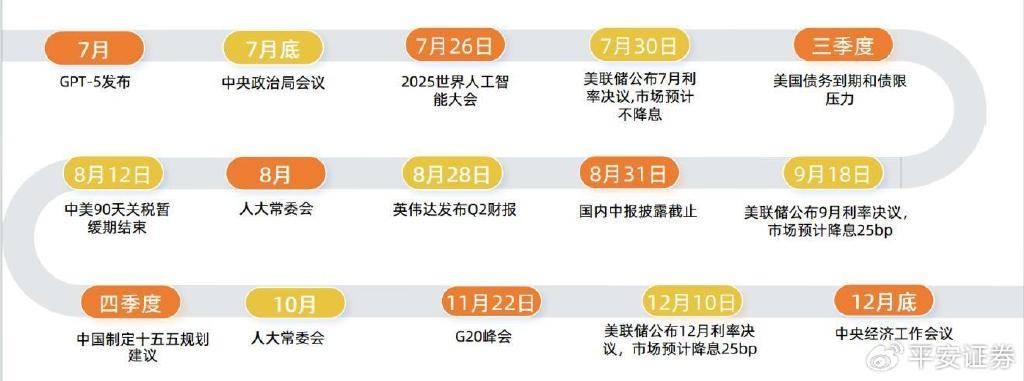
Market Overview - The Shanghai Composite Index has broken through 3700 points, indicating a "slow bull" market trend supported by improved risk appetite and liquidity [1][15] - The A-share market has seen a significant increase in new accounts, with 1.96 million new accounts opened in July, a year-on-year increase of 71% [1][2] - The market is expected to be boosted by upcoming events such as the military parade on September 3 and the Fourth Plenary Session, which may enhance market expectations [1][15] Economic Policies - The Federal Reserve is nearing a rate cut, with expectations for a September cut approaching 100% due to weakening employment and inflation data [2][11] - Domestic policies are gradually being implemented, with the central bank focusing on moderately easing monetary policy and several structural policies expected to be rolled out in the second half of the year [2][10] Investment Strategy - The investment strategy emphasizes a "technology + dividend" approach, focusing on high-quality leaders benefiting from the "anti-involution" trend [3][16] - The technology sector is highlighted as a high-growth area, with the "14th Five-Year Plan" likely to focus on new productivity and advancements in AI technology [3][16] - High-dividend assets are expected to attract incremental capital, with stable performance and valuation advantages in dividend sectors [3][16] Economic Data Insights - In July, new social financing was 1.16 trillion yuan, a year-on-year increase of 389.3 billion yuan, but below expectations [6][7] - Retail sales in July grew by 3.7% year-on-year, down from 4.8% in the previous month, indicating a slowdown in consumption and investment [8][9] - The second quarter monetary policy report emphasizes the need for continued moderate easing of monetary policy [10] Global Market Trends - The U.S. stock market has shown a rebound, with healthcare and consumer discretionary sectors performing well, while the market anticipates a high probability of a rate cut in September [18] - The bond market has experienced a decline, with the 10-year government bond yield rising from 1.71% to 1.73% [19] - Gold prices are expected to remain volatile in a high-risk appetite environment, with market expectations fluctuating ahead of the Jackson Hole central bank meeting [21]

惠理投资盛今:中国资产具备多重核心竞争优势
Shang Hai Zheng Quan Bao· 2025-08-17 13:36
Core Viewpoint - The Hong Kong stock market has shown strong performance this year, driven by multiple core competitive advantages of Chinese assets, which are expected to enhance their attractiveness to international capital [1][2]. Group 1: Factors Driving Hong Kong Stock Market Strength - Three main factors are identified as driving the strength of the Hong Kong stock market: the "hard technology" wave, the rise of the "new economy," and the weakening of the US dollar [2]. - The "hard technology" revolution is expected to bring profound changes to production and lifestyle, with leading Chinese internet companies poised to capitalize on AI applications [2]. - The "new economy" has become a pillar of the Hong Kong stock market, with its market capitalization share increasing from 27% at the end of 2015 to an expected 51% by the end of 2024 [2]. - The weakening US dollar has led to a reallocation of funds, with a slowdown in foreign capital outflow from the Hong Kong market, making it an attractive option for global capital seeking undervalued assets [2]. Group 2: Core Competitive Advantages of Chinese Assets - Chinese assets possess three core competitive advantages: a complete modern industrial system, increased R&D investment leading to brand premium, and significant long-term investments in core technology fields [3]. - The manufacturing sector in China has achieved low-cost, high-efficiency capabilities through vertical integration and scale advantages [3]. - Chinese companies are increasingly recognized for their global competitiveness in areas such as AI, semiconductors, new energy, and aerospace [3]. Group 3: Investment Opportunities in A-Share Market - The A-share market presents four key investment opportunities: stable cash returns in sectors like telecommunications, finance, and utilities; potential in the internet sector and consumer sub-industries due to policy support and AI commercialization; growth in the biopharmaceutical industry driven by improved policies and global competitiveness; and a stabilization in the real estate sector along with improved prospects for chemicals and raw materials [3].
策略定期报告:港股科技会跟上
Guotou Securities· 2025-08-17 10:05
Group 1 - The report emphasizes that the current market is experiencing a liquidity-driven bull market, with the potential for a transition to a fundamental bull market by the end of the year, contingent on external factors such as global tariff resolutions and fiscal expansions in major economies [3][4][87] - The report identifies a significant performance gap between growth stocks, particularly in the ChiNext index, and value stocks, suggesting that the ChiNext index is currently undervalued and poised for further gains [2][31][50] - The report highlights the increasing inflow of southbound funds into Hong Kong stocks, particularly in the technology sector, indicating a shift in investor sentiment towards growth-oriented assets [12][32][44] Group 2 - The report outlines a "three-headed bull" market scenario, which includes a short-term liquidity bull market, a mid-term fundamental bull market, and a long-term transition from old to new economic drivers, suggesting a comprehensive market recovery [3][4][5] - The report notes that the current market environment is conducive to a structural shift towards "middle assets," which are expected to outperform as the economy stabilizes and earnings begin to recover [46][47][56] - The report indicates that the current valuation of the ChiNext index is at a historical low, with a price-to-earnings ratio of 33.89, suggesting a relative valuation advantage compared to other major indices [50][51][52]
“反内卷”不会推动物价普遍上涨
Jing Ji Ri Bao· 2025-08-14 22:09
Group 1 - The essence of the "anti-involution" policy is "correction" rather than "stimulation," aiming to reshape the logic of industrial competition [1][5] - The impact of the "anti-involution" policy on prices is structural and mild, with the key variables for future price trends being the strength of demand recovery and the pace of policy coordination [1][5] - The "anti-involution" policy has led to improvements in supply-demand relationships in certain industries, resulting in positive changes in pricing [2] Group 2 - Since the beginning of the year, signals of the "anti-involution" policy have been continuously reinforced, with various measures taken to address "involution-style" competition [2] - The revised Anti-Unfair Competition Law prohibits selling goods below cost, providing a legal basis for combating "involution-style" competition [2] - The Producer Price Index (PPI) in July remained at a low of -3.6% year-on-year, but the month-on-month decline has narrowed, indicating some stabilization in industrial prices [3][4] Group 3 - The Consumer Price Index (CPI) remains weak overall, but the core CPI has rebounded for three consecutive months, benefiting from reduced price wars in the automotive and home appliance sectors [3] - The improvement in PPI is primarily concentrated in upstream raw materials and industrial products, which have a low direct correlation with consumer spending [4] - The transmission mechanism from PPI to CPI remains ineffective, as insufficient terminal consumer demand limits companies' pricing power [4]
中证文体指数报1922.68点,前十大权重包含岩山科技等
Jin Rong Jie· 2025-08-13 16:15
Group 1 - The core viewpoint of the news is the performance of the China Securities Cultural and Sports Index, which has shown significant growth over the past month, three months, and year-to-date [1] - The China Securities Cultural and Sports Index has increased by 3.64% in the last month, 8.59% in the last three months, and 14.72% year-to-date [1] - The index reflects the overall performance of listed companies related to cultural and sports sectors, including media, entertainment, and sports services [1] Group 2 - The top ten weighted companies in the index include: Focus Media (7.79%), Giant Network (3.67%), Ninebot (3.37%), Yanshan Technology (3.2%), Kaiying Network (3.19%), Kunlun Wanwei (3.04%), Light Media (2.74%), Shenzhou Taiyue (2.67%), Leo Group (2.62%), and 37 Interactive Entertainment (2.5%) [1] - The market share of the index's holdings is 73.49% from Shenzhen Stock Exchange and 26.51% from Shanghai Stock Exchange [1] - The industry composition of the index shows that communication services account for 81.10%, consumer discretionary for 11.78%, consumer staples for 2.03%, industrials for 2.00%, information technology for 1.61%, and materials for 1.48% [2] Group 3 - The index samples are adjusted semi-annually, with adjustments occurring on the next trading day after the second Friday of June and December each year [2] - Weight factors are adjusted in accordance with the sample changes, and generally remain fixed until the next scheduled adjustment [2] - Special circumstances may lead to temporary adjustments of the index, such as delisting of samples or corporate actions like mergers and acquisitions [2]





中金 • 全球研究 | 欧洲例外论?——欧洲市场的潜力与局限
中金点睛· 2025-08-12 23:49
Core Viewpoint - The European equity market is experiencing strong performance due to significant internal policy changes, while the sustainability of the "American exceptionalism" is under scrutiny, prompting investors to seek opportunities outside the U.S. [2][7] Group 1: New Opportunities in Europe - The macro environment has improved, leading to better valuations and earnings in Europe, particularly in sectors that previously lagged, such as banking, utilities, telecommunications, energy, and materials [3][10]. - Policy shifts, especially from Germany, are addressing structural issues and boosting economic growth, with fiscal support directed towards domestic-oriented industries that have underperformed [3][21]. - Global regional allocation is becoming more valuable, with Europe's market size, economic scale, diverse income sources, and institutional stability presenting relative advantages [3][32]. Group 2: Missing Elements in Europe - Despite positive developments, the European equity market still lacks key factors for a robust "European exceptionalism," including limited economic growth potential and structural challenges [4][44]. - The fragmented financial market in Europe hampers equity market performance, and political fragmentation poses challenges to necessary reforms [4][57]. Group 3: Investment Opportunities - The new investment narrative in Europe is shifting towards policy-driven "self-reliance," focusing on military spending, technology independence, energy policies, and enhancing domestic demand [5][59]. - The need for financial market reforms and leveraging Europe's substantial savings base is critical for driving investment [5][60]. Group 4: Policy Changes in Europe - Germany's fiscal plan could reach €1 trillion over the next decade, significantly impacting public spending and economic growth [21][22]. - The EU's "Re-Arm Europe" initiative, totaling €800 billion, aims to bolster fiscal spending, particularly in infrastructure, green transition, and digitalization [21][22]. - Regulatory changes and discussions around EU integration are gaining momentum, which could enhance investment attractiveness despite existing political challenges [26][27]. Group 5: European Market as a Potential Alternative - Regional diversification in investment is becoming increasingly important, with Europe presenting several advantages over other non-U.S. regions, including market size and economic scale [31][32]. - Europe's equity market comprises 12% of the MSCI ACWI index, making it one of the largest equity markets globally [31]. - The EU's stable institutional framework, despite slower decision-making, provides predictability and discipline in fiscal matters [32]. Group 6: Potential Funding Sources - European households currently allocate only 22% of their assets to equities, significantly lower than the U.S. at 41%, indicating potential for increased investment in the equity market [37][38]. - The asset management industry in Europe is well-developed, and recent macro changes could shift the investment landscape towards more favorable allocations in European equities [37][38].

把握跨境投资新机遇 南方沙特ETF于6月24日起发售
Xin Hua Wang· 2025-08-12 06:12
Group 1 - The first batch of ETFs for investing in the Saudi Arabian market, the Southern Fund Southern Dongying Saudi Arabia ETF, was launched on June 24, providing mainland investors with an index-based investment tool for the Saudi market [1] - The Saudi ETF tracks the FTSE Saudi Arabia Index, which is a market capitalization-weighted index representing large and mid-sized companies with Saudi nationality [1] - The top ten weighted stocks in the FTSE Saudi Arabia Index account for 62.36%, focusing on key sectors such as finance, energy, materials, utilities, and communication, with the financial sector exceeding 40% [1] Group 2 - The growth of the Saudi economy is driven by the government's transformation plans, strong funding support, and robust financing capabilities, with Saudi stocks being included in major global indices [2] - The Saudi economy is diversifying, reducing its reliance on the oil industry, with the oil and gas sector's contribution to GDP decreasing from approximately 40% before 2016 to 36% in 2022 [2] - The "Vision 2030" initiative has made Saudi Arabia an attractive investment destination, continuously drawing domestic and international capital [2]
【招银研究】美国经济回暖,国内风偏修复——宏观与策略周度前瞻(2025.08.11-08.15)
招商银行研究· 2025-08-11 10:02
Core Viewpoint - The article discusses the marginal recovery of the US economy, highlighting improvements in GDP growth, employment stability, inflation pressures, and market expectations for interest rate cuts by the Federal Reserve [2][3]. Group 1: US Economic Recovery - The Atlanta Fed's GDPNOW model predicts a Q3 GDP growth rate of 2.5%, with private consumption growth at 2.0% and private investment growth at 2.5%, indicating a recovery from Q2's low [2]. - Initial jobless claims remain low at 226,000, while continuing claims are at 1.974 million, suggesting a stable employment market with limited upward pressure on the unemployment rate [2]. - Service consumption growth is forecasted at 1.9% for Q3, up from 1.4% in Q2, potentially reversing the trend of cooling service inflation [2]. Group 2: Interest Rate Expectations - Market sentiment is influenced by Trump's nomination of Stephen Moore to the Federal Reserve, with expectations for a 25 basis point rate cut in September and 2-3 cuts anticipated for the year [2][3]. - The bond market reflects these expectations, with US Treasury yields remaining low and limited further downside anticipated due to already priced-in rate cuts [3]. Group 3: Currency and Commodity Outlook - The US dollar is expected to remain stable, with limited downside as the market has largely priced in the September rate cut [5]. - Gold prices are influenced by potential tariffs on gold bars, leading to a significant price spread between New York and London gold [6]. Group 4: China's Economic Performance - China's exports grew by 7.2% year-on-year in July, with imports rising by 4.1%, indicating better-than-expected trade performance [8]. - Domestic real estate transactions are down 25.1% year-on-year, with second-hand home prices declining, reflecting ongoing pressure in the housing market [9]. Group 5: Policy Initiatives - The People's Bank of China and other departments issued guidelines to support new industrialization through financial services, focusing on innovation and supply chain resilience [10][11]. - The "anti-involution" policy aims to direct financial resources towards technological innovation and brand upgrades, while monitoring credit flows to prevent risks [11]. Group 6: Market Strategy - The market shows a steady recovery in risk appetite, with both stock and bond markets experiencing slight upward movements [12]. - A balanced allocation strategy is recommended for equities, focusing on dividend-paying sectors and technology, while maintaining a cautious approach to long-duration bonds [14].

出口再超预期后:风险与韧性并存
Haitong Securities International· 2025-08-11 07:14
Export and Import Growth - In July 2025, China's export growth rate was 7.2% (previous value 5.9%), while import growth was 4.1% (previous value 1.1%) [5] - Month-on-month, July exports decreased by 1.1% compared to June, slightly below seasonal levels but higher than the same period in 2024 [5] - The trade surplus decreased in July 2025 [5] Country-Specific Trends - Exports to ASEAN and Latin America saw significant increases, with growth rates of 16.6% and 7.7% respectively, likely due to preemptive shipments before August tariffs [11] - Exports to the United States decreased by 21.7%, while exports to the EU and other regions increased by 9.2% and 19.3% respectively [11] Product-Specific Insights - In the machinery and electronics sector, equipment exports remained strong, while consumer electronics showed a decline due to previous over-shipments [18] - Labor-intensive imports decreased, while grain imports saw a notable increase [23] Future Outlook and Risks - Export growth is expected to moderate, with key risks including the implementation of Section 232 tariffs and increased scrutiny on transshipments [29] - The resilience of capital goods exports is noteworthy, as geopolitical tensions may lead to increased demand for Chinese equipment [29]
上证国新科创板国企指数下跌0.7%
Sou Hu Cai Jing· 2025-08-08 13:56
Group 1 - The Shanghai Stock Exchange National New Sci-Tech Board State-Owned Enterprises Index (950253) opened lower and fluctuated, down 0.7% to 1080.78 points, with a trading volume of 26.665 billion yuan [1] - Over the past month, the index has increased by 8.98%, by 9.11% over the past three months, and by 11.89% year-to-date [1] - The index is composed of state-owned enterprises listed on the Sci-Tech Board or companies with state capital participation without actual control, reflecting the overall performance of state-owned enterprises in the Sci-Tech Board [1] Group 2 - The index samples are adjusted every six months, with adjustments implemented on the next trading day after the second Friday of June and December [2] - Weight factors are generally fixed until the next scheduled adjustment, with temporary adjustments made under special circumstances [2] - Companies that are delisted or undergo mergers, acquisitions, or splits are processed according to calculation and maintenance guidelines [2]