通信

Search documents
20cm速递|创业板人工智能ETF国泰(159388)早盘翻红,把握人工智能确定性机遇与高弹性机会
Mei Ri Jing Ji Xin Wen· 2025-12-29 04:24
Group 1 - The core viewpoint is that 6G will represent a fundamental shift from traditional communication capabilities to an "AI-native" intelligent network paradigm, transforming communication networks from "connection pipelines" to "intelligent service platforms" [1] - The three main lines of 6G development are AI native, integrated sensing, and green intelligence, which will support vertical scenarios such as industrial internet and intelligent transportation through the deep integration of emerging capabilities like AI and sensing [1] - China has shifted from "catching up" to "running alongside" and even "leading" in certain areas of 6G layout, with the next 3-5 years being a critical window for technology shaping and ecosystem building [1] Group 2 - The ChiNext AI ETF Guotai (159388) tracks the ChiNext AI Index (970070), which has a daily fluctuation of 20%, and selects listed companies involved in AI technology and related applications from the ChiNext market [1] - The index covers multiple segments from hardware manufacturing to software development, reflecting the overall performance of AI-related listed companies in the ChiNext market, characterized by significant technological innovation and growth potential [1]

A股跨年行情已经启动,新的主线浮出水面
Zheng Quan Shi Bao Wang· 2025-12-29 03:07
Group 1 - The article highlights that 39 out of 360 industry/theme ETFs reached new highs in December, with established sectors like telecommunications and non-ferrous metals reflecting North American AI infrastructure and resource logic, while new sectors like commercial aerospace ETFs are gaining attention during market fluctuations [2] - The focus on sectors such as chemicals and engineering machinery indicates a shift in China's manufacturing competitiveness towards pricing power, while sectors related to anti-involution, like new energy and steel, are also showing signs of recovery [2] - The investment strategy suggests a preference for sectors with low heat and concentration but potential for long-term ROE improvement, such as chemicals, engineering machinery, and new energy, alongside a keen observation of the trend of RMB appreciation [3] Group 2 - The article discusses the favorable conditions for the spring market rally, emphasizing liquidity-driven characteristics in the A-share market, with expectations for a surge in the CSI A500 ETF towards year-end [3] - It notes that the spring market is supported by loose liquidity, with private equity making concentrated purchases and the RMB's appreciation benefiting market liquidity [3] - The potential for a spring rally is further supported by upcoming events like the Spring Festival and the Two Sessions, which may enhance risk appetite [3] Group 3 - The article indicates that the RMB's appreciation post "breaking 7" is expected to have a positive impact on both the currency and capital markets, with a potential for a spring rally [4][5] - It outlines four key logic points regarding the impact of RMB appreciation on industry allocation, including benefits for industries with high import reliance, those with significant foreign currency liabilities, and domestic demand-driven sectors [5] - The article suggests that the current market conditions do not show clear signs of a bull market peak, with internal policies remaining supportive and external risks easing [6] Group 4 - The article identifies new investment themes emerging in the commodity market and real industry chains, highlighting the increasing consumption of physical goods in manufacturing sectors and the strengthening of China's manufacturing advantages [7] - It recommends focusing on industrial resource products that resonate with AI investment and global manufacturing recovery, as well as sectors like equipment exports and domestic manufacturing recovery [7] - The article emphasizes the importance of capital market expansion and the potential for non-bank financial sectors to benefit from improving asset returns [7] Group 5 - The article states that the A-share market's cross-year rally has begun, driven by positive signals from the Shanghai Composite Index and optimistic institutional investor expectations [8] - It highlights the importance of sectors like non-ferrous metals and AI computing, with commercial aerospace being a primary market focus [8] - The article suggests that the spring market may see a structural and rapid rotation of sectors, with a recommendation for investors to adopt a low-buying strategy [12]

量化观市:货币财政双会定调,后续风格该如何配置?
SINOLINK SECURITIES· 2025-12-29 02:58
Quantitative Models and Construction Methods 1. Model Name: Rotation Model - **Model Construction Idea**: The model is based on the relative performance of micro-cap stocks and "Mao Index" (a large-cap index), using rolling slopes and relative net values to determine rotation signals[19][24] - **Model Construction Process**: 1. Calculate the relative net value of micro-cap stocks to the Mao Index. If the relative net value is above its 243-day moving average, the model prefers micro-cap stocks; otherwise, it prefers the Mao Index[19][24] 2. Compute the 20-day closing price slopes for both micro-cap stocks and the Mao Index. If the slopes diverge and one is positive, the model selects the index with the positive slope to adapt to potential style shifts[19][24] 3. Timing indicators include the 10-year government bond yield (threshold: 0.3) and micro-cap stock volatility crowding (threshold: 0.55). If either indicator hits the threshold, a closing signal is triggered[19][24] - **Model Evaluation**: The model effectively captures style rotation signals and provides a systematic approach to manage risk and optimize returns[19][24] 2. Model Name: Macro Timing Model - **Model Construction Idea**: This model integrates macroeconomic growth and monetary liquidity signals to determine equity allocation levels[44][45] - **Model Construction Process**: 1. Assign signal strengths to economic growth and monetary liquidity dimensions. For December, the signal strengths were 50% and 60%, respectively[45] 2. Combine these signals to recommend an equity allocation level. For December, the recommended equity allocation was 55%[45] 3. The model's performance is tracked, with a year-to-date return of 13.57% compared to a 25.65% return for the Wind All-A Index[44] - **Model Evaluation**: The model provides a balanced approach to equity allocation, leveraging macroeconomic indicators to guide investment decisions[44][45] --- Model Backtesting Results 1. Rotation Model - **Relative Net Value**: Micro-cap stocks to Mao Index relative net value was 2.06, above the 243-day moving average of 1.80[19] - **20-Day Slope**: Micro-cap stocks' 20-day slope was -0.15%, while the Mao Index's slope was 0.00%[19] - **Risk Indicators**: Volatility crowding was -17.17%, below the 55% risk threshold; 10-year government bond yield was 7.32%, below the 30% risk threshold[19] 2. Macro Timing Model - **Economic Growth Signal**: 50%[45] - **Monetary Liquidity Signal**: 60%[45] - **Equity Allocation**: 55%[45] - **Year-to-Date Return**: 13.57% (compared to Wind All-A Index's 25.65%)[44] --- Quantitative Factors and Construction Methods 1. Factor Name: Growth Factor - **Factor Construction Idea**: Measures the growth potential of companies based on financial metrics like net income and operating income growth[58][59] - **Factor Construction Process**: 1. Use single-quarter net income year-over-year growth (NetIncome_SQ_Chg1Y) and single-quarter operating income year-over-year growth (OperatingIncome_SQ_Chg1Y) as key metrics[59] 2. Combine these metrics to rank stocks and construct the factor[59] - **Factor Evaluation**: Demonstrated strong performance with an IC mean of 10.62% across all A-shares[48] 2. Factor Name: Consensus Expectation Factor - **Factor Construction Idea**: Captures market sentiment and expectations based on analysts' forecasts[58][59] - **Factor Construction Process**: 1. Use metrics like expected ROE changes over the past three months (ROE_FTTM_Chg3M) and target return over 180 days (TargetReturn_180D)[59] 2. Rank stocks based on these metrics to construct the factor[59] - **Factor Evaluation**: Performed well with an IC mean of 9.57% across all A-shares[48] 3. Factor Name: Volatility Factor - **Factor Construction Idea**: Measures stock price stability and risk using historical price and volume data[58][59] - **Factor Construction Process**: 1. Use metrics like 60-day return volatility (Volatility_60D) and CAPM residual volatility (IV_CAPM)[59] 2. Rank stocks inversely based on these metrics to construct the factor[59] - **Factor Evaluation**: Underperformed with an IC mean of -20.21% across all A-shares[48] --- Factor Backtesting Results 1. Growth Factor - **IC Mean**: 10.62% (all A-shares)[48] - **Multi-Long-Short Portfolio Return**: 20.54% (all A-shares, year-to-date)[49] 2. Consensus Expectation Factor - **IC Mean**: 9.57% (all A-shares)[48] - **Multi-Long-Short Portfolio Return**: 15.95% (all A-shares, year-to-date)[49] 3. Volatility Factor - **IC Mean**: -20.21% (all A-shares)[48] - **Multi-Long-Short Portfolio Return**: -2.96% (all A-shares, year-to-date)[49]
每日投资策略-20251229
Zhao Yin Guo Ji· 2025-12-29 02:44
Global Market Overview - The Hang Seng Index closed at 25,819, showing a year-to-date increase of 28.71% [1] - The Shanghai Composite Index rose by 0.10% to 3,964, with a year-to-date increase of 18.26% [1] - The US Dow Jones Index decreased by 0.04% to 48,711, with a year-to-date increase of 14.49% [1] - The Nikkei 225 in Japan increased by 0.68% to 50,750, with a year-to-date increase of 27.21% [1] Sector Performance in Hong Kong - The Hang Seng Financial Index remained unchanged at 49,269, with a year-to-date increase of 40.22% [2] - The Hang Seng Real Estate Index also remained unchanged at 17,887, with a year-to-date increase of 19.94% [2] - The Hang Seng Industrial Index stayed at 13,971, reflecting a year-to-date increase of 24.19% [2] Recent Market Trends - A-shares rose last Friday, led by non-ferrous metals, electric equipment, and steel, while electronics, light manufacturing, and communications lagged [3] - The USD/CNY exchange rate fell below 7.0, with expectations of further decline to 6.95 in the first half of next year [3] - The Chinese Ministry of Finance plans to implement more proactive fiscal policies in 2026 to support consumer spending [3] - The Bank of Japan's December meeting minutes indicated a need for gradual interest rate hikes to avoid falling behind inflation [3] US Market Insights - US stocks experienced low trading volume post-Christmas, with materials, information technology, and healthcare sectors rising, while consumer discretionary, energy, and financial sectors fell [3] - Gold and silver prices surged significantly, influenced by margin requirement adjustments for futures contracts [3] - Cryptocurrency markets saw a decline as US investors sold off to offset tax liabilities from stock gains [3]
中原证券晨会聚焦-20251229
Zhongyuan Securities· 2025-12-29 00:20
Market Performance - The A-share market showed slight fluctuations with the Shanghai Composite Index closing at 3,963.68, up by 0.10%, while the Shenzhen Component Index closed at 13,603.89, up by 0.54% [3] - The average P/E ratios for the Shanghai Composite and ChiNext indices are 16.27 and 50.30 respectively, indicating a suitable environment for medium to long-term investments [8][10] Economic Policies - The National Financial Work Conference emphasized boosting consumption in 2026, with plans to implement special actions to support consumer goods and optimize subsidy standards [4][7] - The introduction of guidelines for commercial rocket enterprises on the Sci-Tech Innovation Board aims to facilitate IPO processes for at least 10 companies in the aerospace sector [5][7] Industry Insights - The photovoltaic industry is experiencing a significant increase in prices for silicon wafers and batteries, with N-type silicon wafers seeing price hikes due to cost pressures and industry self-discipline [15][16] - The domestic photovoltaic installation capacity reached 22.02 GW in November, marking a 74.76% increase month-on-month, with expectations of around 300 GW for the year [14] Animation Film Industry - Animation films accounted for nearly 50% of the total box office in 2025, with significant contributions from titles like "Nezha 2" and "Zootopia 2" [22][23] - The domestic animation film sector has seen a rise in quality and influence, with a notable increase in box office share from 32.28% (2013-2019) to 67.59% (2019-2025) [23][24] Automotive Industry - The automotive sector reported a production and sales increase in November, with total vehicle production reaching 3.53 million units, marking a new high [25][26] - The penetration rate of new energy vehicles reached 53.16%, reflecting a strong growth trend supported by favorable policies [26][27] Communication Industry - The communication sector's index rose by 1.44% in November, outperforming major indices, with a significant increase in telecom business volume [31] - The retail sales of communication equipment saw a year-on-year increase of 23.2%, indicating a recovery in the market [32] Food and Beverage Sector - The food and beverage sector experienced a rebound in November, particularly in pre-prepared foods and alcoholic beverages, with increased trading volumes [35]
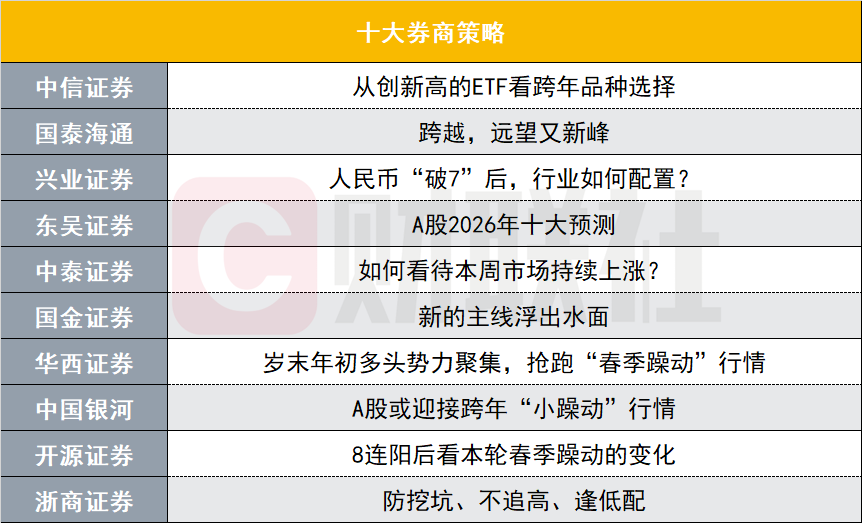
十大券商一周策略:A股跨年行情启动,人民币汇率与春季躁动行情有望共振,新主线浮出水面
Jin Rong Jie· 2025-12-28 23:58
Group 1 - The market is expected to maintain structural opportunities driven by liquidity easing, policy expectations, and a strengthening yuan, with consensus on sectors like technology manufacturing, resource products, and beneficiaries of yuan appreciation [1][4][5] - A total of 39 out of 360 industry/theme ETFs reached new highs in December, with established sectors like telecommunications and non-ferrous metals leading, alongside emerging sectors like commercial aerospace [2][3] - The focus remains on sectors with low heat and high long-term ROE potential, such as chemicals, engineering machinery, and new industries like commercial aerospace, while also tracking the trend of yuan appreciation [3][4] Group 2 - The spring market conditions remain favorable, supported by liquidity and investor expectations, with a potential for volatility in early 2026 due to upcoming events like the Spring Festival and the Two Sessions [4][10] - The yuan's appreciation is expected to enhance domestic purchasing power and attract foreign capital back to Chinese assets, creating significant potential for asset revaluation [5][6] - Key sectors to watch include AI investments, global manufacturing recovery, and consumer sectors benefiting from increased domestic demand, such as aviation, hotels, and food and beverage [9][11][12] Group 3 - The current market is characterized by a lack of clear bull market signals, but the foundation remains solid with improving fundamentals and capital inflows [7][12] - The market is likely to experience a structural and rapid rotation of sectors, with a focus on technology themes and non-bank financial sectors [16][15] - The upcoming spring market is anticipated to show upward momentum, with opportunities for low-positioning strategies and sector switching rather than aggressive trend-following [16][14]
跨越2025 年终行情能否连涨收官?请看本周十大券商策略
智通财经网· 2025-12-28 23:37
Core Viewpoint - The Chinese stock market is experiencing a positive trend as it approaches the end of 2025, with significant movements in various sectors and a focus on potential investment opportunities for 2026 [1][30]. Group 1: Market Trends and Predictions - The Shanghai Composite Index has achieved an "eight consecutive days of gains" [1]. - The total scale of Chinese ETFs has surpassed 6 trillion, setting a new historical high [1]. - Major brokerages have provided insights on market trends, with predictions for 2026 focusing on sectors that may dominate [2][5][13]. Group 2: Sector Analysis - Citic Securities highlights that 39 out of 360 industry/theme ETFs reached new highs in December, with a focus on telecommunications, non-ferrous metals, and commercial aerospace as key sectors [3]. - Industry sectors such as chemicals, engineering machinery, and new energy are expected to see increased attention and potential growth due to their long-term return on equity (ROE) improvement [4]. - Guotai Junan emphasizes the importance of capital markets in driving social confidence and investment, marking a shift from traditional investment methods to more capital-intensive approaches [5]. Group 3: Currency and Economic Factors - The recent appreciation of the Renminbi is attributed to a weaker US dollar and seasonal capital inflows, which may support the Chinese stock market [9][30]. - The potential for a significant influx of capital back into China is anticipated, driven by the reversal of previous trends in currency valuation and investment sentiment [9][10]. - The structural transformation of the Chinese economy is expected to reduce uncertainty and enhance investment opportunities, particularly in technology and manufacturing sectors [7][24]. Group 4: Investment Strategies - Investment strategies are shifting towards sectors that benefit from the current economic environment, including AI hardware, renewable energy, and consumer services [19][31]. - Brokers suggest focusing on thematic trading opportunities in sectors like robotics, commercial aerospace, and healthcare, which are expected to gain traction in the upcoming year [19][31]. - The market is advised to adopt a cautious approach, emphasizing low-cost entry points and avoiding high-risk positions as the market stabilizes [35][36].



上行趋势稳固,收官红盘可期
Orient Securities· 2025-12-28 23:30
Core Viewpoints - The market is expected to experience a stable upward trend, with a potential for a red closing in the upcoming trading days despite minor fluctuations [3][10][15] Industry Comparison - The market has shown a consistent expectation for a rally in technology and dividend stocks since March 2023, indicating that the investment opportunities are shifting towards mid-cap blue-chip stocks after a four-year lull [4][16] Industry Allocation - Investment opportunities are identified in mid-risk stocks across three main lines: 1) The cyclical sector is undergoing a revaluation due to technological empowerment and supply constraints, with a focus on new materials, chemicals, metals, and agricultural products [5][17] 2) The consumer sector, which has been stagnant for years, is at a turning point with generally undervalued stocks and supply contraction, suggesting potential price increases [5][17] 3) The manufacturing sector is transitioning from mere "story speculation" to validating "orders and revenues," with attention on communication, electronics, power equipment, and machinery that show performance verification expectations [5][17] Thematic Investments - Key areas of focus include: - Aerospace satellites, which are becoming a short-term market focal point, with potential for increased volatility and significant IPO progress in satellite networks and commercial rockets [6][18] - Price increases in upstream sectors, driven by supply contraction and structural demand growth, particularly in non-ferrous metals and new energy industries [6][18] - Artificial intelligence, which has shown rotation across various segments but with lower-than-expected intensity, suggesting a need for continued monitoring [6][18] - Nuclear fusion, which is moving from theoretical research to engineering practice, indicating a potential for significant investment demand as commercialization progresses [6][18] Semiconductor Expansion and Domestic Substitution - Domestic wafer fabs are expected to expand production next year, and the capitalization processes of major domestic memory chip manufacturers are advancing, highlighting opportunities in domestic chip manufacturers and semiconductor materials [7][19] Solid-State Batteries - The solid-state battery sector has seen prolonged adjustments, but potential industry catalysts may emerge in the first quarter, warranting attention on the solid-state battery supply chain [7][19]
十大券商一周策略:A股跨年行情已经启动,新的主线浮出水面
Zheng Quan Shi Bao· 2025-12-28 22:47
Group 1 - The core viewpoint is that the A-share market is experiencing a cross-year rally, driven by liquidity and positive policy expectations, with a focus on sectors like AI, commercial aerospace, and materials [9][10][11] - 39 out of 360 industry/theme ETFs reached new highs in December, with established sectors like telecommunications and non-ferrous metals leading, while new sectors like commercial aerospace are gaining traction [1] - The market consensus is shifting towards sectors representing competition in next-generation infrastructure between China and the US, with a focus on manufacturing and pricing power in the global market [1][2] Group 2 - The strategy emphasizes structural opportunities in a volatile market, with a preference for sectors with low concentration but rising attention and long-term ROE potential, such as chemicals and engineering machinery [2] - The outlook for the RMB is positive, with expectations of appreciation driven by improved domestic conditions and external factors, which could lead to significant capital inflows and asset revaluation [4][5] - The spring market is expected to benefit from favorable conditions, including liquidity support and upcoming policy events, with a focus on technology and cyclical sectors [3][10][12] Group 3 - The investment focus is on sectors that benefit from RMB appreciation, such as those with high import material dependency and those that can leverage increased domestic purchasing power [5] - The market is characterized by a structural rotation, with a focus on technology themes and sectors like commercial aerospace, nuclear power, and robotics [12][14] - The overall sentiment is optimistic, with expectations of a continued upward trend in the market leading up to the Spring Festival, supported by strong institutional buying and favorable policy expectations [11][13][14]
低空文旅产业发展趋势报告会举行
Sou Hu Cai Jing· 2025-12-28 19:43
Core Insights - The conference on the development trends of the low-altitude cultural tourism industry was held in Guangzhou, highlighting the natural advantages of the city in developing the low-altitude economy [1] - The integration of low-altitude and cultural tourism is seen as a new approach to enhance tourism dimensions and consumer experiences, while also fostering new productive forces and modern industrial systems [1][3] Group 1: Development Plans - Guangzhou aims to establish a comprehensive low-altitude take-off and landing facility system by 2030, including 10 low-altitude take-off and landing bases, 100 take-off sites, and 1,000 take-off points [1] - The city is focusing on building a full product matrix for low-altitude aircraft and developing flight service platforms as part of its infrastructure [1] Group 2: Industry Trends - The low-altitude cultural tourism sector encompasses four core business types: sightseeing tours, sports experiences, cultural innovation, and educational science popularization [3] - New aviation technologies are expected to transform the cultural tourism industry by shifting from flat sightseeing to three-dimensional experiences, restructuring industry paradigms, and integrating night economy for "aerial scenery" [3]