军工

Search documents
欧洲要成 “桌上菜”?法国高官捅破实话:美国靠不住,中俄伊还在逼
Sou Hu Cai Jing· 2025-08-31 16:58
Group 1 - The warning from French Chief of Staff Burkhard highlights Europe's potential decline in the face of great power competition, indicating that Europe may become "table scraps" in geopolitical struggles [1] - The U.S. withdrawal from its protective role has left Europe in a state of confusion, as NATO's requirement for increased military spending to 2% of GDP puts financial pressure on European nations [3][6] - The military pressure from Russia, particularly its capabilities in Ukraine and energy leverage, poses a significant threat to European security [4][6] Group 2 - China's economic penetration through initiatives like the Belt and Road has raised concerns about Europe's industrial competitiveness and political decision-making [4] - The threats from North Korea and Iran further complicate Europe's security landscape, with North Korea gaining modern warfare experience and Iran's actions destabilizing energy routes [4] - Europe's internal fragmentation, characterized by defense system incompatibility and rising far-right political movements, exacerbates its vulnerability in the face of external challenges [5][6] Group 3 - The metaphor by Blinken, "not at the table, then on the menu," encapsulates Europe's diminishing role as a rule-maker and its current precarious position [8] - To regain agency, Europe must shift from reliance on U.S. military support to investing in its own defense industry and seek cooperation in areas like climate change and global governance [8] - The decline of Europe serves as a reminder that no power is permanent, and without a transition to strategic autonomy and internal unity, the warnings of Burkhard may materialize [8]

A股9月投资策略来了!机构建议这样布局
Zhong Guo Zheng Quan Bao· 2025-08-31 14:44
Group 1: Market Trends - A-shares continue to show an upward trend with sectors like telecommunications and electronics leading the gains, while the metals sector performs well among cyclical stocks [1] - The market is expected to exhibit a phase of consolidation with rotating hotspots, focusing on resource sectors, innovative pharmaceuticals, consumer electronics, chemicals, gaming, and military industries [1][5][6] Group 2: Economic Indicators - The manufacturing PMI for August is reported at 49.4%, a slight increase of 0.1 percentage points from July, indicating an improvement in manufacturing sentiment [3] - The main raw material purchase price index and factory price index for August are 53.3% and 49.1%, respectively, both showing a month-on-month increase, suggesting a continued improvement in market price levels [3] Group 3: Investment Strategies - Central Huijin increased holdings in 12 ETF products in the first half of the year, indicating a stable investment strategy in the ETF market [4] - Investment recommendations include focusing on sectors benefiting from domestic "anti-involution," such as industrial metals, raw materials, and capital goods, as well as insurance and brokerage sectors [7] - The market is expected to remain active with a focus on structural allocation opportunities, particularly in technology growth sectors that have not been fully explored [6][8]
股票策略私募连续三周加仓管理人瞄准新成长板块
Shang Hai Zheng Quan Bao· 2025-08-31 14:15
Core Insights - The stock private equity positions have increased for three consecutive weeks, with the stock private equity position index reaching 75.55% as of August 22, marking a 0.69 percentage point increase from the previous week [1][2] - The index has shown a significant upward trend since August, with a cumulative increase of 1.62 percentage points [2] - 55.29% of stock private equity positions are at full capacity (over 80% allocation), indicating strong confidence in the market [2] Investment Focus - Private equity firms are focusing on emerging growth sectors such as new consumption and technology [6] - Specific areas of interest include robotics, domestic computing power, AI applications, liquid cooling, and military industry sectors, as well as new consumption and media sectors with strong half-year performance [7] - The innovative drug sector is also gaining attention due to benefits from overseas licensing and domestic market expansion [7] Market Sentiment - The high positions reflect optimism among top private equity firms regarding the Chinese economy and market liquidity [5] - The current stock market risk premium remains high, suggesting that the stock market offers attractive value [5] - There is an expectation of a new upward cycle in the market as corporate earnings are anticipated to rebound due to supportive policies and a reversal of the downward trend in profitability [5] Scale Analysis - Among private equity firms, those managing over 50 billion yuan have high positions, with over 50% at full capacity [1][3] - The position index for large private equity firms (over 100 billion yuan) is 78.11%, while those in the 50-100 billion yuan range have a position index of 82.23%, with a notable increase of 3.55 percentage points for the latter [3][4] - A significant portion of these firms, 69.18% in the 50-100 billion yuan range, are fully invested, indicating strong market confidence [3] Strategic Opportunities - The focus on high-end manufacturing and internet sectors is driven by the presence of globally competitive Chinese companies, which are expected to see value reassessment [7] - The trend of Chinese companies expanding overseas is shifting from manufacturing to service sectors, highlighting opportunities in the consumer entertainment industry [7] - Technological advancements in chip design, manufacturing, and AI capabilities are expected to create numerous investment opportunities [7]
国泰海通 · 晨报0901|宏观、策略、海外策略、化妆品
国泰海通证券研究· 2025-08-31 13:59
Macro Analysis - The increase in tariffs has only raised the average U.S. import tax rate by 6.6 percentage points as of June 2024, which is lower than market expectations. The low proportion of taxable goods and changes in import structure are key reasons for this outcome [2][3] - U.S. companies are currently bearing approximately 63% of the tariff costs, while consumers are responsible for less than 40%. This cost distribution may change as inventory is depleted and trade policy uncertainties decrease [3] - If the average U.S. import tax rate rises by 10% within the year, it could push the PCE year-on-year growth rate to 3.1% and the core PCE to 3.4%, assuming stable demand [3] Market Strategy - The Chinese stock market is expected to continue rising, with the index likely to reach new highs. Factors supporting this outlook include accelerated economic transformation, declining risk-free interest rates, and capital market reforms [6][7] - There is an anticipated expansion in market trends, with increased allocations towards mid-cap stocks and undervalued blue-chip stocks. The improvement in traditional industries and a focus on domestic demand are also contributing to this positive outlook [8][9] Industry Comparison - Emerging technology is seen as a primary investment focus, while cyclical financial sectors are viewed as potential dark horses. The Hong Kong stock market is expected to rebound [9][10] - Recommendations include sectors such as AI applications, consumer goods, and high-end equipment, with a particular emphasis on companies benefiting from technological upgrades and policy support [10] Foreign Investment Trends - Following the Fed's shift towards rate cuts, foreign capital may return to Hong Kong stocks, which have seen a historical low in foreign investment allocation. Recent signs indicate a potential stabilization in foreign capital flows [13][14] - Foreign investment preferences in Hong Kong are heavily weighted towards technology and financial sectors, with a notable focus on companies with strong fundamentals and profitability [14][15] Investment Recommendations - The beauty and personal care sector is expected to see significant growth, with a recommendation for selective investment in companies demonstrating product and channel innovation [17][18] - The first half of 2025 showed a revenue increase of 7.2% and a net profit growth of 1.9% in the beauty sector, with personal care outperforming cosmetics and medical aesthetics [18][19]

特朗普最终还是失算了,中方一年前的布局,就把美国后路堵死
Sou Hu Cai Jing· 2025-08-31 11:59
Group 1 - The Trump administration's attempts to engage with China have not resulted in concessions regarding rare earths, leaving the U.S. with no room to maneuver [1][3] - China controls 90% of global rare earth refining capacity, highlighting the strategic importance of these resources in the ongoing U.S.-China trade conflict [3][13] - The U.S. has faced significant economic repercussions from tariffs, with American farmers and companies like Walmart and Tesla feeling the impact of increased costs [3][5] Group 2 - Following a recent phone call with China, the U.S. Treasury refrained from labeling China as a "currency manipulator," indicating a potential thaw in relations [5][24] - The U.S. has escalated restrictions on AI chip exports and Huawei, despite a trade agreement that aimed to reduce tariffs [7][26] - China's recent export restrictions on heavy rare earths are a strategic move to leverage its dominance in the sector, affecting U.S. high-tech industries reliant on these materials [9][15] Group 3 - The U.S. automotive and defense industries are heavily dependent on rare earths, with potential supply disruptions posing serious risks to production [15][18] - China is enhancing its control over rare earth exports through stricter monitoring and regulation, aiming to eliminate illegal activities and ensure a stable market [17][18] - China's diplomatic efforts to strengthen ties with regions like ASEAN and Latin America are part of a strategy to create alternative supply chains, undermining U.S. tariff strategies [20][22] Group 4 - The U.S. appears to be in a precarious position, as China's firm stance on rare earths has left American policymakers reconsidering their approach [24][28] - The ongoing trade conflict underscores the fragility of global supply chains and the critical role of rare earths in future economic stability [28]

9月3日那天,更是资本博弈!全球资金下注,但在中国却无人在意?
Sou Hu Cai Jing· 2025-08-31 10:27
Group 1 - Capital is increasingly seeking safety and profitability, with historical trends showing that during global turmoil, such as the Russia-Ukraine conflict, capital flows rapidly to perceived safe havens like the US [1][3] - The Federal Reserve is expected to end its interest rate hike cycle and shift towards rate cuts, which may lead to a decline in returns on US dollar assets, prompting capital to seek undervalued opportunities in other markets, particularly in China [3][10] - The Chinese stock market is currently experiencing significant foreign capital inflows, with net inflows reaching $27 billion in July and $426 million in August, indicating a growing interest from international investors [10][16] Group 2 - The upcoming military parade in China is seen as a demonstration of national stability and security, which is attractive to international capital amid global uncertainties [6][19] - Goldman Sachs reported that hedge funds are rapidly increasing their investments in Chinese stocks, with the allocation to China by global mutual funds rising to 6.6%, suggesting room for further growth [8][10] - The valuation of Chinese assets is appealing compared to US assets, with the price-to-earnings ratio of the Shanghai Composite Index at 11, significantly lower than the S&P 500's 24, indicating a potential investment opportunity [14][16] Group 3 - The stability of the Chinese yuan around 7.18 and the government's proactive measures to support the stock market are contributing to China's perception as a "safe haven" for capital [16] - The geopolitical landscape is influencing capital flows, with Japan's diplomatic efforts to undermine China's military display being largely ignored by Southeast Asian nations, highlighting China's growing influence [17][19] - The shift in capital preferences is evident as investors reassess their strategies in light of declining returns on US assets and the relative stability and growth potential in China [19]

9月投资策略:关注资源、创新药与消费电子
Xin Lang Cai Jing· 2025-08-31 09:59
Group 1: Economic Events and Market Impact - The potential interest rate cut by the Federal Reserve may weaken the dollar, providing new momentum for the resource market, particularly precious metals and copper [1] - The geopolitical complexities and resource control by countries, such as cobalt in the Democratic Republic of Congo and nickel in Indonesia, are leading to a reassessment of the value of scarce resources [1] Group 2: Consumer Electronics and AI - Apple's upcoming fall event is expected to showcase advancements in edge AI technology, which may drive demand growth across the entire supply chain [2] - Meta's release of AR glasses could introduce new development directions for the industry, despite the current lack of widespread application scenarios [2] Group 3: Industry Trends and Investment Opportunities - Industries with significant capital expenditure over the past two years, such as power semiconductors and electrolytes, are showing signs of marginal reduction and may have substantial upside potential [2] - The military industry is expected to enhance expectations for China's military trade exports, with China's arms exports holding a 5.8% share of the global market [3] - The innovative drug sector is anticipated to see an increase in catalytic events, with potential investment value re-emerging as the market shifts focus [3] Group 4: Investment Recommendations - Investors are advised to concentrate their investments in sectors such as resources, innovative drugs, consumer electronics, chemicals, gaming, and military, which show strong development trends and profit realization potential [3] - Consideration of related ETF products, such as those focused on non-ferrous metals, rare metals, and innovative drugs, is recommended for portfolio diversification and risk control [3]
机构论后市丨9月配置继续聚焦创新药、消费电子等行业;中报有望继续催化非银表现
Di Yi Cai Jing· 2025-08-31 09:45
Group 1 - The consumer electronics sector, particularly the Apple supply chain, is gaining attention due to upcoming product launches from Apple and META [1] - Citic Securities suggests focusing on resources, innovative pharmaceuticals, consumer electronics, chemicals, gaming, and military industries for September investments [1] - The potential for a weaker dollar due to possible Federal Reserve rate cuts may catalyze a new round of growth in resource commodities, especially precious metals and copper [1] Group 2 - Guotai Junan Securities indicates a market shift from small-cap to large-cap stocks, with a focus on sectors benefiting from domestic "anti-involution" and overseas manufacturing recovery [2] - Recommended sectors include industrial metals, raw materials, and capital goods, as well as insurance and brokerage firms benefiting from improved capital returns [2] - The market is expected to see opportunities in consumer-related sectors as profitability improves, with a broadening of market styles underway [2] Group 3 - Minsheng Securities highlights that the market's positive sentiment is supported by proactive fiscal policies and moderately loose monetary policies, which are expected to sustain high trading volumes [3] - The insurance sector is anticipated to benefit from lower liability costs due to a new round of interest rate adjustments, enhancing equity allocations [3] - Brokerage firms are projected to continue their performance recovery trend into 2025, supported by a stable capital market and high trading activity [3]


中信证券:9月配置继续聚焦资源、创新药、消费电子、化工、游戏和军工
Xin Lang Cai Jing· 2025-08-31 08:41
Core Insights - The report highlights key events and investment clues to watch in September, particularly focusing on the potential interest rate cuts by the Federal Reserve, which may strengthen the weak dollar environment and catalyze resource commodities, especially precious metals and copper [1] - The upcoming product launches from Apple and META are expected to drive a new wave of sustainable trends in edge devices and AI ecosystems, with a particular emphasis on the consumer electronics sector, especially the Apple supply chain [1] - The report identifies three lines of clues regarding the trend of "anti-involution," including industries with high capital expenditure intensity showing signs of marginal reduction, sectors demonstrating industry self-discipline or policy implementation, and industries that rely on quotas to continuously enhance profit margins [1] - An increase in innovative drug catalysts is anticipated in September, with recent technology shifts clearing out short-term speculative investments, suggesting that innovative drugs may continue to rise after this adjustment [1] - The report recommends focusing on resource sectors, innovative drugs, consumer electronics, chemicals, gaming, and military industries for investment in September [1]

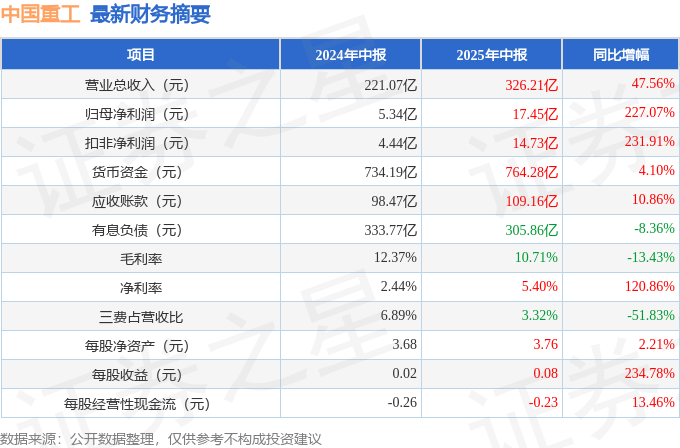
中国重工2025年中报简析:营收净利润同比双双增长,公司应收账款体量较大
Zheng Quan Zhi Xing· 2025-08-30 23:24
Core Viewpoint - China Shipbuilding Industry Corporation (China Heavy Industry) reported strong financial performance for the first half of 2025, with significant increases in revenue and net profit compared to the previous year [1]. Financial Performance - Total revenue for the first half of 2025 reached 32.621 billion yuan, a year-on-year increase of 47.56% [1]. - Net profit attributable to shareholders was 1.745 billion yuan, up 227.07% year-on-year [1]. - In Q2 2025, total revenue was 20.405 billion yuan, reflecting a 70.93% increase year-on-year, while net profit for the quarter was 1.226 billion yuan, up 208.3% [1]. - The gross margin was 10.71%, down 13.43% year-on-year, while the net margin improved to 5.4%, an increase of 120.86% [1]. - Total operating expenses (selling, administrative, and financial) amounted to 1.083 billion yuan, which is 3.32% of revenue, down 51.83% year-on-year [1]. Balance Sheet and Cash Flow - Cash and cash equivalents increased to 76.428 billion yuan, a 4.10% rise from the previous year [1]. - Accounts receivable grew to 10.916 billion yuan, a 10.86% increase, with accounts receivable to net profit ratio reaching 832.89% [1][3]. - Interest-bearing debt decreased to 30.586 billion yuan, down 8.36% year-on-year [1]. Investment Metrics - Earnings per share (EPS) rose to 0.08 yuan, a significant increase of 234.78% year-on-year [1]. - The company has a historical median Return on Invested Capital (ROIC) of -0.94% over the past decade, indicating poor investment returns [1]. Market Sentiment and Fund Holdings - Several funds have increased their holdings in China Heavy Industry, with the largest being Guotai CSI Military ETF, holding 132.283 million shares [4]. - The fund's net asset value increased by 0.76% on August 29, with a 57.42% rise over the past year [4].