消费

Search documents
1月资产配置月度报告:跨年行情多点开花,外需韧性超预期
Sou Hu Cai Jing· 2026-01-13 02:57
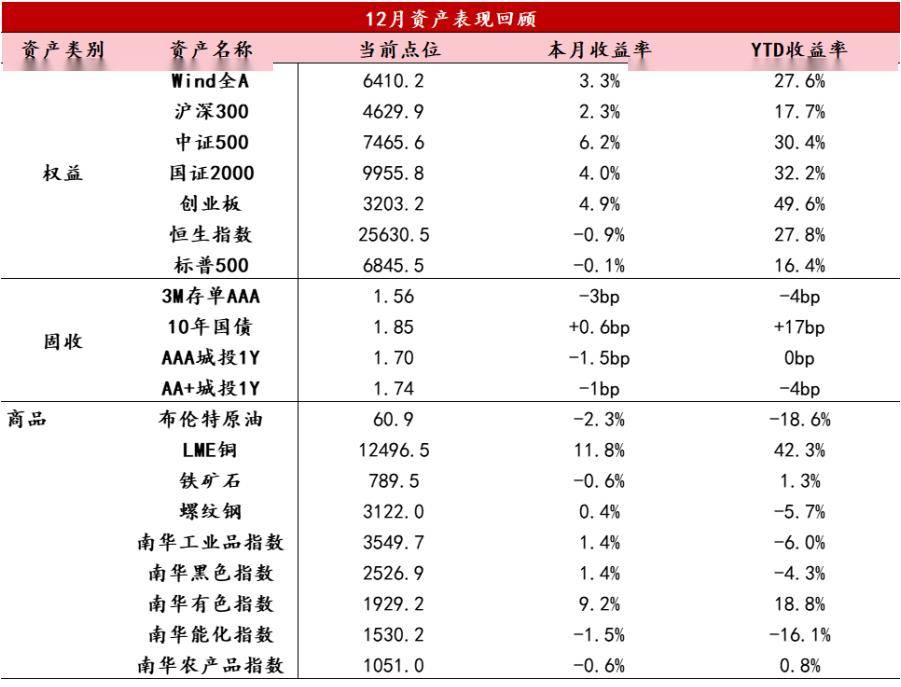
Stock Market Overview - In December, the Federal Reserve's interest rate cut was implemented as expected, leading to fluctuations in future rate cut expectations, while the Nasdaq index experienced volatility [1] - The A-share market showed overall fluctuations, with the Shanghai Composite Index achieving 11 consecutive gains by the end of the month, driven by a positive tone from the Central Economic Work Conference and a declining US dollar index [1] - The Wind All A index recorded a +3.3% increase for the month, with 60% of the Shenwan first-level industries rising, particularly strong performances in defense and military (+17.22%) and non-ferrous metals (+13.68%) [1] Bond Market Overview - The bond market continued to experience wide fluctuations in December, with increased yield volatility and a steeper curve [2] - Despite relatively ample liquidity and the central bank's resumption of bond purchases providing some support, concerns over long-term bond supply and other factors kept the market in a weak oscillation pattern [2] - The 10-year government bond yield ended the month at 1.85%, reflecting an N-shaped trend throughout December [2] Commodity Market Overview - The commodity market showed a bullish atmosphere in December, with precious metals and non-ferrous sectors being the strongest performers [3] - Gold prices fluctuated, with London gold closing at $4318.25 per ounce, up 2.36% from the previous month, while copper prices also saw significant increases [3] - The oil market experienced a downward trend, with Brent crude oil closing at $60.91 per barrel, down 2.26% for the month [3] Macroeconomic Performance - In November, China's exports demonstrated strong resilience, growing by 5.9% year-on-year, driven by a significant increase in machinery and high-tech product exports [5] - However, domestic consumption remained weak, with retail sales growth slowing to 0.3% year-on-year, indicating structural constraints on internal demand [5] - Fixed asset investment continued to decline, with real estate investment adjustments dragging down overall figures, highlighting the challenges in achieving self-sustaining growth [5] Policy Outlook - The Central Economic Work Conference set the tone for macroeconomic policy in 2026, focusing on addressing the structural imbalance of "strong supply and weak demand" [9] - The strategic shift will prioritize investment in human capital and social welfare, aiming to enhance income levels and consumer demand [9] - Fiscal policy is expected to maintain a more active stance, with a nominal deficit rate targeted around 4.0%, while monetary policy will shift focus from total volume to price stability [10][11] Asset Allocation Analysis - In December, net buying in the stock market rebounded to over 2.5 trillion yuan, with significant inflows into equity ETFs [14] - The manufacturing PMI showed a seasonal rebound, indicating improved trade conditions and proactive inventory preparations by companies [15] - Looking ahead to 2026, the market is expected to experience structural trends, with a focus on sectors that demonstrate sustainable performance and profitability [16]

一批港股公司预告2025年业绩 黄金医药等板块报喜
Shang Hai Zheng Quan Bao· 2026-01-12 18:36
Core Viewpoint - Nearly 20 Hong Kong-listed companies have announced their performance forecasts for the year ending December 31, 2025, with 11 companies expecting profit increases, 2 companies anticipating reduced losses, and 1 company projecting a turnaround to profitability [1] Group 1: Gold Mining Sector - Gold mining companies are showing strong performance, driven by rising gold prices and increased production capacity [2] - Lingbao Gold expects a net profit of 1.503 billion to 1.573 billion RMB for 2025, representing a year-on-year growth of 115% to 125%, attributed to optimized production and increased gold output [2] - Zijin Mining International anticipates a net profit of 1.5 billion to 1.6 billion USD for 2025, with a growth of 212% to 233%, driven by higher gold sales prices and profitable acquisitions [2] - Zijin Mining's parent company, Zijin Mining Group, forecasts a net profit of 51 billion to 52 billion RMB for 2025, reflecting a growth of 59% to 62% [3] - Chifeng Jilong Gold expects a net profit of 3 billion to 3.2 billion RMB for 2025, with a growth of 70% to 81%, due to increased gold production and higher sales prices [3] - Multiple gold mining companies are benefiting from a rising gold price cycle, achieving both volume and price increases [4] Group 2: Biopharmaceutical and Consumer Sectors - The biopharmaceutical and consumer sectors also have companies projecting strong performance for 2025 [5] - WuXi AppTec expects an adjusted net profit of 14.957 billion RMB for 2025, a year-on-year increase of approximately 41.33%, driven by its integrated CRDMO business model [5] - Biotech company Baidu Bio expects a non-GAAP net profit of approximately 80.273 million RMB for 2025, reflecting a growth of about 249.50%, supported by strong R&D capabilities and market expansion [5] - Yadea Holdings anticipates a net profit of no less than 2.9 billion RMB for 2025, doubling from 1.27 billion RMB in 2024, due to increased sales of electric two-wheelers [5] Group 3: Operational Efficiency and Growth - Many Hong Kong-listed companies are achieving performance growth through improved operational efficiency and increased product sales [7] - China Shipbuilding Defense expects a net profit of 940 million to 1.12 billion RMB for 2025, with a growth of 149.61% to 196.88%, driven by increased revenue and improved production efficiency [7] - Kinglong Permanent Magnet anticipates a net profit of 660 million to 760 million RMB for 2025, reflecting a growth of 127% to 161%, due to record high production and sales [7] - Sanhua Intelligent Controls expects a net profit of 3.874 billion to 4.649 billion RMB for 2025, with a growth of 25% to 50%, supported by its leading position in the automotive thermal management sector [8]






全球资产配置资金流向月报(2026年1月)-20260112
Shenwan Hongyuan Securities· 2026-01-12 14:42
Group 1: Seasonal Capital Inflows - In January, significant seasonal inflows of global capital into Chinese equity markets (including A-shares, H-shares, and Chinese concept stocks) are expected, with a historical probability of 76% for the Hang Seng Index to have a positive annual return if inflows are positive[12] - Since 2000, global capital typically experiences a significant inflow into Hong Kong local stocks in January after marginal outflows in December[10] - In December 2025, the inflow into the Chinese equity market reached $177.6 billion, while the inflow into the emerging market bond market was $177.7 billion[26] Group 2: Global Asset Flow Overview - As of December 31, 2025, the relative inflow ratio for Chinese fixed-income funds reached 11.2%, leading other markets, while equity funds saw a 1.3% inflow, also leading other major markets[23] - In December, the U.S. equity market saw inflows of $778.8 billion, while emerging markets experienced inflows of $339.5 billion[19] - The inflow into the U.S. fixed-income market was substantial, with $391.3 billion in December, indicating a preference for U.S. assets[19] Group 3: Fund Type Analysis - In December, passive equity funds accounted for a significant portion of inflows into emerging markets, with $347 billion, although this was a decrease from $424 billion in November[60] - Active equity funds saw outflows of $7 billion in emerging markets, with China experiencing a $5 billion outflow in December[60] - The inflow into Chinese fixed-income markets was $178 billion in December, representing 68% of the total inflow into emerging market bonds[57]
韧性筑基,提质绘新:银河基金2026年度策略会精华观点来了
Sou Hu Cai Jing· 2026-01-12 07:20
Macro Economy - In 2025, China's consumer market showed a moderate recovery, with a retail sales growth of 4.0% year-on-year from January to November, although there was a decline in consumption in categories like home appliances and automobiles in the second half due to subsidy reductions and real estate adjustments [1] - The "14th Five-Year Plan" emphasizes economic development and aims for per capita GDP to reach the level of moderately developed countries by 2035, while also focusing on local development and the integration of technological and industrial innovation [1] Real Estate and Trade - Since mid-2025, there has been downward pressure on real estate transaction volumes, with a 26.6% year-on-year decline in transaction area and a 24.65% drop in transaction units in 30 major cities as of October [2] - Despite challenges in the real estate sector, foreign trade has shown resilience, with a 5.4% year-on-year increase in goods exports from January to November, and net exports exceeding 1 trillion USD [2] Technology Sector - In 2025, AI applications achieved significant scale, with a reduction in the "hallucination rate" of a popular AI model from 14% to 2% by the end of the year, leading to a surge in consumer applications [3] - By the end of 2025, global investment in Chinese assets through ETFs reached 831 billion USD, with 95 billion USD flowing into the technology sector, highlighting its importance for foreign investment [3] Semiconductor and AI - The semiconductor, communication, and robotics sectors performed well in 2025, with respective index increases of 127.57%, 45.93%, and 26.33%, driven by rising AI capital expenditures in North America and breakthroughs in domestic supply chains [4] - The AI sector is expected to transition into a monetization phase in 2026, with advancements in semiconductor technology and a focus on cost-effectiveness in the AI industry chain [4] New Energy Sector - The new energy sector in 2025 focused on energy storage and AIDC electrical equipment, with solid-state battery pilot lines and structural optimization in the photovoltaic industry driving temporary price increases [4] - Expectations for 2026 include the solid-state battery reaching a production inflection point [4] Commodities Sector - The non-ferrous metals sector saw an overall increase of 88.50% in 2025, supported by factors such as the Federal Reserve's interest rate cuts and supply chain disruptions [5] - The relationship between AI, new energy, and commodities is highlighted, with predictions of significant shortages in copper and lithium by 2035 [5] Consumer Sector - The consumer sector showed notable improvement in 2025, with a focus on "emotional consumption" and "brand overseas expansion," particularly in domestic appliances and electric vehicles [6] - The consumption sector is characterized by a "hot first half and a quiet second half," with a focus on channel transformation and community-oriented products [6] Pharmaceutical Sector - The pharmaceutical industry is expected to experience structural differentiation and value reassessment in 2026, focusing on innovation, international expansion, and policy reforms [7] - Significant breakthroughs in AI applications in healthcare are anticipated, including AI-assisted diagnostics and clinical transformations [7]
国泰海通证券开放式基金周报(20260111):均衡风格配置,重视科技、非银、消费-20260111
GUOTAI HAITONG SECURITIES· 2026-01-11 14:54
Report Industry Investment Rating The document does not provide a specific industry investment rating. Core Viewpoints of the Report - Future investment strategy suggests balanced style allocation, emphasizing technology, non - banking, and consumption sectors. For stock funds, A - share market may have a spring "good start" with policy expectations, liquidity, and fundamentals improving. For bond funds, short - term negative factors are repaired, but mid - term structural optimization is incomplete. Money funds have no trend investment opportunities in the long - term low - interest environment [3][4]. - Last week, the A - share market continued its upward trend and had a good start, with satellite, AI application, and non - ferrous sectors performing well. The bond market declined, the US stock market reached a new high, and oil and gold prices rose due to geopolitical risks. Funds heavily invested in medical, semiconductor, and military sectors performed well [4][6][7]. Summary by Related Catalogs 1. Last Week's Market Review - **A - share Market**: Continued the upward trend and had a good start during 20260105 - 20260111. Satellite, AI application, and non - ferrous sectors were strong. The satellite sector's popularity and IPO benefits drove the military sector; AI company listings on the Hong Kong Stock Exchange boosted the AI application sector; the US military action in Venezuela affected non - ferrous metal supply and pushed up the sector. The Shanghai Composite Index rose 3.82% to 4120.43, and the Shenzhen Component Index rose 4.40% to 14120.15. The trading volume was 14.13 trillion yuan, with a daily average increase of about 1.56 trillion yuan compared to the previous week. Among industries, defense, media, non - ferrous, computer, and medical sectors led the increase [4][6][7]. - **Bond Market**: Declined as the strong A - share market suppressed it. The 1 - year Treasury yield dropped 5BP to 1.29%, and the 10 - year Treasury yield rose 3BP to 1.88%. Credit spreads narrowed. The ChinaBond Aggregate Net Price Index fell 0.24%, while the CSI Convertible Bond Index rose 4.45% [4][8]. - **Overseas Market**: The US stock market reached a new high, with the Dow Jones Industrial Average rising 2.32%, the S&P 500 rising 1.57%, and the Nasdaq rising 1.88%. European and most Asian markets also rose, except for the Hang Seng Index which fell 0.41%. The US dollar index rose 0.69%. Geopolitical risks from the US military action in Venezuela increased oil and gold prices [4][9]. 2. Last Week's Fund Market Review - **Stock Funds**: Rose 4.92%. Some funds heavily invested in medical, semiconductor, and military sectors performed well. Index funds related to satellite, semiconductor, and media themes did well [4][10][11]. - **Bond Funds**: Rose 0.29%. Partial - debt funds and convertible bond funds with semiconductor and computer in their equity allocation performed well. Among pure - debt funds, those mainly investing in high - grade credit bonds and medium - short - term bonds did better [4][10][11]. - **QDII Funds**: Equity QDII funds rose 2.62%, with funds mainly investing in medicine and semiconductor themes performing well. QDII bond funds rose 0.10% [4][10][12]. - **Money Funds**: Had an annualized yield of 1.58%. Different types of摊余成本法债 funds had different yields [11]. - **Gold ETF and Linked Funds**: Rose 2.85%. Commodity funds rose 2.64% [13]. 3. Future Investment Strategy - **Stock Market**: Policy expectations, liquidity, and fundamentals are expected to improve, and the A - share market may have a spring "good start". Industries with good prospects are technology, non - banking, and consumption. It is recommended to have a balanced style allocation and focus on these sectors [4][14][15]. - **Bond Market**: Short - term negative factors are repaired, but mid - term structural optimization is incomplete. It is recommended to focus on interest - rate bonds with flexible durations and products that mainly invest in high - grade and highly liquid credit bonds [4][15]. - **Money Market**: There are no trend investment opportunities in the long - term low - interest environment [4][15]. - **Commodity Market**: It is advisable to appropriately allocate gold ETFs for long - term and hedging investments [15]. 4. Latest Fund Market Developments - **QDII Quota**: Under the background of promoting inclusive finance, QDII quotas should be more used in public - offering products. Fund companies need to adjust the proportion of QDII quotas used in public - offering and private - placement products, reducing the private - placement quota ratio to within 20% by the end of 2027 and completing at least half of the adjustment by the end of 2026 [17]. - **Fund Sales Fee Regulations**: The official version of the regulations relaxes the redemption fee constraints for bond funds and fine - tunes the subscription and purchase fees. Bond ETFs may become important tools for liquidity management and trading by wealth management institutions. Wealth management funds may gradually increase their allocation to equity funds, with broad - based index funds and low - volatility "fixed - income +" products being more popular [18]. - **Newly Issued Funds**: 11 new funds were established last week, including 3 low - position ordinary FOF funds, 2 strong - equity hybrid funds, 2 stock ETFs, etc. The average subscription days were about 12 days, and the average raised share was 7.45 billion, with a total of 81.91 billion shares [19]. - **Upcoming Fund Dividends**: 99 funds will conduct equity registration in the coming week. The most notable is the Chang Sheng Aerospace and Marine Equipment A, with a dividend of 2.764 yuan per 10 shares [20].
资金出现哪些新信号?
Hu Xiu· 2026-01-11 10:40
Group 1 - The A-share market saw a significant surge with the Shanghai Composite Index breaking the 4100-point mark, indicating a strong market momentum [3] - The trading volume exceeded 3.1 trillion yuan, which is a critical threshold that may attract more follow-up capital into the market [3] - Financing balances have rapidly increased, with some brokerage firms reporting that their margin trading quotas have been fully utilized, indicating strong demand for leveraged investments [3] Group 2 - A substantial amount of capital, approximately 30 trillion yuan, is expected to be "unlocked" in 2026 as funds currently held in fixed deposits mature, which could lead to increased investments in the stock market [3] - The potential inflow of funds into the A-share market is likely to rise, as the stock market currently outperforms other asset classes [3] - The adjustment of export tax rebates for solar and battery sectors may impact the grid sector, although specific effects are yet to be fully assessed [5]
技术择时信号20260109:A股仍维持乐观信号,看好小盘收益弹性
CMS· 2026-01-11 08:17
Quantitative Models and Construction Methods 1. Model Name: DTW Timing Model - **Model Construction Idea**: The DTW timing model is based on a similarity approach, analyzing the similarity between current index trends and historical trends. It selects historical segments with high similarity as references and calculates the weighted average future returns and standard deviations of these segments to generate trading signals [20][22]. - **Model Construction Process**: 1. Use the DTW (Dynamic Time Warping) distance algorithm instead of Euclidean distance to measure similarity, as DTW is better suited for time series problems by addressing sequence misalignment issues [22]. 2. Calculate the weighted average future returns and standard deviations of selected historical segments, where weights are the inverse of the DTW distance [20]. 3. Generate trading signals based on the average future returns and standard deviations [20]. 4. To address the "pathological matching" issue in traditional DTW algorithms, improved DTW algorithms with boundary constraints (e.g., Sakoe-Chiba and Itakura Parallelogram) are applied [24][26][28]. - **Model Evaluation**: The DTW timing model demonstrates stable excess returns in general market conditions but may underperform during periods of sudden macroeconomic policy changes [9]. 2. Model Name: Foreign Capital Timing Model - **Model Construction Idea**: This model leverages information embedded in the price movements of two offshore assets related to A-shares: FTSE China A50 Index Futures (Singapore market) and the Southbound A50 ETF (Hong Kong market) [30]. - **Model Construction Process**: 1. Construct two indicators using FTSE China A50 Index Futures: basis and price divergence [30]. 2. Construct a price divergence indicator using the Southbound A50 ETF [30]. 3. Combine the timing signals from the two assets to form the foreign capital timing signal [30]. - **Model Evaluation**: The model achieves strong performance, with annualized returns of 18.96% (long-short strategy) and 14.19% (long-only strategy) over the full sample period (2014-2024). It also exhibits a high win rate (close to 55%) and a profit-loss ratio exceeding 2.5 [13]. --- Model Backtesting Results 1. DTW Timing Model - **Absolute Return**: 35.52% since November 2022 [9] - **Excess Return (relative to CSI 300)**: 8.60% [9] - **Maximum Drawdown**: 21.32% [9] 2. Foreign Capital Timing Model - **Annualized Return (Long-Short Strategy)**: 18.96% (2014-2024) [13] - **Annualized Return (Long-Only Strategy)**: 14.19% (2014-2024) [13] - **Maximum Drawdown**: 25.69% (Long-Short), 17.27% (Long-Only) [13] - **Win Rate**: Close to 55% [13] - **Profit-Loss Ratio**: Exceeds 2.5 [13] - **Absolute Return (2024)**: 31.33% (Long-Only Strategy) [17] - **Maximum Drawdown (2024)**: 8.23% [17] --- Quantitative Factors and Construction Methods 1. Factor Name: DTW Distance - **Factor Construction Idea**: DTW distance is used as a similarity measure for time series, addressing sequence misalignment issues that arise with traditional Euclidean distance [22]. - **Factor Construction Process**: 1. Compute the DTW distance between the current index trend and historical trends [22]. 2. Use the inverse of the DTW distance as weights to calculate the weighted average future returns and standard deviations of historical segments [20]. 3. Generate trading signals based on these weighted averages [20]. - **Factor Evaluation**: DTW distance is more effective for time series problems compared to Euclidean distance, as it resolves sequence misalignment and improves model performance [22]. 2. Factor Name: Basis and Price Divergence (Foreign Capital Timing Model) - **Factor Construction Idea**: These factors are derived from offshore assets to capture information about A-share market trends [30]. - **Factor Construction Process**: 1. Calculate the basis and price divergence indicators using FTSE China A50 Index Futures [30]. 2. Calculate the price divergence indicator using the Southbound A50 ETF [30]. 3. Combine these indicators to form the foreign capital timing signal [30]. - **Factor Evaluation**: These factors effectively capture offshore market signals and contribute to the strong performance of the foreign capital timing model [13]. --- Factor Backtesting Results 1. DTW Distance - **Absolute Return**: 35.52% since November 2022 [9] - **Excess Return (relative to CSI 300)**: 8.60% [9] - **Maximum Drawdown**: 21.32% [9] 2. Basis and Price Divergence - **Annualized Return (Long-Short Strategy)**: 18.96% (2014-2024) [13] - **Annualized Return (Long-Only Strategy)**: 14.19% (2014-2024) [13] - **Maximum Drawdown**: 25.69% (Long-Short), 17.27% (Long-Only) [13] - **Win Rate**: Close to 55% [13] - **Profit-Loss Ratio**: Exceeds 2.5 [13] - **Absolute Return (2024)**: 31.33% (Long-Only Strategy) [17] - **Maximum Drawdown (2024)**: 8.23% [17]
国内政策优化供给,美联储降息预期减退
Yin He Zheng Quan· 2026-01-11 08:01
Domestic Macro - Domestic policies are optimizing supply, and the synergy between growth stabilization and "anti-involution" policies is evident[1] - Consumer demand remains strong, with a 6.1% increase in travel activity, but movie box office revenues are down 9.8% compared to last year[1] - External demand shows marginal decline, with the Baltic Dry Index (BDI) dropping 21.7% to 1811.4[1] - Production intensity is stronger than previous years, with a production increase of 1.55 percentage points to 79.15%[1] Price Performance - Consumer Price Index (CPI) shows a 1.79% increase, with pork prices stabilizing and apple prices rising seasonally[2] - Producer Price Index (PPI) indicates a rebound in crude oil prices, with a 2.52% increase in WTI[2] Overseas Macro - U.S. non-farm payroll data fell short of expectations, leading to a slowdown in future interest rate cuts[1] - Employment growth is slowing but has not triggered signals of a hard landing, with a 4.4% unemployment rate[2] - Short-term interest rate cut expectations have significantly diminished[2] Fiscal and Monetary Policy - Local government bonds are being issued to promote domestic demand, with a total issuance of 4950 billion[3] - National debt yields are rising, with SHIBOR007 increasing by 51 basis points to 1.9560%[3]
华金证券:春季行情主升时行业如何轮动?
Zhi Tong Cai Jing· 2026-01-10 11:27
Core Viewpoint - The current spring market is expected to favor technology growth and certain cyclical industries, with commercial aerospace and brain-computer interfaces emerging as key investment themes for the season [1][5]. Group 1: Spring Market Trends - The main phase of the spring market may witness a rebound, with industries benefiting from positive policies and trends likely to perform strongly [2]. - Historical data indicates that during the main phase of the spring market, sectors with low valuation sentiment and significant inflows of financing tend to experience a rebound [2]. - Industries such as communication, social services, and beauty care have shown strong performance during previous spring market phases due to favorable policies and industry trends [2]. Group 2: Technology and Cyclical Industries - Technology growth sectors like media, computing, and pharmaceuticals are expected to rebound in the upcoming spring market due to low valuations and sentiment [3]. - Supportive policies for technology growth and cyclical industries are likely to continue, with initiatives in commercial aerospace and artificial intelligence being implemented [3]. - The upward trend in industries related to commercial aerospace and artificial intelligence is anticipated to persist in the short term [3]. Group 3: Economic and Liquidity Outlook - The economy is expected to continue its weak recovery, with profit growth likely to rebound, as indicated by the rising PPI year-on-year growth [4]. - Macro liquidity is projected to further loosen, with potential interest rate cuts from the Federal Reserve and domestic central banks [4]. - Risk appetite in the market may continue to improve due to the implementation of positive policies and limited overseas risks [4]. Group 4: Investment Strategy - The focus should remain on technology growth and cyclical growth sectors, as theme indices typically outperform primary industry indices during the main phase of the spring market [5]. - Commercial aerospace and brain-computer interfaces are highlighted as key investment themes, with the space economy projected to reach $1.8 trillion by 2035 [5]. - Industries such as military (commercial aerospace), new energy (nuclear fusion, energy storage), media (AI applications, gaming), and computing (AI applications, brain-computer interfaces) are recommended for low-cost allocation [5].
投资大家谈 | 摩根资产管理中国权益投资团队2026展望
点拾投资· 2026-01-10 11:00
Core Viewpoint - The article emphasizes the potential for value re-evaluation in Chinese equity assets, particularly in the context of structural opportunities arising from macroeconomic shifts and technological advancements such as AI and lithium battery industries [2][6][12]. Group 1: Market Outlook - The Chinese equity market is at a critical juncture of transitioning from old to new growth drivers, with significant structural opportunities emerging from sectors like AI, high-end manufacturing, and new energy [2][6]. - Morgan Asset Management's China equity team focuses on long-term investment value through in-depth industry research, aiming to provide sustainable alpha for investors [2][6]. Group 2: Investment Strategies - Investment Director Du Meng believes that the future of Chinese equity assets is likely to see a value re-evaluation, driven by international investors reassessing the allocation value of Chinese assets [6][12]. - The investment strategy includes a focus on AI as a major industry trend, with a dynamic approach to participation and adjustment based on ongoing developments [6][12]. Group 3: Sector-Specific Insights - The lithium battery industry is viewed positively for 2026 due to a balanced supply-demand state, new demand from energy storage, and attractive valuations as profit margins are currently low [8][12]. - The AI industry is recognized as a significant trend, with expectations of sustained capital expenditure growth and a focus on companies with strong technological barriers and high order visibility [12][16]. Group 4: Consumer and Financial Sectors - The consumer sector is expected to show structural opportunities, particularly driven by younger generations' spending habits, which differ significantly from previous generations [12][35]. - The financial sector is anticipated to benefit from favorable policies aimed at building a strong financial system, with specific attention to the potential of brokerage and insurance companies [33][35]. Group 5: ETF and Index Investment - The global trend towards index investing continues to grow, with significant inflows into ETFs, particularly in the Asia-Pacific region, where China's ETF market is rapidly expanding [39][40]. - Morgan Asset Management's strategy in the ETF space focuses on providing differentiated solutions and enhancing investor experience through a "boutique" approach [40].