
农产品

Search documents
进博会“签约热”持续升温!亿元级订单不断涌现
Sou Hu Cai Jing· 2025-11-08 10:38
Group 1 - The eighth China International Import Expo (CIIE) is experiencing a surge in signing activities, with intention amounts continuously rising, showcasing global companies seizing new opportunities in the Chinese market [1][5] - A Danish company showcased several new devices designed specifically for the Chinese market, emphasizing the importance of investment in China for its development [3] - A signing event resulted in total intention amounts exceeding 10 billion yuan within an hour, with notable contracts in specialty consumer goods such as wine, Thai coconut water, and New Zealand cheddar cheese [5] Group 2 - In Zhejiang Province, a signing ceremony involved 24 overseas suppliers from countries like the USA, Brazil, and Switzerland, with total procurement amounts reaching 14.5 billion yuan, covering advanced equipment, energy resources, and agricultural products [9][11] - The Shanghai delegation's state-owned enterprises achieved 113 intended procurement orders with a total intention amount of 2.776 billion USD, continuing to show growth [13] - The Shanghai Yangpu trading subgroup's signing orders spanned various sectors including consumer goods, food, and art, with intention amounts reaching new highs [13]

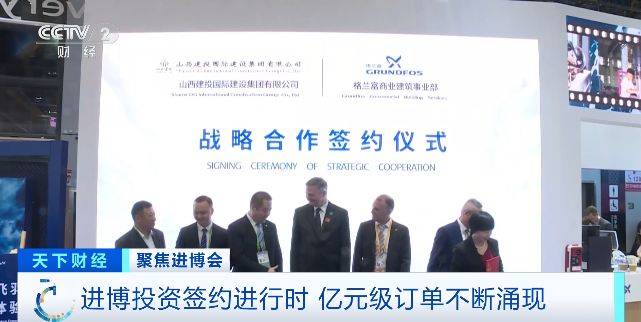
签字,亿元级订单!进博会迎来“签约热潮” 全球企业共享中国市场新机遇
Yang Shi Wang· 2025-11-08 08:46
Group 1 - The eighth China International Import Expo (CIIE) is experiencing a surge in signing activities, with intention amounts continuously rising, showcasing global companies' interest in the Chinese market [1] - A Danish company presented multiple products designed specifically for China, emphasizing the importance of investment in China for its development [3] - The exhibitor Astrid announced plans to sign 13 cooperation agreements with various Chinese partners and has recently invested $100 million in a green factory in Jiangxi Province [5] Group 2 - A signing event resulted in over 10 billion yuan in total intention amounts within one hour, with notable agreements in specialty consumer products such as wine, Thai coconut water, and New Zealand cheddar cheese [7] - The Thai exhibitor Ponsakron highlighted its coconut water products, which are primarily sold in China, and noted that collaboration with COFCO Group will facilitate access to over 1 million retail and vending machine points [9] - In Zhejiang Province, a signing ceremony involved 24 foreign suppliers from countries like the USA, Brazil, and Switzerland, with a total project amount reaching 14.5 billion yuan, covering advanced equipment, energy resources, and agricultural products [11][13] Group 3 - The Shanghai state-owned enterprise delegation achieved 113 intention procurement orders with a total amount of $2.776 billion, continuing its growth trend [15] - The Yangpu trading delegation in Shanghai signed orders across various sectors, including consumer goods, food, and art, achieving a new high in intended transaction amounts [15]

高频数据 | 工业相关数据涨跌分化
Xin Lang Cai Jing· 2025-11-08 05:55
Core Viewpoint - This week, the Nanhua Agricultural Products Index experienced fluctuations downward, while international crude oil prices declined; industrial-related data showed mixed trends in prices and supply [3] Agricultural Products - The Nanhua Agricultural Products Index fluctuated upward, with international crude oil prices declining; agricultural product prices generally increased [4] - Specifically, Brent crude oil decreased by $1.62 per barrel, and WTI crude oil fell by $1.14 per barrel; average wholesale prices for vegetables rose by 0.09 yuan per kilogram, while pork and beef prices increased by 0.43 yuan and 0.56 yuan per kilogram, respectively, but lamb prices dropped by 0.19 yuan per kilogram [5] Industrial Data - Industrial-related data showed mixed trends: the Nanhua Industrial Products Index fluctuated downward, with glass prices slightly rising and coking coal prices declining [15] - Glass futures closed up by 8 yuan per ton, while coking coal futures fell by 16 yuan per ton; the blast furnace operating rate was recorded at 83.15%, slightly up from last week and higher than the historical average [15] Real Estate Investment - Investment-related data in real estate remained weak; land transaction area in 100 major cities increased to approximately 24.89 million square meters, while commodity housing transaction area in 30 major cities rose to about 2.02 million square meters, still significantly below the historical average [24] - The index for second-hand housing listing prices declined, with the decrease rate increasing compared to the previous week; the cumulative value of completed housing area increased but remained below historical levels [24] Travel Consumption - Travel consumption data mostly increased, aligning with seasonal trends; subway passenger volumes in major cities such as Beijing, Shanghai, Guangzhou, and Shenzhen rose, with growth rates of 0.52%, 0.11%, 1.62%, and 1.22%, respectively [34] - Movie box office revenue slightly decreased, falling below the same period in 2024, 2023, and 2021; retail sales of passenger cars surged, exceeding historical levels, while the number of domestic flights executed slightly declined but remained above historical averages [34]

从进博会看全球农业协同发展新图景
Sou Hu Cai Jing· 2025-11-07 16:12
Core Insights - The eighth China International Import Expo (CIIE) showcases a new landscape of global agricultural cooperation, highlighting China's commitment to high-level opening-up and its evolving agricultural consumption patterns [2][10] - The event serves as a platform for global suppliers to adjust their strategies in response to the changing demands of Chinese consumers, who are increasingly focused on quality over quantity [4][6] Group 1: Global Agricultural Cooperation - The CIIE has become a vibrant symbol of China's high-level opening-up, providing a window into the transformation of agricultural consumption and global agricultural collaboration [2] - The expo features products from various countries, including Peru's blueberries and Mali's coffee beans, demonstrating the diversity and quality of agricultural offerings [2][8] Group 2: Market Adaptation and Consumer Trends - Foreign companies are increasingly tailoring their products to meet the personalized and health-conscious preferences of Chinese consumers, as seen with Dole's ultra-sweet bananas and Calbee's taro chips [4][6] - The shift in China's consumption market from "availability" to "quality" is prompting international suppliers to innovate and align their offerings with local consumer trends [4] Group 3: Trade Facilitation and Logistics - China's commitment to expanding its openness has created unprecedented opportunities for global agricultural cooperation, with efficient logistics enabling products like Malaysian durians to reach Chinese consumers almost immediately [6] - The establishment of "green channels" for agricultural products and collaboration with Belt and Road Initiative countries enhances cross-border trade facilitation [6][10] Group 4: Economic and Governance Implications - The CIIE fosters a shared and open international platform, injecting vitality into global economic cooperation and recovery, while allowing countries at different development levels to benefit from China's growth [8] - The expo exemplifies the principle of "consultation, contribution, and shared benefits" in global governance, promoting a win-win scenario for economic collaboration [8][10]

哥伦比亚10月农产品价格同比上涨7.8%
Shang Wu Bu Wang Zhan· 2025-11-07 16:11
Core Insights - Agricultural prices in Colombia increased by 7.8% year-on-year in October, while showing a slight decrease of 0.3% month-on-month, with the agricultural price index reaching 243.95 points and an overall increase of 8.2% for the year [1] Summary by Categories Price Trends - 63.6% of agricultural products experienced price increases across 33 subcategories [1] - Beef contributed the most to the index, rising by 2.42 percentage points [1] Key Products - Prices for bananas, tomatoes, cassava, and fresh milk also saw increases [1] - Conversely, prices for fresh eggs, cocoa, rice, and corn declined [1] Supply and Demand Factors - The rise in beef prices was primarily influenced by rainfall in the Caribbean and eastern plains regions, which led to reduced supply of cattle for slaughter [1] - Domestic consumption recovery and increased exports to Asia and the Middle East boosted demand for beef, making it a significant driver of the price index increase in October [1]

粕类周报:粕类周报贸易关系影响增加,粕类盘面大幅震荡-20251107
Yin He Qi Huo· 2025-11-07 14:47
1. Report Industry Investment Rating No relevant information provided. 2. Core Viewpoints of the Report - The international soybean market has fully reflected the positive factors, and the subsequent upward momentum may be limited. However, there are also many uncertainties, and the downward space is expected to be limited if the overall market demand does not decline significantly [3]. - The domestic soybean meal futures market shows a volatile trend. The near - term contracts are relatively strong due to the loss of soybean crushing profit, the lack of competitiveness of US soybeans compared with Brazilian soybeans, and the tight supply in the long - term domestic market. The current domestic spot market has a relatively loose supply - demand situation, with high inventory and general trading volume [3]. - The domestic rapeseed meal futures market shows a relatively strong trend, mainly affected by the uncertainty of Canadian rapeseed supply. However, the high inventory of granular rapeseed meal limits the price increase space [4]. - For trading strategies, it is recommended to take a bearish view on the long - term contracts for unilateral trading, expand the MRM spread for arbitrage, and adopt the strategy of selling wide straddles for options [4]. 3. Summary by Relevant Catalogs 3.1 Comprehensive Analysis and Trading Strategies 3.1.1 Comprehensive Analysis - The US soybean market shows a high - level volatile trend. The improvement of export prospects has been fully reflected in the price. Further upward movement requires more positive changes in supply. The South American market is under pressure. Brazilian soybean export volume is expected to increase, and the price increase space is limited. Argentina also faces price pressure due to large production [3]. - The domestic soybean meal futures market has a near - term strong and long - term weak pattern. The near - term strength is due to factors such as crushing profit loss and tight long - term supply. The domestic spot market has a loose supply - demand relationship and high inventory [3]. - The domestic rapeseed meal futures market is affected by the uncertainty of Canadian rapeseed import, but the high inventory of granular rapeseed meal restricts the price increase [4]. 3.1.2 Strategies - Unilateral: Adopt a bearish view on the long - term contracts. - Arbitrage: Expand the MRM spread. - Options: Sell wide straddles [4]. 3.2 Core Logic Analysis 3.2.1 US Soybeans: Export Prospects Improve, and the Market Remains at a High Level - The US soybean futures market continues to show a high - level volatile trend. The export prospects have improved, but the price increase space is limited without a significant decline in supply. The US soybean harvest progress is expected to be fast, and the single - yield estimate has been slightly adjusted. The soybean crushing profit has declined, and the export is still slow with high uncertainty [8]. 3.2.2 South America: Sowing Slows Down, and Prices Decline - The South American soybean price shows a downward trend. The Brazilian soybean price has declined, and the new - crop price is relatively firm due to the slow sowing progress. The Brazilian soybean sowing is affected by weather, the demand is general, the crushing profit is low, and the export volume is expected to remain high. The Argentine new - crop sowing has started, and the supply is expected to decrease with limited market impact [11]. 3.2.3 Trade Relations: Changes Increase, and Soybean Meal Fluctuates at a High Level - The domestic soybean meal futures market shows a high - level volatile trend. The oil mill operating rate is expected to decline, the inventory pressure is large, and the crushing profit is average. The demand is good due to high livestock and poultry inventory, but the further inventory accumulation space is limited. The reduction of tariffs on US soybeans does not make them competitive, and the long - term soybean import is expected to decrease [14]. 3.2.4 Market Supply: Loose, and Demand Remains at a Low Level - The domestic rapeseed meal futures market shows a relatively strong trend. The market is affected by the uncertainty of Canadian rapeseed import. The supply of rapeseed for crushing is low, the inventory is low, and the demand is general. The high inventory of granular rapeseed meal makes the market supply - demand relationship relatively loose, and the price increase space is limited [17]. 3.3 Fundamental Data Changes 3.3.1 International Market - The data includes US soybean weekly sales, export inspection volume, monthly crushing volume, and weekly crushing profit; Brazilian and Argentine soybean monthly export and crushing volume [20][23]. 3.3.2 Foreign Premium - It shows the FOB prices of US Gulf, Brazil, and Argentina soybeans and the CNF price of rapeseed [25]. 3.3.3 Macro: Exchange Rate & International Shipping - It involves the exchange rates of the US dollar against the Chinese yuan, Brazilian real, and Argentine peso, and the shipping freight rates of Panamax vessels on different routes [32][38]. 3.3.4 Supply - The data includes soybean and rapeseed import volume and weekly crushing volume [40]. 3.3.5 Demand - It shows the weekly提货量 of soybean meal and rapeseed meal [42]. 3.3.6 Inventory - The data includes the inventory of soybeans, rapeseed, soybean meal, and rapeseed + rapeseed meal [45].
达利欧投资了这家“农产品独角兽”
财富FORTUNE· 2025-11-07 13:54
Core Insights - Fruitist is revolutionizing the blueberry market by offering consistently high-quality blueberries, aiming to eliminate the unpredictability often associated with berry purchases [3][4] - The company has achieved a valuation of $1 billion, supported by significant investments from notable financial entities, including Ray Dalio's family office and J.P. Morgan Asset Management [1][5] - Fruitist's innovative approach includes a complete value chain from patented varieties to global farms, utilizing data-driven logistics to ensure year-round supply [4][5] Company Strategy - The company focuses on redesigning blueberries to ensure quality stability, addressing the common issue of inconsistent fruit quality in the market [3][4] - Fruitist operates farms in eight countries, including Peru, Oregon, Morocco, Egypt, and Yunnan, China, to provide a seamless supply chain [4][5] - The company has developed algorithms to predict optimal quality and yield, showcasing a blend of technology and agriculture [5] Market Position - Fruitist's blueberries are positioned as a healthier snack option in a global snack market projected to reach $800 billion, with the healthy snack segment potentially hitting $100 billion [6][7] - The introduction of grab-and-go "snack cups" reflects the company's strategy to cater to the growing demand for convenient, nutritious snacks [7] - The pricing strategy for Fruitist's blueberries ranges from $5 to $12, with a focus on consumer loyalty driven by quality rather than luxury [8][9] Consumer Trends - The rise of GLP-1 medications, which reduce overall food intake except for fruits and vegetables, is seen as beneficial for Fruitist, aligning with health-conscious consumer trends [8] - The company aims to provide a reliable product that consumers can trust year-round, enhancing customer loyalty through consistent quality [9]

蛋白粕月报 2025/11/07:成本支撑,油弱粕强-20251107
Wu Kuang Qi Huo· 2025-11-07 13:46
1. Report Industry Investment Rating - Not provided in the given content 2. Core Viewpoints of the Report - The import cost of soybeans is expected to fluctuate. Although there are signals of China importing US soybeans, the rise in US soybean prices may be offset by the decline in Brazilian premium. In the short - term, domestic soybean meal is expected to rise with the import cost, and the profit from oil - mill crushing is expected to recover, which will stimulate soybean purchases. In the medium - term, the expectation of a loose global soybean supply remains unchanged, so it is advisable to sell on rebounds [10][11][12] 3. Summary According to the Directory 3.1 Monthly Assessment and Strategy Recommendation - **International Soybeans**: In October, US soybeans rebounded as the market anticipated China's purchase after the APEC meeting. Brazilian new - crop soybeans are being planted normally, with an expected planting progress of 50% by early November. The Brazilian premium has been decreasing, but the increase in US soybean prices has led to a slight rise in the cost of imported soybeans in China. Currently, the cost - side valuation is neutral, and the import cost is expected to fluctuate [10] - **Domestic Double - Meal**: In October, the domestic soybean meal spot price followed the futures price higher, and the basis weakened. The futures price increased with the cost, and the oil - mill crushing profit on the futures market recovered after reaching the bottom. Domestic soybean meal trading was average, but the pick - up volume was relatively high. The inventory days of feed enterprises were 8.02 days, slightly higher than the same period last year. The current soybean purchase schedule indicates a continuous decline in domestic soybean and soybean meal inventories, which provides some support for the domestic soybean - related basis [10] - **Trading Strategy**: For unilateral trading, the market is expected to fluctuate. In the short - term, soybean meal may rise with the import cost, and the profit from crushing will recover, stimulating purchases. In the medium - term, due to the expected loose global soybean supply, it is recommended to sell on rebounds. No specific strategy is provided for arbitrage [12] 3.2 Periodic and Spot Market - **Spot Price**: The report provides historical price charts of soybean meal and rapeseed meal in Guangdong, including the spot prices of soybean meal in Dongguan and rapeseed meal in Huangpu [19] - **Basis of Main Contracts**: Charts of the basis of soybean meal 01 contract and rapeseed meal 01 contract are presented, showing the relationship between the basis and the spot price [22] - **Spread**: Multiple spread charts are provided, such as the spread between soybean meal 11 - 1, 01 - 05, 03 - 05, and 01 - rapeseed meal 01 contracts [24] - **Fund Position**: Charts of the net long positions of US soybean and US soybean meal management funds are shown, along with the relationship between the net long positions and the futures closing prices [27][29] 3.3 Supply Side - **US Soybean Planting Progress**: Charts of US soybean planting progress, emergence rate, flowering rate, and good - to - excellent rate are presented [33] - **Weather Conditions**: There is a possibility of La Nina occurring from October 2025 to January. The report provides precipitation charts of US and Brazilian soybean - producing areas, as well as the impact of La Nina on precipitation and climate in North America and South America [36][37] - **US Soybean Export Progress**: Multiple charts are provided, including the total amount of US soybean export contracts signed with China in the current market year, the sales completion rate of US soybeans in the current year, the total amount of US soybean export contracts signed in the current market year, and the cumulative export shipment volume of US soybeans to China [50] - **China's Oilseed Imports**: Charts of monthly soybean and rapeseed import volumes and forecasts are presented [53] - **China's Oil - Mill Crushing**: Charts of the soybean and rapeseed crushing volumes of major oil mills are provided [55] 3.4 Profit and Inventory - **Oilseed Inventory**: Charts of soybean port inventory and the rapeseed inventory of major oil mills are presented [59] - **Protein Meal Inventory**: Charts of the soybean meal inventory and forecast of coastal major oil mills and the rapeseed meal inventory of coastal major oil mills are provided [62] - **Protein Meal Crushing Profit**: Charts of the crushing profit of imported soybeans in Guangdong and the crushing profit of imported rapeseed in coastal areas are presented [64] 3.5 Demand Side - **Soybean Meal Transaction and Consumption**: Charts of the cumulative transaction volume of soybean meal in major oil mills in the crop year and the apparent consumption of soybean meal are presented [66] - **Breeding Profit**: Charts of the average profit per head of self - breeding and self - raising pigs and the breeding profit of white - feather broilers are presented [68]
软商品日报-20251107
Guo Tou Qi Huo· 2025-11-07 12:55
Report Industry Investment Ratings - Cotton: ★★★, indicating a clear upward trend and relatively appropriate investment opportunities [1] - Pulp: ★☆☆, suggesting a bullish or bearish bias with limited operability on the market [1] - Sugar: ★★★, showing a clear upward trend and relatively appropriate investment opportunities [1] - Apple: ★☆☆, implying a bullish or bearish bias with limited operability on the market [1] - Timber: ★★★, indicating a clear upward trend and relatively appropriate investment opportunities [1] - Natural Rubber: ★☆☆, suggesting a bullish or bearish bias with limited operability on the market [1] - 20 - day Rubber: ★☆☆, implying a bullish or bearish bias with limited operability on the market [1] - Butadiene Rubber: ★☆☆, suggesting a bullish or bearish bias with limited operability on the market [1] Core Views - The report assesses multiple soft commodities including cotton, sugar, apple, rubber, pulp, and timber, providing investment ratings and analyzing the current market situation, supply - demand relationship, and price trends for each commodity, and giving corresponding investment suggestions [1][2][3][4][5][6][7] Summary by Commodity Cotton & Cotton Yarn - Zhengzhou cotton declined slightly today, with the basis gradually weakening and spot trading being average. New cotton cost provides some support to the market, but price increases may face hedging pressure due to average demand. As of October 30, the cumulative processed lint cotton nationwide was 233.9 million tons, a year - on - year increase of 38.6 million tons. As of November 5, the cumulative inspection volume was 215.78 million tons. The demand for pure cotton yarn is average, and the new orders for weavers are poor. It is recommended to wait and see for now [2] Sugar - Overnight, US sugar was weak. In Brazil, the production data in mid - October was neutral, with the cane crushing volume in mid - October basically flat year - on - year and the sugar - making ratio decreasing month - on - month but still slightly up year - on - year. In China, Zhengzhou sugar remained weak. There are rumors of syrup import control, providing some support. The market focus has shifted to the new season's production estimate. The sugar price is expected to remain weak [3] Apple - The futures price fluctuated widely. In the spot market, apple harvesting in Shandong is nearing the end, and there is little off - warehouse stock in the northwest. As of November 6, the national cold - storage apple inventory was 682.74 million tons, a 17% year - on - year decrease. The market focus has shifted to sales expectations. Apple prices are high, and there may be inventory pressure later. A bearish trading strategy is recommended [4] 20 - day Rubber, Natural Rubber, and Synthetic Rubber - Today, RU was weak, and NR & BR declined. The futures market sentiment was cautious. The global natural rubber supply is in the high - production period, but the Yunnan region in China is entering the low - production period. The domestic tire start - up rate increased slightly this week, and the inventory in Qingdao increased. The import volume in October was 66.7 million tons, a 1.2% year - on - year increase and a 10.1% month - on - month decrease. A strategy of trading on oversold rebounds and paying attention to cross - variety arbitrage opportunities is recommended [5] Pulp - Pulp futures rose slightly today. As of November 6, the inventory at major ports in China was 200.8 million tons, a 2.6% month - on - month decrease. In September, the import volume was 295.25 million tons, a year - on - year increase of 27.25 million tons. The demand for pulp is average, and the valuation is low. It is recommended to wait and see or buy on dips [6] Timber - The futures price was weak. The mainstream spot price remained stable. In November, the New Zealand radiata pine price increased, but the domestic spot price was weak, and the import willingness of traders declined. The port delivery volume was above 60,000 cubic meters, and the inventory was low. It is recommended to wait and see [7]
价格全方位多维跟踪体系(2025.11):成本高企与利润分化并存
Guoxin Securities· 2025-11-07 12:15
Core Insights - The report highlights a structural divergence in the prices of major production materials, with 23 out of 49 materials experiencing price increases, while 24 saw declines, indicating a mixed market environment [1][2][3] - Key price increases are observed in upstream coal and non-ferrous metals, particularly copper and aluminum, driven by replenishment demand and cost support [1][2] - Conversely, significant price drops are noted in agricultural products and certain chemicals, reflecting weak downstream consumption and excess supply pressures [1][2] Price Tracking of Major Production Materials - As of October 2025, coal prices have slightly rebounded to 670-680 RMB/ton, while WTI crude oil has decreased to 57 USD/barrel [3] - Non-ferrous metals, including copper and aluminum, have shown strong performance, with copper prices reaching 86,430 RMB/ton and aluminum prices exceeding 21,000 RMB/ton [1][3] - The chemical sector exhibits notable price differentiation, with sulfuric acid prices surging over 700 RMB/ton, while other chemical products like plastics and fertilizers continue to decline [1][2][3] Year-on-Year Price Changes - Year-on-year comparisons reveal that coal prices have decreased by approximately 10%-25%, with the decline rate narrowing, indicating a marginal improvement in supply-demand dynamics [2] - Agricultural products, particularly live pigs, have seen a significant price drop of around 37%, negatively impacting the overall agricultural sector [2] - The non-ferrous metals sector has shown resilience, with electrolytic copper and aluminum prices increasing by 17.4% and 7.3% respectively, reflecting strong international metal market conditions and domestic demand recovery [2] Industry Price Trends - The report indicates that industries such as new energy, new materials, and high-end equipment are experiencing high material price levels and ongoing cost pressures, while traditional sectors like textiles and construction are facing low output prices due to weak downstream demand [4] - Profit margins remain robust in sectors like new energy vehicles and high-end manufacturing, while industries such as chemical fibers and construction materials are under pressure due to high input costs and weak output [4]