
地产

Search documents
午评:创业板指跌逾1%,银行、石油等板块走低,零售板块逆市活跃
Sou Hu Cai Jing· 2025-12-10 04:00
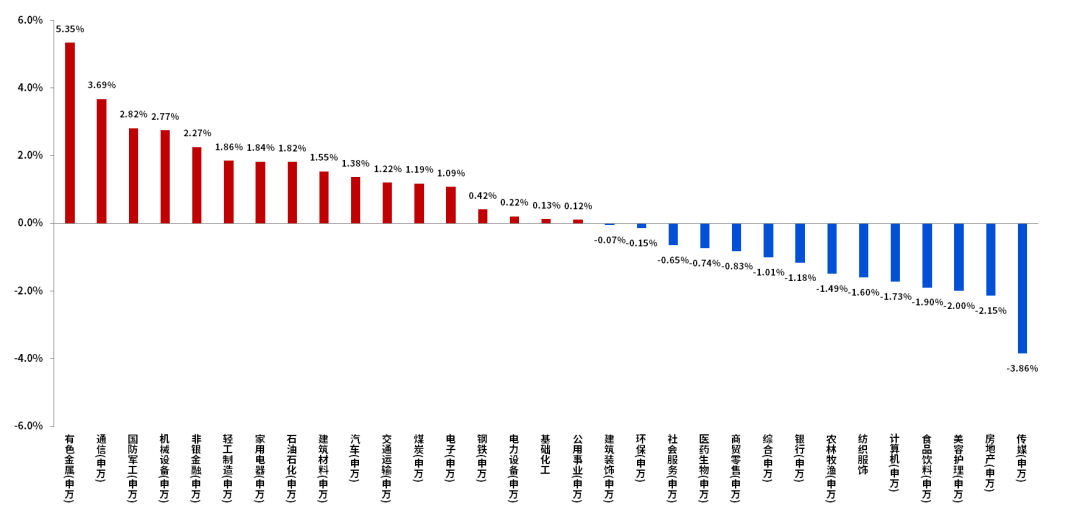
盘面上看,银行、石油、地产、化工等板块走低,零售板块再度活跃,海南自贸、免税概念、黄金概念 等活跃。 东莞证券表示,随着经济韧性增强、企业盈利改善,基本面叠加流动性的双轮驱动或成为市场主旋律。 在此背景下,低估值安全边际、高股息防御属性、业绩成长确定性强以及较强科技特征的行业板块或更 受市场青睐,关注即将出炉的美联储议息会议决议内容。 10日早盘,两市主要股指盘中震荡下探,沪指失守3900点,创业板指、科创50指数等跌超1%,全A超 3800股飘绿。 截至午间收盘,沪指跌0.72%报3881.51点,深证成指跌0.56%,创业板指跌1.23%,科创50指数跌 1.26%,沪深北三市合计成交11455亿元。 ...

宏观专题报告:月度前瞻:经济“量价”回升?-20251210
Shenwan Hongyuan Securities· 2025-12-10 02:19
Group 1: Economic Highlights - In November, production showed signs of weak improvement, with the manufacturing PMI rising 0.2 percentage points to 49.2%[1] - Industrial added value growth is expected to remain stable at 4.9%[1] - Exports rebounded to 5.9% in November, supported by an increase in working days and a reduction in production overhang effects[1] Group 2: Investment and Consumption Insights - Investment pressures may ease as the impact of debt repayment on investment diminishes, with construction investment remaining at -16% in October[2] - Service consumption is expected to improve due to the promotion of autumn holidays, despite a decline in "trade-in" programs[1] - Retail sales growth is projected at 2.7%[1] Group 3: Challenges and Risks - Manufacturing investment remains constrained by companies accelerating debt repayments, with accounts receivable growth dropping to 5.2%[2] - Real estate investment and sales are likely to decline further, with November housing sales down 33.1% year-on-year[2] - The "anti-involution" policy's slow progress in the manufacturing sector keeps cost rates at historically high levels, negatively impacting profits[2] Group 4: Inflation and Price Trends - November inflation indicators are expected to show improvement, with CPI projected to rise to 0.7% year-on-year[3] - PPI is anticipated to recover slightly to around -2% due to ongoing price pressures from upstream commodities[3] - Core CPI may see limited improvement due to the lagging effects of the "anti-involution" policy on downstream prices[3]
中信证券徐广鸿: 估值修复与结构重塑共振 2026年港股锚定四大核心赛道
Zhong Guo Zheng Quan Bao· 2025-12-09 20:46
Core Viewpoint - The Hong Kong stock market is entering a phase of valuation repair and structural reshaping, characterized by undervaluation, capital misalignment, and performance differentiation, with a significant influx of southbound capital and a shift in foreign investment reshaping the funding landscape [1][2]. Valuation and Market Dynamics - The Hang Seng Index has experienced a cumulative decline of over 50% from the post-Lunar New Year of 2021 to January 2024, leading to a significant valuation gap [2]. - As of December 9, 2023, the Hang Seng Index, Hang Seng China Enterprises Index, and Hang Seng Technology Index have recorded cumulative gains of 49.20%, 22.59%, and 24.32%, respectively [2]. - By the end of 2025, the expected EPS growth rate for the Hang Seng Index in 2026 is projected to be 8%, with a dynamic P/E ratio of only 12 times, indicating a notable valuation gap compared to major global markets [2]. Capital Flow and Investment Preferences - Southbound capital has seen a record net inflow of nearly 1.4 trillion HKD by the end of November, marking a new high since the launch of the mutual market access mechanism [3]. - The capital structure shows a clear differentiation, with institutional investors favoring themes like non-bank ETFs and personal investors focusing on growth sectors such as automotive, pharmaceuticals, and consumer goods [3]. - Foreign capital, while still experiencing outflows, has shown signs of recovery since August, with long-term foreign capital seeing its first phase of inflow since September 2022, particularly favoring the information technology sector [3]. Sector Performance and Outlook - The technology sector is expected to see significant profit growth in 2025, contrasting sharply with traditional sectors like finance and real estate [4]. - The Hang Seng Technology Index has shown volatility but continues to strengthen its core competitiveness, with the sector benefiting from advancements in AI and related technologies [4]. - The long-term trend of recovery in the Hong Kong stock market is expected to continue, driven by policy dividends and external risk dynamics [5][6]. Investment Directions - Key investment opportunities for 2026 are identified in four main sectors: technology, pharmaceuticals, resource products, and essential consumer goods, focusing on "earnings certainty + valuation elasticity" [8][9]. - The technology sector, particularly the AI industry chain, is anticipated to benefit from a virtuous cycle of investment and revenue growth, with a focus on leading companies and quality players in the computing power supply chain [8]. - The pharmaceuticals sector is entering a phase of certain growth, supported by policy and industry developments, with a focus on innovative companies and those benefiting from domestic market reforms [8]. - The resource products sector is supported by supply-demand mismatches and liquidity drivers, with expectations of rising commodity prices benefiting related stocks [9]. - The essential consumer goods sector is poised for valuation recovery, supported by domestic policies aimed at boosting consumption and improving income expectations [9].

加仓?
第一财经· 2025-12-09 11:49
Core Viewpoint - The market is experiencing a "more declines than gains, structural differentiation" characteristic, with the technology growth sector being the core due to strong performance certainty and high industry prosperity [5]. Market Performance - 1,305 companies saw an increase in their stock prices, with a rise and fall ratio of 54:12, indicating a selective market performance [5]. - The total trading volume in both markets was 9.2 trillion yuan, a decrease of 6.57%, reflecting a cautious market sentiment and a concentration of funds in a few sectors [6]. Sector Analysis - The computing hardware sector had the highest trading volume, while the retail sector benefited from consumption stimulus policies, leading to a significant increase in trading volume [6]. - Traditional cyclical sectors such as non-ferrous metals, real estate, coal, and brokerage firms collectively adjusted due to a lack of catalysts and capital outflows [5]. Fund Flow and Sentiment - There was a net outflow of 617.91 billion yuan from main funds, while retail investors saw a net inflow, indicating a defensive repositioning by institutions away from the electronic and computing sectors towards banks and public utilities [7]. - Retail investors displayed cautious optimism, focusing on sectors driven by policy catalysts such as commercial aerospace and consumer recovery [7]. Investor Sentiment - The sentiment among retail investors was recorded at 75.85%, indicating a relatively positive outlook despite the cautious market environment [8].


良性回调!周三,A股会开启新反弹了
Sou Hu Cai Jing· 2025-12-09 11:39
盘后,大家都情绪化了。又是4000家股票下跌,光模块、算力再次大涨,也不能说是诱惑你接盘,本来就是正常的反弹行情罢了。之前跌得很多,目前涨得 多很正常。 小凡也趁机买了它们,不过是间接持有。我们是抄底的2900多点的创业板,也跟着它们上涨了,所以为什么要讨厌它们上涨,股市任何筹码上涨都是好事 儿,毕竟都利好指数…… 良性回调! 小凡的策略肯定有用,关键是大多数连看文章的耐心都没有。别说让他们持有耐心了,我们一熬几年,守着自己这点一亩三分地。他们是消费者,我们是投 资者。股市和生活一样,守店的人赚钱,游客是消费者。 今日的回调在预期里面,这里对降息的预期,对工作会议的预期,不可能证券连续拉升,目前关键的行业还是证券、地产了,地产连续大幅回调是加速大消 费赶底。 月初的时候是7.5成仓,目前只有7成仓了,证券、创业都逢高减掉了浮仓。接下来,如果地产、白酒继续跌,可能会动用余粮补仓了,计划补到8成仓,这 样算大概率还可以接受它们跌10%…… 最后总结 不惧波动,就怕自己没有交易计划,跌了不敢买,涨了舍不得卖。为什么大家舍不得卖,因为你都是套住的筹码啊,不像我们是用浮仓捡的带血筹码,卖飞 也没有心理成本。 股市,不要 ...

午评:创业板指涨逾1%,零售板块拉升,CPO概念等活跃
Sou Hu Cai Jing· 2025-12-09 04:21
Market Overview - The Shanghai Composite Index experienced a narrow fluctuation, closing down 0.13% at 3918.83 points, while the ChiNext Index rose over 1% during the session [1] - The total trading volume across the Shanghai, Shenzhen, and North markets reached 12,641 billion [1] Sector Performance - Sectors such as coal, non-ferrous metals, real estate, insurance, brokerage, and pharmaceuticals saw declines, while food and beverage, retail, CPO concepts, and PCB concepts showed strength [1] Policy Insights - Recent policies have focused on capital market and consumption, with a recommendation to pay attention to domestic demand policies, emerging industry policies, and major project developments [1] - The implementation plan released in January aims for large state-owned insurance companies to allocate 30% of new premiums to A-shares annually, indicating a potential influx of long-term capital [1] - Historically, the period from late December to the end of the first quarter is a significant allocation window for insurance funds, suggesting that previously adjusted dividend sectors may regain attention, with a preference for large-cap stocks [1]
A股跨年行情来了!大家做好准备
Sou Hu Cai Jing· 2025-12-08 14:14
Group 1 - The A-share market is experiencing a cross-year rally, with the last trading days of the year being crucial for planning future investments [3][5] - The market has seen significant gains in major indices, but retail investors feel disconnected from the bull market, as gains are primarily driven by institutional investments in dividend stocks and technology [1][3] - Key sectors to watch include securities and real estate, as the recovery of the real estate market is essential for the overall consumption recovery [3][5] Group 2 - There is a prevailing skepticism among investors regarding the potential for inflation and economic recovery, with many doubting the return of positive PPI, CPI, and PMI [7] - The cyclical nature of industries is emphasized, indicating that all sectors go through phases of prosperity and decline, suggesting a potential for future recovery [7] - The real estate sector is highlighted as critical, with the belief that monetary policy adjustments could effectively address liquidity issues and stimulate market activity [5][7]

长城投研速递:跨年行情能见度有望提升
Sou Hu Cai Jing· 2025-12-08 09:46
Policy Trends - Some leading brokerages are expected to benefit from the appropriate easing of capital space and leverage restrictions, which may strengthen the brokerage sector and further boost market sentiment [5][4] - The insurance sector is rebounding due to the adjustment of related business risk factors, with the non-bank sector likely to lead the market sentiment recovery during the year-end period [5][4] - The National Financial Regulatory Administration has announced adjustments to the risk factors for insurance companies' stock investments and overseas investment insurance, aiming to enhance long-term investment management capabilities [4][5] Overseas Macro - The U.S. job market is currently in a state of mild slowdown, with the ADP employment figure for November dropping significantly to -32,000, far below the expected 10,000 [6] - The likelihood of a rate cut by the Federal Reserve in December is approximately 87%, as high interest rates are suppressing employment in interest-sensitive sectors [6] Bond Market - After a rapid rise in long-term yields, the 30-10Y government bond yield spread has gradually returned to a historically reasonable range, indicating initial signs of value for allocation after a significant drop [7][15] - The central bank has continued to net withdraw funds, with a total net withdrawal of 848 billion yuan through reverse repos during the first week of December [7][9] Equity Market - The market style continues to favor resource products and AI, with non-bank sectors gaining momentum, particularly in commercial aerospace and robotics, which have strengthened the military and machinery sectors [16][21] - The Shanghai Composite Index rose by 0.37%, while the Shenzhen Component Index and the ChiNext Index increased by 1.26% and 1.86%, respectively [16] Investment Strategy - The company is optimistic about technology, brokerages, and consumer sectors as the market approaches the year-end offensive [2][22] - The upcoming Central Economic Work Conference is expected to lead to more proactive economic policies, with a focus on stabilizing the short-term macro economy and further easing monetary policy [22][24]
红利国企ETF(510720)近20日资金净流入超4亿元,机构称防御属性受青睐
Sou Hu Cai Jing· 2025-12-08 02:31
注:如提及个股仅供参考,不代表投资建议。指数/基金短期涨跌幅及历史表现仅供分析参考,不预示 未来表现。市场观点随市场环境变化而变动,不构成任何投资建议或承诺。文中提及指数仅供参考,不 构成任何投资建议,也不构成对基金业绩的预测和保证。如需购买相关基金产品,请选择与风险等级相 匹配的产品。基金有风险,投资需谨慎。 每日经济新闻 华创证券指出,红利资产在交运公用、金融、能源化工、食饮、家电、地产、金属、出版等多个行业展 现出配置价值。在交运公用领域,公路、港口、铁路等长久期资产具备防御稳健性,其中公路行业推荐 具备成长潜力的优质高速资产;港口行业海外布局及分红比例提升推升估值弹性;铁路行业受益改革红 利,黄金线路资产具备价格弹性潜力。金融板块中,银行股息率高且资产质量安全边际充足,中长期投 资价值持续。能源化工行业方面,油气作为能源安全基石,长期现金流有保障,资本开支趋势性下修; 煤炭行业反内卷政策超预期,供给约束下行业盈利稳定性增强。金属行业中电解铝企业进入现金流修复 阶段,供需紧平衡支撑铝价,行业吨铝利润有望维持高位。出版行业教育出版主业稳健,稳定高分红叠 加AI教育等新方向布局,配置价值突出。整体来看,红利 ...
南方基金:震荡中的信号:是迷雾还是曙光?
Sou Hu Cai Jing· 2025-12-08 02:25
回顾11月,全球市场在中美贸易会晤预期升温、美联储降息预期反复、AI泡沫担忧加剧等多重扰动下 震荡加剧。 这些信号,让不少朋友开始疑惑:当前市场是在酝酿风险,还是在积蓄动能? 今天,局长就带大家拆解这些"矛盾"背后的逻辑,并聊聊如何在震荡中保持定力。 一、市场为何总要"蹲下"震荡? 市场并非总是一路上扬,"蹲下"震荡实属常态,是消化浮筹、积蓄新动能的过程。 回顾历史,无论是2014年还是2019年,在大的趋势行情启动前,市场都经历过类似的"中场休息"。 2014年7月至11月,沪指在2000-2200点区间横盘近三个月。期间经济数据低迷与改革预期交织,直至11 月21日央行降息为市场注入强心针,开启了一轮波澜壮阔的牛市。 2019年初,市场在中美贸易摩擦与资本市场改革预期中震荡两个月,最终在政策支持与外部缓和下走出 震荡,迎来科技主线崛起。 当前,上证指数在关键点位反复博弈,可视为四中全会后"政策真空期"的蓄势。许多投资者感觉"热点 轮动比翻书还快",这恰恰是震荡市的典型特征——缺乏清晰单一的主线,资金在各板块间试探。从历 史经验看,这种震荡往往在为下一次风格选择做准备。 但需注意,当前经济修复路径与产业格局 ...