建筑业

Search documents
12个重点行业划定稳增长路线图
Da Zhong Ri Bao· 2026-01-03 01:15
Group 1 - The core focus of the news is the release of a policy list aimed at stabilizing and enhancing the growth of 12 key industries in Shandong, which collectively account for approximately 67% of the province's industrial output and 75% of its manufacturing output [2][3] - The 12 identified industries include steel, non-ferrous metals, chemicals, automotive, and textiles, which are characterized by their large scale, strong driving force, and high interconnectivity [2][3] - Specific quantitative growth targets have been set for these industries by 2026, such as a 4% increase in the steel industry's added value, production of 1.2 million new energy vehicles, and revenue exceeding 850 billion yuan for the electronic information manufacturing sector [3] Group 2 - The policy list includes measures to support the commercial aerospace sector, such as subsidies for rocket and satellite companies utilizing offshore launch platforms, with a maximum subsidy of 3 million yuan per project [4] - The initiative aims to foster innovation and industry growth by providing financial support for companies with core technological competitiveness and strong service capabilities in the commercial aerospace field [4] - The government plans to enhance the green transformation of the construction industry by promoting the use of green building materials through government procurement, with a target of at least 40% application of green materials in star-rated green building projects [5] Group 3 - The Shandong government is committed to improving the support mechanisms for private enterprises, including establishing a comprehensive solution mechanism for enterprise demands and enhancing the "Ru Hui Tong" policy implementation platform [6][7] - The focus will be on addressing common issues faced by enterprises and ensuring that beneficial policies are easily accessible and quickly implemented [7]
经济景气水平总体回升
Xin Lang Cai Jing· 2026-01-01 16:40
Core Viewpoint - The manufacturing and non-manufacturing sectors in China showed signs of recovery in December 2025, with key indices rising above the expansion threshold, indicating improved economic conditions [1][4]. Manufacturing Sector - In December 2025, the Manufacturing Purchasing Managers' Index (PMI) reached 50.1%, marking the first time it entered the expansion zone since April [1]. - Among the 21 surveyed industries, 16 reported an increase in PMI compared to the previous month, indicating improved production and operational conditions [1]. - The production index and new orders index were 51.7% and 50.8%, respectively, both showing significant increases of 1.7 and 1.6 percentage points from the previous month [1]. - High-tech manufacturing PMI was 52.5%, up 2.4 percentage points, indicating positive growth trends [3]. - Equipment manufacturing and consumer goods industries both recorded PMIs of 50.4%, rising by 0.6 and 1.0 percentage points, respectively [3]. - The procurement activity accelerated with a procurement volume index of 51.1%, entering the expansion zone [2]. Non-Manufacturing Sector - The Non-Manufacturing Business Activity Index was 50.2%, an increase of 0.7 percentage points, indicating an improvement in the non-manufacturing sector's economic conditions [4]. - The new orders index for non-manufacturing rose to 47.3%, up 1.6 percentage points, reaching the highest level this year [4]. - The business activity expectation index for non-manufacturing was 56.5%, reflecting a continuous increase for three months, indicating rising market confidence [4]. - The construction industry saw a significant improvement, with the business activity index at 52.8%, up 3.2 percentage points from the previous month [4]. Composite Index - The Composite PMI Output Index reached 50.7%, an increase of 1.0 percentage point, indicating overall expansion in production and operational activities [5].

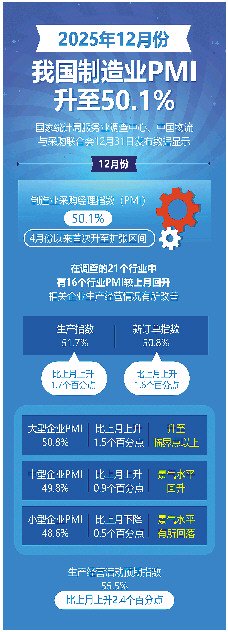
中信证券:后续预计政策效果将进一步显现,推动经济延续边际改善
Xin Lang Cai Jing· 2026-01-01 09:13
Core Viewpoint - The manufacturing sector showed signs of recovery in December, driven by an increase in working days and the effectiveness of policy financial tools, which improved demand in infrastructure and manufacturing investment chains [1] Group 1: Manufacturing Sector - Key indicators related to production and demand improved across the board, with factory price indicators rebounding, reflecting recovery in various manufacturing sectors due to the combination of working day differences and policy support [1] - Industries benefiting from this recovery include those in the infrastructure chain driven by policy financial tools, as well as the automotive and textile sectors, which saw improvements in export growth [1] Group 2: Non-Manufacturing Sector - The non-manufacturing PMI showed improvement, primarily driven by a recovery in the construction industry, while the service sector remains relatively weak, indicating that the impact of incremental tools needs to expand further [1] Group 3: Economic Outlook - Overall, the economic climate improved in December due to the combination of more working days and the influence of policy financial tools, with expectations that the effects of these policies will continue to manifest, promoting marginal economic improvement [1]

PMI三大指数均升至扩张区间—— 我国经济景气水平总体回升
Jing Ji Ri Bao· 2026-01-01 01:52
Core Viewpoint - The overall economic sentiment in China is improving, as indicated by the rise in key indices for manufacturing and non-manufacturing sectors, suggesting a recovery in economic activity [1][2][4]. Manufacturing Sector - In December 2025, the Manufacturing Purchasing Managers' Index (PMI) reached 50.1%, marking its first entry into the expansion zone since April 2025, with 16 out of 21 surveyed industries showing improvement [1][2]. - The New Orders Index rose to 50.8%, increasing by 1.6 percentage points, indicating a significant recovery in market demand after five months below 50% [2]. - The Production Index increased to 51.7%, up by 1.7 percentage points, reflecting a positive expansion in manufacturing activities [2]. - High-tech manufacturing PMI was reported at 52.5%, up by 2.4 percentage points, indicating a favorable growth trend [2]. - Large enterprises' PMI reached 50.8%, up by 1.5 percentage points, with both production and new orders indices exceeding 52% [3]. Non-Manufacturing Sector - The Non-Manufacturing Business Activity Index rose to 50.2%, up by 0.7 percentage points, indicating an improvement in the non-manufacturing sector [4]. - The Business Activity Expectation Index for non-manufacturing reached 56.5%, reflecting a continuous upward trend and strong market expectations [4][5]. - The construction industry saw a significant improvement, with the Business Activity Index at 52.8%, up by 3.2 percentage points, driven by favorable weather and upcoming holidays [4]. Economic Outlook - Experts suggest that the combination of effective economic policies and market dynamics is fostering a positive outlook for the manufacturing sector, with expectations for steady qualitative and quantitative growth in 2026 [3][5].
数据点评 | 12月PMI回升的四大支撑(申万宏观·赵伟团队)
赵伟宏观探索· 2025-12-31 17:40
Core Viewpoint - The December PMI index shows a recovery driven by new momentum and the consumer goods sector, with a reduction in the debt-extraction effect and resilient exports supporting the index [1][4][53]. Group 1: PMI Recovery - The manufacturing PMI rose by 0.9 percentage points to 50.1%, marking a return to the growth line after nine months, despite a decline in high-frequency indicators such as blast furnace operations and freight volume [1][5][53]. - The production and new orders indices increased by 1.7 and 1.6 percentage points, respectively, indicating improved manufacturing activity [1][5][53]. Group 2: Support from New Momentum - PMI in sectors related to new momentum showed significant improvement, although the sustainability of this trend requires further observation due to a lack of corresponding high-frequency indicators [1][12][54]. - Traditional industries like black metal rolling and chemical fibers saw a decline in PMI, while emerging sectors such as electrical machinery and pharmaceuticals experienced a rise [1][12][54]. Group 3: Consumer Sector Improvement - The overall consumer goods sector PMI increased by 1 percentage point to 50.4%, with notable recovery in areas less affected by demand exhaustion risks, such as textiles and apparel, which rose by 4.5 percentage points [2][15][54]. Group 4: Construction Sector Recovery - The construction PMI rose by 3.2 percentage points to 52.8%, indicating a reduction in the marginal impact of debt-extraction on investment, supported by the easing of special refinancing bond issues and the implementation of incremental policies [2][18][54]. - Both housing and civil engineering activities improved, with respective increases of 4.8 and 1.2 percentage points [2][18][54]. Group 5: Export Resilience - The domestic order index rose by 1.6 percentage points to 51.1%, while the new export orders index improved by 1.4 percentage points to 49%, indicating ongoing resilience in exports [2][22][55]. - High-frequency indicators showed a year-on-year increase of 0.6 percentage points in port foreign trade freight volume, maintaining a high level [2][22][55]. Group 6: Economic Growth Outlook - The combination of accelerating new momentum and proactive incremental policies suggests that economic growth will remain resilient, despite traditional momentum facing downward pressure [3][27][55]. - The manufacturing PMI's recovery, driven by new momentum and consumer sectors, alongside improvements in the construction PMI, indicates a positive outlook for economic activity [3][27][55].
12月PMI超预期回暖,产需两端明显回升
Hua Xia Shi Bao· 2025-12-31 16:39
Core Viewpoint - The manufacturing PMI has returned to the expansion zone for the first time since April, indicating a recovery in economic sentiment, driven by stable growth policies and resilient exports [2][4]. Group 1: Manufacturing Sector - The manufacturing PMI for December is reported at 50.1%, marking a significant increase and indicating expansion [2]. - The production index stands at 51.7%, up 1.7 percentage points from the previous month, reflecting accelerated production activities and improved market confidence [4]. - The new orders index has risen to 50.8%, indicating a recovery in market demand, particularly in sectors like food processing and textiles [5]. - Large enterprises' PMI has also returned to the expansion zone at 50.8%, up 1.5 percentage points from last month [5]. Group 2: Non-Manufacturing Sector - The non-manufacturing PMI is reported at 50.2%, showing improvement in the service sector, although the service PMI remains slightly below the expansion threshold at 49.7% [8]. - The construction sector has shown notable recovery, with the construction PMI rising to 52.8%, marking a return to expansion after five months [8]. - The business activity expectation index for the service sector is at 56.4%, indicating increased confidence among service enterprises regarding future market developments [8]. Group 3: Economic Policies and Outlook - The government is expected to implement more proactive macroeconomic policies, with a focus on balancing fiscal expansion and sustainable growth [3]. - The production and business activity expectation index has risen to 55.5%, reflecting enhanced confidence among manufacturing enterprises [7]. - The overall economic environment is supported by favorable external trade conditions and a strong global AI investment trend, contributing positively to exports [6].
2025年12月PMI数据点评:PMI逆季节性回升,预期改善
GUOTAI HAITONG SECURITIES· 2025-12-31 13:12
Manufacturing PMI Insights - In December 2025, the Manufacturing PMI rose to 50.1%, an increase of 0.9 percentage points from November, marking the first time it entered the expansion zone since April 2025[8] - Among the 21 surveyed industries, 16 reported an increase in PMI compared to November, driven by improved trade conditions and proactive inventory preparations ahead of the Spring Festival[8] - The production index and new orders index contributed 0.43 and 0.48 percentage points to the PMI, respectively, indicating a positive shift in manufacturing activity[10] Demand and Supply Dynamics - The new orders index reached 50.8%, up 1.6 percentage points from November, marking its return to the expansion zone for the first time since the second half of the year[14] - The production index also increased to 51.7%, reflecting a 1.7 percentage point rise, driven by stronger demand and improved business sentiment[14] - The raw material purchase price index decreased to 53.1%, down 0.5 percentage points, alleviating cost pressures for downstream manufacturing[17] Non-Manufacturing Sector Performance - The service sector's business activity index slightly increased to 49.7%, up 0.2 percentage points from November, with significant variation across industries[20] - The construction sector saw a notable rise, with the business activity index reaching 52.8%, an increase of 3.2 percentage points, attributed to favorable weather and upcoming holidays[23] Policy Outlook and Risks - Macro policies are expected to be more proactive in 2026, with early issuance of local government debt limits and investment plans totaling approximately 295 billion yuan[27] - A risk remains in the real estate sector, where demand still needs to be stimulated to support broader economic recovery[28]
——12月PMI数据点评:PMI重回荣枯线上,出口拉动高技术生产
Changjiang Securities· 2025-12-31 12:45
Group 1: PMI Performance - December manufacturing PMI rose to 50.1%, marking an 8-month high and exceeding Bloomberg and Reuters' consensus estimate of 49.2%[2] - The PMI increase is characterized by strong structural certainty, although total economic uncertainty remains[2] - High-tech manufacturing PMI surged by 2.4 percentage points to 52.5%, indicating positive growth trends in the sector[7] Group 2: Demand and Production - New orders contributed 53% to the PMI increase, while production contributed 47%[7] - New orders index rose by 1.6 percentage points to 50.8%, and new export orders increased by 1.4 percentage points to 49.0%, reaching a new high since April[7] - Production index significantly improved by 1.7 percentage points to 51.7%, indicating strong expansion momentum[7] Group 3: Price and Inventory Trends - Main raw material purchase price index slightly decreased to 53.1%, while the factory price index rose to 48.9%[7] - Raw material inventory index increased to 47.8%, and finished goods inventory index rose to 48.2%, reflecting synchronized supply and demand improvements[7] Group 4: Non-Manufacturing Sector - Non-manufacturing PMI increased to 50.2%, returning to expansion territory, primarily driven by a 3.2 percentage point rise in construction PMI to 52.8%[7] - The construction sector's improvement is attributed to favorable weather conditions and accelerated project progress, although funding and project availability remain concerns[7] Group 5: Future Outlook - The sustainability of the manufacturing PMI increase is uncertain, with potential risks in demand and external economic conditions[6] - The need for stable growth remains significant as 2026 marks the beginning of the "14th Five-Year Plan," indicating potential policy support to stabilize the economy[2]
国内观察:2025年12月PMI:制造业PMI逆势走强下的亮点
Donghai Securities· 2025-12-31 11:21
Group 1: PMI Overview - In December, the manufacturing PMI rose to 50.1%, up from 49.2% in the previous month, while the non-manufacturing PMI increased to 50.2%, from 49.5%[2] - The December PMI's unexpected strength is attributed to multiple factors, including positive expectations from recent important meetings, easing trade frictions, and increased pre-holiday inventory demand[2] - The manufacturing PMI's month-on-month increase of 0.9 percentage points (pct) significantly exceeds the five-year average decline of 0.3 pct for the same period[2] Group 2: Supply and Demand Dynamics - The production index rose to 51.7% (+1.7 pct), returning above the threshold, while the new orders index increased to 50.8% (+1.6 pct), marking the first time since June that it is above the threshold[2] - The new export orders index also saw a notable increase, rising to 49.0% (+1.4 pct), matching the high point of March this year[2] - The price index showed divergence, with the main raw material purchase price index at 53.1% (-0.5 pct) and the factory price index at 48.9% (+0.7 pct), indicating faster downstream replenishment compared to upstream[2] Group 3: Sector Performance - High-tech manufacturing PMI rose to 52.5% (+2.4 pct), significantly above the overall level, driving the increase in the overall manufacturing PMI[2] - Consumer goods PMI reached 50.4% (+1.0 pct), slightly higher than the overall PMI increase, supported by strong performance in sectors like computer communication and textile manufacturing[2] - The construction PMI was notably strong at 52.8% (+3.2 pct), outperforming seasonal expectations due to favorable weather conditions and pre-holiday construction activity[3]
PMI为何重回扩张?——12月PMI数据解读
陈兴宏观研究· 2025-12-31 11:07
Group 1 - The national manufacturing PMI significantly rebounded to 50.1% in December, marking the first time since April that it entered the expansion zone, with a 0.9 percentage point increase from the previous month [3][4] - Key contributing factors to the PMI increase include rising new orders and production indices, while the employment index declined and the supplier delivery time index increased [3][4] - The recovery in production and demand is synchronized, with domestic demand strengthening relative to external demand, leading to an accumulation of inventory on the demand side and a recovery in downstream profits [2][4] Group 2 - The new export orders index rose significantly after the US-China trade talks in late October, with a cumulative increase of over 3.1 percentage points in November and December, indicating a recovery in external demand [4] - The manufacturing production index reached 51.7% in December, up 1.7 percentage points from the previous month, driven by improved external demand [4] - The manufacturing purchase price index fell to 53.1%, while the factory price index rose to 48.9%, indicating a potential improvement in profit distribution for downstream businesses [8] Group 3 - The non-manufacturing business activity index rose to 50.2%, with the construction sector showing a notable recovery, while the service sector remained slightly below the expansion threshold at 49.7% [7][10] - The construction business activity index increased by 3.2 percentage points to 52.8%, reversing a four-month decline, with new orders in construction reaching a year-high [7] - The service industry business activity expectation index rose to 56.4%, reflecting positive market expectations despite current low activity levels in retail and dining sectors [10]