TMT

Search documents
本期缠论视角下或类似于2017年11月底12月初
Guotou Securities· 2025-11-23 08:03
- The report does not contain any quantitative models or factors, nor does it provide any related construction processes, formulas, or backtesting results[1][7][8]
牛市还在吗,如何应对市场下跌?
雪球· 2025-11-21 13:01
Core Viewpoint - The article discusses the current phase of the A-share market, analyzing it through the lens of the classic bull market three-stage theory, and emphasizes the importance of balancing offensive and defensive strategies in investment as the market transitions from valuation recovery to performance-driven growth [4][6][25]. Group 1: Bull Market Phases - The bull market is divided into three stages: valuation recovery, performance-driven growth, and emotional-driven bubble [6][7]. - The first stage, characterized by policy shifts and risk appetite recovery, has been completed as of October 2024, with the market returning to historical valuation levels [7][9]. - The second stage, currently in progress, focuses on performance verification, with A-share companies' profits growing by 5.4% year-on-year in the first three quarters of 2025, and significant growth in sectors like TMT and manufacturing [9][10]. Group 2: Sector Performance - The TMT sector showed strong performance, with electronic profits up 45.3% year-on-year, and AI-related indices seeing profits increase by 83.3% [10]. - The midstream manufacturing sector also performed well, with profits in the power equipment and new energy sectors growing by 52.5% [10]. - The energy and materials sector benefited from policy changes, with industrial metals and precious metals seeing profit increases of 45.2% and 58.7%, respectively [10]. Group 3: Market Dynamics and Strategy - The current market dynamics suggest a need for a balanced strategy, moving from an aggressive "only attack" approach to a more defensive "balance attack and defense" strategy [18][25]. - A suggested allocation strategy includes maintaining a 50% equity position, diversifying across growth, stable, high-dividend, and cyclical sectors to mitigate risks [19][20]. - The article warns that if the market enters the third phase characterized by bubble-like valuations and extreme market sentiment, a shift to a defensive strategy will be necessary [22][23]. Group 4: Long-term Considerations - The article highlights the importance of sustainable performance growth, questioning whether the current high growth in tech stocks can be maintained amid macroeconomic challenges [13][14]. - It draws parallels with the U.S. market's slow bull experience, emphasizing the need for solid earnings support for a sustainable bull market [14]. - The article concludes that for the A-share market to transition into a long-term bull market, several factors, including macroeconomic stability and improved corporate governance, must be addressed [16][25].


2026年A股年度策略:科技成长的弹性与消费价值的回归
Zhongyuan Securities· 2025-11-21 09:22
External Environment - The Federal Reserve's policy has shifted from inflation reduction to seeking balance, with a focus on managing inflation and debt sustainability in 2026 [6][20] - The U.S. stock market has experienced significant growth despite aggressive interest rate hikes due to factors such as ineffective interest rate transmission, market expectations, and the resilience of technology sector profits [11][12] Internal Environment - The Chinese economy is facing challenges with slowing investment growth, weakened traditional industry momentum, and cautious market expectations, while consumer confidence needs to be boosted [21][22] - The government is implementing policies to enhance internal demand and stabilize the economy, focusing on preventing excessive competition and promoting upgrades in various industries [23][24] Market Environment - The market is experiencing a shift in risk preferences, with a potential transition from small-cap to large-cap stocks as valuation dynamics change [36] - The bond market has shifted from a bull market to a wide-ranging oscillation, with a focus on stable income assets and low-valuation value assets expected to attract incremental funds [39][40] Investment Outlook for 2026 - The technology sector, particularly AI and related industries, is expected to see a slowdown in profit growth after rapid valuation increases, with a focus on undervalued segments with performance support [7] - Traditional industries are advised to focus on quality upgrades driven by AI and the recovery of profits following capacity clearing due to anti-competitive policies [7] - The consumer sector is anticipated to experience a recovery in inventory cycles, with long-term capital gradually returning to the market, particularly in food and beverage, pharmaceuticals, and duty-free sectors [7][41]
关于这几天的A股,我有话想说
Sou Hu Cai Jing· 2025-11-20 11:31
Market Overview - The A-share market experienced a collective decline, with the Shanghai Composite Index down 0.40%, Shenzhen Component down 0.76%, and ChiNext down 1.12%, while the Northbound 50 fell by 1.00%. The total trading volume was 1.72 trillion yuan, a decrease of 20 billion yuan from the previous day, with over 3,850 stocks declining [1] Reasons for Market Adjustment - The first reason for the market adjustment is profit-locking by institutional investors, as November is recognized as a settlement month for public funds and a critical period for annual performance assessment. Institutions tend to shift from seeking excess returns to locking in profits, leading to active portfolio adjustments [2] - The second reason is the uncertainty surrounding the Federal Reserve's interest rate cuts, which has impacted global liquidity. Recent reports suggest that the Fed may not lower interest rates in the first half of next year, disrupting expectations for liquidity easing and causing capital outflows from the Asia-Pacific region, including A-shares [3] - The third reason is the rising tensions in Sino-Japanese relations, which have raised market concerns. Recent remarks from the Japanese Prime Minister and subsequent countermeasures from China, such as travel warnings and import restrictions, have created uncertainty in economic and trade prospects between the two countries, affecting market sentiment [4] Long-term Market Outlook - Despite the current adjustment, the underlying logic supporting the bull market remains intact. China's rapid advancements in technology and military capabilities, along with ongoing policies aimed at boosting economic development and industrial upgrades, are expected to provide key support for the capital market [4] - The market is anticipated to undergo a period of consolidation, which may help digest profit-taking and repair valuation structures, ultimately paving the way for a return to an upward trajectory towards new highs [4] Investment Strategy - Given the recent market corrections, several risk signals have emerged, including the breaking of key moving averages and a decline in trading volume to around 1.7 trillion yuan. If trading volume does not rebound above 2 trillion yuan quickly, the index may struggle to achieve upward momentum in the short term [5] - Investors are advised to adopt a balanced allocation strategy, avoiding heavy bets on high-priced technology stocks and instead diversifying into lower-priced sectors such as AI applications, consumer goods, pharmaceuticals, and dividend assets. This approach allows for both offensive and defensive positioning in response to upcoming market conditions [5][7]
战略数据研究|专题报告:红利择时看反弹的节奏和结构:AH红利资产的定价模式探索系列(III)
Changjiang Securities· 2025-11-19 14:45
Group 1: Market Trends and Conditions - The core drivers of the relative strength between dividend and growth styles are based on long-term expectations of asset fundamentals and short-term liquidity/macroeconomic credit environment changes[2] - Recent developments, including the conclusion of the US-China tariff negotiations and the release of Q3 earnings reports, have led to a correction in short-term risk preferences, transitioning into a medium to long-term economic outlook phase[6] - The current market environment shows a shift from growth towards a balanced dividend allocation due to changes in short-term market risk appetite and fund flow[22] Group 2: Performance and Investment Opportunities - As of November 14, 2025, a total of 845 A-share companies announced mid-term dividends, a significant increase from 704 in the previous year, indicating a growing trend in dividend distribution[51] - The total mid-term dividend amount for A-shares in 2025 is approximately CNY 6,846 billion, reflecting a year-on-year increase of nearly CNY 1,000 billion[54] - The performance of dividend indices has shown significant returns, with the Hang Seng High Dividend Index up 41.28% year-to-date, while growth indices like the ChiNext Index have seen a 45.29% increase[21] Group 3: Risks and Considerations - The analysis is based on historical data and does not guarantee future performance, highlighting the inherent risks in investment strategies[67] - The uncertainty surrounding dividend distributions remains, as the reported mid-term dividend figures may differ from actual payouts, introducing additional risk factors[68]
早盘直击|今日行情关注
申万宏源证券上海北京西路营业部· 2025-11-19 07:05
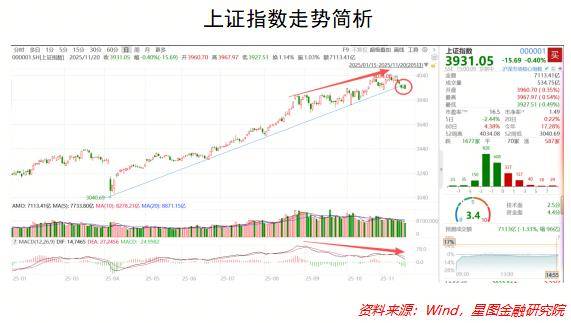
Market Overview - The external market continues to weaken, leading to a contraction in the A-share market. Recent adjustments in overseas markets, particularly regarding AI development, have caused significant declines in major US tech companies. Additionally, the expectation for a Federal Reserve rate cut in December has decreased, resulting in a decline in market risk appetite [1] - The A-share market has shown signs of adjustment influenced by related industry chains, with a general trend of high-low switching and a defensive style typical of year-end consolidation, characterized by sector rotation, unclear main lines, and balanced allocation [1] Market Performance - On Tuesday, both markets continued to adjust, with the Shanghai Composite Index falling below the 30-day moving average. The Shenzhen Component Index also remained below its short-term moving averages, with intraday lows approaching the 60-day moving average. The total trading volume for the day was less than 2 trillion yuan, slightly increasing from Monday [1] - Market hotspots were primarily concentrated in the TMT (Technology, Media, and Telecommunications) sector. In terms of investment style, large-cap blue-chip stocks showed relative resilience, while small and mid-cap stocks experienced larger declines [1] Market Dynamics - The Shanghai Composite Index has been fluctuating around the 4000-point mark, showing a rapid decline after reaching a new high last Friday. The Shenzhen Component Index is currently in a consolidation phase, operating below all short-term moving averages. Close attention is needed to see if short-term moving averages can be regained [1]

10月以来科技跑输红利 风格转换苗头隐现
Zheng Quan Shi Bao· 2025-11-18 22:26
Core Viewpoint - The recent performance of technology stocks in the A-share market has shown signs of slowing down, while dividend stocks have started to perform relatively strongly, indicating a potential shift in market style [1][2] Group 1: Technology and Dividend Style Transition - There is a noticeable transition in the A-share market between technology and dividend styles, with technology stocks recently underperforming compared to dividend stocks [2] - From October 2023, the CSI Technology Index has declined by 4.47%, lagging behind the CSI Dividend Index by over 7 percentage points, which has increased by 3.05% during the same period [2] - In November 2023, the CSI Technology Index further dropped by 6.25%, again underperforming the CSI Dividend Index by nearly 7 percentage points, which only rose by 0.57% [2] Group 2: Historical Context of Style Shifts - Historically, the A-share market has experienced multiple transitions between technology and dividend stocks, with one category often dominating the other [4] - From 2015 to 2024, there have been several instances where technology stocks outperformed dividend stocks, such as in 2015 when the CSI Technology Index surged by 86.45% [5] - Conversely, in 2022, technology stocks saw a significant decline of 32%, while dividend stocks only fell by 5.45%, showcasing the defensive nature of dividend stocks during market downturns [5] Group 3: Current Market Dynamics - The current A-share market structure is described as "dumbbell-shaped," with one end representing low-valuation, high-dividend sectors like banks, and the other end representing high-growth technology stocks [6] - The recent rise in Agricultural Bank's stock price to a historical high further supports the strengthening of this "dumbbell" structure [7] - Despite the recent pullback in technology stocks due to profit-taking, this does not signify the end of a bull market, as both technology and dividend stocks are expected to coexist and drive the market upward [7]
多只热门个股暴跌!A股连续第三日下挫,调整结束了吗?
Hua Xia Shi Bao· 2025-11-18 14:55
Market Overview - A-shares experienced a decline for the third consecutive trading day, with the Shanghai Composite Index falling by 0.8% to 3939.81 points, and the ChiNext Index dropping over 1% [2][3] - More than 4100 stocks closed in the red, with significant drops in previously popular stocks [2][4] External Influences - The primary trigger for the recent market downturn is the potential delay in interest rate cuts by the Federal Reserve, leading to a sharp decline in global stock markets [2][4] - The St. Louis Fed President's comments on limited further rate cut space have reduced expectations for a December rate cut to below 50%, increasing global liquidity tightening concerns [4][5] Sector Performance - The A-share market saw most sectors decline, with the coal sector experiencing a significant drop of over 3%, marking the largest single-day decline since early April [3][4] - The top three sectors with net inflows were internet services, software development, and cultural media, while the sectors with the largest net outflows included batteries, photovoltaic equipment, and chemical products [3] Investment Strategy - Analysts suggest that the market is in a phase of adjustment, with a focus on high-dividend sectors or technology growth stocks in the first half of the bull market, while advocating for a more balanced allocation in the latter half [6][7] - The market is expected to stabilize as the A-share index approaches the 4000-point mark, with a potential for sector rotation between cyclical and technology stocks [7] Future Outlook - Analysts remain optimistic about the Chinese stock market's trend for 2026, anticipating continued inflows of incremental funds and potential outperformance in corporate earnings and AI advancements [7][8] - The market is expected to experience natural recovery after a three-day decline, supported by valuation advantages and trends in fund reallocation [6][7]

2025年第三季度:深圳写字楼市场
Cushman & Wakefield· 2025-11-18 05:39
Group 1: Market Key Indicators - As of the end of Q3 2025, the stock of Grade A office buildings in Shenzhen reached 8.879 million square meters, with a vacancy rate of 29.0% and an average rent of RMB 153.4 per square meter per month [2][3][9] - In 2025, Shenzhen's GDP is expected to grow by 5.1%, the tertiary industry by 6.1%, CPI by 0.1%, and real estate development investment to decline by 15.1% [2] Group 2: Supply - Side Analysis - New supply in Q3 2025 was concentrated in the Qianhai area, which promoted the business atmosphere but also intensified the imbalance between supply and demand, raising the vacancy rate by 1.2 percentage points [3] - The average rent dropped by 4.2% quarter - on - quarter and 11.2% year - on - year, and the net absorption reached 92,000 square meters, a quarterly high since 2024 [3] - Owners are exploring diversified ways to attract customers, such as transforming the cooperation model with office building operators from a traditional rental relationship to a partnership [3] Group 3: Demand - Side Analysis - In the first three quarters, leasing demand was mainly concentrated in TMT, finance, professional services, and retail trade. In Q3, some niche technology companies entered the market [4] - Professional services and finance sectors saw a recovery in leasing demand in Q3, and companies in hotel, circular economy, new consumption, and logistics sectors also had large - area leasing transactions [4] Group 4: Future Outlook - The large amount of upcoming supply will increase the pressure on the Grade A office building market, which may drive more innovative exploration in office building operation [5] Group 5: Regional Market Data - In different regions of Shenzhen, Luohu has a vacancy rate of 36.5%, Futian 20.7%, Nanshan 28.7%, Qianhai 42.4%, and Bao'an 26.0% as of 2025 [9] - The average rent in different regions ranges from RMB 124.04 in Qianhai to RMB 169.14 in Futian [9] Group 6: Transaction and Construction Information - In Q3 2025, major leasing transactions included Point Cat Technology leasing 9,800 square meters in China State - owned Capital Venture Capital Building in Qianhai [10] - Major ongoing construction projects include China Merchants Bank Global Headquarters Building in Shenzhen Bay Super Headquarters Base, expected to be delivered in 2026 [11]
全球“再平衡”之后,如何布局?
Sou Hu Cai Jing· 2025-11-17 08:14
Group 1 - The core viewpoint of the report is that global stock markets are undergoing a structural "rebalancing," with funds rotating from the technology sector to lower-valued sectors [1] - The report highlights two strategies for positioning in the A-share market for the upcoming year: one is that overseas disturbances provide a window for growth in sectors like AI; the other is that expectations of marginal improvement in economic conditions and structural rebalancing offer valuation recovery opportunities for cyclical sectors [1] - Key sectors to focus on include technology growth and cyclical sectors such as rising resource prices, new consumption, and service consumption [1] Group 2 - The report expresses a bullish outlook on the A-share market, indicating that overseas disturbances accelerate internal rebalancing, which provides opportunities for both AI growth and cyclical sectors [2] - It notes that the current pullback in the TMT sector has reached a relatively high value area for short-term investment [2] - The report emphasizes the potential for sustainable valuation recovery opportunities in cyclical sectors [2]