
周期

Search documents
【公募基金】市场缩量上涨,宏观博弈临近——公募基金权益指数跟踪周报(2025.12.01-2025.12.05)
华宝财富魔方· 2025-12-08 09:33
Group 1 - The core viewpoint of the article highlights the recent trends in the A-share market, indicating a continuation of volume contraction and a rotation of themes, with market participants awaiting new guiding signals [3][11]. - The A-share market saw a slight increase in major indices, with the Shanghai Composite Index rising by 0.37%, the CSI 300 by 1.28%, and the ChiNext Index by 1.86%, indicating a stronger performance in growth styles compared to value styles [11]. - The average daily trading volume in the A-share market was 16,870 billion, showing a decrease compared to the previous week, reflecting a cautious market sentiment as it approaches significant policy meetings [11]. Group 2 - The non-bank financial sector is influenced by the recent notification from the financial regulatory authority, which aims to encourage insurance funds to invest more in specific equity assets by adjusting risk factors [4][12]. - The commercial aerospace sector has shown active performance due to recent event-driven catalysts, with significant developments in rocket launches and tests, suggesting a potential shift from emotional to logical investment strategies [4][12][13]. - Precious metals, particularly silver, have experienced a rapid price increase due to global liquidity recovery and supply-demand dynamics, with long-term trends expected to be influenced by the narrative of shrinking dollar credit [4][13]. Group 3 - The public fund market is undergoing a transformation with the introduction of new performance assessment guidelines aimed at correcting past issues of short-term incentives and soft accountability, promoting a focus on value creation and high-quality development [4][14]. - The guidelines emphasize a core assessment system based on investment returns, aiming to align the interests of fund managers with long-term returns for investors [14]. Group 4 - The active equity fund indices showed positive performance, with the Active Stock Fund Selection Index rising by 1.64% last week, achieving a cumulative excess return of 15.40% since inception [5]. - The Value Stock Fund Selection Index increased by 1.62%, with a cumulative excess return of 3.96% since inception, while the Balanced Stock Fund Selection Index rose by 1.00%, achieving a cumulative excess return of 9.27% [6][7]. - The Growth Stock Fund Selection Index saw a smaller increase of 0.64%, with a cumulative excess return of 13.45%, while the Pharmaceutical Stock Fund Selection Index decreased by 1.73%, but still recorded a cumulative excess return of 21.62% [8][9].


本周机构研判:2026年“春季躁动”行情还会有吗?
Sou Hu Cai Jing· 2025-12-07 10:49
Market Overview - A-shares have mostly risen this week due to improved market sentiment and increased risk appetite, with the ChiNext Index showing the best performance, up 1.86% for the week [1] Insurance Sector Insights - The China Banking and Insurance Regulatory Commission has adjusted the risk factors for insurance companies investing in related stocks, encouraging long-term capital to enter the market. This adjustment could release an equity allocation space of up to 100 billion yuan [2] - The reduction in risk factors for insurance companies' stock investments is expected to inject more liquidity into the market, as it allows for greater insurance fund inflows [3] Market Predictions - December may serve as a window for positioning in the cross-year market, with historical trends indicating that low trading volumes during an uptrend can be good buying opportunities [4] - The spring market rally for 2026 may begin as early as mid-December 2023, driven by positive policy stances and improved liquidity conditions [5] - The current market fluctuations may be a normal state before unexpected changes in fundamentals occur, with a focus on resource and traditional manufacturing sectors [6] Sector Performance - The adjustment period for key industry sectors has been sufficient, with gaming and technology sectors showing signs of potential rebounds [9] - The technology growth stocks are expected to benefit from global capital reallocation opportunities, particularly with the anticipated Fed rate cuts [10] - Both technology and cyclical sectors are expected to drive market performance, with opportunities emerging in underperforming growth sectors [11] Overall Market Direction - The overall market trend remains upward, supported by rising risk appetite in overseas markets and increasing domestic policy expectations [12]
A股,重大调整!沪深交易所,最新发布!
券商中国· 2025-11-28 15:11
Core Viewpoint - A-shares are undergoing significant adjustments in multiple key indices, effective December 12, 2025, with changes in sample stocks for indices such as the Shanghai 50, Sci-Tech 50, Shenzhen Component Index, and ChiNext Index [1][2][12]. Index Adjustments - The Shanghai Stock Exchange and China Securities Index Co. announced changes to the sample stocks of the Shanghai 50, Shanghai 180, Shanghai 380, and Sci-Tech 50 indices, with the Shanghai 50 replacing 4 stocks, the Shanghai 180 replacing 7 stocks, the Shanghai 380 replacing 38 stocks, and the Sci-Tech 50 replacing 2 stocks [2][12]. - The Shanghai 50 index will include new stocks such as SAIC Motor, Northern Rare Earth, Huadian New Energy, and Zhongke Shuguang, while removing Poly Developments, China Mobile, China Aluminum, and CRRC [2][3]. - The Shanghai 180 index will add stocks like Guotou Capital, Zhongtian Technology, and Huadian New Energy, while removing stocks such as COSCO Shipping Energy and Nanshan Aluminum [3][4]. - The Shanghai 380 index will see 38 stocks added, including COSCO Shipping Energy and Jinfat Technology, and will remove stocks like Guotou Capital and Furuida [4][5]. - The Sci-Tech 50 index will replace Huaxi Biological and Hangcai Co. with new additions including Aojie Technology and Shengke Communication [6][7]. Shenzhen Stock Exchange Adjustments - The Shenzhen Stock Exchange will also implement sample stock adjustments for the Shenzhen Component Index, ChiNext Index, Shenzhen 100, and ChiNext 50, effective December 15, 2025 [7][8]. - The Shenzhen Component Index will add stocks such as Deep Housing A and Demingli, while removing stocks like China National Pharmaceutical and Tibet Mining [7][8]. - The ChiNext Index will include new stocks like Shuanglin Co. and Changshan Pharmaceutical, while removing stocks such as Bihui Source and Yihua Recording [8][10]. Broader Market Implications - The adjustments in sample stocks are expected to enhance the representation of sectors such as information technology, communication services, and industrials, leading to a more balanced industry allocation in the A-series indices [12][13]. - Analysts suggest that the market may experience a spring rally, with potential shifts in capital towards AI applications and sectors aligned with national policy support, such as hydrogen energy and quantum technology [14].




光大期货金融期货日报-20251120
Guang Da Qi Huo· 2025-11-20 03:43
1. Report Industry Investment Rating - No specific industry investment rating is provided in the report. 2. Core Viewpoints - **Stock Index**: The A - share market closed lower with volatility yesterday. The liquidity rally since June is over, and the market focuses on fundamentals. New - quality productivity themes led by AI have optimistic growth expectations, especially in the upstream hardware manufacturing of the technology sector, but they lack event catalysts and are in a volatile phase. Traditional economic sectors are in a volatile recovery, and it's hard to enter a fundamental bull market in the short term. The market volume, volatility, and risk appetite are decreasing, and the index is expected to be volatile in the short term. Overseas tech stocks also face expected divergence, and US tech stocks pulled back last week [1]. - **Treasury Bonds**: Treasury bond futures closed lower yesterday. The central bank conducted 310.5 billion yuan of 7 - day reverse repurchases, achieving a net injection of 115 billion yuan. The central bank's resumption of Treasury bond trading strengthens the expectation of reasonable and sufficient funds, which is beneficial to the bond market. The economic outlook for the fourth quarter is stable, the short - term necessity of central bank interest rate cuts is low, and the "stock - bond seesaw" effect disturbs bond market sentiment. The bond market is expected to continue the volatile pattern [1][2]. 3. Summary by Relevant Catalogs 3.1 Research Viewpoints - **Stock Index**: Yesterday, the A - share market was volatile and closed down. The Wind All - A index fell 0.3% with a trading volume of 1.74 trillion yuan. The CSI 1000 and CSI 500 indexes declined by 0.82% and 0.4% respectively, while the SSE 50 and CSI 300 indexes rose by 0.58% and 0.44% respectively. The new - quality productivity themes led by AI have good mid - term profitability expectations but lack short - term catalysts. Traditional economic sectors are in a volatile recovery, and the index is expected to be volatile in the short term. Overseas tech stocks also faced setbacks last week [1]. - **Treasury Bonds**: Yesterday, the 30 - year, 10 - year, 5 - year, and 2 - year Treasury bond futures main contracts fell by 0.40%, 0.06%, 0.03%, and 0.03% respectively. The central bank conducted 310.5 billion yuan of 7 - day reverse repurchases, with a winning bid rate of 1.4%. After the expiration of 195.5 billion yuan of reverse repurchases, a net injection of 115 billion yuan was achieved. The weighted average interest rates of DR001 and DR007 declined. The central bank's actions strengthen the expectation of sufficient funds, but the "stock - bond seesaw" effect disturbs sentiment. The bond market is expected to be volatile [1][2]. 3.2 Daily Price Changes - **Stock Index Futures**: The IH rose 0.45% from 2,997.6 to 3,011.0, the IF increased 0.22% from 4,555.0 to 4,565.2, the IC decreased 0.35% from 7,079.8 to 7,054.8, and the IM dropped 0.73% from 7,351.8 to 7,298.2 [3]. - **Stock Indexes**: The SSE 50 rose 0.58% from 3,003.0 to 3,020.3, the CSI 300 increased 0.44% from 4,568.2 to 4,588.3, the CSI 500 decreased 0.40% from 7,151.0 to 7,122.7, and the CSI 1000 dropped 0.82% from 7,448.1 to 7,387.2 [3]. - **Treasury Bond Futures**: The TS fell 0.03% from 102.49 to 102.46, the TF decreased 0.04% from 105.92 to 105.88, the T dropped 0.07% from 108.50 to 108.43, and the TL declined 0.38% from 116.53 to 116.09 [3]. 3.3 Market News - The Shanghai Stock Exchange revised and released the "Guidelines for the Application of Self - regulatory Rules for Funds of the Shanghai Stock Exchange No. 1 - Index Funds (Revised in November 2025)", which came into effect on November 19, 2025. For index funds with non - broad - based stock indexes as underlying indexes, several requirements need to be met, such as the number of constituent securities being no less than 30, the single - constituent security weight not exceeding 15% and the total weight of the top 5 constituent securities not exceeding 60%, etc. [4] 3.4 Chart Analysis 3.4.1 Stock Index Futures - The report provides charts of the trends of IH, IF, IM, IC main contracts, and their respective monthly basis trends [6][7][9]. 3.4.2 Treasury Bond Futures - Charts include the trends of Treasury bond futures main contracts, Treasury bond spot yields, and the basis and inter - period spreads of 2 - year, 5 - year, 10 - year, and 30 - year Treasury bond futures, as well as cross - variety spreads and capital interest rates [13][14][19]. 3.4.3 Exchange Rates - Charts show the central parity rates of the US dollar, euro against the RMB, forward exchange rates of the US dollar and euro against the RMB, the US dollar index, and exchange rates between the euro, pound, and yen against the US dollar [22][23][26]
一图看懂:主动优选基金经理,在2025年3季报里都说了啥?
银行螺丝钉· 2025-11-19 13:56
Core Insights - The article provides an overview of fund managers' perspectives and strategies based on their recent quarterly reports, highlighting different investment styles and market outlooks [1][2]. Group 1: Fund Manager Perspectives - Fund managers express varying views on market conditions, with some maintaining optimism about equity assets due to low interest rates and the potential for corporate earnings recovery [17][18]. - Different investment styles are categorized, including deep value, growth value, balanced, and growth styles, each with distinct characteristics and focus areas [19][35][51]. Group 2: Deep Value Style - Deep value managers focus on low valuation metrics such as low P/E ratios and high dividend yields, primarily investing in sectors like finance, real estate, and energy [10][12]. - Historical performance shows that this style performed well in 2016-2017 and 2021-2024, while underperforming in 2019-2020 [15][16]. Group 3: Growth Value Style - Growth value managers prioritize companies with strong profitability and stable cash flows, often holding stocks for the long term [20][22]. - Concerns about market risks and valuation levels are noted, with some managers highlighting the extreme valuation disparities across sectors [22][24]. Group 4: Balanced Style - Balanced style managers seek a combination of growth and value, focusing on companies with favorable PEG ratios and exploring opportunities across various sectors [35][36]. - They emphasize the importance of maintaining a diversified portfolio while identifying high-quality investment opportunities [40][46]. Group 5: Growth Style - Growth style managers focus on high revenue and earnings growth, often investing in emerging industries such as AI, renewable energy, and technology [51][62]. - The article notes a shift in focus from technology to consumer sectors as the market stabilizes, with an emphasis on identifying companies with strong growth potential [55][58]. Group 6: Market Outlook - The overall market sentiment is cautiously optimistic, with expectations of continued structural opportunities despite potential short-term volatility [40][62]. - Fund managers are adjusting their portfolios in response to macroeconomic conditions, focusing on sectors with strong growth prospects and managing risks associated with high valuations [31][70].

光大期货金融期货日报-20251119
Guang Da Qi Huo· 2025-11-19 05:15
Report Industry Investment Rating - The investment rating for stock index futures is "sideways", and for government bond futures is "relatively strong" [1] Core Viewpoints - The A-share market oscillated and closed lower yesterday, with TMT performing well and coal and power equipment sectors correcting. The overall market is expected to be range - bound in the short term as the liquidity-driven market since June ended and the focus returns to fundamentals. Traditional economic sectors are in a slow recovery, and overseas tech stocks also face expectation divergence [1]. - Government bond futures closed higher yesterday. The central bank's actions and economic expectations have a positive impact on the bond market, but the "stock - bond seesaw" effect causes some disturbances. The bond market is expected to continue its oscillating pattern [1][2] Summary by Directory 1. Research Views Stock Index Futures - Yesterday, the A - share market closed down with Wind All - A dropping 0.93% and a trading volume of 1.95 trillion yuan. The CSI 1000, CSI 500, SSE 50, and CSI 300 indices all declined. New - quality productivity themes led by AI have optimistic growth expectations, especially in the upstream hardware manufacturing of the tech sector, but they lack catalysts and have entered a sideways trend since November. Traditional economic sectors are in a slow recovery and are unlikely to enter a fundamental bull market in the short term. Overseas tech stocks also face expectation divergence [1]. Government Bond Futures - Yesterday, government bond futures closed higher, with the 30 - year, 10 - year, 5 - year, and 2 - year main contracts rising. The central bank conducted 4075 billion yuan of 7 - day reverse repurchases, with a net injection of 37 billion yuan. DR001 rose 2BP to 1.53%, and DR007 remained flat at 1.52%. The central bank's actions strengthen the expectation of reasonable and sufficient funds, which is positive for the bond market. However, the "stock - bond seesaw" effect causes some disturbances, and the bond market is expected to oscillate [1][2] 2. Daily Price Changes Stock Index Futures - On November 18, 2025, IH dropped 0.39% to 2,997.6, IF dropped 0.58% to 4,555.0, IC dropped 0.89% to 7,079.8, and IM dropped 0.58% to 7,351.8 compared to November 17 [3]. Stock Indices - The SSE 50 dropped 0.30% to 3,003.0, the CSI 300 dropped 0.65% to 4,568.2, the CSI 500 dropped 1.17% to 7,151.0, and the CSI 1000 dropped 1.00% to 7,448.1 on November 18, 2025, compared to November 17 [3]. Government Bond Futures - On November 18, 2025, TS rose 0.01% to 102.49, TF rose 0.01% to 105.92, T rose 0.01% to 108.50, and TL rose 0.07% to 116.53 compared to November 17 [3] 3. Market News - As of the week ending October 18, the number of initial jobless claims in the US was 232,000, and the number of continuing jobless claims was 1,957,000, up from 1,947,000 the previous week. The US Federal government shutdown led to a lack of regular weekly data [4]. - China's Foreign Ministry held consultations with Japan's officials. China sternly protested against Japanese Prime Minister Kaochi Sanae's wrong remarks on China, urging Japan to retract the remarks and stop causing trouble on China - related issues [4] 4. Chart Analysis Stock Index Futures - The report provides charts of the trends of IH, IF, IM, IC main contracts, and their respective basis trends [6][7][9] Government Bond Futures - The report includes charts of the trends of government bond futures main contracts, bond yields, basis, inter - period spreads, cross - variety spreads, and fund rates [13][14][19] Exchange Rates - The report presents charts of the central parity rates of the US dollar, euro against the RMB, forward exchange rates, the US dollar index, and exchange rates between major currencies [22][23][26]
基金分析报告:核心资产基金池:超额稳中有升
Minsheng Securities· 2025-11-18 11:59
Group 1 - The report defines core assets in the A-share market from four perspectives: industry leaders, resource endowment, excellent business models, and technological advantages [1][9] - The core asset fund pool has shown low volatility, with an annualized return of 13.14% from February 2, 2015, to November 7, 2025, outperforming the equity fund index by 3.31% [1][16] - The core asset fund pool has consistently achieved excess returns in most years, particularly in volatile and bear markets, but may lag in extreme style markets [1][18] Group 2 - The excess returns of the core asset fund pool primarily stem from industry allocation and stock selection, with a focus on large-cap quality investments [2][21] - The current long-term allocation emphasizes consumption, cyclical, and financial sectors, with a recent reduction in manufacturing and financial allocations [2][24] - The report provides a list of selected core asset funds, highlighting their performance and management details, with a focus on funds that have a high proportion of core assets in their top holdings [3][27] Group 3 - The core asset fund pool is defined by specific criteria, including a focus on actively managed equity funds with significant holdings in core assets [26] - The selection process for core asset funds emphasizes low beta exposure and high operating cash flow relative to market capitalization [27] - The report includes a detailed analysis of individual funds, showcasing their investment strategies and performance metrics [28][29][30][31][32][33][34][35][36][37][38][39][40][41][42][43][44][45][46][47][48][49][50][51][52][53][54][55]
沪指争夺4000点关口 机构研判年末风格趋于平衡
Shang Hai Zheng Quan Bao· 2025-11-16 17:55
Core Insights - The A-share market is experiencing fluctuations around the 4000-point mark, with a notable acceleration in the rotation rhythm between and within sectors, including AI, new energy, resource products, and consumer goods, although the sustainability of the upward trend is limited [1][2] - Analysts suggest that the recent wide fluctuations in the A-share market are influenced by both domestic and international factors, including a decline in risk appetite in overseas markets and resistance at the 4000-point level [1][2] - The market is expected to maintain a range-bound oscillation in the short term, with a potential rebalancing of market styles lasting several months, while technology growth sectors like TMT and advanced manufacturing are anticipated to lead index breakthroughs in the longer term [1][3] Market Outlook - The A-share market is likely to continue its oscillation pattern, with rapid sector rotation observed, particularly as funds shift from previously high-performing technology sectors to lower-performing sectors such as resources, consumption, and pharmaceuticals [2][3] - Analysts from various firms indicate that the current market structure reflects a global trend of "rebalancing," with funds moving away from technology stocks due to concerns over AI bubbles and external events impacting risk preferences [2][3] - The investment strategy should focus on structural allocation around themes of "anti-involution" and AI applications, leveraging trends in prosperity, policy direction, and capital flow to achieve excess returns [2][3] Sector Performance - In the context of year-end market style assessments, analysts suggest that sectors that have lagged may perform better during this oscillation phase, with a focus on high-dividend, consumer, and cyclical stocks [3][4] - The technology sector, particularly TMT and advanced manufacturing, is expected to maintain a long-term advantage due to relative profitability and global semiconductor cycles, despite a temporary shift towards value stocks [3][4] - The current market environment is characterized by a high degree of volatility, driven by valuation and expectations, with a potential shift back to technology stocks as the underlying industrial logic strengthens [3][5]
国信证券荀玉根:“买好的”看科技主线 “买得好”关注地产、券商、白酒消费
Zhi Tong Cai Jing· 2025-10-28 11:47
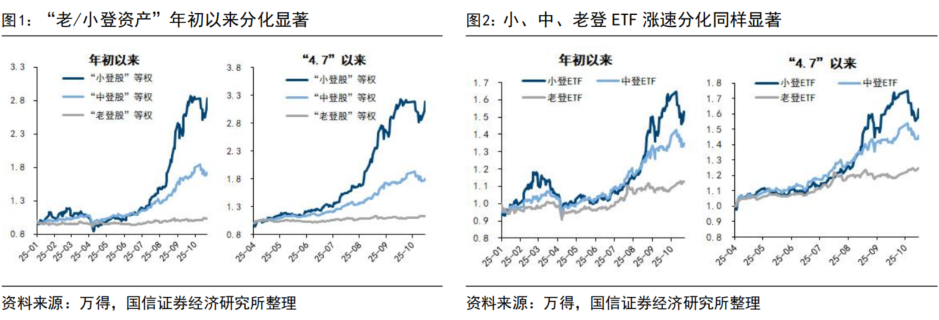
Core Viewpoint - The report by Guosen Securities highlights an extreme divergence between "old" and "new" assets in the market, emphasizing that high growth does not necessarily equate to high investment returns, and that finding fundamentally sound valuation opportunities can lead to significant returns [1][2]. Group 1: Performance Divergence - Since 2025, "small new stocks" have significantly outperformed "old stocks," with the "small new stock" portfolio rising by 183.8% compared to just 3.9% for "old stocks" [2]. - From April 7, 2025, "small new stocks" surged over 200%, while "old stocks" only increased by 13.6% [2]. - The "small new ETF" has risen by 53.1% since 2025, while the "old ETF" has only seen a 13.1% increase [2]. Group 2: Valuation and Market Activity - As of October 24, the PE ratio for "small new" sectors like electronics and computing is at the 99th percentile since 2019, while "old" sectors like real estate and liquor are at the 56th percentile [8]. - The trading volume for "small new" sectors has increased to 33%, while "old" sectors have dropped to below 2.8%, indicating a significant divergence in market activity [8]. Group 3: Investment Strategy - The report stresses the importance of not only selecting high-quality stocks ("buy good") but also ensuring they are purchased at favorable valuations ("buy well") to achieve high returns [11]. - Historical examples illustrate that higher growth does not guarantee better returns, as seen in the comparison between IBM and New Jersey Standard Oil from 1950 to 2003 [11][12]. - The banking sector has shown resilience, with a decline of only 3.9% compared to a 31.1% drop in the overall market, highlighting the potential for finding undervalued stocks with solid fundamentals [15]. Group 4: Market Trends and Seasonal Effects - The current market is characterized by a "small new stock" era, but there are seasonal opportunities for "old stocks," particularly in real estate, liquor, and brokerage sectors [20][29]. - Historical bull markets have shown that each cycle has a leading sector that aligns with prevailing economic trends, with AI and technology being the current focus [21]. - Seasonal effects suggest that value sectors may outperform in the fourth quarter, with historical data indicating a 64% success rate for value over growth during this period [23].

真正切换未至
Guotou Securities· 2025-10-23 07:31
Group 1 - The report emphasizes the potential for a significant style switch in the fourth quarter, suggesting that the strong performance of mainstream stocks in Q3 may not continue into Q4, indicating a high probability of style switching [1][9]. - Historical analysis shows that in bull markets driven by liquidity, style switching is more pronounced compared to fundamental-driven bull markets, which tend to have less volatility and fewer style changes [1][2]. - The report introduces an "A-share high-cut low" index, which indicates that low-positioned stocks are becoming more effective, suggesting a shift in market dynamics [1][2]. Group 2 - The report notes that the current market is experiencing a "high-cut low" pricing process, characterized by high-positioned stocks declining while low-positioned stocks are rapidly rotating, indicating that a clear style switch has not yet formed [2]. - The mid-term style switch is highlighted, with a focus on the transition from value to growth stocks, marking the beginning of a new cycle in 2025 [2][24]. - Short-term observations indicate that the internal rotation of high and low-positioned technology stocks lacks clear patterns, relying more on industrial logic rather than trading sentiment [2][3]. Group 3 - The report discusses the relationship between A-share technology stocks and Hong Kong technology stocks, noting that the relative excess returns of the ChiNext index compared to the Hang Seng Tech index have peaked and are now declining [3][28]. - It highlights the difficulty in breaking through the high differentiation between technology and cyclical styles, with recent PPI stabilization making it challenging for these styles to diverge significantly [3][31]. - The report also mentions the convergence of M2 and social financing growth rates, indicating that large-cap stocks are currently outperforming small-cap stocks [3][36]. Group 4 - The report evaluates the potential transition from a "liquidity bull" to a "fundamental bull" in the fourth quarter, tracking signals related to geopolitical and economic cycles [3][4]. - It suggests that the upcoming APEC meeting and the end of the new round of US-China tariff exemptions may lead to a more stable internal and external environment, which is crucial for economic growth [4]. - The report anticipates that the true style switch may not occur until November, when low-positioned cyclical stocks could become the focus of investment strategies [4].