股票

Search documents
墨西哥市场2026年宏观事件前瞻:协定审查与货币政策成焦点
Jing Ji Guan Cha Wang· 2026-02-11 21:10
Macro Events Impacting the Mexican Market - The Mexican market may experience volatility due to macro events that could affect related funds and stocks [1] Industry Policy and Environment - The US-Mexico-Canada Agreement (USMCA) is set for a formal review in the summer of 2026, with potential disputes over origin rules, labor, and energy issues possibly increasing market volatility [2] Policy Situation - The Bank of Mexico plans to lower the benchmark interest rate to 7% by December 2025, with expectations of further reduction to around 6.5% in 2026; inflation is projected to return to the 3% target range by the third quarter of 2026, influenced by domestic and external economic data [3] Capital Flow Trends - As of early February 2026, investors are increasingly shifting towards international equity funds, with emerging markets experiencing net inflows for the seventh consecutive week, which may indirectly affect asset allocation in Mexico [4] Future Development - External uncertainties, including the Federal Reserve's policy pace, expectations of interest rate hikes by the Bank of Japan, and changes in carry trade structures, may exert short-term pressure on the peso exchange rate and capital flows, impacting the stock market; Mexico's economy is expected to recover moderately in 2026, but attention is needed on trade policies and inflation risks [5]
RadexMarkets瑞德克斯:市场齐涨共振
Xin Lang Cai Jing· 2026-02-10 12:45
在资本市场狂欢的同时,贵金属领域也迎来了"过山车"式的极致反转。RadexMarkets瑞德克斯认为,金 银价格的反复拉扯反映了交易者对于宏观流动性预期的极度敏感。事实数据表示,白银上周在经历 92 进入本周,市场焦点将完全锁定在因政策延迟而延后发布的美国 1 月非农就业报告上。目前市场共识预 期新增就业人数约为 7 万人,失业率预计维持在 4.4% 的高位。考虑到周二即将公布的美国零售销售数 据以及周五的核心 CPI 通胀读数,这三大支柱数据将共同构筑市场对美联储下一步政策导向的终极预 期。此外,RadexMarkets瑞德克斯表示,地缘政经局势也带来了新的波动点,高市早苗在日本选举中的 绝对优势促使日元同步走强,日经 225 指数对此反应积极,相关货币对的联动效应或将在本周外汇市场 持续发酵。 综上所述,尽管短期内受政府关停及解密文件等突发因素干扰,但全球主要资产的底部支撑已初步显 现。RadexMarkets瑞德克斯认为,本周将是宏观政策与经济数据共振的超级周,非农报告的超预期表现 可能成为美元及大宗商品走势的分水岭。在当前高波动率的环境下,投资者应密切关注本周四英国 GDP 数据的发布及日本施政方向的 ...


隔夜夜盘市场走势:资讯早间报-20260210
Guan Tong Qi Huo· 2026-02-10 03:03
Report Summary 1. Overnight Night Market Trends - International precious metal futures generally closed higher, with COMEX gold futures rising 2.10% to $5084.20 per ounce and COMEX silver futures surging 8.00% to $83.05 per ounce [4]. - U.S. crude oil and Brent crude oil main contracts both increased, with U.S. crude rising 1.37% to $64.42 per barrel and Brent crude climbing 1.59% to $69.13 per barrel [5]. - London base metals all went up, with LME tin leading the gain, rising 6.63% to $49815.0 per ton [5]. - Domestic futures main contracts showed mixed results, with caustic soda rising over 2% and some other commodities also posting gains, while styrene and coking coal dropped over 1% [5]. 2. Important Information Macro Information - In January, China's futures market trading volume and turnover increased by 65.09% and 105.14% year - on - year respectively [8]. - As of February 9, 2026, the Shanghai Export Containerized Freight Index (European Route) dropped 7.5% compared to the previous period [9]. - The Ministry of Commerce will take multiple measures in 2026 to promote the expansion and quality improvement of automobile consumption [9]. - The U.S. White House official expects employment data to decline but not to cause panic [10]. - The U.S. Maritime Administration advised ships to avoid Iranian waters [10]. Energy and Chemical Futures - As of February 9, 2026, the inventory of styrene in Jiangsu ports decreased by 11.42% [11]. - The Shanghai International Energy Exchange adjusted the daily price limit and margin ratio for some contracts [13]. - The operating rate of Chinese LOW - E glass sample enterprises decreased by 2.7% [13]. Metal Futures - As of February 9, 2026, the inventory of electrolytic aluminum in major Chinese markets increased by 2.2 tons [15]. - The Guangzhou Futures Exchange adjusted the price limit and margin standards for lithium carbonate, platinum, and palladium futures contracts during the Spring Festival [15]. - The Shanghai Gold Exchange adjusted the margin ratio and price limit for some contracts [15]. - In Indonesia, some mines' RKAB were fully approved, and the price of far - month futures quotes increased [16]. - Due to production cuts by some enterprises, the output of polysilicon decreased in February and the inventory increased slightly [18]. - The U.S. Treasury Secretary said that gold seemed to be in a typical speculative selling situation [19]. Black - Series Futures - From February 2 to February 8, 2026, the global iron ore shipment volume decreased, as well as the shipment volume from Australia and Brazil [21]. - The arrival volume of iron ore at Chinese ports decreased from February 2 to February 8, 2026 [21]. - Australian ports affected by the hurricane resumed operations [21]. - An Ansteel blast furnace will be under maintenance from February 25, affecting the daily iron - making output [22]. Agricultural Product Futures - In Argentina, the soybean sowing in the 2025/2026 season ended, but the crop growth and moisture conditions deteriorated [25]. - The domestic soybean crushing volume reached a near - record high, and is expected to decline during the Spring Festival [25]. - In Brazil, the soybean harvest area reached 16% of the expected area, and the second - season corn sowing area reached 22% [25]. - A U.S. exporter sold 26.4 tons of soybeans to China [26]. - India's palm oil demand is expected to rebound, but the competition from soybean oil will limit its growth [26]. - The U.S. soybean export inspection volume decreased, and the proportion of exports to China increased [26]. 3. Financial Market Financial - On Monday, the A - share market rose significantly, with the Shanghai Composite Index rising 1.41%, and market turnover increasing [28]. - The Hong Kong stock market also closed higher, but the southbound capital sold nearly HK$1.9 billion [28]. - By the end of January 2026, the number of Chinese billion - dollar private equity managers reached a record high, and most of them achieved positive returns [28]. - A JPMorgan analyst said that if anti - involution is effective, the A - share market may have a "slow - bull" market in 2026 [29]. Industry - The Ministry of Commerce will take measures to promote automobile consumption [30]. - Market regulators introduced new regulations for liquid food transportation [32]. - Chongqing introduced real - estate policies, including housing purchase subsidies [32]. - A global humanoid robot fighting league was launched [32]. - The "companion occupation" emerged, but needs standardization [32]. - Goldman Sachs predicted a severe supply shortage in the global memory market from 2026 - 2027 [33]. - Memory prices increased by 80% - 90% in the first quarter of 2026 [33]. Overseas - The U.S. is reducing tariffs on Bangladeshi goods [34]. - There were political upheavals in the UK [36]. - The U.S. employment growth is expected to slow down [36]. - The U.S. Energy Secretary will visit Venezuela [36]. - The French central bank governor will step down early [36]. - The Japanese Prime Minister proposed food tax cuts [36]. International Stock Markets - U.S. stock indexes closed higher, led by technology stocks [37]. - European stock indexes also rose, supported by sector rotation [38]. - Japanese and South Korean stock indexes soared, driven by different factors [40]. - A short - selling institution apologized for a false accusation against an AppLovin shareholder [40]. Commodities - Multiple exchanges adjusted the price limit and margin ratio for futures contracts [41]. - Hong Kong plans to include precious metals in the preferential tax system for funds and family offices [42]. - International precious metals, crude oil, and base metals futures generally rose [44]. Bonds - The Chinese bond market continued to perform well, and the central bank conducted reverse repurchase operations [45]. - Japanese investors' bond - buying behavior changed in 2025 [45]. - Most U.S. Treasury yields declined [45]. Exchange Rates - The on - shore and offshore RMB against the U.S. dollar rose, and the U.S. dollar index fell [47]. 4. Upcoming Data and Events - There are multiple economic data releases scheduled in different countries, such as Japan's January M2, Singapore's Q4 2025 GDP, etc. [49] - There are also various events, including central bank operations, corporate earnings reports, and official speeches [49]
亚洲股市普涨,“高市交易”下日股再创新高,金银下挫,美元企稳人民币走强
Sou Hu Cai Jing· 2026-02-10 02:53
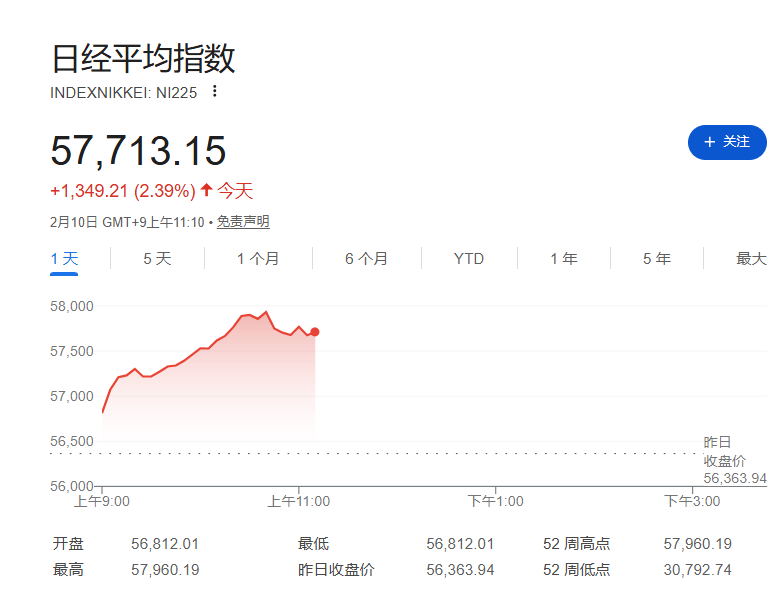
Core Viewpoint - The Asian stock markets continued their strong performance, led by Japan, following Prime Minister Fumio Kishida's election victory, which boosted investor confidence and led to significant gains in the Nikkei 225 index [1][2]. Market Performance - The Nikkei 225 index surpassed the 57,000-point mark, rising by 2.64% to reach a new historical high [6]. - The Topix index also increased by 1.08%, setting a new record [2]. - The KOSPI index in South Korea rose by 1.21%, nearing its historical closing high [4][5]. - The S&P/ASX 200 index in Australia gained 0.39%, aiming for a third consecutive day of increases [4][5]. Currency and Commodity Markets - The offshore RMB strengthened, breaking the 6.91 mark against the USD for the first time since May 2023, currently reported at 6.9094 [9]. - The US dollar index stabilized around 96.97 after a significant drop, which was the largest single-day decline in two weeks [7]. - Gold prices fell by 1% to $5,016.56 per ounce, while silver dropped by 2.5% to $81.31 per ounce [10]. - WTI crude oil futures decreased by 0.1% to $64.15 per barrel [14].
宏观与大宗商品周报:冠通期货研究报告-20260209
Guan Tong Qi Huo· 2026-02-09 11:08
1. Report Industry Investment Rating No information provided in the report. 2. Core Viewpoints - The capital market has been in a high - volatility state in the past week, shifting from divergence to a collective correction. Overseas, the divergence on AI has resurfaced, and the sharp correction of technology stocks, Bitcoin, and precious metals led by silver has impacted asset prices and raised investors' risk - aversion sentiment. In the domestic market, due to the upcoming Spring Festival holiday, futures exchanges have announced margin hikes, leading to a significant outflow of funds from the futures market [5][10]. - The Fed is likely to keep the interest rate unchanged in March, with a probability of 82.3%. The market expects about two interest rate cuts in 2026 [6][65]. 3. Summary by Relevant Catalogs Market Overview - The capital market was highly volatile last week, with a collective correction. Overseas, the AI divergence affected asset prices. In the domestic market, the approaching Spring Festival led to margin hikes and a large - scale outflow of futures market funds. The BDI index dropped sharply, and most commodities corrected. The domestic bond market rebounded, while the stock index and most commodity categories declined. The Wind commodity index had a weekly change of - 21.16%, with 2 out of 10 commodity category indices rising and 8 falling. Precious metals led the decline, followed by non - ferrous metals with a - 5.07% drop. The energy - chemical sector was dragged down by the fall in crude oil prices, and coal - coking - steel and oilseeds also had notable declines. Agricultural products showed mixed performance [5][16]. - In terms of the futures market's capital flow, there was an overall significant outflow of funds from the commodity futures market. The coal - coking - steel and soft commodity sectors saw the most obvious capital inflows, while the precious metals and non - ferrous metals sectors had significant outflows. The volatility of the international CRB commodity index and domestic commodity indices increased. Most commodity futures categories saw higher volatility, except for the agricultural and grain sectors. The chemical and precious metals sectors had remarkable increases in volatility [6]. - The market's focus in the next week will be on the US non - farm payrolls report and CPI data. The non - farm payrolls report may adjust up to 1 million employment data. The market expects non - farm employment growth in January to be in the range of 60,000 - 80,000. China's January inflation and money supply data are also expected to be released next week. The Middle East situation seems to be stabilizing, with indirect talks between the US and Iran [7]. Large - scale Assets - The capital market was highly volatile last week, shifting from divergence to a collective correction. Overseas, the divergence on AI affected asset prices and raised risk - aversion sentiment. The VIX index rose slightly, the US dollar rebounded, and the RMB remained stable. Both the US and Chinese stock markets were under pressure. In the domestic market, due to the Spring Festival, futures exchanges raised margins, leading to a large - scale outflow of funds from the futures market. The BDI index dropped, and most commodities corrected [10]. Sector Express - The domestic bond market rebounded, the stock index declined, and most commodity categories were weak. The growth - style stocks performed significantly worse than the value - style stocks. The CSI 500 and CSI 1000 both fell by more than - 2%, while the CSI 300 and SSE 50 fell by about - 1%. The Wind commodity index had a weekly change of - 21.16%, with 2 out of 10 commodity category indices rising and 8 falling. Precious metals led the decline, followed by non - ferrous metals, and the energy - chemical sector was affected by the fall in crude oil prices [16]. Capital Flow - Last week, there was an overall significant outflow of funds from the commodity futures market. The coal - coking - steel and soft commodity sectors had the most obvious capital inflows, while the precious metals and non - ferrous metals sectors had significant outflows [18]. Variety Performance - Most domestic major commodity futures declined with large margins last week. The top - rising commodity futures were polysilicon, alumina, and glass, while the top - falling ones were Shanghai silver, platinum, and Shanghai tin [22]. Fluctuation Characteristics - Last week, the volatility of the international CRB commodity index increased, and the volatilities of the domestic Wind commodity index and Nanhua commodity index both increased significantly. Most commodity futures categories saw higher volatility, except for the agricultural and grain sectors. The chemical and precious metals sectors had remarkable increases in volatility [25]. Macro Logic - The stock index was weak and declined across the board last week. Growth - style stocks had larger fluctuations and deeper declines. The valuation of the stock index was under pressure, and the equity risk premium (ERP) rebounded from a low level [32]. - The commodity price index fell from a high level, and the inflation expectation declined slightly under pressure [35]. - The US bond yield declined overall, the term structure was stable, the term spread fluctuated narrowly, the real interest rate was under pressure, and the gold price fluctuated sharply, first falling and then rising [52]. - The US high - frequency "recession indicator" fluctuated, the Citigroup Economic Surprise Index rebounded, and the 10Y - 3M spread of US bonds widened significantly and then fluctuated narrowly [57]. Data Tracking - Most international major commodities declined, the BDI index dropped sharply, the CRB index fell, soybeans and corn rose slightly, and gold, silver, copper, and oil all declined. The silver price plunged, and the gold - silver ratio rebounded sharply from a low level [28]. - The asphalt开工率 declined seasonally, real - estate sales remained weak, freight rates decreased, and short - term capital interest rates fluctuated downward [44]. - The US bond interest rate decreased, the China - US interest rate spread rebounded, the inflation expectation rose and then fell, the financial conditions showed signs of bottoming out, the US dollar index declined, and the RMB was strong [55]. Fed Interest Rate Cut Expectation - The Fed is likely to keep the interest rate unchanged at 3.5 - 3.75% in March, with a probability of 82.3% (slightly lower than last week's 87.3%). The probability of a 25 - bp interest rate cut to 3.25 - 3.5% increased slightly to 17.7%. The market expects about two interest rate cuts in 2026 [65]. This Week's Focus - Monday (February 9): Eurozone February Sentix Investor Confidence Index. - Tuesday (February 10): US December retail sales data, US December import price index. - Wednesday (February 11): China's January CPI, US January non - farm payrolls report. - Thursday (February 12): UK Q4 GDP preliminary value. - Friday (February 13): US January CPI. - Other: The People's Bank of China is expected to announce January money supply data during the week [70].
[2月8日]美股指数估值数据(全球股票、商品深V反弹;全球指数星级更新)
银行螺丝钉· 2026-02-08 13:39
Group 1 - The global stock and commodity markets experienced significant volatility this week, with a 1.5% decline in the global stock index and a 4% drop in the Nasdaq 100 index [3][4][5]. - Commodity prices also saw large fluctuations, with gold dropping by 10% and silver experiencing even larger declines [6][7]. - However, by Friday evening, global markets rebounded sharply, with the global stock index rising over 2% and commodities like gold and silver also increasing significantly [10][11][12]. Group 2 - The initial market volatility was attributed to concerns over the uncertainty surrounding the Federal Reserve's interest rate cuts, especially following Trump's nomination of a hawkish candidate for the Fed [15][16]. - This uncertainty led to a tightening of liquidity, adversely affecting leveraged investors and growth-style stocks, which are sensitive to liquidity changes [17][23]. - The Fed's recent comments indicating a potential decrease in inflation helped alleviate short-term liquidity concerns, contributing to the market rebound on Friday [18][20][22]. Group 3 - The tightening of liquidity this year has been particularly unfavorable for leveraged investors and growth/small-cap stocks, leading to potential short-term volatility [23][24]. - Despite this, the Fed is expected to cut rates again in 2026, and there is currently ample liquidity in both USD and RMB markets [25][27]. - Attention should be paid to the trends in USD interest rates in the second half of the year, as the Fed's rate cycle typically lasts 3-5 years [28][30]. Group 4 - A star rating chart for the global stock market indicates that the market was undervalued in previous years (2018, 2020, 2022) and has recently returned to a rating of around 4.1-4.2 stars after a significant drop in April 2025 [32]. - Currently, the global stock index is rated around 2.9 stars, suggesting it is not particularly cheap [32]. - The star rating system indicates that a 4-5 star rating represents relatively low valuation, while a 1-2 star rating indicates a high valuation [33]. Group 5 - There are global stock index funds available in overseas markets, with a total scale exceeding one trillion USD, but there are currently no such funds available in mainland China [35]. - The company has launched a "Global Index Advisory Portfolio" that diversifies investments across various stock markets, including US, UK, Hong Kong, and A-shares [36]. - Interested investors can engage with the advisory service to simulate similar investment effects [37][39]. Group 6 - The new book "Dividend Index Fund Investment Guide" has been released and quickly topped sales charts on platforms like JD.com [41]. - This book aims to address common questions about dividend products and is designed to be accessible for beginners, allowing for quick reading and understanding [43][44].

2026年2月6日凌晨全球多类资产遭抛售:加密市场超43万人爆仓 涉资20.69亿美元
Sou Hu Cai Jing· 2026-02-08 13:22
北京时间2月6日凌晨,全球多类资产遭遇集中抛售,加密货币市场出现大规模爆仓。CoinGlass数据显 示,近24小时内,加密货币市场共有超43万人爆仓,爆仓总金额达20.69亿美元。 针对本轮资产价格波动,美国芝加哥商业交易所宣布调整部分黄金、白银和铝等期货合约的保证金比 例,黄金新保证金比例上调至9%,白银上调至18%,新标准将于当地时间2月6日收盘后正式生效。 市场有风险,投资需谨慎。本文为AI基于第三方数据生成,仅供参考,不构成个人投资建议。 来源:市场资讯 交易平台SynFutures首席运营官Wenny Cai指出,当前清算规模巨大,市场情绪已转向风险规避,价格 走势更多受资产负债表机制驱动,而非市场叙事逻辑。Marex Solutions高级全球市场策略师Ilan Solot表 示:"这基本反映了当前市场的看空情绪,比特币近期未能发挥避险资产作用,也是原因之一。" 彭博汇编数据显示,比特币交易所交易基金在录得约5.62亿美元净流入后,后续两个交易日出现超8亿 美元资金流出。CryptoQuant报告指出,去年同期大量购入比特币的美国ETF,在2026年已转为净卖出 方。Monarq Asset M ...
US Consumer Data Sparks Relief Rally in Bitcoin, Gold, and Stocks
Yahoo Finance· 2026-02-06 19:47
Core Viewpoint - Global markets experienced a significant rebound on February 6 after a sharp sell-off, with Bitcoin recovering to around $70,000 and US equities, gold, and silver also advancing due to technical buying and easing macro fears [1]. Group 1: Market Recovery - The rebound was initiated after key technical levels held across asset classes, particularly the S&P 500 touching its 100-day moving average, which triggered mechanical buying from funds rebalancing risk exposure [2]. - Bitcoin mirrored this pattern, rebounding sharply after a brief fall to $60,000 as forced liquidations slowed and funding rates stabilized, allowing spot buyers to support a short-term recovery [3]. Group 2: Positioning and Selling Pressure - The previous sell-off had cleared excess leverage across markets, particularly in crypto, where derivatives positioning had been heavily skewed toward longs, amplifying downside risks [4]. - By February 6, much of the excess leverage had been flushed out, easing marginal selling pressure and allowing prices to rebound without new bullish catalysts [6]. Group 3: Macro Signals - US macro data released on February 6 showed stronger-than-expected consumer sentiment, marking a six-month high, which helped stabilize market sentiment and reduced fears of sudden economic deterioration [7]. - Bond markets reacted by pricing a slightly higher probability of a near-term rate cut from the Federal Reserve, which pushed short-term yields lower and eased financial conditions, supporting risk assets [8]. Group 4: Safe-Haven Assets - Gold and silver also saw sharp recoveries, reinforcing the view that the prior session's decline was due to liquidity stress rather than a fundamental rejection of safe-haven assets [9].
“银行螺丝钉”:基民怎样才能真正赚到钱
Sou Hu Cai Jing· 2026-02-06 10:55
Core Viewpoint - The company "Bank Screw" has completely suspended subscriptions to its stock-related fund advisory portfolio, indicating that the current stock market is relatively high and investors may face a volatility risk of 20-30% if they enter now [2][19]. Group 1: Market Conditions and Investment Strategies - The current stock market is perceived as being at a high level, prompting the suspension of fund subscriptions [3][19]. - For ordinary investors, dividend index funds are recommended due to their relatively lower volatility, making them more suitable as an entry point [3][10]. - The recent performance of the STAR Market and ChiNext has shown significant volatility, making them more appropriate for experienced investors with higher risk tolerance [3][9]. - In 2026, two key signals to watch are the Federal Reserve's interest rate cycle and the recovery of fundamentals, which could impact market conditions significantly [4][22]. Group 2: Investor Behavior and Fund Performance - A notable phenomenon exists where funds may be profitable while individual investors are not, with 37% of investors still losing money despite a bull market [7][8]. - The primary reasons for investor losses include chasing trends and frequent trading, which lead to higher transaction costs and lower average returns [8][10]. - The growth of dividend products has been accelerated by declining interest rates, making their cash flow more attractive compared to traditional savings [11][12]. Group 3: Valuation and Investment Timing - The historical price-to-earnings (P/E) ratio for major indices like the CSI 300 is between 8-15, with the current P/E ratio slightly above this range, indicating a potential overvaluation [14][15]. - Investors are advised to be cautious during bull markets, as significant price increases may not be sustainable, leading to potential mean reversion [16][17]. - The optimal investment strategy varies by market phase, with dividend stocks being more suitable in the latter stages of a bull market and early stages of a bear market [12][13]. Group 4: Key Economic Indicators - The Federal Reserve's interest rate decisions and the overall recovery of corporate earnings are critical indicators for market performance in 2026 [22][27]. - Observing the year-on-year growth of corporate earnings in the first half of the year will be essential to gauge market momentum [28].

瑞银全球经济和策略研究主管卡普顿:股票或是最值得配置的资产
2 1 Shi Ji Jing Ji Bao Dao· 2026-02-05 23:24
2026年伊始,全球经济正回归长期潜在增长轨道,信贷逐步修复,市场信心边际回升。瑞银全球经济和策略研究主管卡普顿(Arend Kapteyn)在接受南方财经记者专访时表示,在利差收窄、汇率波动有限且市场流动性充足的背景下,股票仍是最具优势的资产类别,美 股今年预计可涨约10%,欧洲与日本市场也有望录得约8%的涨幅。 他对中国经济保持乐观:新兴经济部门已贡献约四分之一的增长,是推动整体经济的重要动力。他建议投资者在新兴市场中重点关注中国 与巴西,这不仅可获取AI相关敞口,也兼顾估值与盈利增长优势。 卡普顿。资料图 中国在全球新经济领域领先 南方财经:我们把目光转向中国。怎么看中国经济前景?未来推动经济增长的主要动力会来自哪些方面? 卡普顿:现在还处在年初阶段,我们的预测通常还会经历多次调整。 我们认为,新兴经济部门对整体经济增长的贡献,已经接近四分之一。从重要性来看,这些新经济领域的影响已超过房地产行业。然而, 这些变化并未充分反映在我们用于预测的整体数据中。因此,如果仅看先前的预测结果,增长似乎并不强劲;但结合我们实际观察到的经 济运行情况,我认为真实的经济表现要强劲得多。 你可以从不同角度去验证这些新兴经济 ...