
股票

Search documents
当前股票回报是否过高
Guo Ji Jin Rong Bao· 2025-09-29 02:54
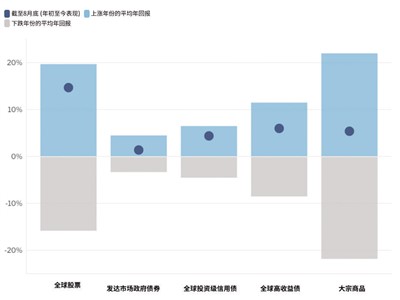
Core Insights - Global stock markets have shown strong performance since the beginning of 2025, with the MSCI Global Index rising approximately 15% year-to-date, continuing a robust trend from previous years [1] - The average annual return for global stocks since the end of the 2022 bear market has reached 20%, which may surprise some investors who typically anchor their expectations around a long-term average return of 7%-10% [1] - This strong performance is not an anomaly but a recurring feature in market cycles, with investment-grade credit bonds historically yielding 6%-7% during economic expansions, while high-yield credit bonds have averaged returns of 11%-12% [1] Investment Insights - Investors should not be deterred by strong market performance; the 15%-20% rise in stocks this year should not be a reason for concern unless an economic downturn is anticipated [2] - Managing downside risk is crucial for enhancing long-term average returns; investors may consider funds that maintain strong participation in rising markets while minimizing downside risk, such as defensive equity funds and hedge funds [2] - Assets with favorable return characteristics, such as credit bonds, are particularly valuable for asset allocators, as they tend to perform well in up years and experience smaller losses in down years [2] Areas of Focus - Key structural growth catalysts to watch include fiscal stimulus, policy reforms, and potential interest rate cuts by central banks [3] - Monitoring inflation trends and the potential rise in cross-asset correlations is essential, despite significant progress made by central banks in controlling inflation [3] - The ability of corporate earnings growth to extend beyond large tech companies to a broader range of industries will be critical for achieving a more balanced and sustainable market rally [5]

大类资产早报-20250929
Yong An Qi Huo· 2025-09-29 02:00
Report Date - The report was released on September 29, 2025 [1] Global Asset Market Performance 10 - Year Treasury Yields of Major Economies - On September 26, 2025, yields in countries like the US were 4.176%, UK 4.745%, etc. Changes varied across different time - frames (latest, one - week, one - month, one - year). For example, the US had a latest change of 0.005, a one - week change of 0.048, a one - month change of - 0.054, and a one - year change of 0.434 [2] 2 - Year Treasury Yields of Major Economies - On September 26, 2025, yields such as the US at 3.570, UK at 4.009, etc. had different changes over different periods. For instance, the US had a latest change of 0.040, a one - week change of 0.050, a one - month change of 0.030, and a one - year change of - 0.040 [2] Dollar Exchange Rates Against Major Emerging Economies' Currencies - On September 26, 2025, the dollar - to - Brazilian real rate was 5.344 with a latest change of - 0.37%. Rates against other currencies also had various changes over different time - spans [2] RMB Data - On September 26, 2025, on - shore RMB was 7.135, off - shore RMB was 7.144, the mid - price was 7.115, and the 12 - month NDF was 6.994. Each had different percentage changes over different periods [2] Major Economies' Stock Indexes - On September 26, 2025, the S&P 500 was 6643.700, the Dow Jones Industrial Index was 46247.290, etc. Indexes had different latest, one - week, one - month, and one - year changes. For example, the S&P 500 had a latest change of 0.59%, a one - week change of - 0.31%, a one - month change of 2.84%, and a one - year change of 16.50% [2] Credit Bond Indexes - Different credit bond indexes (US investment - grade, euro - zone investment - grade, etc.) had different latest, one - week, one - month, and one - year changes. For example, the US investment - grade credit bond index had a latest change of 0.06%, a one - week change of - 0.40%, a one - month change of 1.22%, and a one - year change of 3.16% [2][3] Stock Index Futures Trading Data Index Performance - Closing prices of A - shares, CSI 300, etc. had corresponding percentage changes. For example, A - shares closed at 3828.11 with a - 0.65% change [4] Valuation - PE (TTM) and its环比 changes were provided for indexes like CSI 300, S&P 500, etc. For example, the CSI 300 had a PE (TTM) of 14.04 with a - 0.09环比 change [4] Risk Premium - Risk premium data and its环比 changes were given for some indexes. For example, the S&P 500 had a 1/PE - 10 rate of - 0.56 with a - 0.03环比 change [4] Fund Flows - Latest values and 5 - day average values of fund flows for different indexes were presented. For example, A - shares had a latest fund flow of - 1188.84 and a 5 - day average of - 537.15 [4] Trading Volume - Latest trading volumes and环比 changes were provided for different markets. For example, the Shanghai and Shenzhen stock markets had a latest trading volume of 21468.85 with a - 2242.05环比 change [4] Main Contract Premium or Discount - Basis and percentage changes were given for futures contracts like IF, IH, IC. For example, IF had a basis of - 25.05 and a - 0.55% change [4] Treasury Bond Futures Trading Data - Closing prices and percentage changes were provided for treasury bond futures like T00, TF00, etc. For example, T00 closed at 107.680 with a - 0.04% change [5] - Funding rates (R001, R007, SHIBOR - 3M) and their daily changes were presented. For example, R001 was 1.3344% with a - 47.00 BP daily change [5]
美国债务危机:2025年的全球隐忧与重塑机遇
Di Yi Cai Jing· 2025-09-28 12:37
Core Insights - The debt crisis is a systemic challenge for the global economy, significantly impacting financial stability, geopolitical dynamics, and market trends [1][17] - The rapid increase in U.S. federal debt, projected to reach $37.3 trillion by September 2025, poses risks to both domestic and international economic conditions [1][17] - Understanding the causes, manifestations, and potential consequences of the debt crisis is crucial for investors, economists, and policymakers [1] Causes of the Debt Crisis - The primary driver of the rapid growth in U.S. federal debt is the persistent budget deficit, with a projected deficit of $1.9 trillion for the fiscal year 2025, equivalent to 6% of GDP [2] - Tax cuts and increased spending, particularly from the Trump administration, have significantly reduced federal revenue, leading to an estimated $3.4 trillion increase in deficits from 2025 to 2034 [2] - Mandatory spending, including Social Security and Medicare, along with rising interest payments, are major contributors to the expanding deficit [2] Interest Costs and Market Dynamics - High interest costs exacerbate the debt issue, with projected interest payments reaching $952 billion in 2025, accounting for 18.4% of federal revenue [3] - The current high-interest environment, with a 10-year Treasury yield around 4.1%, has led to a significant increase in interest costs compared to previous years [3] - Rising bond yields across major economies signal a potential reset of the monetary system, affecting the value of the dollar and inflation pressures [4] Interconnectedness of Debt and Markets - The bond market, valued at over $50 trillion, is highly interconnected with equity and precious metals markets, with rising debt leading to increased borrowing costs [5] - The S&P 500 index has seen significant growth, but its valuation relative to GDP indicates potential bubble risks [5] - Gold has emerged as a hedge against currency devaluation, with prices rising from $1,770 per ounce in 2020 to $3,682 per ounce in 2025 [5][6] Geopolitical Implications - High debt levels limit diplomatic flexibility, particularly in U.S.-China relations, where China holds approximately $780 billion in U.S. debt [8] - The trend of de-dollarization is accelerating, with non-dollar trade increasing and central banks shifting towards gold as a primary asset [8] - Historical patterns suggest that high debt levels can lead to military conflicts as a means to divert public attention from domestic issues [8] Social and Political Consequences - Wealth inequality has reached historic highs, with 90% of stock market wealth concentrated among the top 10% of the population [9] - Public concern over the federal budget deficit is significant, but political divisions hinder effective reform [9] - The lack of coherent fiscal policy exacerbates the debt crisis, with differing approaches from political parties complicating solutions [9] Fiscal Management and Cash Flow - The U.S. Treasury General Account (TGA) has a balance of $410 billion, significantly below the target of $850 billion, necessitating frequent borrowing [10] - The short-term nature of U.S. debt makes the government sensitive to interest rate fluctuations, increasing refinancing costs [10] - The debt ceiling poses a significant risk, with potential market turmoil if Congress fails to raise or suspend it in a timely manner [11] Solutions and Future Outlook - Addressing the debt crisis requires a multi-faceted approach, including economic growth strategies, spending controls, and inflation management [13] - Long-term reforms should focus on balancing the budget, optimizing tax policies, and fostering international cooperation to attract foreign investment [15] - The next decade is critical for U.S. fiscal stability, necessitating decisive action to ensure long-term economic prosperity [16][17]
1,000 Americans Became Millionaires Every Day in 2024: 3 Assets That Are Driving Their Wealth
Yahoo Finance· 2025-09-27 14:57
Core Insights - The rise in personal wealth in the U.S. is significant, with approximately 1,000 Americans becoming millionaires daily, as reported in UBS' 2025 Global Wealth Report [1] Group 1: Key Assets Driving Wealth - Real estate is a traditional yet effective path to millionaire status, with homeownership contributing to significant wealth accumulation [3] - Home values have appreciated rapidly, allowing families to build wealth through equity growth, even with modest down payments [4] - Renting out property can provide additional income, aiding in mortgage repayment and reinvestment opportunities [5] Group 2: Investment Strategies - Stock market investments, particularly in tech and energy sectors, have seen substantial growth, with long-term holding strategies yielding the best results [6] - Consistent contributions to index funds, such as the S&P 500, can lead to significant wealth accumulation over time [6] - Employer-sponsored retirement plans, like 401(k)s, have enabled many average-income workers to build substantial retirement savings through consistent contributions [7]
没想到!这样配置居然能跑赢99%的散户!
雪球· 2025-09-27 13:01
Core Viewpoint - The article emphasizes the importance of a diversified, long-term investment strategy, particularly through a "permanent investment strategy" that balances various asset classes to achieve stable returns while minimizing risk [4][5][12]. Group 1: Investment Strategy - The author advocates for a global multi-asset allocation approach, suggesting that investors should not overly concentrate on high-valuation sectors [4][5]. - A sample permanent investment portfolio is proposed, consisting of 12.5% in Nasdaq 100, 12.5% in S&P 500, 25% in gold, 25% in Chinese bonds, and 25% in U.S. bonds [6][12]. - Historical backtesting of this strategy shows a three-year return of 70.74%, outperforming the CSI 300's 18.41% and slightly lagging behind the S&P 500's 83.51% [9][12]. Group 2: Risk and Performance Metrics - The maximum drawdown for the permanent strategy is reported at 9.19%, significantly lower than the CSI 300's 24.8% and the S&P 500's 18.62% [9][12]. - The Sharpe ratio for the permanent strategy is calculated at 0.12, compared to 0.02 for the CSI 300 and 0.08 for the S&P 500, indicating better risk-adjusted returns [9][12]. - The strategy's positive return days are at 55.14%, slightly higher than the CSI 300's 49%, suggesting that while the strategy does not yield daily profits, it benefits from lower volatility [9][12]. Group 3: Long-term Performance - Over five years, the permanent strategy achieved a return of 79.1%, while the CSI 300 only returned 0.07% and the S&P 500 returned 115.36% [13]. - The article notes that rebalancing the portfolio over five years resulted in a decrease in performance from 76.3% to 66.6%, attributed to the strong upward trends in U.S. stocks and gold [17]. - The author argues that long-term rebalancing can enhance returns during market downturns by locking in profits and allowing for reinvestment at lower prices [17]. Group 4: Asset Correlation - The correlation between S&P 500 and Nasdaq 100 is very high at 0.97, indicating limited diversification benefits between these two assets [20]. - In contrast, the correlation between S&P 500 and gold is only 0.01, and between S&P 500 and U.S. bonds is 0.09, highlighting the importance of including low-correlation assets in a diversified portfolio [20]. - The article suggests that the current market is heavily concentrated in large-cap tech stocks, which may pose risks if the broader economy weakens [21].

每日投行/机构观点梳理(2025-09-25)
Jin Shi Shu Ju· 2025-09-25 10:56
Group 1: Currency and Economic Outlook - Barclays reports that despite recent negative events, the US dollar has remained resilient, with no significant decline observed since May, even amid weak economic data and challenges to the Federal Reserve's credibility [1] - Goldman Sachs predicts that the US economy will recover in the coming months, which may support the dollar's continued strength [1] Group 2: Oil and Emerging Markets - Goldman Sachs states that a complete ban on Russian oil imports by the EU is unlikely due to reliance from certain member states like Hungary and Slovakia, and any potential ban would only redistribute oil flows rather than reduce global supply [2] - Goldman Sachs expects emerging market stocks and currencies to rise by the end of the year, raising the MSCI Emerging Markets Index target from 1,370 to 1,480 points, indicating a potential 10% upside [2] Group 3: Domestic Market Insights - Dongfang Jincheng forecasts stable and ample market liquidity by year-end, with potential for a new round of reserve requirement ratio cuts and government bond purchases [4] - CITIC Securities highlights the long video industry benefiting from favorable policies, which may enhance production capacity and efficiency for content creators [6][10] - CITIC Securities notes a recovery in the restaurant industry, with August seeing a year-on-year increase in dining revenue, suggesting structural opportunities for leading companies with strong compliance and quality [8] Group 4: Sector-Specific Developments - CITIC Securities indicates that the carbon fiber industry is in a recovery phase, with strong demand in wind energy and aerospace sectors, recommending attention to high-quality companies with international exposure [9] - China Galaxy Securities observes a slight increase in cement prices due to seasonal demand, with expectations for further price support from rising coal prices [11][12] - China Galaxy Securities also reports positive signals in panel procurement ahead of the overseas promotional season, indicating a potential peak in TV demand [13] Group 5: Electronic Materials - Huatai Securities emphasizes the importance of electronic cloth in the PCB-CCL supply chain, predicting a supply shortage for various specialty electronic cloth products until 2026, and recommends companies with rapid capacity expansion [14][15]
智昇黄金原油分析:分歧明显存在 黄金上涨不歇
Sou Hu Cai Jing· 2025-09-24 09:10
黄金方面:今年黄金已上涨超44%,各国央行持续增购黄金,欧洲央行的调查数据显示,全球央行黄金 储备总量达到3.6万吨。近三年来,全球央行每年增持黄金超过1000吨,是过去十年平均水平的两倍。 本周美联储官员密集发表讲话,芝加哥联储主席格尔斯比表示,美国经济面临经济增长放缓和劳动力市 场疲软的双重压力,在降息的问题上需要保持谨慎。利率可以逐步的下调,但通胀仍高于目标,不宜激 进地降息。 来源:智昇财论 智昇研究黄金高级分析师欧文认为,近日多位美联储官员发表讲话,一部分的表述鹰派,对通胀表示担 忧,降息持谨慎态度;另一部分则呼吁降息,美联储内部分歧加大。 技术面:黄金周线月线多头趋势,不断刷新历史高点。小时图来看,黄金昨日(9月23日)晚间开始回 落,在3755美元一线获得支撑,日内继续上涨的概率大,日内上方可以先看向高点3790美元一线。 原油方面:近期,欧洲正在加大对俄罗斯能源出口的制裁,包括出口价格的下调以及通过法案提前一年 结束购买俄罗斯能源。同时,特朗普敦促欧洲尽快地停止购买俄罗斯能源,并试图切断其主要资金来 源,对印度的采购行为征收50%的关税。 今天凌晨,美国至9月19日当周API原油库存数据,录得 ...
大类资产早报-20250924
Yong An Qi Huo· 2025-09-24 01:09
Report Overview - Report Title: Global Asset Market Performance - Major Asset Morning Report - Report Date: September 24, 2025 - Research Team: Macro Team of the Research Center 1. Report Industry Investment Rating - No industry investment rating is provided in the report. 2. Report's Core View - The report presents the performance data of various global asset markets on September 23, 2025, including 10 - year and 2 - year government bond yields of major economies, exchange rates of the US dollar against major emerging - economy currencies, major economy stock indices, credit bond indices, stock index futures trading data, and government bond futures trading data. 3. Summary by Relevant Catalogs 3.1 Global Asset Market Performance - Bond Yields - **10 - Year Government Bond Yields**: On September 23, 2025, the 10 - year government bond yields of the US, UK, France, etc. were 4.107%, 4.679%, 3.563% respectively. The latest changes ranged from - 0.041 (US) to 0.004 (France), with weekly changes from - 0.030 (Switzerland) to 0.078 (US), monthly changes from - 0.155 (US) to 0.065 (France), and annual changes from - 0.220 (Switzerland) to 0.912 (UK) [2]. - **2 - Year Government Bond Yields**: On September 23, 2025, the 2 - year government bond yields of the US, UK, Germany, etc. were 3.570%, 3.950%, 2.019% respectively. The latest changes ranged from 0.000 (US, Japan) to 0.011 (South Korea), with weekly changes from - 0.014 (China 1Y) to 0.058 (Japan), monthly changes from - 0.012 (UK) to 0.084 (Germany), and annual changes from - 0.432 (South Korea) to 0.544 (Japan) [2]. 3.2 Global Asset Market Performance - Exchange Rates - **US Dollar against Major Emerging - Economy Currencies**: On September 23, 2025, the exchange rates of the US dollar against the Brazilian real, South African rand, etc. were 5.282, 17.245 respectively. The latest changes ranged from - 0.99% (Brazil) to 0.24% (South Korean won), with weekly changes from - 0.54% (South African rand) to 1.09% (South Korean won), monthly changes from - 2.75% (Brazil) to 0.05% (South Korean won), and annual changes from - 5.07% (Brazil) to 4.58% (South Korean won) [2]. - **Renminbi**: On September 23, 2025, the on - shore RMB, off - shore RMB, and the central parity rate were 7.113, 7.113, 7.106 respectively. The latest changes were - 0.02%, - 0.03%, - 0.07% respectively, with weekly changes of - 0.02%, 0.12%, 0.04% respectively, monthly changes of - 0.55%, - 0.56%, - 0.18% respectively, and annual changes of 0.23%, 0.18%, 0.04% respectively [2]. 3.3 Global Asset Market Performance - Stock Indices - **Major Economy Stock Indices**: On September 23, 2025, the S&P 500, Dow Jones Industrial Average, and NASDAQ were 6656.920, 46292.780, 22573.470 respectively. The latest changes ranged from - 0.95% (NASDAQ) to 0.59% (Mexican stock index), with weekly changes from - 0.03% (Spanish stock index) to 1.21% (German DAX), monthly changes from - 2.24% (German DAX) to 7.29% (Mexican stock index), and annual changes from 5.45% (French CAC) to 31.35% (Spanish stock index) [2]. 3.4 Global Asset Market Performance - Credit Bond Indices - **Credit Bond Indices**: The latest changes of the US investment - grade credit bond index, euro - zone investment - grade credit bond index, etc. ranged from - 0.03% (euro - zone investment - grade credit bond index) to 0.40% (emerging - economy high - yield credit bond index), with weekly changes from - 0.39% (US investment - grade credit bond index) to 0.27% (euro - zone high - yield credit bond index), monthly changes from 0.26% (euro - zone investment - grade credit bond index) to 1.61% (US investment - grade credit bond index), and annual changes from 3.66% (US investment - grade credit bond index) to 13.30% (emerging - economy high - yield credit bond index) [2][3]. 3.5 Stock Index Futures Trading Data - **Index Performance**: The closing prices of A - shares, CSI 300, SSE 50, etc. were 3821.83, 4519.78, 2919.51 respectively, with changes of - 0.18%, - 0.06%, - 0.09% respectively [4]. - **Valuation**: The PE (TTM) of the CSI 300, SSE 50, and CSI 500 were 14.01, 11.64, 34.17 respectively, with环比 changes of 0.04, 0.07, - 0.25 respectively [4]. - **Fund Flow**: The latest values of the fund flow of A - shares, the main board, and small - and medium - sized enterprise boards were - 1566.78, - 1050.60, etc., with 5 - day average values of - 1037.14, - 806.14, etc. respectively [4]. - **Trading Volume**: The latest trading volumes of the Shanghai and Shenzhen stock markets, CSI 300, and SSE 50 were 24943.82, 6805.14, 1689.87 respectively, with环比 changes of 3728.99, 1173.65, 125.86 respectively [4]. - **Main Contract Premium/Discount**: The basis of IF, IH, and IC were - 35.98, 5.49, - 240.11 respectively, with premiums/discounts of - 0.80%, 0.19%, - 3.34% respectively [4]. 3.6 Government Bond Futures Trading Data - **Government Bond Futures**: The closing prices of T00, TF00, T01, and TF01 were 107.715, 105.625, 107.385, 105.505 respectively, with changes of 0.13%, 0.09%, 0.12%, 0.09% respectively [5]. - **Funding Rates**: The funding rates of R001, R007, and SHIBOR - 3M were 1.4619%, 1.5218%, 1.5620% respectively, with daily changes of - 7.00 BP, - 1.00 BP, 0.00 BP respectively [5].
罕见!黄金今年36次、美股28次,同创新高,什么信号?如何交易?
Sou Hu Cai Jing· 2025-09-23 11:54
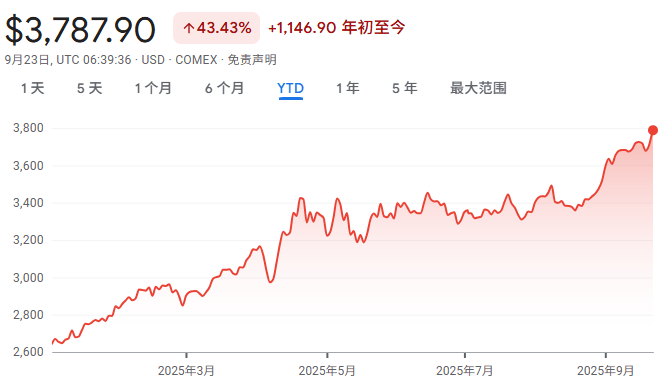
Core Viewpoint - The Federal Reserve is initiating interest rate cuts, leading to a surge in global asset prices, with significant movements in both risk and safe-haven assets [1][5]. Group 1: Market Performance - Nvidia's substantial investment in OpenAI has reignited the AI boom, pushing the three major U.S. stock indices to new highs, with the S&P 500 index hitting its 28th record high this year [2]. - COMEX gold prices closed at $3,775.10, marking the 36th record high of the year, with a year-to-date increase of approximately 43% [2]. Group 2: Market Dynamics - The simultaneous rise of risk and safe-haven assets has led to skepticism among investors regarding whether the market has reached "perfect pricing" [5]. - Bank of America strategist Michael Hartnett suggests that the combination of tariff cuts, tax reductions, and interest rate cuts creates a "run-it-hot" policy environment, providing implicit guarantees for the economy and stock market [5]. - Deutsche Bank's report indicates that the market has not yet reached a "perfect pricing" state, suggesting that concerns about future risks may actually provide room for potential market increases [5][6]. Group 3: Investment Strategies - Hartnett proposes a five-point trading strategy to navigate the current market conditions, including investing directly in bubble assets, constructing a "barbell" portfolio, shorting corporate bonds of bubble companies, shorting U.S. bonds, and trading volatility [10][11]. - The current market sentiment is characterized by a belief that "money is depreciating, and holding it is less favorable than consumption or investment," driving funds into risk assets [6]. Group 4: Gold Market Analysis - The rise in gold prices is attributed to geopolitical uncertainties, inflation concerns, and expectations of interest rate cuts, creating a "perfect storm" for gold [13][14]. - Deutsche Bank notes that the high gold prices reflect market fear rather than extreme optimism, indicating a typical sign of investors seeking safe-haven assets [13]. - Despite concerns about a potential bubble, key market indicators have not shown signs of irrational exuberance, suggesting that the current gold market may be in a sustained bull phase rather than a bubble [14][15].

大类资产早报-20250923
Yong An Qi Huo· 2025-09-23 01:18
Report Information - Report Date: September 23, 2025 [2] - Report Type: Global Asset Market Performance and Futures Trading Data Report Global Asset Market Performance 10 - Year Treasury Yields of Major Economies - On September 22, 2025, the 10 - year Treasury yields of the US, UK, France, etc. were 4.148, 4.712, 3.559 respectively. The latest changes were 0.020, - 0.002, 0.006; weekly changes were 0.109, 0.080, 0.081; monthly changes were - 0.128, 0.021, 0.050; and annual changes were 0.473, 0.931, 0.710 [3]. 2 - Year Treasury Yields of Major Economies - On September 22, 2025, the 2 - year Treasury yields of the US, UK, Germany, etc. were 3.570, 3.976, 2.014 respectively. The latest changes were 0.050, 0.000, - 0.005; weekly changes were 0.050, 0.028, - 0.002; monthly changes were - 0.020, 0.038, 0.045; and annual changes were - 0.020, 0.161, - 0.206 [3]. US Dollar Exchange Rates Against Major Emerging - Market Currencies - On September 22, 2025, the US dollar exchange rates against the Brazilian real, South African rand, South Korean won, etc. were 5.335, 17.326, 1391.250 respectively. The latest changes were 0.21%, - 0.10%, - 0.43%; weekly changes were 0.35%, - 0.19%, 0.36%; monthly changes were - 1.41%, - 1.60%, 0.05%; and annual changes were - 5.16%, - 2.67%, 3.67% [3]. Stock Indices of Major Economies - On September 22, 2025, the S&P 500, Dow Jones Industrial Average, NASDAQ, etc. were 6693.750, 46381.540, 22788.980 respectively. The latest changes were 0.44%, 0.14%, 0.70%; weekly changes were 1.19%, 1.09%, 1.97%; monthly changes were 3.95%, 2.43%, 6.25%; and annual changes were 19.62%, 12.86%, 29.71% [3]. Credit Bond Indices - The latest changes of the US investment - grade credit bond index, euro - area investment - grade credit bond index, etc. were - 0.16%, 0.06%, etc.; weekly changes were - 0.53%, - 0.03%, etc.; monthly changes were 1.47%, 0.43%, etc.; and annual changes were 3.74%, 4.30%, etc. [3][4] Futures Trading Data Stock Index Futures Trading Data - The closing prices of A - shares, CSI 300, SSE 50, etc. were 3828.58, 4522.61, 2922.18 respectively, with percentage changes of 0.22%, 0.46%, 0.43%. The PE (TTM) of CSI 300, SSE 50, etc. were 13.97, 11.57, etc., with环比 changes of 0.01, - 0.01, etc. The latest values of capital flows in A - shares, the main board, etc. were - 336.93, - 447.76, etc. The latest trading volumes of the Shanghai and Shenzhen stock markets, CSI 300, etc. were 21214.83, 5631.49, etc., with环比 changes of - 2023.46, - 407.38, etc. The basis of IF, IH, IC were - 38.61, 0.82, - 211.93, with amplitudes of - 0.85%, 0.03%, - 2.93% [5]. Treasury Bond Futures Trading Data - The closing prices of T00, TF00, T01, TF01 were 107.975, 105.770, 107.620, 105.640 respectively, with percentage changes of 0.00%, 0.00%, 0.00%, 0.00%. The R001, R007, SHIBOR - 3M were 1.4749%, 1.5262%, 1.5620% respectively, with daily changes of - 5.00, 1.00, 0.00 BP [6]