贵金属

Search documents
长城基金:市场主线逐渐清晰,硬科技与顺周期机会凸显
Xin Lang Cai Jing· 2026-02-27 11:51
Core Viewpoint - The A-share market has shown a continuation of the risk appetite recovery observed before the Spring Festival, characterized by "increased volume and structural differentiation" in the first trading week after the holiday [1][3]. Market Performance - The overall market trend is influenced by rising overseas uncertainties, with geopolitical and tariff narratives resurfacing, leading to a pullback in the Hong Kong stock market while energy and resource sectors perform relatively well [1][3]. - A-shares exhibit a stronger internal momentum, maintaining high trading volumes with total turnover exceeding 2 trillion yuan [1][3]. Market Structure - The market style has shifted from a focus on "pure software/AI applications" to "hard technology + cyclical stocks" [1][3]. - The cyclical sector has shown a phase of strength, driven by geopolitical risk premiums pushing up energy prices and uncertainties around tariffs leading to "re-inflation trades" [1][3]. - The hard technology sector is characterized by a "discerning" approach, with funds favoring companies with verifiable orders and performance in the computing hardware chain (e.g., optical communication, PCB, liquid cooling), while being sensitive to AI software themes lacking performance validation [1][3]. Investment Strategy - The first week after the holiday has reinforced market risk appetite, but variables such as overseas geopolitical issues, tariffs, and interest rate expectations may amplify volatility [4]. - The current investment focus is clear, transitioning from narrative-driven to performance-driven, with attention on the following areas: - Emphasis on "performance verification" and "domestic substitution," particularly in AI computing hardware chains, semiconductor equipment, and materials, while avoiding high-volatility stocks without performance support [4]. - Focus on cyclical and resource sectors, leveraging the "hedging attributes" of geopolitical premiums and re-inflation, with potential value in energy, precious metals, and non-ferrous metals, while also considering traditional industries benefiting from "anti-involution" [4]. - Defensive and thematic directions, suggesting high-dividend sectors may offer some "anti-volatility" value amid increased fluctuations, with recommendations to base themes on policy documents and industry progress, avoiding purely conceptual extrapolations [4].
陷入致命僵持,今晚黄金一锤定音!
Sou Hu Cai Jing· 2026-02-27 09:49
Group 1: Gold and Silver Market - Gold prices experienced a slight increase of 0.4%, closing at $5183.88, after dipping to around $5130 but supported by buying interest [1] - Silver prices initially broke the $90 mark but fell over 4%, ultimately closing down 1.01% at $88.3, with current trading around $89.47 [1] Group 2: U.S. Economic Indicators - The latest unemployment claims report showed 212,000 initial claims, slightly below the expected 215,000, indicating a stable U.S. economy without overheating or cooling [5] - The report suggests that the urgency for interest rate cuts by the Federal Reserve may be less pressing, as market expectations shifted from certainty of a June rate cut to a more uncertain outlook [5] - Federal Reserve officials expressed a cautious optimism regarding potential rate cuts, with suggestions for a total of 1% reduction over four meetings this year [6][8] Group 3: Market Reactions and Predictions - The upcoming U.S. Producer Price Index (PPI) report is anticipated, with expectations of a 0.3% month-over-month increase, which could influence the Fed's interest rate decisions [9] - If PPI data exceeds expectations, it may reinforce the Fed's stance on maintaining high rates, while lower-than-expected data could ease tightening concerns, benefiting gold and equities [9] Group 4: Market Sentiment and Concerns - Concerns in the stock market were heightened by warnings from notable investor Michael Burry regarding potential risks in Nvidia's financial health due to weak demand for AI chips [12]


美元黄昏,黄金归来——地缘新秩序下的A股三大主线
Hua Er Jie Jian Wen· 2026-02-27 07:58
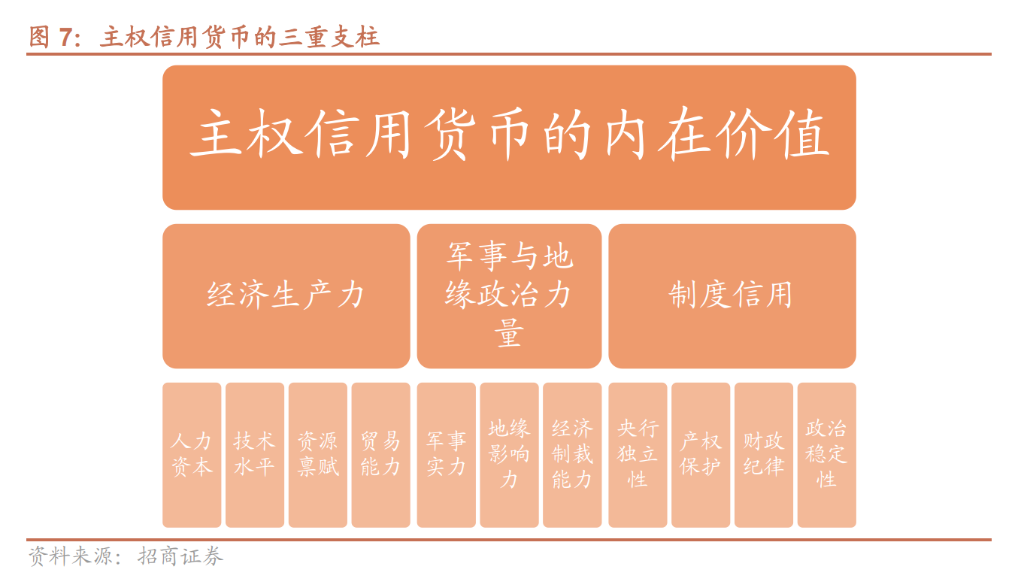
Core Viewpoint - The global capital market is undergoing a profound restructuring since 2022, with a historical decoupling of gold from the dollar system, driven by structural fractures in the "three pillars" of dollar credit: institutional credit, economic productivity, and military deterrence [1][4][5] Group 1: Decoupling of Gold and Dollar - The report indicates that the traditional pricing logic of gold, which was tightly bound to the dollar framework, has been disrupted, particularly during the aggressive interest rate hikes by the Federal Reserve from 2022 to 2024 [5][8] - The decoupling is attributed to the simultaneous structural collapse of the three pillars supporting sovereign credit currency systems, including the erosion of institutional credit, hollowing out of economic productivity, and weakening of military power [8][9] Group 2: Shift in Global Credit System - The dollar is increasingly viewed as a geopolitical weapon rather than a shared global liquidity public good, accelerating the reconstruction of the global credit system [4][8] - Gold is re-emerging as a "shadow anchor" in the global monetary system, highlighting its ultimate value scale function beyond sovereign attributes [4][9] Group 3: A-Share Market Implications - The traditional macro analysis framework based on "growth-profit-valuation" is becoming obsolete, necessitating a shift towards a new paradigm centered on "safety-resilience-control" as core variables for asset pricing [14][16] - Investors are advised to focus on three main strategic lines: resource-based hard assets, core technology autonomy, and industries related to national security [16][17] Group 4: Investment Strategy - The first strategic line emphasizes resource and hard currency assets, including traditional precious metals and critical mineral resources essential for AI and energy transition [16][17] - The second line focuses on core technology assets, particularly in AI, semiconductors, commercial aerospace, and frontier energy technologies [16][17] - The third line pertains to security assets, which are essential for national security and have stable demand due to their reliance on government and state-owned enterprises [16][17]
A股收评:沪指涨0.39%!小金属、电力股掀涨停潮,半导体承压
Ge Long Hui· 2026-02-27 07:42
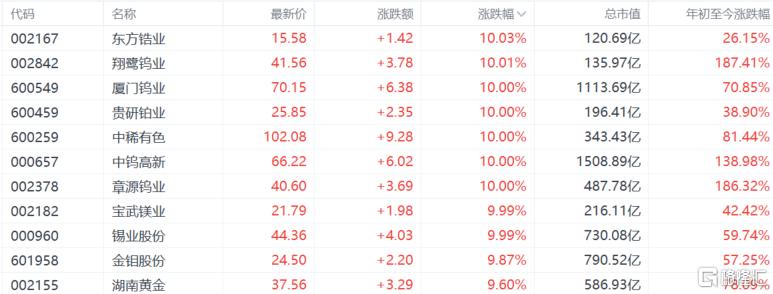
Market Overview - A-shares showed mixed performance on February 27, with the Shanghai Composite Index rising by 0.39% to 4162 points, while the Shenzhen Component Index fell by 0.06% and the ChiNext Index dropped by 1.04% [1][2]. Sector Performance Strong Performers - The small metals, rare earth, and non-ferrous metals sectors experienced significant gains, with multiple stocks such as Xiamen Tungsten and Zhongtung High-tech hitting the daily limit [2][4]. - The precious metals sector was active, with spot gold reaching $5200, leading to a surge in stocks like Hunan Gold, which also hit the daily limit [6][7]. - The power sector showed strong performance, with stocks like Jiawei New Energy and South Network Energy hitting the daily limit [8][9]. - The coal sector also saw gains, with Shanxi Coking Coal and New Dazhou A rising over 6% [10][11]. Weak Performers - The paper sector faced significant declines, with Hengda New Materials dropping over 8% [12][13]. - The storage chip and semiconductor sectors experienced downturns, with Shengmei Shanghai falling over 8% [14][15]. Key Stock Movements Small Metals - Notable stocks in the small metals sector included: - Dongfang Zirconium: +10.03% - Xianglu Tungsten: +10.01% - Huasix Color: +10.01% - Xiamen Tungsten: +10.00% [5]. Precious Metals - Key stocks in the precious metals sector included: - Hunan Gold: +10.01% - Hengbang Shares: +5.18% - Xiaocheng Technology: +4.96% [7]. Power Sector - Significant gainers in the power sector included: - Jiawei New Energy: +19.91% - South Network Energy: +10.04% - Fuling Power: +10.02% [9]. Coal Sector - Major stocks in the coal sector included: - Shanxi Coking Coal: +6.36% - New Dazhou A: +6.10% [11]. Paper Sector - Decliners in the paper sector included: - Hengda New Materials: -8.31% - Wuzhou Special Paper: -7.03% [13]. Semiconductor Sector - Key stocks in the semiconductor sector included: - Shengmei Shanghai: -8.11% - Yuanjie Technology: -5.74% [15]. Price Movements and Market Trends - The price of tungsten powder surpassed 1800 RMB/kg, marking a 469.6% increase compared to last year and a 66.7% increase since the beginning of this year [5]. - The market is experiencing a recovery in trading volume and financing scale post-holiday, with expectations for policy-driven market movements as the Two Sessions approach [19].

收评:沪指涨0.39% 贵金属板块走强
Zhong Guo Jing Ji Wang· 2026-02-27 07:27
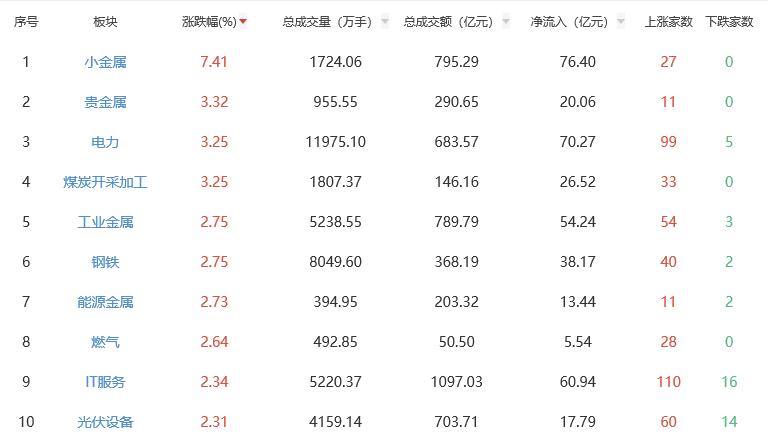
Market Overview - The A-share market showed mixed performance with the Shanghai Composite Index closing at 4162.88 points, up by 0.39%, and a total trading volume of 10,723.68 billion yuan [1] - The Shenzhen Component Index closed at 14,495.09 points, down by 0.06%, with a trading volume of 14,156.56 billion yuan [1] - The ChiNext Index ended at 3,310.31 points, down by 1.04%, with a trading volume of 6,627.59 billion yuan [1] Sector Performance Top Gaining Sectors - The small metals sector led the gains with an increase of 7.41%, totaling a trading volume of 1,724.06 million hands and a net inflow of 795.29 million yuan [2] - The precious metals sector rose by 3.32%, with a trading volume of 955.55 million hands and a net inflow of 290.65 million yuan [2] - The power sector increased by 3.25%, with a trading volume of 11,975.10 million hands and a net inflow of 683.57 million yuan [2] Top Losing Sectors - The paper sector experienced a decline of 1.44%, with a trading volume of 674.54 million hands and a net outflow of 4.79 million yuan [2] - The components sector fell by 1.40%, with a trading volume of 1,846.66 million hands and a net outflow of 58.14 million yuan [2] - The electronic chemicals sector decreased by 1.18%, with a trading volume of 990.05 million hands and a net outflow of 23.51 million yuan [2]
三大核心变量主导金价:关税、地缘与美联储政策
Sou Hu Cai Jing· 2026-02-27 07:14
Core Viewpoint - Recent international gold prices have shown a significant rebound, breaking through key resistance levels and reflecting strong performance driven by geopolitical tensions, adjustments in U.S. tariff policies, and Federal Reserve monetary policy statements [1] Group 1: U.S. Tariff Policy Adjustments - The U.S. Supreme Court ruled on February 20 that the large-scale tariff policy implemented by the Trump administration was illegal, leading to the cessation of these tariffs starting February 24, 2026 [2] - In response, Trump announced an executive order to impose an additional 10% tariff on all goods imported into the U.S. for 150 days, later increasing it to 15%, maintaining existing tariffs amid rising trade policy uncertainty [2] Group 2: Geopolitical Risks - The ongoing negotiations between the U.S. and Iran have become a key variable affecting gold prices, with recent talks showing mixed progress and leading to fluctuations in market sentiment [2] - Following a significant drop in gold prices below $4,900 per ounce, renewed tensions and military deployments by the U.S. in the Middle East have driven gold prices back above $5,000 per ounce, with further escalation possible depending on the outcome of negotiations [2] Group 3: Federal Reserve Monetary Policy - Recent statements from Federal Reserve officials have been hawkish, indicating that interest rates may remain unchanged for an extended period due to improving labor market data and persistent inflation risks [3] - The Fed's stance has supported a rebound in the U.S. dollar, indirectly influencing precious metal prices [3] Group 4: Market Impact and Future Focus - Gold and silver have recently strengthened due to uncertainties surrounding tariffs and risks of U.S. military action against Iran, recovering approximately half and one-third of their declines from late January, respectively [4] - The market is expected to maintain a volatile but less intense trading range, with ongoing geopolitical tensions providing long-term support for precious metals [4] - Future attention should be on the progress of U.S.-Iran negotiations, as a successful agreement could lead to a sudden market shift, while failure could push gold prices towards historical highs [4]
全球最大黄金ETF连续4日增持,黄金ETF华夏(518850)近20日吸金超28亿元
Mei Ri Jing Ji Xin Wen· 2026-02-27 06:53
Group 1 - The core viewpoint of the article highlights the recent strength in gold prices, with current trading around $5,212, and a notable performance of gold-related ETFs [1] - As of February 26, the SPDR Gold Trust has increased its holdings by 19.15 tons over four consecutive days, bringing the total to 1,097.90 tons [1] - The ZFX Shan Hai Securities report indicates that despite increased market volatility, investor enthusiasm for the metals and mining sector remains strong, with gold and copper being favored commodities for investment this year [1] Group 2 - In the past 20 trading days, the Huaxia Gold ETF (518850) has seen net inflows for 17 days, totaling 2.813 billion yuan [1] - The article attributes the strong demand for precious metals to multiple favorable factors, including growth momentum in emerging markets, a macro backdrop of globalization reversal, and an intensifying trend of de-dollarization [1] - Structural factors are providing robust support for gold prices, allowing for quick recovery and establishment of solid support levels after technical pullbacks [1]
黄金股板块盘中上行,黄金股票ETF(517400)盘中涨超1.6%,美伊谈判反复,贵金属上行持续
Mei Ri Jing Ji Xin Wen· 2026-02-27 06:15
2月27日,黄金股板块盘中上行,黄金股票ETF(517400)盘中涨超1.6%,美伊谈判反复,贵金属上行 持续。 风险提示:提及个股仅用于行业事件分析,不构成任何个股推荐或投资建议。指数等短期涨跌仅供参 考,不代表其未来表现,亦不构成对基金业绩的承诺或保证。观点可能随市场环境变化而调整,不构成 投资建议或承诺。提及基金风险收益特征各不相同,敬请投资者仔细阅读基金法律文件,充分了解产品 要素、风险等级及收益分配原则,选择与自身风险承受能力匹配的产品,谨慎投资。 华西证券指出,资源品方面,贵金属和石油上涨,或与美伊谈判反复的背景相关。由于关键议题仍未达 成协议,美伊局势恶化,伦敦金现货价接连上涨,有色&石油板块的修复趋势有望延续。行业层面,关 注资源品,例如贵金属、工业有色和原油,由商品市场涨价逻辑推动。 展望后市,黄金的长期趋势仍然坚实。在货币超发及财政赤字货币化背景下,美元信用体系受到挑战; 加上全球地缘动荡频发推动资产储备多元化,黄金作为安全资产的需求持续提升,全球"去美元化"的趋 势使得黄金有望成为新一轮定价锚,使得贵金属有望具备上行动能。"美联储降息周期+海外不确定性 加剧+全球去美元化趋势"对于金价构 ...
黄金发出警报:美国正撞上债务墙,美联储无解
Jin Shi Shu Ju· 2026-02-27 06:13
Group 1 - The current international accumulation phase of the gold bull market has officially ended, transitioning into a second phase driven by pressures from the U.S. credit system [1] - The U.S. national debt has exceeded $38.5 trillion, with projections indicating that net interest payments will more than double to $2.1 trillion by 2036 [1] - The true debt burden is significantly higher when accounting for unfunded liabilities such as Medicare and Social Security, making current debt levels mathematically impossible to repay under the current dollar valuation [1] Group 2 - Unlike the 2008 financial crisis, where the Federal Reserve could inflate the housing market, the challenges in rescuing the private equity sector are different due to high-leverage companies facing bankruptcy from insufficient consumer demand [2] - The expectation is not for a massive stock market crash like in 1929 or 2008, but rather for gold to experience significant volatility and rise [2] - Structural changes are occurring in the physical metal market as manufacturers abandon standard inventory models, leading to tighter industrial silver demand [2] Group 3 - Tightening banks are increasing margin requirements for smelters and refiners, which is limiting the flow of gold into retail and institutional markets [2] - Historically, central banks have held gold reserves equivalent to about one-third of their balance sheets, suggesting that applying this historical ratio to the current Federal Reserve balance sheet implies a substantial increase in the implied gold price [2] - Gold must rise to a price that can rebalance the Federal Reserve's balance sheet, with estimates suggesting $8,000 would achieve a one-third allocation and $12,000 would reach approximately half [3]
HALO交易爆火!有色金属“杀”回来了
Ge Long Hui A P P· 2026-02-27 06:09
Group 1 - The core viewpoint of the article highlights a significant resurgence in the non-ferrous metals sector, particularly in small metals, precious metals, rare earths, lead, zinc, copper, and cobalt, amidst a weak A-share market [1][2]. - Multiple stocks in the sector have reached historical highs, with notable performances including Zhangyuan Tungsten, which achieved five consecutive trading limits in seven days, and Hunan Gold, which rose over 9% [3][4]. Group 2 - The price of tungsten has surged dramatically, with tungsten powder exceeding 1800 yuan/kg, marking a 469.6% increase compared to last year and a 66.7% rise since the beginning of this year [8]. - The price of ammonium paratungstate (APT) has reached a historic high of 1.1 million yuan/ton, reflecting an increase of over 400% since last year [9]. - The demand for strategic metals is being driven by the AI industry, which is contributing to price increases in key upstream metals [5][10]. Group 3 - The recent price increases in rare earth products, including praseodymium and neodymium oxides, have accelerated the prosperity of the rare earth sector [6]. - Market analysts suggest that the combination of U.S. AI pricing policies, tight raw material supplies, and continuous capital inflows are driving the sustained rise in the small metals sector [10]. - The investment strategy recommended by Zhongyin Securities emphasizes focusing on industrial metals and strategic small metals as a spear, while using precious metals as a shield [11].