汽车

Search documents
宏观经济专题:工业开工韧性仍强
KAIYUAN SECURITIES· 2026-03-23 12:45
Supply and Demand - Construction activity shows resilience, with building start rates performing reasonably well despite seasonal variations[2] - Industrial production remains strong, with overall industrial operating rates at historical highs for the lunar period[2] - Demand for construction materials is higher than the same period in 2025, indicating signs of stabilization in the construction sector[3] Commodity Prices - International commodity prices are influenced by ongoing geopolitical tensions, with oil prices continuing to rise and gold prices experiencing significant fluctuations[4] - Domestic industrial product prices are showing a strong upward trend, with notable increases in rebar and coal prices[4] Real Estate Market - New housing transactions in first-tier cities show positive year-on-year growth, with a 61.1% increase in average transaction area compared to the previous lunar period[5] - Second-hand housing transactions in major cities like Beijing and Shanghai have also performed well, with year-on-year increases of 7% and 17% respectively[5] Export Trends - South Korea's AI product exports continue to show strong growth, which may benefit China's exports due to rising energy prices[6] - Overall, China's export volume is expected to decline significantly in March, influenced by global oil price increases[6] Liquidity and Interest Rates - Recent weeks have seen a decline in funding rates, with the R007 rate at 1.48% and DR007 at 1.42% as of March 20[73] - The central bank has implemented a net withdrawal of 35.3 billion yuan through reverse repos in the last two weeks[75] Risk Factors - Potential risks include unexpected fluctuations in commodity prices and stronger-than-expected policy measures[79]
水泥发运明显回升——每周经济观察第63期
一瑜中的· 2026-03-23 11:20
Core Viewpoint - The article discusses the current economic conditions in China, highlighting both improvements and declines in various sectors, including cement shipping rates, oil prices, consumer demand, and trade activities [2][3][4][24]. Group 1: Economic Activity - The Huachuang Macro WEI index has risen to 5.00% as of March 15, 2026, up from 4.58% on March 8, indicating a recovery in economic activity [9]. - The increase in the WEI index is primarily driven by improvements in consumer demand for passenger vehicles and production rates in the semi-steel tire sector, influenced by the Spring Festival holiday effects [9]. Group 2: Asset Performance - The stock-bond Sharpe ratio difference remains high at 2.16, indicating that stocks still offer better relative value compared to bonds, despite a slight decline from previous highs [11]. - The bond yield curve has steepened, with 1-year, 5-year, and 10-year government bond yields reported at 1.2568%, 1.5625%, and 1.8299%, respectively [47]. Group 3: Consumer Demand - Retail sales of passenger vehicles continue to show negative growth, with a year-on-year decline of 21.3% as of March 15, 2026, compared to a 25.4% drop in February [14]. - The real estate market shows signs of contraction, with residential sales area down by 12% year-on-year as of March 20, 2026 [15]. Group 4: Production - Cement shipping rates have improved significantly, reaching 30.6% as of March 20, 2026, an increase of 11 percentage points from March 13, although still 7.6 percentage points lower than the previous year [20]. - The construction industry shows a recovery in work resumption rates, with 62% of construction sites reopening as of March 18, 2026, up 19.5 percentage points from the previous period [21]. Group 5: Trade - Port container throughput growth continues to decline, with a year-on-year increase of only 2.5% as of March 15, 2026, down from 16.5% in the previous year [24]. - The shipping market is experiencing mixed trends, with the Shanghai export container freight index showing a slight decrease of 0.2% [24][25]. Group 6: Prices - Oil prices have continued to rise, with Brent crude oil reaching $112.2 per barrel, an increase of 8.8% [3][33]. - In contrast, gold and copper prices have seen significant declines, with gold priced at $4576.3 per ounce, down 8.9%, and copper at $12128 per ton, down 5.6% [4][33]. Group 7: Fiscal Policy - The government plans to implement a more proactive fiscal policy, with new local bond issuance plans totaling 111.4 billion yuan for the week of March 23, 2026 [39][40].

——金融工程市场跟踪周报20260323:静待资金、量能共振-20260323
EBSCN· 2026-03-23 09:25
- The report tracks the performance of major broad-based indices and sector indices, noting that the A-share market experienced a significant downturn last week, with major broad-based indices closing down for the week[1][12][13] - The report highlights that the valuation percentiles of major broad-based indices such as the SSE 50, CSI 300, CSI 500, CSI 1000, and ChiNext Index are at "moderate" levels, while the SSE Composite Index is at a "dangerous" level[1][19] - The report tracks quantitative sentiment indicators, including volume timing signals, the proportion of rising stocks in the CSI 300, and moving average sentiment indicators, noting that all volume timing signals for the indices are currently cautious[24][25] - The report observes market profitability effects through cross-sectional and time-series volatility, noting that the cross-sectional volatility of CSI 300 index constituents increased week-on-week, indicating an improved short-term alpha environment, while the cross-sectional volatility of CSI 500 and CSI 1000 index constituents decreased, indicating a deteriorated short-term alpha environment[2][37][38] - The report tracks institutional research activities, noting that the top five stocks of interest to institutions last week were Blue Sail Medical, Hailianxin, Dike Co., Aima Technology, and Oulu Tong[3][55][56] - The report tracks the performance of stock index futures, noting that the main contracts of SSE 50, CSI 300, CSI 500, and CSI 1000 index futures all experienced an increase in discount rates compared to the previous trading week[58][59][60] - The report tracks southbound capital flows, noting that southbound funds had a net outflow of HKD 6.329 billion last week, with HKD 6.121 billion net outflow from the Shanghai Stock Connect and HKD 208 million net outflow from the Shenzhen Stock Connect[3][71] - The report tracks changes in financing scale, noting that as of March 19, 2026, the financing balance was CNY 2.632251 trillion, a decrease of CNY 1.01 billion compared to March 13, 2026[3][73] - The report tracks the ETF market, noting that stock ETFs had a median return of -3.01% last week, with a net outflow of CNY 9.865 billion, while cross-border ETFs had a median return of -0.16%, with a net inflow of CNY 1.642 billion[3][76][77] - The report tracks the degree of fund concentration, noting that the degree of fund concentration increased slightly week-on-week, while the excess returns of concentrated stocks and concentrated funds both decreased week-on-week[3][82][84]
汽车行业月报:淡季产销阶段性承压,车企陆续披露年报-20260323
Zhongyuan Securities· 2026-03-23 09:15
Group 1: Industry Performance Review - The automotive industry index (CITIC) fell by 8.13% as of March 20, underperforming the CSI 300 index by 5.08 percentage points, ranking 17th among 30 CITIC primary industries [4][11] - The automotive sector has seen a year-to-date decline of 5.22%, also underperforming the CSI 300 index by 3.87 percentage points [11] - The top five performing stocks in the automotive sector for the month include Nabichuan, Fulim Precision, BYD, Hailun Zhe, and Xuelong Group [4][16] Group 2: Key Data Tracking - In February 2026, automotive production and sales were 1.672 million and 1.805 million units, respectively, down 31.7% and 23.1% month-on-month, and down 20.5% and 15.2% year-on-year [6][30] - The passenger car market showed weak performance, with production and sales of 1.4 million and 1.536 million units in February 2026, down 32.1% and 22.7% month-on-month, and down 21.6% and 15.4% year-on-year [6][44] - The commercial vehicle market remained stable, with production and sales of 273,000 and 270,000 units in February 2026, down 29.7% and 24.9% month-on-month, but down only 14.1% and 14.0% year-on-year [6][56] - New energy vehicle production and sales in February 2026 were 695,000 and 765,000 units, respectively, down 21.8% and 14.2% year-on-year, with a penetration rate of 42.37% [6][63] Group 3: Investment Recommendations - The report maintains a "stronger than market" investment rating for the automotive industry, highlighting ongoing efforts to regulate competition in the new energy vehicle sector and promote high-quality development [6][82] - Key investment focuses include vehicle manufacturers with global capabilities and technological innovation, as well as sectors with strong growth potential such as intelligent driving and core components [6][6] - The report suggests that if growth sectors experience sufficient adjustments and sentiment returns to low levels, it may present a strategic window for phased investments at low valuations [6][6]
可转债周报:正股持续承压,转债估值支撑有所显现-20260323
Dong Fang Jin Cheng· 2026-03-23 08:52
1. Report Industry Investment Rating - No information provided in the report 2. Core Viewpoints of the Report - The hydrogen industry in China has officially entered a new development stage of multi-scenario large-scale application and full-chain commercial operation, and the convertible bond (CB) market will follow the equity market in wide - range fluctuations, with defensive attributes remaining the core in CB allocation. CPO, energy storage, coal chemical and other sectors with high performance certainty and weak impact from energy prices are expected to have stronger resilience in the wide - range fluctuations. Double - low CBs and large - cap CBs are relatively dominant, and the game of CB downward revision can also be continuously concerned [3][5][8][9] 3. Summary by Relevant Catalogs Policy Tracking - On March 16, the Ministry of Industry and Information Technology and other three departments issued the "Notice on Carrying out Pilot Work on Comprehensive Application of Hydrogen Energy", aiming to create a replicable hydrogen energy application model and make hydrogen energy a new economic growth point, marking that the hydrogen industry in China has entered a new stage from the exploration period mainly based on transportation demonstration [4] Secondary Market - **Equity Market**: The main domestic equity market indices showed mixed performance last week. The Shanghai Composite Index and Shenzhen Component Index fell 3.38% and 2.90% respectively, while the ChiNext Index rose 1.26%. The risk appetite of the equity market decreased, and the small - cap style was under significant pressure. Overseas, affected by the Iran - US war, the global market except for crude oil prices declined significantly, and precious metals such as gold fell deeply [5] - **CB Market**: The main indices of the CB market all declined last week. The CB market continued to decline, but the anti - decline attribute of CBs was revealed, and the valuation began to recover. The net redemption scale of CB ETFs expanded to 4582 million yuan. Structurally, the large - cap style in the CB market continued to be dominant, and the double - low index of CBs led the decline among sub - indices. In terms of industries, all industries' CBs fell, and most industries' CB valuations rebounded. Looking forward, the CB market is expected to continue wide - range fluctuations, and defensive attributes are the core in allocation [6][7][8][9] - **Individual CBs**: Most CBs in the market fell last week. Among the rising ones, low - valuation sectors such as photovoltaic and semiconductor were favored by risk - averse funds; among the falling ones, some CBs with strong redemption risks had deep corrections [9] Primary Market - **New Issues and Listings**: Last week, Shang 26 CB and Boshi CB were issued, and Tonglian CB was listed. Lianchuang CB expired and delisted, and Shouhua CB, Tianjian CB, and Guanglian CB were redeemed early. As of last Friday, the outstanding scale of the CB market was 528394 million yuan, a decrease of 28790 million yuan compared with the beginning of the year and 3544 million yuan compared with the previous week [27] - **Approval Progress**: Four CBs were approved by the CSRC to be issued, totaling 6428 million yuan, and 12 CBs passed the review of the Issuance Examination Committee, totaling 11892 million yuan [3][33] - **Clause Tracking**: Four CBs announced downward revisions of conversion prices, and two CBs announced early redemptions. Sixteen CBs had a conversion ratio of over 5%, which was the same as the previous week [35]
比亚迪收红 第二代刀片电池车型迎上市潮
Shang Hai Zheng Quan Bao· 2026-03-23 08:47
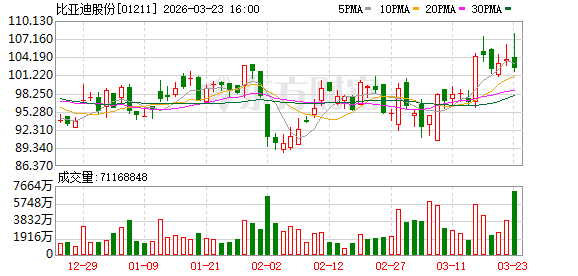
Core Viewpoint - BYD's stock performance has been strong, with a 4.46% increase, driven by positive news regarding new technologies and upcoming product launches [2] Group 1: New Technologies and Products - BYD has launched its second-generation blade battery and flash charging technology, which shows improvements in charging speed, energy density, lifespan, and safety compared to the first generation [3] - The company plans to introduce 10 new models equipped with the second-generation blade battery, enhancing its product matrix and potentially increasing sales due to rising oil prices [6] - A new intelligent driving technology conference is expected in April, focusing on self-developed chips, full-range lidar, and world model algorithms, which could significantly reduce the cost of advanced driving technologies [6][9] Group 2: Sales and Market Expansion - Citigroup forecasts that BYD's domestic and export sales will expand monthly, reaching approximately 220,000 to 250,000 units by March 2026 [3] - BYD's overseas sales are projected to exceed 1 million units by 2025, accounting for about 20% of total sales, with significant orders from Argentina and Mexico marking a key step in its Latin American market strategy [13] Group 3: Workforce and Production Capacity - BYD is ramping up recruitment across its facilities, with over 1,000 operational positions and more than 1,100 technical roles available, reflecting its commitment to increasing production capacity [10] - The company currently employs over 900,000 people, making it the largest automotive company by employee count in the A-share market [10] Group 4: Solid-State Battery Development - BYD is committed to investing in solid-state battery technology, facing significant scientific challenges but aiming to maintain its leadership in liquid battery technology while advancing solid-state research [10]

——主题形态学输出0320:高送转主题右侧突破
Huafu Securities· 2026-03-23 08:46
Investment Highlights - The report identifies a new theme of "high share transfers" as a right-side breakout opportunity [4][9] - The ongoing right-side trend is noted in the water and electricity sector [4][11] - The report highlights sectors showing bottom stabilization, including trust, financial opening, small base stations, and COVID-19 testing [4][16] - Bottom reversal opportunities are identified in animal vaccines, the pig industry, and innovative drugs [4][18] Theme Morphology Outputs - The report categorizes themes into four types: right-side breakout, right-side trend, bottom stabilization, and bottom reversal [4][8] - The right-side breakout theme includes high share transfers, photovoltaic inverters, chicken industry, propylene, and water electricity indices [4][9] - The right-side trend theme is focused on the water electricity index [4][11] - Bottom stabilization themes include trust index, financial opening index, small base station index, and COVID-19 antigen testing index [4][16] - Bottom reversal themes encompass CAR-T therapy, pig fever vaccine, animal vaccine index, monoclonal antibody index, pig industry index, and innovative drugs index [4][18]
汽车周观点:油价上涨强化出海逻辑,重视整车配置机会
GOLDEN SUN SECURITIES· 2026-03-23 08:24
Investment Rating - The industry investment rating is maintained as "Increase" [5] Core Views - The automotive sector is experiencing a significant improvement in weekly data, with wholesale daily averages increasing to 31,000 vehicles in the first week of March and 58,000 vehicles in the second week, alongside retail daily averages of 31,000 and 45,000 vehicles respectively. This improvement is attributed to the end of the holiday season and new vehicle launches. The rise in oil prices due to geopolitical tensions in the Middle East is expected to boost demand for new energy vehicles, accelerating the overseas expansion of automotive companies. The profitability of car manufacturers is currently at a low point, but is expected to improve from March to June as new vehicles are launched and sales recover [1][2][3] Summary by Sections Weekly Dynamics - The report highlights that new energy vehicle companies such as Xiaopeng, Li Auto, and others have achieved significant year-on-year sales growth, with Xiaopeng and Li Auto reaching profitability in Q4 2025. The overall sales growth for these companies is reported at 126% for Xiaopeng and 103% for Li Auto [10][12] Weekly Market Performance - The automotive sector saw an overall decline of 4.40% in the week from March 16 to March 22, ranking 16th out of 31 sectors. The Shanghai Composite Index fell by 3.38%, while the Shenzhen Component Index and CSI 300 Index decreased by 2.90% and 2.19% respectively. Among sub-sectors, passenger vehicles showed a slight increase of 0.78%, while other segments like automotive services and parts experienced declines of 5.53% and 6.20% respectively [13][20] Recommendations - The report suggests focusing on several companies across different segments: 1. Passenger Vehicles: Jianghuai Automobile, Geely Automobile, BYD, Xiaopeng Motors, Tesla 2. Commercial Vehicles: Weichai Power, China National Heavy Duty Truck Group, Yutong Bus, King Long Automobile 3. Liquid Cooling: Yinlun Holdings, Feilong Holdings, Ruikeda 4. Robotics: Zhejiang Rongtai, Laling Holdings, Deka Motor Holdings, Top Group, Sanhua Intelligent Controls, Xinquan, Shuanghuan Transmission, Hengshuai 5. Autonomous Driving: Horizon Robotics, Hesai Technology, Suteng Juchuang, Pony.ai, Nexperia, Coboda, Jingwei Hirun, Borsali 6. Commercial Aviation: Chaojie Holdings, Haoneng Holdings, Jingwei Hirun [3]




资本市场周报(2026年第1期):美以伊冲突持续,全球资本市场表现如何?-20260323
Yin He Zheng Quan· 2026-03-23 07:41
Core Insights - The ongoing conflict in the Middle East, particularly the U.S.-Israel-Iran tensions, has led to increased risks in global energy supply and market volatility, resulting in a dual logic of "risk aversion" and "stagflation trading" in capital markets [5][7] - Brent crude oil prices surged to $108.65 per barrel, an increase of 8.15% from the previous week and 53.37% since the onset of the conflict [5][7] - Major global stock indices have faced downward pressure, with the U.S. dollar strengthening and gold prices declining by 10.49% [8] Global Capital Market Overview A-shares and Hong Kong Market Review - The Shanghai Composite Index closed at 3957.05, down 3.38% for the week, while the Hang Seng Index fell by 0.74% to 25277.32 [15][21] - The Shenzhen Component Index decreased by 2.90%, closing at 13866.20 [15] Overseas Market Review - The Dow Jones Industrial Average fell by 2.11% to 45577.47, while the S&P 500 and Nasdaq Composite dropped by 1.90% and 2.07%, respectively [23] - European indices such as the DAX and CAC40 saw declines of 4.55% and 3.11% [24] Global Bond Market Dynamics - The yield on the 10-year U.S. Treasury bond rose to 4.39%, reflecting market concerns over inflation driven by rising oil prices and geopolitical tensions [27] Major Currency Exchange Rates - The U.S. dollar strengthened against the Japanese yen, closing at 159.25, while the dollar to Chinese yuan exchange rate was 6.89 [29] Major Commodity Prices - Brent crude oil prices increased significantly, while gold prices fell to $4491.67 per ounce, down 10.49% from the previous week [30] Important Policy Developments - The People's Bank of China emphasized the need for high-level financial market openness, aiming to enhance investment convenience and cross-border regulatory cooperation [31] - The China Securities Regulatory Commission is working on improving the stability of the capital market, focusing on long-term capital inflows and enhancing the quality of listed companies [32] - A new liquidity support mechanism for non-bank financial institutions is being explored to prevent systemic financial risks [33] - Hong Kong's regulatory body has tightened controls on investment banking practices, limiting the number of active projects for sponsors to enhance project quality [37] - South Korea announced a ban on the spin-off of subsidiaries by listed companies to protect shareholder interests and improve market valuation [38]






美光:未来汽车将需要300GB的内存
芯世相· 2026-03-23 06:34
Core Insights - Micron's CEO Sanjay Mehrotra highlighted that with the introduction of L4 autonomous vehicles, the demand for RAM will exceed 300GB, driven by the strong demand for high-end HBM chips from AI cloud providers [3] - Micron reported a significant revenue increase of 200%, reaching $23.86 billion in Q2 2023, primarily due to AI infrastructure and structural supply constraints [3] - The company plans to build multiple fabs in Japan, Singapore, and New York, aiming for a 20% capacity increase by 2026 to alleviate supply-side pressures [3] Group 1: Automotive Memory and Processing Needs - The surge in data from advanced driver-assistance systems (ADAS) and autonomous driving sensors is creating unprecedented demands on automotive memory and storage systems [5] - As vehicles become more electronic and intelligent, the challenges faced in automotive systems are increasingly similar to those in large data centers [6] - The integration of high-priority data functions necessitates faster data transmission speeds between processing units and memory [6] Group 2: System Architecture and Design - The shift towards software-defined vehicles allows for modular design, enabling better bandwidth and memory capacity management [10] - Centralized architectures are being favored over distributed ECUs to handle the large volumes of real-time data from multiple sensors [10] - The design of vehicles is evolving to incorporate various processing units and memory types, focusing on performance where it is most needed [8] Group 3: Memory Technology Trends - LPDDR memory is gaining traction due to its higher bandwidth and lower power consumption, with LPDDR6 achieving 14.4Gb/s [12] - The automotive sector is increasingly utilizing DRAM for computation and NAND for data storage, with a focus on balancing performance and cost [14] - Emerging memory types like MRAM and RRAM are being explored for their low power and high-density storage capabilities [18] Group 4: Future Directions and Challenges - The complexity of future vehicles will require a layered memory and storage architecture to ensure performance and safety [11] - As the industry moves towards L4 and L5 autonomous driving, the need for higher memory capacity and bandwidth will become critical [13] - The automotive memory market is highly concentrated, with a few leading manufacturers dominating, making it essential for OEMs to understand the storage industry dynamics [14]