服务业

Search documents
长春高新:12月15日召开董事会会议
Mei Ri Jing Ji Xin Wen· 2025-12-15 12:43
Group 1 - The core viewpoint of the article is that Changchun High-tech (SZ 000661) held its 15th meeting of the 11th Board of Directors on December 15, 2025, to review the proposal for signing an exclusive licensing agreement for the GenSci098 injection project [1] - For the first half of 2025, the revenue composition of Changchun High-tech is as follows: 92.83% from the pharmaceutical industry, 6.81% from real estate, and 0.36% from the service industry [1] - As of the time of reporting, the market capitalization of Changchun High-tech is 37.6 billion yuan [1]

——11月经济数据点评:11月经济:从分化看转型
Shenwan Hongyuan Securities· 2025-12-15 12:43
Consumption - In November, the year-on-year growth of social retail sales was 1.3%, down 1.6 percentage points from the previous month, significantly below the expected 2.9%[1][7] - Retail sales of goods fell sharply, with categories like gold and jewelry down 29.1% to 8.5%, and home appliances down 4.8% to -19.4%[2][8] - Service retail sales showed positive performance, with a cumulative year-on-year increase of 5.4%[2][8] Investment - Fixed asset investment in November recorded a year-on-year decline of 10.1%, but this was an improvement of 2.1 percentage points from October[3][39] - Infrastructure investment improved by 2.9 percentage points to -6.7%, supported by new special bonds and policy financial tools[3][17] - Manufacturing investment rose by 4.3 percentage points to -3.6%, indicating a recovery in certain sectors[3][41] Real Estate - Real estate development investment fell by 15.9% year-on-year, with a significant drop of 6.9 percentage points to -29.9% in November[2][43] - New construction and completion rates remained in negative growth, with new starts down 27.7% and completions down 25.4%[2][43] - Despite falling prices, the sales area of commercial housing increased by 7.7 percentage points to -17.9%[2][43] Production - Industrial added value maintained a growth rate of 4.8% in November, only slightly down by 0.1 percentage points from the previous month[3][26] - The production of food and beverages saw significant recovery, with growth rates of 5.6% and -0.6% respectively[3][26] - The automotive sector experienced a notable decline, with production down 4.9 percentage points to 11.9%[3][26] Policy Implications - The economic structure is increasingly differentiated during the policy transition, with a shift from goods consumption to service consumption[4][31] - The government's focus on "new investment" areas is beginning to show positive effects, with overall investment expected to stabilize in the future[4][31] - Risks remain from external environmental changes and the pace of growth policy implementation may not meet expectations[5][50]
11月经济数据点评:化解供强需弱矛盾需进一步扩大内需
Western Securities· 2025-12-15 11:52
Economic Growth Trends - In November, industrial value added grew by 4.8% year-on-year, slightly down from 4.9% in October[1] - The service production index increased by 4.2% year-on-year in November, a decrease from 4.6% in October[1] - Overall economic growth momentum has weakened, with both industrial and service sectors falling below 5% growth since Q4[1] Consumer Spending and Retail Performance - Social retail sales grew by only 1.3% year-on-year in November, down from 2.9% in October[1] - Online retail sales increased by 1.5% year-on-year in November, significantly lower than the 4.9% growth in October[1] - The "Double Eleven" shopping festival saw reduced consumer engagement, impacting retail performance[1] Investment and Real Estate Market - Fixed asset investment fell by 2.6% cumulatively from January to November, with a 12% decline in November alone[2] - Real estate development investment dropped by 30.3% year-on-year in November, indicating a worsening trend[2] - The sales area of commercial housing decreased by 17.3% year-on-year in November, with sales revenue down by 25.1%[2] Policy Recommendations - The central economic work conference emphasized the need for stronger domestic demand to address the supply-demand imbalance[3] - Plans for 2026 include more proactive fiscal and monetary policies to stimulate consumption and stabilize investment[3] - Risks include potential trade frictions and continued declines in the real estate market, which may affect policy effectiveness[3]
11月经济数据点评:11月经济:从“分化”看“转型”
Shenwan Hongyuan Securities· 2025-12-15 11:34
Economic Data - In November, the year-on-year growth of social retail sales was 1.3%, lower than the expected 2.9% and the previous value of 2.9%[1] - Fixed asset investment showed a cumulative year-on-year decline of 2.6%, worse than the expected -2.2% and the previous -1.7%[1] - Real estate development investment fell by 15.9% year-on-year, compared to an expectation of -15.4% and a previous value of -14.7%[1] - Industrial added value increased by 4.8% year-on-year, slightly below the expected 5% and the previous 4.9%[1] Consumption Trends - Consumption policies have shifted focus from goods to services, with social retail sales slowing down while service retail sales increased by 5.4% year-on-year[2] - The decline in retail sales was influenced by the fading effect of e-commerce promotions and a downturn in demand for home appliances, automobiles, and furniture[2] - Service consumption remained resilient, with restaurant income showing a slight decline but overall service retail growth improving[2] Investment Insights - Fixed asset investment saw a marginal recovery, with a month-on-month increase of 2.1 percentage points to -10.1%, marking the first rebound since Q2[3] - Infrastructure investment improved by 2.9 percentage points to -6.7%, supported by new special bonds and policy financial tools[3] - Manufacturing investment rose by 4.3 percentage points to -3.6%, while service sector investment increased by 0.6 percentage points to -12.3%[3] Real Estate Sector - Real estate financing weakened significantly, with credit financing growth dropping by 11.5 percentage points to -25.3%, leading to a sharp decline in real estate investment growth to -29.9%[4] - New construction and completion rates remained in negative growth territory, with new starts down by 27.7% and completions down by 25.4%[4] - Despite falling prices, the sales area and sales amount of commercial housing increased by 7.7 percentage points and 2.8 percentage points, respectively[4]
重点关注|商务部、中国人民银行、金融监管总局联合印发!
Sou Hu Cai Jing· 2025-12-15 11:24
Core Viewpoint - The recent Central Economic Work Conference emphasizes the need for financial institutions to enhance support for expanding domestic demand, with a focus on boosting consumption through coordinated efforts between business and finance [1]. Financial Support for Key Consumption Areas - Financial support will be increased for key areas of consumption, including upgrading product consumption, expanding service consumption, and fostering new types of consumption [2][3][4]. - Financial institutions are encouraged to collaborate with platforms and key merchants to improve payment services and better meet consumer needs for upgrading products [5]. - Personal consumption loans will be developed with differentiated policies on amounts, terms, and interest rates based on customer creditworthiness [5]. Collaboration Between Business and Finance - Local business departments and financial management departments are urged to strengthen communication and collaboration to address challenges in implementing financial support for consumption [9]. - Financial institutions are encouraged to develop specific action plans and implement policies to support consumption [9]. - The integration of financial support with local consumption promotion activities is encouraged to stimulate consumer potential [9]. Innovation in Financial Products and Services - Financial products and services will be innovated to better fit the characteristics of service consumption, including sectors like hospitality, entertainment, and education [12]. - New financial services will be developed to support emerging consumption trends such as green consumption, digital consumption, and AI-driven consumption [13]. - Financial institutions are encouraged to create tailored financial products for rural areas and support local consumption initiatives [10][14]. Promotion of Consumption Activities - Financial institutions are encouraged to actively participate in local consumption promotion activities and develop specialized products to reach more consumers [15]. - The use of digital currency and smart contracts is promoted to enhance the efficiency of consumption subsidy policies [15]. - Collaboration between financial institutions and merchants is encouraged to develop financial products that cater to the unique needs of the consumption industry [15]. Enhancing Rural and County-Level Consumption - Financial services will be tailored to support rural consumption and promote the sale of agricultural products [10]. - Financial institutions are encouraged to provide financing for logistics and distribution centers in rural areas to enhance local commerce [10]. - Support for county-level consumption initiatives will be provided through credit support for local promotional activities [10].
数据点评|11月经济:从“分化”看“转型”(申万宏观·赵伟团队)
申万宏源宏观· 2025-12-15 11:13
Core Viewpoint - Economic differentiation reveals clues about policy transformation, as "old indicators" overlook "new changes" in the economy [2][4][89] Consumption - Consumption policies are shifting from goods to services, leading to a decline in social retail sales while service retail shows strength. The social retail sales growth fell to 1.3%, driven by a decline in retail growth for goods such as home appliances and automobiles [2][8][68] - Service consumption remains positive, with total service retail sales increasing by 5.4% year-on-year, despite a slight decline in restaurant income [2][4][8] Real Estate - Real estate financing weakened due to credit risks from certain property companies, causing a significant drop in investment. In November, self-raised funds for property companies decreased, leading to a 25.3% decline in credit financing growth [2][12][63] - Real estate investment growth fell to -29.9%, with new construction and completion rates also showing significant negative growth [2][12][63] Investment - Recent policy measures have alleviated the "crowding out effect" of debt repayment on investment, with fixed asset investment showing a month-on-month rebound of 2.1% to -10.1% [3][22][88] - Infrastructure investment improved by 2.9% to -6.7%, while manufacturing and service sector investments also saw slight recoveries [3][22][88] Production - Industrial production maintained resilience, with industrial value-added growth stabilizing at 4.8%. The easing of workday effects and previous high inventory levels contributed to this stability [3][33][42] - Certain downstream industries, such as food and textiles, experienced significant production growth, while the automotive sector saw a decline [3][33][42] Summary - The economic structure is increasingly differentiated during the policy transformation process, but the positive effects of policies on the economy are becoming evident. Consumption policies are transitioning towards services, and while indicators for goods consumption are declining, service retail growth is rising [4][89][90] - Investment policies are focusing on "new investment" areas, with signs of improvement in new infrastructure and service sector investments, despite ongoing challenges in the real estate sector [4][89][90]

如何提高居民消费率?
CMS· 2025-12-15 07:34
证券研究报告 | 宏观专题报告 2025 年 12 月 15 日 如何提高居民消费率? 根据消费经济的一般演进路径,随着居民收入不断提高,消费重心会逐渐从日 常消耗品转向耐用商品,并进一步向服务领域扩展。当前,我国人均 GDP 已 跃升至 1.3 万美元以上,居民消费格局呈现出从商品主导向服务主导转变的趋 势。与一般发达国家相比,我国服务消费占比明显偏低,"十五五"时期提升 居民消费率的战略选择就是大力发展服务消费。 ❑ 消费的宏观特征:消费率低,但消费量并不低;政府消费占比较高,居民 消费率偏低;实物消费占比高,而服务型消费占比低。 1)中国整体消费率(最终消费支出/GDP)明显低于一般发达国家,但最 终消费量并不低,剔除价格、汇率等因素,按照购买力平价后的绝对消费 量接近美国,且大于整个欧盟总和;由于中国属于制造业大国,国内商 品、服务价格普遍低于国际平均水平。 2)最终消费结构中,中国居民消费率(居民消费支出/GDP)不仅低于全 球平均水平,而且低于同为发展中国家的印度、巴西等国;中国政府消费 额以及占 GDP 的比重均高于全球水平,亦高于一般发达国家,形成了 "官方消费比民间旺盛"的独特现象。 3)与 ...
博时基金陈显顺:中央经济工作会议释放积极信号,为“十五五”开局定向领航
Xin Lang Cai Jing· 2025-12-15 06:53
Core Viewpoint - The Central Economic Work Conference held on December 10-11 in Beijing outlines the economic work for 2026, emphasizing high-quality development to address uncertainties in the current economic landscape [1][8]. Group 1: Macroeconomic Policy - The conference signals a continuation of a more proactive fiscal policy and moderately loose monetary policy, enhancing the synergy of macroeconomic policies [1][2][3]. - Emphasis on "optimizing expenditure structure" and scientific management within fiscal policy aims to stabilize total demand while directing funds towards key areas such as technology innovation and public welfare [3][10]. - Monetary policy is set to remain "moderately loose," with flexibility in using various tools like reserve requirement ratio cuts and interest rate reductions to ensure adequate liquidity [3][10]. Group 2: Domestic Demand and Economic Structure - The conference prioritizes "expanding domestic demand" as a key task, reflecting a strategic decision to strengthen the internal economic drive amid rising external uncertainties [3][4][11]. - Key strategies for expanding domestic demand include stabilizing income, enhancing consumer confidence, optimizing supply, and promoting investment to create a virtuous cycle [4][11]. Group 3: Innovation and New Growth Drivers - Future growth drivers will focus on the integration of cutting-edge technology with industries, particularly in areas like artificial intelligence, new energy, and high-end manufacturing [5][11]. - The capital market is identified as a crucial element in nurturing new growth drivers, with a call for reforms to better support national innovation strategies [5][11]. Group 4: Reform and High-Quality Development - The conference highlights the need for reforms to eliminate "involutionary" competition and establish a unified national market, which is essential for enhancing economic vitality [6][12]. - Recommendations include setting high standards for market access and fair competition rules to guide enterprises in phasing out outdated capacities [12]. Group 5: International Cooperation and Investment Opportunities - China's opening up is shifting towards institutional openness, with future cooperation expected to focus on service trade, digital trade, and green low-carbon sectors [6][13]. - Investment opportunities are anticipated in domestic leading service enterprises, technology companies in digital trade, and firms in the renewable energy sector that can engage in international standard-setting [13].
中国经济多维数据“增长”表现亮眼 数字消费、绿色消费、健康消费成为新热点
Yang Shi Wang· 2025-12-15 06:31
Group 1 - The core viewpoint of the articles highlights stable growth in industrial production, with significant increases in equipment manufacturing and high-tech manufacturing sectors [1] - From January to November, the industrial added value of large-scale enterprises increased by 6.0% year-on-year, with mining, manufacturing, and electricity, heat, gas, and water production and supply sectors growing by 6.3%, 4.6%, and 4.3% respectively in November [1] - Equipment manufacturing and high-tech manufacturing saw added value growth of 7.7% and 8.4% respectively, surpassing the overall industrial growth by 2.9 and 3.6 percentage points [1] Group 2 - In November, the national service industry production index grew by 4.2% year-on-year, indicating stable growth in the service sector [1] - From January to November, the service industry production index increased by 5.6%, with large-scale service enterprises' revenue growing by 7.6% year-on-year [1] - The business activity index for the service industry was recorded at 49.5% in November, while the business activity expectation index stood at 55.9% [1] Group 3 - The total retail sales of consumer goods increased by 4% year-on-year from January to November, reflecting a faster growth rate compared to the same period last year [2] - The retail sales of services grew by 5.4% year-on-year, with a continuous recovery over three months, outpacing the growth of goods retail sales [2] - Online retail sales of physical goods rose by 5.7% year-on-year, accounting for 25.9% of total retail sales, indicating a shift towards digital, green, and health-oriented consumption trends [2]
日本大型制造业信心跃升四年新高 央行加息预期再获强化
Zhi Tong Cai Jing· 2025-12-15 02:07
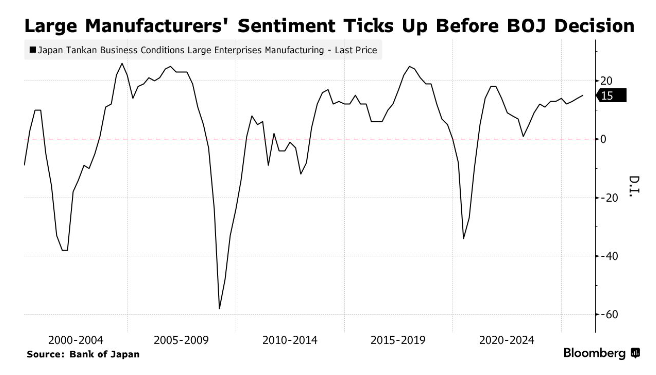
Group 1 - The confidence index for large manufacturers in Japan has risen to a four-year high, reinforcing market expectations for a potential interest rate hike by the Bank of Japan this week [1][3] - The Tankan survey revealed that the large manufacturing sentiment index increased from 14 in September to 15 in December, aligning with economists' median expectations [1] - The large non-manufacturing sentiment index remained steady at 34, close to its highest level since the early 1990s, indicating that more companies view their business conditions as "good" rather than "poor" [1] Group 2 - The Tankan survey indicates that Japanese companies have not significantly felt the impact of U.S. tariff policies, which the Bank of Japan has highlighted as a source of uncertainty [3] - The survey results provide the Bank of Japan with insights into how companies are responding to the U.S. tariff adjustments, particularly in the oil and coal manufacturing sector [3] - The continued weakness of the yen benefits export-oriented companies but raises operational costs for service sector firms, which employ a majority of Japan's workforce [3] Group 3 - Companies expect the yen to trade at 147.06 against the dollar for the current fiscal year, a further depreciation from the previous forecast of 145.68 [3] - The Bank of Japan's Governor, Kazuo Ueda, has emphasized that uncertainties surrounding U.S. tariff policies and initial progress in wage negotiations will be key factors in considering the next interest rate hike [3] - Concerns have arisen regarding the economic spillover effects from deteriorating Japan-China relations, particularly following comments made by Prime Minister Fumio Kishida about Taiwan, which have led to a significant drop in Chinese tourist numbers [3]