
TMT

Search documents
美联储今夜降息!对中国市场与汽车行业影响全解析
Sou Hu Cai Jing· 2025-09-17 14:24
Group 1: Federal Reserve Rate Cut - The Federal Reserve is expected to announce a rate cut of 25 basis points, marking the first cut in nine months, aimed at addressing signs of economic slowdown rather than a full-blown crisis [1][2] - The current economic context is characterized by "stagflation," with slowing growth and relatively high inflation, as indicated by a core PCE year-on-year growth of 2.86% and a core CPI growth of 3.2% [2] Group 2: Impact on Chinese Assets - The rate cut is anticipated to have a threefold positive impact on Chinese assets, including expanded monetary policy space, stabilization and appreciation of the RMB exchange rate, and accelerated capital reallocation [2][5] - The Chinese capital market is expected to see a wave of foreign capital inflow, benefiting from the easing of external monetary policy constraints [5] Group 3: Opportunities in A-shares and H-shares - In the A-share market, three sectors are identified as clear beneficiaries: technology growth sectors (TMT, semiconductors, AI), large financial sectors (banks, brokerages, insurance), and high-dividend stocks (electricity, oil, state-owned enterprises) [2][10] - The H-share market is more sensitive to external liquidity, with significant foreign capital allocation towards software, services, and technology hardware sectors, driven by advancements in AI technologies [3] Group 4: Automotive Industry Benefits - The automotive industry is poised to benefit from both policy and funding advantages, with a target of achieving approximately 32.3 million vehicle sales in 2025, a year-on-year growth of about 3% [6] - The expected sales of new energy vehicles (NEVs) are projected to reach around 15.5 million, reflecting a growth of approximately 20% [6] - The rate cut will lower financing costs for automakers, enhance consumer confidence, and support overall consumption, particularly in the automotive sector [7][8] Group 5: Commodity and Bond Market Effects - The rate cut is expected to positively influence the commodity and bond markets, with industrial metals like copper and aluminum anticipated to break upward, and gold prices receiving short-term support [9] - The bond market is likely to see a clear downward trend in interest rates, enhancing the investment value of government and interest rate bonds [9] Group 6: Asset Allocation Strategy - Experts recommend prioritizing equity assets in the current environment, particularly in technology growth, high-dividend blue chips, and large financial sectors, while suggesting moderate allocation to bond assets [10] - Investors are advised to be cautious of potential overvaluation in certain sectors due to pre-existing rate cut expectations [10]
策略深度报告:A股主升初期调整后的应对策略
Huaxin Securities· 2025-09-17 06:42
Group 1 - The report highlights that the initial adjustments during the main upward phases of A-shares in 2015, 2017, and 2020 typically saw an average adjustment period of 11 trading days, with an average decline of nearly 5% for the overall market and a 20% pullback in popular sectors [5][28][32] - The report indicates that the current adjustment has lasted for 6 trading days with a decline of 2.35%, and popular sectors have experienced a pullback of 28.5%, suggesting that the adjustment is nearing completion and a consolidation phase is beginning [5][8][66] - The report suggests that the main upward phase of A-shares is characterized by a significant influx of household deposits into the market, which has been a driving force behind the current upward trend [15][17] Group 2 - The report outlines that the adjustment in 2015 was primarily driven by regulatory warnings and weak earnings reports, leading to a decline in market sentiment [33][36] - In 2017, the adjustment was influenced by disappointing macroeconomic data and external shocks, such as credit rating downgrades, which affected investor confidence [51][52] - The 2020 adjustment was marked by a significant outflow of northbound capital and the IPO of a major company, which created short-term liquidity pressure on the market [64][66] Group 3 - The report identifies key sectors to focus on during the current market phase, including interest rate-sensitive sectors (TMT, non-bank financials, and metals), sectors benefiting from a potential PPI recovery (chemicals, machinery, and consumer goods), and growth sectors that may see rotation (AI hardware, innovative pharmaceuticals, and defense) [8][66] - The report emphasizes that the style rotation in the market is contingent on fundamental performance, with growth sectors expected to continue leading, while a shift towards consumer and cyclical sectors may occur if earnings improve [7][8][66]
兴业证券:美联储降息后各大类资产如何表现?
智通财经网· 2025-09-16 23:04
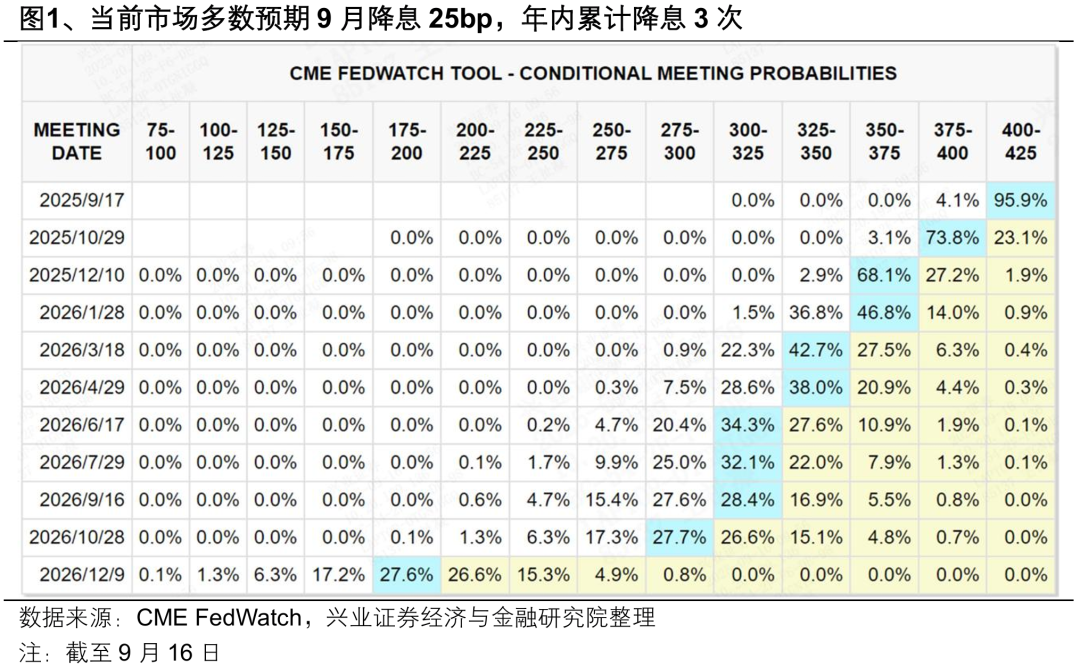
Core Viewpoint - The Federal Reserve is expected to initiate a new round of interest rate cuts, with a 95% probability of a 25 basis point "preventive rate cut" in September [2][3]. Group 1: Market Reactions to Rate Cuts - Historical analysis shows that "preventive rate cuts" and "recessionary rate cuts" have different impacts on major asset prices [3][4]. - Following preventive rate cuts, A-shares benefit from liquidity easing and improved risk appetite, particularly in sectors like TMT (Technology, Media, Telecommunications), food and beverage, social services, beauty care, and biomedicine [4][8]. - In contrast, during recessionary rate cuts, A-shares and Hong Kong stocks tend to decline due to global economic downturns, with defensive assets like non-bank financials, banks, and cyclical sectors such as petrochemicals and chemicals performing better [4][8]. Group 2: Sector Performance Analysis - Under preventive rate cuts, various sectors show significant average price changes: - Technology sector (Electronics) sees an average increase of 19.07% over 10 days, 35.64% over 30 days, and 33.10% over 60 days [8]. - Consumer sectors (Food & Beverage) experience increases of 16.14%, 22.26%, and 19.22% respectively [8]. - For recessionary rate cuts, sectors like non-essential consumer goods and technology also perform well, but defensive sectors like energy and telecommunications gain prominence [9]. Group 3: Broader Market Implications - The U.S. stock market is expected to respond positively to preventive rate cuts, with fundamentals driving overall market performance [9]. - The dollar and U.S. Treasury yields are influenced by the same dynamics, with preventive cuts initially suppressing the dollar but later leading to an upward trend as fundamentals improve [11][14]. - Gold prices may initially rise due to liquidity easing but could decline as economic expectations improve and the dollar strengthens [16].


高景气赛道反复活跃,创业板ETF建信(159956)所跟踪指数涨超2%,重要政策为储能行业发展提供明确指引
Xin Lang Cai Jing· 2025-09-16 01:29
Group 1 - The ChiNext Index (399006) rose by 1.51% as of September 15, 2025, with notable stock performances including Shengbang Co., Ltd. (300661) up 20.00%, Hunan YN Energy (301358) up 10.77%, and Ningde Times (300750) up 9.14% [1] - The National Development and Reform Commission and the Energy Administration jointly issued the "Special Action Plan for Large-Scale Construction of New Energy Storage (2025-2027)", aiming for a national new energy storage installed capacity of over 180 million kilowatts by 2027, driving direct investment of approximately 250 billion yuan [1] - Longjiang Securities indicated that the policy provides clear guidance for the energy storage industry, with increasing demand for large-scale storage and improving project economics due to new pricing mechanisms in regions like Ningxia [1] Group 2 - Huaxi Securities noted that the consensus in the market is for the Federal Reserve to lower interest rates in September, with subsequent US-China negotiations being a key factor influencing global risk appetite [2] - The current bull market in A-shares is supported by strong policies aimed at stabilizing the stock market, with potential incremental funds from residents remaining abundant [2] - The upcoming Fourth Plenary Session in October may catalyze policies in hard technology and new productivity sectors, while the overseas AI industry capital expenditure expectations are rising, positively impacting the market [2]






逾600家公司披露未来三年分红规划
Zheng Quan Shi Bao· 2025-09-15 18:34
Group 1 - The technology sector, represented by TMT indices, has seen significant growth, with indices in communication, electronics, and media rising over 30% as of September 15 [1] - In contrast, the dividend sector has underperformed, with the CSI Dividend Index declining over 1% this year [1] - Long-term effectiveness of dividend strategies remains intact, with low valuation and high dividend yields attracting long-term capital [1] Group 2 - Companies with high dividend potential are gaining attention, with over 600 companies disclosing shareholder return plans for 2025-2027 [2] - Jianghe Group plans to distribute at least 80% of its net profit or a minimum of 0.45 yuan per share in cash dividends during 2025-2027 [2] - Huaihe Energy aims to distribute no less than 75% of its net profit or a minimum of 0.19 yuan per share in cash dividends during the same period [2] Group 3 - China Shenhua and Mindray Medical are tied for third place, each planning to distribute at least 65% of their net profit in cash dividends from 2025 to 2027 [3] - Other companies like Guodian Power, Zhongfu Industrial, and Wantong Expressway also have dividend rates of at least 60% [3] - Historical data shows that these companies have strong dividend records, with cumulative dividends exceeding 100% of net profits in the last three years for some [3] Group 4 - Institutions predict earnings per share for high dividend companies, with Sichuan Road and Bridge expected to have a dividend yield exceeding 6% based on a 60% payout ratio [4] - Zhongfu Industrial is also projected to have a dividend yield over 5% based on similar calculations [4] - A total of 25 stocks are forecasted to have dividend yields exceeding 2%, with an average annual increase of nearly 11%, outperforming the CSI Dividend Index [4]





流动性和基本面的双重视角
2025-09-15 14:57
Summary of Key Points from Conference Call Records Industry Overview - The financial data for August 2025 indicates a year-on-year growth rate of social financing at 8.8%, with a continuous decline in loan growth. The cumulative new loans from January to August decreased by approximately 1 trillion yuan compared to the previous year, with significant reductions in household credit [1][4] - The upstream resource and real estate chain industries continue to decline, while the consumer and infrastructure sectors show positive signals. The midstream manufacturing and TMT (Technology, Media, and Telecommunications) sectors perform strongly, and the financial industry releases favorable signals [2][11] Core Insights and Arguments - The central bank's monetary policy remains multi-targeted, requiring a balance between internal and external factors. It is crucial to monitor the impact of fiscal policy on social financing and maintain a moderately loose monetary policy to support reasonable growth in money supply [6][7] - The A-share market has experienced a rebound after a period of volatility, particularly in the technology growth sector. The market is expected to focus on performance and policy in September and October, with the upcoming 20th Central Committee's Fourth Plenary Session influencing market expectations [8][9] - In the first half of 2025, the overall revenue growth rate of A-shares turned positive, with a year-on-year increase of 0.03%. However, the revenue growth rate of non-financial sectors declined, while the net profit growth rate remained positive at 2.44% [9][10] Important but Potentially Overlooked Content - The phenomenon of "residential deposit migration" began to show signs from July, with household deposits declining for two consecutive months and the growth rate falling below M2. This trend indicates a shift of funds towards non-bank sectors, such as stocks and other equity assets [5][11] - The financial sector shows signs of recovery, with banks, securities, and insurance industries reporting positive net profit growth. The TMT sector continues to exhibit high levels of prosperity, particularly in the semiconductor and consumer electronics segments [16] - The infrastructure sector displays a mixed performance, with certain sub-sectors like airports experiencing high growth, while logistics shows signs of recovery due to policy changes [17] - Future investment opportunities should be analyzed based on growth potential (net profit growth), stability (ROE), and valuation matching. Key sectors to watch include precious metals, cement, and TMT, particularly in gaming software development [18][19]
早盘直击|今日行情关注
申万宏源证券上海北京西路营业部· 2025-09-15 02:24
Group 1 - The macroeconomic data continues to show resilience, with August PPI reading at -2.9%, indicating a marginal improvement in the economy [1] - Financial data is on an upward trend, supporting the real economy and investment environment, which provides significant backing for the domestic capital market [1] - The focus moving forward will be on the Federal Reserve's interest rate cut decision, which currently has a high probability and is expected to positively impact global risk asset prices [1] Group 2 - The market experienced a rebound last week, with the Shanghai Composite Index recovering short-term moving averages and reaching new highs [2] - The Shenzhen Component Index outperformed, indicating strong market elasticity, while average daily trading volume decreased to approximately 23,000 billion [2] - Market hotspots were primarily in the TMT and upstream raw materials sectors, with technology and small-cap stocks leading in gains [2] - The market is attempting to resume an upward trend after technical consolidation, with major indices recovering previous losses and reaching new highs [2] - However, there are concerns regarding declining trading volume and rapid rotation of market hotspots, suggesting potential market divergence and a focus on structural trends [2]

牛市中的震荡如何演绎?
2025-09-15 01:49
Summary of Conference Call Records Industry Overview - The A-share market is currently experiencing a strong oscillation pattern, with limited upward potential and minimal downward risk, influenced by market sentiment, economic data, and Sino-U.S. relations [1][2][5] - The technology growth sector is performing exceptionally well, particularly companies with strong industrial trends. Cyclical industries and previously underperforming growth companies, such as the telecommunications sector, also present opportunities for low-cost positioning [1][3][12] Core Insights and Arguments - Key factors contributing to market oscillation include: 1. High-level financing leading to cooling risks, with a total inflow of nearly 60 billion since September 5, and financing balances exceeding 2.3 trillion, a historical high [5] 2. Economic data from August indicating a weak recovery, with export growth slowing to approximately 4% year-on-year and a decline in new social financing and RMB loans [5] 3. Increased risk from U.S.-China semiconductor sanctions, although ongoing trade negotiations may mitigate long-term impacts [5][10] - Historical patterns suggest that oscillations in bull markets typically end with significant policy changes or external events that positively influence risk appetite [6][12] - Current indicators for the end of the oscillation phase are not fully met: - The valuation percentile of the Shanghai Composite Index is around 66, above the neutral level of 50% [8] - Trading volume has decreased by a maximum of 37%, not exceeding the 50% threshold [8] - The turnover rate remains high at 72%, indicating insufficient cooling [8] Industry Rotation and Opportunities - Industry rotation is incomplete, with consumer and cyclical sectors not showing significant recovery. In the agriculture, forestry, animal husbandry, and fishery sector, only leading stocks have increased, with an average rise of 8.1%, while non-leading stocks only rose by 1.4% [9][12] - Recommended sectors for investment include: 1. Technology, Media, and Telecommunications (TMT) and non-ferrous metals, which are expected to continue their upward trend [13][14] 2. Telecommunications and innovative pharmaceuticals, which may show signs of recovery and potential for upward movement [13][14] Additional Important Insights - The current market sentiment remains relatively high, which could lead to a decrease in potential gains [5] - The overall liquidity environment is favorable, with policies supporting inflows and a low-risk external environment due to ongoing negotiations with the U.S. [11][12] - The short-term economic outlook remains weak, but there are signs of recovery in corporate earnings data, suggesting a potential for gradual improvement [11][12]
十大券商策略:“慢牛”行情延续,多维择时模型持续看多A股
Ge Long Hui A P P· 2025-09-15 00:39
Group 1: Market Overview - Global stock indices mostly rose last week, with the Asia-Pacific market leading, as the Hang Seng Tech Index surged by 5.3% [1] - The A-share market exhibited a V-shaped trend, with the Shenzhen Component Index and the ChiNext Index both increasing by 2.1% [1] Group 2: Brokerage Strategies - CITIC Securities emphasizes that the current market rally is largely related to overseas exposure, recommending a focus on resources, new productive forces, and overseas expansion [1] - Huatai Securities' multi-dimensional timing model has achieved a cumulative return of 40.41% this year, continuing to favor A-shares, particularly in sectors like liquor, precious metals, banking, and oil [2] - Everbright Securities maintains a bullish outlook on the bull market, focusing on TMT sectors, citing reasonable market valuations and new positive factors emerging [2] Group 3: Capital Flows and Market Sentiment - CICC notes an acceleration of southbound capital inflows into Hong Kong stocks, with the Hang Seng Index surpassing 26,000 points, and suggests that fundamental structures remain a stable choice [3] - Xinda Securities identifies September as a watershed for fast and slow bull markets, indicating that the current bull market may have policy catalysts that could lead to a significant bull market [4] Group 4: Sector Focus - CITIC Jiantou highlights the importance of focusing on sectors with strong fundamentals, such as AI, new energy, and innovative pharmaceuticals, while also monitoring inflation trends [5] - Huaxi Securities believes that the A-share "slow bull" market will continue, with high-growth sectors likely to benefit from policy support and increased capital inflows [6] - Dongwu Securities recommends actively positioning in the AI industry chain, particularly in segments that may serve as "call options" due to potential breakthroughs [7] Group 5: Emerging Technologies - Galaxy Securities reports that the satellite internet sector is poised for growth, with advancements in satellite communication transitioning from "connectivity" to "intelligence," reshaping the industry [8]
中泰证券A股中报透视:科技景气对冲周期寻底 消费延续分化
智通财经网· 2025-09-14 23:45
Group 1 - The overall performance of A-shares showed slight stabilization in Q2 2025, with marginal improvement in revenue but ongoing pressure on profits. Total revenue for A-shares declined by only 0.02% year-on-year, with a 0.39 percentage point improvement compared to Q1. Excluding financials and oil & petrochemicals, revenue turned positive with a growth of 0.41%, while net profit growth for the parent company dropped to 2.46%, a decrease of 1 percentage point from Q1 [1][2] - The traditional weight sectors showed marginal recovery, while emerging growth sectors faced profit pressure. The net profit of the Shanghai Composite Index grew by less than 1% year-on-year, while the ChiNext maintained over 13% growth. The proportion of loss-making companies was 23.15%, a decrease of 1.5 percentage points from Q1, but over 30% of companies still experienced profit declines, highlighting a pronounced structural divergence [2][3] Group 2 - The technology sector maintained high prosperity, with strong demand and high profit growth in the TMT sector. The electronics industry saw a year-on-year net profit growth of 30%, while the communications sector grew by 8.2%. The AI capital expenditure continued to support the upstream infrastructure sector, with notable performance in optical modules and chips [3][4] - The new energy and high-end manufacturing sectors maintained growth, with the machinery and electrical equipment sectors showing good growth due to sustained demand from the new energy vehicle sector. However, the automotive sector faced profit pressure due to frequent price wars, impacting profit margins [4][5] Group 3 - The consumer sector continued to show a divergence, with overall demand still insufficient to fully reverse the situation. The food and beverage, textile and apparel, and retail sectors all saw declines in net profit. In contrast, the home appliance sector experienced a revenue growth of 4.5% and a net profit growth of nearly 4% in Q2, although this was a slowdown compared to Q1 [6][7] - Looking ahead, the "demand front-loading" from national subsidies may continue to manifest, making it difficult for sectors like home appliances to maintain growth. However, the "new consumption" trend may create a mid-term prosperity trend, with strong growth potential in pet economy, gaming, and other emerging consumption sectors [7][8] Group 4 - Investment suggestions for the second half of the year indicate that the A-share profit pattern may continue to show structural divergence. Three main lines of focus include: 1) Continued capital expenditure in AI driving prosperity in the industry chain, with attention on servers and IDC; 2) Ongoing consumer divergence with the rise of "self-consumption" and "cost-effective consumption," focusing on gaming and pet sectors; 3) Dividend sectors such as transportation and coal, benefiting from "anti-involution" policies, with potential for recovery in profitability and valuation [8]
