
耐用消费品

Search documents
众鑫股份(603091):首次覆盖报告:全球化战略推进,海外基地优势显著
GUOTAI HAITONG SECURITIES· 2025-10-15 07:22
Investment Rating - The report assigns an "Accumulate" rating to the company with a target price of 96.97 CNY [4][10]. Core Insights - The company's global capacity layout effectively addresses uncertainties in the foreign trade environment, with a focus on expanding overseas production bases [2][28]. - The company has maintained rapid revenue growth, primarily from environmentally friendly packaging for food service, with 98% of its revenue derived from this segment [28][30]. - The report highlights the company's commitment to sustainable growth through continuous technological innovation and capacity expansion, particularly in Thailand [41][28]. Financial Summary - Total revenue is projected to grow from 13.26 billion CNY in 2023 to 30.41 billion CNY by 2027, reflecting a compound annual growth rate (CAGR) of 22.7% from 2019 to 2024 [3][28]. - Net profit attributable to shareholders is expected to increase from 2.31 billion CNY in 2023 to 7.24 billion CNY in 2027, with a significant growth rate of 69.4% in 2026 [3][10]. - The earnings per share (EPS) is forecasted to rise from 2.26 CNY in 2023 to 7.08 CNY in 2027 [3][10]. Industry Analysis - The biodegradable materials industry is experiencing high demand due to increasing global environmental regulations and consumer preferences for sustainable products [18][21]. - The report notes that the company is well-positioned in the biodegradable materials market, which is expected to see continued growth as traditional plastic alternatives gain traction [18][21]. - The competitive landscape includes domestic and international players, with the company leveraging its technological advancements and overseas production capabilities to enhance its market share [16][28].
“增长滤镜”下的东盟消费潜力再评估
Yin He Zheng Quan· 2025-10-14 08:57
Group 1: ASEAN Consumption Potential - ASEAN's consumption scale is projected to grow, with GDP growth rates expected to be 4.9% in 2024 and 4.0% in 2025, reflecting a steady economic outlook[6] - The region's consumption growth is driven by a rising middle class and a young population, with significant increases in consumer spending expected in durable goods sectors like jewelry and automobiles[6] - The optimistic expectations for ASEAN's consumption potential may reflect either genuine growth or an overly optimistic "growth filter" effect from global capital[6] Group 2: Import Dynamics - Local production in ASEAN struggles to meet mid-to-high-end consumer demand, leading to a notable "import substitution effect" where imports fill the supply-demand gap[6] - Countries like Singapore and Malaysia exhibit strong import demand, with significant growth in durable consumer goods, indicating a shift towards higher value-added products[6] - The import growth rates for key ASEAN markets are projected at 10.6% for Singapore and 8.7% for Malaysia, showcasing robust external absorption capabilities[23] Group 3: Future Outlook - The key to transforming consumption into economic growth lies in developing a local consumption-oriented manufacturing system and enhancing the capacity for high-value products[6] - By 2030, ASEAN's GDP is expected to grow at rates of 2.9% to 4.7%, indicating a potential for sustained economic expansion driven by consumer demand[6] - The region's consumption market is entering a critical phase of upgrading, with a projected increase in the share of final consumption expenditure in GDP, currently at 66%[17]
港股打新,迎千倍认购时代
3 6 Ke· 2025-10-09 02:43
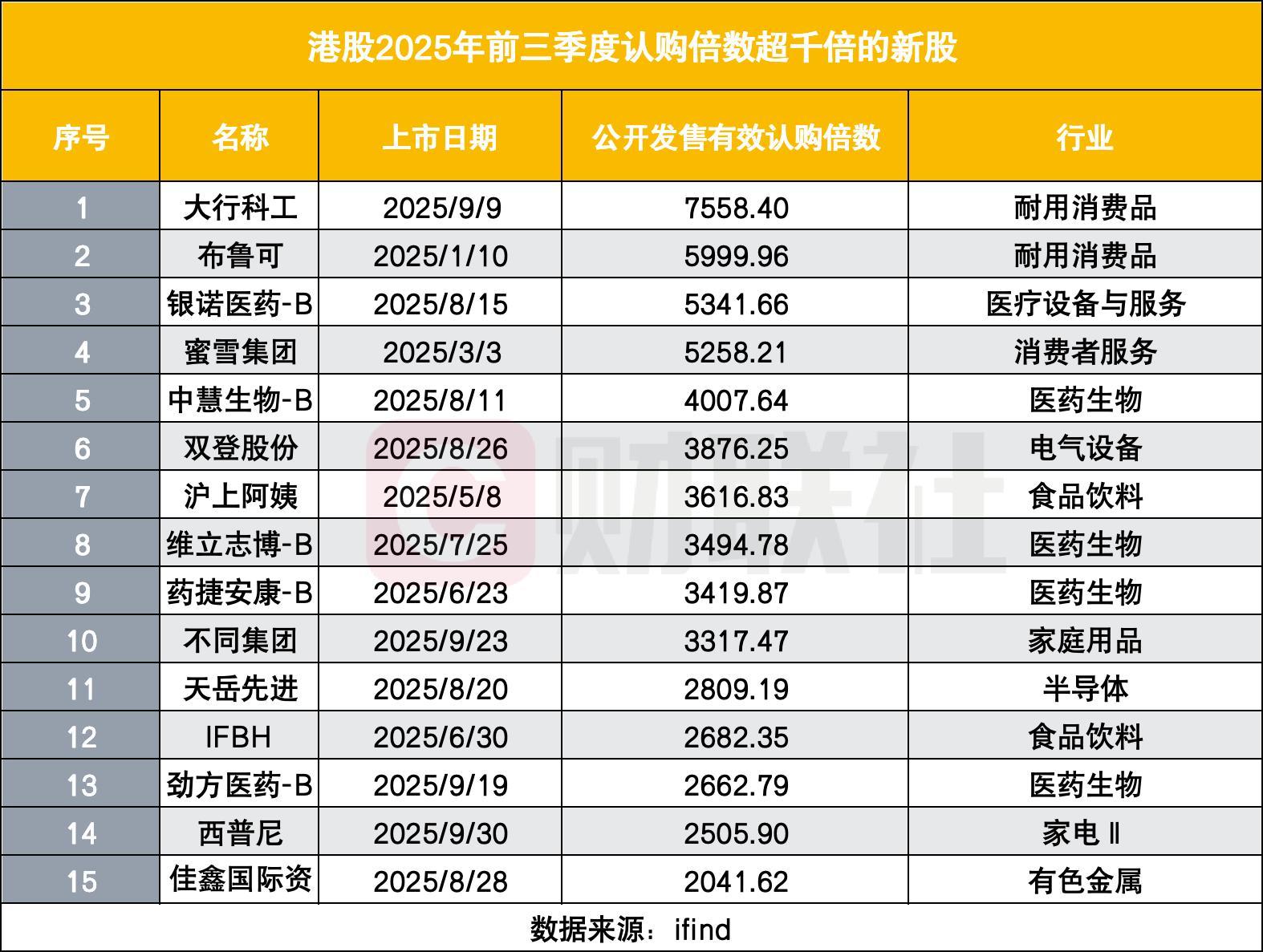
Core Insights - The Hong Kong IPO market experienced significant growth in the first three quarters of 2025, leading globally with 68 new listings and total fundraising of HKD 182.45 billion, representing increases of 51% and 227% year-on-year respectively [1][2] - The market saw a high level of oversubscription, with 98% of new stocks receiving excess subscriptions and 86% of these having oversubscription multiples exceeding 20 times, doubling from the previous year [1][4] - The decline in the first-day drop rate to 24% marks a nine-year low, with an average first-day return rate of 28%, significantly higher than the previous year's 10.82% [6][7] Market Activity - The number of new stocks with oversubscription multiples exceeding 1,000 reached 15, accounting for nearly 23% of the total, with the highest being Daheng Technology at 7558.40 times [2][3] - The pharmaceutical and durable consumer goods sectors were particularly favored, with several companies in these industries achieving high subscription rates [2][8] Regulatory Environment - The increase in market activity occurred in a post-regulatory environment, following the Hong Kong Securities and Futures Commission's new rules that ended the era of "high leverage" in IPO subscriptions [4][5] - The new regulations aimed to address issues of excessive leverage and chaotic funding practices, resulting in a healthier market structure [5][6] Investment Performance - The significant improvement in the profitability of new stocks is attributed to a combination of policy benefits, ample liquidity, and industry upgrades [7][8] - The performance of large new listings, such as Ningde Times, which saw a first-day increase of 16% and a cumulative rise of over 87% by September 30, highlights the strong market sentiment [6][7] Market Dynamics - The IPO market is driven by a dual engine of technology and consumer sectors, with the medical and pharmaceutical industries leading in the number of listings, while manufacturing accounted for over 30% of fundraising [8] - The diverse industry distribution enhances market resilience and attractiveness, moving away from reliance on a single sector [8]

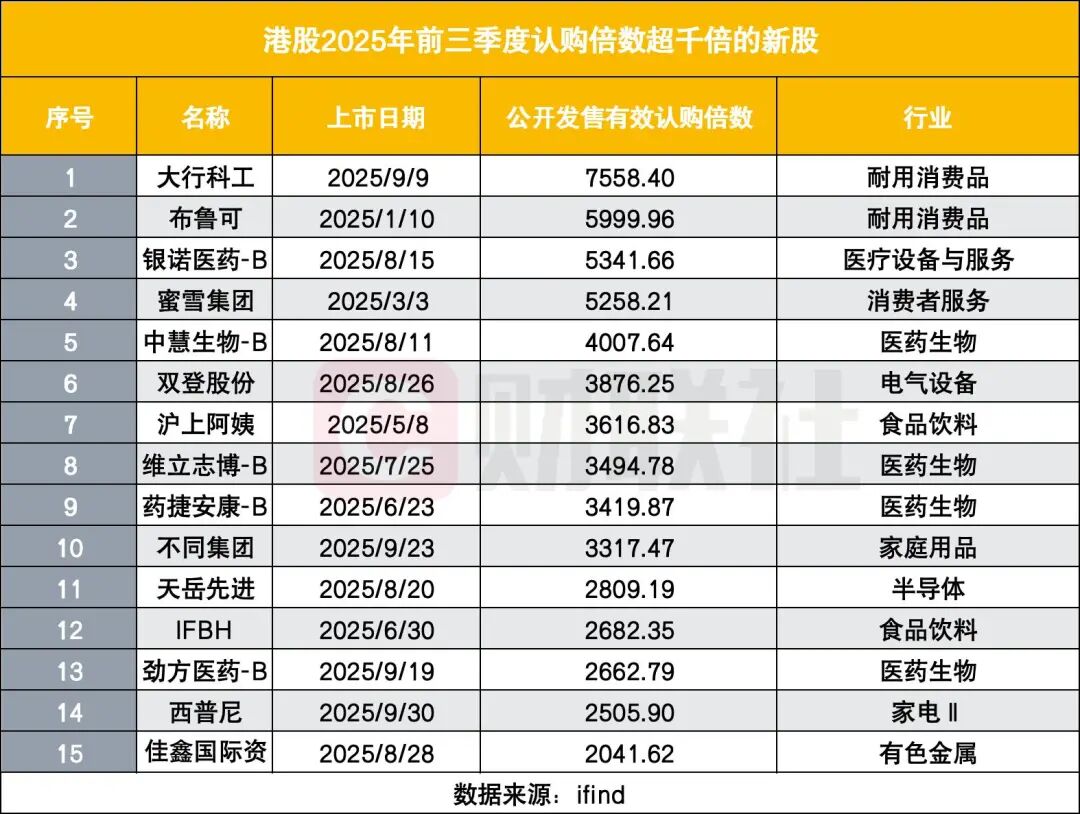
港股打新迎千倍认购时代:最高近8000倍,破发率仅24%创九年新低
Feng Huang Wang· 2025-10-09 01:33
Core Insights - The Hong Kong IPO market has experienced significant growth in the first three quarters of 2025, leading globally with 68 new listings and total fundraising of HKD 182.45 billion, representing a 51% and 227% increase year-on-year, respectively [1][4] - The market has seen a high level of oversubscription, with 98% of new stocks being oversubscribed and 86% having oversubscription multiples exceeding 20 times, doubling from the previous year [1][4] - The decline in the first-day drop rate to 24% marks a nine-year low, with an average first-day return of 28%, significantly up from 10.82% in the previous year [6][7] Market Activity - A total of 15 new stocks had oversubscription multiples exceeding 1,000 times, accounting for nearly 23% of the new listings, with the highest being Daheng Technology at 7,558.40 times [2][3] - The pharmaceutical and durable consumer goods sectors have been particularly favored, with several biotech companies achieving high oversubscription rates, indicating strong investor interest in innovative drug companies [2][3] Regulatory Environment - The recent surge in market activity is attributed to a healthier growth environment following regulatory changes that ended the era of high-leverage IPO subscriptions, with the Hong Kong Securities and Futures Commission implementing measures to curb excessive leverage [4][5] - The previous year saw only 2 new stocks with oversubscription multiples exceeding 1,000 times, highlighting the shift in market dynamics post-regulation [4][5] Investment Returns - The significant increase in first-day returns and the reduction in the drop rate have contributed to a more favorable investment environment, attracting more investors to the IPO market [6][7] - The performance of large new listings, such as NIO's H-shares, which saw a first-day increase of 16% and a cumulative rise of over 87% by September 30, has further enhanced the appeal of IPO investments [6][7] Market Drivers - The robust performance of the Hong Kong IPO market is driven by a combination of policy incentives, ample liquidity, and an evolving industrial landscape, with the medical and pharmaceutical sectors leading in new listings [7][8] - The Hong Kong Stock Exchange has received 348 listing applications as of October 5, 2025, indicating strong interest from companies, particularly in the technology and consumer sectors [7][8]



9月外资净流入中国股市46亿美元:买了啥?卖了啥?
Sou Hu Cai Jing· 2025-10-03 10:23
Group 1 - In September, foreign capital net inflow into the Chinese stock market reached $4.6 billion, marking the highest monthly figure since November of the previous year [3] - Passive funds contributed significantly to this inflow, with $5.2 billion entering, while active funds experienced a slight outflow of $0.6 billion [3] - By the end of September, total inflow from foreign passive funds for the year reached $18 billion, surpassing the total of $7 billion for the entire previous year [3] Group 2 - Active funds showed a preference for increasing holdings in capital goods and semiconductors, indicating a focus on sectors with strong fundamentals [3][4] - Notable stocks that saw increased investment include Alibaba, CATL, and JD.com, while Tencent, Ping An Insurance, and Pop Mart experienced reduced holdings [3] - The sustained interest from passive funds and the strategic focus of active funds suggest a long-term commitment to the Chinese market based on genuine demand and solid fundamentals [4]

支持消费品以旧换新,第四批690亿元资金近日已下达
Sou Hu Cai Jing· 2025-09-30 09:20
Group 1 - The National Development and Reform Commission (NDRC) has allocated a total of 300 billion yuan in special bonds to support the consumption upgrade policy, with the latest batch being 69 billion yuan [1][2] - The government aims to boost consumption as a primary task this year, with the "old-for-new" policy playing a significant role in this initiative [2][3] - From January to August, 330 million people have claimed subsidies under the "old-for-new" policy, leading to over 2 trillion yuan in related sales, contributing to a 4.6% year-on-year growth in total retail sales of consumer goods [5][6] Group 2 - Analysts suggest that future consumption policies may expand the scope of subsidies from durable goods to general consumer goods and services [5] - The government has also introduced new policies to support service consumption, with 19 measures aimed at enhancing service supply in various sectors [6] - The expected growth rate of retail sales is projected to reach 4.5% this year, reflecting a 1.0 percentage point acceleration compared to the previous year [6]

华安国证港股通消费主题ETF(159285):促服务消费若干措施出台,港股通消费迎配置良机
Changjiang Securities· 2025-09-24 14:11
- The Guozheng Hong Kong Stock Connect Consumer Theme Index is constructed using the Paasche weighted method and is calculated daily on a chained basis[3][11][39] - The index selects stocks from the Hong Kong Stock Exchange that meet specific criteria, such as being involved in consumer-related industries (e.g., apparel, jewelry, home appliances, food and beverages) and having mutual market access qualifications[43] - The index excludes stocks with abnormal price fluctuations, significant financial issues, or major operational problems in the past year[43] - The index selects the top 50 stocks based on the highest average daily market capitalization over the past year, after removing the bottom 10% in terms of average daily trading volume[43] - The Guozheng Hong Kong Stock Connect Consumer Theme Index has a cumulative return of 24.22% since its base date (December 31, 2014) as of September 16, 2025, outperforming the Hang Seng Equal Weight Index (-7.82%) and the Hang Seng Index (12.00%)[71] - The index's PE (TTM) ratio is 19.30 as of September 16, 2025, which is lower than 80.88% of the time since its launch on April 11, 2022, indicating a relatively undervalued state[75][77]
美联储降息等于美股大涨?有一个重要前提和关键指标
Hua Er Jie Jian Wen· 2025-09-11 07:29
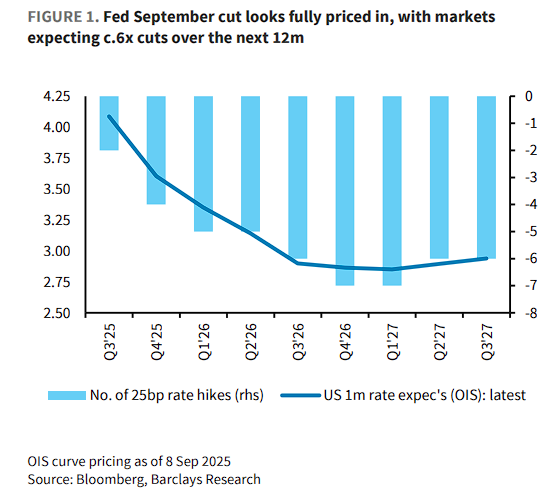
Core Viewpoint - The performance of the stock market after the Federal Reserve resumes interest rate cuts is heavily dependent on whether the economy enters a recession, with the unemployment rate being a key indicator for determining the economic trajectory [1][3]. Economic Conditions - Historical data shows that in the past fifty years, there have been seven instances where the Fed resumed rate cuts after a significant pause. Out of these, four were accompanied by economic recessions, while three saw continued economic expansion, leading to vastly different stock market performances [1][7]. - In scenarios without a recession, the MSCI World Index showed average performance increases of 1%, 2%, 8%, and 17% over 1 month, 3 months, 6 months, and 12 months respectively after rate cuts. In contrast, during recessionary periods, the average performance was -2%, 2%, 0%, and 6% [7][10]. Unemployment Rate - The unemployment rate is highlighted as a critical variable for distinguishing between recession and economic expansion. During recessions, the unemployment rate tends to rise for nearly a year after rate cuts, accumulating an increase of 2-3 percentage points. Conversely, in expanding economies, the unemployment rate only sees a slight increase before declining within a few quarters [3][14][17]. Market Expectations - Currently, the U.S. unemployment rate has risen to 4.3%, which is a significant factor driving market expectations for the Fed to resume rate cuts. Barclays economists predict that the Fed may lower the federal funds rate to 3.0% by the end of 2026 as the labor market slows [17]. Yield Curve and Sector Performance - The shape of the yield curve significantly influences sector performance. Historically, a flattening yield curve during bull markets is most favorable for the stock market, while cyclical sectors perform best during steepening phases in bear markets [6][20]. - In the absence of a recession, the yield curve tends to steepen moderately after rate cuts, while in recession scenarios, it initially steepens before flattening out, transitioning to a steepening phase again as the economy recovers [20][24].
克罗地亚工业产出连续增势在7月中断,同比下滑0.9%
Shang Wu Bu Wang Zhan· 2025-09-10 15:24
Core Insights - Croatia's industrial output experienced a year-on-year decline of 0.9% in July, marking the first decrease after seven consecutive months of growth [1] Group 1: Industrial Performance - Three out of five sectors reported a decline: durable consumer goods production fell by 11.8%, energy production decreased by 10.2%, and non-durable consumer goods dropped by 1.3% [1] - In contrast, the production of intermediate goods increased by 5.4%, and capital goods production rose by 3.0% [1]
A股及港股2025年中报分析:整体业绩稳健,科技板块延续高景气
EBSCN· 2025-09-07 13:11
Group 1 - A-shares show resilience with notable performance in the midstream and technology sectors, as the overall revenue growth for A-shares turned positive in 2025H1, with cumulative year-on-year revenue growth of 0.2% for all A-shares and 0.2% for non-financial A-shares [15][33][76] - The profit growth for A-shares in 2025H1 has slowed but remains positive, with cumulative year-on-year net profit growth of 2.6% for all A-shares and 2.8% for non-financial A-shares, reflecting a slight decline compared to 2025Q1 [33][43][76] - The midstream sector's performance has improved significantly, with a profit growth rate of 11.3% in 2025H1, while the technology sector maintained a high profit growth rate of 17.1% [2][43][44] Group 2 - The return on equity (ROE) for all non-financial A-shares has slightly rebounded, with a TTM ROE of 7.5% in 2025Q2, showing a minor increase from 7.4% in 2025Q1 [48][56] - The midstream and technology sectors have shown significant ROE recovery, with midstream ROE at 4.8% and technology ROE at 6.4% in 2025Q2, indicating improvements from the previous quarter [58][66] - Industries such as food and beverage, home appliances, and non-ferrous metals have demonstrated notable ROE improvements, with food and beverage ROE reaching 20.9% in 2025Q2 [67][70] Group 3 - Hong Kong stocks have maintained stable performance, with non-financial profit growth slightly improving in 2025H1, and the Hang Seng Technology Index showing a high profit growth rate of 20.8% [4][5][32] - The profit growth for the Hang Seng Index and Hang Seng Non-Financial Index in 2025H1 was 2.5% and 4.0%, respectively, indicating a recovery compared to 2024H2 [4][5][27] - The sectors with higher profitability in Hong Kong include durable consumer goods, building materials, media, and hardware equipment, with significant improvements in net profit growth and ROE in 2025H1 [5][32][37]