
铜

Search documents
综合晨报:美国哈赛特表态就业数据将下降-20260210
Dong Zheng Qi Huo· 2026-02-10 00:41
Report Industry Investment Ratings - Not provided in the content Core Views of the Report - The labor market's downward pressure is increasing, and the US dollar is expected to weaken in the short term [2][16] - The US stock market is expected to maintain high - level fluctuations, and the bond market has upward momentum but also faces adjustment pressure [20][22] - Most commodities show different trends, with some in a weak or strong oscillation state, and the prices of some are affected by supply and demand, policies, and geopolitical factors [25][34][53] Summary by Relevant Catalogs 1. Financial News and Comments 1.1 Macro Strategy (Gold) - Gold prices oscillated and closed higher, benefiting from the sharp decline of the US dollar index and the existence of certain risk - aversion sentiment. The market's expectation of a March interest - rate cut is about 20%. It is expected that the overall trend of precious metals will be oscillatory before the Spring Festival. It is recommended to reduce positions [12][13] 1.2 Macro Strategy (Foreign Exchange Futures - US Dollar Index) - Hasset stated that employment data will decline, and the downward pressure on the labor market is increasing. The US dollar is expected to weaken in the short term [14][16][17] 1.3 Macro Strategy (US Stock Index Futures) - Google plans to raise about $20 billion through issuing US dollar bonds. The short - term situation of the US stock market is a mix of long and short factors, and it is expected to maintain high - level oscillations [19][20] 1.4 Macro Strategy (Treasury Bond Futures) - The central bank conducted 113 billion yuan of 7 - day reverse repurchase operations, with a net investment of 38 billion yuan on the day. The bond market has upward momentum, but the probability of an interest - rate cut in the short term is low. It is recommended to pay attention to short - selling opportunities after the upward momentum weakens [21][22][23] 2. Commodity News and Comments 2.1 Black Metals (Rebar/Hot - Rolled Coil) - Steel prices continue the weak oscillation pattern. Before the Spring Festival, the fundamental pressure increases, and the price is under pressure. It is recommended to treat steel prices with an oscillatory mindset and pay attention to risks with a light position before the festival [25][26] 2.2 Black Metals (Steam Coal) - The price of steam coal at Beigang is relatively stable. The Indonesian policy has some impact, but the coal price is seasonally strong, with the policy mainly strengthening the bottom and the upward elasticity being limited [27][28][29] 2.3 Black Metals (Iron Ore) - Iron ore prices are still weak and oscillatory. The iron - making process is moderately resuming production, and it is necessary to wait for the order situation in March after the Spring Festival [30] 2.4 Agricultural Products (Soybean Oil/Rapeseed Oil/Palm Oil) - The palm oil inventory has increased. Before the release of the MPOB report, the market is in a wait - and - see state. It is necessary to pay attention to the impact of MPOB data and control positions to avoid risks [31] 2.5 Agricultural Products (Soybean Meal) - Private exporters sold 264,000 tons of soybeans to China. The CBOT soybeans are oscillating strongly, but the soybean meal inventory in oil mills has reached a record high for the same period. It is expected that the futures price will maintain an oscillation, and the soybean meal will be weaker than the external market [32][33][34] 2.6 Non - ferrous Metals (Lithium Carbonate) - The fundamentals of lithium carbonate are improving in reality, but the futures market is greatly affected by macro - sentiment and capital flow. After the Spring Festival, it is expected that the supply and demand will both increase, and the price center may rise significantly. It is recommended to take a bullish approach and pay attention to buying opportunities at low prices [37][38][39] 2.7 Non - ferrous Metals (Copper) - The macro - negative sentiment is gradually digested by the market, but the short - term fundamentals limit the price increase. It is expected that the price will oscillate widely in the short term, and it is recommended to wait and see [42][43] 2.8 Non - ferrous Metals (Lead) - The lead market is in a situation of weak supply and demand. The price is oscillating, and the decline space is limited. It is recommended to wait and see in the short term and pay attention to mid - term long - position opportunities [44][45] 2.9 Non - ferrous Metals (Zinc) - The zinc market is oscillating. The zinc ore production expectation may change. Before the Spring Festival, the operation difficulty is high. It is recommended to use call options instead for unilateral operations and wait and see for arbitrage [47][48] 2.10 Non - ferrous Metals (Tin) - The semiconductor industry's revenue is expected to reach $1 trillion in 2026. The supply of tin is expected to ease, but there are still uncertainties. The demand is weak. It is expected that the price will oscillate widely [49][51][52] 2.11 Energy Chemicals (Crude Oil) - Venezuela's oil production has rebounded. The oil price is oscillating upward, and the risk premium is expected to support the oil price. It is necessary to pay attention to the follow - up negotiations between the US and Iran [53][54] 2.12 Energy Chemicals (Liquefied Petroleum Gas - LPG) - Due to the geopolitical situation in Iran, the LPG price is expected to oscillate strongly [55][56] 2.13 Energy Chemicals (Asphalt) - The asphalt inventory has increased, and the market trading atmosphere is weak. The demand has basically stagnated. It is necessary to pay attention to the changes in the geopolitical situation [56][57] 2.14 Energy Chemicals (Urea) - The supply of urea is relatively abundant, and the demand fluctuation is not obvious. Before and after the Spring Festival, the urea price may oscillate and adjust. It is not recommended to continue to allocate more at the current price [59][60] 2.15 Energy Chemicals (Styrene) - The pure benzene inventory in East China ports has increased. The styrene market is entering the supply elasticity test stage. The current bullish trading of the styrene futures has temporarily ended. It is recommended to reduce the risk exposure before the festival [61][62] 2.16 Shipping Index (Container Freight Rate) - Affected by the Spring Festival and geopolitical factors, the container freight rate is expected to oscillate strongly in the short term. It is recommended to wait and see [63][64]
有色金属行业周报:临近春节假期致需求走弱,铜铝价格以稳为主
Huaxin Securities· 2026-02-10 00:24
Investment Rating - The report maintains a "Recommended" investment rating for the gold, copper, aluminum, tin, and antimony industries [10][12]. Core Views - The demand for copper and aluminum has weakened as the Spring Festival approaches, leading to stable prices in these metals [6][9]. - The gold market is supported by the Federal Reserve's ongoing interest rate cuts, which are expected to continue throughout the year [10]. - The report highlights a tightening supply for copper, which is expected to support prices [10]. Summary by Sections 1. Industry Performance - The non-ferrous metals sector (Shenwan) has shown a performance of +3.3% over 1 month, +24.2% over 3 months, and +102.0% over 12 months, outperforming the CSI 300 index [3]. 2. Price and Inventory Data - Copper prices: LME copper closed at $12,900 per ton, down 4.02% from January 30, while SHFE copper closed at ¥99,810 per ton, down 3.26% [6]. - Aluminum prices: Domestic electrolytic aluminum prices are at ¥23,110 per ton, down ¥1,530 from January 30 [8]. - Inventory levels: LME copper inventory is at 183,275 tons, with a week-on-week increase of 8,300 tons, while SHFE copper inventory is at 248,911 tons, up 15,907 tons [6]. 3. Downstream Demand - The operating rate for domestic refined copper rod production is 69.07%, down 0.47 percentage points, while the operating rate for aluminum profiles is 36.0%, down 8.3 percentage points [8][9]. - The report notes that as the Spring Festival approaches, downstream processing enterprises are beginning to shut down, leading to a decline in demand [9]. 4. Recommendations for Individual Stocks - Recommended stocks in the gold sector include Zhongjin Gold, Shandong Gold, and China National Gold International [12]. - In the copper sector, recommended stocks include Zijin Mining, Western Mining, and Jincheng Mining [12]. - For aluminum, recommended stocks include Shenhuo Co., Yunnan Aluminum, and Tianshan Aluminum [12]. - In the tin sector, recommended stocks include Tin Industry Co. and Huaxi Nonferrous [12].






国泰海通|有色:关注企稳后的布局机会
国泰海通证券研究· 2026-02-09 13:58
Group 1: Precious Metals - The core viewpoint emphasizes the importance of macroeconomic factors on metal prices, particularly in a tight supply-demand balance, with monetary policy, macro expectations, geopolitical dynamics, and supply disruptions being critical influences [1] - Recent adjustments in precious metal prices are attributed to a decline in risk appetite, influenced by disappointing earnings reports from US tech stocks and expectations of a strong dollar and Federal Reserve's balance sheet reduction [1] - China's central bank continued gold purchases in January, and the increase in gold ETF holdings will support gold prices [1] Group 2: Copper - Ongoing macroeconomic pressures are impacting copper prices, with expectations of strategic reserves providing some support [2] - The establishment of a "copper concentrate strategic reserve" aims to enhance resource control and mitigate overseas supply disruptions, while AI-driven infrastructure demands are expected to support copper prices [2] - Despite macroeconomic pressures, copper prices are anticipated to stabilize due to strategic premium support [2] Group 3: Aluminum - Aluminum prices are under pressure due to a combination of macroeconomic factors and seasonal demand weakness, with a decline in processing rates observed [2] - The ISM services PMI in the US returned to expansion, but lower-than-expected ADP employment figures contributed to price fluctuations [2] - Social inventory trends indicate a continued accumulation during the off-season [2] Group 4: Tin - Tin prices are experiencing downward pressure due to macroeconomic factors and reduced funding, but there is resilience in downstream purchasing as prices decline [2] - Increased activity in the Indonesian tin market and supply recovery in Myanmar may lead to marginally looser supply conditions [2] Group 5: Energy Metals - Demand for lithium remains strong despite a four-week inventory reduction, with expectations of preemptive battery demand due to changes in export tax policies [3] - The cobalt sector faces high prices due to tight raw material supplies, while companies are extending their reach into downstream markets to enhance competitive advantages [3] - Rare earth prices, particularly for praseodymium and neodymium oxides, are rising due to tight supply-demand dynamics [3] Group 6: Strategic Metals - Tungsten prices are on the rise due to long-term contracts and supply-demand dynamics, with a notable increase in prices across the industry [3] - The uranium market is seeing long-term contract prices reach a ten-year high, driven by rigid supply and ongoing nuclear power development [3]


稀土价格持续上行,盛和资源强势涨停!有色ETF华宝劲涨2%,机构:资源股中期有望重拾升势!
Xin Lang Ji Jin· 2026-02-09 11:42
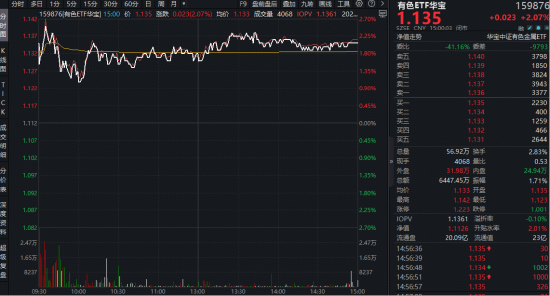
Core Viewpoint - The resurgence of spot gold prices above $5,000 has boosted market sentiment, leading to significant activity in the non-ferrous metals sector, particularly with the Huabao ETF [1] Group 1: Market Performance - The Huabao non-ferrous ETF (159876) saw a high level of activity, with intraday prices rising by 2.5% and closing up by 2.07% [1] - Key constituent stocks such as Shenghe Resources and Hunan Silver reached their daily limit, while other stocks like Silver Nonferrous and China Rare Earth saw increases of over 8% and 6%, respectively [1] Group 2: Industry Trends - The People's Bank of China has increased its gold reserves for 15 consecutive months, with reserves reaching 7.419 million ounces by the end of January 2026, up from 7.415 million ounces in December 2025 [3] - The price of light rare earths has been on the rise, with praseodymium and neodymium prices increasing by 5,000 yuan/ton to 925,000 yuan/ton, and praseodymium oxide prices rising by 7,500 yuan/ton to 752,500 yuan/ton [3] - The demand for gold from central banks is expected to provide a strong support for gold prices, while the ongoing rise in rare earth prices is anticipated to bolster the profitability of the industry [3] Group 3: Investment Opportunities - The Huabao non-ferrous ETF and its linked funds cover a wide range of sectors including copper, aluminum, gold, rare earths, and lithium, allowing investors to capture the beta performance across different economic cycles [3] - The ETF serves as an efficient tool for investors looking to gain exposure to the non-ferrous metals sector, being a financing and margin trading target [3]

有色金属基础周报:AI泡沫的担忧再次浮现,有色金属整体弱势调整-20260209
Chang Jiang Qi Huo· 2026-02-09 07:10
Report Industry Investment Rating No relevant information provided. Core Viewpoints of the Report - This week, macro factors continued to dominate the financial market. Concerns about the AI bubble resurfaced, leading to a sharp decline in global markets, including stocks, precious metals, and non - ferrous metals. However, Shanghai copper rebounded due to news of increased state purchases and then declined again with the external market, finally stabilizing at around 100,000 [4]. - The copper market's sharp decline was mainly driven by sudden panic in the macro - level, and some factors that previously pushed copper prices to new highs have changed. But copper will remain a focus of global strategic resource competition, and its structural shortage may continue. Before the Spring Festival, copper prices may stabilize after a rapid release of risks [4]. - The aluminum market shows mixed trends. Alumina production capacity has some fluctuations, and electrolytic aluminum supply is increasing unexpectedly. The demand of downstream enterprises is weakening, and the inventory is accumulating [4]. - The zinc market is in a situation of weak supply and demand. Zinc prices are expected to fluctuate in the short term due to macro - sentiment disturbances and pre - holiday capital outflows [4]. - The lead market has sufficient supply and weak demand. Affected by the decline in precious metal prices, lead prices hit a new low in 2026. After the pre - holiday profit - taking of short - selling funds in precious metals, the market may stabilize [4]. - The nickel market has a strong support at the mine end, but the demand is weak, and the inventory is accumulating. It is expected to maintain a volatile trend [5]. - The tin market has a tight supply of tin ore, and the downstream demand maintains rigid procurement. It is expected to continue to fluctuate, and attention should be paid to the supply resumption and downstream demand [5]. - The industrial silicon and polysilicon markets are affected by production cuts on both the supply and demand sides, and are expected to fluctuate [5]. - The lithium carbonate market is affected by factors such as mine risks and changes in supply and demand. It is expected to continue to fluctuate in the power demand off - season [5]. Summary by Relevant Catalogs 1. Macro - **Economic data of the current week (2/2 - 2/8)**: China's January RatingDog manufacturing PMI was 50.3, higher than the previous value; the eurozone's January manufacturing PMI was 49.5; the US January ISM manufacturing PMI was 52.6, reaching a new high since February 2022; the US January ADP employment increase was 22,000, lower than expected; the US January ISM services PMI was 53.8, reaching a new high since 2024 [12][13][15][17][18]. - **Policy and news**: China's Non - ferrous Metals Industry Association proposed to include copper concentrates in the national reserve; US President Donald Trump plans to invest $12 billion in strategic key mineral reserves [14][16]. - **Next - week economic data calendar (2/9 - 2/15)**: It includes data such as China's January M1 and M2 money supply year - on - year, the US January NFIB small business optimism index, and the US January unemployment rate [20]. 2. Copper - **Market review**: Shanghai copper first rebounded and then declined, and finally stabilized at around 100,000. The copper market was mainly affected by macro factors and inventory changes [4]. - **Key data tracking**: It includes LME copper spot/three - month spread, Shanghai copper inter - period spread curve, COMEX institutional positions, and global visible copper inventory [30][33]. 3. Aluminum - **Market review**: Shanghai aluminum showed a trend of rising and then adjusting, with the overall upward trend temporarily maintained [37]. - **Key data tracking**: It includes 6063 aluminum rod inventory, alumina port inventory, aluminum bauxite port inventory, electrolytic aluminum social inventory, electrolytic aluminum cost and profit, and alumina production cost and profit [41][42][43][45]. 4. Zinc - **Market review**: Shanghai zinc showed a trend of rising and then adjusting, with the upward trend of shock temporarily unchanged [50]. - **Key data tracking**: It includes Shanghai Futures Exchange zinc inventory/warehouse receipts, global visible zinc inventory, 0 zinc ingot premium, zinc forward curve, and zinc - related product prices [52][53][58][59]. 5. Lead - **Market review**: Shanghai lead showed a downward trend of shock, with overall range fluctuations [65]. - **Key data tracking**: It includes Shanghai Futures Exchange lead inventory/warehouse receipts, global lead inventory, lead forward curve, lead spot premium, and LME lead (spot/three - month) spread [67][70][74]. 6. Nickel - **Market review**: Shanghai nickel fell from a high level and was under pressure from the lower edge of the upper shock area [78]. - **Key data tracking**: It includes Shanghai Futures Exchange nickel inventory, LME nickel global inventory, high - nickel iron and Jinchuan nickel plate prices, nickel and nickel sulfate prices, and stainless steel inventory [81][82][87][88][90][91][92]. 7. Tin - **Market review**: Shanghai tin continued to decline after rising, and was temporarily supported by the lower trend line [95]. - **Key data tracking**: It includes tin futures closing prices, Shanghai tin premium, tin smelting profit, LME tin (spot/three - month) spread, tin - related product prices, Shanghai Futures Exchange tin inventory, and LME tin inventory [98][99][100][101][104]. 8. Other Metals (Gold, Silver, etc.) - **Trend analysis**: Shanghai gold rebounded after falling from a high level, maintaining an overall upward trend; Shanghai silver fell again after a rebound, breaking through the previous low, and the trend weakened; platinum and palladium showed wide - range fluctuations; industrial silicon showed wide - range fluctuations and broke through the lower limit of the range; alumina showed small - range fluctuations; polysilicon showed small - range fluctuations and stabilized; aluminum alloy showed small - range fluctuations and the downward trend changed; stainless steel and lithium carbonate fell from high levels, and the upward trend changed [109][111][112][114][116][118][119][122].
国泰海通:关注企稳后的有色金属布局机会
智通财经网· 2026-02-09 06:20
Group 1: Precious Metals - The decline in market risk appetite has led to adjustments in precious metal prices, with gold supported by continued purchases from the People's Bank of China and rising ETF holdings [2] - Silver prices are influenced by stable leasing rates and a rapid decline in U.S. silver inventories [2] Group 2: Copper - The expectation of strategic reserves for copper provides support despite macroeconomic pressures, with a focus on upstream resources to counter overseas supply disruptions [3] - The demand for copper is driven by AI computing infrastructure and grid modernization, indicating strong resilience in pricing [3] Group 3: Aluminum - Aluminum prices are under pressure due to seasonal demand weakness, with a decline in processing rates and an increase in social inventory [4] - The macroeconomic environment shows mixed signals, with the ISM services PMI returning to expansion but ADP employment figures falling short of expectations [4] Group 4: Tin - Tin prices are under downward pressure due to overseas macroeconomic factors and reduced funding, but there is increased purchasing interest from downstream sectors as prices decline [5] - The supply side may see marginal easing with increased activity in Indonesian tin transactions and the resumption of production in Myanmar [5] Group 5: Energy Metals - Lithium demand remains strong despite a four-week inventory reduction, with expectations of preemptive battery demand due to changes in export tax policies [6] - Cobalt prices are high due to tight upstream raw material supply, while companies are extending their reach into electric new energy sectors to enhance competitive advantages [6] Group 6: Rare Earths - The supply-demand balance for light rare earths remains tight, with prices continuing to rise due to pre-holiday stocking needs [7] - The investment value of rare earths as a strategic resource is highlighted, with specific companies recommended for investment [7] Group 7: Strategic Metals - Tungsten prices are experiencing a systematic increase driven by supply-demand dynamics, with significant price hikes reported by leading companies [8] - The market for uranium is expected to continue rising due to persistent supply-demand gaps and the development of nuclear power [9]

有色金属:关注企稳后的布局机会
GUOTAI HAITONG SECURITIES· 2026-02-09 05:15
Investment Rating - The report assigns an "Overweight" rating for the non-ferrous metals industry [4] Core Insights - The report emphasizes the importance of macroeconomic factors such as monetary policy, macro expectations, geopolitical dynamics, and supply disruptions in influencing metal price trends [2] - The report highlights the need to focus on investment opportunities following stabilization in the market [8] Summary by Sections 1. Industry and Stock Performance - The non-ferrous metals sector experienced a decline of 8.51% last week, underperforming major indices [14][16] 2. Metal Prices and Inventory - Copper prices decreased by 3.45% to 100,100 CNY/ton, while aluminum prices fell by 5.07% to 23,315 CNY/ton [24] - SHFE gold prices dropped by 8.92% to 1,090.12 CNY/gram, while COMEX gold rose by 5.13% to 4,988.60 USD/ounce [26] - SHFE silver prices decreased by 37.17% to 18,799 CNY/kg, with COMEX silver down by 1.28% to 77.53 USD/ounce [26] 3. Macro Data Tracking - The report tracks key macroeconomic indicators, including the U.S. CPI and PCE, which show a year-on-year increase of 2.7% and 2.79%, respectively [29][30] - China's CPI and PPI for December were reported at 0.8% and -1.9%, respectively [30] 4. Precious Metals: Low Inventory Disturbances - The report notes that low inventory levels continue to disrupt precious metal prices, with significant fluctuations observed in both gold and silver markets [52][53] 5. Copper: Price Fluctuations - The report indicates that copper prices are expected to fluctuate, with supply-side adjustments and demand dynamics playing crucial roles [65][72] 6. Aluminum: Price Adjustments - Aluminum prices are under pressure due to macroeconomic sentiment and seasonal demand fluctuations, with a noted decrease in processing rates [10][80] 7. Energy Metals: Strong Demand - The report highlights robust demand for energy metals, particularly lithium, despite some price pressures due to macroeconomic factors [89][92] 8. Rare Earths: Price Trends - Prices for rare earth elements, particularly praseodymium and neodymium oxides, continue to rise, supported by tight supply conditions [11]




有色金属行业报告(2026.2.2-2026.2.6):高波行情渐退,逢低布局有色板块
China Post Securities· 2026-02-09 02:12
证券研究报告:有色金属|行业周报 发布时间:2026-02-09 行业投资评级 强于大市 |维持 | 行业基本情况 | | | | --- | --- | --- | | 收盘点位 | | 9431.31 | | 52 | 周最高 | 11180.33 | | 52 | 周最低 | 4295.55 | 高波行情渐退,逢低布局有色板块 l 投资要点 贵金属:波动率预计已达到极致,黄金企稳。贵金属继续波动, 伦敦金最低点跌至 4400 美金左右,沪金最低跌至 1000 元左右,波动 率在周一放大到极致后开始减退,也为本轮调整找到了最低点——伦 敦金 4400 美元/沪金 1000 元。白银 ETF 的增持可能是短期折价带来 的套利机会所致,不能简单作为企稳信号。短期来看,黄金基本见底, 以市场给出的前低作锚进行交易。长期来看,沃什的降息+缩表政策 的实施,会对长端美债带来难以对冲的风险,美债走出牛陡的情况下, 黄金值得增配。 行业相对指数表现 2025-02 2025-04 2025-07 2025-09 2025-11 2026-02 -8% 7% 22% 37% 52% 67% 82% 97% 112% 12 ...
铜行业周报(20260202-20260206):TC 现货价续创历史新低,铜精矿现货延续紧张-20260208
EBSCN· 2026-02-08 14:43
Investment Rating - The report maintains an "Overweight" rating for the copper industry [6] Core Views - Short-term copper prices are expected to fluctuate, but there is optimism for an upward trend in copper prices in 2026 due to ongoing supply-demand tightness [1][4] - The TC spot price continues to hit historical lows, indicating tight procurement of copper concentrate [1][3] - The report recommends specific companies for investment: Zijin Mining, Luoyang Molybdenum, Jincheng Mining, and Western Mining, while also suggesting to pay attention to Tongling Nonferrous Metals [4] Supply and Demand Summary - **Supply**: - As of February 6, 2026, domestic copper concentrate inventory at major ports is 638,000 tons, down 5.2% from the previous week [2][46] - The TC spot price is at -51.23 USD/ton, a decrease of 0.9 USD/ton from January 30, 2026, marking a low since September 2007 [3][57] - **Demand**: - Cable manufacturing utilization rate increased by 0.7 percentage points to 60.15% as of February 5, 2026 [4][70] - Air conditioning production is projected to decline by 31.6% in February, 6.5% in March, and increase by 4.0% in April 2026 [4][87] Inventory Summary - Domestic copper social inventory increased by 4.0% week-on-week, while LME copper inventory rose by 4.9% [2][24] - Global inventory across major exchanges reached 1,021,000 tons, up 3.6% from January 30, 2026 [2][24] Price Trends - As of February 6, 2026, SHFE copper closed at 100,100 CNY/ton, down 3.45% from January 30, 2026, while LME copper closed at 13,060 USD/ton, down 0.08% [1][17]


有色品种春节前后价格及库存变化
Hua Tai Qi Huo· 2026-02-08 13:47
1. Report Industry Investment Rating - Not provided in the content 2. Core Viewpoints of the Report - In 2026, before and after the Spring Festival, the non - ferrous metal market showed a differentiated pattern. Macro factors dominated the price direction of non - ferrous metals, while the differences in the fundamentals of each variety led to the differentiation of inventory and consumption performance. The post - festival resumption of work rhythm would be the key variable [4]. 3. Summary According to the Directory Copper - **Pricing and Supply - side Situation**: The pricing of copper is more inclined to the framework of "macro - led direction, supply rigidity provides bottom support". The short - term upward movement of copper prices is often driven by macro factors, and the mid - term support comes from the "rigidity" of the supply side. In January 2026, the copper mine supply was tight, and the spot TC continued to decline, reaching a record low of - 49.84 US dollars per dry ton at the end of the month [12]. - **Refining and Supply**: Near the Spring Festival, the refined copper smelting showed the characteristics of tight raw materials, stable production, and limited impact of maintenance. Although the spot TC of copper concentrate continued to decline, the supply of recycled copper and waste anode plates was loose, supporting the high - level production of smelters. The estimated impact of smelter maintenance on refined copper production in January was about 20,000 tons. It is expected that the Yangshan copper premium will fluctuate within a narrow range, and the net import volume of refined copper will remain relatively stable [16]. - **Downstream Processing**: During the approach of the Spring Festival, the copper processing industry showed a co - existence of seasonal stocking demand and the inhibitory effect of high prices. The starting rate of refined copper rods recovered from 47.82% at the beginning of the month to 69.54% at the end of the month. The finished product inventory increased by 3.91% month - on - month, indicating that the actual digestion ability of the terminal market was still insufficient. The starting rate of copper cables increased slightly at the end of the year, with State Grid orders as the core support. The enameled wire sector was relatively strong, with the starting rate maintained at 79% - 83% [17]. - **Inventory Situation**: As of February 5, 2026, the copper social inventory had reached 335,800 tons, and the pre - festival inventory was at a relatively high level. If the subsequent arrival increases, the downstream resumption of work is slow, or the spot maintains a discount pattern, the peak of inventory accumulation may further rise; otherwise, the window for the decline of high inventory after the festival may appear earlier [18][19]. Lead - **Supply - side Situation**: Before the Spring Festival, the lead concentrate market was in a pattern of tight supply and rising costs. The processing fees were at a low level, and the production cost of smelting enterprises increased. In February, the supply and demand of the lead concentrate industry would enter a weak stage. After the festival, the supply - tight pattern of the lead concentrate market would intensify, and the processing fees would likely continue to run at a low level [20][22]. - **Consumption - side Situation**: The lead market showed the characteristic of "even weaker in the off - season". The consumer market of electric bicycle batteries was weak, and the inventory of dealers was high. The export orders of automobile batteries decreased. The weekly starting rate of lead - battery enterprises dropped to about 69% and continued to decline. After the festival, the resumption of work rhythm would be the key variable, and the actual restocking demand of the downstream would be gradually released after the Lantern Festival [22][23]. - **Inventory Situation**: As of February 5, 2026, the lead ingot social inventory had reached 40,400 tons, and the inventory accumulation started earlier than in previous years. If the subsequent lead concentrate arrival increases, the resumption of work of lead - battery enterprises after the festival is slow, or the spot discount pattern continues, the peak of inventory accumulation may further rise; otherwise, the window for the decline of high inventory after the festival may appear earlier [28][29]. Aluminum - **Price and Market Situation**: After New Year's Day, the price of Shanghai Aluminum's main contract rose by 16%, but the price transmission was blocked, and the downstream consumption was severely suppressed. The spot discount of aluminum ingots widened rapidly, and the aluminum rod entered a negative processing fee. The production of aluminum rods and aluminum sheets and foils decreased significantly [30][32]. - **Inventory Situation**: From December 18, 2025, to early February, the inventory accumulation of aluminum ingots had reached 239,000 tons. It is expected that the peak of inventory accumulation this year may reach 1.4 million tons, and if the aluminum price remains high, the inventory accumulation may reach 1.5 million tons [40]. Zinc - **Price and Market Performance**: After New Year's Day, the zinc ingot price rose by 15%. Although it was in the consumption off - season, the downstream processing enterprises were less sensitive to the absolute price of zinc, and the rigid demand for procurement still existed. The starting rate of downstream consumption remained strong and resilient until the end of January, and entered the off - season in February, which was in line with the seasonal performance in previous years [43]. - **Inventory Situation**: In 2026, the inventory accumulation of zinc started in February, about 15 days before the Chinese New Year, which was not much different from previous years. It is expected that the peak of inventory accumulation during the Spring Festival this year will be less than 250,000 tons, close to 200,000 tons [43][46]. - **Supply - side and Valuation**: The current smelting loss of zinc is at a historical high level. Although the by - product income is high, the comprehensive smelting profit is still partially in a loss state. The zinc price valuation is not high, and there is still a risk of a short squeeze if the inventory is quickly depleted after the festival [54]. Operation Suggestions - For copper, pay attention to the post - festival resumption of work progress and inventory depletion rhythm, and lay out long positions on dips [5]. - For aluminum, be vigilant against high - inventory pressure, and it is recommended to wait and see or short on rallies [5]. - For lead, pay attention to the release of restocking demand after the Lantern Festival, and mainly conduct range operations for the time being [5]. - For zinc, the smelting loss supports the price, it is recommended to go long on dips, and pay attention to the risk of a short squeeze [5].