
铁合金

Search documents
黑色产业链日报-20251107
Dong Ya Qi Huo· 2025-11-07 12:39
Report Industry Investment Rating No relevant content provided. Core Viewpoints - Steel products may show a volatile trend after challenging the previous low support level, as the arrival volume of iron ore at ports has increased significantly, port inventories are accumulating, iron ore valuations are relatively high, the consumption demand for finished products has entered the off - season, and the subsequent improvement in apparent demand is difficult. Additionally, recent macro - sentiment has weakened, and iron ore prices have declined while coking coal prices have corrected [3]. - The iron ore market is in a short - term pattern of "exhausted macro - benefits and pressured fundamentals". With high global shipments, accumulating port inventories, shrinking steel mill profits, falling hot metal production, and high finished product inventory pressure, the upside potential for iron ore prices is limited [22]. - The demand for coking coal and coke has reached a phased peak, and short - term prices may face adjustments. However, in the long - term, due to policies restricting coking coal supply elasticity and upcoming winter storage, the downward adjustment space for coking coal spot prices may be limited. If coking coal supply tightens in the fourth quarter and winter storage demand is released in mid - to late November, the overall valuation center of the black industry may rise [34]. - Ferroalloys are expected to be volatile, as they have returned to the fundamentals of high inventory and weak demand after the macro - sentiment subsided, but are supported by the cost side [46]. - The rigid demand for soda ash is expected to weaken due to the renewed expectation of glass cold repair. Although the cost side is expected to be firm, without production cuts, the valuation has limited upward elasticity. The medium - to long - term supply of soda ash is expected to remain high, and the upper - and middle - stream inventories are high, restricting prices, but there is cost support below [55]. - The coal - to - gas conversion in Shahe will be gradually implemented this month, which may affect market supply and sentiment, but its impact is considered limited as the off - season approaches and the middle - stream inventory is high. The 01 contract of glass may continue to be highly contested until near delivery. Structurally, without unexpected production cuts, the price of the 01 contract of glass will tend to decline, but with cost support and policy expectations in the long - term [83]. Summary by Relevant Catalogs Steel Products - **Prices and Spreads**: - On November 7, 2025, the closing prices of螺纹钢01, 05, and 10 contracts were 3034, 3095, and 3132 yuan/ton respectively, with corresponding price changes compared to November 6. The closing prices of热卷01, 05, and 10 contracts were 3245, 3254, and 3276 yuan/ton respectively [4]. - The spot prices of螺纹钢 and热卷 in different regions also showed certain changes on November 7 compared to November 6. For example, the汇总 price of螺纹钢 in China was 3226 yuan/ton, and the汇总 price of热卷 in Shanghai was 3260 yuan/ton [10][12]. - The卷螺差 and基差 of螺纹 steel and hot - rolled coils also had corresponding values and changes [16][10]. - The ratios of螺纹/铁矿 and螺纹/焦炭 remained stable on November 7 compared to November 6 [19]. Iron Ore - **Prices and Spreads**: - On November 7, 2025, the closing prices of iron ore 01, 05, and 09 contracts were 760.5, 740, and 722 yuan/ton respectively, with corresponding基差 values. The prices of different iron ore varieties such as日照PB粉,日照卡粉, and日照超特 also decreased compared to November 6 [23]. - **Fundamentals**: - The日均铁水产量 was 234.22 million tons on November 7, showing a decreasing trend compared to previous periods. The 45港到港量 increased significantly, and the 45港库存 also continued to accumulate [27]. Coking Coal and Coke - **Prices and Spreads**: - On November 7, 2025, the仓单 costs and基差 of coking coal from different sources (such as唐山蒙5,口岸蒙5, etc.) and coke (such as日照港湿熄,晋中湿熄, etc.) had corresponding values and changes [37]. - The期货月差 of coking coal and coke also showed certain trends [37]. - **Fundamentals**: - The即期焦化利润 improved slightly, but most coking plants still suffered serious losses. The demand for coking coal and coke has reached a phased peak, and the number of steel mills under maintenance has increased [34]. Ferroalloys - **Silicon Iron**: - On November 7, 2025, the硅铁基差 in Ningxia was - 26, and the spot prices in different regions such as Ningxia, Inner Mongolia, etc. remained stable or decreased slightly compared to previous periods. The仓单 quantity increased [46]. - **Silicon Manganese**: - The硅锰基差 in Inner Mongolia was 210 on November 7, and the spot prices in different regions also showed certain changes. The仓单 quantity increased significantly [48]. Soda Ash - **Prices and Spreads**: - On November 7, 2025, the closing prices of纯碱01, 05, and 09 contracts were 1210, 1294, and 1363 yuan/ton respectively, with corresponding月差 values. The基差 values in different regions such as沙河 and Qinghai also changed [56]. - The重碱 and轻碱 market prices in different regions had corresponding values on November 7, and the价差 between重碱 and轻碱 also varied by region [59]. - **Fundamentals**: - The glass cold - repair expectation may lead to a weakening of the rigid demand for soda ash. The supply of soda ash is expected to remain high in the medium - to long - term, and the upper - and middle - stream inventories are high [55]. Glass - **Prices and Spreads**: - On November 7, 2025, the closing prices of玻璃01, 05, and 09 contracts were 1091, 1225, and 1315 yuan/ton respectively, with corresponding月差 values. The基差 values in different regions such as Shahe and Hubei also changed [84]. - **Fundamentals**: - The coal - to - gas conversion in Shahe may affect market supply and sentiment, but the impact is limited due to the approaching off - season and high middle - stream inventory. The 01 contract of glass may continue to be highly contested until near delivery [83].
黑色金属日报-20251107
Guo Tou Qi Huo· 2025-11-07 11:56
Report Industry Investment Ratings - **Thread Steel**: ★★★ (implied by the context as more positive) [1] - **Hot Rolled Coil**: ★★★ (implied by the context as more positive) [1] - **Iron Ore**: ★☆☆ [1] - **Coke**: ★☆☆ [1] - **Coking Coal**: ★☆☆ [1] - **Silicon Manganese**: ★☆☆ [1] - **Silicon Iron**: ★☆★ [1] Core Viewpoints - The overall steel market is under pressure due to weak demand expectations and declining exports, with the disk remaining under pressure. The iron ore market is expected to be in a weak and volatile state, while the coke and coking coal markets may be in a relatively strong and volatile state. The silicon manganese and silicon iron markets have strong price support at the bottom [1][2][3][5][6][7] Summary by Category Steel - The disk showed a weak and volatile trend. The demand and production of thread steel and hot rolled coil both declined, with inventory changes varying. Iron - water production continued to fall, and the negative feedback pressure in the industrial chain remained to be alleviated. The overall domestic demand was weak, and steel exports declined from the high level. The disk was under pressure, and attention should be paid to the support at the lower edge of the shock range and marginal demand changes [1] Iron Ore - The disk declined. The global iron ore shipment was at a high level, and the domestic arrival volume increased significantly. The port inventory was accumulating. The terminal demand entered the off - season, and the iron - water production continued to decrease. The supply - demand relationship was gradually loosening, and there was still a risk of negative feedback in the off - season industrial chain. It was expected to be in a weak and volatile state [2] Coke - The price fluctuated downward. After the third round of price increase was quickly implemented, there was an expectation of a fourth round. The coking profit was average, and the daily production and inventory decreased slightly. The downstream demand was weak, and the steel mills had a strong desire to lower the price. The disk price was at a premium, and it was expected to be in a relatively strong and volatile state [3] Coking Coal - The price fluctuated downward. The Mongolian coal import volume was high, and the coking coal production decreased slightly. The total inventory increased slightly, and attention should be paid to the impact of safety inspections. The downstream demand was weak, and the steel mills had a strong desire to lower the price. The disk price was at a discount to Mongolian coal, and it was expected to be in a relatively strong and volatile state [5] Silicon Manganese - The price fluctuated. The iron - water production continued to decline, while the weekly production of silicon manganese increased slightly, and the inventory was slowly accumulating. The manganese ore inventory decreased slightly, and the price had strong support at the bottom [6] Silicon Iron - The price fluctuated. The iron - water production continued to decline, but the export demand increased to about 40,000 tons, and the secondary demand increased marginally. The supply remained at a high level, and the inventory decreased. The price had strong support at the bottom [7]
【行业分析】中国钼铁行业政策汇总、发展现状及投资前景预测报告——智研咨询发布
Sou Hu Cai Jing· 2025-11-07 08:15
Core Insights - Molybdenum iron, an alloy composed of 55%-75% molybdenum, is essential for producing stainless steel, heat-resistant steel, acid-resistant steel, and tool steel, with a density of 9.0g/cm³ to 9.5g/cm³ and a melting point around 2700°C [2][4] Production and Demand - In 2024, China's cumulative molybdenum iron production is projected to reach 217,700 tons, reflecting a year-on-year increase of 5.1%, with apparent demand at 217,600 tons [2] - From January to August 2025, cumulative production is expected to be 161,400 tons, a significant year-on-year growth of 13.8%, with apparent demand at 161,700 tons, indicating a balanced supply-demand scenario [2] - Major production regions in China include Liaoning, Henan, and Shaanxi [2] Price Trends - The price of 60% molybdenum iron in China surged from 98,600 CNY/ton in 2020 to 252,200 CNY/ton in 2023, driven by intensified supply-demand conflicts [2] - In 2024, prices are expected to remain high but decline compared to 2023 due to supply release and weakened downstream demand [2] Import and Export Dynamics - Between 2022 and 2024, molybdenum iron exports have been declining, while imports have been increasing, indicating a shift towards a stronger import market [2] - In 2024, molybdenum iron imports are projected at 7,963.5 tons, a substantial year-on-year increase of 61.0%, while exports are expected to be 8,122.9 tons, down 4.7% [2] - For January to August 2025, import and export volumes are anticipated to be 3,834.4 tons and 3,601.0 tons, respectively [2] Industry Outlook - The demand for molybdenum iron is expected to remain resilient, supported by the stainless steel and special steel sectors, as well as the upgrading of high-end manufacturing [2]





2025年9月中国铁合金出口数量和出口金额分别为7万吨和1.32亿美元
Chan Ye Xin Xi Wang· 2025-11-07 03:14
Core Insights - The report by Zhiyan Consulting highlights a decline in China's ferroalloy exports in September 2025, with a volume of 70,000 tons, representing a year-on-year decrease of 5.3% and an export value of 13.2 million USD, down 14.2% year-on-year [1] Group 1: Export Data - In September 2025, China's ferroalloy export volume was 70,000 tons, showing a decrease of 5.3% compared to the previous year [1] - The export value for the same period was 13.2 million USD, reflecting a year-on-year decline of 14.2% [1] Group 2: Industry Analysis - Zhiyan Consulting is recognized as a leading industry consulting firm in China, specializing in in-depth industry research and providing comprehensive consulting services [1] - The firm has over a decade of experience in the industry research field, focusing on delivering tailored industry solutions to empower investment decisions [1]

黑色供应周报:铁合金-20251107
Zhong Tai Qi Huo· 2025-11-07 02:22
General Information - Report Title: Black Supply Weekly Report - Ferroalloys [1] - Report Date: November 7, 2025 [2] - Analyst: Dong Xueshan [2] - Qualification Number: F3075616 [2] - Trading Consultation Certificate Number: Z0018025 [2] Core Data Silicon Manganese - National weekly production: 20.19 million tons, a decrease of 5,845 tons from the previous week, with a cumulative year - on - year decrease of 14.59% [3] - Inner Mongolia weekly production: 9.70 million tons, a decrease of 700 tons from the previous week, with a cumulative year - on - year increase of 1.81% [3] - Ningxia weekly production: 4.75 million tons, unchanged from the previous week, with a cumulative year - on - year increase of 13.47% [3] - Guangxi weekly production: 1.07 million tons, an increase of 455 tons from the previous week, with a cumulative year - on - year decrease of 1.99% [3] - Guizhou weekly production: 1.61 million tons, an increase of 700 tons from the previous week, with a cumulative year - on - year decrease of 17.43% [3] - Yunnan weekly production: 0.99 million tons, a decrease of 6,160 tons from the previous week, with a cumulative year - on - year increase of 13.64% [3] - Other regions weekly production: 2.07 million tons, a decrease of 140 tons from the previous week, with a cumulative year - on - year decrease of 24.09% [3] Silicon Iron - National weekly production: 11.41 million tons, an increase of 910 tons from the previous week, with a cumulative year - on - year increase of 6.85% [3] - Inner Mongolia weekly production: 3.68 million tons, an increase of 700 tons from the previous week, with a cumulative year - on - year increase of 4.25% [3] - Ningxia weekly production: 2.98 million tons, unchanged from the previous week, with a cumulative year - on - year increase of 11.22% [3] - Shaanxi weekly production: 1.84 million tons, an increase of 140 tons from the previous week, with a cumulative year - on - year increase of 0.45% [3] - Qinghai weekly production: 1.62 million tons, a decrease of 210 tons from the previous week, with a cumulative year - on - year decrease of 10.82% [3] - Gansu weekly production: 1.18 million tons, an increase of 280 tons from the previous week, with a cumulative year - on - year increase of 11.30% [3] - Other regions weekly production: 0.01 million tons, an increase of 1 ton from the previous week, with a cumulative year - on - year increase of 0.00% [3] Data Notes - The update date of the Steel Union terminal is every Thursday, and the data display date is Friday of the current week [6] - Data sources: Mysteel; compiled by Zhongtai Futures [6]
硅铁:成本端存抬升预期,宽幅震荡,锰硅:板块情绪共振,宽幅震荡
Guo Tai Jun An Qi Huo· 2025-11-07 01:52
Report Summary 1. Investment Rating No investment rating information is provided in the report. 2. Core View - Silicon ferroalloy is expected to experience wide - range fluctuations due to the potential increase in cost - end factors. - Manganese ferroalloy will have wide - range fluctuations due to sector sentiment resonance [1]. 3. Summary by Directory 3.1 Fundamental Tracking - **Futures Data**: - Silicon ferroalloy 2601 closed at 5586 yuan/ton, up 26 yuan from the previous trading day, with a trading volume of 160,696 and an open interest of 169,595. Silicon ferroalloy 2605 closed at 5650 yuan/ton, up 40 yuan, with a trading volume of 2,153 and an open interest of 9,414. - Manganese ferroalloy 2601 closed at 5798 yuan/ton, up 22 yuan, with a trading volume of 148,442 and an open interest of 351,061. Manganese ferroalloy 2605 closed at 5848 yuan/ton, up 26 yuan, with a trading volume of 8,599 and an open interest of 43,675 [1]. - **Spot Data**: - The aggregated price of silicon ferroalloy FeSi75 - B in Inner Mongolia was 5220 yuan/ton. The price of silicon - manganese FeMn65Si17 in Inner Mongolia was 5620 yuan/ton. - The price of manganese ore Mn44 block was 40.0 yuan/ton - degree, up 0.2 yuan. The price of small - sized semi - coke in Shenmu was 760 yuan/ton. - The spot - futures price difference of silicon ferroalloy (spot - 01 futures) was - 366 yuan/ton, down 26 yuan. The spot - futures price difference of manganese ferroalloy (spot - 01 futures) was - 178 yuan/ton, down 22 yuan [1]. - **Spread Data**: - The near - far month spread of silicon ferroalloy 2601 - 2605 was - 64 yuan/ton, down 14 yuan. The near - far month spread of manganese ferroalloy 2601 - 2605 was - 50 yuan/ton, down 4 yuan. - The cross - variety spread of manganese ferroalloy 2601 - silicon ferroalloy 2601 was 212 yuan/ton, down 4 yuan. The cross - variety spread of manganese ferroalloy 2605 - silicon ferroalloy 2605 was 198 yuan/ton, down 14 yuan [1]. 3.2 Macro and Industry News - On November 6th, the starting price of Hongliulin lump coal, the raw material for semi - coke, was 720 yuan/ton, up 45 yuan/ton from the previous period. The auction volume was 7.8 million tons, down 2.8 million tons. The average transaction price was 783.36 yuan/ton, up 78.39 yuan/ton from the previous average price. The lowest auction price was 773 yuan/ton, and the highest was 790 yuan/ton [1]. - On November 6th, the price of 72 silicon ferroalloy in Shaanxi was 5000 - 5200 yuan/ton, in Ningxia was 5200 - 5250 yuan/ton (up 25 yuan), in Qinghai was 5150 - 5250 yuan/ton, in Gansu was 5150 - 5250 yuan/ton, and in Inner Mongolia was 5150 - 5250 yuan/ton. The price of 75 silicon ferroalloy in Shaanxi was 5700 yuan/ton, in Ningxia was 5650 - 5700 yuan/ton (down 50 yuan), in Qinghai was 5600 - 5700 yuan/ton (down 75 yuan), in Gansu was 5650 - 5700 yuan/ton, and in Inner Mongolia was 5650 - 5700 yuan/ton. The FOB price of 72 silicon ferroalloy was 1020 - 1040 US dollars/ton (down 10 US dollars), and the FOB price of 75 silicon ferroalloy was 1110 - 1130 US dollars/ton. The northern quotation of 6517 silicon - manganese was 5550 - 5650 yuan/ton, and the southern quotation was 5600 - 5700 yuan/ton [2]. - A steel mill in Shandong set the price of silicon - manganese at 5720 yuan/ton (cash - inclusive delivered to the factory) and the purchase volume was 1000 tons. A steel mill in Jiangsu set the price of silicon - manganese at 5800 yuan/ton (acceptance - inclusive delivered to the factory) and the purchase volume was 3000 tons. Xinyu Iron and Steel set the purchase price of silicon ferroalloy at 5770 yuan/ton, down 30 yuan/ton from the previous round, with a purchase volume of 600 tons [3]. 3.3 Trend Intensity - The trend intensity of silicon ferroalloy is 0, and the trend intensity of manganese ferroalloy is 0. The trend intensity ranges from - 2 to 2, representing weak, relatively weak, neutral, relatively strong, and strong, where - 2 is the most bearish and 2 is the most bullish [3].
永安期货铁合金早报-20251107
Yong An Qi Huo· 2025-11-07 00:53
Report Industry Investment Rating - Not provided in the content Core Viewpoints - Not provided in the content Summary by Related Catalogs Price - For silicon ferroalloy, on November 7, 2025, the latest price of Ningxia 72 silicon ferroalloy natural block was 5150 yuan, with no daily change and a weekly decrease of 70 yuan; the main contract price was 5586 yuan, with a daily increase of 26 yuan and a weekly increase of 36 yuan [2]. - For silicon manganese alloy, on the same day, the ex - factory price of Inner Mongolia 6517 silicon manganese alloy was 5620 yuan, with no daily change and a weekly decrease of 60 yuan; the main contract price was 5798 yuan, with a daily increase of 22 yuan and a weekly decrease of 44 yuan [2]. Supply - The production data of 136 silicon ferroalloy production enterprises in China over the years from 2021 - 2025 are presented, including monthly production, weekly production (with a capacity ratio of 95%), and monthly capacity utilization rates in Inner Mongolia, Ningxia, and Shaanxi [4]. - The weekly production data of silicon manganese alloy in China from 2021 - 2025 are also provided [6]. Demand - The report shows the demand data of silicon manganese alloy in China (in ten thousand tons, according to the Steel Union's caliber) from 2021 - 2025, as well as the monthly production forecast data of crude steel in China [4][7]. - It also includes the monthly procurement volume and price data of FeSi75 - B by Hebei Iron and Steel Group, and the monthly procurement volume and price data of 6517 silicon manganese alloy by Hebei Iron and Steel Group [4][6]. Inventory - For silicon ferroalloy, the weekly inventory data of 60 sample enterprises in China, Ningxia, Inner Mongolia, and Shaanxi from 2021 - 2025 are presented, along with daily data on warehouse receipts, effective forecasts, and the sum of warehouse receipts and effective forecasts [5]. - For silicon manganese alloy, the daily data on warehouse receipts, effective forecasts, and the sum of warehouse receipts and effective inventory in China from 2021 - 2025 are provided, as well as the weekly inventory data of 63 sample enterprises in China [7]. Cost - Profit - The cost - profit data of silicon ferroalloy include electricity prices in Inner Mongolia, Qinghai, Ningxia, and Shaanxi, the market price of small - sized blue charcoal in Shaanxi, the production profit of blue charcoal in China, and the production cost and profit of silicon ferroalloy in Inner Mongolia and Ningxia [5]. - The cost - profit data of silicon manganese alloy include the profit data in Inner Mongolia, Guangxi, the northern region, and the southern region (according to the Steel Union's caliber), and the profit data of silicon manganese alloy in Ningxia and Guangxi converted to the main contract [7].
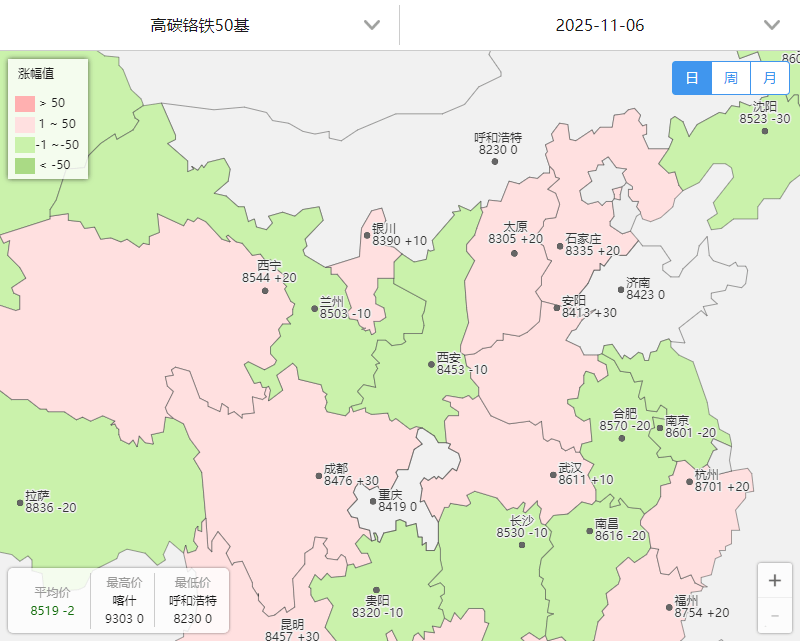
【铬铁】天津港南非铬精粉期货依旧平盘,高铬市场弱稳观望!
Sou Hu Cai Jing· 2025-11-07 00:42
Core Viewpoint - The high carbon ferrochrome market is currently influenced by both "weak reality" and "weak expectations," leading to a lack of market confidence, although short-term attention is needed on raw material adjustments, downstream stainless steel market changes, and effective demand release [1] Group 1: Market Performance - The current market price for high carbon ferrochrome is around 8100-8300 CNY per 50 base tons, reflecting a weak and cautious market outlook [2] - Terminal demand remains sluggish, with the stainless steel market continuing to operate weakly, which has intensified negative sentiment towards ferrochrome [2] - Recent trading activity in the high carbon ferrochrome market has been lackluster, with strong price-cutting sentiment towards chrome ore, although a decline in chrome ore prices has created some bargaining pressure in the ferrochrome market [2] Group 2: Chrome Ore Market - The latest price for South African chrome concentrate (40-42% grade) at Tianjin Port is reported at 282 USD per ton, remaining stable compared to previous periods [4] - A detailed price table for chrome ore indicates various grades and their corresponding prices, with South African block ore (36%-38% grade) priced at 52-54 CNY per ton and South African concentrate (42%-44% grade) priced at 300-310 USD per ton [5]

硅锰的窘境
对冲研投· 2025-11-06 12:06
Core Viewpoint - The article discusses the current state of the silicon manganese market, highlighting supply surplus, resilient demand, and weakening profits as key factors influencing price movements and market dynamics [4][6][9]. Group 1: Supply Dynamics - Supply levels have not decreased entering the fourth quarter, with high production willingness from producers due to previous price increases leading to hedging activities [6]. - There is a consensus on supply surplus, which is suppressing price rebound potential [6][8]. - The silicon manganese market is experiencing significant supply surplus, leading to lower market attention and price weakness [8][11]. Group 2: Demand Resilience - The crude steel production data from the China Iron and Steel Association indicates that production has remained stable year-on-year, suggesting steady demand for silicon manganese [9]. Group 3: Profitability Challenges - Silicon manganese profits are declining due to supply surplus and inherent industry challenges, particularly the difficulty of achieving "anti-involution" in a predominantly private enterprise sector [10][11]. - The competition between steel mills and manganese mines affects silicon manganese pricing, with steel mills' thin margins intensifying the price negotiation dynamics [11]. - The complete cash cost support for silicon manganese remains relatively strong, with a low point of 5350 and current cash costs at 5700, indicating a potential for price recovery when prices fall below cash costs [14].

黑色建材日报-20251106
Wu Kuang Qi Huo· 2025-11-06 01:23
Report Industry Investment Rating No relevant content provided. Core Viewpoints of the Report - The overall atmosphere in the commodity market was weak yesterday, with finished steel prices showing a weak and volatile trend. Although the steel demand has officially entered the off - season and there is a risk of inventory accumulation for hot - rolled coils, with the implementation of the Fed's easing expectations and positive signals from the China - US meeting, the market sentiment and capital environment are expected to improve, and the steel consumption end may gradually recover in the future [2]. - For iron ore, the supply is still at a high level in the same period, but the demand continues to weaken, and the inventory pressure remains. After the macro - events are realized, the fundamentals of iron ore are weak, and the price is expected to be weak and volatile in the short term. If the US liquidity problem is alleviated, the price may stabilize [5]. - Regarding manganese silicon and silicon iron, the fundamentals are not ideal, and they are likely to follow the trend of the black sector. The operability is relatively low [10]. - For industrial silicon, the supply pressure persists, and the demand support weakens. The price is likely to fluctuate with the commodity market in the short term, and attention should be paid to the option game near the expiration [13]. - For polysilicon, the supply - demand pattern may improve marginally, but the short - term inventory reduction is limited. The market has strong expectations for the industry meeting, and the price is highly volatile [16]. - For glass, the market expects an improvement in the supply structure, but the price increase is restricted by the low procurement enthusiasm of downstream factories. The sustainability of the market depends on spot transactions and inventory reduction [19]. - For soda ash, the industry operating rate remains high, the loss continues to expand, and the demand is mainly for rigid restocking. The price is expected to continue the weak and volatile pattern in the short term [21]. Summary by Related Catalogs Steel Market Quotes - The closing price of the rebar main contract was 3024 yuan/ton, down 20 yuan/ton (- 0.65%) from the previous trading day. The registered warehouse receipts decreased by 2708 tons, and the main contract positions increased by 65237 lots. The Tianjin and Shanghai aggregate prices decreased by 10 yuan/ton and 30 yuan/ton respectively [1]. - The closing price of the hot - rolled coil main contract was 3253 yuan/ton, down 12 yuan/ton (- 0.36%) from the previous trading day. The registered warehouse receipts remained unchanged, and the main contract positions decreased by 23039 lots. The Lecong and Shanghai aggregate prices decreased by 10 yuan/ton and 20 yuan/ton respectively [1]. Strategy Views - Rebar shows a situation of both supply and demand increasing, with inventory continuously decreasing, performing neutrally overall. Hot - rolled coils have a continuous recovery in demand, but the production is still high, and the inventory level is still relatively high [2]. Iron Ore Market Quotes - The main contract (I2601) of iron ore closed at 776.00 yuan/ton, with a change of + 0.06% (+ 0.50). The positions decreased by 3095 lots to 54.47 million lots. The weighted position was 94.35 million lots. The spot price of PB powder at Qingdao Port was 782 yuan/wet ton, with a basis of 55.23 yuan/ton and a basis rate of 6.64% [4]. Strategy Views - Supply: The overseas iron ore shipment volume decreased slightly but remained at a high level in the same period. The shipments from Australia and Brazil both declined, with FMG having a significant decline. The shipments from non - mainstream countries decreased slightly, and the near - end arrival volume rebounded to the annual high [5]. - Demand: The daily average pig iron output decreased by 3.54 million tons to 236.36 million tons. The number of blast furnaces under maintenance far exceeded those under restart. The steel mill profitability reached a new low, and some blast furnaces started maintenance due to profit decline. Environmental protection restrictions in Hebei also affected pig iron production [5]. - Inventory: Port inventory continued to increase, while steel mill inventory decreased [5]. Manganese Silicon and Silicon Iron Market Quotes - On November 5, the main contract of manganese silicon (SM601) closed up 0.38% at 5776 yuan/ton. The spot price in Tianjin was 5680 yuan/ton, with a basis of 116 yuan/ton [7][8]. - The main contract of silicon iron (SF601) closed up 0.91% at 5560 yuan/ton. The spot price in Tianjin was 5550 yuan/ton, with a discount of 10 yuan/ton to the futures [8]. Strategy Views - The fundamentals of manganese silicon are not ideal, and the potential driver may come from the manganese ore end. If the black sector strengthens, attention should be paid to the possible disturbances in the manganese ore end [10]. - The supply - demand fundamentals of silicon iron have no obvious contradictions and drivers, and it is likely to follow the black sector [10]. Industrial Silicon and Polysilicon Market Quotes - Industrial silicon: The main contract (SI2601) closed at 9020 yuan/ton, up 1.52% (+ 135). The weighted contract positions decreased by 13071 lots to 398388 lots. The spot price of East China non - oxygenated 553 was 9300 yuan/ton, with a basis of 280 yuan/ton; the 421 was 9700 yuan/ton, with a basis of - 120 yuan/ton [12]. - Polysilicon: The main contract (PS2601) closed at 53355 yuan/ton, down 0.67% (- 360). The weighted contract positions decreased by 7354 lots to 230402 lots. The average price of N - type granular silicon was 50.5 yuan/kg, and the basis was - 1155 yuan/ton [15]. Strategy Views - Industrial silicon: The supply pressure persists. Although the production in Southwest China is reduced during the dry season, the production in Northwest China continues to rise. The demand support weakens, and the price is likely to fluctuate with the commodity market in the short term [13]. - Polysilicon: Some production capacities will be overhauled, and the production in November will be reduced to 120,000 tons. The supply - demand pattern may improve marginally, but the short - term inventory reduction is limited. The market has strong expectations for the industry meeting, and the price is highly volatile [16]. Glass and Soda Ash Market Quotes - Glass: The main contract closed at 1097 yuan/ton on Wednesday afternoon, down 0.72% (- 8). The weekly inventory of float glass sample enterprises decreased by 823,000 cases (- 1.24%). The top 20 long - position holders increased 27375 lots, and the top 20 short - position holders increased 45091 lots [18]. - Soda ash: The main contract closed at 1195 yuan/ton on Wednesday afternoon, up 0.50% (+ 6). The weekly inventory of soda ash sample enterprises decreased by 10,000 tons (- 1.24%), with heavy - soda inventory decreasing by 48,100 tons and light - soda inventory increasing by 48,000 tons. The top 20 long - position holders decreased 16327 lots, and the top 20 short - position holders decreased 16452 lots [20]. Strategy Views - Glass: The market expects an improvement in the supply structure, but the price increase is restricted by the low procurement enthusiasm of downstream factories. The sustainability of the market depends on spot transactions and inventory reduction [19]. - Soda ash: The industry operating rate remains high, the loss continues to expand, and the demand is mainly for rigid restocking. The price is expected to continue the weak and volatile pattern in the short term [21].