
化工

Search documents
黑色产业链日报-20260311
Dong Ya Qi Huo· 2026-03-11 09:58
Report Summary 1. Report Industry Investment Rating No investment rating information is provided in the report. 2. Core Views - **Steel**: After the Two Sessions, real - estate policies are mainly stable with limited stimulus. Market expectations have returned to fundamentals. Steel exports face pressure, hot - rolled coil inventory is high, and the pressure from warehouse receipts is large. Insufficient inventory reduction may lead to price declines, and the rebound height is limited [3]. - **Iron Ore**: Against the backdrop of war concerns and domestic policy support, tightened spot liquidity has pushed prices higher, but the fundamentals show a seasonal weakening in both supply and demand. Supply pressure persists, and the expectation of steel mill production cuts is rising under stagflation risks, leading to inventory accumulation. If the Strait of Hormuz is blocked, the contraction in iron ore demand from Gulf countries may far exceed the reduction in Iranian supply. Coupled with only a seasonal rebound in shipping costs, the upside space is limited [21]. - **Coking Coal and Coke**: Domestic coal mines are in the resumption stage, and Mongolian coal customs clearance has recovered rapidly, resulting in large supply pressure. The short - term surplus contradiction of coking coal has intensified. The cost of coking coal for coke has loosened, and coking profits have expanded slightly. The rise in chemical product prices has improved comprehensive profits, and coke enterprise operations are expected to increase. From March to April, it is the verification period for terminal demand. The late Spring Festival has led to a slow resumption of work, and the uncertainty of the Middle East route has suppressed steel exports. The overall downward pressure on the black series is large, and the bottom of coking coal and coke has support but limited elasticity [31]. - **Ferroalloys**: In the short term, the cost support for ferroalloys is gradually strengthening, but the weak downstream steel terminal demand and high plate inventory pressure may limit the upward space for ferroalloys [50]. - **Soda Ash**: Supply - side maintenance may gradually increase, which will affect production in stages. In terms of supply and demand, the rigid demand is currently stable but weak. There may be unexpected disturbances on the supply side, which may affect soda ash production in stages. The inventory performance is better than expected. If the futures price rises, there is some restocking space for middle - stream players such as those involved in futures - cash arbitrage, but due to limited demand elasticity, the price increase space is expected to be limited. The downward price space needs inventory accumulation to open up. In the long - term, the high - supply expectation remains unchanged, and we need to wait for further accumulation of industrial contradictions. In addition to the fundamentals, the overall valuation of soda ash and glass is not high, and there may be an impact from other sectors [64]. - **Glass**: Currently, the glass production and sales are temporarily weak, and the market is still in the recovery stage. The daily melting volume of float glass has dropped to around 148,000 tons, but the high inventory in the middle - stream has always been a risk concern in the market. Once a negative feedback occurs, the spot pressure will be very large, and the downstream may not be able to bear it. Secondly, there are continuous news about ignition and cold - repair, and there are many new lines in Shahe waiting to be ignited. The expectation of supply recovery and high middle - stream inventory limit the upside of glass, and the demand needs to be verified. In addition to the fundamentals, macro and sentiment factors also need to be considered, and there may be an impact [87]. 3. Summary by Directory Steel - **Futures Prices**: On March 11, 2026, the closing prices of rebar 01, 05, and 10 contracts were 3170, 3115, and 3144 yuan/ton respectively, and those of hot - rolled coil 01, 05, and 10 contracts were 3292, 3269, and 3278 yuan/ton respectively [4]. - **Spot Prices**: On March 11, 2026, the rebar summary price in China was 3317 yuan/ton, and the hot - rolled coil summary price in Shanghai was 3250 yuan/ton [9][11]. - **Price Spreads**: The 01 - 05 month spread of rebar was 55 yuan/ton, and that of hot - rolled coil was 23 yuan/ton on March 11, 2026 [4]. Iron Ore - **Futures Prices**: On March 11, 2026, the closing prices of 01, 05, and 09 contracts were 740.5, 787.5, and 758.5 yuan/ton respectively [22]. - **Spot Prices**: On March 11, 2026, the price of Rizhao PB powder was 772 yuan/ton [22]. - **Fundamentals**: As of March 6, 2026, the daily average pig iron output was 227.59 tons, the 45 - port desilting volume was 311.08 tons, and the 45 - port inventory was 17117.86 tons [26]. Coking Coal and Coke - **Futures Prices**: On March 11, 2026, the 09 - 01 month spread of coking coal was - 214 yuan/ton, and that of coke was - 94 yuan/ton [35]. - **Spot Prices**: On March 11, 2026, the ex - factory price of Anze low - sulfur main coking coal was 1450 yuan/ton, and the ex - factory price of Jinzhong quasi - first - grade wet coke was 1280 yuan/ton [38]. - **Profits**: The on - site coking profit was - 28 yuan/ton on March 11, 2026 [35]. Ferroalloys - **Silicon Iron**: On March 10, 2026, the silicon iron basis in Ningxia was 4 yuan/ton, and the silicon iron 01 - 05 month spread was 58 yuan/ton [51]. - **Silicon Manganese**: On March 11, 2026, the silicon manganese basis in Inner Mongolia was 84 yuan/ton, and the silicon manganese 01 - 05 month spread was 106 yuan/ton [52]. Soda Ash - **Futures Prices**: On March 11, 2026, the closing prices of 05, 09, and 01 contracts were 1255, 1322, and 1357 yuan/ton respectively [65]. - **Spot Prices**: On March 11, 2026, the market price of heavy soda ash in North China was 1280 yuan/ton [65]. Glass - **Futures Prices**: On March 11, 2026, the closing prices of 05, 09, and 01 contracts were 1112, 1225, and 1283 yuan/ton respectively [88]. - **Production and Sales**: On March 6, 2026, the production - sales ratio in Shahe was 131, in Hubei was 100, in East China was 92, and in South China was 100 [89].
每日商品期市纵览-20260311
Dong Ya Qi Huo· 2026-03-11 09:51
Report Industry Investment Rating No relevant content provided. Core Viewpoints - The global market risk preference has risen due to the signal of easing in the Middle East situation, but there are still uncertainties in the short - term, and most markets are expected to be volatile [2]. - The prices of various commodities are affected by multiple factors such as geopolitical situations, supply - demand relationships, and cost changes, and different commodities have different trends and influencing factors [1][2][3]. Summary by Category Financial Futures - **Stock Index**: The short - term is expected to be mainly volatile due to factors such as geopolitical risks and the need to wait for more positive policy signals after the Two Sessions [2]. - **Treasury Bonds**: Although the short - term export and import data are good, it is difficult to change the overall economic judgment. The value of treasury bonds has risen after the decline, and the negative impact from the Middle East has not completely dissipated [2]. Non - Ferrous Metals - **Platinum and Palladium**: The long - term upward basis still exists, but in the short - term, the risk of postponed interest - rate cut expectations needs to be vigilant [3]. - **Gold and Silver**: The prices are affected by factors such as the Fed's monetary policy expectations, geopolitical situations, and trade policy uncertainties. Attention should be paid to the Middle East situation and US CPI, PCE data [3][4]. - **Copper**: The price increase is mainly driven by short - covering. The global macro - environment is complex, and both supply and demand are affected by multiple factors [4]. - **Aluminum**: The short - term price is dominated by the war situation and fluctuates sharply [5]. - **Alumina**: The short - term spot price has rebounded, but the medium - to - long - term surplus pattern remains unchanged. Attention should be paid to the release of new production capacity in March [6]. - **Cast Aluminum Alloy**: It has a strong follow - up relationship with Shanghai Aluminum, and there is strong support below [7]. - **Zinc**: The supply may be affected by the Iran situation and energy costs, and the demand side has inventory pressure. The short - term metal price may be suppressed [7]. - **Nickel and Stainless Steel**: The supply of Indonesian wet - process production lines is volatile, and stainless steel is supported by the peak - season expectation [8]. - **Tin**: The supply is tight, and the demand is starting to resume work. The high inventory suppresses the price, and attention should be paid to the inventory - reduction speed and the development of the Iran situation [8]. - **Lithium Carbonate**: The short - term demand is affected by the Middle East situation, but the long - term downstream demand growth logic remains unchanged [9]. - **Industrial Silicon and Polysilicon**: The industry is at the bottom of the current production - capacity cycle, and attention should be paid to the "anti - involution" process and the marginal optimization of the supply - demand structure [9]. - **Lead**: The current supply - demand is weak, and the price is expected to fluctuate. Attention should be paid to the possible negative feedback on the market during the delivery week and the implementation of secondary lead delivery [10][11]. Black Metals - **Rebar and Hot - Rolled Coil**: After the Two Sessions, the real - estate policy is mainly stable, and the steel export faces pressure. The high inventory of hot - rolled coils may lead to price decline [12]. - **Iron Ore**: The price is relatively strong due to the tight liquidity of spot goods, but the fundamental supply - demand is seasonally weak. The upside space is limited [12]. - **Coking Coal and Coke**: The supply pressure is large, and the overall black - metal series has downward pressure, but there is support at the bottom [13]. - **Ferrosilicon and Silicomanganese**: The short - term cost support is gradually strengthening, but the upward space may be limited due to weak downstream demand and high inventory of plates [14]. Energy and Chemicals - **Crude Oil**: The market focuses on the Middle East situation. The development of the US - Iran situation and the subsequent navigation of the Strait of Hormuz are crucial [15]. - **Fuel Oil**: The Asian fuel - oil market remains strong due to supply tightening, increased ship demand, and other factors [15]. - **Asphalt**: The price will follow the cost - end crude oil, and the short - term geopolitical disturbance is the core factor [16]. - **LPG**: The price follows the crude oil, and the Middle East situation needs to be continuously tracked [16]. - **Plastics**: The short - term supply pressure is limited, and the supply - demand pattern is relatively good [17]. - **Urea**: The US - Iran war may break the current weak balance of domestic urea [17]. - **Soda Ash**: The supply may be affected by maintenance, and the inventory performance is better than expected. The price space is limited [18]. - **Glass**: The production and sales are currently weak, and the high inventory in the middle reaches restricts the price increase [19]. - **Caustic Soda**: The supply is sufficient, the demand is weak, and the market is in a supply - strong and demand - weak pattern, showing a weak - oscillating trend [20]. Agricultural Products - **Hogs**: The current market is mainly affected by the weak post - Spring Festival demand, and the price has limited upward and downward space [21]. - **Oilseeds**: The price is supported by factors such as planting - cost increase, export improvement, and biodiesel boost. The domestic market will follow the performance of US soybeans in the short - term [21]. - **Oils**: The market is expected to be range - bound, and attention can be paid to the weakening of the price differences between rapeseed oil and soybean oil, and rapeseed oil and palm oil [22]. - **Cotton**: The domestic supply - demand tightening expectation supports the price, but the high price difference between domestic and foreign cotton exerts pressure on the upside [23]. - **Eggs**: The short - term demand improvement supports the price to be strong in oscillation, but the upside space is limited [24]. - **Red Dates**: The market focus is on the demand side. The price may remain in a low - level oscillation due to the loose domestic supply - demand [24].
市场上行,板块轮动
Tebon Securities· 2026-03-11 09:29
Market Analysis - The A-share market continues its upward trend, with a notable divergence among individual stocks. The Shanghai Composite Index closed at 4133.43 points, up 0.25%, while the Shenzhen Component Index rose 0.78% to 14465.41 points. The ChiNext Index increased by 1.31% to 3349.53 points, but the Sci-Tech 50 Index fell by 1.37% to 1401.08 points, indicating internal differentiation within the technology sector [2][5]. - The total market turnover reached approximately 2.53 trillion yuan, a slight increase of 4.6% compared to the previous trading day, reflecting a high level of market activity. There were 2055 stocks that rose, while 3284 stocks fell, showcasing a structural market characteristic [2][5]. Sector Performance - The new energy sector experienced a significant surge, with photovoltaic inverter and lithium battery electrolyte indices rising by 5.30% and 4.60%, respectively. The energy storage index increased by 3.22%. Notably, the stock price of CATL surged nearly 6%, reaching 396.8 yuan per share, with a total market capitalization of 1.83 trillion yuan. The market continues to favor the new energy sector, driven by the rapid development of artificial intelligence and the inclusion of "computing and electricity synergy" in the government work report [5][7]. - Conversely, the defense, media, computer, and electronics sectors saw declines of 1.51%, 1.20%, 0.79%, and 0.71%, respectively, reflecting recent adjustments related to the OpenClaw concept and associated risk warnings from the National Internet Emergency Center [5][7]. Bond Market - The government bond futures market experienced slight adjustments, with the 30-year main contract TL2606 closing at 111.250 yuan, down 0.19%. The 10-year main contract T2606 closed at 108.260 yuan, down 0.04%, with a trading volume of 647.29 billion yuan, indicating active market trading but cautious sentiment [11]. - The central bank conducted a net withdrawal of 14 billion yuan, with short-term funding rates slightly rising. The overnight Shibor increased by 4.9 basis points to 1.367%, while the 7-day Shibor rose by 2.8 basis points to 1.460% [11]. Commodity Market - The South China commodity index rose to 3077.03 points, up 0.79%. Following a significant pullback in the energy sector, the market displayed clear sector rotation, with shipping and chemical products emerging as new leaders. The shipping index surged by 7.15%, while various commodities like caustic soda and PVC saw substantial increases [9][15]. - In contrast, crude oil and lithium carbonate led the declines, with crude oil futures dropping by 9.61% to 662.0 yuan per barrel. The International Energy Agency proposed releasing over 182 million barrels of oil to mitigate price spikes caused by geopolitical tensions, which is expected to exert downward pressure on oil prices [15][9]. Investment Opportunities - Recent hot sectors include AI applications, commercial aerospace, nuclear fusion, quantum technology, brain-computer interfaces, robotics, and consumer goods, all of which are supported by government policies and technological advancements. The focus remains on the transformation of application scenarios and the progress of domestic projects [13][16]. - The market is advised to monitor the developments in the Middle East, as ongoing geopolitical tensions may influence market sentiment and sector performance [16].
午后爆发!600328,3分钟涨停!
证券时报· 2026-03-11 08:49
Market Overview - The Shanghai Composite Index rose by 0.25% to close at 4133.43 points, while the Shenzhen Component Index increased by 0.78% and the ChiNext Index gained 1.31% [2] - The total trading volume in the Shanghai and Shenzhen markets reached approximately 2.53 trillion yuan, an increase of over 110 billion yuan compared to the previous trading day [2] Solar Industry - The solar industry stocks experienced a strong rally, with companies like Shihang New Energy hitting the 20% limit up, and others like Mingyang Electric and Ailuo Energy rising over 10% [4][6] - The driving force behind the current solar market is shifting from a technical rebound to a structural revaluation due to the reshaping of the global energy geopolitical landscape [6] - Global energy investment is accelerating towards distributed and decentralized solutions, with solar power being a core supply pillar for distributed green electricity [6] Chemical Industry - The chemical sector saw a significant rise, with companies like Jinniu Chemical and Zhongyan Chemical hitting the limit up [8] - Concerns over oil supply disruptions have led to rising international oil prices, which in turn have driven up prices for basic chemical products and downstream industries [8] - The domestic chemical industry is entering the end of its expansion cycle, with outdated capacity being eliminated, improving the supply-demand balance in the sector [8] Fertilizer Sector - Fertilizer stocks performed well, with companies like Yuegui Co. and Luxi Chemical hitting the limit up, and others like Hualu Hengsheng rising over 6% [9][11] - The ongoing conflict in the Middle East is impacting fertilizer transportation, which is expected to lead to rising prices in the U.S. fertilizer market as the planting season approaches [11] - The Middle East plays a crucial role in global urea supply, with Iran and Qatar significantly influencing global trade volumes, and geopolitical tensions are likely to push up international urea prices [11]



高盛闭门会-中东局势动荡后的全球能源商品与股票市场展望
Goldman Sachs· 2026-03-11 08:12
Investment Rating - The report indicates a positive outlook for the energy sector, particularly for U.S. refining companies and chemical industries, suggesting potential investment opportunities due to current market dynamics [11][20]. Core Insights - The geopolitical tensions in the Middle East, particularly the risks associated with the Strait of Hormuz, could lead to significant increases in oil prices, potentially exceeding $150 per barrel if supply disruptions persist [1][3]. - The global natural gas market is experiencing significant divergence, with prices in Asia and Europe expected to rise above $20 per million British thermal units, while U.S. prices remain relatively stable due to export capacity limits [5][16]. - U.S. refining companies are positioned advantageously due to their ability to source both heavy and light crude oil, coupled with a cost advantage in natural gas, which is expected to enhance their profitability in the current market [11][12]. Summary by Sections Oil Market Dynamics - Brent crude oil prices are nearing $120 per barrel, with potential for further increases if supply disruptions continue, particularly from the Strait of Hormuz, which has seen a reduction of approximately 18 million barrels per day in exports [3][9]. - The tightness in refined oil products is more pronounced than in crude oil, with jet fuel prices experiencing significant spikes due to supply chain disruptions [9][10]. Natural Gas Market - The Asian JKM and European TTF natural gas prices are projected to rise significantly, driven by supply disruptions from Qatar, which accounts for 20% of global gas supply [5][15]. - U.S. natural gas prices remain independent of global fluctuations due to export capacity constraints, providing a competitive edge in the domestic market [5][16]. Chemical Industry Outlook - The U.S. chemical sector is poised to benefit from a steepening cost curve, with increased operational rates expected to enhance EBITDA significantly, despite long-term pressures from new capacities in China [20][21]. - Companies like Methanex are highlighted as potential investment opportunities due to their exposure to market dynamics influenced by geopolitical tensions affecting supply chains [21]. Refining Sector Performance - U.S. refining companies have shown strong stock performance, with a 30% increase in stock prices this year, driven by rising refining margins and favorable market conditions [11][12]. - The report emphasizes the structural advantages of U.S. refiners, particularly in the context of global supply constraints and rising product prices [11][12]. Geopolitical Impact - The ongoing geopolitical risks in the Middle East are expected to have lasting effects on oil and gas supply chains, necessitating a reevaluation of investment strategies in the energy sector [14][19].
从涨价加剧到滞胀风险-传导的两个阶段-受益的几类资产
2026-03-11 08:11
Summary of Conference Call Notes Industry Overview - The discussion revolves around the impact of rising oil prices on various industries and the potential for stagflation risks in the economy [1][2]. Key Points and Arguments Price Transmission Mechanism - The transmission of rising oil prices to stagflation can be divided into two stages: 1. **Direct Price Transmission**: Oil price increases directly affect downstream industries such as petroleum refining and petrochemicals, leading to cost increases of approximately 16% and 11% respectively for these sectors when oil prices rise by 30% [2][3]. 2. **Economic Downturn Pressure**: Sustained high oil prices can suppress end demand, posing challenges to economic growth and leading to stagflation, where inflationary pressures conflict with the need for economic support [2][3]. Cost Impact on Industries - A 30% increase in oil prices results in significant cost impacts across various sectors: - Directly affected industries like petroleum refining and gas supply see costs rise by 16% and 11% respectively. - Broader industries such as chemicals, metals, and electricity experience cost pressures exceeding 2% due to indirect effects [3][4]. Financial Market Implications - Stagflation expectations can lead to a systemic suppression of risk assets, particularly impacting technology stocks, which have previously benefited from liquidity [3][4]. - The anticipated rise in interest rates to combat inflation may hinder capital expenditures in tech-related sectors, affecting their valuations and growth prospects [3][4]. Sectoral Risk Exposure - Industries with high export dependence, such as home appliances, electronics, and automotive, face greater risks during global demand contractions, with overseas revenue exceeding 20% [4]. - Conversely, sectors reliant on domestic demand, like real estate, public utilities, and food and beverage, show resilience with overseas revenue below 5% [4]. Investment Opportunities and Risk Mitigation Strategies - **Initial Phase**: Investment opportunities focus on sectors benefiting from price increases, including oil, chemicals, and metals, with potential spillover effects into agricultural products [5][6]. - **Subsequent Phase**: As stagflation risks intensify, strategies should shift towards risk aversion, reducing equity exposure and increasing allocations to safe-haven assets like gold and bonds [5][6]. - Defensive sectors such as utilities, food and beverage, and non-bank financials are recommended due to their lower exposure to cost pressures and stronger resilience against demand contractions [6].
A股三大指数收涨,港股蔚来大涨14%,美团、网易、京东健康跌超2%
2 1 Shi Ji Jing Ji Bao Dao· 2026-03-11 07:54
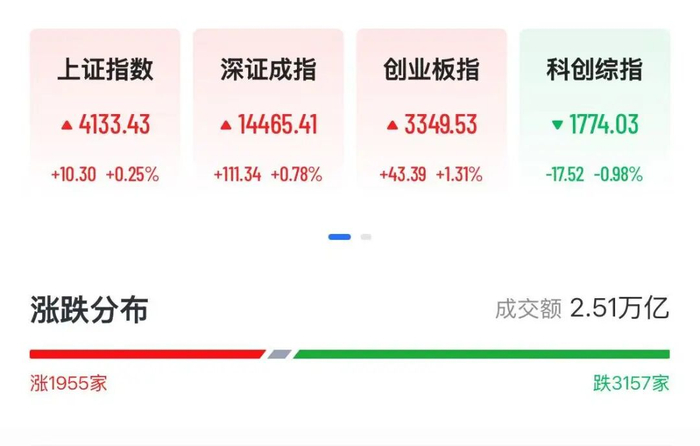
Market Overview - On March 11, the three major indices collectively rose, with the ChiNext Index initially increasing over 2% before retreating, while the Sci-Tech Innovation Index fell by 0.98%. Over 3,200 stocks in the market declined [1][2]. Index Performance - Shanghai Composite Index closed at 4,133.43, up by 10.30 points or 0.25% - Shenzhen Component Index closed at 14,465.41, up by 111.34 points or 0.78% - ChiNext Index closed at 3,349.53, up by 43.39 points or 1.31% - Sci-Tech Innovation Index closed at 1,774.03, down by 17.52 points or 0.98% - The total trading volume reached 2.51 trillion yuan, with 1,955 stocks rising and 3,157 stocks falling [2]. Sector Performance - The energy storage and lithium mining sectors were active throughout the day, with green energy concepts experiencing a surge. Green power stocks saw consecutive gains, and energy-saving wind power stocks hit the daily limit [2]. - The chemical sector saw a strong rally, particularly in coal and salt chemicals, with stocks like Jinniu Chemical and Zhongyan Chemical hitting the daily limit. The ongoing geopolitical conflict in the Middle East has pushed up international oil prices, supporting chemical product costs [2]. - The chemical fiber sector collectively rose, with companies like Zhongfu Shenying increasing over 14%. The price of spandex was raised, with increases of 2,000 yuan/ton for Taihe New Materials and 3,000 yuan/ton for Huahai Spandex reported [2]. Coal Sector - The coal sector experienced fluctuations, with Huadian Energy achieving consecutive gains. Other companies like China Coal Energy and Yanzhou Coal Mining also saw increases [3]. Downward Trends - The small metals sector declined, with companies like Xianglu Tungsten and Zhongtung High-tech dropping over 5%. The gas turbine sector also weakened, with stocks like Jereh and Tunan falling collectively [3]. - The "lobster" concept stocks saw a collective decline, with companies like Kunlun Wanwei and Qingyun Technology dropping over 4% [4]. Hong Kong Market - In the Hong Kong market, the Hang Seng Index fell by 0.21% and the Hang Seng Tech Index decreased by 0.14%. Most popular tech stocks declined, with Meituan, NetEase, and JD Health dropping over 2%. However, automotive stocks surged, with NIO rising over 14% and other companies like Li Auto and Xpeng increasing over 4%. NIO reported a quarterly operating profit of 1.25 billion yuan, marking the company's first quarterly profit [7].



煤及基础化工期权早报-20260311
Wu Kuang Qi Huo· 2026-03-11 06:37
1. Report Industry Investment Rating - No relevant content provided 2. Core Viewpoints of the Report - The report provides a comprehensive analysis of coal and basic chemical options, including market data, option factors, and行情解读与策略建议 for methanol (MA), caustic soda (SH), urea (UR), and polyvinyl chloride (V) [6][18][30][42] 3. Summary by Directory 3.1 Methanol (MA) - **标的期货市场数据**: MA605 contract had a closing price of 2365 yuan yesterday, up 176 yuan or 8.04% from the previous day, with a trading volume of 2857070 lots and an open interest of 942819 lots [6] - **期权因子 - 量仓PCR**: The trading volume of MA (methanol call options) was 1461980, with a change of 318759, and the open interest was 300039, with a change of 48593. The trading volume PCR was 0.47, with a change of 0.08, and the open interest PCR was 0.86, with a change of 0.05 [4] - **期权因子 - 压力支撑**: The pressure level of MA options was 2750, and the support level was 2200 [6] - **行情解读与策略建议**: The implied volatility of MA (methanol options) remained above the average of 0.2313. The open interest PCR of MA options was reported at 0.5145, at the 16.73% level in the past year. The recommended directional strategy was to construct a bull spread combination strategy of call options, such as B_MA2605C2350 and S_MA2605C2700 [6][7] 3.2 Caustic Soda (SH) - **标的期货市场数据**: SH605 contract had a closing price of 2082 yuan yesterday, down 31 yuan or 1.46% from the previous day, with a trading volume of 419245 lots and an open interest of 204249 lots [18] - **期权因子 - 量仓PCR**: The trading volume of SH (caustic soda call options) was 180178, with a change of -62258, and the open interest was 102704, with a change of 12891. The trading volume PCR was 0.6, with a change of 0.17, and the open interest PCR was 0.36, with a change of -0.12 [16] - **期权因子 - 压力支撑**: The pressure level of SH options was 2640, and the support level was 1920 [18] - **行情解读与策略建议**: The implied volatility of SH (caustic soda options) remained above the average of 0.2962. The open interest PCR of SH options was reported at 0.368, at the 17.14% level in the past year. The recommended volatility strategy was to construct a short neutral call + put option combination strategy, such as S_SH2605P2000 and S_SH2605C2280 [18][19] 3.3 Urea (UR) - **标的期货市场数据**: UR605 contract had a closing price of 1817 yuan yesterday, down 21 yuan or 1.14% from the previous day, with a trading volume of 343555 lots and an open interest of 262781 lots [30] - **期权因子 - 量仓PCR**: The trading volume of UR (urea call options) was 20059, with a change of 7645, and the open interest was 65795, with a change of 6134. The trading volume PCR was 0.15, with a change of -0.02, and the open interest PCR was 0.49, with a change of -0.05 [28] - **期权因子 - 压力支撑**: The pressure level of UR options was 2040, and the support level was 1700 [30] - **行情解读与策略建议**: The implied volatility of UR (urea options) remained above the average of 0.2219. The open interest PCR of UR options was reported at 0.5991, at the 49.80% level in the past year. The recommended volatility strategy was to construct a short call + put option combination strategy, such as S_UR2605P1820 and S_UR2605C1880 [30][31] 3.4 Polyvinyl Chloride (V) - **标的期货市场数据**: V2605 contract had a closing price of 4855 yuan yesterday, down 104 yuan or 2.09% from the previous day, with a trading volume of 1288990 lots and an open interest of 1218760 lots [42] - **期权因子 - 量仓PCR**: The trading volume of V (polyvinyl chloride call options) was 322319, with a change of 62797, and the open interest was 195309, with a change of 347. The trading volume PCR was 0.21, with a change of -0.02, and the open interest PCR was 0.39, with a change of 0.04 [40] - **期权因子 - 压力支撑**: The pressure level of V options was 6200, and the support level was 4700 [42] - **行情解读与策略建议**: The implied volatility of V (polyvinyl chloride options) remained above the average of 0.2001. The open interest PCR of V options was reported at 0.3634, at the 79.18% level in the past year. The recommended directional strategy was to construct a bull spread combination strategy of call options, such as B_V2605C4800 + S_V2605C5300 [42][43]
继续HALO?还是期待TACO
Guotou Securities· 2026-03-11 06:09
Core Insights - The report discusses the current dynamics between the "Technology + Overseas" and "Resource" sectors, highlighting an inherent contradiction that may lead to a decisive outcome between AI technology and traditional resource commodities [2][3] - The report emphasizes that the ongoing geopolitical tensions, particularly the military conflict between the US and Iran, have led to a surge in oil prices, disrupting the previously balanced relationship between the two sectors [2][3] - It suggests that the current "HALO" trading strategy, which is based on AI technology's creative destruction, may lead to a disconnection between asset values and fundamentals, driven by emotions rather than cash flow [3][4] Summary by Sections Current Market Dynamics - The report notes that the "Technology + Overseas" sector has recently faced challenges, with the rise in oil prices contributing to a narrative of "secondary inflation" that disrupts the previous balance with resource sectors [2][3] - It highlights that the current market is characterized by a shift from growth chasing to embracing certainty and scarcity, particularly in sectors less likely to be replaced by AI [7] HALO and TACO Trading Strategies - "HALO" trading is defined as a strategy focusing on heavy assets and low obsolescence, which seeks to hedge against uncertainties exacerbated by geopolitical tensions [7] - "TACO" trading, originating from Trump's tariff policies, is viewed as a short-term trading strategy that capitalizes on market volatility and is expected to lead to a recovery in oil prices, which could benefit the "Technology + Overseas" sector [4][7] Future Outlook - The report concludes that 2026 will not be a year dominated by either technology or cyclical sectors, but rather a period of coexistence, termed "New and Old Dance Together," emphasizing the importance of balanced portfolio management [4][15] - It identifies four key sectors for investment: non-ferrous resources, cyclical chemicals, AI applications, and overseas engineering machinery, advocating for a strategy that balances these sectors [4][15]
金融期货早评-20260311
Nan Hua Qi Huo· 2026-03-11 05:34
1. Report Industry Investment Ratings No relevant information provided. 2. Core Views of the Report - In the complex external environment affected by the Middle - East conflict, China's foreign trade showed strong resilience and achieved an unexpected growth in the first two months of 2026, mainly driven by the external demand boom in the global AI super - cycle, the global industrial chain restocking cycle, and the low - base effect. The report suggests a "no - prediction, multi - response" approach and recommends more observation and less trading in the current complex market [2]. - For different financial products: - In the short - term, the stock index is expected to fluctuate, and it is recommended to hold positions and wait and see; for treasury bonds, it is recommended to hold a small long - term position and buy at low prices for short - term trading [6][7]. - In the commodity market, different commodities have different trends. For example, lithium carbonate is expected to have a wide - range shock, and it is recommended to consider buying at low prices when the non - ferrous metal sector weakens. Industrial silicon and polysilicon are also in a wide - range shock, and it is necessary to wait for the improvement of the supply - demand pattern. In the non - ferrous metal market, the short - term trend of aluminum is dominated by the war situation, and it is recommended to sell deep out - of - the - money put options. Copper is in a shock adjustment state, and it is recommended that industrial customers replenish inventory as normal and speculative customers consider the volatility recovery strategy [8][12][16]. 3. Summary by Relevant Catalogs 3.1 Financial Futures 3.1.1 Macro - Market information includes the possible US - Russia - Ukraine talks in Turkey next week, the complex situation in Iran, and China's goods trade import and export growth of 18.3% in the first two months [1]. - China's foreign trade data in the first two months of 2026 exceeded market expectations, which was mainly due to the external demand dividend in the global AI super - cycle and showed strong resilience in the context of the Middle - East conflict. The report also mentioned that the global market is affected by multiple factors, and it is recommended to operate with the principle of "no - prediction, multi - response" [2]. 3.1.2 RMB Exchange Rate - The RMB against the US dollar showed a volatile appreciation trend in the previous trading day. The short - term RMB is difficult to start a trend appreciation due to the relatively strong US dollar index. In the medium - to - long - term, if the domestic economic fundamentals continue to improve and exports remain resilient, the RMB may show a moderate appreciation trend. It is recommended that export enterprises lock in forward exchange settlement in batches at around 6.93, and import enterprises adopt the strategy of rolling foreign exchange purchase at the 6.82 mark [3][4]. 3.1.3 Stock Index - The stock index rose collectively in the previous trading day, but the external uncertainty is still large. The short - term is expected to fluctuate, and it is recommended to hold positions and wait for the end of the Two Sessions to release more positive policy signals [5][6]. 3.1.4 Treasury Bonds - The futures bonds opened higher and then declined on Tuesday, and the afternoon market gradually recovered. The short - term data and the performance of a single industry cannot change the overall judgment of the economy. It is recommended to hold a small long - term position and buy at low prices for short - term trading [6][7]. 3.2 Commodities 3.2.1 New Energy - **Lithium Carbonate**: The futures price showed a wide - range shock. The long - term demand growth logic of the downstream industries remains unchanged, and it is recommended to consider buying at low prices when the non - ferrous metal sector weakens [8]. - **Industrial Silicon and Polysilicon**: Both showed a wide - range shock. The photovoltaic industry has good prospects in the context of global energy transformation, but the current industry is at the bottom of the production cycle, and it is necessary to wait for the improvement of the supply - demand pattern [9][10]. 3.2.2 Non - Ferrous Metals - **Aluminum**: The short - term trend is dominated by the Middle - East war situation, and it is recommended to sell deep out - of - the - money put options [12]. - **Copper**: The market is in a shock adjustment state. It is recommended that industrial customers replenish inventory as normal and speculative customers consider the volatility recovery strategy [13][16]. - **Zinc**: The short - term is affected by inventory accumulation and the overall pressure of the sector, showing a weak trend, but the medium - term is expected to be strong [17]. - **Nickel - Stainless Steel**: The supply - side reduction expectation continues. The short - term new energy link may be strong, and it is necessary to pay attention to the digestion of the peak - season expectation [18][19]. - **Tin**: It rebounded slightly under the expectation of a cease - fire. The supply is tight, and the price is suppressed by high inventory. It is necessary to pay attention to the inventory removal speed and the development of the Iran situation [20][21]. - **Lead**: It is in a weak shock state. The current supply and demand are both weak, and it is expected to maintain a shock operation [22]. 3.2.3 Oils and Fats and Feeds - **Oilseeds**: The 3 - month USDA report had limited adjustments. The external market fluctuated and closed up, and the internal market rebounded due to shipping issues. It is recommended to conduct positive spreads between months or widen the spread between soybean meal and rapeseed meal [23][24]. - **Oils and Fats**: The short - term is in a range - bound shock. It is recommended to pay attention to the weakening of the spread between rapeseed oil and soybean oil and rapeseed oil and palm oil [25]. 3.2.4 Energy and Oil and Gas - **SC**: The trading focus is on the Middle - East situation, especially the navigation situation in the Strait of Hormuz and the negative feedback caused by the depletion of oil - producing countries' inventories [27][29]. - **Fuel Oil**: The Asian fuel oil market remains strong, but the short - term spread has回调 [30][31]. - **Asphalt**: The price is affected by the cost of crude oil. The short - term is affected by geopolitical factors, and the price may decline smoothly when the rigid demand fails to meet expectations after the geopolitical factors subside [32]. 3.2.5 Precious Metals - **Platinum and Palladium**: The long - term bullish foundation remains, but it is necessary to be vigilant against the short - term adjustment risk caused by the delay of the interest - rate cut expectation. It is recommended to control the position [36][37]. - **Gold and Silver**: Strategically, it is still bullish on precious metals. It is recommended to buy on dips in the medium - to - long - term. Pay attention to the support levels and be vigilant against risks such as inflation and liquidity [38][39]. 3.2.6 Chemicals - **Pulp - Offset Paper**: The pulp futures price is in a low - level shock. The short - to - medium - term is expected to continue the low - level shock, and it is necessary to pay attention to the impact of the Middle - East situation. The offset paper futures price is in a range - bound shock [41][43]. - **Pure Benzene - Styrene**: The cost support is enhanced due to the Middle - East conflict, but the price followed the decline of crude oil at night. It is necessary to pay attention to the callback risk [44][45]. - **LPG**: It basically follows the trend of crude oil. It is necessary to continue to observe the development of the Iran situation [46][47]. - **Methanol**: The trading logic has changed twice. It may catch up with the increase of olefins next week, but it is necessary to be vigilant against the risk of geopolitical easing [48][49]. - **Plastics and PP**: The market sentiment has cooled down. The short - term supply pressure is limited, and it is recommended to be cautious and not to rush to short [50][51]. - **Rubber**: It is affected by the geopolitical situation and shows a wide - range shock. It is recommended to be bullish on dips in the medium - term, hold light positions, and pay close attention to the Iran situation [52][57]. - **Urea**: The war risk may drive up the price, and it is likely to catalyze a market driven by international cost and domestic sentiment [58][59]. - **Glass and Soda Ash**: The soda ash supply may be affected by maintenance, and the price space is limited. The glass production and sales are currently weak, and the price is restricted by supply recovery expectations and high intermediate inventories [60][61]. 3.3 Black Metals - **Rebar and Hot - Rolled Coil**: The cost provides support, but the upward space is limited. The short - term furnace charge is in a strong shock, driving the steel price to rebound, but the rebound height is limited [62][64]. - **Iron Ore**: The short - term price has support, but the upward space is limited due to high supply, weak demand, and structural negative factors [65][66]. - **Coking Coal and Coke**: The supply of coking coal may be affected by safety inspections, and the short - term surplus contradiction intensifies. The price of black metals may face downward pressure, and the price elasticity of coking coal and coke is restricted [67][68]. - **Ferrosilicon and Ferromanganese**: The cost support is gradually strengthening, but the upward space is limited due to weak downstream demand and high inventory pressure of plates [69][70]. 3.4 Agricultural and Soft Commodities - **Hogs**: The piglet replenishment sentiment is weak. It is recommended to sell call options of the main hog contract [72][74]. - **Cotton**: The current supply - demand situation supports the cotton price, but the high domestic - foreign cotton price difference restricts the upward space. It is necessary to pay attention to the geopolitical situation and US foreign trade policies [75][76]. - **Sugar**: The short - term trend is strong, mainly driven by the increase in oil prices. The price is expected to continue the strong pattern [77][78]. - **Eggs**: The short - term demand improvement supports the price to be strong in shock, but the upward space is limited due to the high inventory and the off - season background. It is recommended to sell call options of the main egg contract [79]. - **Apples**: The futures price is strongly supported in the short - term due to the scarcity of delivery products, and it maintains a strong shock pattern [87][89]. - **Jujubes**: The price is under pressure due to the loose supply - demand situation and weak demand, and it is expected to maintain a low - level shock [90]. - **Logs**: The inventory has increased significantly after the festival, and the demand has not recovered significantly. The price is affected by the geopolitical situation. It is recommended to wait and see for the time being [91].