军工

Search documents
A股开盘速递 | A股涨跌不一 沪指涨0.09% 油气板块走强
智通财经网· 2026-01-09 01:43
Group 1 - The A-share market shows mixed performance with the Shanghai Composite Index up by 0.09% and the ChiNext Index down by 0.69% [1] - The oil and gas sector is strong, with Sinopec opening at the daily limit price; military and diversified financial sectors are also active, while coal and semiconductor sectors are among the biggest decliners [1] - Huatai Securities suggests that while the Shanghai Composite Index's record streak is notable, it should not be overly emphasized as it does not indicate significant trends in longer time frames; they expect a controlled rhythm in the short term with a focus on the 5-day moving average [1] Group 2 - According to China Merchants Securities, the probability of A-shares continuing an upward trend in January is high, supported by expected acceleration in local government special bond issuance and central budget investments [2] - The firm anticipates a marginal improvement in the fundamental outlook, with increased domestic capital inflow into A-shares due to accumulated profit effects and a strengthening yuan [2] - Key sectors to watch in January include commercial aerospace, AI applications, AI computing power, and semiconductor equipment, along with service consumption and non-bank financials [2] Group 3 - Dongfang Securities notes that despite the market's need for consolidation, the upward trend remains the main theme, driven by recent policy support for the AI industry and its integration into various hardware products [3] - The firm expects continued strong performance in sectors such as commercial aerospace, military, and controllable nuclear fusion, influenced by competitive dynamics and geopolitical risks [3] - The Shanghai Composite Index may test the 4100-point mark in the short term, despite external market volatility [3]
【机构策略】短期内题材板块呈现结构性分化是大概率事件
Zheng Quan Shi Bao Wang· 2026-01-09 01:33
Group 1 - The A-share market experienced fluctuations with strong performance in sectors such as aerospace, shipbuilding, internet services, and power equipment, while energy metals, securities, insurance, and non-ferrous metals lagged behind [1] - Key factors supporting the market include increased attractiveness of RMB assets, expectations for early-year credit issuance, and positive changes in corporate profit structures driven by advanced manufacturing and overseas enterprises [1] - The domestic monetary policy is expected to maintain a stance of "moderate easing," with the market anticipating that the Federal Reserve will continue its rate-cutting cycle into 2026, leading to a more accommodative global liquidity environment [1] Group 2 - The A-share market continued to show a mixed trend, with large-cap stocks underperforming while small-cap stocks and thematic investments, particularly in commercial aerospace and brain-computer interface sectors, performed well [2] - The market is likely to experience structural fluctuations, with profit-taking from previous gains and a supportive environment for a "slow bull" market, suggesting a focus on mainline sectors and careful management of rotation rhythms [2] - The market remains in a healthy adjustment phase, with the CSI 1000 and Sci-Tech 50 indices outperforming others, and the overall trend for the Shanghai Composite Index remains strong as long as it does not fall back below historical trendline pressures [2]
美股科技股遭抛售,军工股全线上涨,中国金龙指数涨1.09%
Guan Cha Zhe Wang· 2026-01-09 00:32
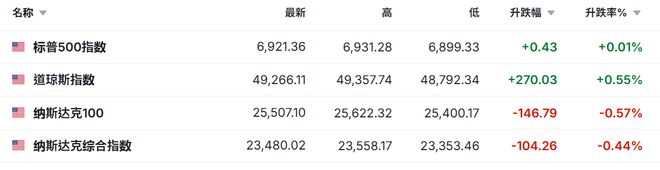
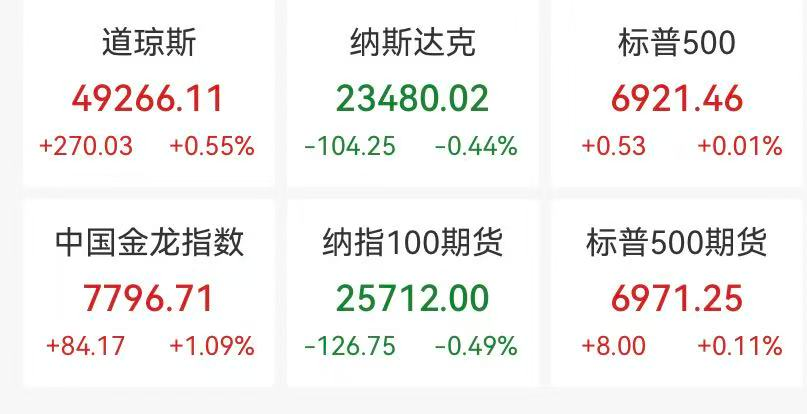
据美国消费者新闻与商业频道(CNBC)等媒体报道,当地时间1月8日,美股三大指数收盘涨跌不一, 科技股当日遭到抛售。 截至收盘,道琼斯工业平均指数上涨270.03点,涨幅0.55%,收于49266.11点;标准普尔500指数上涨 0.53点,涨幅为0.01%,收于6921.46点;纳斯达克综合指数下跌104.25点,跌幅0.44%,收于23480.02 点。 | 名称 ▼ | 最新 | 展 | િક્દ | 升跌幅 ▼ | 升跌率% ▼ | | --- | --- | --- | --- | --- | --- | | ■ 标普500指数 | 6,921.36 | 6,931.28 | 6,899.33 | +0.43 | +0.01% | | ■ 道琼斯指数 | 49,266.11 | 49,357.74 | 48,792.34 | +270.03 | +0.55% | | 1 纳斯达克100 | 25,507.10 | 25,622.32 | 25,400.17 | -146.79 | -0.57% | | 120 纳斯达克综合指数 | 23,480.02 | 23,558.17 | 23,353.46 ...

1月9日早餐 | 中石化与中航油重组
Xuan Gu Bao· 2026-01-09 00:10
Group 1: Market Overview - U.S. stock market showed mixed performance with the S&P 500 up 0.01% and the Dow Jones up 0.55%, while the Nasdaq fell by 0.44% [1] - Chip stocks experienced a decline, with Nvidia dropping over 2% and SanDisk falling more than 5% [2] - The U.S. unemployment data led to a rebound in bond yields and a rise in the dollar index, which approached a four-week high [3] Group 2: Industry Developments - Nvidia partnered with Siemens and Commonwealth Fusion Systems to accelerate the development of commercial fusion energy [5] - The Chinese government is promoting advanced manufacturing, including satellite constellation projects and reusable rocket technology [6] - The State-owned Assets Supervision and Administration Commission announced the merger of China Petroleum and China Aviation Oil, enhancing capabilities in Sustainable Aviation Fuel (SAF) [11] Group 3: Company Announcements - Several companies reported significant stock price increases, with Qianzhao Optoelectronics and Shaoyang Hydraulic both rising by 20.01% [16] - Ant Group's user engagement surged, with daily inquiries exceeding 10 million, doubling its monthly active users to 30 million [12] - China’s aerospace sector continues to attract attention, with Blue Arrow Aerospace signing contracts for satellite launch services [12]


美股能源股大涨,国际油价涨超4%,特朗普:下任美联储主席心中已有决定
2 1 Shi Ji Jing Ji Bao Dao· 2026-01-08 23:53
Market Overview - The U.S. stock market opened lower on Thursday, with mixed closing results: Dow Jones up 0.55%, S&P 500 up 0.01%, and Nasdaq down 0.44% [1] - Major technology stocks mostly declined, with Intel down over 3%, Nvidia down more than 2%, and Microsoft down over 1%, while Google, Amazon, and Tesla rose over 1% [2] Sector Performance - The storage sector experienced widespread declines, with SanDisk down over 5%, Seagate Technology down over 7%, Western Digital down over 6%, and Micron Technology down over 3% [3] - Defense stocks performed strongly, with Lockheed Martin up over 4% and Northrop Grumman up over 2%, both reaching intraday gains exceeding 9% [3] - Energy stocks rose across the board, with ConocoPhillips up over 5%, ExxonMobil up over 3%, and Chevron up over 2%. The S&P 500 Energy Index increased by 3.2%, marking the largest single-day gain since April 2025 [3] International Oil Prices - International oil prices surged, with NYMEX WTI crude and ICE Brent crude both rising by 4%, closing at $58.4 per barrel and $62.79 per barrel, respectively [3] Chinese Stocks - Most Chinese stocks saw gains, with the Nasdaq Golden Dragon China Index up 1.09%. Notable performers included Century Internet up nearly 11%, and companies like Global Data and Youdao up over 7% [5] Precious Metals - Gold prices saw a slight increase, nearing $4,490 per ounce, while silver prices fluctuated, initially dropping over 1.6% before recovering to above $77 per ounce [6][7] Cryptocurrency Market - Major cryptocurrencies mostly declined, with Bitcoin experiencing a drop of over 2% before slightly recovering by 0.16%, trading at $91,246 per coin [7]
新浪财经资讯AI速递:昨夜今晨财经热点一览 丨2026年1月9日
Xin Lang Cai Jing· 2026-01-08 23:46
Group 1: Stock Market and Economic Data - US stock market indices closed mixed, with the Dow Jones up 0.55%, Nasdaq down 0.44%, and S&P 500 nearly flat. Defense stocks surged following Trump's proposal for a significant increase in military spending, while tech stocks mostly retreated. Alibaba rose over 5% [1][16] - The upcoming non-farm payroll report is anticipated by traders to assess the economic outlook after a period of market gains [1][16] Group 2: Corporate Leadership Changes - Vanke Group announced the resignation of Chairman Yu Liang, marking the end of his 35-year career with the company. His departure signifies a shift from a manager-led era to a more stable operational approach in the real estate sector [2][17] - New Hongze's Vice Chairman Meng Xue announced the voluntary relinquishment of all salary, including annual salary and performance bonuses, to focus on long-term strategy. The couple, who control approximately 61% of the company, have not taken salaries since its listing [3][17] Group 3: Regulatory and Legal Developments - India's new antitrust law allows fines based on global revenue, putting Apple at risk of a potential $38 billion fine. Apple has filed a lawsuit to challenge the law, claiming it is retroactive and excessively punitive [4][18] - The Cambodian National Bank has initiated the liquidation process for Prince Bank due to a trust crisis following the founder's arrest, halting all new business while allowing depositors to withdraw funds [12][26] Group 4: Market Trends and Predictions - Silver prices experienced a sharp decline after a nearly 200% increase in 2025, with experts predicting a high volatility trading pattern for 2026 rather than a continued bull market. Factors supporting silver include ongoing supply shortages and industrial demand [5][20] - The restructuring of Sinopec and China Aviation Oil is expected to exceed the revenue of PetroChina, potentially lowering aviation fuel costs and impacting airline procurement expenses [6][20] Group 5: Foreign Investment and Market Outlook - Foreign institutions like Goldman Sachs and UBS are optimistic about the Chinese market in 2026, predicting a 20% increase in the MSCI China Index, driven by reasonable valuations and profit growth from sectors like high-end manufacturing and internet [9][23] Group 6: Policy Reforms - The central government has indicated a forthcoming reform of the public housing fund system, aiming to enhance fund efficiency and support housing consumption amid changing market conditions [10][24] Group 7: Corporate Strategies and Adjustments - After taking control of Hongsheng Beverage Group, Zong Fuli initiated a strategic overhaul to improve operational efficiency and reduce dependency on the Wahaha system, facing challenges in team integration and market coordination [13][26] - Blue Arrow Aerospace is pursuing an IPO on the STAR Market, aiming to raise 7.5 billion yuan for developing reusable rocket technology, despite reporting significant losses and high R&D expenditures [14][15][26]




利好突袭!深夜,全线大涨!
券商中国· 2026-01-08 23:29
一则利好消息彻底引爆。 隔夜美股市场,美股军工股全线爆发,美国航天国防股指数ETF盘中一度大涨超4%,克瑞拓斯安全防卫 (Kratos)一度暴涨超20%,军用无人机厂商Aerovironment一度大涨超16%,洛克希德·马丁盘中最高涨超 9%。消息面上,美国总统特朗普表示2027财年美国军费应提升至1.5万亿美元,相当于较今年预算增逾50%。 华尔街分析师普遍认为,美国国防开支增长的方向明确。 另外,美联储货币政策走向也备受市场关注。美联储理事米兰表示,他希望2026年美联储累计降息150个基 点,以提振劳动力市场。美国财长贝森特明确指出,美联储不应推迟进一步降息,他还透露,下任美联储主席 人选将于1月公布。特朗普表示,他已敲定下一任美联储主席提名人选。 军工股全线爆发 美东时间1月8日,美股三大指数震荡分化,英伟达等科技巨头回落,截至收盘,道指涨0.55%,纳指跌 0.44%,标普500指数涨0.01%。 美股大型科技股涨跌不一,博通大跌超3%,英伟达跌超2%,微软跌超1%,苹果、Meta小幅收跌;亚马逊大 涨近2%,谷歌、特斯拉涨超1%。 存储芯片概念股集体下挫,希捷科技大跌超7%,西部数据跌超6%,S ...

【环球财经】资金板块轮动 纽约股市三大股指8日涨跌不一
Xin Hua Cai Jing· 2026-01-08 23:01
美国合众银行财富管理部门投资策略负责人罗伯·哈沃斯(Rob Haworth)认为,科技和人工智能将依然 是2026年的一个投资主题,但这一交易作为股市上涨驱动因素的地位将依赖于应用案例是否会出现以及 在什么板块出现。 哈沃斯说,可以看到医疗健康领域正出现应用的早期迹象。机器人、保险和诊断等相关企业将会是人工 智能的早期受益者,这也是成长故事发生的地方。 美国劳工部当日早间发布的数据显示,美国上周首次申领失业救济的人数为20.8万,高于市场预期的 20.5万和前一周修订后的20万。 美国就业咨询机构查林杰-格雷-克里斯马斯公司(Challenger, Gray & Christmas, Inc.)当日盘前发布 的数据显示,美国雇主2025年12月裁员人数为3.55万人,低于前一月的7.13万人,为2024年7月以来最低 水平。 美国财长贝森特8日在明尼苏达经济俱乐部发表讲话时表示,降息将对每个明尼苏达州居民生活带来可 见的影响。降息是让美国经济增长更强所缺的唯一"佐料",这是为何美联储不应延迟降息的原因。 新华财经纽约1月8日电(记者刘亚南)受资金从科技板块向其他领域轮动,纽约股市三大股指8日开盘 时涨跌不一, ...
特朗普一句话,军工股深夜集体飙涨
Zheng Quan Shi Bao· 2026-01-08 22:53
美国总统特朗普提高军费预算的言论刺激美股军工板块大幅上涨。特朗普还要求国防企业加大生产和研 发投入,停止股票回购和派息。 提高军费预算 特朗普是在其社交媒体发布相关言论。他呼吁到2027年将美国国防开支大幅增长50%,把军费预算提高 至1.5万亿美元。而当前美国年度军费已达到创纪录的9010亿美元。他声称这笔巨额开支将通过关税收 入来承担,此举旨在打造一支"梦想军队"。 特朗普当天还表示,在军工企业响应其"更快、更可靠地生产军事装备"的号召之前,他将"禁止"这些企 业进行股票回购和分红。 此外,特朗普炮轰军工企业高管薪酬、股票期权以及其他各种形式的收入高得离谱,但装备生产速度却 不够快,就算生产出来,维护保养也不够及时妥善。 "从现在开始,这些高管必须建设全新的现代化生产工厂,用于交付和维护这些重要装备,并生产未来 最新型号的军事装备!在此之前,任何高管的年薪都不应超过500万美元——尽管这个数字听起来很 高,但仅仅是他们目前收入的一小部分。此外,已售装备的维护和维修速度也太慢,必须立即改进。作 为总统,我要求维护工作必须做到精准及时。" 在当天另一条帖文中,特朗普把矛头对准雷神公司(RTX.N)。他指责雷神 ...
特朗普创纪录1.5万亿军费要打“世界大战”?军工股大反弹,无人机厂商两位数高涨
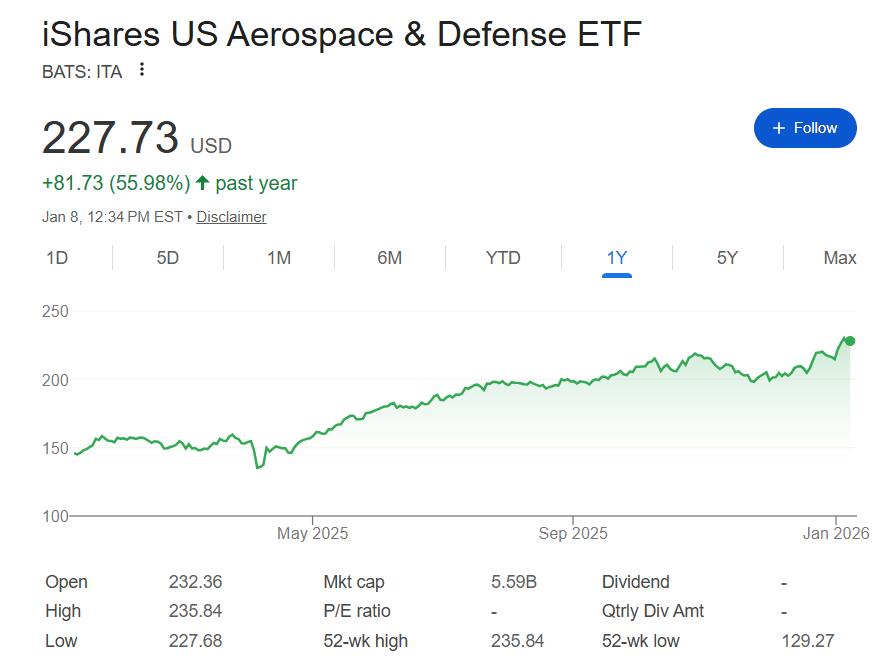
Hua Er Jie Jian Wen· 2026-01-08 19:04
Core Viewpoint - President Trump's recent statements have caused significant volatility in the defense sector, with threats to limit dividends and stock buybacks for defense contractors leading to a sharp decline in military stocks, followed by a strong rebound after his proposal to increase military spending to $1.5 trillion for fiscal year 2027, a 50% increase from the current budget of $901 billion [1][2][10]. Group 1: Market Reactions - Following Trump's statements, defense stocks experienced a dramatic rebound, with major companies like Lockheed Martin (LMT) rising over 9%, Northrop Grumman (NOC) nearly 11%, and Raytheon Technologies (RTX) up nearly 6% [5][9]. - The iShares U.S. Aerospace & Defense ETF (ITA) has seen a cumulative increase of over 50% in the past 12 months, reflecting strong performance in the defense sector [2]. - Global defense stocks also rose, with European defense stocks increasing by up to 3.8% on the same day, and notable gains in companies like BAE Systems and Rheinmetall [9]. Group 2: Budget Proposal and Challenges - Trump's proposal to increase the defense budget by 50% is historically rare, with the last similar increase occurring during the Korean War in 1951 [10]. - The feasibility of this budget increase faces challenges, as the Congressional Budget Office (CBO) estimates a budget deficit of 5.5% of GDP for the current year, with projected tax revenues falling short of the anticipated defense spending growth [10][11]. - Political hurdles exist, as the proposed budget would require significant support in the Senate, and there are concerns about whether defense contractors can absorb such a large increase in spending [11]. Group 3: Analyst Perspectives - Analysts generally express cautious optimism regarding the direction of U.S. defense spending, with expectations for higher expenditures amid stricter scrutiny of companies [12][13]. - Some analysts suggest that limiting capital returns could free up billions for capacity expansion or acquisitions, indicating a potential shift in investment strategies within the defense sector [13]. - The geopolitical landscape is driving increased defense spending, with analysts noting that the world is becoming a more dangerous place, further justifying the proposed budget increase [13][14].