
金融行业

Search documents
淘气天尊:2025年收官,持股还是持币过节?(12.31)
Jin Rong Jie· 2025-12-31 04:48
Market Overview - The market showed a slight upward trend followed by a pullback, with the Shanghai Composite Index opening at 3968 points and closing down 2 points at 3962 points, while the ChiNext Index opened at 3247 points and closed down 35 points at 3207 points [1] - A total of 2735 stocks rose and 1731 stocks fell, indicating a bearish sentiment as the number of declining stocks outnumbered advancing ones [1] Stock Performance - Among the rising stocks, 56 had gains exceeding 9%, and 319 had gains over 3%. Conversely, 3049 stocks declined, with 9 falling more than 9% and 262 falling over 3% [1] - The market was primarily supported by the materials and financial sectors, but the overall strength was limited as most stocks lacked momentum [1] Technical Analysis - The market is currently facing resistance in the 3977-3983 range, with a need for caution as the market has shown signs of testing lower support levels around 3930-3950 [1] - Investors are advised to be patient and wait for opportunities, particularly in stocks that have not shown significant movement [1] Year-End Reflection - As the year comes to a close, the market is approaching the 4000-point mark, prompting discussions on whether to hold stocks or cash during the holiday season [1] - Investors are encouraged to consider their individual stock positions and market conditions before making decisions, emphasizing that there is no one-size-fits-all answer [1] Future Outlook - The market may continue to experience fluctuations in the coming year, influenced by international developments, but maintaining a balanced approach to investing is crucial [1] - The focus should be on individual stock analysis rather than solely on index performance, promoting a strategy of patience and careful decision-making [1]
李剑阁:AI催生金融新业态 智能投顾、数字员工等将持续涌现
Feng Huang Wang Cai Jing· 2025-12-29 10:48
Core Insights - The integration of artificial intelligence (AI) in the financial sector has transitioned from pilot testing to large-scale implementation and ecological collaboration, becoming a key driver for the transformation and upgrading of the industry [1][2] - AI technology is deeply embedded in the entire financial business chain, enhancing risk prevention, investment decision-making, customer service, and operational management [1] - The future will see a closer integration of AI technology with industry scenarios, extending its application to key sectors such as industry, healthcare, and finance, highlighting its role as a core engine for industrial upgrading [1] Group 1 - AI will enhance the quality and efficiency of financial services by optimizing processes and enabling intelligent decision-making, shifting the industry focus from scale competition to quality competition [1] - AI will expand the boundaries of financial services, addressing challenges in inclusive finance, green finance, and digital finance, allowing for more precise and widespread coverage of key areas and weak links in the real economy [1] Group 2 - AI will give rise to new financial business formats and models, such as smart investment advisory, digital employees, and cross-border intelligent finance, continuously enriching and improving the financial ecosystem [2]
宏观经济周度高频前瞻报告:经济周周看:本周经济景气度延续回落-20251228
ZHESHANG SECURITIES· 2025-12-28 13:20
Economic Indicators - The GDP weekly high-frequency prosperity index as of December 27 is 4.9%, slightly up from the revised 4.8% of the previous week, indicating marginal economic growth improvement[1] - The industrial weekly prosperity index remains stable at 8.1%, while the service sector index has slightly decreased to 2.9%[7] - The construction sector shows a slight improvement in physical workload, with rebar apparent demand at 202.8 million tons, down from 208.6 million tons the previous week[7] Demand and Consumption - External demand remains the strongest variable, while consumer demand continues to show low-level fluctuations, with a consumer high-frequency index of 2.3%[18] - Real estate sales in 30 major cities decreased to 254.7 million square meters, a 1% week-on-week decline and a 41% year-on-year decline[46] - The container throughput for exports decreased to 620,100 TEUs, down from 658,900 TEUs the previous week, although the year-to-date growth is 5.45%[55] Price Trends - Consumer prices are generally stable, with agricultural product wholesale prices showing a slight decrease of 0.17% week-on-week[64] - The average wholesale price of pork is 17.51 yuan per kilogram, down 0.4% week-on-week, while the average price of six monitored fruits increased by 1.6%[71]
尚福林、杨伟民、白重恩、高培勇,最新发声!
Sou Hu Cai Jing· 2025-12-27 09:27
最新发声。 12月27日,在中国财富管理50人论坛2025年会上,原银监会主席、证监会原主席尚福林,第十三届全国 政协经济委员会副主任杨伟民,清华大学经济管理学院院长白重恩,中国社会科学院学部委员高培勇等 专家学者就当前多个宏观经济热点发表见解。 4.政策不仅要聚焦扩大需求、优化供给,也要优化分配,形成供给、需求、分配三位一体、方向一致的 系统性政策。 来看会上重要观点: 1. 迈向"十五五",加快建设金融强国,是质的有效提升和量的合理增长有机统一,是综合性、系统性、 引领性的跃升。 2. 保持制造业合理比重包含两层含义:一是我国制造业占GDP的比重保持在合理水平;二是我国制造业 占全球制造业比重能够保持基本稳定。 3. 凝聚新质生产力的新制造,不再是过去烟囱林立、管道密集、劳动密集的产业,而是科技创新与产 业、产品创新"前店后厂"式,研发人员密集,知识产权密集的制造业,新制造恰恰应该布局在中心城市 及其城市群地区,因为研发人员主要在这里。 其中,在金融体制改革层面,要构建与中国式现代化相匹配的"六大支柱"体系。要完善中央银行制度, 构建科学稳健的货币政策体系和覆盖全面的宏观审慎管理体系,畅通货币政策传导机制 ...
尚福林、杨伟民、白重恩、高培勇,最新发声!
证券时报· 2025-12-27 09:14
Core Viewpoint - The conference emphasized the importance of accelerating the construction of a financial power during the "15th Five-Year Plan" period, focusing on the organic unity of qualitative improvement and reasonable quantitative growth, as well as comprehensive, systematic, and leading advancements [2][5]. Group 1: Financial Development - The financial sector in China has achieved historic growth in scale and quality during the "14th Five-Year Plan," laying a solid foundation for building a financial power [5]. - Challenges remain in the financial development landscape, including imbalances in social capital allocation and the need for traditional financing and risk control models to adapt to new economic realities [5][6]. - The "15th Five-Year Plan" suggests focusing on financial services for the real economy, deepening financial system reforms, and enhancing global financial governance [5][6]. Group 2: Manufacturing and New Quality Productivity - The conference highlighted the need to maintain a reasonable proportion of manufacturing in GDP and globally, emphasizing that new quality productivity should not be confined to traditional industrial models [2][8]. - New manufacturing should focus on technology and product innovation, with a concentration of research and development personnel in central cities and urban clusters [10][8]. - The development of emerging and future industries is expected to primarily occur in key regions such as Beijing, Shanghai, and the Guangdong-Hong Kong-Macau Greater Bay Area [10][8]. Group 3: Policy Optimization - Policies should not only focus on expanding demand and optimizing supply but also on optimizing distribution to create a cohesive system of supply, demand, and distribution [3][12]. - The transition from consumption stimulus policies to income distribution adjustment policies is necessary to enhance the income of low-income groups and ensure that disposable income growth outpaces economic growth [12][11]. Group 4: Debt Management and Reform Investment - The proposal to replace local government debt with national bonds aims to alleviate repayment pressure on local governments, improve their cash flow, and foster economic growth [15][13]. - Investment in reform is crucial, with a focus on using fiscal and monetary policies to support the transitional costs of reforms, thereby facilitating better conditions for future reforms [14][15].


华泰证券今日早参-20251226
HTSC· 2025-12-26 02:41
Group 1: Macroeconomic Insights - The offshore RMB/USD exchange rate has surpassed the important threshold of 7.00, with onshore RMB also breaking 7.01, indicating a potential for further appreciation of the RMB [2] - The report anticipates a 4-5% annualized appreciation of the RMB, which will not adversely affect China's export competitiveness [2] - Factors such as the peak in foreign exchange settlements and improved US-China trade relations are expected to support the RMB's appreciation, enhancing foreign investment interest in RMB assets [2] Group 2: Fixed Income Market - The total government bond supply for 2025 is projected to reach 14.4 trillion, with both national and local bonds nearing 99% supply completion as of December 25, 2025 [3] - The market is currently focused on the supply-demand dynamics of interest rate bonds and the structure of bond issuance [3] - The report highlights the potential for REITs to recover from recent price declines, with the REITs total return index having dropped 4.28% recently but showing signs of recovery [4] Group 3: Technology Sector - Insights from the SEMICON Japan conference indicate three key investment opportunities for 2026: AI-driven storage cycles, semiconductor process upgrades, and price increases in technology commodities [5] - There is significant debate among investors regarding the competitive positioning of OpenAI against Google and the sustainability of NAND price increases [5] Group 4: Non-Ferrous Metals Industry - The report suggests that high metal prices may drive exploration and service companies to transition towards mining development, utilizing models such as equity participation and EPC+O [6] - This transition is expected to be significant as smaller mining owners seek external support for development due to limited capital and technical capabilities [6] Group 5: Banking Sector Dynamics - A wave of deposit maturities is anticipated, with approximately 50 trillion in term deposits maturing in the coming year, primarily concentrated in the 2-5 year range [8] - This situation is expected to alleviate pressure on banks' net interest margins but may lead to increased volatility in the funding landscape [8]

开局之年——2026年宏观经济与资本市场展望①
Xin Lang Cai Jing· 2025-12-26 02:34
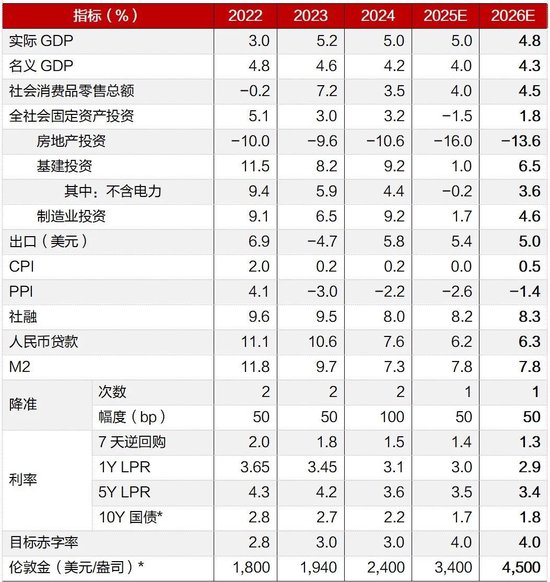
Group 1: Macroeconomic Outlook - The US economy is expected to maintain steady growth in 2026, supported by fiscal policies during the midterm election year, with a projected GDP growth of 2.4% and CPI inflation around 2.5% [1][7][55] - The K-shaped economic recovery in the US is likely to continue, with a concentration of growth in the "AI + finance" sectors, while the consumer sector shows signs of low-quality growth [1][10][55] - The Federal Reserve is anticipated to adopt a dovish stance, potentially lowering interest rates to around 3% [1][51][55] Group 2: Chinese Economic Forecast - China's GDP growth is projected to reach 4.8% in 2026, characterized by stable external demand, improved internal demand, and price recovery [2][4][82] - The fiscal policy will be more proactive, with a target deficit rate of 4.0%, corresponding to a deficit scale of 5.85 trillion yuan, and a total fiscal arrangement of 43 trillion yuan [2][86][87] - Monetary policy is expected to be moderately accommodative, with a potential reduction in the OMO rate to 1.3% and a reserve requirement ratio cut of 50 basis points [3][92][93] Group 3: Investment and Consumption Trends - Fixed asset investment growth in China is expected to recover to 1.8%, driven by increased fiscal spending and the commencement of major projects [2][5][86] - Retail sales growth is projected to rise to 4.5%, supported by strong consumer policies [2][5][86] - The capital market outlook suggests a bullish trend for the stock market, with A-shares expected to continue upward momentum, while the bond market may experience fluctuations [3][6]
【UNforex财经事件】年末资金分流加剧 股市修复与避险配置并行
Sou Hu Cai Jing· 2025-12-23 03:36
Group 1: Market Overview - Global financial markets are entering a typical year-end trading rhythm, with liquidity tightening and a mixed sentiment of risk appetite and safe-haven demand [1] - The Dow Jones Industrial Average showed resilience, rising over 200 points on Monday, with financial and materials sectors leading the performance [1][3] - The market is expected to finish the year on a stable and slightly positive note, despite the holiday trading period [1] Group 2: Gold Market - Gold continues to serve as a core asset in the macro hedging system, maintaining a strong performance with a nearly 70% increase year-to-date, marking one of the strongest annual performances since the late 1970s [2] - Morgan Stanley maintains a bullish outlook on gold, citing uncertainties in tariff policies, ongoing central bank purchases, and strong demand from ETFs and physical markets as key supports for the current gold bull market [2] - The upward trend in gold prices is expected to remain solid as long as quarterly demand stays above critical levels, with no signs of a slowdown in central bank and long-term fund allocations [2] Group 3: Stock Market Dynamics - The Dow Jones Industrial Average continues to gain momentum ahead of the holidays, with AI-related stocks attracting attention and financial and materials sectors showing strong performance [3] - The market is attempting to approach phase highs within a limited year-end trading window, but liquidity constraints are becoming more apparent [3] - Investors are actively reducing risk exposure while participating in year-end trading, preparing for the next phase of market conditions [3] Group 4: Macroeconomic Factors - Recent inflation data has not provided clear guidance, with some key components missing due to government shutdowns, leading to cautious market sentiment regarding CPI reports [4] - Expectations for further rate cuts remain, but pricing of policy paths has slowed, with the Fed likely to maintain a reserved stance on the inflation report [4] - Upcoming ADP employment and GDP data are viewed as the last significant macro indicators before the holidays, with current ADP employment numbers indicating a weak labor market trend [4] Group 5: Interest Rates and Bond Market - Traders are increasing bullish positions on U.S. Treasuries, betting on a decline in 10-year Treasury yields to around 4%, reflecting ongoing concerns about economic slowdown and policy shifts [5] - Large asset management firms are signaling a defensive stance by increasing cash holdings and reducing leverage, indicating heightened caution towards high valuation environments and geopolitical risks [5] - The market is characterized by a complex structure of rising risk appetite and safe-haven demand, emphasizing the importance of position management and rhythm control [5] Group 6: Overall Market Sentiment - The current global market dynamics are shaped by year-end risk appetite, policy uncertainties, and geopolitical factors [6] - U.S. stocks are supported by a rate-cut environment and year-end sentiment, while gold continues to operate within historical high ranges due to safe-haven demand and structural allocation forces [6] - The market is likely to maintain a structurally volatile pattern until key data and policy paths become clearer, with the sustainability of asset price trends needing further validation through upcoming events [6]
明年将如何提高居民收入、扩内需,中央财办详解中央经济工作会议
2 1 Shi Ji Jing Ji Bao Dao· 2025-12-17 12:33
Core Viewpoint - The central economic work meeting emphasizes a positive outlook for China's economy, projecting a growth rate of around 5% for 2025, with the total economic output expected to reach approximately 140 trillion yuan [1] Group 1: Macroeconomic Policies - China will continue to implement more proactive fiscal and monetary policies in 2026, maintaining necessary fiscal deficits and debt levels while optimizing fiscal expenditure structures [2] - The total government bond issuance for 2025 is projected to be 11.86 trillion yuan, with a deficit rate expected to rise to around 4% [2][3] - Monetary policy will focus on maintaining liquidity and supporting economic growth, with tools such as interest rate cuts and reserve requirement ratio adjustments being utilized flexibly [3][4] Group 2: Income and Employment - A series of measures to promote income growth and stabilize employment are expected in 2026, including the implementation of a plan to increase urban and rural residents' income [5][6] - The government aims to enhance the basic pension for residents and improve consumption capacity, with a focus on ensuring that income growth aligns with economic growth [6][8] Group 3: Consumption and Investment - Expanding domestic demand is a top priority for 2026, with a shift from goods consumption to a balanced focus on both goods and service consumption [9] - Investment is expected to stabilize, with a focus on infrastructure and social welfare projects, while also encouraging private investment in high-tech and service sectors [10][11][12] - The government plans to enhance investment in areas such as urban renewal, healthcare, and childcare, while also leveraging government funds to stimulate private sector investment [11][12]
2026年大类资产展望:快慢变量分野,新老资产收敛
GF SECURITIES· 2025-12-16 13:10
Group 1: Asset Performance Overview - In 2025, major asset classes showed extreme differentiation under the "narrative trading" theme, with gold leading the performance, achieving a year-to-date (YTD) return of over 120%[4] - The YTD ranking of major assets as of December 12, 2025, was gold > ChiNext Index > STAR 50 > LME copper futures > European stocks > Hang Seng Index > Japanese stocks > MSCI Emerging Markets > NASDAQ > CSI 300 > global bonds > South China Agricultural Index > China bonds > USD > crude oil > long volatility strategy[4] - The "entrepreneurial board index + LME copper futures + London gold" combination achieved a YTD return of 130.3%, while the "CSI 300 + USD index + Brent crude oil futures" returned only -8.3%, resulting in a performance gap of 138.6%, the highest since 2013[5] Group 2: Market Dynamics and Strategies - The asset rotation speed in 2025 deviated from historical seasonal patterns, with significant fluctuations observed, particularly a sharp decline from July to September, contrasting with typical trends[6] - A simple multi-asset annual rebalancing strategy yielded a cumulative return of 17.5% in 2025, marking the third consecutive year of positive returns, but lagged behind most stock market performances[6] - The classic asset rotation framework, which correlates asset rotation with economic cycles, was challenged in 2025 due to significant macroeconomic changes, suggesting a shift towards a "narrative + macro factor" pricing model for 2026[9] Group 3: Liquidity and Correlation Insights - Short-term liquidity acts as a "switch" for asset price increases, while narrative trading amplifies asset price movements, indicating a symbiotic relationship between liquidity and narrative trading[10] - The CSAD (Cross-Sectional Absolute Deviation) metric indicated a strong correlation between narrative trading intensity and asset prices, with a notable decrease in asset correlation observed in late 2025[11] - The correlation between domestic equities and bonds in China remained negative throughout 2025, with a notable reduction in volatility differences, suggesting a potential shift towards equilibrium in the future[19] Group 4: Future Outlook and Economic Indicators - The 2026 outlook suggests a potential "mirror" relationship with 2025, with expectations of a gradual loosening of narrative trading and a return to lower correlation among major assets[8] - The anticipated nominal GDP growth for 2026 is projected at 4.7% to 5.2%, with a focus on consumption recovery and fixed asset investment stabilization[32] - The performance of major asset classes in 2026 is expected to be influenced by inflation dynamics, with a ranking of asset probabilities indicating that Hong Kong stocks > A-shares > Renminbi > commodities > black metals > US stocks > China bonds > US bonds > gold > USD[30]