
乘用车

Search documents
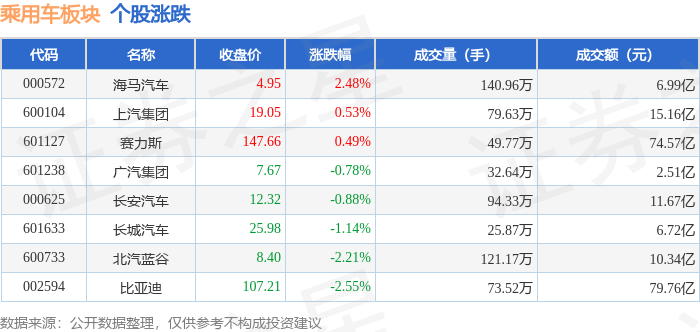
乘用车板块9月3日跌0.96%,比亚迪领跌,主力资金净流出14.06亿元
Zheng Xing Xing Ye Ri Bao· 2025-09-03 08:40
Group 1 - The passenger car sector experienced a decline of 0.96% on September 3, with BYD leading the drop [1] - The Shanghai Composite Index closed at 3813.56, down 1.16%, while the Shenzhen Component Index closed at 12472.0, down 0.65% [1] - Major stocks in the passenger car sector showed mixed performance, with Haima Automobile rising by 2.48% and BYD falling by 2.55% [1] Group 2 - The net outflow of main funds in the passenger car sector was 1.406 billion yuan, while retail investors saw a net inflow of 999.5 million yuan [1] - Specific stock fund flows indicated that BYD had a significant main fund outflow of 1.242 billion yuan, while it attracted 294 million yuan from speculative funds [1]


美的分拆智慧物流业务赴港IPO,八马茶业再度递交上市申请
Xin Lang Cai Jing· 2025-09-02 15:53
Group 1: Recent IPOs on Hong Kong Stock Exchange - Two companies listed on the Hong Kong Stock Exchange from August 25 to August 31 [2] - Shuangdeng Group Co., Ltd. (6960.HK) listed on August 26, focusing on energy storage batteries, with a first-day increase of 31.29% and a market cap of approximately HKD 73 billion [3] - Jiaxin International Resources Investment Co., Ltd. (3858.HK) listed on August 28, specializing in tungsten mining, with a first-day increase of 177.84% and a market cap of approximately HKD 148 billion [3] Group 2: New Stock Offerings - One company completed its new stock offering during the week of August 25 to August 31 [4] - Aux Electric, a global provider of high-quality air conditioning solutions, went through the listing hearing [5] Group 3: Companies Submitting Listing Applications - A total of 22 companies submitted main board listing applications and one company submitted a GEM listing application from August 25 to August 31 [7] - Notable companies include: - Nazhen Technology, a global provider of optical communication solutions, submitted its application on August 25 [8] - Chengdu Guoxing Aerospace Technology Co., Ltd., a participant in China's commercial aerospace industry, submitted its application on August 25 [9] - InxMed Limited-B, a biotech company focused on cancer treatment, submitted its application on August 25 [9] Group 4: Financial Performance and Projections - Nazhen Technology projected revenues of CNY 5.043 billion, CNY 4.239 billion, and CNY 5.087 billion from 2022 to 2024, with profits of CNY 429 million, CNY 216 million, and CNY 89 million respectively [18] - Guoxing Aerospace projected revenues of CNY 177 million, CNY 508 million, and CNY 553 million from 2022 to 2024, with losses of CNY 91 million, CNY 139 million, and CNY 177 million respectively [20] - InxMed Limited-B reported no commercial sales revenue for 2023 and 2024, with losses of CNY 209 million and CNY 185 million respectively [23] Group 5: Industry Insights - The energy storage battery market is growing, with Shuangdeng Group focusing on applications in communication base stations and data centers [3] - The tungsten mining sector is highlighted by Jiaxin International, which is developing the Bakuta tungsten mine in Kazakhstan [3] - The optical communication sector is represented by Nazhen Technology, which ranks fifth globally in optical module revenue [18]

中泰汽车25Q2汽车行业总结:盈利分化,强者恒强
ZHONGTAI SECURITIES· 2025-09-02 11:48
Investment Rating - The report maintains a positive outlook on the automotive industry, particularly on intelligent autonomous vehicles, robot components, and leading heavy-duty truck manufacturers [4][6]. Core Insights - The automotive industry is experiencing a recovery in demand, with wholesale sales of passenger vehicles reaching 7.11 million units in Q2 2025, a year-on-year increase of 13% and a quarter-on-quarter increase of 10.8% [4][8]. - The penetration rate of new energy vehicles (NEVs) reached a record high of 51.1% in Q2 2025, with wholesale sales of NEVs hitting 3.63 million units, up 33.6% year-on-year and 25.2% quarter-on-quarter [4][8]. - The performance of major automakers such as Xiaopeng and Leap Motor exceeded expectations, while most others met forecasts [4][15][19]. Summary by Sections 1. Passenger Vehicles - Q2 2025 saw a steady recovery in passenger vehicle sales, with wholesale and retail volumes increasing significantly compared to Q1 [4][8]. - The demand for NEVs continues to grow, with a notable increase in sales and market penetration [4][8]. 2. Auto Parts - The auto parts sector is experiencing a divergence in profitability, with some companies outperforming while others struggle due to increased competition and supply chain pressures [4][6]. - Companies like Fuyao Glass and Shanghai Yalong reported better-than-expected performance in Q2 2025 [4][6]. 3. Heavy-Duty Trucks - The domestic market for heavy-duty trucks remains robust, with Q2 2025 sales of heavy trucks reaching 201,000 units, a year-on-year increase of 21% [4][6]. - Exports are recovering, particularly in non-Russian regions, despite a decline in sales to Russia [4][6]. 4. Investment Recommendations - The report recommends focusing on intelligent autonomous vehicles, robot components, and leading heavy-duty truck manufacturers, highlighting specific companies such as Xiaopeng, Geely, and Leap Motor for passenger vehicles, and China National Heavy Duty Truck and Weichai Power for heavy-duty trucks [4][6].



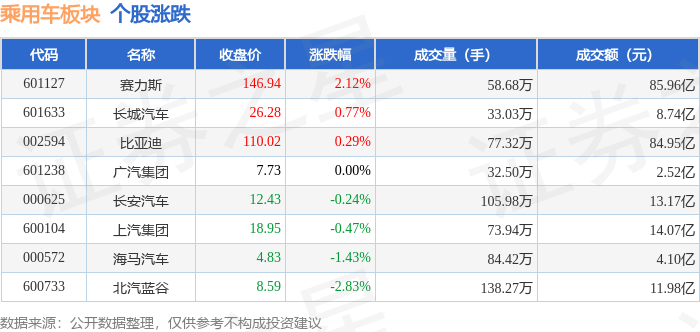
乘用车板块9月2日涨0.36%,赛力斯领涨,主力资金净流出295.6万元
Zheng Xing Xing Ye Ri Bao· 2025-09-02 08:55
Market Overview - The passenger car sector increased by 0.36% on September 2, with Sailyis leading the gains [1] - The Shanghai Composite Index closed at 3858.13, down 0.45%, while the Shenzhen Component Index closed at 12553.84, down 2.14% [1] Individual Stock Performance - Sailyis (601127) closed at 146.94, up 2.12% with a trading volume of 586,800 shares and a transaction value of 859.6 million [1] - Great Wall Motors (601633) closed at 26.28, up 0.77% with a trading volume of 330,300 shares and a transaction value of 874 million [1] - BYD (002594) closed at 110.02, up 0.29% with a trading volume of 773,200 shares and a transaction value of 849.5 million [1] - GAC Group (601238) remained unchanged at 7.73 with a trading volume of 325,000 shares and a transaction value of 252 million [1] - Changan Automobile (000625) closed at 12.43, down 0.24% with a trading volume of 1,059,800 shares and a transaction value of 1.317 billion [1] - SAIC Motor (600104) closed at 18.95, down 0.47% with a trading volume of 739,400 shares and a transaction value of 1.407 billion [1] - Haima Automobile (000572) closed at 4.83, down 1.43% with a trading volume of 844,200 shares and a transaction value of 410 million [1] - BAIC Blue Valley (600733) closed at 6.59, down 2.83% with a trading volume of 1,382,700 shares and a transaction value of 1.198 billion [1] Fund Flow Analysis - The passenger car sector experienced a net outflow of 2.956 million from institutional investors and a net outflow of 232 million from speculative funds, while retail investors saw a net inflow of 235 million [1] - Sailyis had a net inflow of 49.7 million from institutional investors, while speculative funds saw a net outflow of 24.7 million [2] - BYD had a net inflow of 31.958 million from institutional investors, with a net outflow of 10.5 million from speculative funds and a net inflow of 73.159 million from retail investors [2] - Great Wall Motors had a net outflow of 83.706 million from institutional investors, with a net inflow of 30.448 million from speculative funds and a net inflow of 53.257 million from retail investors [2] - Changan Automobile had a net outflow of 130 million from institutional investors, with a net inflow of 12.374 million from speculative funds and a net inflow of 117 million from retail investors [2] - BAIC Blue Valley had a net outflow of 190 million from institutional investors, with a net inflow of 33.740 million from speculative funds and a net inflow of 15.67 million from retail investors [2]





9月1日重要公告一览
Xi Niu Cai Jing· 2025-09-01 10:19
Group 1 - Weisheng Information won four projects in August with a total amount of 85.5377 million yuan, accounting for 3.12% of the company's total revenue for 2024 [1] - Longqi Technology's shareholder plans to reduce its stake by up to 4.09%, equating to a maximum of 19.1916 million shares [1] - Guojin Modern's subsidiary received a drug registration certificate for injectable Nicardipine, used for treating unstable angina [3][4] Group 2 - SAIC Motor reported a total vehicle sales of 363,400 units in August, a year-on-year increase of 41.04%, with new energy vehicle sales reaching 129,800 units, up 49.89% [5] - Kuka Home plans to invest 1.124 billion yuan to build a self-owned base in Indonesia, aiming to enhance its international strategy [6] - Samsung Medical's subsidiary signed a contract for an intelligent meter project in Egypt worth 58.8 million USD, approximately 419 million yuan [8] Group 3 - North Vehicle Blue Valley's subsidiary reported a total production of 10,587 units in August, a year-on-year decrease of 15.13%, while sales increased by 3.47% [12] - Xianghe Industrial signed contracts worth 400 million yuan for railway fastener system components [13] - Hengrui Medicine's HRS9531 injection has received acceptance for its marketing authorization application [14] Group 4 - Hualu Hengsheng resumed normal production after completing maintenance on production facilities [16] - Shanghai Pharmaceuticals' hydrochloride verapamil injection passed the consistency evaluation for generic drugs [18] - Shanghai Construction received approval for debt financing tools with a registration period of two years [20] Group 5 - Kangli Elevator terminated the sale of its wholly-owned subsidiary due to the buyer's failure to obtain necessary approvals [21] - Times Wan Heng appointed Li Zhizhong as the new deputy general manager [22] - Hanma Technology reported a total truck sales of 1,051 units in August, a year-on-year increase of 58.05% [24] Group 6 - Wenzhou Hongfeng's subsidiary received a utility model patent certificate for a servo adjustment device [26] - Yibin Technology received a project designation from a domestic new energy vehicle company, with an estimated total sales of 243 million yuan over five years [28] - Star Ring Technology's H-share issuance application was accepted by the China Securities Regulatory Commission [30] Group 7 - Microchip Bio's vice president resigned for personal reasons [31] - Zhongxin Co. announced the resignation of a non-independent director due to personal reasons [32] - Changcheng Military Industry's vice chairman resigned due to retirement [35] Group 8 - Jiukang Bio received four invention patent certificates related to detection reagents [36] - Meino Bio's subsidiary changed its registered address [37] - Kuangda Technology announced a potential change in control due to a share transfer [38] Group 9 - China Rare Earth confirmed no undisclosed significant matters amid stock price fluctuations [72]




崔东树:预计2025年全国乘用车市场零售同比增长10%
Zhi Tong Cai Jing· 2025-09-01 09:11
Core Insights - The article highlights the changing dynamics of the Chinese passenger car market, indicating a significant shift towards a "strong North, weak South" pattern in market performance, with expectations of a 10% year-on-year growth in retail sales by 2025 [1][2] Group 1: Regional Market Trends - The northern car market is showing strong growth, particularly in Northeast and North China, while the southern regions are underperforming despite better economic conditions [2][3] - By July 2025, the northern market's share increased by 0.9 percentage points compared to the previous year, and by 5.6 percentage points compared to 2022, indicating a robust upward trend [2] - The central region's market share also improved, with a 1.5 percentage point increase year-on-year in July 2025, suggesting a positive trend in the middle regions [2] Group 2: Policy Impact on Market Structure - Government subsidies are favoring low-end and economic vehicles, leading to a recovery in the economy segment, particularly benefiting A00 and A0 class electric vehicles in Northern and Northeast regions [1][3] - The "Two New" subsidy policy is seen as a fair approach, significantly benefiting the development of small and micro electric vehicles [1][6] Group 3: New Energy Vehicle Market Analysis - The new energy vehicle market is expected to perform strongly in 2025, with both pure electric and plug-in hybrid vehicles showing positive trends [5] - In Northern regions, the demand for traditional fuel vehicles remains high, with fuel vehicles still accounting for about 60% of the market, while Eastern regions have seen new energy vehicles surpassing 50% [5] Group 4: Changes in Vehicle Structure - The SUV segment is experiencing strong growth, particularly in the central and western regions, driven by geographical factors that favor SUV demand [4] - The overall market structure is shifting towards more affordable electric vehicles due to government incentives, which are effectively stimulating consumer interest [6][7]
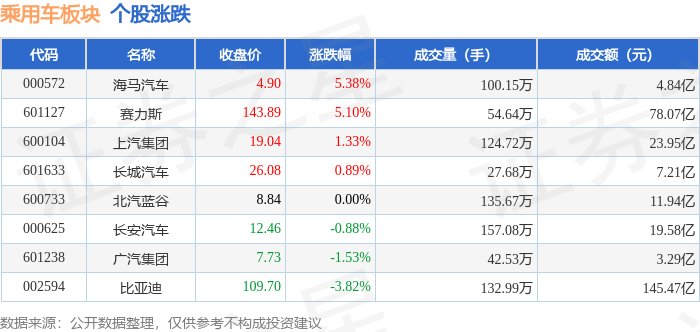
乘用车板块9月1日跌0.15%,比亚迪领跌,主力资金净流出18.35亿元
Zheng Xing Xing Ye Ri Bao· 2025-09-01 08:39
Group 1 - The passenger car sector experienced a slight decline of 0.15% on September 1, with BYD leading the drop [1] - The Shanghai Composite Index closed at 3875.53, up 0.46%, while the Shenzhen Component Index closed at 12828.95, up 1.05% [1] - Key stocks in the passenger car sector showed varied performance, with Haima Automobile rising by 5.38% and BYD falling by 3.82% [1] Group 2 - The passenger car sector saw a net outflow of 1.835 billion yuan from main funds, while retail investors contributed a net inflow of 1.764 billion yuan [1] - Notable individual stock fund flows included a significant outflow from BYD of 1.478 billion yuan, while retail investors brought in 999.26 million yuan [1] - The trading volume and turnover for major stocks varied, with SAIC Motor achieving a turnover of 2.395 billion yuan and BYD at 14.547 billion yuan [1]
大众朗逸发动机故障灯亮无法解决?4S店:大概率软件问题,但目前无新系统可升级
Feng Huang Wang· 2025-09-01 05:25
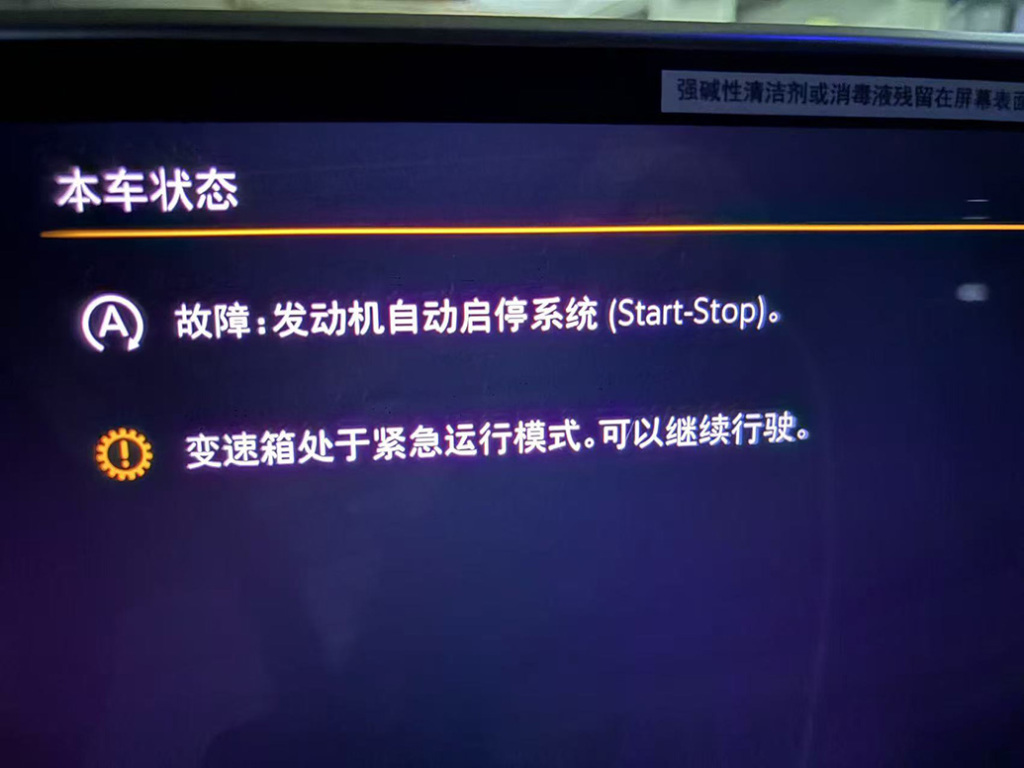
使用一个月后,车辆发动机报警灯不断亮起。 刘女士称,6月19日,自己正常驾驶时,车辆发动机报警灯突然亮起,紧接着仪表盘弹出"故障:发动机自动启停系统""变速箱处于紧急运行模 式,可以继续行驶"的提示,此后发动机报警灯便一直常亮。次日,她即将车开到华亮4S店检修。经维修后,报警灯恢复正常。她以为问题就此解 决,没想到这只是开始。 刘女士新车的发动机故障提示 苏州市消费者刘女士近日向澎湃公众互动平台"服务湃"投诉称,其今年5月购置的大众朗逸,两个多月里多次出现发动机报警灯故障,历经三次维 修仍未彻底解决。4S店给出的解决方案是"等待汽车系统升级",然而,并未明确时间。对此,8月31日,涉事4S店相关负责人拒绝接受采访。 今年5月12日,刘女士花费130900元,在上汽大众苏州华亮4S店(苏州华亮汽车销售公司),购买了一辆2024款"大众朗逸1.5L星空五百万版"新 车。 7月25日,发动机报警灯第三次亮起,刘女士再次将车送到4S店。 6月26日,距上次检修仅过去6天,车辆发动机报警灯再次亮起。无奈,刘女士只能再次将车送往4S店,进行第二次检修。 刘女士称,两次检修似乎都未找到发动机报警灯故障的症结。 聊天记录显示 ...
广汽集团跌2.04%,成交额2.30亿元,主力资金净流出1895.04万元
Xin Lang Zheng Quan· 2025-09-01 05:22
Group 1 - GAC Group's stock price decreased by 2.04% on September 1, reaching 7.69 CNY per share, with a trading volume of 230 million CNY and a turnover rate of 0.40%, resulting in a total market capitalization of 78.415 billion CNY [1] - Year-to-date, GAC Group's stock price has dropped by 17.49%, with a 5-day decline of 5.41%, a 20-day increase of 2.26%, and a 60-day increase of 0.65% [1] - The company's main business segments include passenger vehicles (73.23% of revenue), automotive-related businesses (21.98%), and financial and other services (4.79%) [1] Group 2 - As of June 30, GAC Group reported a total of 135,800 shareholders, an increase of 1.03% from the previous period, with an average of 0 circulating shares per shareholder [2] - For the first half of 2025, GAC Group achieved operating revenue of 42.611 billion CNY, a year-on-year decrease of 7.88%, and a net profit attributable to shareholders of -2.538 billion CNY, a year-on-year decrease of 267.39% [2] - Since its A-share listing, GAC Group has distributed a total of 25.639 billion CNY in dividends, with 4.602 billion CNY distributed over the past three years [3] Group 3 - As of June 30, 2025, the top ten circulating shareholders of GAC Group include Hong Kong Central Clearing Limited, which holds 120 million shares, an increase of 19.8711 million shares from the previous period [3] - Huatai-PB CSI 300 ETF and E Fund CSI 300 ETF are also among the top ten circulating shareholders, holding 39.7123 million shares and 28.1267 million shares respectively, with increases of 3.4609 million shares and 2.7954 million shares [3]
长城汽车涨2.05%,成交额3.89亿元,主力资金净流出350.83万元
Xin Lang Cai Jing· 2025-09-01 04:20
Core Viewpoint - Great Wall Motors' stock price has shown a modest increase this year, with significant gains over the past 20 and 60 days, indicating positive market sentiment towards the company [2]. Financial Performance - For the first half of 2025, Great Wall Motors achieved operating revenue of 92.335 billion yuan, a year-on-year increase of 0.99%, while net profit attributable to shareholders decreased by 10.48% to 6.337 billion yuan [2]. - The company has distributed a total of 34.696 billion yuan in dividends since its A-share listing, with 8.95 billion yuan distributed in the last three years [3]. Stock Market Activity - As of September 1, Great Wall Motors' stock price was 26.38 yuan per share, with a market capitalization of 225.785 billion yuan [1]. - The stock has increased by 1.93% year-to-date, 2.81% over the last five trading days, 18.72% over the last 20 days, and 19.15% over the last 60 days [2]. Shareholder Structure - As of June 30, 2025, the number of shareholders increased to 178,500, reflecting a growth of 18.73% [2]. - Major shareholders include China Securities Finance Corporation and Hong Kong Central Clearing Limited, with notable changes in their holdings [3].