消费

Search documents
国信证券荀玉根:“买好的”看科技主线 “买得好”关注地产、券商、白酒消费
Zhi Tong Cai Jing· 2025-10-28 11:47
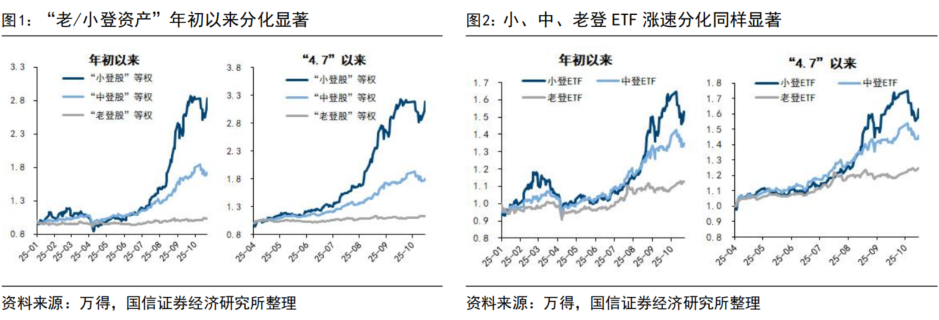
Core Viewpoint - The report by Guosen Securities highlights an extreme divergence between "old" and "new" assets in the market, emphasizing that high growth does not necessarily equate to high investment returns, and that finding fundamentally sound valuation opportunities can lead to significant returns [1][2]. Group 1: Performance Divergence - Since 2025, "small new stocks" have significantly outperformed "old stocks," with the "small new stock" portfolio rising by 183.8% compared to just 3.9% for "old stocks" [2]. - From April 7, 2025, "small new stocks" surged over 200%, while "old stocks" only increased by 13.6% [2]. - The "small new ETF" has risen by 53.1% since 2025, while the "old ETF" has only seen a 13.1% increase [2]. Group 2: Valuation and Market Activity - As of October 24, the PE ratio for "small new" sectors like electronics and computing is at the 99th percentile since 2019, while "old" sectors like real estate and liquor are at the 56th percentile [8]. - The trading volume for "small new" sectors has increased to 33%, while "old" sectors have dropped to below 2.8%, indicating a significant divergence in market activity [8]. Group 3: Investment Strategy - The report stresses the importance of not only selecting high-quality stocks ("buy good") but also ensuring they are purchased at favorable valuations ("buy well") to achieve high returns [11]. - Historical examples illustrate that higher growth does not guarantee better returns, as seen in the comparison between IBM and New Jersey Standard Oil from 1950 to 2003 [11][12]. - The banking sector has shown resilience, with a decline of only 3.9% compared to a 31.1% drop in the overall market, highlighting the potential for finding undervalued stocks with solid fundamentals [15]. Group 4: Market Trends and Seasonal Effects - The current market is characterized by a "small new stock" era, but there are seasonal opportunities for "old stocks," particularly in real estate, liquor, and brokerage sectors [20][29]. - Historical bull markets have shown that each cycle has a leading sector that aligns with prevailing economic trends, with AI and technology being the current focus [21]. - Seasonal effects suggest that value sectors may outperform in the fourth quarter, with historical data indicating a 64% success rate for value over growth during this period [23].


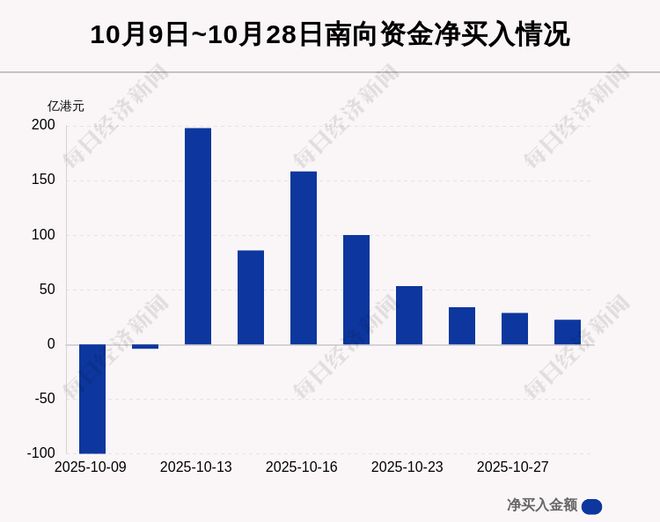
最新出炉!10月28日港股通净流入22.58亿港元,其中5.125亿港元都买了它
Mei Ri Jing Ji Xin Wen· 2025-10-28 10:47
Group 1 - The core point of the article highlights the active trading of southbound funds, with a total of 8 stocks experiencing net buying, led by China Mobile with a net purchase of 512.5 million HKD [2][4] - The most significant net selling stock was Alibaba-W, with a net sell amounting to 522.6 million HKD [2][4] Group 2 - The list of actively traded stocks includes China Mobile (0941.HK) with a closing price of 85.55 HKD and a net buying amount of 5.13 billion HKD, reflecting a price increase of 0.41% [4] - Other notable stocks with net buying include Huahong Semiconductor (1347.HK) with 396 million HKD and a closing price of 86.15 HKD, and Pop Mart (9992.HK) with 323 million HKD and a closing price of 228.2 HKD, both showing slight declines [4] - Conversely, Alibaba-W (9988.HK) had a closing price of 171.0 HKD and a net selling amount of 5.23 billion HKD, indicating a decrease of 1.50% [4]
图解丨南下资金连续6日净买入中芯国际,共计30亿港元
Ge Long Hui A P P· 2025-10-28 10:12
Group 1 - Southbound funds net bought Hong Kong stocks worth 2.258 billion HKD today [1] - The top net purchases included China Mobile at 512 million HKD, Hua Hong Semiconductor at 396 million HKD, Pop Mart at 322 million HKD, Meituan-W at 166 million HKD, and Sanhua Intelligent Control at 114 million HKD [1] - The top net sales included Alibaba-W at 522 million HKD, Tencent Holdings at 356 million HKD, and Li Auto-W at 292 million HKD [1] Group 2 - Southbound funds have net bought SMIC for six consecutive days, totaling 3.01773 billion HKD [1]




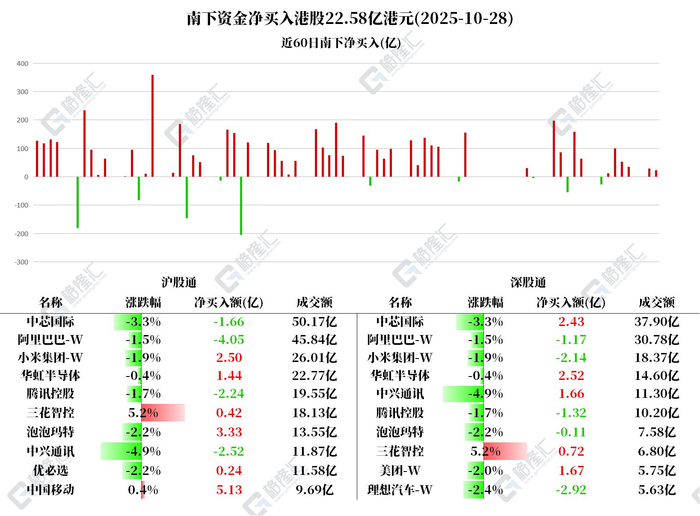
伯克希尔罕见遭遇“卖出”评级
财联社· 2025-10-28 09:57
Core Viewpoint - Berkshire Hathaway, led by Warren Buffett, has received a rare "sell" rating from Keefe, Bruyette & Woods due to concerns over its earnings outlook and macroeconomic risks, particularly with Buffett set to step down as CEO [2][3]. Group 1: Rating Changes - Keefe, Bruyette & Woods downgraded Berkshire's Class A shares from "market perform" to "underperform," citing multiple factors moving in an unfavorable direction for the company [2][3]. - This downgrade is the only "sell" rating among six analysts who continuously cover Berkshire [3]. Group 2: Leadership Transition - Berkshire announced that Vice Chairman Greg Abel will succeed Buffett as CEO on January 1, 2024, while Buffett will remain as Chairman [3]. - The transition raises concerns about succession risks and the potential impact on investor confidence as Buffett gradually steps back from daily management [8]. Group 3: Business Performance and Challenges - Berkshire's Class B shares fell by 0.82% on a recent Monday, with a year-to-date increase of only 7.8%, compared to a 16% rise in the S&P 500 index [5]. - Analysts predict that various business segments, including GEICO, Berkshire Reinsurance Group, Berkshire Energy, and BNSF Railway, may face ongoing or emerging profitability challenges [8]. - Specific concerns include the peak of GEICO's underwriting profit margins, declining property catastrophe reinsurance rates, decreasing short-term interest rates, and pressures from tariffs on railway transport [8].

[10月27日]指数估值数据(A股港股继续上涨,回到4.1星)
银行螺丝钉· 2025-10-27 14:22
Core Viewpoint - The overall market has shown a recovery, with significant increases in both A-shares and Hong Kong stocks, indicating a positive trend in the investment landscape [1][10][13]. Market Performance - The Shanghai Composite Index is approaching 4000 points, while the CSI All Share Index has reached 5913 points, nearing its post-National Day level of 5967 points [3][4]. - Both large-cap and small-cap stocks have risen, with large-cap stocks showing slightly more growth [5]. - Growth and value styles have both experienced increases, with the STAR Market showing particularly strong performance [6][7]. - The Hang Seng Index has also risen, led by technology stocks [10]. Economic Indicators - The U.S. Consumer Price Index for September indicated a slowdown in inflation, which was below market expectations [11]. - The likelihood of a continued decline in U.S. dollar interest rates has increased, contributing to a global stock market rally [12]. Investment Strategies - The article highlights that despite market fluctuations, many investors have seen profits, with over 94% of holders in the actively selected portfolio being profitable [17][18]. - It discusses the importance of maintaining a long-term investment perspective and avoiding panic selling during market downturns [32][33]. - The article emphasizes that a majority of investors who engaged in regular investments or increased their positions during market lows have benefited from reduced costs and earlier profits [34][35]. Upcoming Events - A live session is scheduled for October 28 to discuss the reasons behind the recent significant increases in A-shares and Hong Kong stocks, the valuation advantages of RMB assets, and future market prospects [39].

基金双周报:ETF市场跟踪报告-20251027
Ping An Securities· 2025-10-27 10:04
ETF Market Overview - As of October 24, the performance of ETF products varied, with the Shanghai 50 index showing the highest increase among major broad-based ETFs, while the dividend-themed ETFs had the largest gains among industry and thematic products [2][9] - In the past two weeks, major broad-based ETFs such as the CSI A50, CSI 2000, and Shanghai 50 saw net inflows, while the CSI A500 ETF experienced the largest net outflow [2][9] - The recent trend indicates a shift in fund flows, with the New Energy ETF moving from net inflow to net outflow, while the Pharmaceutical ETF transitioned from net outflow to net inflow [16] ETF Fund Flow Analysis - The cumulative fund flow for major broad-based ETFs has shown a trend of outflows turning into inflows and then back to outflows since the beginning of 2025, with significant inflows into the CSI 300 ETF in April, followed by continued outflows in subsequent months [10][12] - Recent data indicates that, apart from the Shanghai 50 ETF, which shifted from net outflow to net inflow, other major broad-based ETFs have transitioned from net inflows to net outflows in the past two weeks [10][12] Thematic ETF Tracking - For technology-themed ETFs, those tracking the Hang Seng Technology index saw significant net inflows, while products tracking the CS Artificial Intelligence index experienced net outflows [32] - Dividend-themed ETFs tracking the low-volatility dividend index had the highest net inflows, whereas those tracking the dividend index saw net outflows [35] New ETF Products and Market Growth - In the past two weeks, a total of 8 new ETFs were launched, with a combined issuance of 2.997 billion shares, all of which were stock ETFs [26] - Compared to the end of 2024, the scale of various ETFs has increased significantly, with bond ETFs, commodity ETFs, industry + dividend ETFs, QDII ETFs, and broad-based ETFs growing by 293.33%, 197.82%, 112.34%, 52.18%, and 13.97% respectively [26] Fund Management Scale Distribution - As of October 24, Huaxia Fund has the largest ETF scale at 912.812 billion, with E Fund's ETF management scale expanding by over 250 billion compared to the previous year [27][28]
宏观周报(10月第4周):中美会谈进展带动风险偏好上扬-20251027
Century Securities· 2025-10-27 00:49
Group 1: Economic Overview - Q3 2025 actual GDP growth was 4.8%, aligning with market expectations, while nominal GDP growth was 3.73%[9] - The gap between actual and nominal GDP growth narrowed from 1.26 percentage points in Q2 to 1.07 percentage points in Q3[10] - Capacity utilization rate increased by 0.6 percentage points to 74.6% in Q3, indicating some progress in reducing "involution" effects[10] Group 2: Market Sentiment and Trends - Market sentiment improved due to progress in China-US talks and the Fourth Plenary Session, leading to a volume-declining market rise[8] - The Shanghai Composite Index rose by 2.88%, while the Shenzhen Component Index increased by 4.73%[8] - The technology sector led market performance, with small-cap indices showing a 4.16% increase[8] Group 3: Investment and Consumption Data - Fixed asset investment showed a cumulative year-on-year decline of 0.5%, below the expected 0%[9] - Real estate development investment fell by 13.9% year-on-year, worse than the expected decline of 13.4%[9] - Retail sales growth in September was 3%, slightly below the expected 3.1%[9] Group 4: International Market Dynamics - US CPI rose by 3% year-on-year in September, lower than market expectations, leading to a fully priced-in expectation of two 25 basis point rate cuts by the Fed[8] - The US dollar index fell by 0.38%, while the offshore RMB appreciated against the dollar[8] - Oil prices increased due to a reduction of 961,000 barrels in US EIA crude oil inventories[8]
华泰A股策略:配置可适度向哑铃型倾斜
Xin Lang Cai Jing· 2025-10-26 23:28
Core Viewpoint - The recent A-share market has entered a phase of low-volume fluctuations due to macroeconomic uncertainties, with short-term market variability still present. However, market sentiment indicators suggest a return to neutral territory, indicating limited adjustment in investor sentiment and presenting a potential opportunity for allocation [1] Group 1: Market Sentiment and Allocation Strategy - Quantitative and profit-making effect indicators have reverted to neutral levels, but the willingness of funds to "buy the dip" remains, suggesting limited adjustment in investor sentiment [1] - The allocation strategy should shift towards a "barbell" approach, focusing on both high-growth and defensive sectors [1] Group 2: Sector Focus - Technology is expected to remain a short-term market focus, with low-positioned targets in sectors such as Hang Seng Technology, A-share computing power, and robotics being primary allocation directions [1] - Defensive dividend sectors may still present allocation opportunities due to ongoing uncertainties in Sino-U.S. relations [1] - The cyclical consumer sector has weak fundamental expectations, but risks appear to be sufficiently digested, allowing for potential left-side positioning in certain consumer areas [1]
银万资本余涛: 周期底部“翻石头” 喧嚣中坚守价值投资
Zhong Guo Zheng Quan Bao· 2025-10-26 21:12
Core Insights - The article emphasizes a value-oriented investment approach, focusing on underappreciated assets during market fluctuations [1][2][3] Investment Strategy - The investment strategy involves maintaining a fully invested position since the fund's inception in June 2017, emphasizing the importance of finding undervalued stocks with a safety margin [2][3] - The focus is on individual stock value rather than market timing, with successful investments made in sectors like CXO, Hong Kong consumer stocks, and copper mining during periods of market pessimism [2][3] Valuation and Cycles - The core of the investment philosophy is based on valuation and market cycles, with a belief that low prices provide a strong safety margin and potential for significant returns when cycles recover [3] - Current areas of interest include leading companies in the liquor industry and the home furnishings sector, which have been temporarily overlooked by the market [3] AI Industry Perspective - Despite the AI industry's prominence, the company remains cautious, citing a lack of deep understanding and high valuations of related stocks [4] - The company is actively learning about the AI sector while focusing on more stable investments, such as copper mining stocks, which are seen as undervalued with significant growth potential [4][5] Long-term Market Outlook - The long-term market outlook is driven by the entrepreneurial spirit of Chinese entrepreneurs, with expectations for the emergence of competitive companies that create new demand [6][7] - The investment approach is characterized by a continuous learning mindset, analyzing fundamentals, industry dynamics, and management effectiveness to identify suitable investment opportunities [7]
做科技投资 “进攻者”以产品思维锻造长期价值——访恒越基金吴海宁
Shang Hai Zheng Quan Bao· 2025-10-26 15:37
Core Viewpoint - The investment philosophy of Wu Haining emphasizes "product thinking" and focuses on companies with strong product capabilities, aiming for long-term value rather than short-term gains [3][4][10]. Investment Strategy - Wu Haining prefers investing in companies at the "1-10" growth stage, where the industry logic is validated and companies can consistently exceed performance expectations [3][8]. - The investment approach combines individual stock selection with portfolio management, integrating insights from private equity and public fund management [5][6]. Selection Criteria - Three product-oriented standards guide company selection: 1. Industry quality with large potential and high demand, such as the energy storage sector [8]. 2. Competitive barriers, focusing on technology and manufacturing capabilities for manufacturing firms, and brand loyalty for consumer companies [8]. 3. Management alignment with company interests and ability to execute strategies [8]. Performance and Market Outlook - Wu Haining's fund achieved a remarkable return of 124% over the past year, demonstrating effective risk management and dynamic portfolio adjustments [7]. - The current market is viewed as a short-term correction, but the long-term growth trend for technology stocks is believed to be only halfway through [10][11]. Focus Areas - Three main technology investment themes are highlighted: 1. The AI industry chain, with domestic hardware companies expected to compete globally [10]. 2. The acceleration of semiconductor localization, enhancing certainty in chip and equipment materials [10]. 3. Energy storage, driven by overseas electricity shortages and domestic economic viability [10]. Investment Philosophy - The philosophy stresses the importance of technology-driven growth and the need for companies to have solid performance backing, aligning with the belief that great products lead to long-term value [10][11].